change time Alfa Romeo 4C 2017 User Guide
[x] Cancel search | Manufacturer: ALFA ROMEO, Model Year: 2017, Model line: 4C, Model: Alfa Romeo 4C 2017Pages: 289, PDF Size: 2.61 MB
Page 137 of 289
engine fails to start within 10 seconds, turn the ignition
switch to the STOP (OFF/LOCK) position, wait 10 to
15 seconds, then repeat the “Normal Starting” proce-
dure.
Cold Weather Operation
Your engine is designed to operate at temperatures as
low as 0°F (-18°C).
CAUTION!
Use of the recommended SAE 5W-40 Synthetic oil
and adhering to the prescribed oil change intervals
is important to prevent engine damage and ensure
satisfactory starting in cold conditions.
If Engine Fails To Start
WARNING!
Never pour fuel or other flammable liquids into the
throttle body air inlet opening in an attempt to start
the vehicle. This could result in a flash fire causing
serious personal injury.
CAUTION!
•Do not attempt to push or tow your vehicle to get
it started. Vehicles equipped with a Alfa Twin
Clutch Transmission cannot be started this way.
Unburned fuel could enter the catalytic converter
and once the engine has started, ignite and dam-
age the converter and vehicle.
• To prevent damage to the starter, do not continu-
ously crank the engine for more than 15 seconds
at a time. Wait 10 to 15 seconds before trying
again.
After Starting
The idle speed is controlled automatically, and it will
decrease as the engine warms up.
Turbo Charger “Cool Down”
This vehicle is equipped with an after-run pump to cool
the turbocharger after the engine is shut off. Depending
on the type of driving and the amount of cargo, the
pump will run for up to five minutes after the engine
has been shut off to circulate coolant through the
turbocharger.
5
STARTING AND OPERATING 135
Page 143 of 289
General Notes
When the vehicle is stopped and in gear, always keep
the brake pedal pressed until you decide to set off, then
release the brake and accelerate gradually.
During prolonged stops with the engine running, it is
advisable to keep the transmission in NEUTRAL (N).
When stopped on an incline, always hold the vehicle in
place using the brakes. On steep inclines, Hill Start
Assist (HSA) will temporarily hold the vehicle in posi-
tion when the brake pedal is released. If the accelerator
pedal is not applied after a short time, the vehicle will
roll back. Either reapply the brake (to hold the vehicle)
or press the accelerator to climb the hill.
Only shift between FIRST (1) and REVERSE (R) when
completely stopped, with the brake pedal pressed.
When necessary, it is possible to engage FIRST (1),
REVERSE (R) or NEUTRAL (N) with the engine off, the
key at MAR-ON and the brake pressed. In this case,
wait at least five seconds between one gear change and
the next, in order to safeguard the operation of the
hydraulic system, and the pump in particular.For uphill departures, accelerate gradually but fully,
immediately after releasing the parking brake or the
brake pedal; this allows the engine speed to increase to
provide more torque at the wheels.
ALFA DNA SYSTEM (DYNAMIC VEHICLE
CONTROL SYSTEM)
This vehicle is equipped with a “Alfa DNA” system
lever (located on the center console). There are four
modes of operation to be selected according to driving
style and road conditions:
•
Dynamic (This mode alters the transmission’s auto-
matic shift schedule for sportier driving [D]).
• Natural (mode for driving in normal conditions [N]).
• All Weather (mode for driving in poor grip condi-
tions, such as rain and snow [A]).
• Race (sports driving mode [D]).5
STARTING AND OPERATING 141
Page 216 of 289
Engine Oil
Checking Oil Level
To assure proper engine lubrication, the engine oil must
be maintained at the correct level. Check the oil level at
regular intervals. The best time to check the engine oil
level is before starting the engine after it has sat
overnight.
Do not check oil level when the engine is warm.
Checking engine oil level when the engine is warm will
give you an incorrect reading.
Checking the oil while the vehicle is on level ground,
and has sat overnight, will improve the accuracy of the
oil level readings. Maintain the oil level between the
range markings on the dipstick. The safe range is
indicated by a crosshatch zone. Adding 1 quart of oil
when the reading is at the low end of the indicated
range will result in the oil level at the full end of the
indicator range.
CAUTION!
Do not overfill the engine with oil. Overfilling the
engine with oil will cause oil aeration, which can
lead to loss of oil pressure and an increase in oil
temperature. This loss of oil pressure and increased
oil temperature could damage your engine.
Change Engine Oil
The oil change indicator system will remind you that it
is time to take your vehicle in for scheduled mainte-
nance. Refer to the “Maintenance Schedule” for further
information.
NOTE:The actual interval for changing the oil and
replacing the engine oil filter depends on the vehicle
usage conditions and is signalled by the warning light
or message (if present) on the instrument panel or every
12 months.
Engine Oil Selection
For best performance and maximum protection for
turbocharged engines under all types of operating
conditions, the manufacturer recommends synthetic
engine oils that are API Certified and meet the require-
ments of FCA Material Standard MS-12991.
214 MAINTAINING YOUR VEHICLE
Page 225 of 289
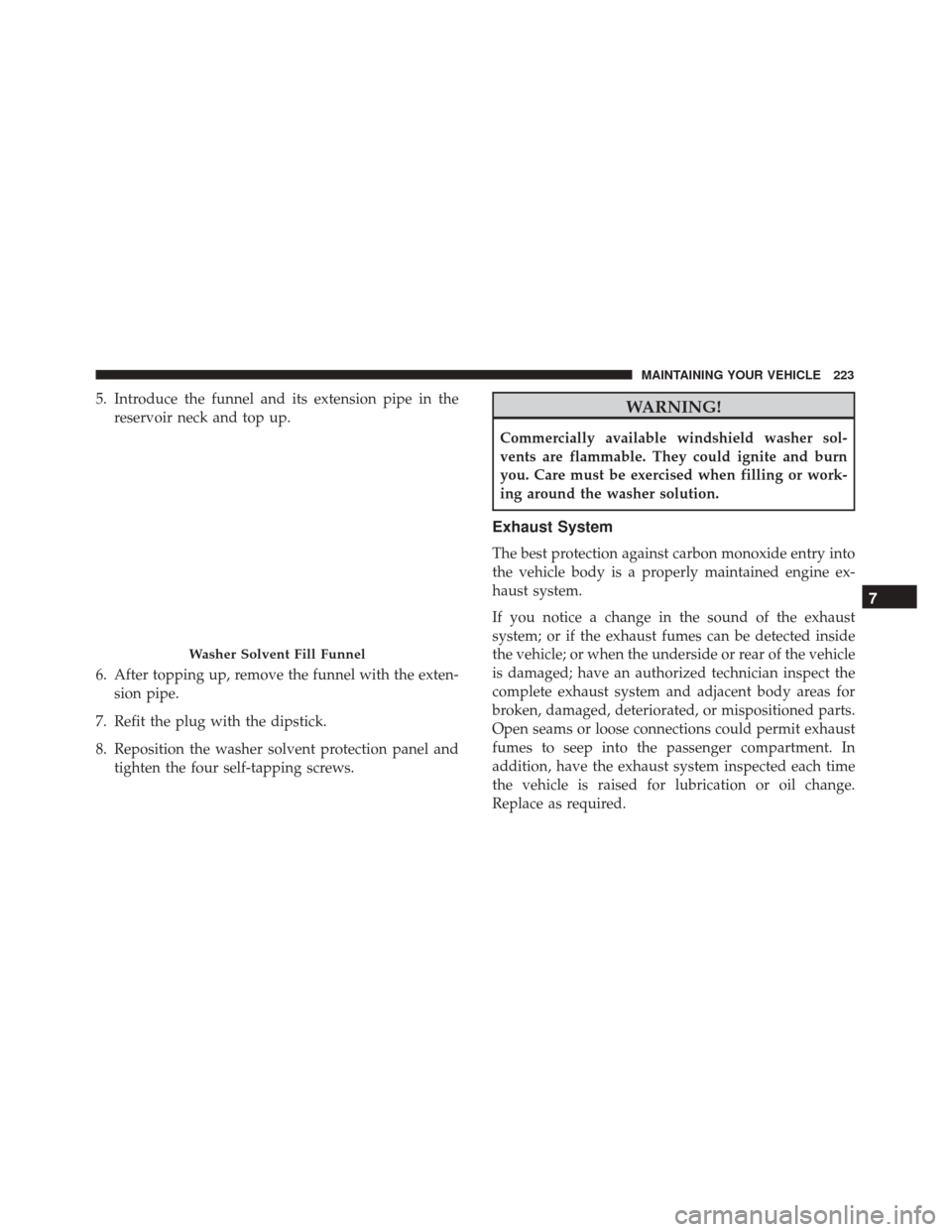
5. Introduce the funnel and its extension pipe in thereservoir neck and top up.
6. After topping up, remove the funnel with the exten- sion pipe.
7. Refit the plug with the dipstick.
8. Reposition the washer solvent protection panel and tighten the four self-tapping screws.WARNING!
Commercially available windshield washer sol-
vents are flammable. They could ignite and burn
you. Care must be exercised when filling or work-
ing around the washer solution.
Exhaust System
The best protection against carbon monoxide entry into
the vehicle body is a properly maintained engine ex-
haust system.
If you notice a change in the sound of the exhaust
system; or if the exhaust fumes can be detected inside
the vehicle; or when the underside or rear of the vehicle
is damaged; have an authorized technician inspect the
complete exhaust system and adjacent body areas for
broken, damaged, deteriorated, or mispositioned parts.
Open seams or loose connections could permit exhaust
fumes to seep into the passenger compartment. In
addition, have the exhaust system inspected each time
the vehicle is raised for lubrication or oil change.
Replace as required.
Washer Solvent Fill Funnel
7
MAINTAINING YOUR VEHICLE 223
Page 248 of 289
BULB REPLACEMENT
NOTE:Lens fogging can occur under certain atmo-
spheric conditions. This will usually clear as atmo-
spheric conditions change to allow the condensation to
change back into a vapor. Turning the lamps on will
usually accelerate the clearing process.
Front Light Clusters
The front head lamp contains bulbs for the parking
lights/daytime running lights (DRL), low beam head-
lights, high beam headlights and direction indicators.
If bulb replacement is required, please see an autho-
rized dealer.
1 — Daytime Running Lights
2 — Direction Indicator
3 — High/Low Beam Lights
246 MAINTAINING YOUR VEHICLE
Page 249 of 289
Side Lights/Daytime Running Lights (DRL)
These are LEDs. For the replacement, contact the your
authorized dealer.
Low/High Beam Bi-Halogen Headlights
To change the bulb, proceed as follows:
1. Turn the steering wheel completely.
2. Open the protective flap by rotating the screw.3. Remove protective cover from headlamp assembly.
1 — Direction Indicator Bulb Protective Flap
2 — Headlamp Bulb Protective Flap
Protective Cover
7
MAINTAINING YOUR VEHICLE 247
Page 262 of 289
MAINTENANCE SCHEDULE
Your vehicle is equipped with an automatic oil change
indicator system. The oil change indicator system will
remind you that it is time to take your vehicle in for
scheduled maintenance.
Based on engine operation conditions, the oil change
indicator message will illuminate in the instrument
cluster. This means that an engine oil and engine oil
filter change is required for your vehicle. Operating
conditions such as frequent short-trips, trailer tow,
extremely hot or cold ambient temperatures will influ-
ence when the “Change Oil” or “Oil Change Required”
message is displayed. Severe Operating Conditions can
cause the change oil message to illuminate as early as
3,500 miles (5,600 km) since last reset. Have your
vehicle serviced as soon as possible, within the next 500
miles (805 km).
The Wrench Warning Light may appear in the cluster as
a service reminder when vehicle maintenance is re-
quired, according to the scheduled maintenance mile-
age. The maintenance schedule intervals are set by the
manufacturer. Failure to have them carried out may
void your New Vehicle Limited Warranty.NOTE:
The actual interval for changing the oil and
replacing the engine oil filter depends on the vehicle
usage conditions and is signalled by the warning light
or message (if present) on the instrument panel or every
12 months.
Severe Duty All Models
In addition, if your vehicle is used under demanding
conditions, including:
• On the track.
• On dusty roads.
• Short, repeated trips (less than 4-5 miles or 7-8 km) at
sub-zero temperatures.
• Allowing the engine to idle for extended periods of
time.
• Driving for long distances at low speeds.
• Allowing the vehicle to sit for long periods of inac-
tivity.
260 MAINTENANCE SCHEDULES
Page 268 of 289
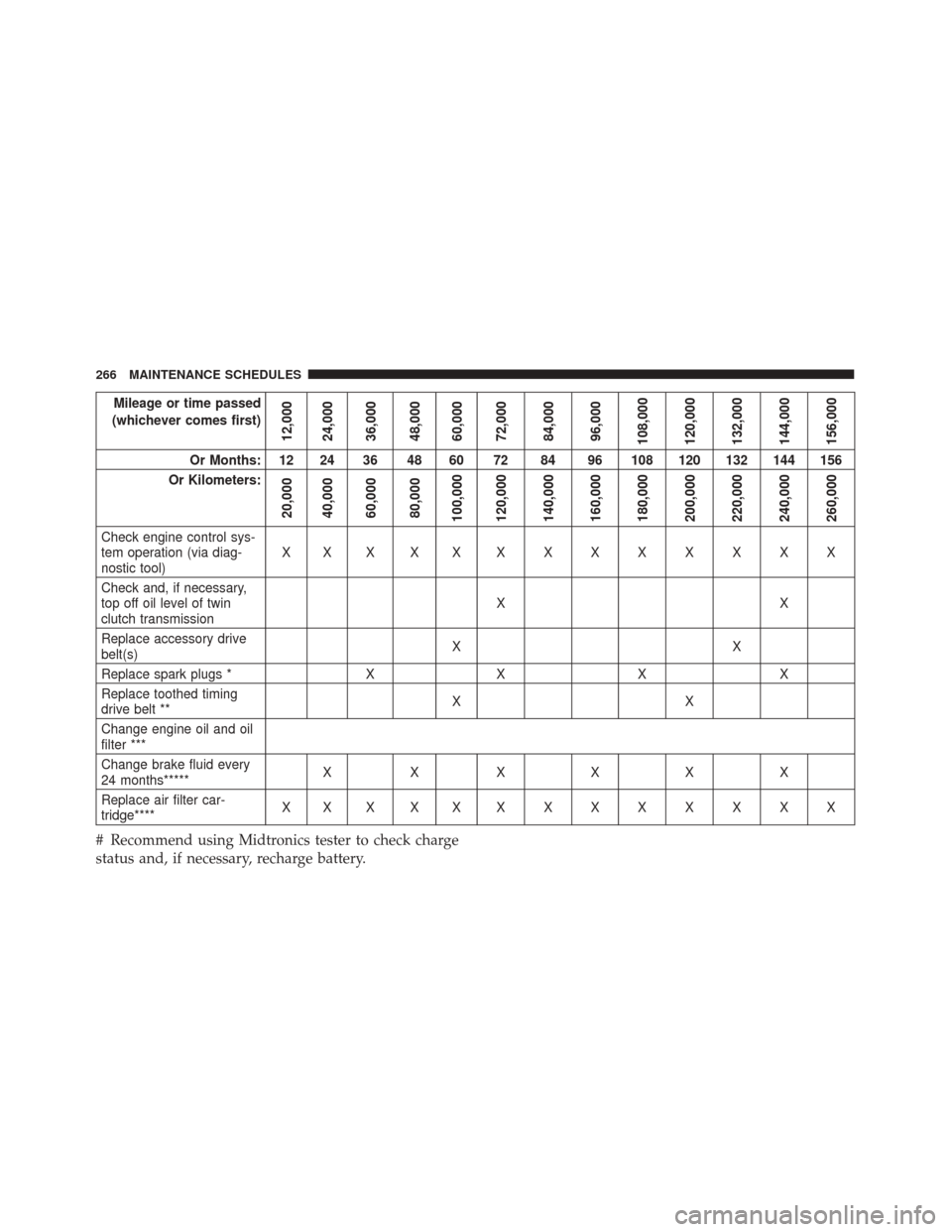
Mileage or time passed
(whichever comes first)
12,000
24,000
36,000
48,000
60,000
72,000
84,000
96,000
108,000
120,000
132,000
144,000
156,000
Or Months: 12 24 36 48 60 72 84 96 108 120 132 144 156
Or Kilometers:
20,000
40,000
60,000
80,000
100,000
120,000
140,000
160,000
180,000
200,000
220,000
240,000
260,000
Check engine control sys-
tem operation (via diag-
nostic tool) XXXXXXXXXXXXX
Check and, if necessary,
top off oil level of twin
clutch transmission XX
Replace accessory drive
belt(s) XX
Replace spark plugs * X X X X
Replace toothed timing
drive belt ** XX
Change engine oil and oil
filter ***
Change brake fluid every
24 months***** XXX X X X
Replace air filter car-
tridge**** XXXXXXXXXXXXX
# Recommend using Midtronics tester to check charge
status and, if necessary, recharge battery.
266 MAINTENANCE SCHEDULES