load capacity Alfa Romeo 4C 2017 Owner's Manual
[x] Cancel search | Manufacturer: ALFA ROMEO, Model Year: 2017, Model line: 4C, Model: Alfa Romeo 4C 2017Pages: 289, PDF Size: 2.61 MB
Page 163 of 289
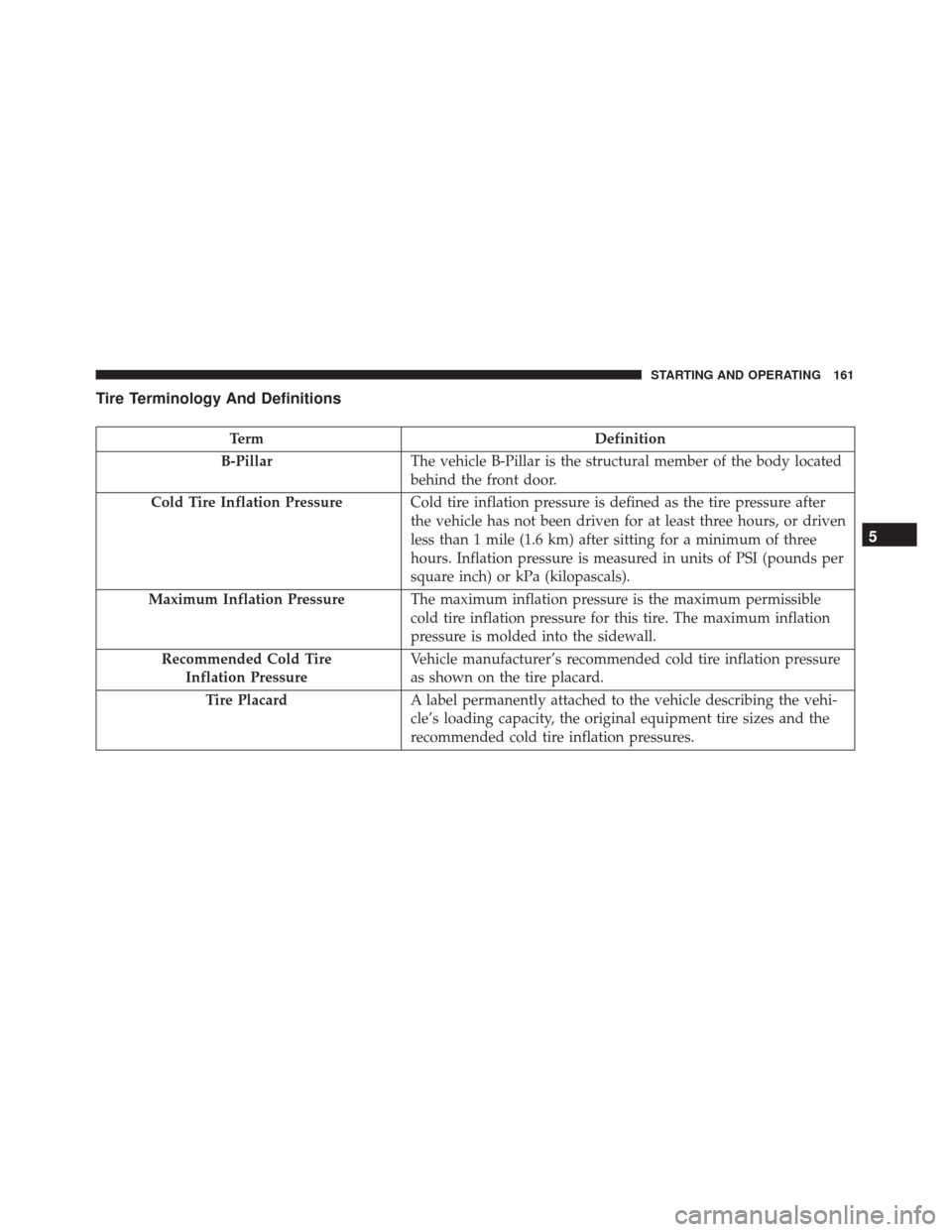
Tire Terminology And Definitions
TermDefinition
B-Pillar The vehicle B-Pillar is the structural member of the body located
behind the front door.
Cold Tire Inflation Pressure Cold tire inflation pressure is defined as the tire pressure after
the vehicle has not been driven for at least three hours, or driven
less than 1 mile (1.6 km) after sitting for a minimum of three
hours. Inflation pressure is measured in units of PSI (pounds per
square inch) or kPa (kilopascals).
Maximum Inflation Pressure The maximum inflation pressure is the maximum permissible
cold tire inflation pressure for this tire. The maximum inflation
pressure is molded into the sidewall.
Recommended Cold Tire Inflation Pressure Vehicle manufacturer’s recommended cold tire inflation pressure
as shown on the tire placard.
Tire Placard A label permanently attached to the vehicle describing the vehi-
cle’s loading capacity, the original equipment tire sizes and the
recommended cold tire inflation pressures.
5
STARTING AND OPERATING 161
Page 165 of 289
WARNING!
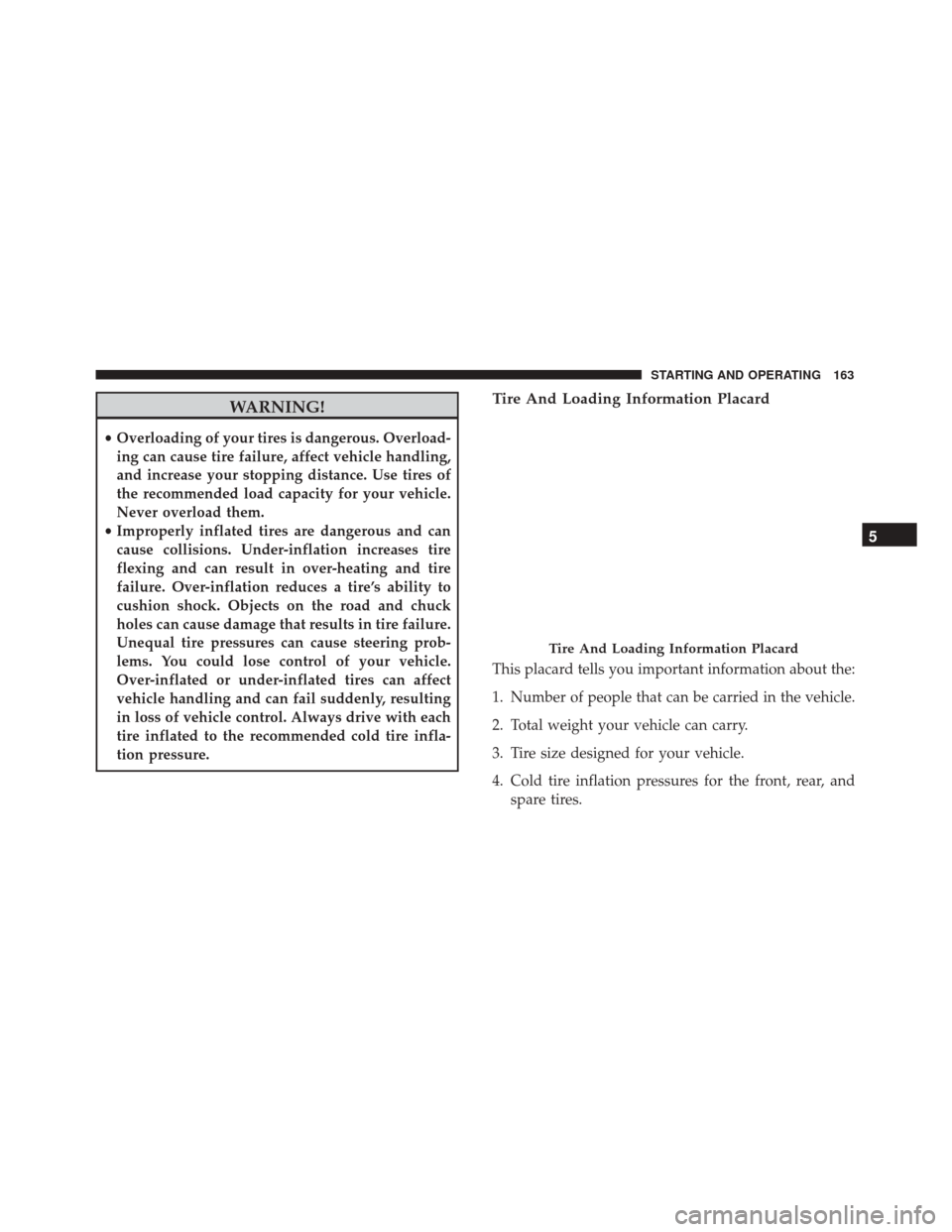
•Overloading of your tires is dangerous. Overload-
ing can cause tire failure, affect vehicle handling,
and increase your stopping distance. Use tires of
the recommended load capacity for your vehicle.
Never overload them.
• Improperly inflated tires are dangerous and can
cause collisions. Under-inflation increases tire
flexing and can result in over-heating and tire
failure. Over-inflation reduces a tire’s ability to
cushion shock. Objects on the road and chuck
holes can cause damage that results in tire failure.
Unequal tire pressures can cause steering prob-
lems. You could lose control of your vehicle.
Over-inflated or under-inflated tires can affect
vehicle handling and can fail suddenly, resulting
in loss of vehicle control. Always drive with each
tire inflated to the recommended cold tire infla-
tion pressure.
Tire And Loading Information Placard
This placard tells you important information about the:
1. Number of people that can be carried in the vehicle.
2. Total weight your vehicle can carry.
3. Tire size designed for your vehicle.
4. Cold tire inflation pressures for the front, rear, and spare tires.
Tire And Loading Information Placard
5
STARTING AND OPERATING 163
Page 166 of 289
Loading
The vehicle maximum load on the tire must not exceed
the load carrying capacity of the tire on your vehicle.
You will not exceed the tire’s load carrying capacity if
you adhere to the loading conditions, tire size, and cold
tire inflation pressures specified on the Tire and Load-
ing Information placard in “Vehicle Loading” in the
“Starting And Operating” section of this manual.
NOTE:Under a maximum loaded vehicle condition,
gross axle weight ratings (GAWRs) for the front and
rear axles must not be exceeded. For further informa-
tion on GAWRs, vehicle loading, and trailer towing,
refer to “Vehicle Loading” in the “Starting And Oper-
ating” section of this manual.
To determine the maximum loading conditions of your
vehicle, locate the statement “The combined weight of
occupants and cargo should never exceed XXX kg or
XXX lbs” on the Tire and Loading Information placard.
The combined weight of occupants, cargo/luggage and
trailer tongue weight (if applicable) should never ex-
ceed the weight referenced here.
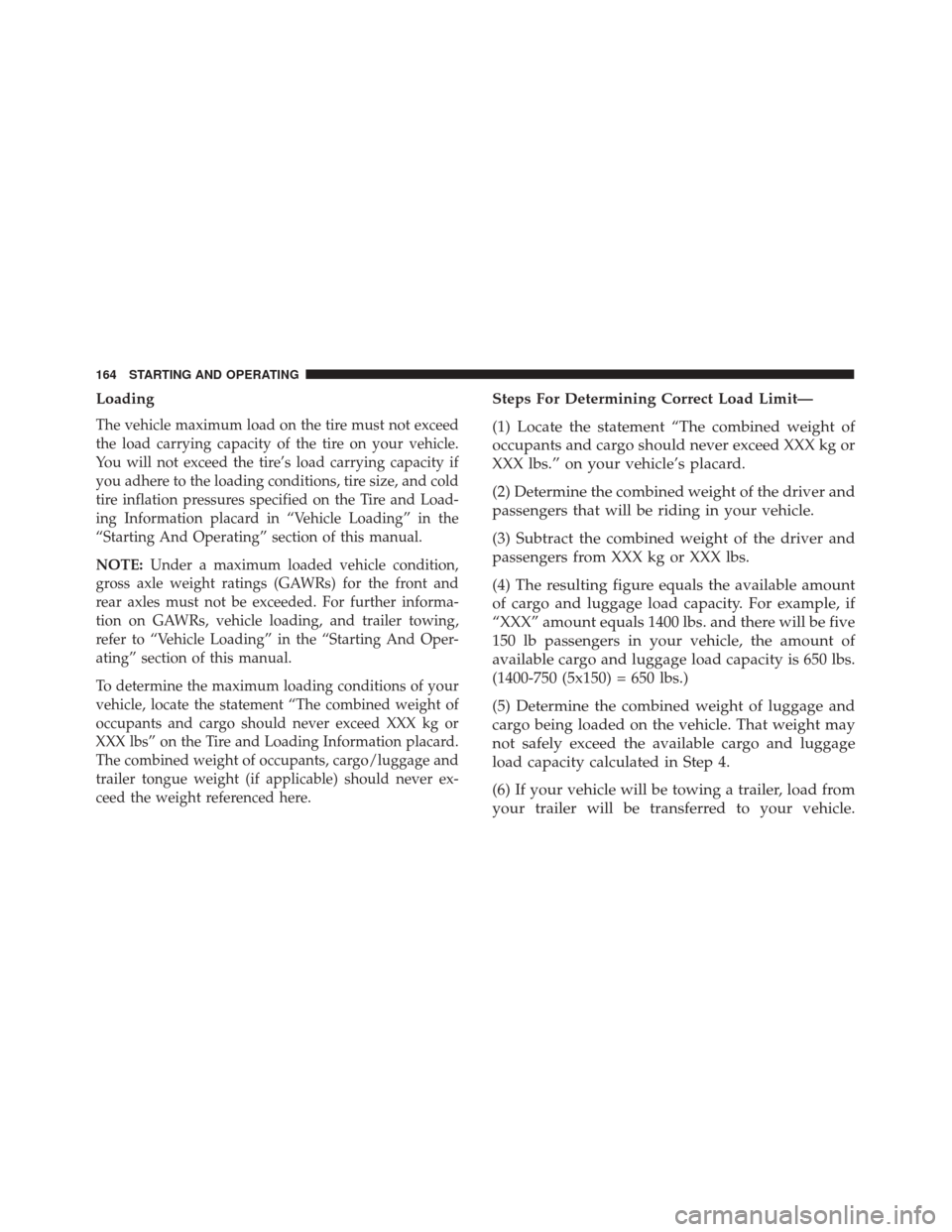
Steps For Determining Correct Load Limit—
(1) Locate the statement “The combined weight of
occupants and cargo should never exceed XXX kg or
XXX lbs.” on your vehicle’s placard.
(2) Determine the combined weight of the driver and
passengers that will be riding in your vehicle.
(3) Subtract the combined weight of the driver and
passengers from XXX kg or XXX lbs.
(4) The resulting figure equals the available amount
of cargo and luggage load capacity. For example, if
“XXX” amount equals 1400 lbs. and there will be five
150 lb passengers in your vehicle, the amount of
available cargo and luggage load capacity is 650 lbs.
(1400-750 (5x150) = 650 lbs.)
(5) Determine the combined weight of luggage and
cargo being loaded on the vehicle. That weight may
not safely exceed the available cargo and luggage
load capacity calculated in Step 4.
(6) If your vehicle will be towing a trailer, load from
your trailer will be transferred to your vehicle.
164 STARTING AND OPERATING
Page 167 of 289
Consult this manual to determine how this reduces
the available cargo and luggage load capacity of your
vehicle.
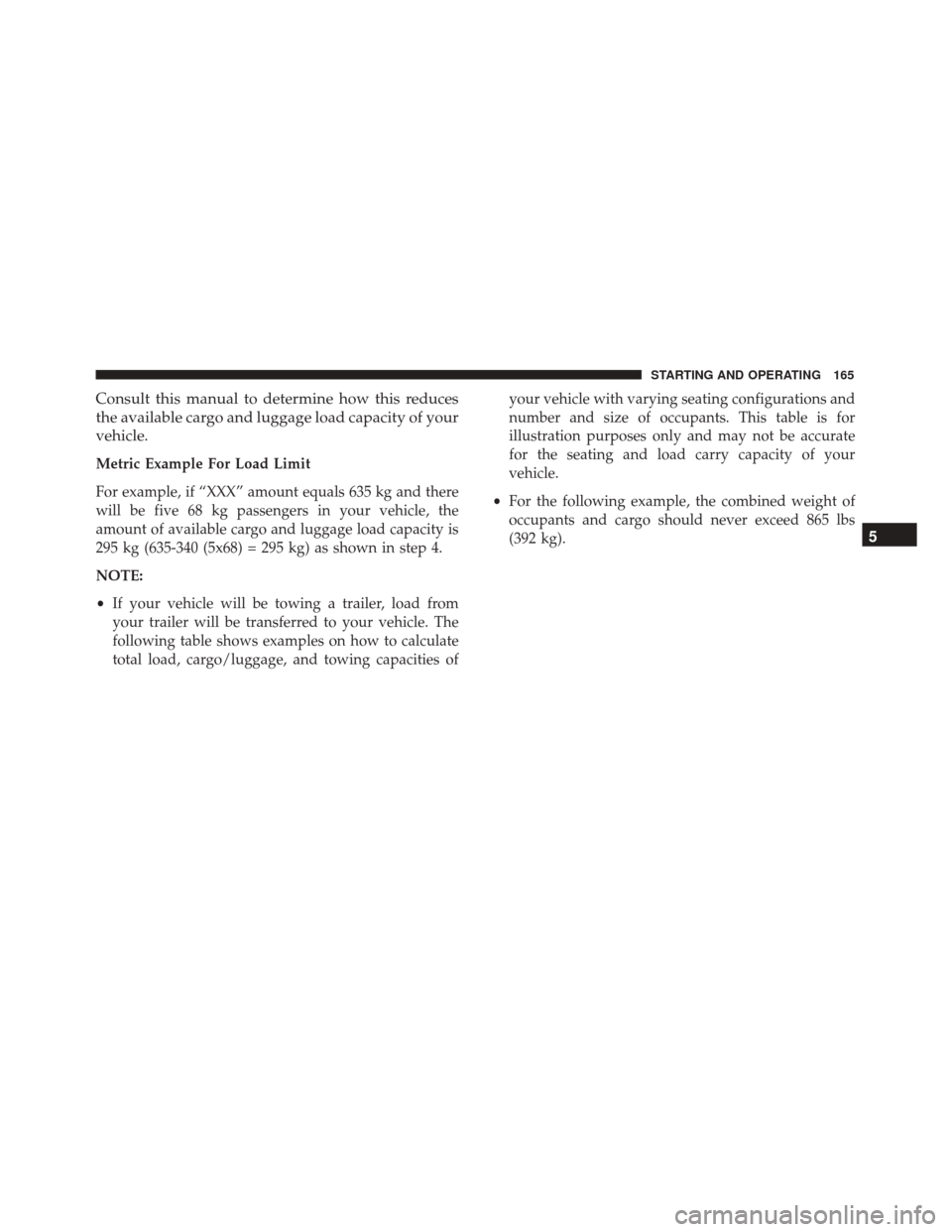
Metric Example For Load Limit
For example, if “XXX” amount equals 635 kg and there
will be five 68 kg passengers in your vehicle, the
amount of available cargo and luggage load capacity is
295 kg (635-340 (5x68) = 295 kg) as shown in step 4.
NOTE:
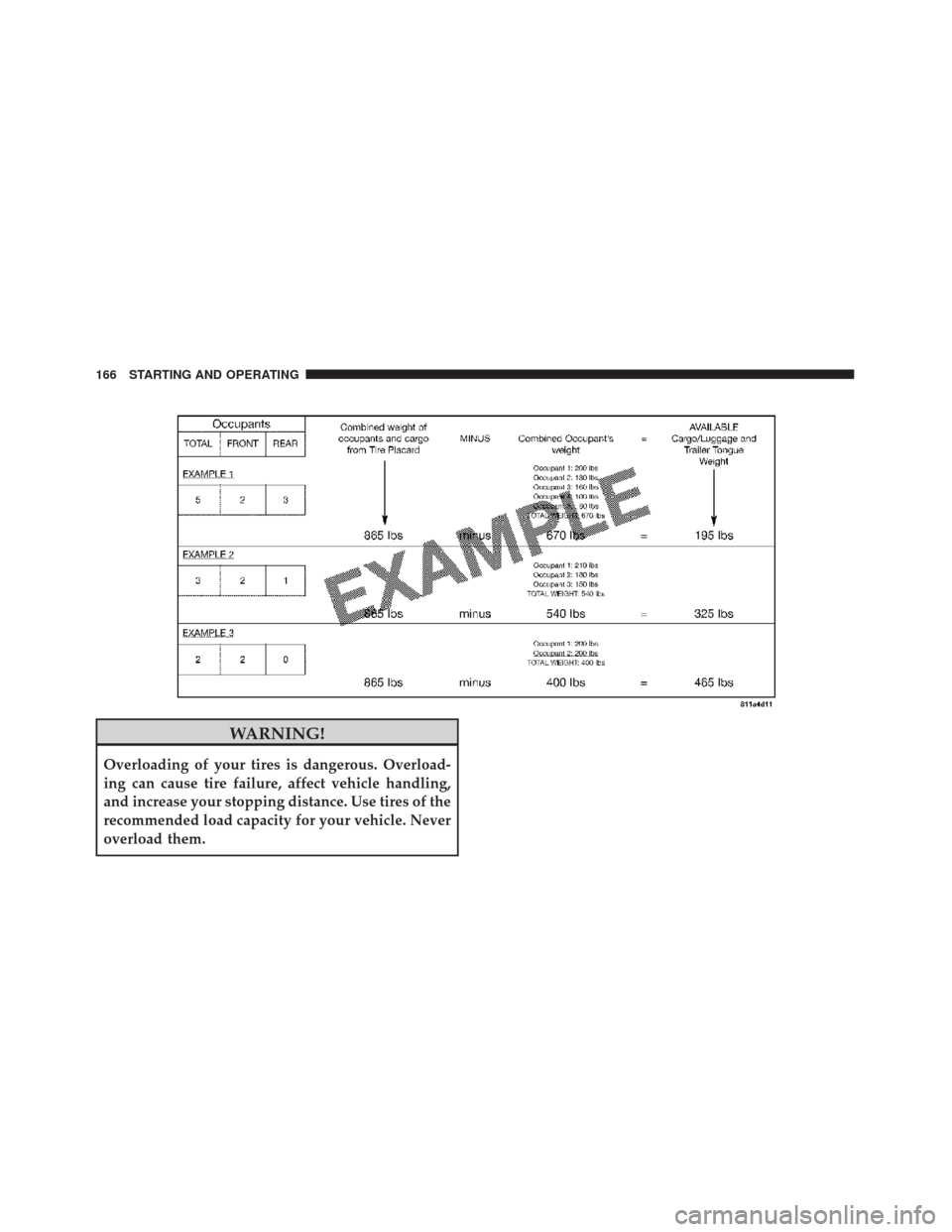
•If your vehicle will be towing a trailer, load from
your trailer will be transferred to your vehicle. The
following table shows examples on how to calculate
total load, cargo/luggage, and towing capacities of your vehicle with varying seating configurations and
number and size of occupants. This table is for
illustration purposes only and may not be accurate
for the seating and load carry capacity of your
vehicle.
• For the following example, the combined weight of
occupants and cargo should never exceed 865 lbs
(392 kg).
5
STARTING AND OPERATING 165
Page 168 of 289
WARNING!
Overloading of your tires is dangerous. Overload-
ing can cause tire failure, affect vehicle handling,
and increase your stopping distance. Use tires of the
recommended load capacity for your vehicle. Never
overload them.
166 STARTING AND OPERATING
Page 171 of 289
Example: If garage temperature = 68°F (20°C) and the
outside temperature = 32°F (0°C) then the cold tire
inflation pressure should be increased by 3 psi (21 kPa),
which equals 1 psi (7 kPa) for every 12°F (7°C) for this
outside temperature condition.
Tire pressure may increase from 2 to 6 psi (13 to 40 kPa)
during operation. DO NOT reduce this normal pressure
build up or your tire pressure will be too low.
Tire Pressures For High Speed Operation
The manufacturer advocates driving at safe speeds and
within posted speed limits. Where speed limits or condi-
tions are such that the vehicle can be driven at high
speeds, maintaining correct tire inflation pressure is very
important. Increased tire pressure and reduced vehicle
loading may be required for high-speed vehicle opera-
tion. Refer to your authorized tire dealer or original
equipment vehicle dealer for recommended safe operat-
ing speeds, loading and cold tire inflation pressures.
WARNING!
High speed driving with your vehicle under maxi-
mum load is dangerous. The added strain on your
tires could cause them to fail. You could have a
serious collision. Do not drive a vehicle loaded to
the maximum capacity at continuous speeds above
75 mph (120 km/h).
Radial Ply Tires
WARNING!
Combining radial ply tires with other types of tires
on your vehicle will cause your vehicle to handle
poorly. The instability could cause a collision. Al-
ways use radial ply tires in sets of four. Never
combine them with other types of tires.
5
STARTING AND OPERATING 169
Page 173 of 289
Snow Tires
Some areas of the country require the use of snow tires
during the Winter. Snow tires can be identified by a
“mountain/snowflake” symbol on the tire sidewall.If you need snow tires, select tires
equivalent in size and type to the
original equipment tires. Use snow
tires only in sets of four; failure to do
so may adversely affect the safety
and handling of your vehicle.
Snow tires generally have lower speed ratings than
what was originally equipped with your vehicle and
should not be operated at sustained speeds over 75 mph
(120 km/h). For speeds above 75 mph (120 km/h), refer
to original equipment or an authorized tire dealer for
recommended safe operating speeds, loading and cold
tire inflation pressures.
While studded tires improve performance on ice, skid
and traction capability on wet or dry surfaces may be
poorer than that of non-studded tires. Some states
prohibit studded tires; therefore, local laws should be
checked before using these tire types.
Run Flat Tires — If Equipped
Run Flat tires allow you the capability to drive 50 miles
(80 km) at 50 mph (80 km/h) after a rapid loss of
inflation pressure. This rapid loss of inflation is referred
to as the Run Flat mode. A Run Flat mode occurs when
the tire inflation pressure is of/or below 14 psi (96 kPa).
Once a Run Flat tire reaches the run flat mode it has
limited driving capabilities and needs to be replaced
immediately. A Run Flat tire is not repairable.
It is not recommended driving a vehicle loaded at full
capacity or to tow a trailer while a tire is in the run flat
mode.
See the tire pressure monitoring section for more infor-
mation.
Spare Tires — If Equipped
NOTE: For vehicles equipped with Tire Service Kit
instead of a spare tire, please refer to the “Tire Service
Kit” section located in your Owner ’s Information kit for
further information.
5
STARTING AND OPERATING 171
Page 179 of 289
WARNING!(Continued)
only the tire and wheel sizes with load ratings
approved for your vehicle.
•Never use a tire with a smaller load index or
capacity, other than what was originally equipped
on your vehicle. Using a tire with a smaller load
index could result in tire overloading and failure.
You could lose control and have a collision.
• Failure to equip your vehicle with tires having
adequate speed capability can result in sudden
tire failure and loss of vehicle control.
CAUTION!
Replacing original tires with tires of a different size
may result in false speedometer and odometer read-
ings.
TIRE CHAINS (TRACTION DEVICES)
Use of traction devices require sufficient tire-to-body
clearance. Follow these recommendations to guard
against damage.
• Traction device must be of proper size for the tire, as
recommended by the traction device manufacturer. •
Install on Rear Tires Only.
• Reduced size snow chains with a maximum projec-
tion of 7 mm beyond the tire profile can be fitted on
vehicles equipped with 235/40 R18 rear tire.
CAUTION!
To avoid damage to your vehicle or tires, observe
the following precautions:
•
Because of restricted traction device clearance be-
tween tires and other suspension components, it is
important that only traction devices in good condi-
tion are used. Broken devices can cause serious
damage. Stop the vehicle immediately if noise
occurs that could indicate device breakage. Remove
the damaged parts of the device before further use.
• Install device as tightly as possible and then
retighten after driving about ½ mile (0.8 km).
• Do not exceed 30 mph (48 km/h).
• Drive cautiously and avoid severe turns and large
bumps, especially with a loaded vehicle.
•
Do not drive for a prolonged period on dry pave-
ment.
(Continued)
5
STARTING AND OPERATING 177
Page 283 of 289
Passing..............................72
Seat Belt Reminder ......................97
Service ............................. .246
Tire Pressure Monitoring (TPMS) ...........100
Turn Signal ....................... .59, 107
Warning (Instrument Cluster
Description) ...................... .99, 107
Loading Vehicle Tires .............................. .162
Locks .................................18
Auto Unlock ..........................19
Door ................................18
Power Door ...........................18
Lubrication, Body ....................... .218
Lug Nuts ............................. .193
Maintenance Free Battery ...................216
Maintenance, General .....................213
Maintenance Procedures ...................213
Maintenance Schedule .....................260
Malfunction Indicator Light (Check Engine) .....................105, 211
Manual, Service ........................ .273
Manual Transmission Lubricant Selection .....................258 Master Cylinder (Brakes)
...................230
Methanol ............................. .184
Mirrors ................................63
Electric Remote ........................64
Heated ..............................65
Outside ..............................64
Rearview .............................63
Modifications/Alterations, Vehicle ..............6
Monitor, Tire Pressure System ...............179
MTBE/ETBE .......................... .184
Multi-Function Control Lever ................71
New Vehicle Break-In Period .................55
Occupant Restraints .......................24
Octane Rating, Gasoline (Fuel) ...............183
Oil, Engine ..................... .214, 256, 257
Capacity ........................... .256
Change Interval ...................... .214
Checking ........................... .214
Disposal ............................ .215
Filter .............................. .215
Filter
Disposal ....................... .215
Materials Added To ....................215
Pressure Warning Light ...................96
10
INDEX 281
Page 286 of 289
Storing Your Vehicle..................... .244
Supplemental Restraint System - Air Bag ........36
Telescoping Steering Column .................76
Tilt Steering Column .......................76
Tire And Loading Information Placard ......162, 163
Tire Markings .......................... .157
Tires.................... .59, 167, 171, 172, 178
Aging (Life Of Tires) ....................175
Air Pressure ...................... .162, 167
Chains ............................. .177
Compact Spare ....................... .172
General Information ..............167, 171, 172
High Speed ......................... .169
Inflation Pressures .....................168
Life Of Tires ......................... .175
Load Capacity .....................162, 164
Pressure Monitor System (TPMS) ...........179
Pressure Warning Light ..................100
Quality Grading ...................... .178
Radial ............................. .169
Replacement ......................... .176
Rotation ............................ .178
Safety .......................... .157, 167
Sizes .............................. .158Snow Tires
.......................... .171
Spare Tire ..................171, 172, 173, 174
Spinning ........................... .174
Tread Wear Indicators ...................175
Tire Safety Information ....................157
To Open Deck Lid ........................68
Towing .............................. .189
Recreational ......................... .189
Towing Eyes ........................... .204
Towing Vehicle Behind A Motorhome ..........189
Traction .............................. .146
Trailer Towing ......................... .189
T
ransaxle Automatic .............................9
Transmission .......................... .136
Automatic .......................... .136
Fluid .............................. .233
Maintenance ......................... .233
Transporting Passengers ....................56
Tread Wear Indicators .....................175
Turn Signals ........................... .107
Uniform Tire Quality Grades ................178
Unleaded Gasoline ...................... .183
284 INDEX