warning Alfa Romeo 4C 2018 Owner's Manual
[x] Cancel search | Manufacturer: ALFA ROMEO, Model Year: 2018, Model line: 4C, Model: Alfa Romeo 4C 2018Pages: 279, PDF Size: 3.08 MB
Page 181 of 279
4. Connect the opposite end of the negative(-)jumper
cable to a good engine ground of the vehicle with the
discharged battery (exposed metal part of the en-
gine) away from the battery and the fuel injection
system.
WARNING!
Do not connect the jumper cable to the negative (-)
post of the discharged battery. The resulting elec-
trical spark could cause the battery to explode and
could result in personal injury. Only use the spe-
cific ground point, do not use any other exposed
metal parts.
5. Start the engine in the vehicle that has the booster battery, let the engine idle a few minutes, and then
start the engine in the vehicle with the discharged
battery.
6. Once the engine is started, remove the jumper cables in the reverse sequence:
Disconnecting The Jumper Cables
1. Disconnect the negative (-)jumper cable from the
engine (-)ground of the vehicle with the discharged
battery. 2. Disconnect the negative end
(-)of the jumper cable
from the negative (-)post of the booster battery.
3. Disconnect the opposite end of the positive (+)
jumper cable from the positive (+)post of the booster
battery.
4. Disconnect the positive (+)end of the jumper cable
from the positive (+)post of the vehicle with the
discharged battery.
If frequent jump starting is required to start your
vehicle you should have the battery and charging
system inspected at an authorized dealer.
CAUTION!
Accessories plugged into the vehicle power outlets
draw power from the vehicle’s battery, even when
not in use (i.e., cellular devices, etc.). Eventually, if
plugged in long enough without engine operation,
the vehicle’s battery will discharge sufficiently to
degrade battery life and/or prevent the engine from
starting.
7
IN CASE OF EMERGENCY 179
Page 182 of 279
IF YOUR ENGINE OVERHEATS
In any of the following situations, you can reduce the
potential for overheating by taking the appropriate
action.
•On highways — slow down.
• In city traffic — while stopped, place the transmis-
sion in NEUTRAL, but do not increase engine idle
speed.
NOTE: There are steps that you can take to slow down
an impending overheat condition:
• If your air conditioner (A/C) is on, turn it off. The
A/C system adds heat to the engine cooling system
and turning the A/C off can help remove this heat.
• You can also turn the temperature control to maxi-
mum heat, the mode control to floor and the blower
control to high. This allows the heater core to act as a
supplement to the radiator and aids in removing heat
from the engine cooling system.
WARNING!
You or others can be badly burned by hot engine
coolant (antifreeze) or steam from your radiator. If
you see or hear steam coming from under the hood,
do not open the hood until the radiator has had time
to cool. Never try to open a cooling system pressure
cap when the radiator or coolant bottle is hot.
CAUTION!
Driving with a hot cooling system could damage
your vehicle. If the temperature gauge reads 240°F
(116°C) or greater pull over and stop the vehicle.
Idle the vehicle with the air conditioner turned off
until the coolant temperature drops back into the
normal range 200–230°F (93–110°C). The digital
warning light may switch on (together with a mes-
sage on the instrument cluster display) to indicate
that the coolant temperature is too high; in this case,
stop the engine and call for service.
180 IN CASE OF EMERGENCY
Page 184 of 279
When using a tow eye, be sure to follow the “Tow Eye
Usage Precautions” in this section.
Tow Eye Usage Precautions
The transmission must be in NEUTRAL when flat
towing this vehicle. The ignition must be ON in order to
place the transmission in NEUTRAL. Therefore, if the
key is unavailable or the battery is discharged, this
vehicle must be towed with all four wheels OFF the
ground (using a vehicle trailer or flatbed truck).
•Ensure that the tow eye is properly seated and secure
in the mounting receptacle. •
The tow eye is recommended for use with an ap-
proved tow bar and or rope.
• Do not use the tow eye to pull the vehicle onto a
flatbed truck.
• Do not use the tow eye to free a stuck vehicle.
WARNING!
Stand clear of vehicles when pulling with tow eyes.
•Do not use a chain with a tow eye. Chains may
break, causing serious injury or death.
• Do not use a tow strap with a tow eye. Tow straps
may break or become disengaged, causing serious
injury or death.
• Failure to follow proper tow eye usage may cause
components to break resulting in serious injury
or death.
Tow Eye
182 IN CASE OF EMERGENCY
Page 185 of 279
CAUTION!
•The tow eye must be used exclusively for road-
side assistance operations. Only use the tow eye
with an appropriate device in accordance with the
highway code (a rigid bar or rope) to flat tow the
vehicle for a short distance to the nearest service
location.
(Continued)
CAUTION! (Continued)
•Tow eyes MUST NOT be used to tow vehicles off
the road or where there are obstacles.
• In compliance with the above conditions, towing
with a tow eye must take place with two vehicles
(one towing, the other towed) aligned as much as
possible along the same center line. Damage to
your vehicle may occur if these guidelines are not
followed.
• When towing, only use a facility that can tow
vehicles with low ground clearances as extensive
damage can result by using a standard tow truck
platform.
Tow Eye Warning Label7
IN CASE OF EMERGENCY 183
Page 189 of 279
SCHEDULED SERVICING
Your vehicle is equipped with an automatic oil change
indicator system. The oil change indicator system will
remind you that it is time to take your vehicle in for
scheduled maintenance.
Based on engine operation conditions, the oil change
indicator message will illuminate in the instrument
cluster. This means that an engine oil and engine oil
filter change is required for your vehicle. Operating
conditions such as frequent short-trips, trailer tow,
extremely hot or cold ambient temperatures will influ-
ence when the “Change Oil” or “Oil Change Required”
message is displayed. Severe Operating Conditions can
cause the change oil message to illuminate as early as
3,500 miles (5,600 km) since last reset. Have your
vehicle serviced as soon as possible, within the next 500
miles (805 km).
The Wrench Warning Light may appear in the cluster as
a service reminder when vehicle maintenance is re-
quired, according to the scheduled maintenance mile-
age. The maintenance schedule intervals are set by the
manufacturer. Failure to have them carried out may
void your New Vehicle Limited Warranty.NOTE:
The actual interval for changing the oil and
replacing the engine oil filter depends on the vehicle
usage conditions and is signalled by the warning light
or message (if present) on the instrument panel or every
12 months.
Severe Duty All Models
In addition, if your vehicle is used under demanding
conditions, including:
• On the track.
• On dusty roads.
• Short, repeated trips (less than 4-5 miles or 7-8 km) at
sub-zero temperatures.
• Allowing the engine to idle for extended periods of
time.
• Driving for long distances at low speeds.
• Allowing the vehicle to sit for long periods of inac-
tivity.
Under any of the above circumstances, the following
checks need to be performed more frequently than
indicated in the Maintenance Plan:
• Check front and rear disc brake pad condition and
wear.
8
SERVICING AND MAINTENANCE 187
Page 192 of 279
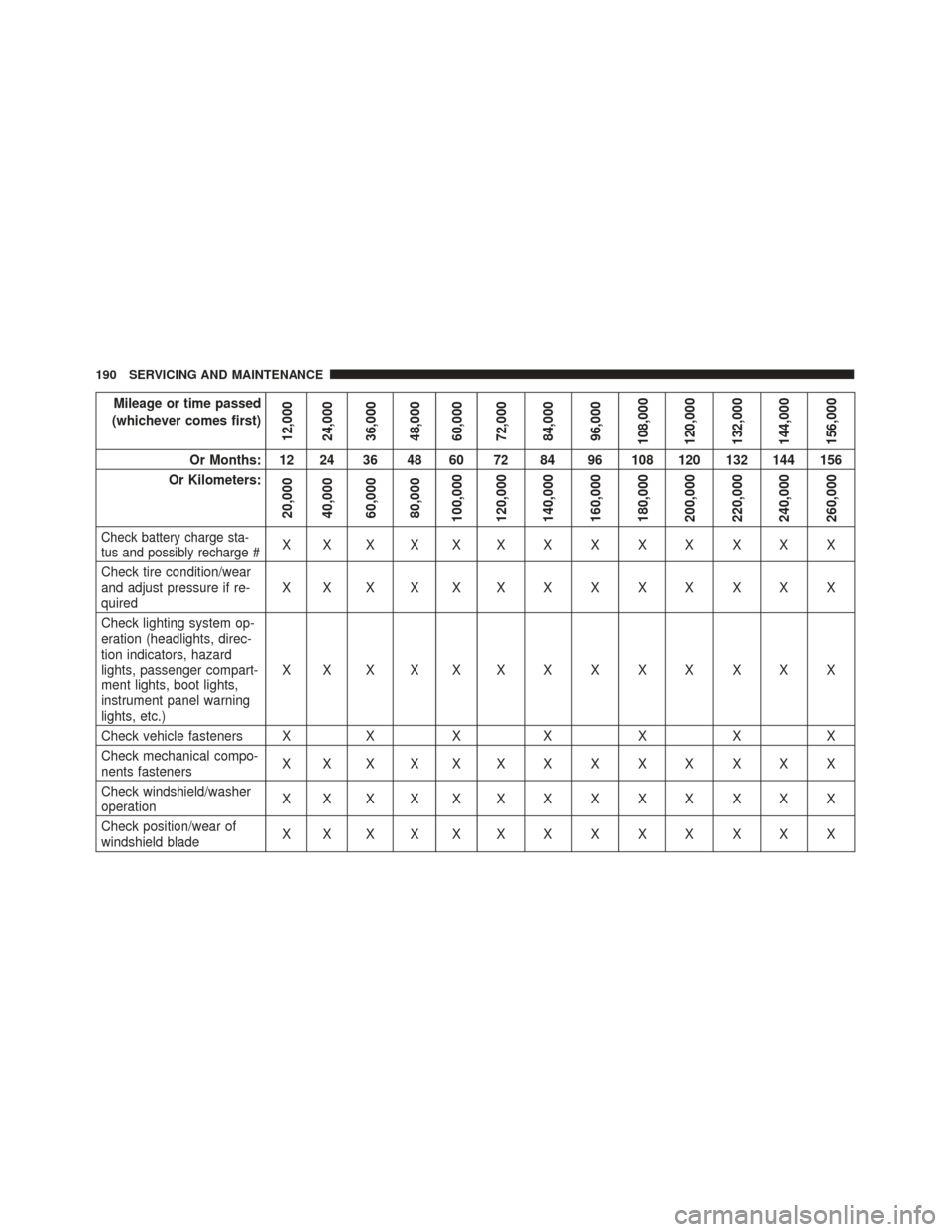
Mileage or time passed
(whichever comes first)
12,000
24,000
36,000
48,000
60,000
72,000
84,000
96,000
108,000
120,000
132,000
144,000
156,000
Or Months: 12 24 36 48 60 72 84 96 108 120 132 144 156
Or Kilometers:
20,000
40,000
60,000
80,000
100,000
120,000
140,000
160,000
180,000
200,000
220,000
240,000
260,000
Check battery charge sta-
tus and possibly recharge #XXXXXXXXXXXXX
Check tire condition/wear
and adjust pressure if re-
quired XXXXXXXXXXXXX
Check lighting system op-
eration (headlights, direc-
tion indicators, hazard
lights, passenger compart-
ment lights, boot lights,
instrument panel warning
lights, etc.) XXXXXXXXXXXXX
Check vehicle fasteners X X X X X X X
Check mechanical compo-
nents fasteners XXXXXXXXXXXXX
Check windshield/washer
operation XXXXXXXXXXXXX
Check position/wear of
windshield blade XXXXXXXXXXXXX
190 SERVICING AND MAINTENANCE
Page 196 of 279
* The spark plug change interval is mileage based only,
yearly intervals do not apply. The following are essen-
tial to ensure correct operation and prevent serious
damage to the engine:
•Only use spark plugs of the same make and type
which are specially certified for such engines (refer to
“Fluids And Lubricants” in “Technical Specifica-
tions” for further information).
• Strictly comply with the spark plug replacement
interval given in the maintenance plan for spark plug
replacement.
• Contact your Alfa Romeo Dealer if you have ques-
tions.
** Regardless of the distance covered, the timing belt
must be changed every four years for particularly
demanding use (cold climates, city driving, long peri-
ods of idling) or at least every five years.
*** The actual interval for changing the oil and replac-
ing the engine oil filter depends on the vehicle usage
conditions and is signalled by the warning light or
message (if present) on the instrument panel or every 12
months. **** If the vehicle is operated in a dusty or dirty
environment the engine air filter has to be changed
every 6,500 miles (10,000 km).
***** DOT 4 brake fluid must be changed every two
years regardless of mileage.
WARNING!
•
You can be badly injured working on or around a
motor vehicle. Do only service work for which
you have the knowledge and the right equipment.
If you have any doubt about your ability to
perform a service job, take your vehicle to a
competent mechanic.
• Failure to properly inspect and maintain your
vehicle could result in a component malfunction
and effect vehicle handling and performance.
This could cause an accident.
194 SERVICING AND MAINTENANCE
Page 200 of 279
5. After the check, reinsert the plug with the controlpipe in the initial position.
6. Reposition the washer solvent protection panel and tighten the four self-tapping screws.
If the level is not sufficient, namely if there is no washer
solvent inside the pipe, proceed as follows:
1. To avoid any interference during the procedure, lift the windshield wiper blade.
2. Loosen the four screws using the supplied screw- driver. Remove the washer solvent protection panel.
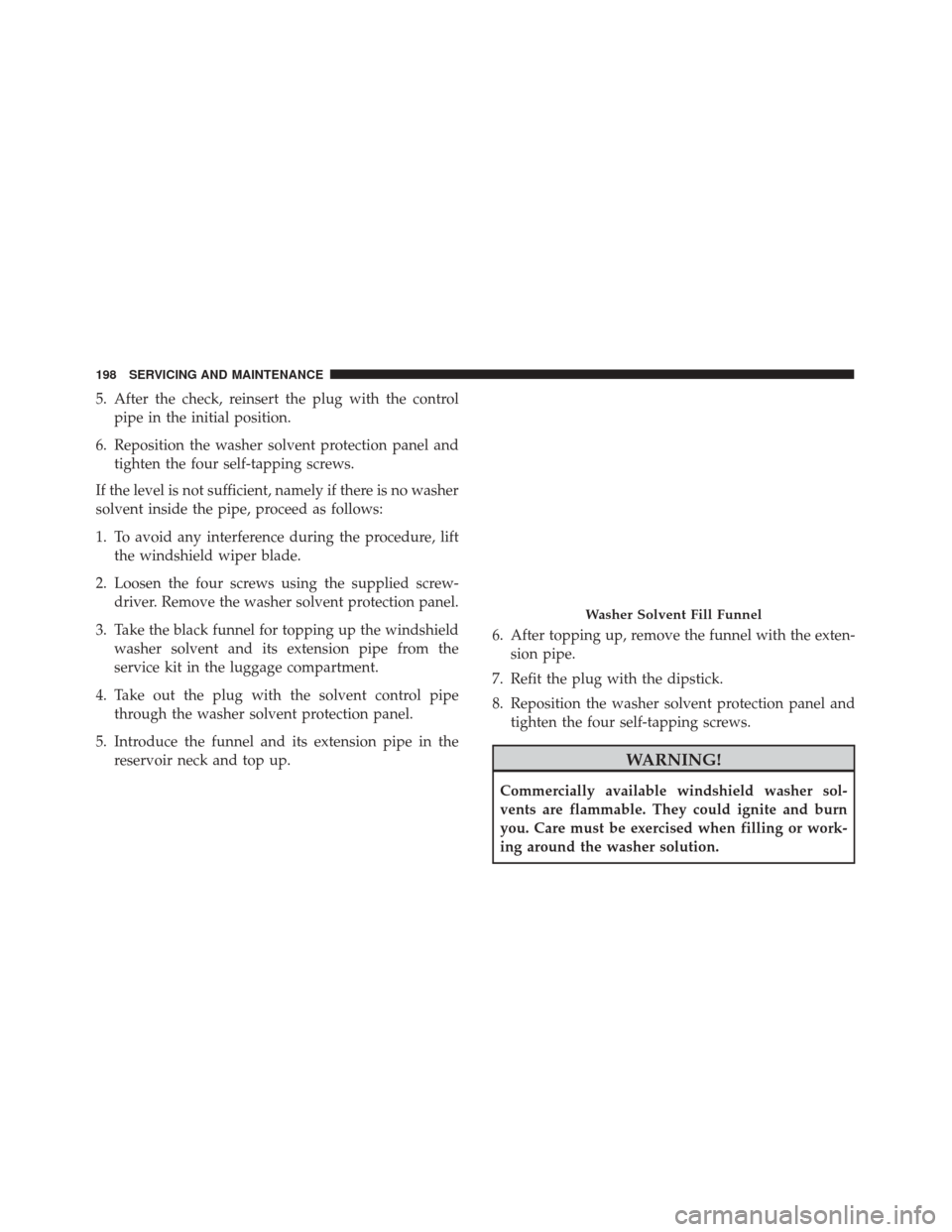
3. Take the black funnel for topping up the windshield washer solvent and its extension pipe from the
service kit in the luggage compartment.
4. Take out the plug with the solvent control pipe through the washer solvent protection panel.
5. Introduce the funnel and its extension pipe in the reservoir neck and top up. 6. After topping up, remove the funnel with the exten-
sion pipe.
7. Refit the plug with the dipstick.
8. Reposition the washer solvent protection panel and tighten the four self-tapping screws.
WARNING!
Commercially available windshield washer sol-
vents are flammable. They could ignite and burn
you. Care must be exercised when filling or work-
ing around the washer solution.
Washer Solvent Fill Funnel
198 SERVICING AND MAINTENANCE
Page 201 of 279
Maintenance-Free Battery
Your vehicle is equipped with a maintenance-free bat-
tery. You will never have to add water, nor is periodic
maintenance required.
WARNING!
•Battery fluid is a corrosive acid solution and can
burn or even blind you. Do not allow battery
fluid to contact your eyes, skin, or clothing. Do
not lean over a battery when attaching clamps. If
acid splashes in eyes or on skin, flush the area
immediately with large amounts of water. Refer
to “Jump Starting Procedure” in “In Case Of
Emergency” for further information.
• Battery gas is flammable and explosive. Keep
flame or sparks away from the battery. Do not use
a booster battery or any other booster source with
an output greater than 12 Volts. Do not allow
cable clamps to touch each other.
• Battery posts, terminals, and related accessories
contain lead and lead compounds. Wash hands
after handling.
(Continued)
WARNING! (Continued)
•The battery in this vehicle has a vent hose that
should not be disconnected and should only be
replaced with a battery of the same type (vented).
CAUTION!
• It is essential when replacing the cables on the
battery that the positive cable is attached to the
positive post and the negative cable is attached to
the negative post. Battery posts are marked posi-
tive (+) and negative (-) and are identified on the
battery case. Cable clamps should be tight on the
terminal posts and free of corrosion.
• If a “fast charger” is used while the battery is in
the vehicle, disconnect both vehicle battery cables
before connecting the charger to the battery. Do
not use a “fast charger” to provide starting volt-
age.
8
SERVICING AND MAINTENANCE 199
Page 202 of 279
DEALER SERVICE
The pages that follow contain therequiredmaintenance
services determined by the engineers who designed
your vehicle.
Besides those maintenance items specified in the fixed
maintenance schedule, there are other components
which may require servicing or replacement in the
future.
CAUTION!
• Failure to properly maintain your vehicle or per-
form repairs and service when necessary could
result in more costly repairs, damage to other
components or negatively impact vehicle perfor-
mance. Immediately have potential malfunctions
examined by an authorized dealer or qualified
repair center.
• Your vehicle has been built with improved fluids
that protect the performance and durability of
your vehicle and also allow extended mainte-
nance intervals. Do not use chemical flushes in
these components as the chemicals can damage
(Continued)
CAUTION! (Continued)
your engine, transmission, or air conditioning.
Such damage is not covered by the New Vehicle
Limited Warranty. If a flush is needed because of
component malfunction, use only the specified
fluid for the flushing procedure.
Engine Oil
Change Engine Oil
The oil change indicator system will remind you that it
is time to take your vehicle in for scheduled mainte-
nance. Refer to the “Maintenance Plan” for further
information.
NOTE:The actual interval for changing the oil and
replacing the engine oil filter depends on the vehicle
usage conditions and is signalled by the warning light
or message (if present) on the instrument panel or every
12 months.
Engine Oil Selection
For best performance and maximum protection for
turbocharged engines under all types of operating
conditions, the manufacturer recommends synthetic
200 SERVICING AND MAINTENANCE