maintenance Alfa Romeo 4C 2018 Owner's Guide
[x] Cancel search | Manufacturer: ALFA ROMEO, Model Year: 2018, Model line: 4C, Model: Alfa Romeo 4C 2018Pages: 279, PDF Size: 3.08 MB
Page 194 of 279
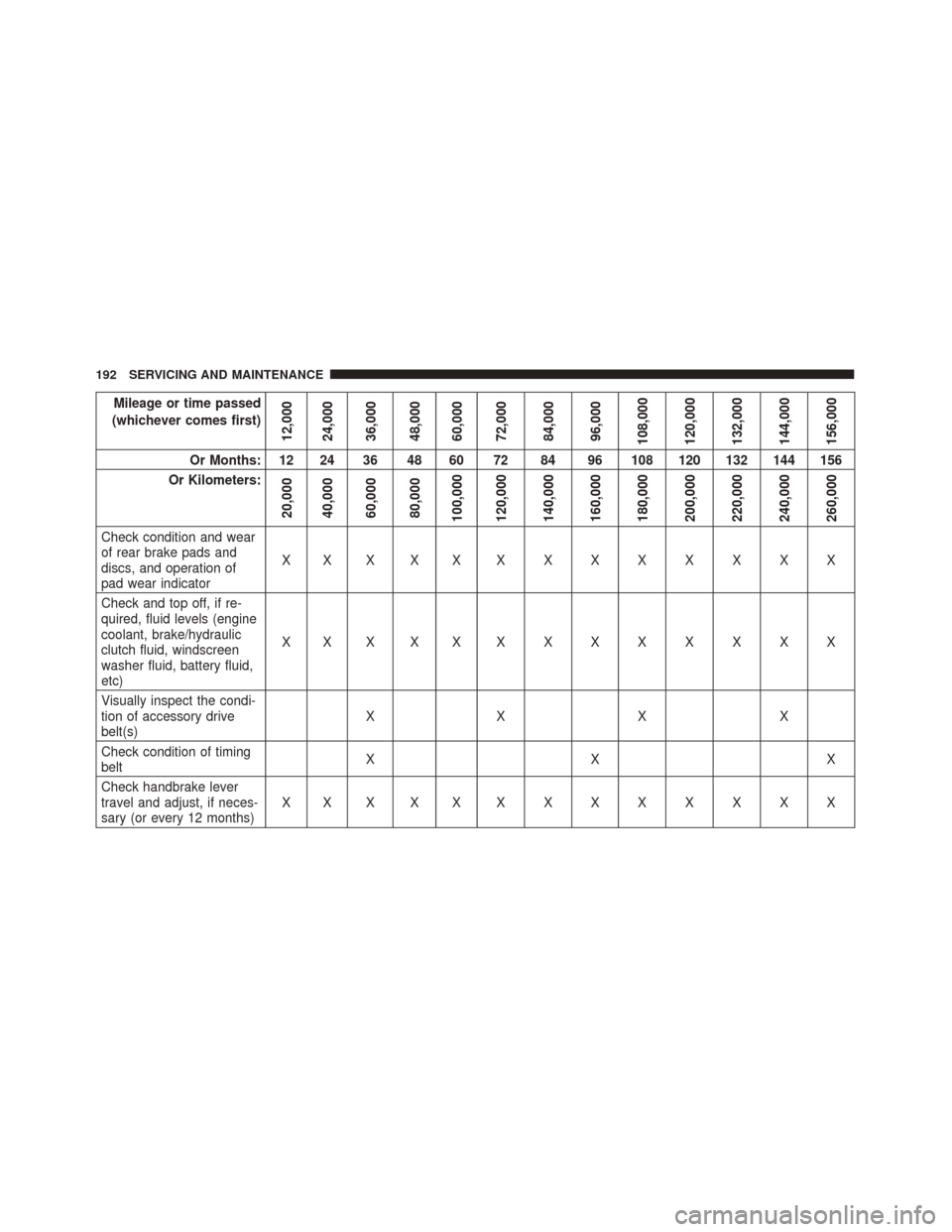
Mileage or time passed
(whichever comes first)
12,000
24,000
36,000
48,000
60,000
72,000
84,000
96,000
108,000
120,000
132,000
144,000
156,000
Or Months: 12 24 36 48 60 72 84 96 108 120 132 144 156
Or Kilometers:
20,000
40,000
60,000
80,000
100,000
120,000
140,000
160,000
180,000
200,000
220,000
240,000
260,000
Check condition and wear
of rear brake pads and
discs, and operation of
pad wear indicator XXXXXXXXXXXXX
Check and top off, if re-
quired, fluid levels (engine
coolant, brake/hydraulic
clutch fluid, windscreen
washer fluid, battery fluid,
etc) XXXXXXXXXXXXX
Visually inspect the condi-
tion of accessory drive
belt(s) XX X X
Check condition of timing
belt XX X
Check handbrake lever
travel and adjust, if neces-
sary (or every 12 months) XXXXXXXXXXXXX
192 SERVICING AND MAINTENANCE
Page 195 of 279
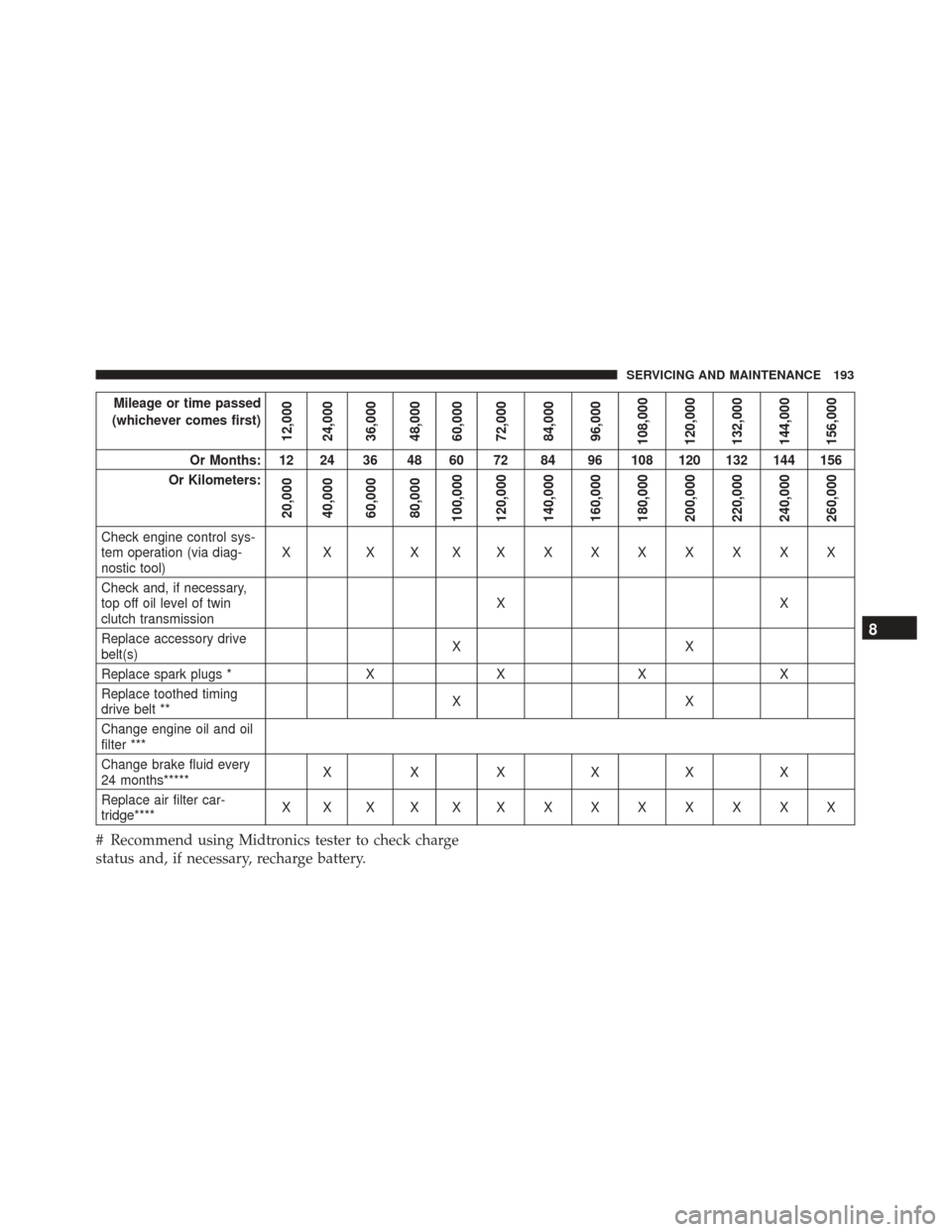
Mileage or time passed
(whichever comes first)
12,000
24,000
36,000
48,000
60,000
72,000
84,000
96,000
108,000
120,000
132,000
144,000
156,000
Or Months: 12 24 36 48 60 72 84 96 108 120 132 144 156
Or Kilometers:
20,000
40,000
60,000
80,000
100,000
120,000
140,000
160,000
180,000
200,000
220,000
240,000
260,000
Check engine control sys-
tem operation (via diag-
nostic tool) XXXXXXXXXXXXX
Check and, if necessary,
top off oil level of twin
clutch transmission XX
Replace accessory drive
belt(s) XX
Replace spark plugs * X X X X
Replace toothed timing
drive belt ** XX
Change engine oil and oil
filter ***
Change brake fluid every
24 months***** XXX X X X
Replace air filter car-
tridge**** XXXXXXXXXXXXX
# Recommend using Midtronics tester to check charge
status and, if necessary, recharge battery.
8
SERVICING AND MAINTENANCE 193
Page 196 of 279
* The spark plug change interval is mileage based only,
yearly intervals do not apply. The following are essen-
tial to ensure correct operation and prevent serious
damage to the engine:
•Only use spark plugs of the same make and type
which are specially certified for such engines (refer to
“Fluids And Lubricants” in “Technical Specifica-
tions” for further information).
• Strictly comply with the spark plug replacement
interval given in the maintenance plan for spark plug
replacement.
• Contact your Alfa Romeo Dealer if you have ques-
tions.
** Regardless of the distance covered, the timing belt
must be changed every four years for particularly
demanding use (cold climates, city driving, long peri-
ods of idling) or at least every five years.
*** The actual interval for changing the oil and replac-
ing the engine oil filter depends on the vehicle usage
conditions and is signalled by the warning light or
message (if present) on the instrument panel or every 12
months. **** If the vehicle is operated in a dusty or dirty
environment the engine air filter has to be changed
every 6,500 miles (10,000 km).
***** DOT 4 brake fluid must be changed every two
years regardless of mileage.
WARNING!
•
You can be badly injured working on or around a
motor vehicle. Do only service work for which
you have the knowledge and the right equipment.
If you have any doubt about your ability to
perform a service job, take your vehicle to a
competent mechanic.
• Failure to properly inspect and maintain your
vehicle could result in a component malfunction
and effect vehicle handling and performance.
This could cause an accident.
194 SERVICING AND MAINTENANCE
Page 197 of 279
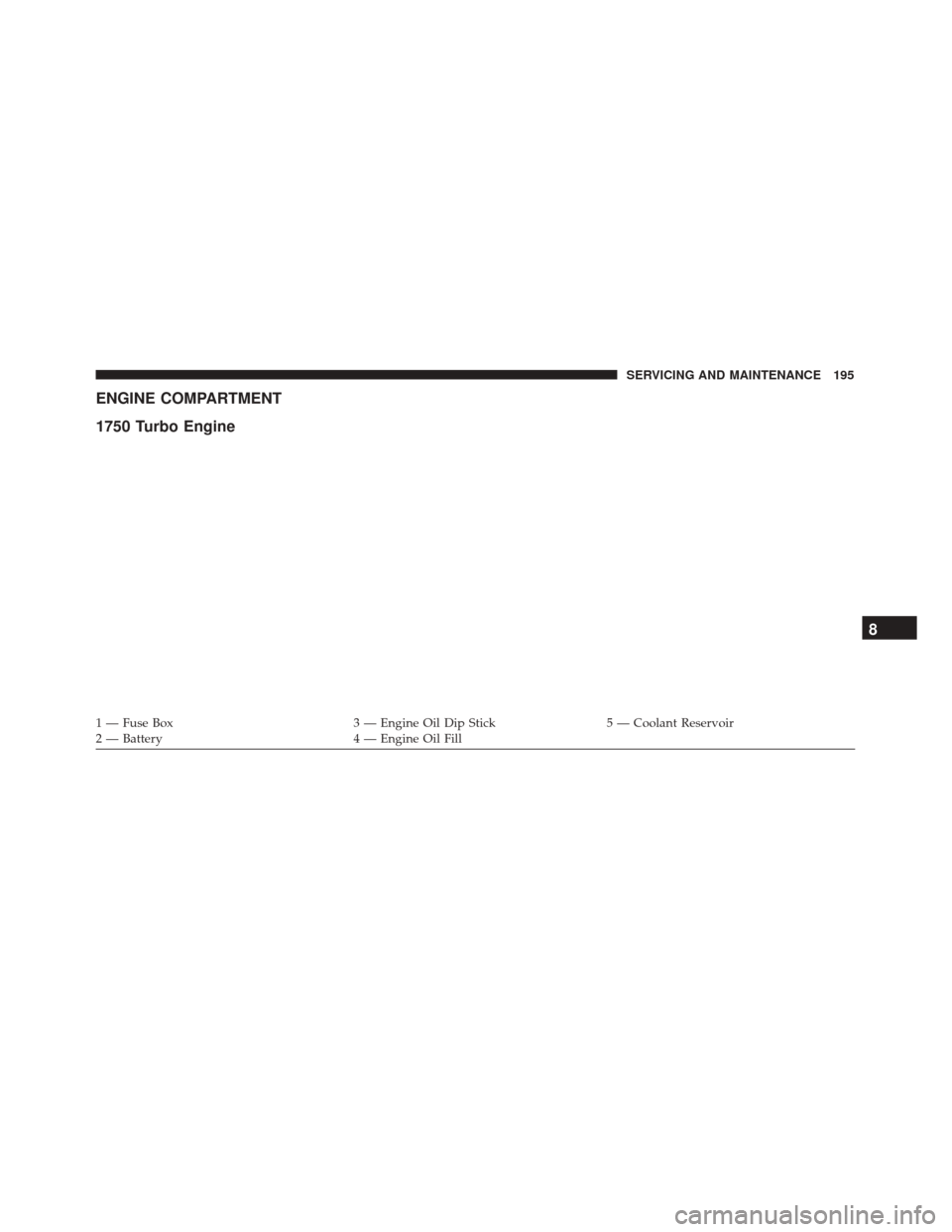
ENGINE COMPARTMENT
1750 Turbo Engine
1 — Fuse Box3 — Engine Oil Dip Stick5 — Coolant Reservoir
2 — Battery 4 — Engine Oil Fill
8
SERVICING AND MAINTENANCE 195
Page 198 of 279
Checking Oil Level
To assure proper engine lubrication, the engine oil must
be maintained at the correct level. Check the oil level at
regular intervals. The best time to check the engine oil
level is before starting the engine after it has sat
overnight.
Do not check oil level when the engine is warm.
Checking engine oil level when the engine is warm will
give you an incorrect reading.
Checking the oil while the vehicle is on level ground, and
has sat overnight, will improve the accuracy of the oil
level readings. Maintain the oil level between the range
markings on the dipstick. The safe range is indicated by a
crosshatch zone. Adding 1 quart of oil when the reading
is at the low end of the indicated range will result in the
oil level at the full end of the indicator range.
CAUTION!
Do not overfill the engine with oil. Overfilling the
engine with oil will cause oil aeration, which can
lead to loss of oil pressure and an increase in oil
temperature. This loss of oil pressure and increased
oil temperature could damage your engine.
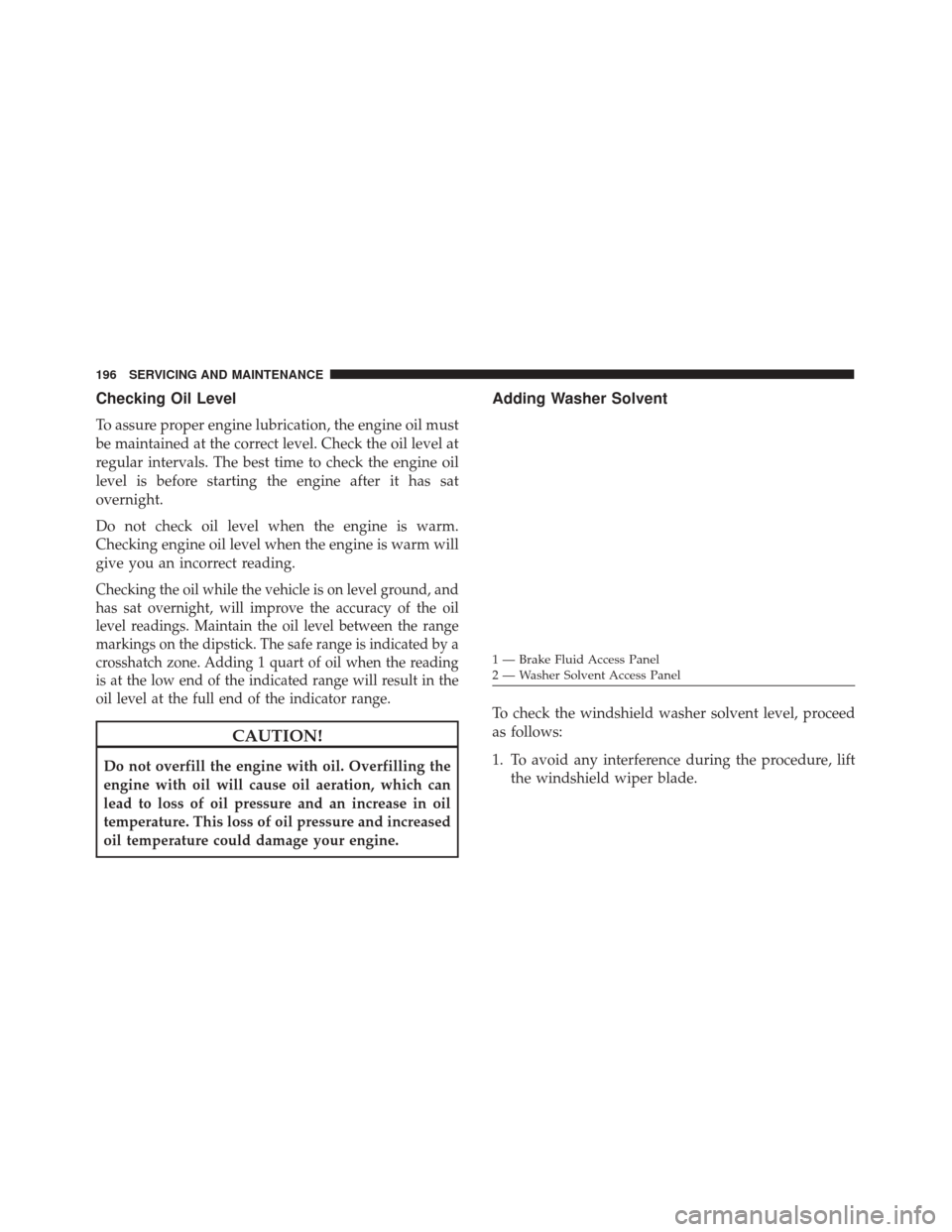
Adding Washer Solvent
To check the windshield washer solvent level, proceed
as follows:
1. To avoid any interference during the procedure, liftthe windshield wiper blade.
1 — Brake Fluid Access Panel
2 — Washer Solvent Access Panel
196 SERVICING AND MAINTENANCE
Page 199 of 279
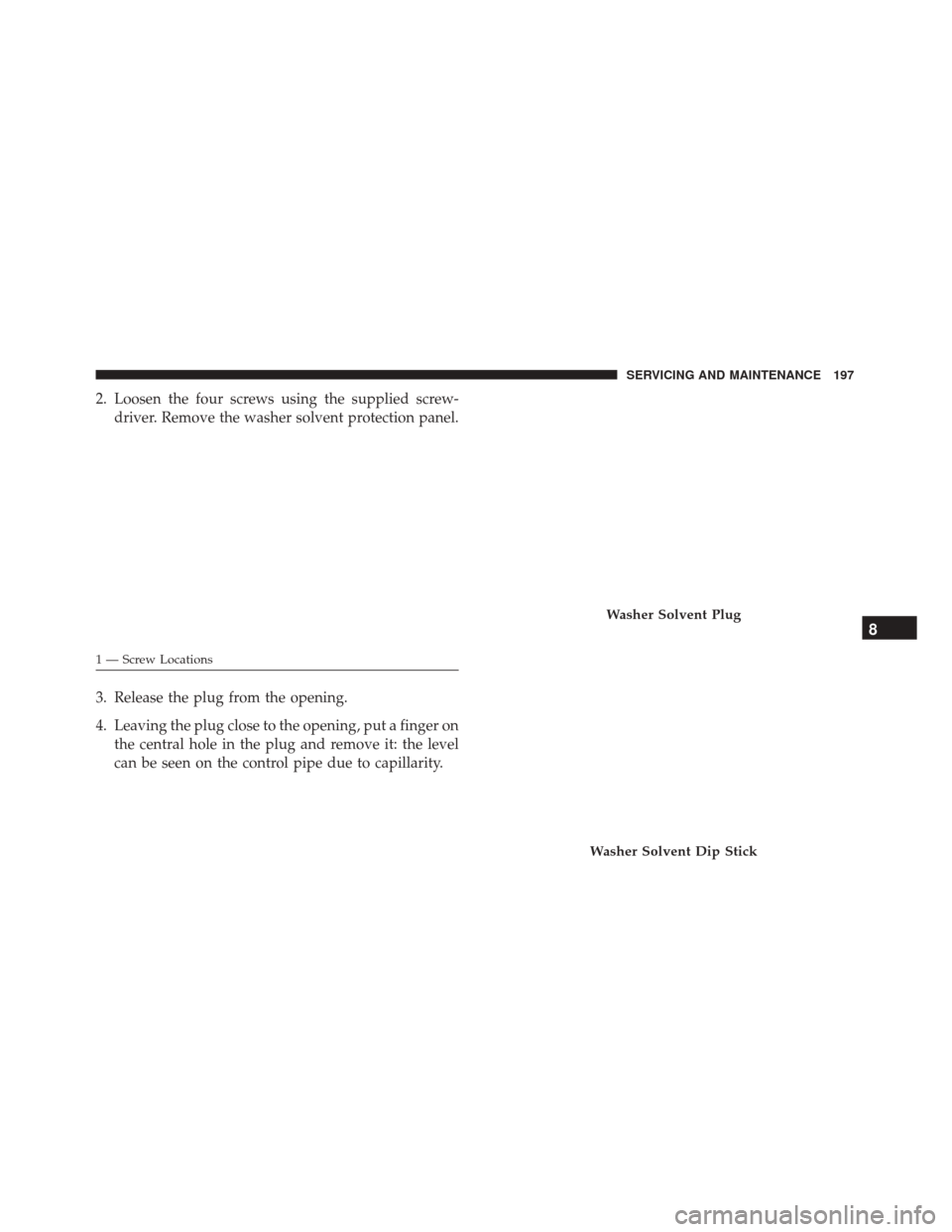
2. Loosen the four screws using the supplied screw-driver. Remove the washer solvent protection panel.
3. Release the plug from the opening.
4. Leaving the plug close to the opening, put a finger on the central hole in the plug and remove it: the level
can be seen on the control pipe due to capillarity.
1 — Screw Locations
Washer Solvent Plug
Washer Solvent Dip Stick
8
SERVICING AND MAINTENANCE 197
Page 200 of 279
5. After the check, reinsert the plug with the controlpipe in the initial position.
6. Reposition the washer solvent protection panel and tighten the four self-tapping screws.
If the level is not sufficient, namely if there is no washer
solvent inside the pipe, proceed as follows:
1. To avoid any interference during the procedure, lift the windshield wiper blade.
2. Loosen the four screws using the supplied screw- driver. Remove the washer solvent protection panel.
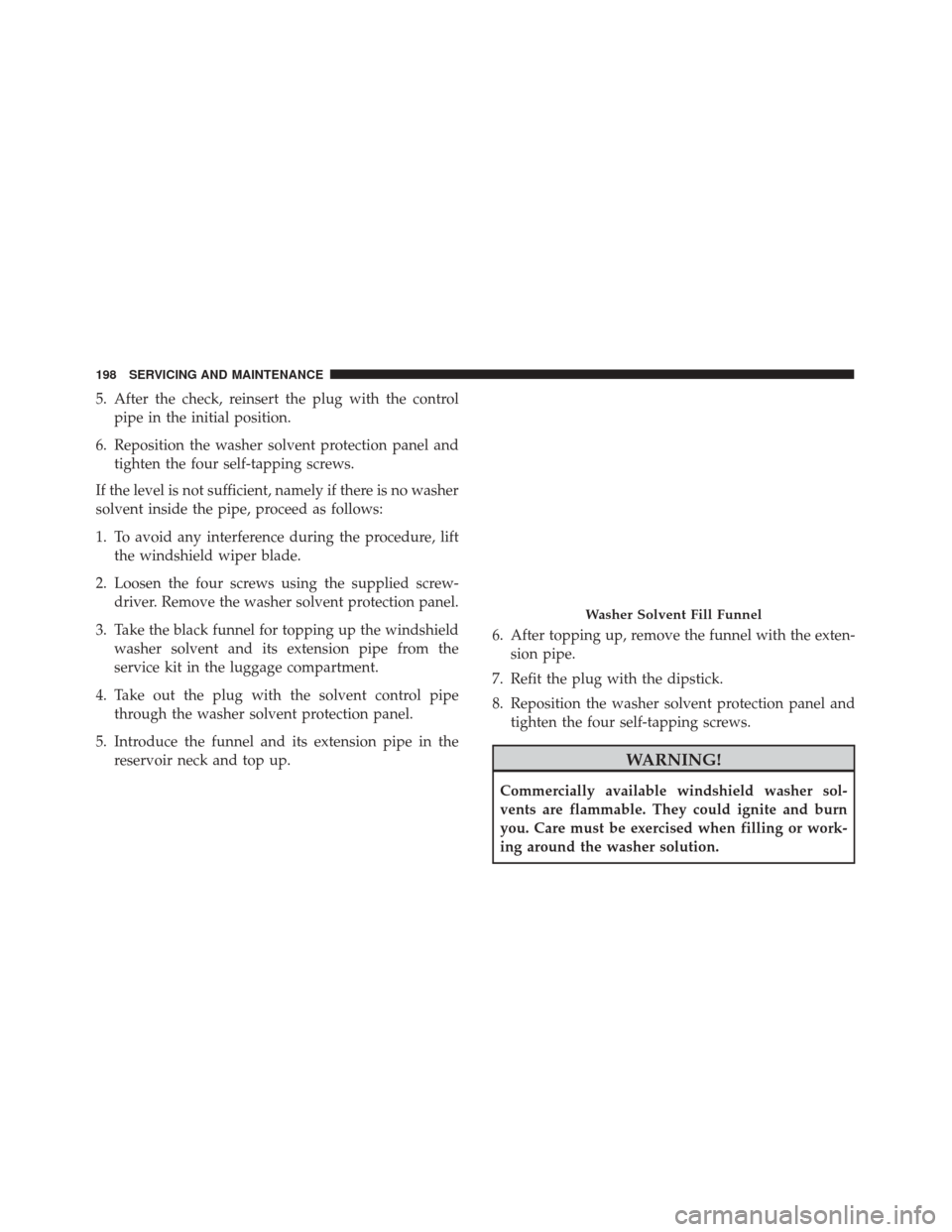
3. Take the black funnel for topping up the windshield washer solvent and its extension pipe from the
service kit in the luggage compartment.
4. Take out the plug with the solvent control pipe through the washer solvent protection panel.
5. Introduce the funnel and its extension pipe in the reservoir neck and top up. 6. After topping up, remove the funnel with the exten-
sion pipe.
7. Refit the plug with the dipstick.
8. Reposition the washer solvent protection panel and tighten the four self-tapping screws.
WARNING!
Commercially available windshield washer sol-
vents are flammable. They could ignite and burn
you. Care must be exercised when filling or work-
ing around the washer solution.
Washer Solvent Fill Funnel
198 SERVICING AND MAINTENANCE
Page 201 of 279
Maintenance-Free Battery
Your vehicle is equipped with a maintenance-free bat-
tery. You will never have to add water, nor is periodic
maintenance required.
WARNING!
•Battery fluid is a corrosive acid solution and can
burn or even blind you. Do not allow battery
fluid to contact your eyes, skin, or clothing. Do
not lean over a battery when attaching clamps. If
acid splashes in eyes or on skin, flush the area
immediately with large amounts of water. Refer
to “Jump Starting Procedure” in “In Case Of
Emergency” for further information.
• Battery gas is flammable and explosive. Keep
flame or sparks away from the battery. Do not use
a booster battery or any other booster source with
an output greater than 12 Volts. Do not allow
cable clamps to touch each other.
• Battery posts, terminals, and related accessories
contain lead and lead compounds. Wash hands
after handling.
(Continued)
WARNING! (Continued)
•The battery in this vehicle has a vent hose that
should not be disconnected and should only be
replaced with a battery of the same type (vented).
CAUTION!
• It is essential when replacing the cables on the
battery that the positive cable is attached to the
positive post and the negative cable is attached to
the negative post. Battery posts are marked posi-
tive (+) and negative (-) and are identified on the
battery case. Cable clamps should be tight on the
terminal posts and free of corrosion.
• If a “fast charger” is used while the battery is in
the vehicle, disconnect both vehicle battery cables
before connecting the charger to the battery. Do
not use a “fast charger” to provide starting volt-
age.
8
SERVICING AND MAINTENANCE 199
Page 202 of 279
DEALER SERVICE
The pages that follow contain therequiredmaintenance
services determined by the engineers who designed
your vehicle.
Besides those maintenance items specified in the fixed
maintenance schedule, there are other components
which may require servicing or replacement in the
future.
CAUTION!
• Failure to properly maintain your vehicle or per-
form repairs and service when necessary could
result in more costly repairs, damage to other
components or negatively impact vehicle perfor-
mance. Immediately have potential malfunctions
examined by an authorized dealer or qualified
repair center.
• Your vehicle has been built with improved fluids
that protect the performance and durability of
your vehicle and also allow extended mainte-
nance intervals. Do not use chemical flushes in
these components as the chemicals can damage
(Continued)
CAUTION! (Continued)
your engine, transmission, or air conditioning.
Such damage is not covered by the New Vehicle
Limited Warranty. If a flush is needed because of
component malfunction, use only the specified
fluid for the flushing procedure.
Engine Oil
Change Engine Oil
The oil change indicator system will remind you that it
is time to take your vehicle in for scheduled mainte-
nance. Refer to the “Maintenance Plan” for further
information.
NOTE:The actual interval for changing the oil and
replacing the engine oil filter depends on the vehicle
usage conditions and is signalled by the warning light
or message (if present) on the instrument panel or every
12 months.
Engine Oil Selection
For best performance and maximum protection for
turbocharged engines under all types of operating
conditions, the manufacturer recommends synthetic
200 SERVICING AND MAINTENANCE
Page 203 of 279
engine oils that are API Certified and meet the require-
ments of FCA Material Standard MS-12991.
Engine Oil Viscosity — 1750 Turbo Engine (SAE
Grade)
SAE 5W-40 full synthetic engine oil is recommended for
all operating temperatures. This engine oil improves
low temperature starting and vehicle fuel economy.
Lubricants which do not have both the engine oil
certification mark and the correct SAE viscosity grade
number should not be used.
Materials Added To Engine Oil
The manufacturer strongly recommends against the
addition of any additives (other than leak detection
dyes) to the engine oil. Engine oil is an engineered
product and its performance may be impaired by
supplemental additives.
Disposing Of Used Engine Oil And Oil Filters
Care should be taken in disposing of used engine oil
and oil filters from your vehicle. Used oil and oil filters,
indiscriminately discarded, can present a problem to
the environment. Contact an authorized dealer, servicestation or governmental agency for advice on how and
where used oil and oil filters can be safely discarded in
your area.
Engine Oil Filter
The engine oil filter should be replaced with a new filter
at every engine oil change.
Engine Oil Filter Selection
This manufacturer’s engines have a full-flow type dis-
posable oil filter. Use a filter of this type for replace-
ment. The quality of replacement filters varies consid-
erably. Only high quality filters should be used to
assure most efficient service. Mopar engine oil filters are
high quality oil filters and are recommended.
Engine Air Cleaner Filter
Refer to the “Maintenance Plan” in this section for the
proper maintenance intervals.
NOTE:
Be sure to follow the “Severe Duty Conditions”
maintenance interval if applicable.
8
SERVICING AND MAINTENANCE 201