brakes Alfa Romeo 4C 2018 Owner's Manual
[x] Cancel search | Manufacturer: ALFA ROMEO, Model Year: 2018, Model line: 4C, Model: Alfa Romeo 4C 2018Pages: 279, PDF Size: 3.08 MB
Page 76 of 279
CAUTION!(Continued)
sensor to become inoperable. After using an after-
market tire sealant it is recommended that you take
your vehicle to your authorized dealer to have your
sensor function checked.
— Anti-Lock Brake (ABS) Warning Light
This light monitors the Anti-Lock Brake System (ABS).
The light will turn on when the ignition is placed in the
ON/RUN or MAR/ON/RUN position and may stay
on for as long as four seconds.
If the ABS light remains on or turns on while driving,
then the Anti-Lock portion of the brake system is not
functioning and service is required. However, the con-
ventional brake system will continue to operate nor-
mally if the brake warning light is not on.
If the ABS light is on, the brake system should be
serviced as soon as possible to restore the benefits of
Anti-Lock Brakes. If the ABS light does not turn on
when the ignition is placed in the ON/RUN or MAR/
ON/RUN position, have the light inspected by an
authorized dealer.
— Electronic Stability Control (ESC) Warning
Light — If Equipped
The “ESC Indicator Light” in the instrument cluster will
come on when the ignition is placed in the ON/RUN or
MAR/ON/RUN position, and when ESC is activated. It
should go out with the engine running. If the “ESC
Indicator Light” comes on continuously with the engine
running, a malfunction has been detected in the ESC
system. If this light remains on after several ignition
cycles, and the vehicle has been driven several miles
(kilometers) at speeds greater than 30 mph (48 km/h),
see your authorized dealer as soon as possible to have
the problem diagnosed and corrected.
• The “ESC Off Indicator Light” and the “ESC Indica-
tor Light” come on momentarily each time the igni-
tion is placed in the ON/RUN or MAR/ON/RUN
position.
• Each time the ignition is turned to ON/RUN or
MAR/ON/RUN, the ESC system will be on, even if
it was turned off previously.
• The ESC system will make buzzing or clicking
sounds when it is active. This is normal; the sounds
will stop when ESC becomes inactive.
74 GETTING TO KNOW YOUR INSTRUMENT PANEL
Page 84 of 279
SAFETY FEATURES
Four-Wheel Anti-Lock Brake System (ABS)
The Four-Wheel ABS is designed to aid the driver in
maintaining vehicle control under adverse braking con-
ditions. The system operates with a separate computer
to modulate hydraulic pressure, to prevent wheel
lock-up and to help avoid skidding on slippery sur-
faces.
The system’s pump motor runs during an ABS stop to
provide regulated hydraulic pressure. The pump motor
makes a low humming noise during operation, which is
normal.
The ABS includes an amber ABS Warning Light. When
the light is illuminated, the ABS is not functioning. The
system reverts to standard non-anti-lock brakes. Turn-
ing the ignition OFF and ON again may reset the ABS if
the fault detected was only momentary.
WARNING!
•When the ABS intervenes and you feel the brake
pedal pulsating, do not reduce the pressure, but
hold it down firmly and confidently; in doing so
(Continued)
WARNING! (Continued)
you will brake in the shortest distance possible,
depending on the current road conditions.
• For maximum efficiency of the braking system, a
bedding-in period of about 311 miles (500 km) is
required: during this period it is advisable to
avoid sharp, repeated and prolonged braking.
• If the ABS intervenes, this indicates that the grip
of the tires on the road is nearing its limit: you
must slow down to a speed compatible with the
available grip.
• The ABS can’t overrule the natural laws of phys-
ics, and can’t increase the grip available according
to the condition of the road.
• The ABS cannot prevent accidents, including
those due to excessive speed on corners, driving
on low-grip surfaces or aquaplaning.
• The capability of the ABS must never be tested
irresponsibly and dangerously, in such a way as
to compromise personal safety and the safety of
others.
(Continued)
82 SAFETY
Page 134 of 279
The parking brake lever is located in the central tunnel.
To apply the parking brake, pull the parking brake lever
up as firmly as possible. To release the parking brake,
pull the parking brake lever up slightly, push the center
button, then lower the parking brake lever completely.
When the parking brake is applied with the ignition
switch in the MAR (ACC/ON/RUN) position, the
Brake Warning Light in the instrument cluster display
will illuminate.
When parking on a hill, it is important to turn the front
wheels toward the curb on a downhill grade and away
from the curb on an uphill grade. The parking brakeshould always be applied whenever the driver is not in
the vehicle.
WARNING!
•
Never leave children alone in a vehicle, or with
access to an unlocked vehicle.
•
Allowing children to be in a vehicle unattended is
dangerous for a number of reasons. A child or others
could be seriously or fatally injured. Children
should be warned not to touch the parking brake,
brake pedal or the transmission gear selector.
• Do not leave the key fob in or near the vehicle or
in a location accessible to children. A child could
operate power windows, other controls, or move
the vehicle.
• Be sure the parking brake is fully disengaged
before driving; failure to do so can lead to brake
failure and a collision.
• Always fully apply the parking brake when leav-
ing your vehicle, or it may roll and cause damage
or injury. Also be certain to leave a manual
transmission in REVERSE or FIRST gear. Failure
to do so may allow the vehicle to roll and cause
damage or injury.
Parking Brake Lever
132 STARTING AND OPERATING
Page 140 of 279
General Notes
When the vehicle is stopped and in gear, always keep
the brake pedal pressed until you decide to set off, then
release the brake and accelerate gradually.
During prolonged stops with the engine running, it is
advisable to keep the transmission in NEUTRAL (N).
When stopped on an incline, always hold the vehicle in
place using the brakes. On steep inclines, Hill Start
Assist (HSA) will temporarily hold the vehicle in posi-
tion when the brake pedal is released. If the accelerator
pedal is not applied after a short time, the vehicle will
roll back. Either reapply the brake (to hold the vehicle)
or press the accelerator to climb the hill.
Only shift between FIRST (1) and REVERSE (R) when
completely stopped, with the brake pedal pressed.
When necessary, it is possible to engage FIRST (1),
REVERSE (R) or NEUTRAL (N) with the engine off, the
key at MAR-ON and the brake pressed. In this case,
wait at least five seconds between one gear change and
the next, in order to safeguard the operation of the
hydraulic system, and the pump in particular.For uphill departures, accelerate gradually but fully,
immediately after releasing the parking brake or the
brake pedal; this allows the engine speed to increase to
provide more torque at the wheels.
ALFA DNA SYSTEM (DYNAMIC VEHICLE
CONTROL SYSTEM)
This vehicle is equipped with a “Alfa DNA” system
lever (located on the center console). There are four
modes of operation to be selected according to driving
style and road conditions:
•
Dynamic (This mode alters the transmission’s auto-
matic shift schedule for sportier driving [D]).
• Natural (mode for driving in normal conditions [N]).
• All Weather (mode for driving in poor grip condi-
tions, such as rain and snow [A]).
• Race (sports driving mode [D]).
138 STARTING AND OPERATING
Page 155 of 279
•Replace tires when tread wear indicators first become
visible.
• Keep tires properly inflated.
• Maintain sufficient distance between your vehicle
and the vehicle in front of you to avoid a collision in
a sudden stop.
Your vehicle may be equipped with a Limited Slip
Differential (LSD) that reduces, but does not eliminate,
the amount of wheel slip across a given axle for
improved handling.
Driving Through Water
Driving through water more than a few inches/
centimeters deep will require extra caution to ensure
safety and prevent damage to your vehicle.
Flowing/Rising Water
WARNING!
Do not drive on or across a road or path where water
is flowing and/or rising (as in storm run-off). Flowing
water can wear away the road or path’s surface and
(Continued)
WARNING! (Continued)
cause your vehicle to sink into deeper water. Further-
more, flowing and/or rising water can carry your
vehicle away swiftly. Failure to follow this warning
may result in injuries that are serious or fatal to you,
your passengers, and others around you.
Shallow Standing Water
Although your vehicle is capable of driving through
shallow standing water, consider the following Cau-
tions and Warnings before doing so.
WARNING!
•Driving through standing water limits your vehi-
cle’s traction capabilities. Do not exceed 5 mph
(8 km/h) when driving through standing water.
• Driving through standing water limits your vehi-
cle’s braking capabilities, which increases stop-
ping distances. Therefore, after driving through
standing water, drive slowly and lightly press on
the brake pedal several times to dry the brakes.
(Continued)
6
STARTING AND OPERATING 153
Page 190 of 279
•Check cleanliness of tailgate locks.
• Check cleanliness and lubrication of chassis and
steering linkage.
• Visually inspect condition of: engine, gearbox, trans-
mission, pipes and hoses (exhaust - fuel system -
brakes) and rubber elements (gaiters - sleeves -
bushes - etc.).
• Check battery charge and battery fluid level (electro-
lyte).
• Visually inspect condition of the auxiliary drive belts.
• Check and, if necessary, change engine oil and re-
place oil filter.
• Check and, if necessary, replace air cleaner filter.
Using the vehicle on a track should be regarded as an
exception. The vehicle has been designed and manufac-
tured for road use.
Change engine oil at 4,000 miles (6,500 km) if the
vehicle is operated in a dusty and off road environment.
This type of vehicle use is considered Severe Duty. If the vehicle is operated in a dusty or dirty environ-
ment the engine air filter has to be changed every 6,500
miles (10,000 km).
Once A Month Or Before A Long Trip/Periodic
Checks
Every 600 miles (1,000 km) or before long trips, check
and, if necessary, top off the following:
•
Check engine oil level.
• Check brake fluid level.
• Check windshield washer fluid level.
• Check the tire inflation pressures and look for un-
usual wear or damage.
• Check the fluid levels of the coolant reservoir and
brake master cylinder reservoir, and add as needed
• Check function of all interior and exterior lights.
Every 2,000 miles (3,000 km) check and, if necessary, top
up: engine oil level.
188 SERVICING AND MAINTENANCE
Page 193 of 279
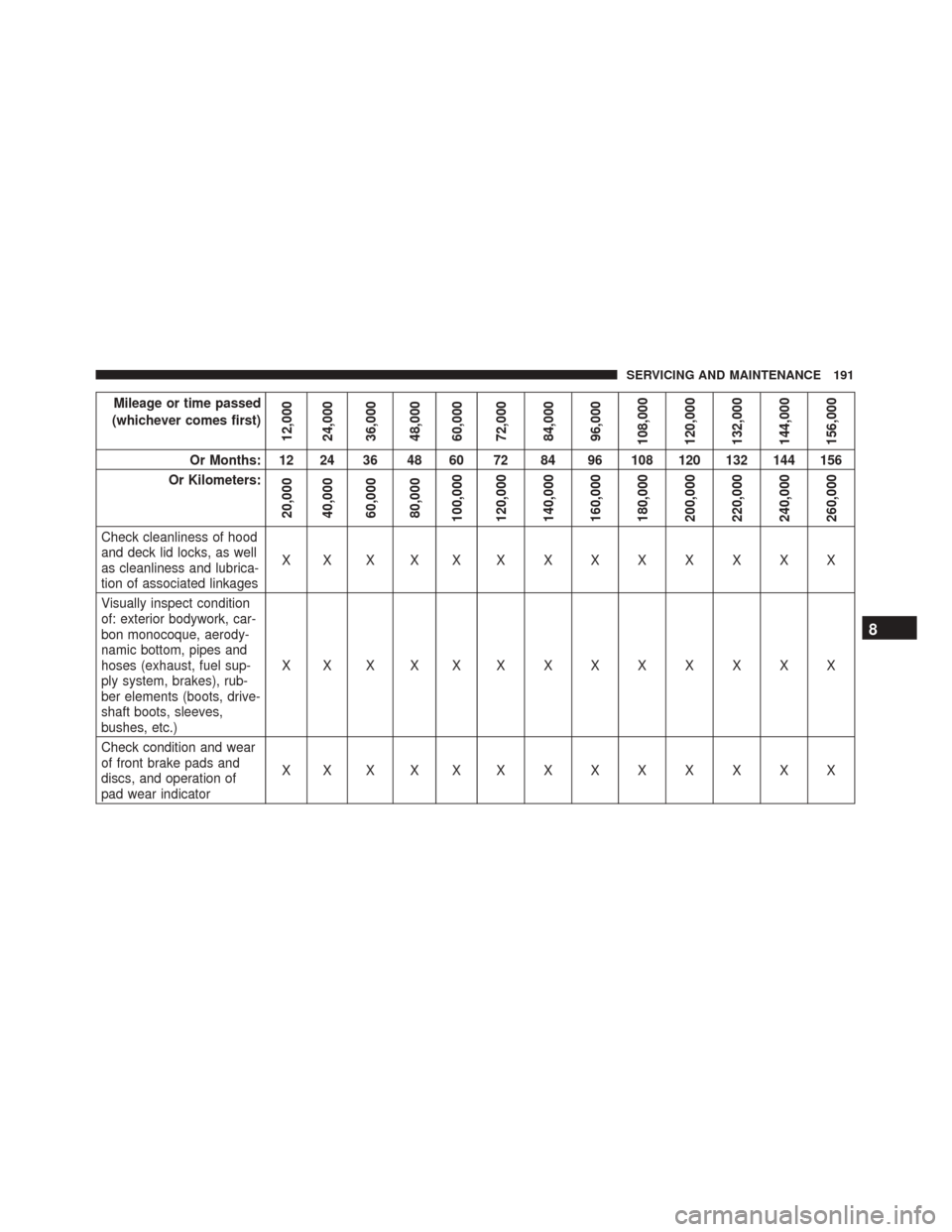
Mileage or time passed
(whichever comes first)
12,000
24,000
36,000
48,000
60,000
72,000
84,000
96,000
108,000
120,000
132,000
144,000
156,000
Or Months: 12 24 36 48 60 72 84 96 108 120 132 144 156
Or Kilometers:
20,000
40,000
60,000
80,000
100,000
120,000
140,000
160,000
180,000
200,000
220,000
240,000
260,000
Check cleanliness of hood
and deck lid locks, as well
as cleanliness and lubrica-
tion of associated linkages XXXXXXXXXXXXX
Visually inspect condition
of: exterior bodywork, car-
bon monocoque, aerody-
namic bottom, pipes and
hoses (exhaust, fuel sup-
ply system, brakes), rub-
ber elements (boots, drive-
shaft boots, sleeves,
bushes, etc.) XXXXXXXXXXXXX
Check condition and wear
of front brake pads and
discs, and operation of
pad wear indicator XXXXXXXXXXXXX
8
SERVICING AND MAINTENANCE 191
Page 214 of 279
•If frequent engine coolant (antifreeze) additions are
required, the cooling system should be pressure
tested for leaks.
• Maintain engine coolant (antifreeze) concentration at
a minimum of 50% OAT coolant (conforming to
MS.90032) and distilled water for proper corrosion
protection of your engine which contains aluminum
components.
• Make sure that the coolant expansion bottle overflow
hoses are not kinked or obstructed.
• Keep the front of the radiator clean. If your vehicle is
equipped with air conditioning, keep the front of the
condenser clean.
• Do not change the thermostat for Summer or Winter
operation. If replacement is ever necessary, install
ONLY the correct type thermostat. Other designs
may result in unsatisfactory engine coolant (anti-
freeze) performance, poor gas mileage, and increased
emissions.
Brake System
In order to assure brake system performance, all brake
system components should be inspected periodically. Refer to the “Maintenance Plan” in this section for the
proper maintenance intervals.
WARNING!
Riding the brakes can lead to brake failure and
possibly a collision. Driving with your foot resting
or riding on the brake pedal can result in abnor-
mally high brake temperatures, excessive lining
wear, and possible brake damage. You would not
have your full braking capacity in an emergency.
Brake Master Cylinder
The fluid level in the master cylinder should be checked
when performing under hood services, or immediately
if the “Brake Warning Light” is on.
Be sure to clean the top of the master cylinder area
before removing the cap. If necessary, add fluid to bring
the fluid level up to the requirements described on the
brake fluid reservoir. Fluid level can be expected to fall
as the brake pads wear. The brake fluid level should be
checked when the pads are replaced. However, low
fluid level may be caused by a leak and a checkup may
be needed.
212 SERVICING AND MAINTENANCE
Page 239 of 279
CAUTION!(Continued)
Limited Warranty. Only car wash soap, Mopar
Wheel Cleaner or equivalent is recommended.
NOTE: If you intend parking or storing your vehicle for
an extended period after cleaning the wheels with
wheel cleaner, drive your vehicle and apply the brakes
to remove the water droplets from the brake compo-
nents. This activity will remove the red rust on the
brake rotors and prevent vehicle vibration when brak-
ing.
Dark Vapor Chrome, Black Satin Chrome, or Low
Gloss Clear Coat Wheels
CAUTION!
If your vehicle is equipped with these specialty
wheels, DO NOT USE wheel cleaners, abrasives, or
polishing compounds. They will permanently dam-
age this finish and such damage is not covered by
the New Vehicle Limited Warranty. HAND WASH
ONLY USING MILD SOAP AND WATER WITH A
SOFT CLOTH. Used on a regular basis; this is all
that is required to maintain this finish.
Tire Chains (Traction Devices)
Use of traction devices require sufficient tire-to-body
clearance. Follow these recommendations to guard
against damage.
• Traction device must be of proper size for the tire, as
recommended by the traction device manufacturer.
• Install on Rear Tires Only.
• Reduced size snow chains with a maximum projec-
tion of 7 mm beyond the tire profile can be fitted on
vehicles equipped with 235/40 R18 rear tire.
CAUTION!
To avoid damage to your vehicle or tires, observe
the following precautions:
•
Because of restricted traction device clearance be-
tween tires and other suspension components, it is
important that only traction devices in good condi-
tion are used. Broken devices can cause serious
damage. Stop the vehicle immediately if noise
occurs that could indicate device breakage. Remove
the damaged parts of the device before further
use.
(Continued)
8
SERVICING AND MAINTENANCE 237
Page 250 of 279
BRAKE SYSTEM
Your vehicle is equipped with dual hydraulic brake
systems. If either of the two hydraulic systems loses
normal capability, the remaining system will still func-
tion. However, there will be some loss of overall brak-
ing effectiveness. You may notice increased pedal travel
during application, greater pedal force required to slow
or stop, and potential activation of the “Brake System
Warning Light”.
In the event power assist is lost for any reason (i.e.,
repeated brake applications with the engine off), the
brakes will still function. However, the effort required
to brake the vehicle will be much greater than that
required with the power system operating.
FUEL REQUIREMENTS — 1750 TURBO
The 1750 turbo engine is designed to
meet all emissions regulations and pro-
vide excellent fuel economy and perfor-
mance when using high-quality premium
unleaded gasoline with an octane rating
of only 91 or higher. Light spark knock at low engine speeds is not harmful
to your engine. However, continued heavy spark knock
at high speeds can cause damage and immediate ser-
vice is required.
Poor quality gasoline can cause problems such as hard
starting, stalling and hesitations. If you experience these
symptoms, try another brand of gasoline (with the
appropriate octane rating for your engine) before con-
sidering service for the vehicle.
Reformulated Gasoline
Many areas of the country require the use of cleaner
burning gasoline referred to as “Reformulated Gaso-
line”. Reformulated gasoline contains oxygenates and
are specifically blended to reduce vehicle emissions and
improve air quality.
The use of reformulated gasoline is recommended.
Properly blended reformulated gasoline will provide
improved performance and durability of engine and
fuel system components.
Materials Added To Fuel
Besides using unleaded gasoline with the proper octane
rating, gasolines that contain detergents, corrosion and
stability additives are recommended. Using gasolines
248 TECHNICAL SPECIFICATIONS