cooling Alfa Romeo 4C Spider 2017 User Guide
[x] Cancel search | Manufacturer: ALFA ROMEO, Model Year: 2017, Model line: 4C Spider, Model: Alfa Romeo 4C Spider 2017Pages: 297, PDF Size: 2.84 MB
Page 236 of 297
NOTE:
•It is the owner’s responsibility to maintain the proper
level of protection against freezing according to the
temperatures occurring in the area where the vehicle
is operated.
• Some vehicles require special tools to add coolant
properly. Failure to fill these systems properly could
lead to severe internal engine damage. If any coolant
is needed to be added to the system, please contact
your local authorized dealer.
• Mixing engine coolant (antifreeze) types is not rec-
ommended and can result in cooling system damage.
If HOAT and OAT coolant are mixed in an emer-
gency, have a authorized dealer drain, flush, and
refill with OAT coolant (conforming to MS.90032) as
soon as possible.
Cooling System Pressure Cap
The cap must be fully tightened to prevent loss of
engine coolant (antifreeze) and to ensure that engine
coolant (antifreeze) will return to the radiator from the
coolant recovery tank. The cap should be inspected and cleaned if there is any
accumulation of foreign material on the sealing sur-
faces.
WARNING!
•
Do not open hot engine cooling system. Never
add engine coolant (antifreeze) when the engine
is overheated. Do not loosen or remove the cap to
cool an overheated engine. Heat causes pressure
to build up in the cooling system. To prevent
scalding or injury, do not remove the pressure cap
while the system is hot or under pressure.
• Do not use a pressure cap other than the one
specified for your vehicle. Personal injury or
engine damage may result.
Disposal Of Used Engine Coolant
Used ethylene glycol-based engine coolant (antifreeze)
is a regulated substance requiring proper disposal.
Check with your local authorities to determine the
disposal rules for your community. To prevent ingestion
by animals or children, do not store ethylene glycol-
based engine coolant in open containers or allow it to
234 MAINTAINING YOUR VEHICLE
Page 237 of 297
remain in puddles on the ground. If ingested by a child
or pet, seek emergency assistance immediately. Clean
up any ground spills immediately.
Coolant Level
The coolant expansion bottle provides a quick visual
method for determining that the coolant level is ad-
equate. With the engine off and cold, the level of the
engine coolant (antifreeze) in the bottle should be
between the “MIN” and “MAX” marks.
As long as the engine operating temperature is satisfac-
tory, the coolant bottle need only be checked once a
month.
When additional engine coolant (antifreeze) is needed
to maintain the proper level, it should be added to the
coolant bottle. Do not overfill.
Points To Remember
NOTE:When the vehicle is stopped after a few miles/
kilometers of operation, you may observe vapor coming
from the front of the engine compartment. This is
normally a result of moisture from rain, snow, or high
humidity accumulating on the radiator and being va-
porized when the thermostat opens, allowing hot en-
gine coolant (antifreeze) to enter the radiator. If an examination of your engine compartment shows
no evidence of radiator or hose leaks, the vehicle may
be safely driven. The vapor will soon dissipate.
•
Do not overfill the coolant expansion bottle.
• Check the coolant freeze point in the radiator and in
the coolant expansion bottle. If engine coolant (anti-
freeze) needs to be added, the contents of the coolant
expansion bottle must also be protected against freez-
ing.
• If frequent engine coolant (antifreeze) additions are
required, the cooling system should be pressure
tested for leaks.
• Maintain engine coolant (antifreeze) concentration at
a minimum of 50% OAT coolant (conforming to
MS.90032) and distilled water for proper corrosion
protection of your engine which contains aluminum
components.
• Keep the front of the radiator clean. If your vehicle is
equipped with air conditioning, keep the front of the
condenser clean.
• Do not change the thermostat for Summer or Winter
operation. If replacement is ever necessary, install
ONLY the correct type thermostat. Other designs
7
MAINTAINING YOUR VEHICLE 235
Page 265 of 297
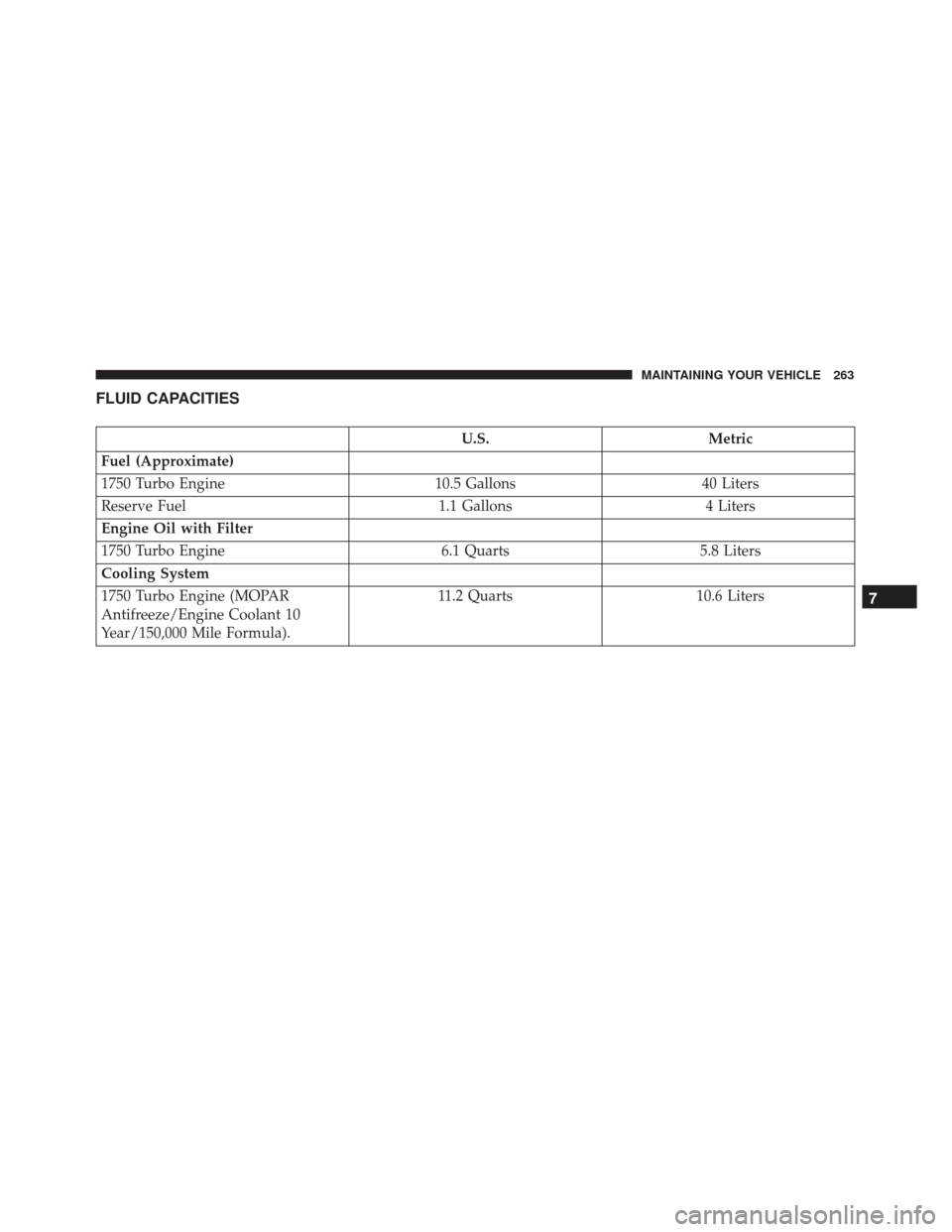
FLUID CAPACITIES
U.S.Metric
Fuel (Approximate)
1750 Turbo Engine 10.5 Gallons40 Liters
Reserve Fuel 1.1 Gallons4 Liters
Engine Oil with Filter
1750 Turbo Engine 6.1 Quarts5.8 Liters
Cooling System
1750 Turbo Engine (MOPAR
Antifreeze/Engine Coolant 10
Year/150,000 Mile Formula). 11.2 Quarts
10.6 Liters
7
MAINTAINING YOUR VEHICLE 263
Page 272 of 297
•Check screen wash/wipe system and positioning/
wear of windshield.
Every 2,000 miles (3,000 km) check and, if necessary, top
up: engine oil level.
Maintenance Chart
Required Maintenance Intervals
Refer to the maintenance schedules on the following
page for the required maintenance intervals.
At Every Oil Change Interval As Indicated By Oil Change Indicator System:
Change oil and filter.
Inspect battery and clean and tighten terminals as required.
Inspect brake pads, shoes, rotors, drums, and hoses. Inspect engine cooling system protection and hoses. Check and adjust hand brake.Inspect exhaust system.
Inspect engine air cleaner filter if using in dusty or off-road conditions.
270 MAINTENANCE SCHEDULES
Page 287 of 297
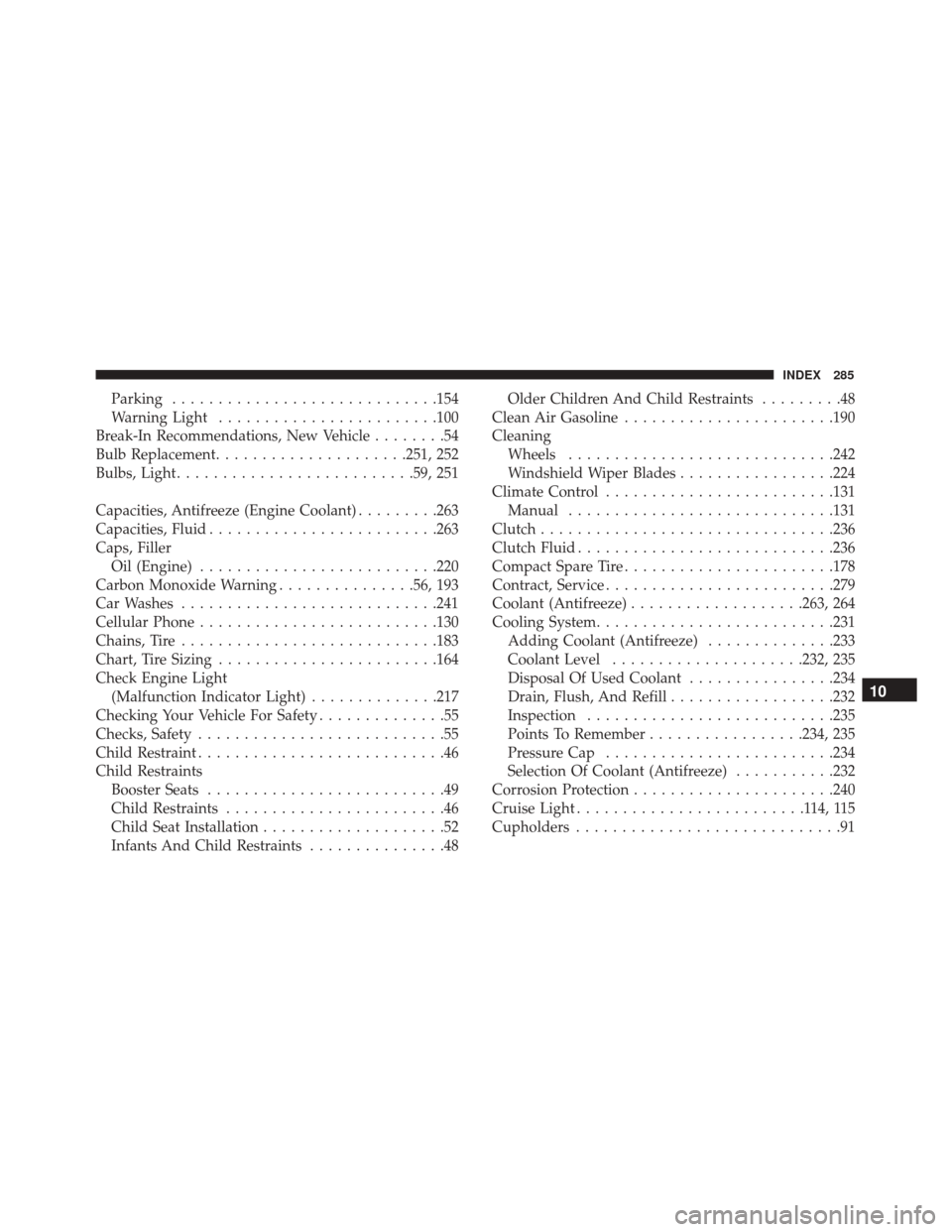
Parking............................ .154
Warning Light ........................100
Break-In Recommendations, New Vehicle ........54
Bulb Replacement .....................251, 252
Bulbs, Light ..........................59, 251
Capacities, Antifreeze (Engine Coolant) .........263
Capacities, Fluid ........................ .263
Caps, Filler Oil (Engine) ..........................220
Carbon Monoxide Warning ...............56, 193
Car Washes ............................241
Cellular Phone ..........................130
Chains, Tire ............................183
Chart, Tire Sizing ........................164
Check Engine Light (Malfunction Indicator Light) ..............217
Checking Your Vehicle For Safety ..............55
Checks, Safety ...........................55
Child Restraint ...........................46
Child Restraints Booster Seats ..........................49
Child Restraints ........................46
Child Seat Installation ....................52
Infants And Child Restraints ...............48Older Children And Child Restraints
.........48
Clean Air Gasoline .......................190
Cleaning Wheels ............................ .242
Windshield Wiper Blades .................224
Climate Control ........................ .131
Manual ............................ .131
Clutch ............................... .236
Clutch Fluid ............................236
Compact Spare Tire .......................178
Contract, Service ........................ .279
Coolant (Antifreeze) ...................263, 264
Cooling System ..........................231
Adding Coolant (Antifreeze) ..............233
Coolant Level .....................232, 235
Disposal Of Used Coolant ................234
Drain, Flush,
And Refill ..................232
Inspection .......................... .235
Points To Remember .................234, 235
Pressure Cap ........................ .234
Selection Of Coolant (Antifreeze) ...........232
Corrosion Protection ..................... .240
Cruise Light .........................114,115
Cupholders .............................9110
INDEX 285
Page 288 of 297
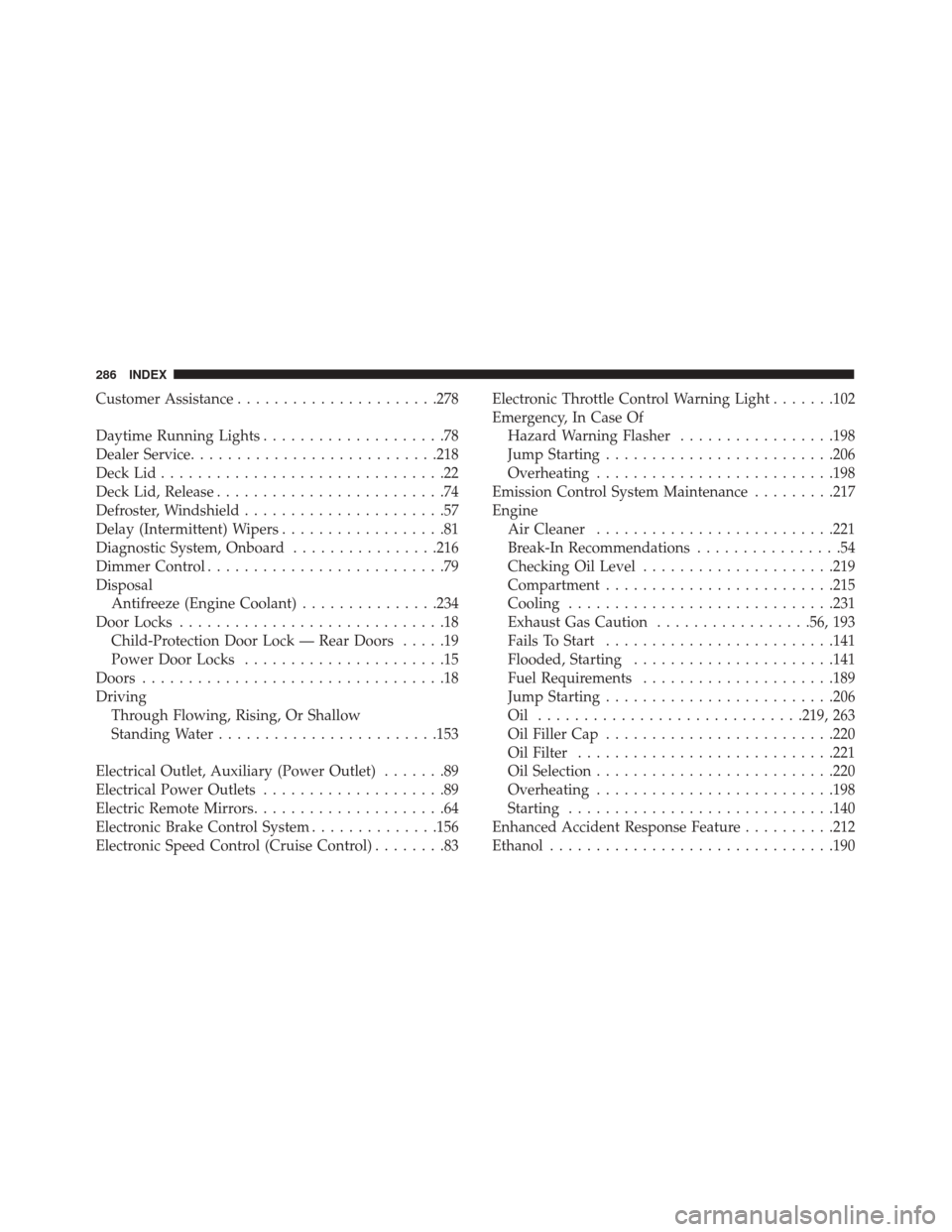
Customer Assistance..................... .278
Daytime Running Lights ....................78
Dealer Service .......................... .218
Deck Lid ...............................22
Deck Lid, Release .........................74
Defroster, Windshield ......................57
Delay (Intermittent) Wipers ..................81
Diagnostic System, Onboard ................216
Dimmer Control ..........................79
Disposal Antifreeze (Engine Coolant) ...............234
Door Locks .............................18
Child-Protection Door Lock — Rear Doors .....19
Power Door Locks ......................15
Doors .................................18
Driving Through Flowing, Rising, Or Shallow
Standing Water ........................153
Electrical Outlet, Auxiliary (Power Outlet) .......89
Electrical Power Outlets ....................89
Electric Remote Mirrors .....................64
Electronic Brake Control System ..............156
Electronic Speed Control (Cruise Control) ........83Electronic Throttle Control Warning Light
.......102
Emergency, In Case Of Hazard Warning Flasher .................198
Jump Starting ........................ .206
Overheating ..........................198
Emission Control System Maintenance .........217
Engine Air Cleaner ..........................221
Break-In Recommendations ................54
Checking Oil Level .....................219
Compartment ........................ .215
Cooling ............................ .231
Exhaust Gas Caution .................56, 193
Fails To Start ........................ .141
Flooded, Starting ..................... .141
Fuel Requirements .....................189
Jump Starting ........................ .206
Oil .............................219, 263
Oil Filler Cap ........................ .220
Oil Filter ............................221
Oil Selection ..........................220
Over
heating ..........................198
Starting ............................ .140
Enhanced Accident Response Feature ..........212
Ethanol ...............................190
286 INDEX