check engine Alfa Romeo 4C Spider 2018 Owner's Guide
[x] Cancel search | Manufacturer: ALFA ROMEO, Model Year: 2018, Model line: 4C Spider, Model: Alfa Romeo 4C Spider 2018Pages: 294, PDF Size: 3.31 MB
Page 203 of 294
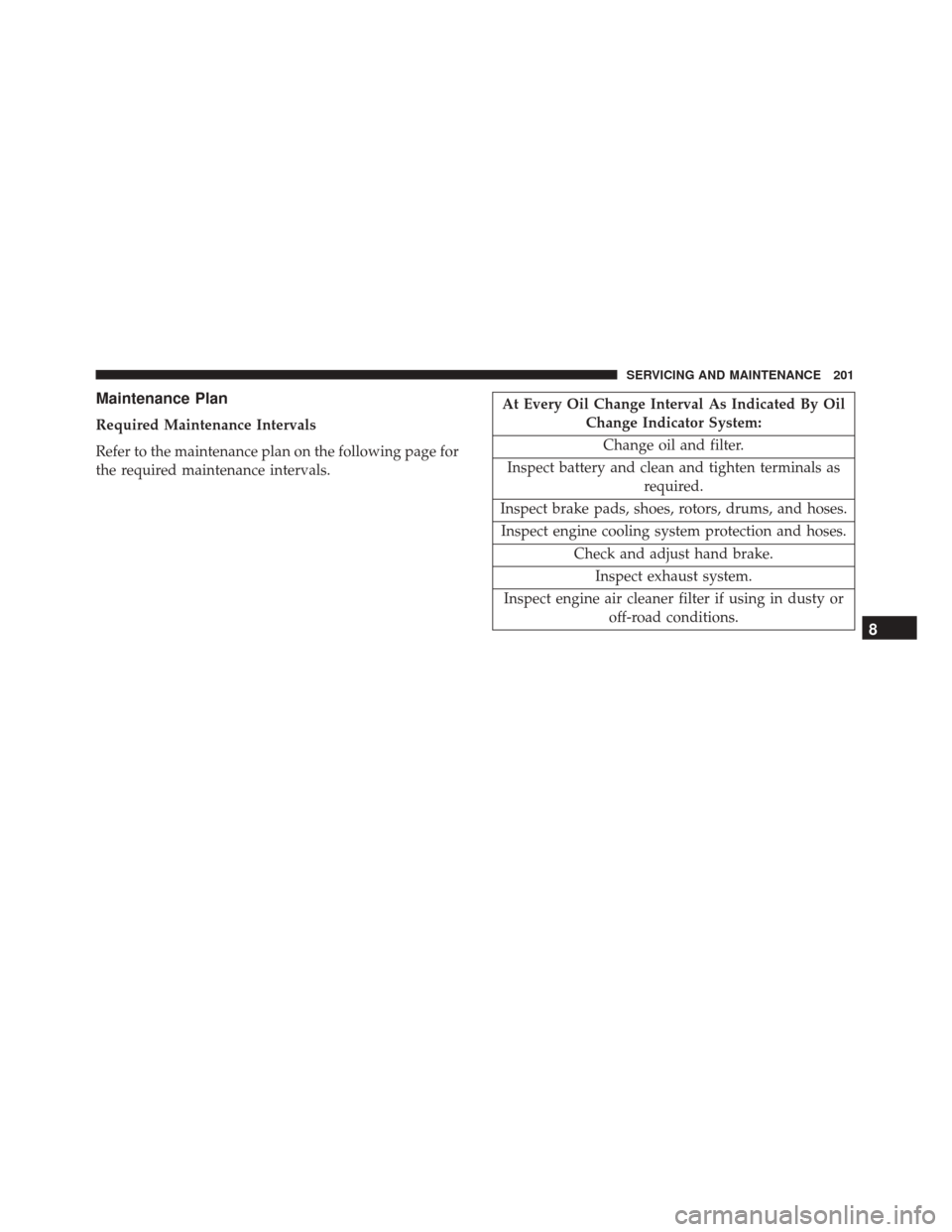
Maintenance Plan
Required Maintenance Intervals
Refer to the maintenance plan on the following page for
the required maintenance intervals.
At Every Oil Change Interval As Indicated By OilChange Indicator System:
Change oil and filter.
Inspect battery and clean and tighten terminals as required.
Inspect brake pads, shoes, rotors, drums, and hoses. Inspect engine cooling system protection and hoses. Check and adjust hand brake.Inspect exhaust system.
Inspect engine air cleaner filter if using in dusty or off-road conditions.
8
SERVICING AND MAINTENANCE 201
Page 206 of 294
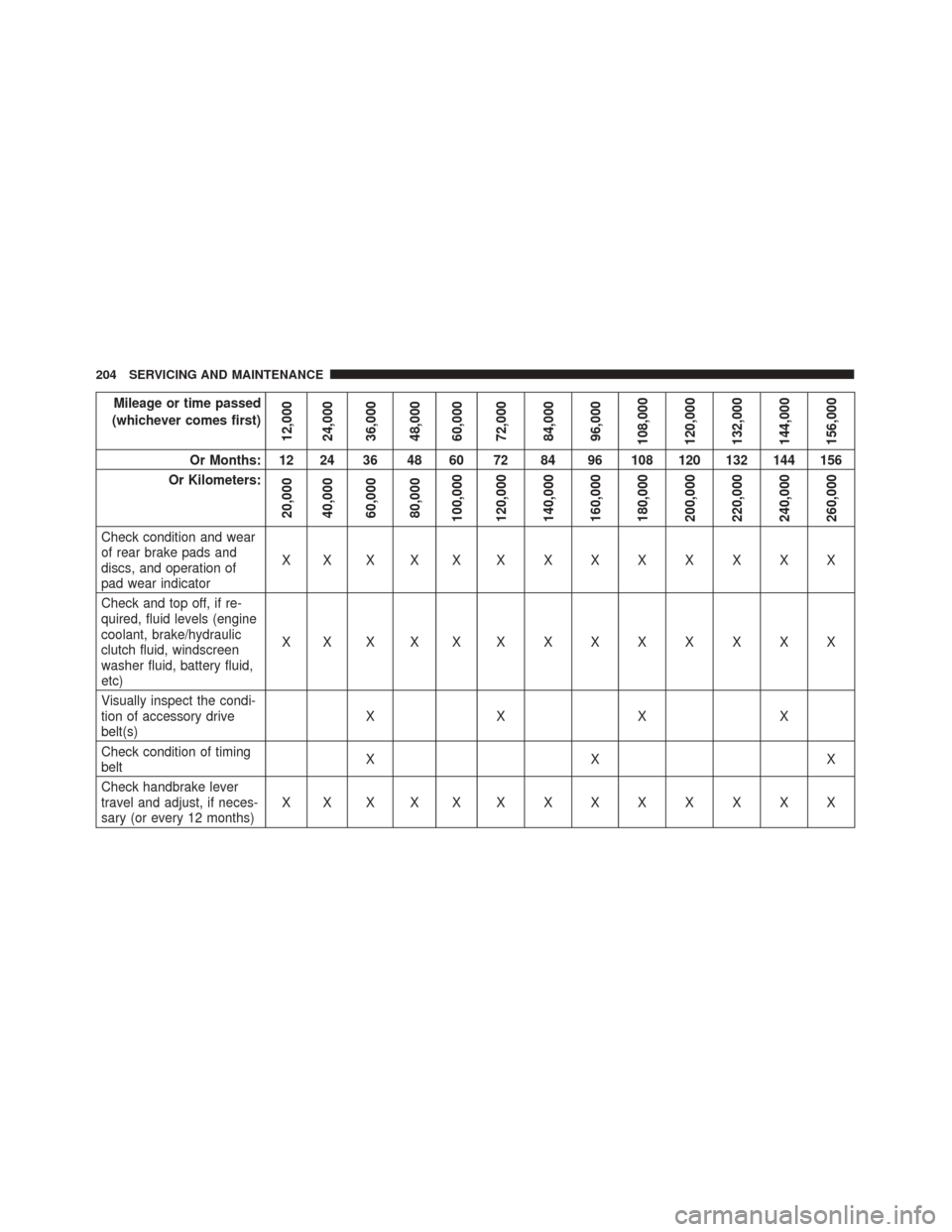
Mileage or time passed
(whichever comes first)
12,000
24,000
36,000
48,000
60,000
72,000
84,000
96,000
108,000
120,000
132,000
144,000
156,000
Or Months: 12 24 36 48 60 72 84 96 108 120 132 144 156
Or Kilometers:
20,000
40,000
60,000
80,000
100,000
120,000
140,000
160,000
180,000
200,000
220,000
240,000
260,000
Check condition and wear
of rear brake pads and
discs, and operation of
pad wear indicator XXXXXXXXXXXXX
Check and top off, if re-
quired, fluid levels (engine
coolant, brake/hydraulic
clutch fluid, windscreen
washer fluid, battery fluid,
etc) XXXXXXXXXXXXX
Visually inspect the condi-
tion of accessory drive
belt(s) XX X X
Check condition of timing
belt XX X
Check handbrake lever
travel and adjust, if neces-
sary (or every 12 months) XXXXXXXXXXXXX
204 SERVICING AND MAINTENANCE
Page 207 of 294
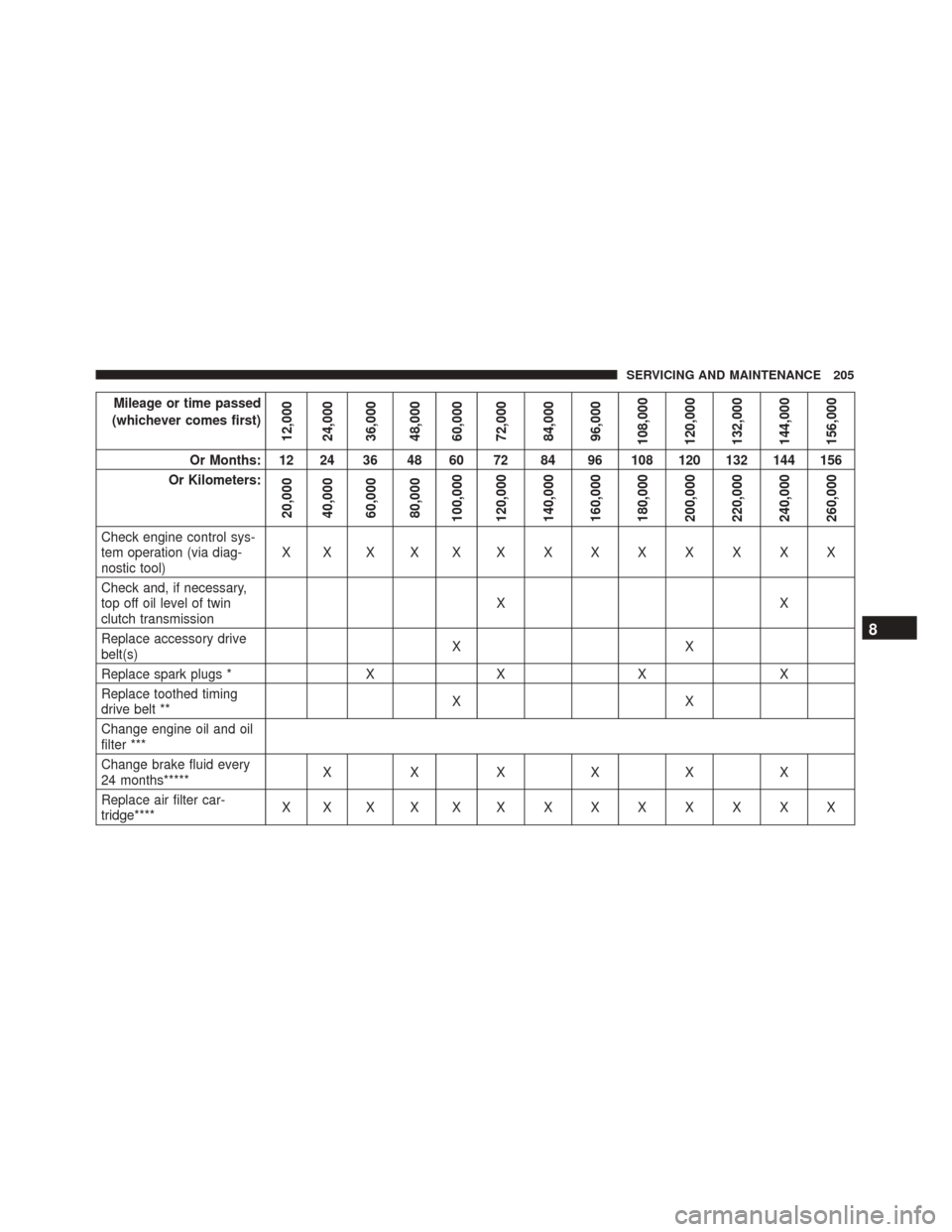
Mileage or time passed
(whichever comes first)
12,000
24,000
36,000
48,000
60,000
72,000
84,000
96,000
108,000
120,000
132,000
144,000
156,000
Or Months: 12 24 36 48 60 72 84 96 108 120 132 144 156
Or Kilometers:
20,000
40,000
60,000
80,000
100,000
120,000
140,000
160,000
180,000
200,000
220,000
240,000
260,000
Check engine control sys-
tem operation (via diag-
nostic tool) XXXXXXXXXXXXX
Check and, if necessary,
top off oil level of twin
clutch transmission XX
Replace accessory drive
belt(s) XX
Replace spark plugs * X X X X
Replace toothed timing
drive belt ** XX
Change engine oil and oil
filter ***
Change brake fluid every
24 months***** XXX X X X
Replace air filter car-
tridge**** XXXXXXXXXXXXX
8
SERVICING AND MAINTENANCE 205
Page 208 of 294
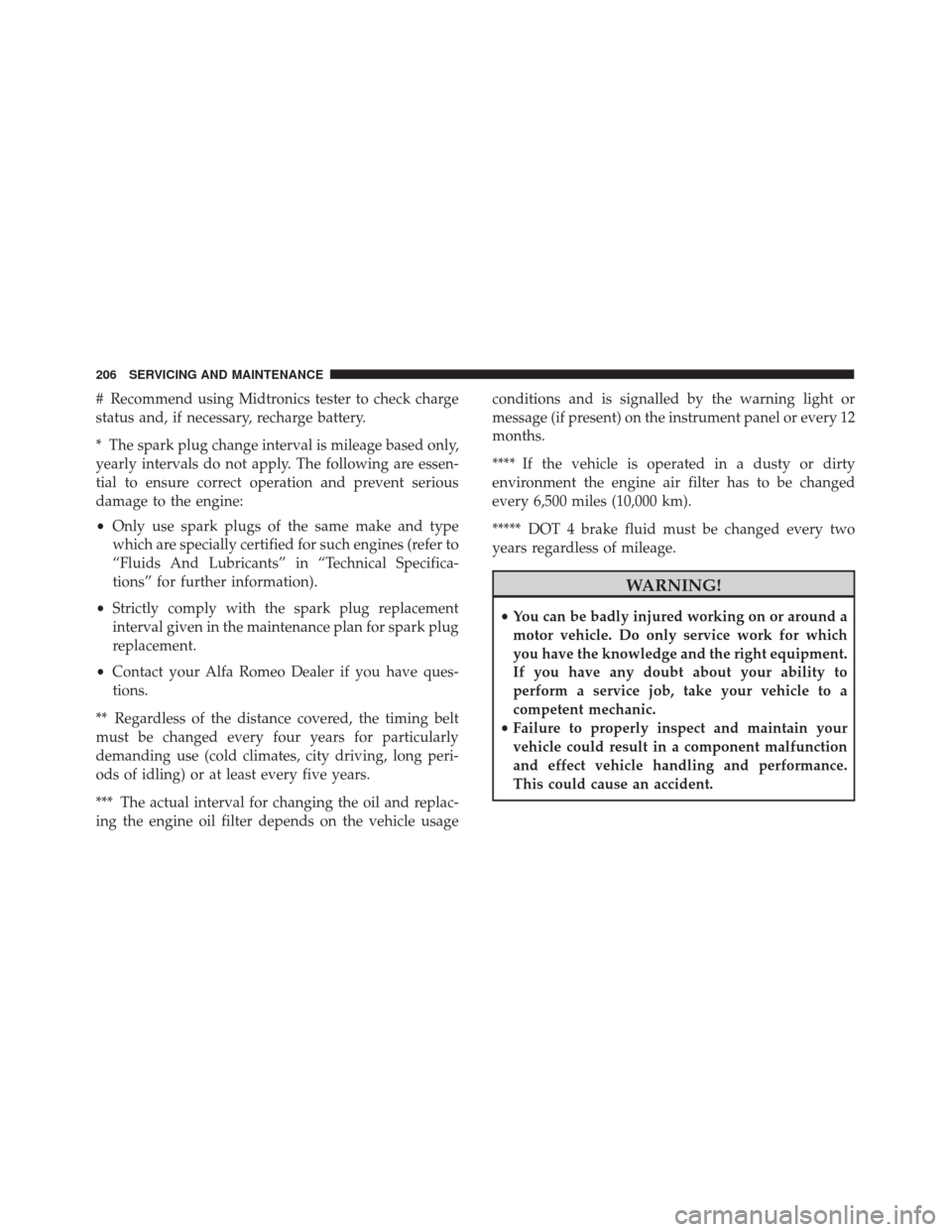
# Recommend using Midtronics tester to check charge
status and, if necessary, recharge battery.
* The spark plug change interval is mileage based only,
yearly intervals do not apply. The following are essen-
tial to ensure correct operation and prevent serious
damage to the engine:
•Only use spark plugs of the same make and type
which are specially certified for such engines (refer to
“Fluids And Lubricants” in “Technical Specifica-
tions” for further information).
• Strictly comply with the spark plug replacement
interval given in the maintenance plan for spark plug
replacement.
• Contact your Alfa Romeo Dealer if you have ques-
tions.
** Regardless of the distance covered, the timing belt
must be changed every four years for particularly
demanding use (cold climates, city driving, long peri-
ods of idling) or at least every five years.
*** The actual interval for changing the oil and replac-
ing the engine oil filter depends on the vehicle usage conditions and is signalled by the warning light or
message (if present) on the instrument panel or every 12
months.
**** If the vehicle is operated in a dusty or dirty
environment the engine air filter has to be changed
every 6,500 miles (10,000 km).
***** DOT 4 brake fluid must be changed every two
years regardless of mileage.
WARNING!
•
You can be badly injured working on or around a
motor vehicle. Do only service work for which
you have the knowledge and the right equipment.
If you have any doubt about your ability to
perform a service job, take your vehicle to a
competent mechanic.
• Failure to properly inspect and maintain your
vehicle could result in a component malfunction
and effect vehicle handling and performance.
This could cause an accident.
206 SERVICING AND MAINTENANCE
Page 210 of 294
Checking Oil Level
To assure proper engine lubrication, the engine oil must
be maintained at the correct level. Check the oil level at
regular intervals. The best time to check the engine oil
level is before starting the engine after it has sat
overnight.
Do not check oil level when the engine is warm.
Checking engine oil level when the engine is warm will
give you an incorrect reading.
Checking the oil while the vehicle is on level ground,
and has sat overnight, will improve the accuracy of the
oil level readings. Maintain the oil level between the
range markings on the dipstick. The safe range is
indicated by a crosshatch zone. Adding 1 quart of oil
when the reading is at the low end of the indicated
range will result in the oil level at the full end of the
indicator range.
CAUTION!
Do not overfill the engine with oil. Overfilling the
engine with oil will cause oil aeration, which can
lead to loss of oil pressure and an increase in oil
temperature. This loss of oil pressure and increased
oil temperature could damage your engine.
Adding Washer Solvent
1 — Brake Fluid Access Panel
2 — Washer Solvent Access Panel
208 SERVICING AND MAINTENANCE
Page 216 of 294
WARNING!
The air induction system (air cleaner, hoses, etc.)
can provide a measure of protection in the case of
engine backfire. Do not remove the air induction
system (air cleaner, hoses, etc.) unless such removal
is necessary for repair or maintenance. Make sure
that no one is near the engine compartment before
starting the vehicle with the air induction system
(air cleaner, hoses, etc.) removed. Failure to do so
can result in serious personal injury.
Engine Air Cleaner Filter Selection
The quality of replacement engine air cleaner filters
varies considerably. Only high quality filters should be
used to assure most efficient service. Mopar engine air
cleaner filters are a high quality filter and are recom-
mended.
Engine Cover
To avoid possible damage to the engine cover, please
disconnect each of the four mounting studs by pulling the
engine cover upward, and then lift off the complete cover.
Tilting the engine cover when one or more studs are still
engaged will lead to premature failure of the couplers.
To reassemble the cover back onto the engine, first make
sure it is properly aligned, the oil cap is centered, and
that all four studs are lined up with their couplers. Then
gently push on the four corners of the engine cover to
snap the stud back into position.
No tools are required to remove or reassemble the
engine cover.
Air Conditioner Maintenance
For best possible performance, your air conditioner
should be checked and serviced by an authorized dealer
at the start of each warm season. This service should
include cleaning of the condenser fins and a perfor-
mance test. Drive belt tension should also be checked at
this time.
WARNING!
• Use only refrigerants and compressor lubricants
approved by the manufacturer for your air condi-
tioning system. Some unapproved refrigerants are
flammable and can explode, injuring you. Other
unapproved refrigerants or lubricants can cause
the system to fail, requiring costly repairs. Refer
(Continued)
214 SERVICING AND MAINTENANCE
Page 220 of 294
Windshield Washer Nozzles
The windshield washer nozzles are adjustable. They
originally adjusted at the factory. Should it be necessary
to adjust them again, contact your authorized Alfa
Romeo Dealer.
If there is not a jet of fluid, first check that there is fluid
in the washer reservoir. Refer to “Adding Washer
Solvent” in this chapter for further information.
Then check that the nozzle holes are not clogged; use a
suitable tool such as a needle to unblock them if
necessary.
Exhaust System
The best protection against carbon monoxide entry into
the vehicle body is a properly maintained engine ex-
haust system.
If you notice a change in the sound of the exhaust
system; or if the exhaust fumes can be detected inside
the vehicle; or when the underside or rear of the vehicle
is damaged; have an authorized technician inspect the
complete exhaust system and adjacent body areas forbroken, damaged, deteriorated, or mispositioned parts.
Open seams or loose connections could permit exhaust
fumes to seep into the passenger compartment. In
addition, have the exhaust system inspected each time
the vehicle is raised for lubrication or oil change.
Replace as required.
WARNING!
•
Exhaust gases can injure or kill. They contain
carbon monoxide (CO), which is colorless and
odorless. Breathing it can make you unconscious
and can eventually poison you. To avoid breath-
ing CO, refer to “Safety Tips” in “Safety” for
further information.
• A hot exhaust system can start a fire if you park
over materials that can burn. Such materials
might be grass or leaves coming into contact with
your exhaust system. Do not park or operate your
vehicle in areas where your exhaust system can
contact anything that can burn.
218 SERVICING AND MAINTENANCE
Page 222 of 294
Cooling System
WARNING!
•Turn vehicle off and disconnect the fan motor
lead before working near the radiator cooling fan.
• You or others can be badly burned by hot engine
coolant (antifreeze) or steam from your radiator. If
you see or hear steam coming from under the
hood, do not open the hood until the radiator has
had time to cool. Never open a cooling system
pressure cap when the radiator or coolant bottle is
hot.
• Keep hands, tools, clothing, and jewelry away
from the radiator cooling fan when the hood is
raised. The fan starts automatically and may start
at any time, whether the engine is running or not.
• When working near the radiator cooling fan,
disconnect the fan motor lead or turn the ignition
switch to the OFF position. The fan is temperature
controlled and can start at any time the ignition
switch is in the ON position.
Coolant Checks
Check engine coolant (antifreeze) protection every 12
months (before the onset of freezing weather, where
applicable). If the engine coolant (antifreeze) is dirty or
rusty in appearance, the system should be drained,
flushed and refilled with fresh engine coolant (anti-
freeze). Check the front of the A/C condenser for any
accumulation of bugs, leaves, etc. If dirty, clean by
gently spraying water from a garden hose vertically
down the face of the condenser.
Cooling System — Drain, Flush And Refill
NOTE: Some vehicles require special tools to add
coolant properly. Failure to fill these systems properly
could lead to severe internal engine damage. If any
coolant is needed to be added to the system please
contact an local authorized dealer.
If the engine coolant (antifreeze) is dirty or contains
visible sediment, have an authorized dealer clean and
flush with OAT coolant (antifreeze) (conforming to
MS.90032).
Refer to the “Maintenance Plan” in this section for the
proper maintenance intervals.
220 SERVICING AND MAINTENANCE
Page 225 of 294
Cooling System Pressure Cap
The cap must be fully tightened to prevent loss of
engine coolant (antifreeze), and to ensure that engine
coolant (antifreeze) will return to the radiator from the
coolant expansion bottle/recovery tank if so equipped.
The cap should be inspected and cleaned if there is any
accumulation of foreign material on the sealing sur-
faces.
WARNING!
•Do not open hot engine cooling system. Never
add engine coolant (antifreeze) when the engine
is overheated. Do not loosen or remove the cap to
cool an overheated engine. Heat causes pressure
to build up in the cooling system. To prevent
scalding or injury, do not remove the pressure cap
while the system is hot or under pressure.
• Do not use a pressure cap other than the one
specified for your vehicle. Personal injury or
engine damage may result.
Disposal Of Used Coolant
Used ethylene glycol-based coolant (antifreeze) is a
regulated substance requiring proper disposal. Check
with your local authorities to determine the disposal
rules for your community. To prevent ingestion by
animals or children, do not store ethylene glycol-based
coolant in open containers or allow it to remain in
puddles on the ground. If ingested by a child or pet,
seek emergency assistance immediately. Clean up any
ground spills immediately.
Coolant Level
The coolant expansion bottle provides a quick visual
method for determining that the coolant level is ad-
equate. With the engine off and cold, the level of the
engine coolant (antifreeze) in the bottle should be
between the “MIN” and “MAX” marks.
As long as the engine operating temperature is satisfac-
tory, the coolant bottle need only be checked once a
month.
When additional engine coolant (antifreeze) is needed
to maintain the proper level, it should be added to the
coolant bottle. Do not overfill.8
SERVICING AND MAINTENANCE 223
Page 226 of 294
Points To Remember
NOTE:When the vehicle is stopped after a few miles/
kilometers of operation, you may observe vapor coming
from the front of the engine compartment. This is
normally a result of moisture from rain, snow, or high
humidity accumulating on the radiator and being va-
porized when the thermostat opens, allowing hot en-
gine coolant (antifreeze) to enter the radiator.
If an examination of your engine compartment shows
no evidence of radiator or hose leaks, the vehicle may
be safely driven. The vapor will soon dissipate.
• Do not overfill the coolant expansion bottle.
• Check the coolant freeze point in the radiator and in
the coolant expansion bottle. If engine coolant (anti-
freeze) needs to be added, the contents of the coolant
expansion bottle must also be protected against freez-
ing.
• If frequent engine coolant (antifreeze) additions are
required, the cooling system should be pressure
tested for leaks. •
Maintain engine coolant (antifreeze) concentration at
a minimum of 50% OAT coolant (conforming to
MS.90032) and distilled water for proper corrosion
protection of your engine which contains aluminum
components.
• Make sure that the coolant expansion bottle overflow
hoses are not kinked or obstructed.
• Keep the front of the radiator clean. If your vehicle is
equipped with air conditioning, keep the front of the
condenser clean.
• Do not change the thermostat for Summer or Winter
operation. If replacement is ever necessary, install
ONLY the correct type thermostat. Other designs
may result in unsatisfactory engine coolant (anti-
freeze) performance, poor gas mileage, and increased
emissions.
Brake System
In order to assure brake system performance, all brake
system components should be inspected periodically.
Refer to the “Maintenance Plan” in this section for the
proper maintenance intervals.
224 SERVICING AND MAINTENANCE