coolant level Alfa Romeo 4C Spider 2018 Owner's Manual
[x] Cancel search | Manufacturer: ALFA ROMEO, Model Year: 2018, Model line: 4C Spider, Model: Alfa Romeo 4C Spider 2018Pages: 294, PDF Size: 3.31 MB
Page 143 of 294
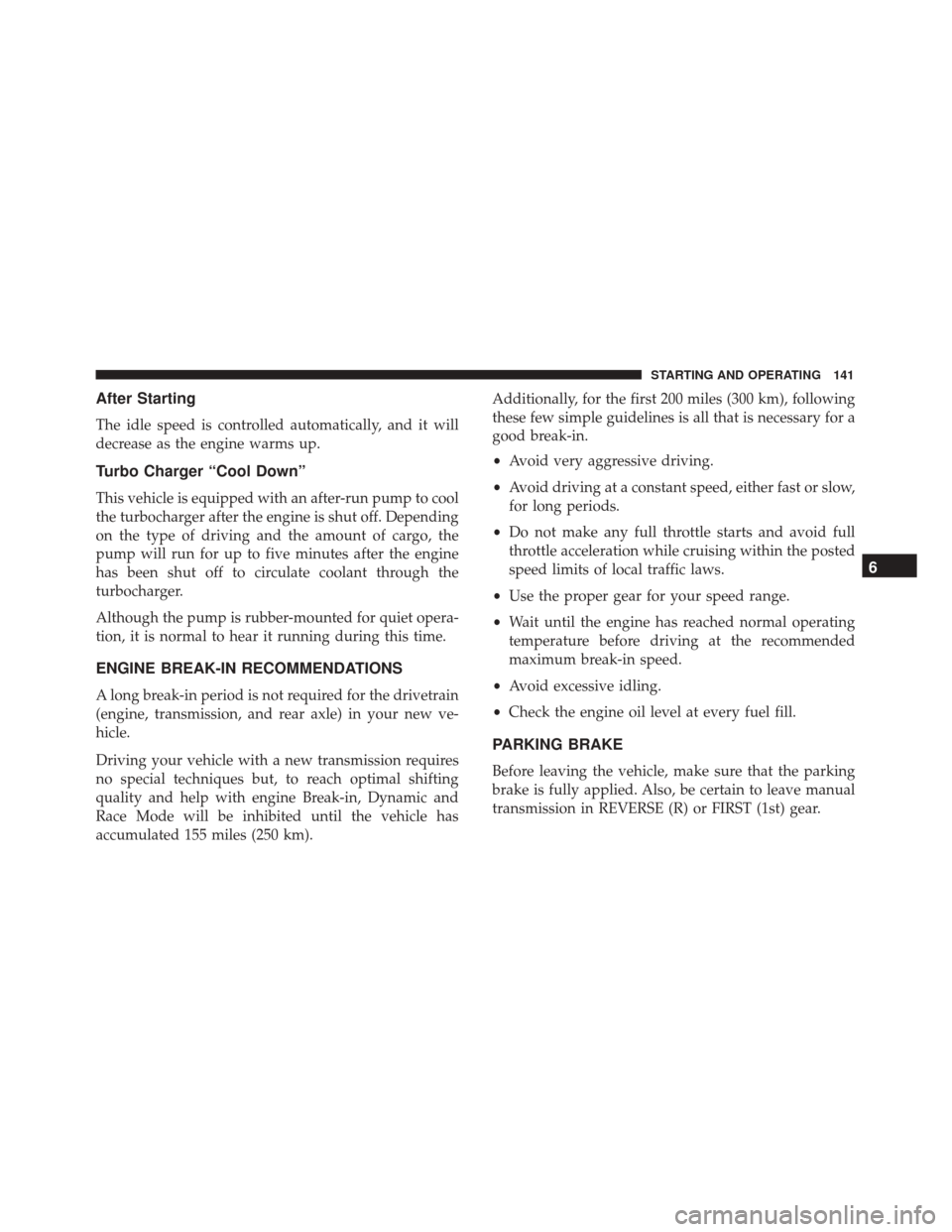
After Starting
The idle speed is controlled automatically, and it will
decrease as the engine warms up.
Turbo Charger “Cool Down”
This vehicle is equipped with an after-run pump to cool
the turbocharger after the engine is shut off. Depending
on the type of driving and the amount of cargo, the
pump will run for up to five minutes after the engine
has been shut off to circulate coolant through the
turbocharger.
Although the pump is rubber-mounted for quiet opera-
tion, it is normal to hear it running during this time.
ENGINE BREAK-IN RECOMMENDATIONS
A long break-in period is not required for the drivetrain
(engine, transmission, and rear axle) in your new ve-
hicle.
Driving your vehicle with a new transmission requires
no special techniques but, to reach optimal shifting
quality and help with engine Break-in, Dynamic and
Race Mode will be inhibited until the vehicle has
accumulated 155 miles (250 km).Additionally, for the first 200 miles (300 km), following
these few simple guidelines is all that is necessary for a
good break-in.
•
Avoid very aggressive driving.
• Avoid driving at a constant speed, either fast or slow,
for long periods.
• Do not make any full throttle starts and avoid full
throttle acceleration while cruising within the posted
speed limits of local traffic laws.
• Use the proper gear for your speed range.
• Wait until the engine has reached normal operating
temperature before driving at the recommended
maximum break-in speed.
• Avoid excessive idling.
• Check the engine oil level at every fuel fill.
PARKING BRAKE
Before leaving the vehicle, make sure that the parking
brake is fully applied. Also, be certain to leave manual
transmission in REVERSE (R) or FIRST (1st) gear.
6
STARTING AND OPERATING 141
Page 202 of 294
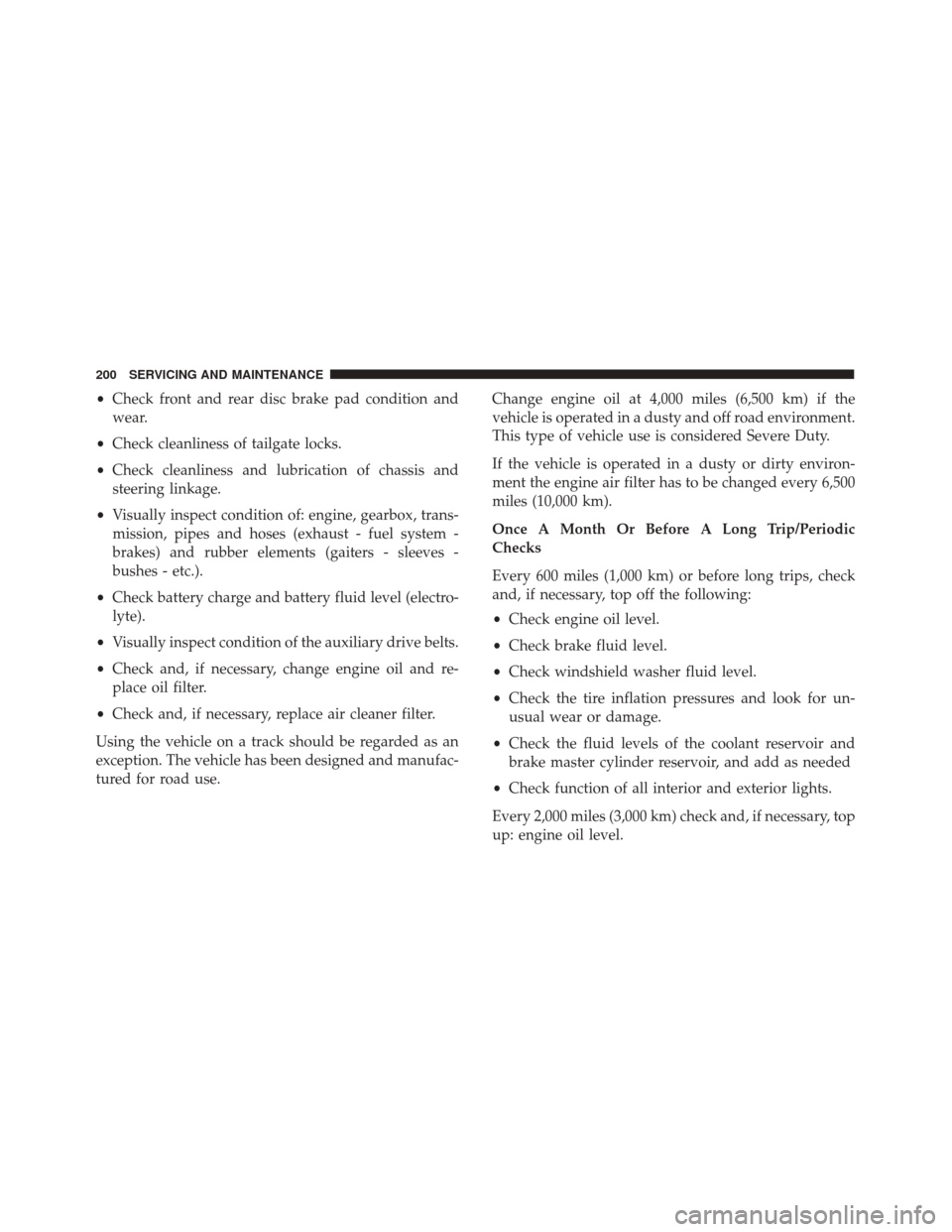
•Check front and rear disc brake pad condition and
wear.
• Check cleanliness of tailgate locks.
• Check cleanliness and lubrication of chassis and
steering linkage.
• Visually inspect condition of: engine, gearbox, trans-
mission, pipes and hoses (exhaust - fuel system -
brakes) and rubber elements (gaiters - sleeves -
bushes - etc.).
• Check battery charge and battery fluid level (electro-
lyte).
• Visually inspect condition of the auxiliary drive belts.
• Check and, if necessary, change engine oil and re-
place oil filter.
• Check and, if necessary, replace air cleaner filter.
Using the vehicle on a track should be regarded as an
exception. The vehicle has been designed and manufac-
tured for road use. Change engine oil at 4,000 miles (6,500 km) if the
vehicle is operated in a dusty and off road environment.
This type of vehicle use is considered Severe Duty.
If the vehicle is operated in a dusty or dirty environ-
ment the engine air filter has to be changed every 6,500
miles (10,000 km).
Once A Month Or Before A Long Trip/Periodic
Checks
Every 600 miles (1,000 km) or before long trips, check
and, if necessary, top off the following:
•
Check engine oil level.
• Check brake fluid level.
• Check windshield washer fluid level.
• Check the tire inflation pressures and look for un-
usual wear or damage.
• Check the fluid levels of the coolant reservoir and
brake master cylinder reservoir, and add as needed
• Check function of all interior and exterior lights.
Every 2,000 miles (3,000 km) check and, if necessary, top
up: engine oil level.
200 SERVICING AND MAINTENANCE
Page 206 of 294
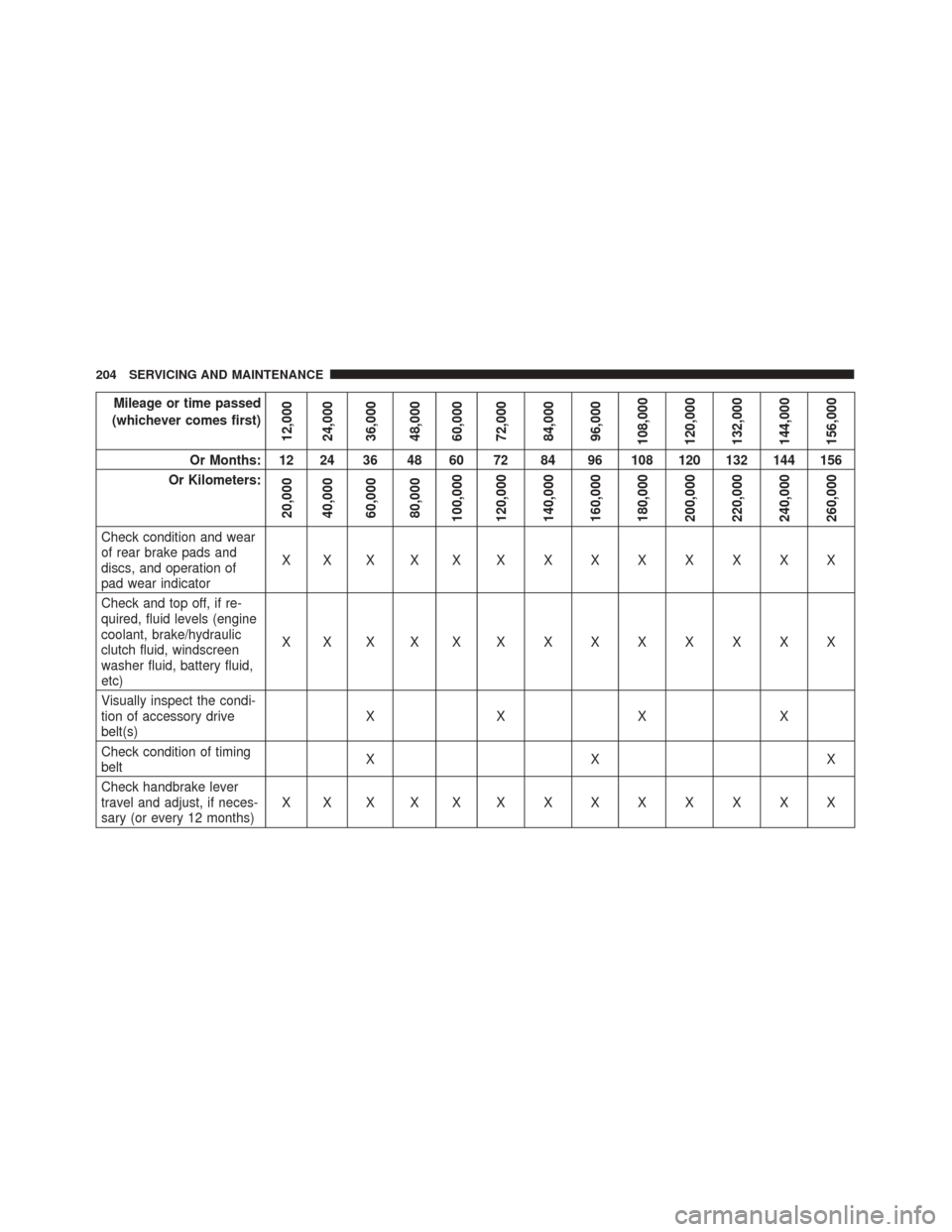
Mileage or time passed
(whichever comes first)
12,000
24,000
36,000
48,000
60,000
72,000
84,000
96,000
108,000
120,000
132,000
144,000
156,000
Or Months: 12 24 36 48 60 72 84 96 108 120 132 144 156
Or Kilometers:
20,000
40,000
60,000
80,000
100,000
120,000
140,000
160,000
180,000
200,000
220,000
240,000
260,000
Check condition and wear
of rear brake pads and
discs, and operation of
pad wear indicator XXXXXXXXXXXXX
Check and top off, if re-
quired, fluid levels (engine
coolant, brake/hydraulic
clutch fluid, windscreen
washer fluid, battery fluid,
etc) XXXXXXXXXXXXX
Visually inspect the condi-
tion of accessory drive
belt(s) XX X X
Check condition of timing
belt XX X
Check handbrake lever
travel and adjust, if neces-
sary (or every 12 months) XXXXXXXXXXXXX
204 SERVICING AND MAINTENANCE
Page 224 of 294
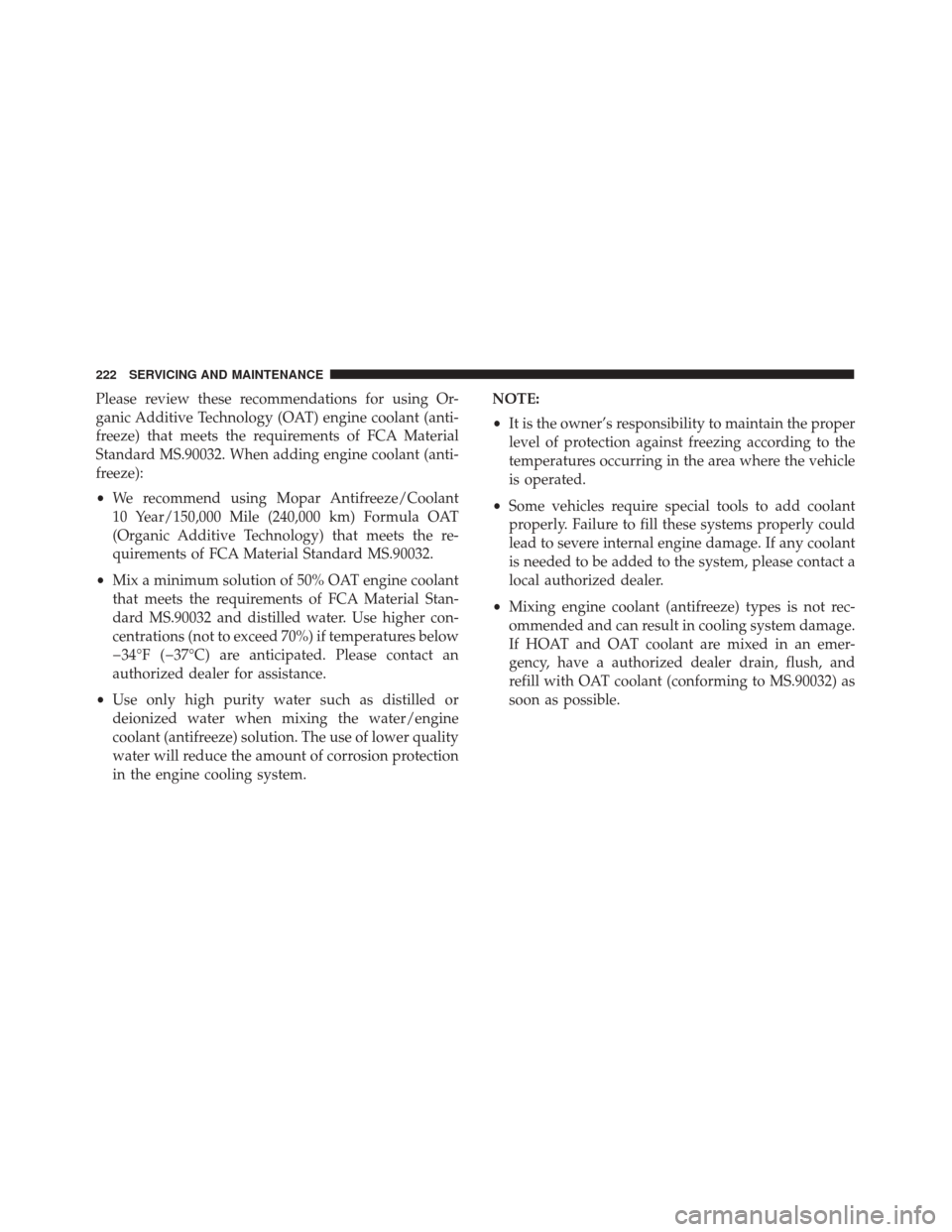
Please review these recommendations for using Or-
ganic Additive Technology (OAT) engine coolant (anti-
freeze) that meets the requirements of FCA Material
Standard MS.90032. When adding engine coolant (anti-
freeze):
•We recommend using Mopar Antifreeze/Coolant
10 Year/150,000 Mile (240,000 km) Formula OAT
(Organic Additive Technology) that meets the re-
quirements of FCA Material Standard MS.90032.
• Mix a minimum solution of 50% OAT engine coolant
that meets the requirements of FCA Material Stan-
dard MS.90032 and distilled water. Use higher con-
centrations (not to exceed 70%) if temperatures below
34°F (37°C) are anticipated. Please contact an
authorized dealer for assistance.
• Use only high purity water such as distilled or
deionized water when mixing the water/engine
coolant (antifreeze) solution. The use of lower quality
water will reduce the amount of corrosion protection
in the engine cooling system. NOTE:
•
It is the owner’s responsibility to maintain the proper
level of protection against freezing according to the
temperatures occurring in the area where the vehicle
is operated.
• Some vehicles require special tools to add coolant
properly. Failure to fill these systems properly could
lead to severe internal engine damage. If any coolant
is needed to be added to the system, please contact a
local authorized dealer.
• Mixing engine coolant (antifreeze) types is not rec-
ommended and can result in cooling system damage.
If HOAT and OAT coolant are mixed in an emer-
gency, have a authorized dealer drain, flush, and
refill with OAT coolant (conforming to MS.90032) as
soon as possible.
222 SERVICING AND MAINTENANCE
Page 225 of 294
Cooling System Pressure Cap
The cap must be fully tightened to prevent loss of
engine coolant (antifreeze), and to ensure that engine
coolant (antifreeze) will return to the radiator from the
coolant expansion bottle/recovery tank if so equipped.
The cap should be inspected and cleaned if there is any
accumulation of foreign material on the sealing sur-
faces.
WARNING!
•Do not open hot engine cooling system. Never
add engine coolant (antifreeze) when the engine
is overheated. Do not loosen or remove the cap to
cool an overheated engine. Heat causes pressure
to build up in the cooling system. To prevent
scalding or injury, do not remove the pressure cap
while the system is hot or under pressure.
• Do not use a pressure cap other than the one
specified for your vehicle. Personal injury or
engine damage may result.
Disposal Of Used Coolant
Used ethylene glycol-based coolant (antifreeze) is a
regulated substance requiring proper disposal. Check
with your local authorities to determine the disposal
rules for your community. To prevent ingestion by
animals or children, do not store ethylene glycol-based
coolant in open containers or allow it to remain in
puddles on the ground. If ingested by a child or pet,
seek emergency assistance immediately. Clean up any
ground spills immediately.
Coolant Level
The coolant expansion bottle provides a quick visual
method for determining that the coolant level is ad-
equate. With the engine off and cold, the level of the
engine coolant (antifreeze) in the bottle should be
between the “MIN” and “MAX” marks.
As long as the engine operating temperature is satisfac-
tory, the coolant bottle need only be checked once a
month.
When additional engine coolant (antifreeze) is needed
to maintain the proper level, it should be added to the
coolant bottle. Do not overfill.8
SERVICING AND MAINTENANCE 223
Page 283 of 294
Brake System....................... .224, 262
Anti-Lock (ABS) ........................90
Master Cylinder ...................... .225
Parking ............................ .141
Warning Light .........................77
Break-In Recommendations, New Vehicle .......141
Bulb Replacement ....................... .166
Bulbs, Light ........................ .135, 166
Capacities, Antifreeze (Engine Coolant) .........266
Capacities, Fluid ........................ .266
Caps, Filler Oil (Engine) ...................... .207, 213
Radiator (Coolant Pressure) ...............223
Carbon Monoxide Warning ..............132, 265
Car Washes ........................... .254
Cellular Phone ......................... .272
Chains, Tire ........................... .250
Changing A Flat Tire ..................... .229
Chart, Tire Sizing ....................... .231
Check Engine Light (Malfunction Indicator Light) . .86
Checking Your Vehicle For Safety .............132
Checks, Safety ......................... .132
Child Restraint ......................... .123Child Restraints
Booster Seats ........................ .127
Child Restraints ...................... .123
Child Seat Installation ...................129
Infants And Child Restraints ..............125
Older Children And Child Restraints ........126
Clean Air Gasoline ...................... .262
Cleaning Wheels ............................ .249
Windshield Wiper Blades .................216
Climate Control ..........................36
Manual ..............................36
Compact Spare Tire ...................... .247
Contract, Service ........................ .276
Coolant (Antifreeze) ..................... .266
Coolant Pressure Cap (Radiator Cap) ..........223
Cooling
System......................... .220
Adding Coolant (Antifreeze) ..............221
Coolant Level .....................220, 223
Disposal Of Used Coolant ................223
Drain, Flush, And Refill ..................220
Inspection .......................... .223
Points To Remember ....................224
Pressure Cap ........................ .223
12
INDEX 281
Page 284 of 294
Radiator Cap........................ .223
Selection Of Coolant (Antifreeze) ...........221
Corrosion Protection ..................... .253
Cruise Light .............................84
Cupholders .............................57
Customer Assistance ..................... .274
Daytime Running Lights ....................31
Dealer Service .......................... .212
Deck Lid, Release .........................51
Defroster, Windshield .....................133
Delay (Intermittent) Wipers ..................34
Diagnostic System, Onboard .................85
Dimmer Control ..........................34
Disabled Vehicle Towing ...................192
Disposal Antifreeze (Engine Coolant) ...............223
Door Locks Child-Protection Door Lock — Rear Doors .....23
Driver’s Seat Back Tilt ......................24
Driving Through Flowing, Rising, Or Shallow Standing
Water .............................. .163
Electrical Outlet, Auxiliary (Power Outlet) .......58Electrical Power Outlets
....................58
Electric Remote Mirrors .....................29
Electronic Brake Control System ...............91
Electronic Speed Control (Cruise Control) .......153
Electronic Throttle Control Warning Light ........78
Emergency, In Case Of Hazard Warning Flasher .................166
Jacking ............................ .229
Jump Starting ........................ .187
Overheating ......................... .191
Towing ............................ .192
Emission Control System Maintenance ..........86
Engine ............................... .207
Air Cleaner ......................... .213
Break-In Recommendations ...............141
Checking Oil Level .....................208
Compartment ........................ .207
Cooling ............................ .220
Exhaust Gas Caution ................132, 265
Fails To Start ........................ .140
Flooded,
Starting ..................... .140
Fuel Requirements .....................262
Jump Starting ........................ .187
Oil ............................ .212, 266
Oil Filler Cap ..................... .207, 213
282 INDEX