check engine Alfa Romeo 4C Spider 2019 Owner's Guide
[x] Cancel search | Manufacturer: ALFA ROMEO, Model Year: 2019, Model line: 4C Spider, Model: Alfa Romeo 4C Spider 2019Pages: 292, PDF Size: 3.25 MB
Page 204 of 292
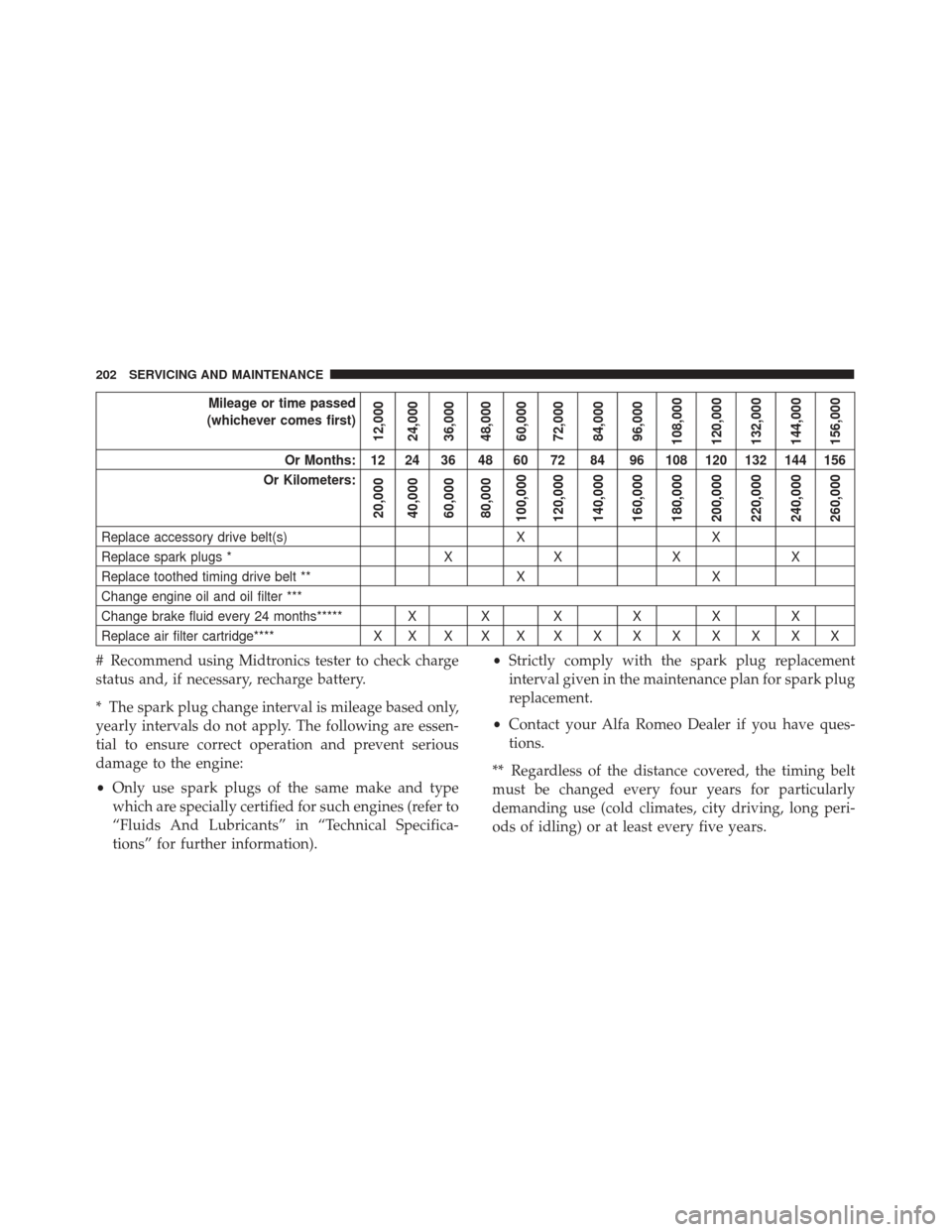
Mileage or time passed
(whichever comes first)
12,000
24,000
36,000
48,000
60,000
72,000
84,000
96,000
108,000
120,000
132,000
144,000
156,000
Or Months: 12 24 36 48 60 72 84 96 108 120 132 144 156
Or Kilometers:
20,000
40,000
60,000
80,000
100,000
120,000
140,000
160,000
180,000
200,000
220,000
240,000
260,000
Replace accessory drive belt(s) XX
Replace spark plugs * XX X X
Replace toothed timing drive belt ** XX
Change engine oil and oil filter ***
Change brake fluid every 24 months***** X X X XX X
Replace air filter cartridge**** X X X X X X X X XXXXX
# Recommend using Midtronics tester to check charge
status and, if necessary, recharge battery.
* The spark plug change interval is mileage based only,
yearly intervals do not apply. The following are essen-
tial to ensure correct operation and prevent serious
damage to the engine:
•Only use spark plugs of the same make and type
which are specially certified for such engines (refer to
“Fluids And Lubricants” in “Technical Specifica-
tions” for further information). •
Strictly comply with the spark plug replacement
interval given in the maintenance plan for spark plug
replacement.
• Contact your Alfa Romeo Dealer if you have ques-
tions.
** Regardless of the distance covered, the timing belt
must be changed every four years for particularly
demanding use (cold climates, city driving, long peri-
ods of idling) or at least every five years.
202 SERVICING AND MAINTENANCE
Page 207 of 292
Checking Oil Level
To assure proper engine lubrication, the engine oil must be
maintained at the correct level. Check the oil level at
regular intervals. The best time to check the engine oil level
is before starting the engine after it has sat overnight.
Do not check oil level when the engine is warm.
Checking engine oil level when the engine is warm will
give you an incorrect reading.
Checking the oil while the vehicle is on level ground,
and has sat overnight, will improve the accuracy of the
oil level readings. Maintain the oil level between the
range markings on the dipstick. The safe range is
indicated by a crosshatch zone. Adding 1 quart of oil
when the reading is at the low end of the indicated
range will result in the oil level at the full end of the
indicator range.
CAUTION!
Do not overfill the engine with oil. Overfilling the
engine with oil will cause oil aeration, which can
lead to loss of oil pressure and an increase in oil
temperature. This loss of oil pressure and increased
oil temperature could damage your engine.
Adding Washer Solvent
To check the windshield washer solvent level, proceed
as follows:
1. To avoid any interference during the procedure, liftthe windshield wiper blade.
2. Loosen the four screws using the supplied screw- driver. Remove the washer solvent protection panel.
1 — Brake Fluid Access Panel
2 — Washer Solvent Access Panel
8
SERVICING AND MAINTENANCE 205
Page 213 of 292
WARNING!
The air induction system (air cleaner, hoses, etc.)
can provide a measure of protection in the case of
engine backfire. Do not remove the air induction
system (air cleaner, hoses, etc.) unless such removal
is necessary for repair or maintenance. Make sure
that no one is near the engine compartment before
starting the vehicle with the air induction system
(air cleaner, hoses, etc.) removed. Failure to do so
can result in serious personal injury.
Engine Air Cleaner Filter Selection
The quality of replacement engine air cleaner filters
varies considerably. Only high quality filters should be
used to assure most efficient service. Mopar engine air
cleaner filters are a high quality filter and are recom-
mended.
Engine Cover
To avoid possible damage to the engine cover, please
disconnect each of the four mounting studs by pulling the
engine cover upward, and then lift off the complete cover.
Tilting the engine cover when one or more studs are still
engaged will lead to premature failure of the couplers.
To reassemble the cover back onto the engine, first make
sure it is properly aligned, the oil cap is centered, and
that all four studs are lined up with their couplers. Then
gently push on the four corners of the engine cover to
snap the stud back into position.
No tools are required to remove or reassemble the
engine cover.
Air Conditioner Maintenance
For best possible performance, your air conditioner
should be checked and serviced by an authorized dealer
at the start of each warm season. This service should
include cleaning of the condenser fins and a perfor-
mance test. Drive belt tension should also be checked at
this time.
WARNING!
• Use only refrigerants and compressor lubricants
approved by the manufacturer for your air condi-
tioning system. Some unapproved refrigerants are
flammable and can explode, injuring you. Other
unapproved refrigerants or lubricants can cause
the system to fail, requiring costly repairs. Refer
(Continued)
8
SERVICING AND MAINTENANCE 211
Page 217 of 292
If there is not a jet of fluid, first check that there is fluid
in the washer reservoir. Refer to “Adding Washer
Solvent” in this chapter for further information.
Then check that the nozzle holes are not clogged; use a
suitable tool such as a needle to unblock them if
necessary.
Exhaust System
The best protection against carbon monoxide entry into
the vehicle body is a properly maintained engine ex-
haust system.
If you notice a change in the sound of the exhaust
system; or if the exhaust fumes can be detected inside
the vehicle; or when the underside or rear of the vehicle
is damaged; have an authorized technician inspect the
complete exhaust system and adjacent body areas for
broken, damaged, deteriorated, or mispositioned parts.
Open seams or loose connections could permit exhaust
fumes to seep into the passenger compartment. In
addition, have the exhaust system inspected each time
the vehicle is raised for lubrication or oil change.
Replace as required.
WARNING!
•Exhaust gases can injure or kill. They contain
carbon monoxide (CO), which is colorless and
odorless. Breathing it can make you unconscious
and can eventually poison you. To avoid breath-
ing CO, refer to “Safety Tips” in “Safety” for
further information.
• A hot exhaust system can start a fire if you park
over materials that can burn. Such materials
might be grass or leaves coming into contact with
your exhaust system. Do not park or operate your
vehicle in areas where your exhaust system can
contact anything that can burn.
CAUTION!
• The catalytic converter requires the use of un-
leaded fuel only. Leaded gasoline will destroy the
effectiveness of the catalyst as an emissions con-
trol device and may seriously reduce engine per-
formance and cause serious damage to the engine.
• Damage to the catalytic converter can result if
your vehicle is not kept in proper operating
(Continued)
8
SERVICING AND MAINTENANCE 215
Page 219 of 292
WARNING!(Continued)
•Keep hands, tools, clothing, and jewelry away
from the radiator cooling fan when the hood is
raised. The fan starts automatically and may start
at any time, whether the engine is running or not.
• When working near the radiator cooling fan,
disconnect the fan motor lead or turn the ignition
switch to the OFF position. The fan is temperature
controlled and can start at any time the ignition
switch is in the ON position.
Coolant Checks
Check engine coolant (antifreeze) protection every 12
months (before the onset of freezing weather, where
applicable). If the engine coolant (antifreeze) is dirty or
rusty in appearance, the system should be drained,
flushed and refilled with fresh engine coolant (anti-
freeze). Check the front of the A/C condenser for any
accumulation of bugs, leaves, etc. If dirty, clean by
gently spraying water from a garden hose vertically
down the face of the condenser.
Cooling System — Drain, Flush And Refill
NOTE: Some vehicles require special tools to add
coolant properly. Failure to fill these systems properly
could lead to severe internal engine damage. If any
coolant is needed to be added to the system please
contact an authorized dealer.
If the engine coolant (antifreeze) is dirty or contains
visible sediment, have an authorized dealer clean and
flush with OAT coolant (antifreeze) (conforming to
MS.90032).
Refer to the “Maintenance Plan” in this section for the
proper maintenance intervals.
Selection Of Coolant
Refer to “Fluids And Lubricants” in “Technical Specifi-
cations” for further information.
NOTE:
•
Mixing of engine coolant (antifreeze) other than speci-
fied Organic Additive Technology (OAT) engine cool-
ant (antifreeze), may result in engine damage and may
decrease corrosion protection. Organic Additive Tech-
nology (OAT) engine coolant is different and should
8
SERVICING AND MAINTENANCE 217
Page 222 of 292
Disposal Of Used Coolant
Used ethylene glycol-based coolant (antifreeze) is a
regulated substance requiring proper disposal. Check
with your local authorities to determine the disposal
rules for your community. To prevent ingestion by
animals or children, do not store ethylene glycol-based
coolant in open containers or allow it to remain in
puddles on the ground. If ingested by a child or pet,
seek emergency assistance immediately. Clean up any
ground spills immediately.
Coolant Level
The coolant expansion bottle provides a quick visual
method for determining that the coolant level is ad-
equate. With the engine off and cold, the level of the
engine coolant (antifreeze) in the bottle should be
between the “MIN” and “MAX” marks.
As long as the engine operating temperature is satisfac-
tory, the coolant bottle need only be checked once a
month.
When additional engine coolant (antifreeze) is needed
to maintain the proper level, it should be added to the
coolant bottle. Do not overfill.
Points To Remember
NOTE:When the vehicle is stopped after a few miles/
kilometers of operation, you may observe vapor coming
from the front of the engine compartment. This is
normally a result of moisture from rain, snow, or high
humidity accumulating on the radiator and being va-
porized when the thermostat opens, allowing hot en-
gine coolant (antifreeze) to enter the radiator.
If an examination of your engine compartment shows
no evidence of radiator or hose leaks, the vehicle may
be safely driven. The vapor will soon dissipate.
• Do not overfill the coolant expansion bottle.
• Check the coolant freeze point in the radiator and in
the coolant expansion bottle. If engine coolant (anti-
freeze) needs to be added, the contents of the coolant
expansion bottle must also be protected against freez-
ing.
• If frequent engine coolant (antifreeze) additions are
required, the cooling system should be pressure
tested for leaks.
• Maintain engine coolant (antifreeze) concentration at
a minimum of 50% OAT coolant (conforming to
220 SERVICING AND MAINTENANCE
Page 223 of 292
MS.90032) and distilled water for proper corrosion
protection of your engine which contains aluminum
components.
• Make sure that the coolant expansion bottle overflow
hoses are not kinked or obstructed.
• Keep the front of the radiator clean. If your vehicle is
equipped with air conditioning, keep the front of the
condenser clean.
• Do not change the thermostat for Summer or Winter
operation. If replacement is ever necessary, install
ONLY the correct type thermostat. Other designs
may result in unsatisfactory engine coolant (anti-
freeze) performance, poor gas mileage, and increased
emissions.
Brake System
In order to assure brake system performance, all brake
system components should be inspected periodically.
Refer to the “Maintenance Plan” in this section for the
proper maintenance intervals.
WARNING!
Riding the brakes can lead to brake failure and
possibly a collision. Driving with your foot resting
or riding on the brake pedal can result in abnor-
mally high brake temperatures, excessive lining
wear, and possible brake damage. You would not
have your full braking capacity in an emergency.
Brake Master Cylinder
The fluid level in the master cylinder should be checked
when performing under hood services, or immediately
if the “Brake Warning Light” is on.
Be sure to clean the top of the master cylinder area
before removing the cap. If necessary, add fluid to bring
the fluid level up to the requirements described on the
brake fluid reservoir. Fluid level can be expected to fall
as the brake pads wear. The brake fluid level should be
checked when the pads are replaced. However, low
fluid level may be caused by a leak and a checkup may
be needed.
8
SERVICING AND MAINTENANCE 221
Page 227 of 292
CAUTION!(Continued)
in transmission shift quality. Refer to “Fluids And
Lubricants” in “Technical Specifications” for fluid
specifications.
Special Additives
The manufacturer strongly recommends against using
any special additives in the transmission.
Transmission fluid is an engineered product and its
performance may be impaired by supplemental addi-
tives. Therefore, do not add any fluid additives to the
transmission. The only exception to this policy is the
use of special dyes for diagnosing fluid leaks.
CAUTION!
Do not use chemical flushes in your transmission as
the chemicals can damage your transmission com-
ponents. Such damage is not covered by the New
Vehicle Limited Warranty.
Fluid Level Check
The fluid level is preset at the factory and does not
require adjustment under normal operating conditions. Frequent fluid level checks are not required, but have
your authorized dealer check the fluid level as specified
in the Maintenance Schedule to ensure proper transmis-
sion function and longevity. The transmission has no
dipstick, but your authorized dealer can check your
transmission fluid level using special service tools. If
you notice fluid leakage or transmission malfunction,
visit your authorized dealer immediately to have the
transmission fluid level checked. Operating the vehicle
with an improper fluid level can cause severe transmis-
sion damage.
Fluid Changes
Under normal operating conditions, the fluid installed
at the factory will provide satisfactory lubrication for
the life of the vehicle. However, change the fluid if it
becomes contaminated (with water, etc.), or if the
transmission is disassembled for any reason.
RAISING THE VEHICLE
In the case where it is necessary to raise the vehicle, go
to an authorized dealer or service station.
8
SERVICING AND MAINTENANCE 225
Page 279 of 292
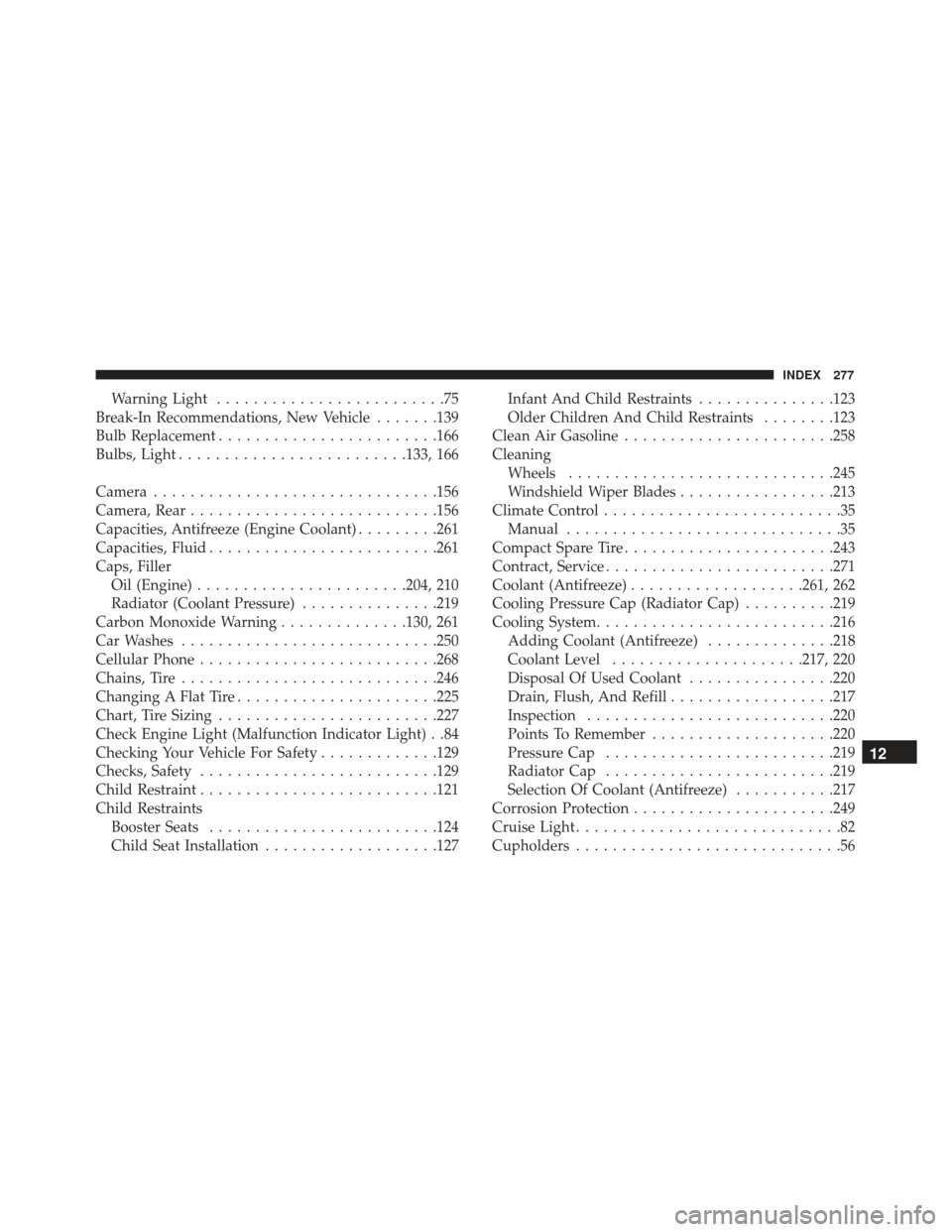
Warning Light.........................75
Break-In Recommendations, New Vehicle .......139
Bulb Replacement ....................... .166
Bulbs, Light ........................ .133, 166
Camera .............................. .156
Camera, Rear .......................... .156
Capacities, Antifreeze (Engine Coolant) .........261
Capacities, Fluid ........................ .261
Caps, Filler Oil (Engine) ...................... .204, 210
Radiator (Coolant Pressure) ...............219
Carbon Monoxide Warning ..............130, 261
Car Washes ........................... .250
Cellular Phone ......................... .268
Chains, Tire ........................... .246
Changing A Flat Tire ..................... .225
Chart, Tire Sizing ....................... .227
Check Engine Light (Malfunction Indicator Light) . .84
Checking Your Vehicle For Safety .............129
Checks, Safety ......................... .129
Child Restraint ......................... .121
Child Restraints Booster Seats ........................ .124
Child Seat Installation ...................127 Infant And Child Restraints
...............123
Older Children And Child Restraints ........123
Clean Air Gasoline ...................... .258
Cleaning Wheels ............................ .245
Windshield Wiper Blades .................213
Climate Control ..........................35
Manual ..............................35
Compact Spare Tire ...................... .243
Contract, Service ........................ .271
Coolant (Antifreeze) ...................261, 262
Cooling Pressure Cap (Radiator Cap) ..........219
Cooling System ......................... .216
Adding Coolant (Antifreeze) ..............218
Coolant
Level .....................217, 220
Disposal Of Used Coolant ................220
Drain, Flush, And Refill ..................217
Inspection .......................... .220
Points To Remember ....................220
Pressure Cap ........................ .219
Radiator Cap ........................ .219
Selection Of Coolant (Antifreeze) ...........217
Corrosion Protection ..................... .249
Cruise Light .............................82
Cupholders .............................56
12
INDEX 277
Page 280 of 292
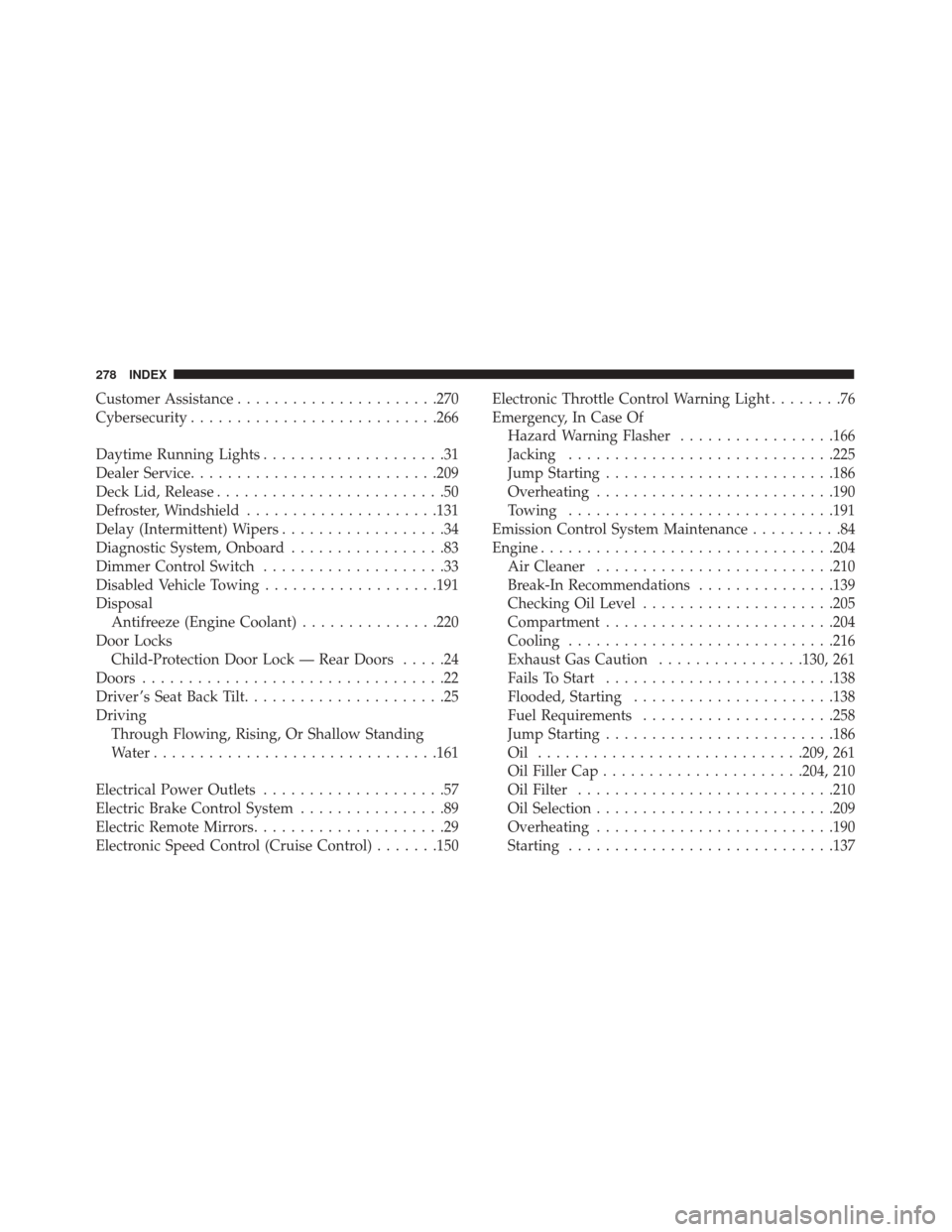
Customer Assistance..................... .270
Cybersecurity .......................... .266
Daytime Running Lights ....................31
Dealer Service .......................... .209
Deck Lid, Release .........................50
Defroster, Windshield .....................131
Delay (Intermittent) Wipers ..................34
Diagnostic System, Onboard .................83
Dimmer Control Switch ....................33
Disabled Vehicle Towing ...................191
Disposal Antifreeze (Engine Coolant) ...............220
Door Locks Child-Protection Door Lock — Rear Doors .....24
Doors .................................22
Driver ’s Seat Back Tilt ......................25
Driving Through Flowing, Rising, Or Shallow Standing
Water .............................. .161
Electrical Power Outlets ....................57
Electric Brake Control System ................89
Electric Remote Mirrors .....................29
Electronic Speed Control (Cruise Control) .......150Electronic Throttle Control Warning Light
........76
Emergency, In Case Of Hazard Warning Flasher .................166
Jacking ............................ .225
Jump Starting ........................ .186
Overheating ......................... .190
Towing ............................ .191
Emission Control System Maintenance ..........84
Engine ............................... .204
Air Cleaner ......................... .210
Break-In Recommendations ...............139
Checking Oil Level .....................205
Compartment ........................ .204
Cooling ............................ .216
Exhaust Gas Caution ................130, 261
Fails To Start ........................ .138
Flooded, Starting ..................... .138
Fuel Requirements .....................258
Jump Starting ........................ .186
O
il ............................ .209, 261
Oil Filler Cap ..................... .204, 210
Oil Filter ........................... .210
Oil Selection ......................... .209
Overheating ......................... .190
Starting ............................ .137
278 INDEX