warning light Alfa Romeo 4C Spider 2019 Workshop Manual
[x] Cancel search | Manufacturer: ALFA ROMEO, Model Year: 2019, Model line: 4C Spider, Model: Alfa Romeo 4C Spider 2019Pages: 292, PDF Size: 3.25 MB
Page 192 of 292
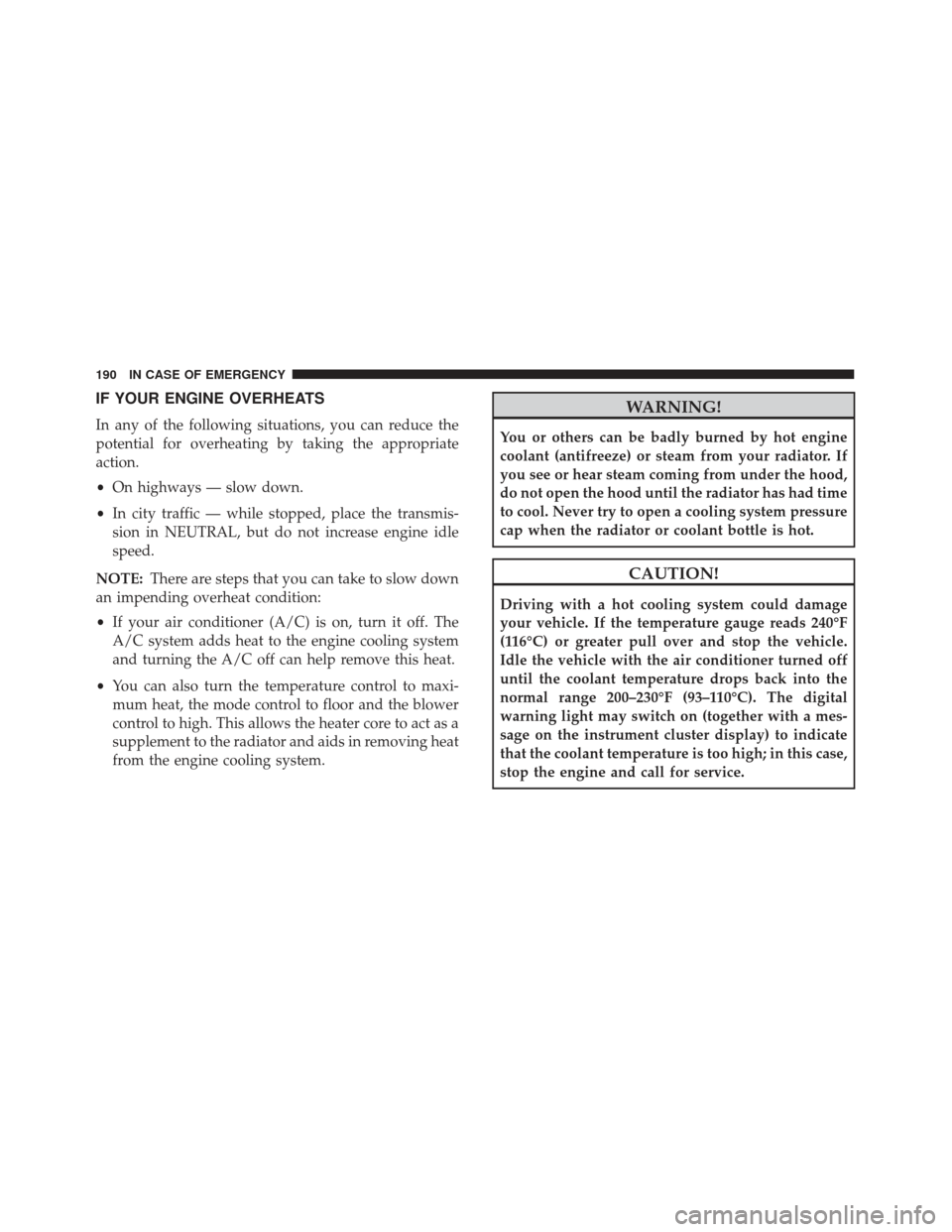
IF YOUR ENGINE OVERHEATS
In any of the following situations, you can reduce the
potential for overheating by taking the appropriate
action.
•On highways — slow down.
• In city traffic — while stopped, place the transmis-
sion in NEUTRAL, but do not increase engine idle
speed.
NOTE: There are steps that you can take to slow down
an impending overheat condition:
• If your air conditioner (A/C) is on, turn it off. The
A/C system adds heat to the engine cooling system
and turning the A/C off can help remove this heat.
• You can also turn the temperature control to maxi-
mum heat, the mode control to floor and the blower
control to high. This allows the heater core to act as a
supplement to the radiator and aids in removing heat
from the engine cooling system.
WARNING!
You or others can be badly burned by hot engine
coolant (antifreeze) or steam from your radiator. If
you see or hear steam coming from under the hood,
do not open the hood until the radiator has had time
to cool. Never try to open a cooling system pressure
cap when the radiator or coolant bottle is hot.
CAUTION!
Driving with a hot cooling system could damage
your vehicle. If the temperature gauge reads 240°F
(116°C) or greater pull over and stop the vehicle.
Idle the vehicle with the air conditioner turned off
until the coolant temperature drops back into the
normal range 200–230°F (93–110°C). The digital
warning light may switch on (together with a mes-
sage on the instrument cluster display) to indicate
that the coolant temperature is too high; in this case,
stop the engine and call for service.
190 IN CASE OF EMERGENCY
Page 199 of 292
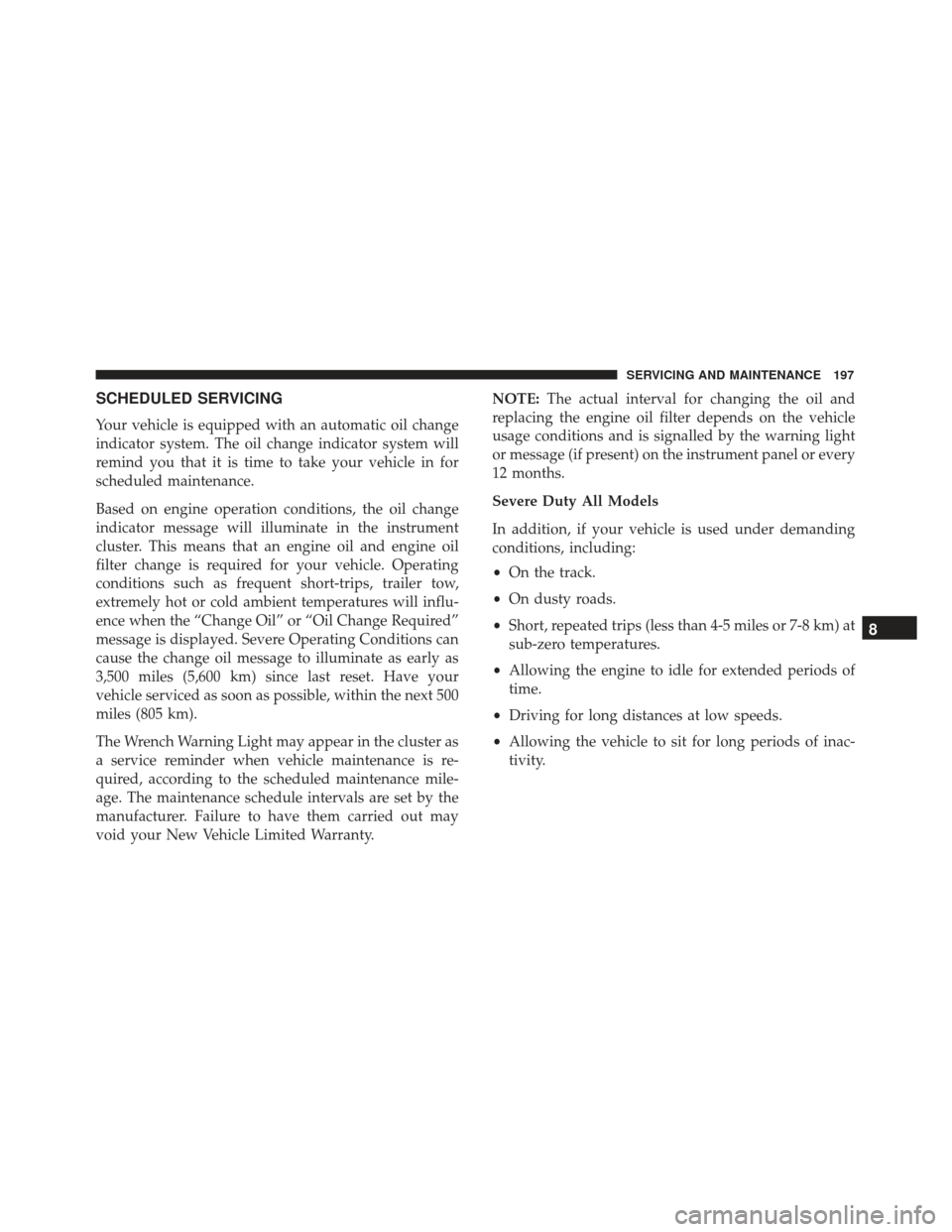
SCHEDULED SERVICING
Your vehicle is equipped with an automatic oil change
indicator system. The oil change indicator system will
remind you that it is time to take your vehicle in for
scheduled maintenance.
Based on engine operation conditions, the oil change
indicator message will illuminate in the instrument
cluster. This means that an engine oil and engine oil
filter change is required for your vehicle. Operating
conditions such as frequent short-trips, trailer tow,
extremely hot or cold ambient temperatures will influ-
ence when the “Change Oil” or “Oil Change Required”
message is displayed. Severe Operating Conditions can
cause the change oil message to illuminate as early as
3,500 miles (5,600 km) since last reset. Have your
vehicle serviced as soon as possible, within the next 500
miles (805 km).
The Wrench Warning Light may appear in the cluster as
a service reminder when vehicle maintenance is re-
quired, according to the scheduled maintenance mile-
age. The maintenance schedule intervals are set by the
manufacturer. Failure to have them carried out may
void your New Vehicle Limited Warranty.NOTE:
The actual interval for changing the oil and
replacing the engine oil filter depends on the vehicle
usage conditions and is signalled by the warning light
or message (if present) on the instrument panel or every
12 months.
Severe Duty All Models
In addition, if your vehicle is used under demanding
conditions, including:
• On the track.
• On dusty roads.
• Short, repeated trips (less than 4-5 miles or 7-8 km) at
sub-zero temperatures.
• Allowing the engine to idle for extended periods of
time.
• Driving for long distances at low speeds.
• Allowing the vehicle to sit for long periods of inac-
tivity.
8
SERVICING AND MAINTENANCE 197
Page 202 of 292
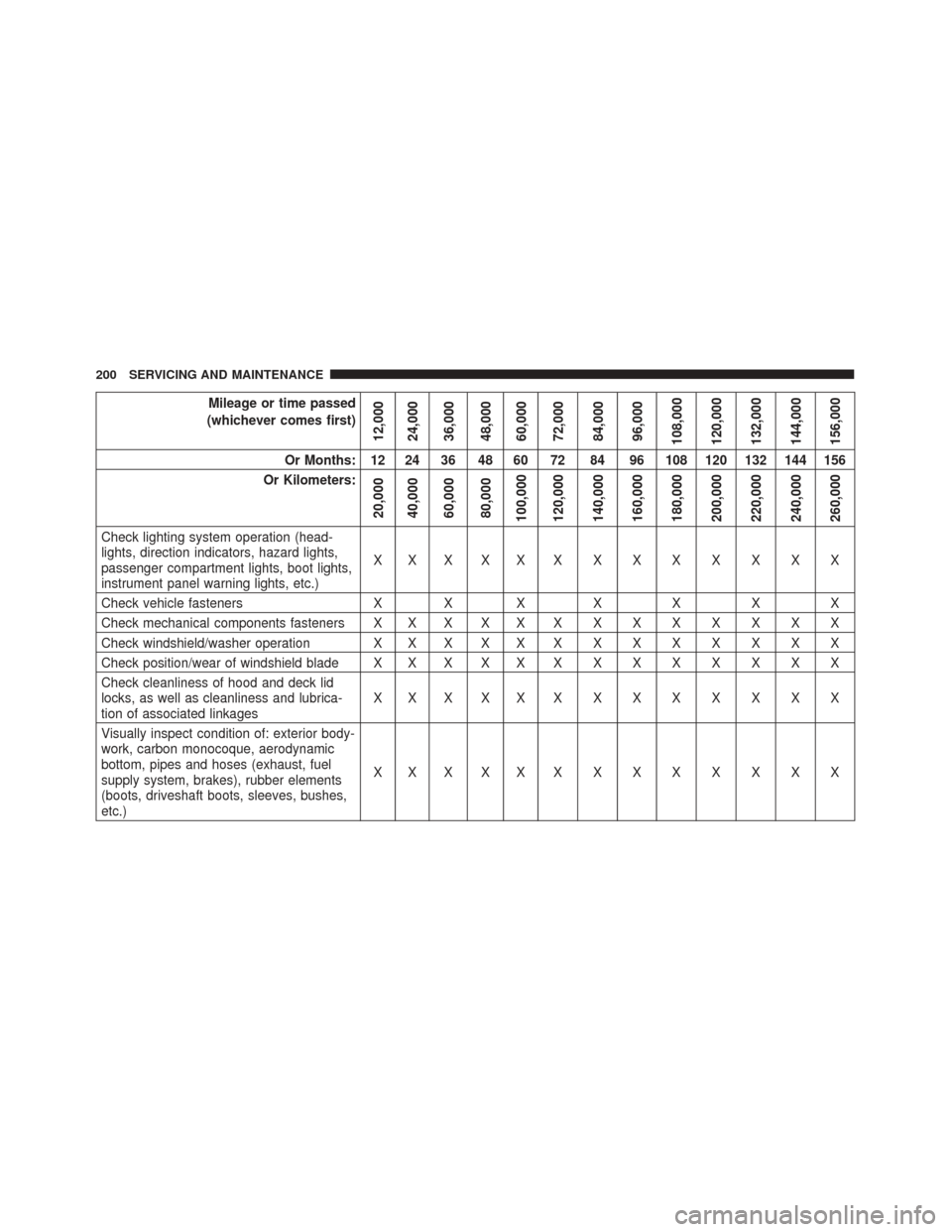
Mileage or time passed
(whichever comes first)
12,000
24,000
36,000
48,000
60,000
72,000
84,000
96,000
108,000
120,000
132,000
144,000
156,000
Or Months: 12 24 36 48 60 72 84 96 108 120 132 144 156
Or Kilometers:
20,000
40,000
60,000
80,000
100,000
120,000
140,000
160,000
180,000
200,000
220,000
240,000
260,000
Check lighting system operation (head-
lights, direction indicators, hazard lights,
passenger compartment lights, boot lights,
instrument panel warning lights, etc.) XXXXXXXXXXXXX
Check vehicle fasteners X X X X X X X
Check mechanical components fasteners X X X X X X X X XXXXX
Check windshield/washer operation X X X X X X X X XXXXX
Check position/wear of windshield blade X X X X X X X X XXXXX
Check cleanliness of hood and deck lid
locks, as well as cleanliness and lubrica-
tion of associated linkages XXXXXXXXXXXXX
Visually inspect condition of: exterior body-
work, carbon monocoque, aerodynamic
bottom, pipes and hoses (exhaust, fuel
supply system, brakes), rubber elements
(boots, driveshaft boots, sleeves, bushes,
etc.) XXXXXXXXXXXXX
200 SERVICING AND MAINTENANCE
Page 205 of 292
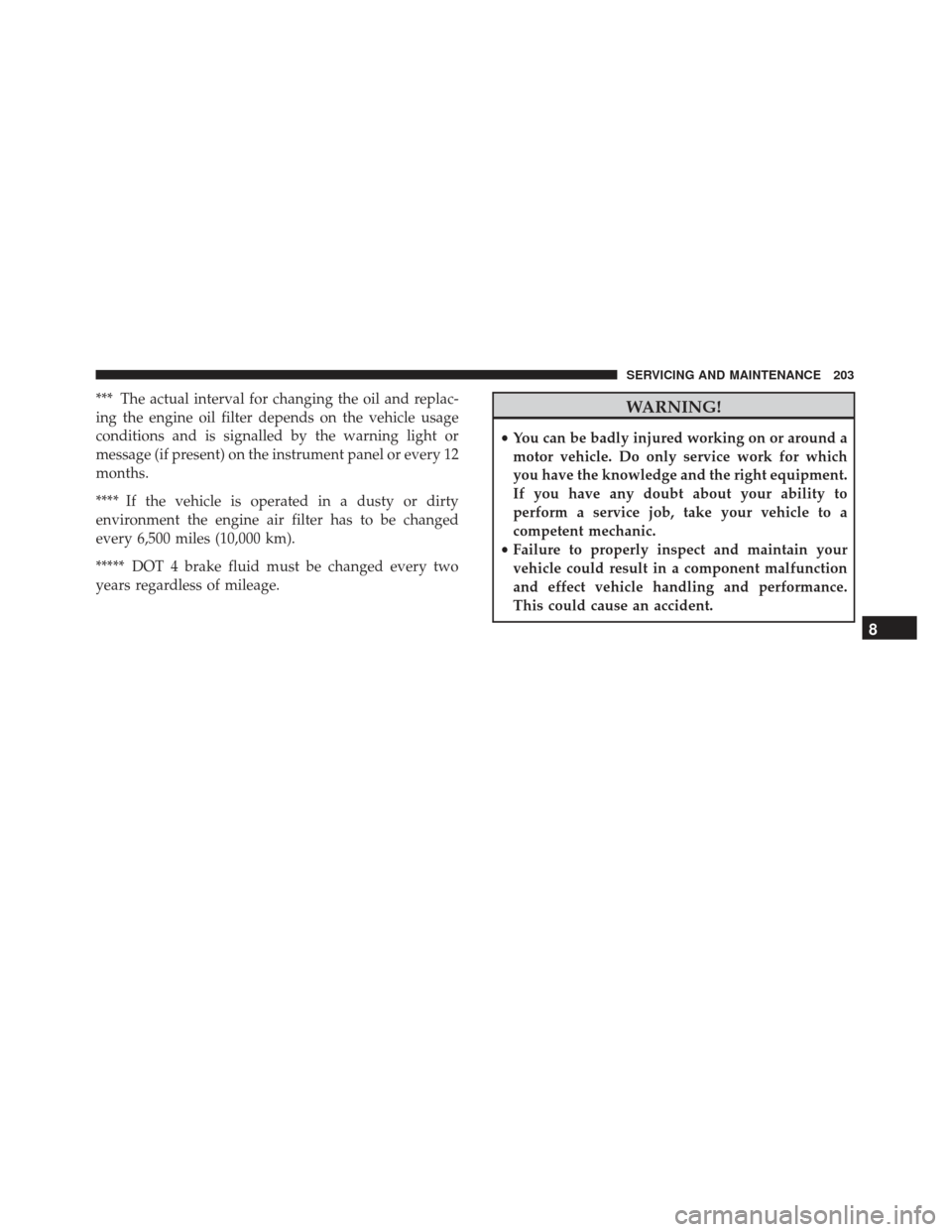
*** The actual interval for changing the oil and replac-
ing the engine oil filter depends on the vehicle usage
conditions and is signalled by the warning light or
message (if present) on the instrument panel or every 12
months.
**** If the vehicle is operated in a dusty or dirty
environment the engine air filter has to be changed
every 6,500 miles (10,000 km).
***** DOT 4 brake fluid must be changed every two
years regardless of mileage.WARNING!
•You can be badly injured working on or around a
motor vehicle. Do only service work for which
you have the knowledge and the right equipment.
If you have any doubt about your ability to
perform a service job, take your vehicle to a
competent mechanic.
• Failure to properly inspect and maintain your
vehicle could result in a component malfunction
and effect vehicle handling and performance.
This could cause an accident.
8
SERVICING AND MAINTENANCE 203
Page 211 of 292
DEALER SERVICE
The pages that follow contain therequiredmaintenance
services determined by the engineers who designed
your vehicle.
Besides those maintenance items specified in the fixed
maintenance schedule, there are other components
which may require servicing or replacement in the
future.
CAUTION!
• Failure to properly maintain your vehicle or per-
form repairs and service when necessary could
result in more costly repairs, damage to other
components or negatively impact vehicle perfor-
mance. Immediately have potential malfunctions
examined by an authorized dealer or qualified
repair center.
• Your vehicle has been built with improved fluids
that protect the performance and durability of
your vehicle and also allow extended mainte-
nance intervals. Do not use chemical flushes in
these components as the chemicals can damage
(Continued)
CAUTION! (Continued)
your engine, transmission, or air conditioning.
Such damage is not covered by the New Vehicle
Limited Warranty. If a flush is needed because of
component malfunction, use only the specified
fluid for the flushing procedure.
Engine Oil
Change Engine Oil
The oil change indicator system will remind you that it
is time to take your vehicle in for scheduled mainte-
nance. Refer to the “Maintenance Plan” for further
information.
NOTE:The actual interval for changing the oil and
replacing the engine oil filter depends on the vehicle
usage conditions and is signalled by the warning light
or message (if present) on the instrument panel or every
12 months.
Engine Oil Selection
For best performance and maximum protection for
turbocharged engines under all types of operating
conditions, the manufacturer recommends synthetic
8
SERVICING AND MAINTENANCE 209
Page 223 of 292
MS.90032) and distilled water for proper corrosion
protection of your engine which contains aluminum
components.
• Make sure that the coolant expansion bottle overflow
hoses are not kinked or obstructed.
• Keep the front of the radiator clean. If your vehicle is
equipped with air conditioning, keep the front of the
condenser clean.
• Do not change the thermostat for Summer or Winter
operation. If replacement is ever necessary, install
ONLY the correct type thermostat. Other designs
may result in unsatisfactory engine coolant (anti-
freeze) performance, poor gas mileage, and increased
emissions.
Brake System
In order to assure brake system performance, all brake
system components should be inspected periodically.
Refer to the “Maintenance Plan” in this section for the
proper maintenance intervals.
WARNING!
Riding the brakes can lead to brake failure and
possibly a collision. Driving with your foot resting
or riding on the brake pedal can result in abnor-
mally high brake temperatures, excessive lining
wear, and possible brake damage. You would not
have your full braking capacity in an emergency.
Brake Master Cylinder
The fluid level in the master cylinder should be checked
when performing under hood services, or immediately
if the “Brake Warning Light” is on.
Be sure to clean the top of the master cylinder area
before removing the cap. If necessary, add fluid to bring
the fluid level up to the requirements described on the
brake fluid reservoir. Fluid level can be expected to fall
as the brake pads wear. The brake fluid level should be
checked when the pads are replaced. However, low
fluid level may be caused by a leak and a checkup may
be needed.
8
SERVICING AND MAINTENANCE 221
Page 242 of 292
WARNING!(Continued)
follow this warning can result in sudden tire fail-
ure. You could lose control and have a collision
resulting in serious injury or death.
NOTE: Wheel Valve Stem must be replaced as well
when installing new tires due to wear and tear in
existing tires.
Keep dismounted tires in a cool, dry place with as little
exposure to light as possible. Protect tires from contact
with oil, grease, and gasoline.
Replacement Tires
The tires on your new vehicle provide a balance of many
characteristics. They should be inspected regularly for
wear and correct cold tire inflation pressures. The manu-
facturer strongly recommends that you use tires equiva-
lent to the originals in size, quality and performance
when replacement is needed. Refer to the paragraph on
“Tread Wear Indicators” in this section. Refer to the Tire
and Loading Information placard or the Vehicle Certifi-
cation Label for the size designation of your tire. The
Load Index and Speed Symbol for your tire will be found
on the original equipment tire sidewall.
See the Tire Sizing Chart example found in the “Tire
Safety Information” section of this manual for more
information relating to the Load Index and Speed
Symbol of a tire.
It is recommended to replace the two front tires or two
rear tires as a pair. Replacing just one tire can seriously
affect your vehicle’s handling. If you ever replace a
wheel, make sure that the wheel’s specifications match
those of the original wheels.
It is recommended you contact an authorized tire dealer
or original equipment dealer with any questions you
may have on tire specifications or capability. Failure to
use equivalent replacement tires may adversely affect
the safety, handling, and ride of your vehicle.
WARNING!
• Do not use a tire, wheel size, load rating, or speed
rating other than that specified for your vehicle.
Some combinations of unapproved tires and
wheels may change suspension dimensions and
performance characteristics, resulting in changes
to steering, handling, and braking of your vehicle.
(Continued)
240 SERVICING AND MAINTENANCE
Page 258 of 292
VEHICLE IDENTIFICATION NUMBER
The Vehicle Identification Number (VIN) is found on
the left front corner of the instrument panel, visible
through the windshield. This number also appears
engraved on an Aluminum plate glued and riveted on
the floor crossmember under the passenger seat.
NOTE:It is illegal to remove or alter the VIN.
BRAKE SYSTEM
Your vehicle is equipped with dual hydraulic brake
systems. If either of the two hydraulic systems loses
normal capability, the remaining system will still func-
tion. However, there will be some loss of overall brak-
ing effectiveness. You may notice increased pedal travel
during application, greater pedal force required to slow
or stop, and potential activation of the “Brake System
Warning Light”.
In the event power assist is lost for any reason (i.e.,
repeated brake applications with the engine off), the
brakes will still function. However, the effort required
to brake the vehicle will be much greater than that
required with the power system operating.
WHEEL AND TIRE TORQUE SPECIFICATIONS
Proper lug nut/bolt torque is very important to ensure
that the wheel is properly mounted to the vehicle. Any
time a wheel has been removed and reinstalled on the
vehicle, the lug nuts/bolts should be torqued using a
properly calibrated torque wrench using a high quality
six sided (hex) deep wall socket.
Vehicle Identification Number
256 TECHNICAL SPECIFICATIONS
Page 260 of 292
WARNING!
To avoid the risk of forcing the vehicle off the jack,
do not tighten the lug nuts/bolts fully until the
vehicle has been lowered. Failure to follow this
warning may result in personal injury.
FUEL REQUIREMENTS — 1750 TURBO
The 1750 turbo engine is designed to
meet all emissions regulations and pro-
vide excellent fuel economy and perfor-
mance when using high-quality premium
unleaded gasoline with an octane rating
of only 91 or higher.
Light spark knock at low engine speeds is not harmful
to your engine. However, continued heavy spark knock
at high speeds can cause damage and immediate ser-
vice is required.
Poor quality gasoline can cause problems such as hard
starting, stalling and hesitations. If you experience these
symptoms, try another brand of gasoline (with the
appropriate octane rating for your engine) before con-
sidering service for the vehicle.
Reformulated Gasoline
Many areas of the country require the use of cleaner
burning gasoline referred to as “Reformulated Gaso-
line”. Reformulated gasoline contains oxygenates and
are specifically blended to reduce vehicle emissions and
improve air quality.
The use of reformulated gasoline is recommended.
Properly blended reformulated gasoline will provide
improved performance and durability of engine and
fuel system components.
Materials Added To Fuel
Besides using unleaded gasoline with the proper octane
rating, gasolines that contain detergents, corrosion and
stability additives are recommended. Using gasolines
that have these additives will help improve fuel
economy, reduce emissions, and maintain vehicle per-
formance. Designated TOP TIER Detergent
Gasoline contains a higher level of
detergents to further aide in mini-
mizing engine and fuel system de-
posits. When available, the usage of
258 TECHNICAL SPECIFICATIONS
Page 274 of 292
the manufacturer’s Service Contract National Customer
Hotline at 1-800-521-9922 (Canadian residents, call
(877) 230-0563 English / (877) 515-9112 French).
The manufacturer will not stand behind any service
contract that is not the manufacturer’s service contract.
It is not responsible for any service contract other than
the manufacturer’s service contract. If you purchased a
service contract that is not a manufacturer’s service
contract, and you require service after the manufactur-
er’s New Vehicle Limited Warranty expires, please refer
to the contract documents, and contact the person listed
in those documents.
We appreciate that you have made a major investment
when you purchased the vehicle. An authorized dealer
has also made a major investment in facilities, tools, and
training to assure that you are absolutely delighted with
the ownership experience. You will be pleased with
their sincere efforts to resolve any warranty issues or
related concerns.WARNING!
Engine exhaust (internal combustion engines only),
some of its constituents, and certain vehicle compo-
nents contain, or emit, chemicals known to the State
of California to cause cancer and birth defects, or
other reproductive harm. In addition, certain fluids
contained in vehicles and certain products of com-
ponent wear contain, or emit, chemicals known to
the State of California to cause cancer and birth
defects, or other reproductive harm.
WARRANTY INFORMATION
See the Warranty Information Booklet for the terms and
provisions of FCA US LLC warranties applicable to this
vehicle and market.
MOPAR PARTS
Mopar fluids, lubricants, parts, and accessories are
available from an authorized dealer. They are recom-
mended for your vehicle in order to help keep the
vehicle operating at its best.
272 CUSTOMER ASSISTANCE