fuel Alfa Romeo 4C Spider 2019 Owner's Manual
[x] Cancel search | Manufacturer: ALFA ROMEO, Model Year: 2019, Model line: 4C Spider, Model: Alfa Romeo 4C Spider 2019Pages: 292, PDF Size: 3.25 MB
Page 63 of 292
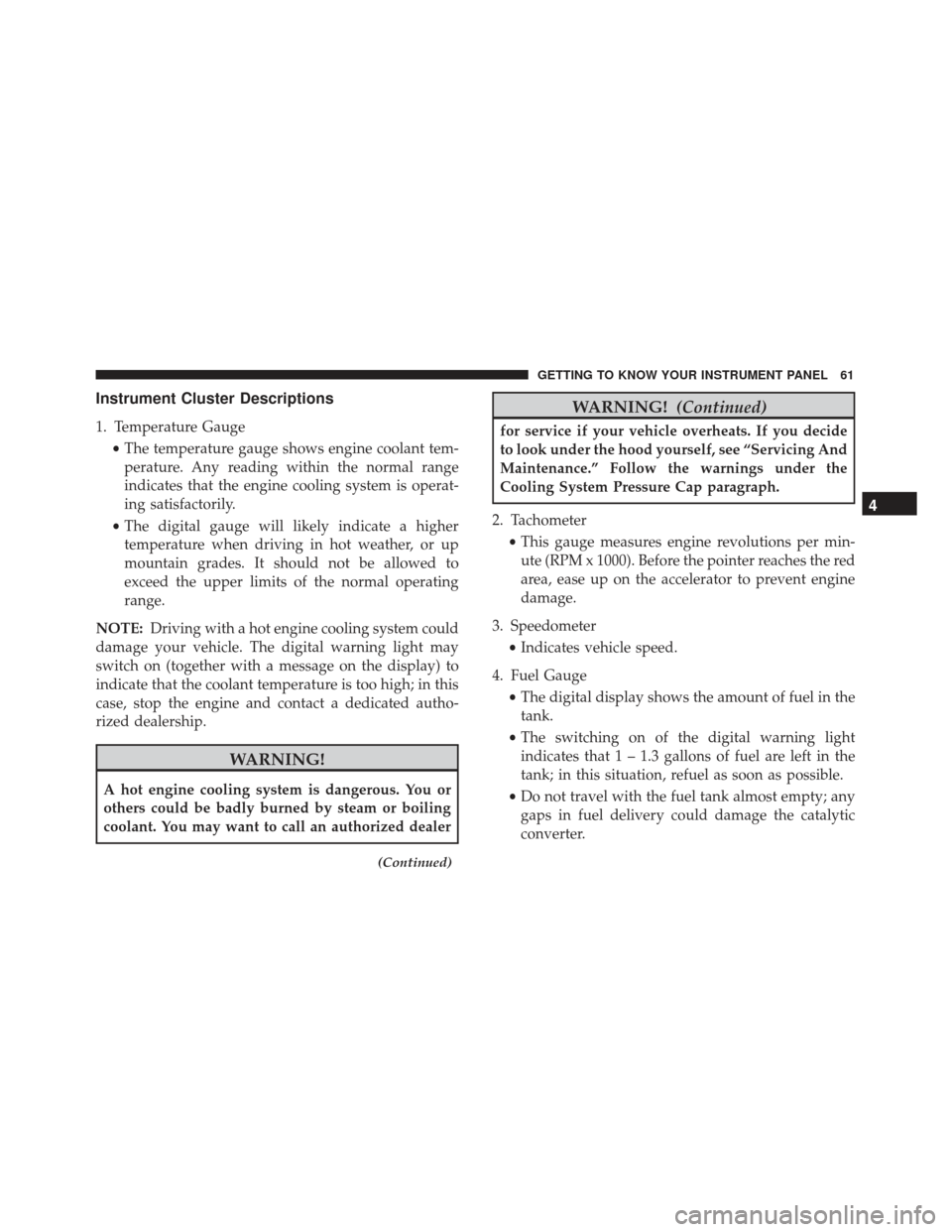
Instrument Cluster Descriptions
1. Temperature Gauge•The temperature gauge shows engine coolant tem-
perature. Any reading within the normal range
indicates that the engine cooling system is operat-
ing satisfactorily.
• The digital gauge will likely indicate a higher
temperature when driving in hot weather, or up
mountain grades. It should not be allowed to
exceed the upper limits of the normal operating
range.
NOTE: Driving with a hot engine cooling system could
damage your vehicle. The digital warning light may
switch on (together with a message on the display) to
indicate that the coolant temperature is too high; in this
case, stop the engine and contact a dedicated autho-
rized dealership.
WARNING!
A hot engine cooling system is dangerous. You or
others could be badly burned by steam or boiling
coolant. You may want to call an authorized dealer
(Continued)
WARNING! (Continued)
for service if your vehicle overheats. If you decide
to look under the hood yourself, see “Servicing And
Maintenance.” Follow the warnings under the
Cooling System Pressure Cap paragraph.
2. Tachometer •This gauge measures engine revolutions per min-
ute (RPM x 1000). Before the pointer reaches the red
area, ease up on the accelerator to prevent engine
damage.
3. Speedometer •Indicates vehicle speed.
4. Fuel Gauge •The digital display shows the amount of fuel in the
tank.
• The switching on of the digital warning light
indicates that 1 – 1.3 gallons of fuel are left in the
tank; in this situation, refuel as soon as possible.
• Do not travel with the fuel tank almost empty; any
gaps in fuel delivery could damage the catalytic
converter.
4
GETTING TO KNOW YOUR INSTRUMENT PANEL 61
Page 64 of 292
•The fuel pump symbol points to the side of
the vehicle where the fuel door is located.
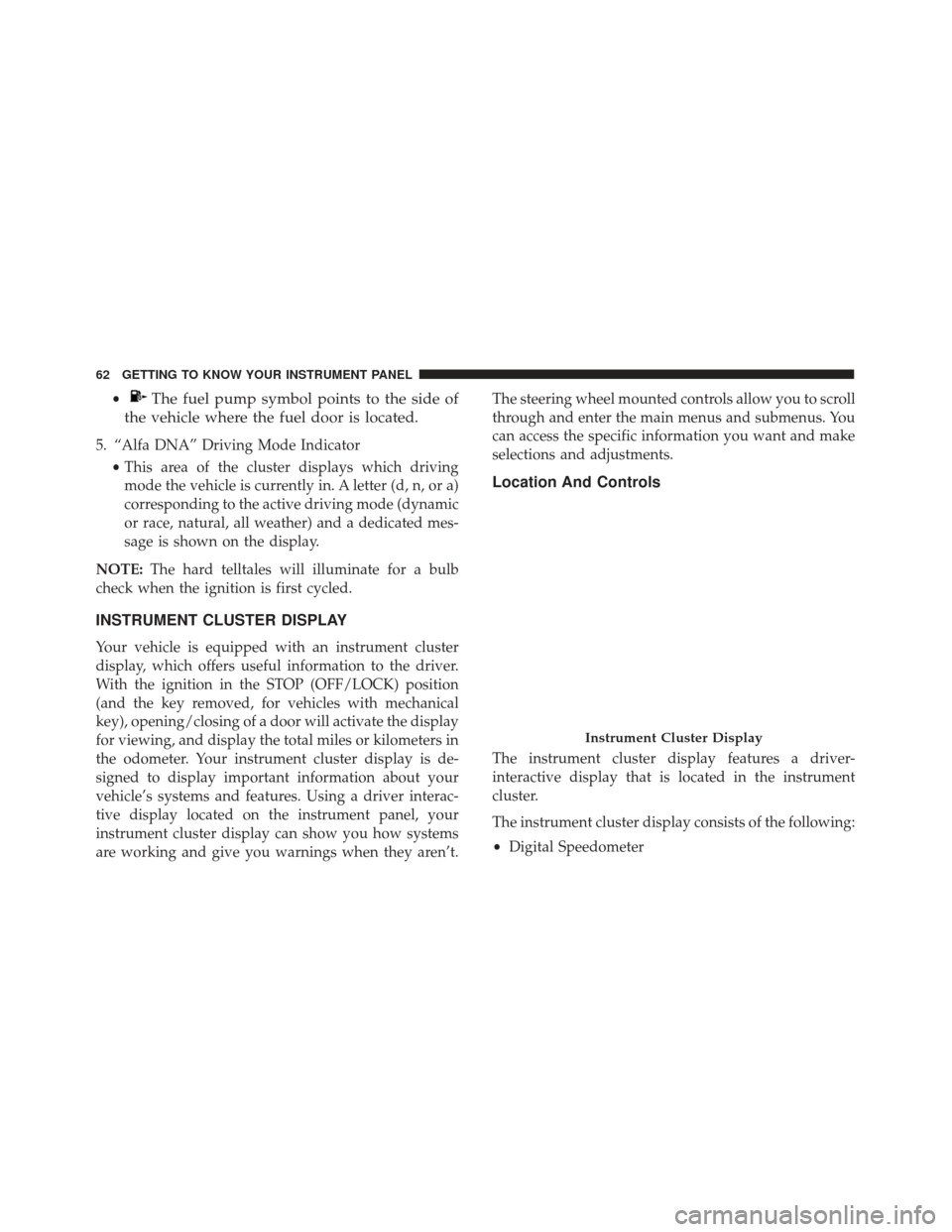
5. “Alfa DNA” Driving Mode Indicator
•This area of the cluster displays which driving
mode the vehicle is currently in. A letter (d, n, or a)
corresponding to the active driving mode (dynamic
or race, natural, all weather) and a dedicated mes-
sage is shown on the display.
NOTE: The hard telltales will illuminate for a bulb
check when the ignition is first cycled.
INSTRUMENT CLUSTER DISPLAY
Your vehicle is equipped with an instrument cluster
display, which offers useful information to the driver.
With the ignition in the STOP (OFF/LOCK) position
(and the key removed, for vehicles with mechanical
key), opening/closing of a door will activate the display
for viewing, and display the total miles or kilometers in
the odometer. Your instrument cluster display is de-
signed to display important information about your
vehicle’s systems and features. Using a driver interac-
tive display located on the instrument panel, your
instrument cluster display can show you how systems
are working and give you warnings when they aren’t. The steering wheel mounted controls allow you to scroll
through and enter the main menus and submenus. You
can access the specific information you want and make
selections and adjustments.
Location And Controls
The instrument cluster display features a driver-
interactive display that is located in the instrument
cluster.
The instrument cluster display consists of the following:
•
Digital Speedometer
Instrument Cluster Display
62 GETTING TO KNOW YOUR INSTRUMENT PANEL
Page 65 of 292
•Vehicle Info
• Fuel Economy Info
• Trip Info
• Screen Setup
• Vehicle Settings
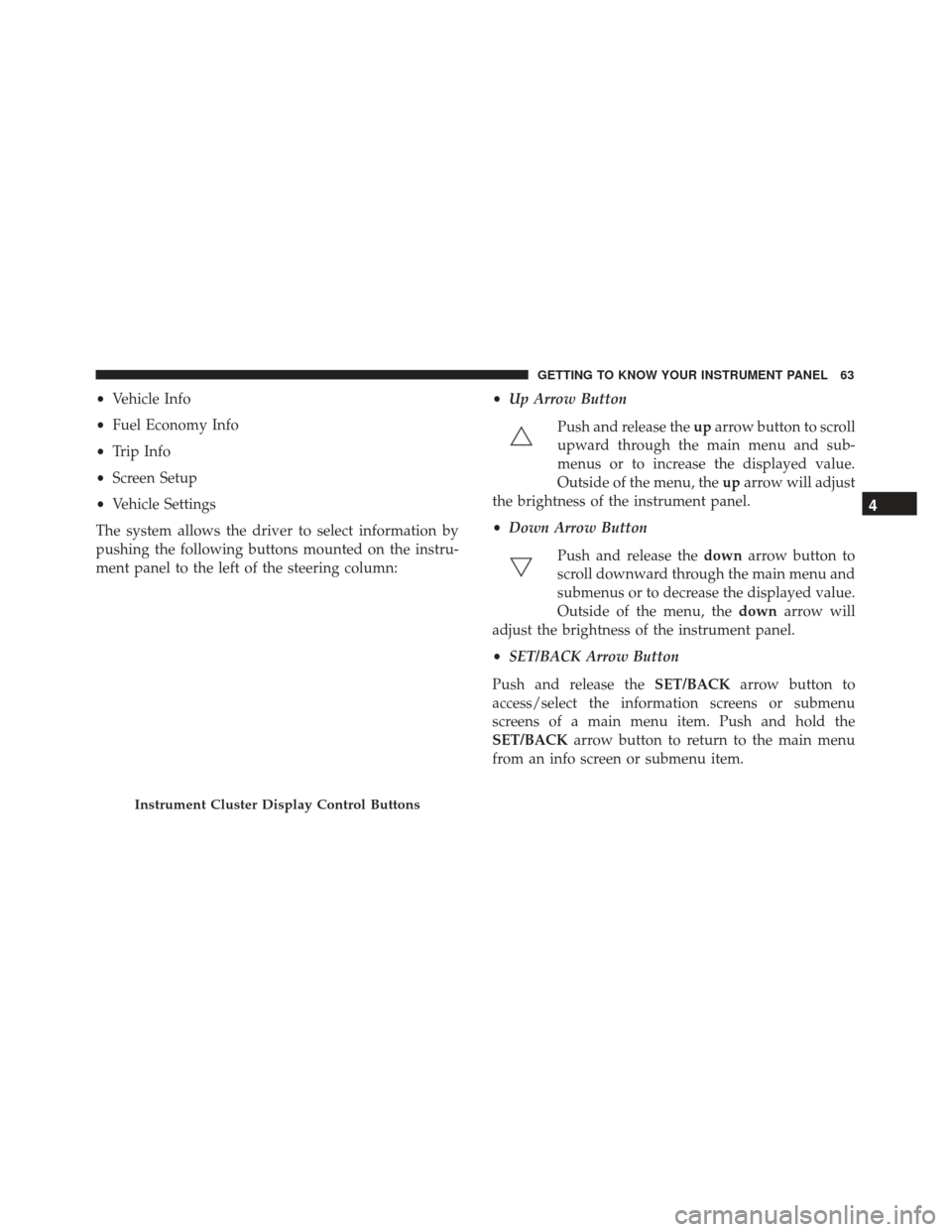
The system allows the driver to select information by
pushing the following buttons mounted on the instru-
ment panel to the left of the steering column: •
Up Arrow Button
Push and release the uparrow button to scroll
upward through the main menu and sub-
menus or to increase the displayed value.
Outside of the menu, the uparrow will adjust
the brightness of the instrument panel.
• Down Arrow Button
Push and release the downarrow button to
scroll downward through the main menu and
submenus or to decrease the displayed value.
Outside of the menu, the downarrow will
adjust the brightness of the instrument panel.
• SET/BACK Arrow Button
Push and release the SET/BACKarrow button to
access/select the information screens or submenu
screens of a main menu item. Push and hold the
SET/BACK arrow button to return to the main menu
from an info screen or submenu item.
Instrument Cluster Display Control Buttons
4
GETTING TO KNOW YOUR INSTRUMENT PANEL 63
Page 70 of 292
4. Push and release theupordown arrow button for
setting.
5. Briefly push the SET/BACKbutton and “day” will
flash on the display.
6. Push and release the upordown button for setting.
NOTE: The setting will increase or decrease by one
unit each time the upordown arrow button is pushed.
Push and hold the upordown arrow button to
increase/decrease the setting rapidly. Save the setting
by briefly pushing the button when you approach the
required setting.
Briefly push the SET/BACKbutton to go back to the
menu screen, or push and hold the SET/BACKbutton
(approximately one second) to go back to the main
screen without storing the settings.
Autoclose
With this function active, the doors will automatically lock
at when the vehicle’s speed exceeds 12 MPH (20 km/h).
To change the setting, proceed as follows:
1. Briefly push the SET/BACKbutton “On” or “Off”
will flash on the display (according to the previous
setting). 2. Push and release the
upordown arrow button for
setting.
3. Briefly push the SET/BACKbutton to go back to the
menu screen, or push and hold the SET/BACK
button (approximately one second) to go back to the
main screen without storing the settings.
Units (Set Units)
This function may be used to set the measurement unit
in three submenus: “Distance,” “Temperature” and
“Fuel Economy.”
To set the required unit, proceed as follows:
1. Briefly push the SET/BACKbutton to display the
three submenus.
2. Push and release the upordown arrow button to
navigate the three submenus.
3. Select the required submenu and then briefly push the SET/BACK button.
4. When accessing the “Distance” submenu, briefly push the SET/BACK button. Either “mi” or “km”
will appear on the display (according to the previous
setting).
68 GETTING TO KNOW YOUR INSTRUMENT PANEL
Page 71 of 292
5. Push and release theupordown arrow button for
setting.
6. Briefly push the SET/BACKbutton to return to the
submenu.
7. When accessing the “Fuel Economy” submenu, briefly push the SET/BACKbutton. Either “mpg,”
“km/l ” or “l/100km” will appear on the display
(according to the previous setting).
If the distance unit set is “mi,” the fuel economy unit
will be displayed in “mpg.”
If the distance unit set is “km,” the fuel economy unit
will be displayed in either km/l or l/100km.
1. Push and release the upordown arrow button for
setting.
2. Briefly push the SET/BACKbutton to return to the
submenu.
3. When accessing the “Temperature” submenu, briefly push the SET/BACK button. Either “°F” or “°C” will
appear on the display (according to the previous
setting). 4. Push and release the
upordown arrow button for
setting.
5. Briefly push the SET/BACKbutton to return to the
submenu.
When you have made the required settings, briefly
push the SET/BACK button to go back to the submenu
screen, or push and hold the SET/BACKbutton (ap-
proximately one second) to go back to the main screen
without storing the settings.
Language (Selecting The Language)
The messages can be displayed in the following lan-
guages: Italian, English (USA), German, Portuguese,
Spanish, French, Chinese, Russian, and Mexican Span-
ish.
To set the required language, proceed as follows:
1. Briefly push the SET/BACKbutton. The previously
set “language” will flash on the display.
2. Push and release the upordown arrow button for
setting.
4
GETTING TO KNOW YOUR INSTRUMENT PANEL 69
Page 74 of 292
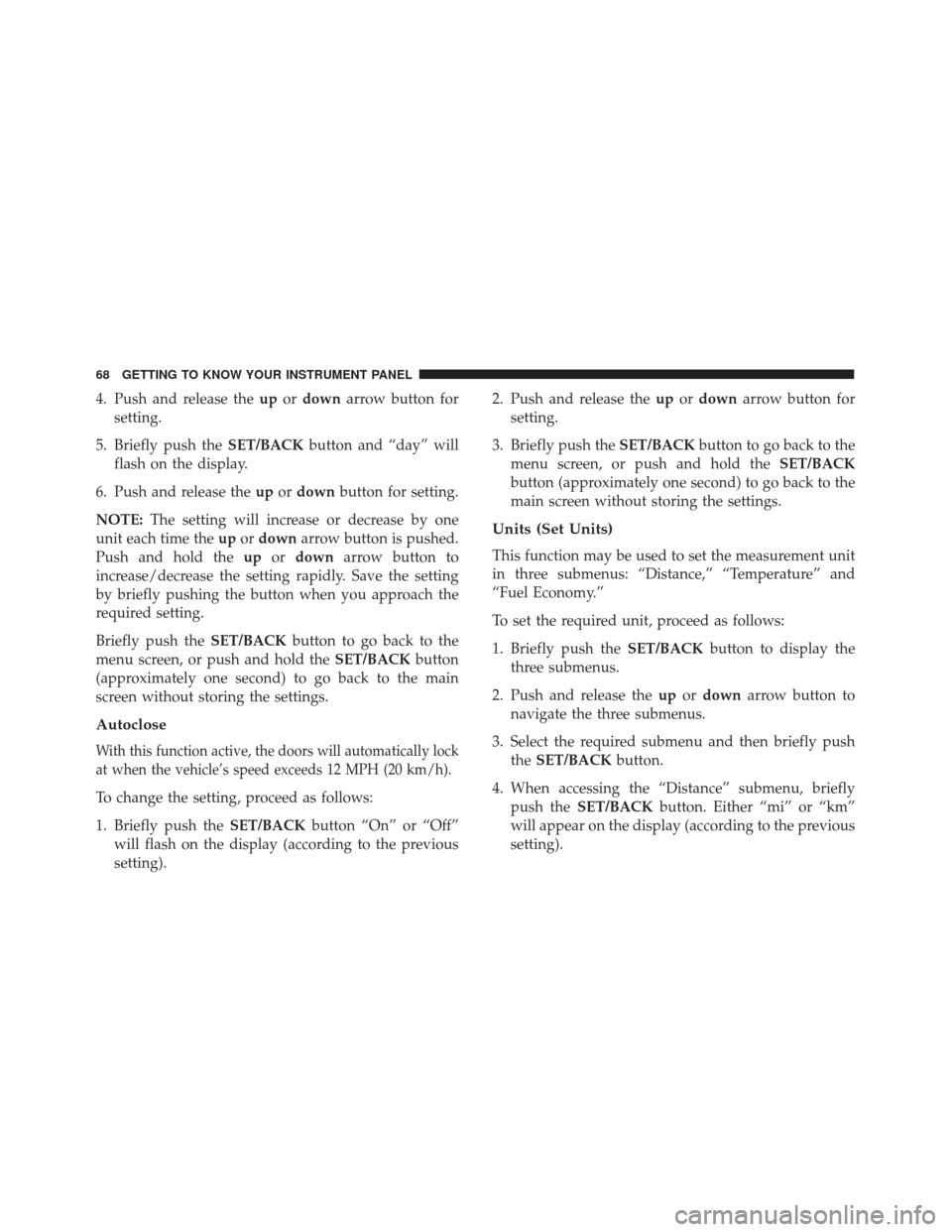
After a few seconds, the name of the selected value is
replaced by the corresponding icon.
Range
This indicates the distance which may be traveled with
the fuel remaining in the tank, assuming that driving
conditions will not change. The message “----” will
appear on the display in the following cases:
•Distance less than 30 miles (or 50 km).
• The vehicle is parked for a long time with the engine
running. NOTE:
The range depends on several factors: driving
style, type of route (freeway, residential, mountain
roads, etc.), conditions of use of the vehicle (load, tire
pressure, etc.). Trip planning must take into account the
above notes.
Average Fuel Consumption
This value shows the approximate average consump-
tion since the last reset.
Travel Distance
This value shows the distance covered since the last
reset.
Current Fuel Consumption
This indicates the fuel consumption. The value is con-
stantly updated. The message “----” will appear on the
display if the vehicle is parked with the engine running.
Average Speed
This value shows the vehicle’s average speed as a
function of the overall time elapsed since the last reset.
Travel Time
This value shows the time elapsed since the last reset.
Instrument Cluster Display
72 GETTING TO KNOW YOUR INSTRUMENT PANEL
Page 75 of 292
Tire Pressure Values
This screen will display OK at each Tire Pressure
Monitoring sensor. Refer to “Tire Pressure Monitoring
System” in “Safety” for further information.
TRIP COMPUTER
The Trip Computer is located in the instrument cluster.
It features a driver-interactive display (displays infor-
mation such as trip information, range, fuel consump-
tion, average speed, and travel time).
NOTE:The Uconnect System also has a Trip Computer
display and menus to customize the information dis-
played in the cluster. For further information, refer to
“Uconnect Settings” in “Multimedia”.
Trip Button
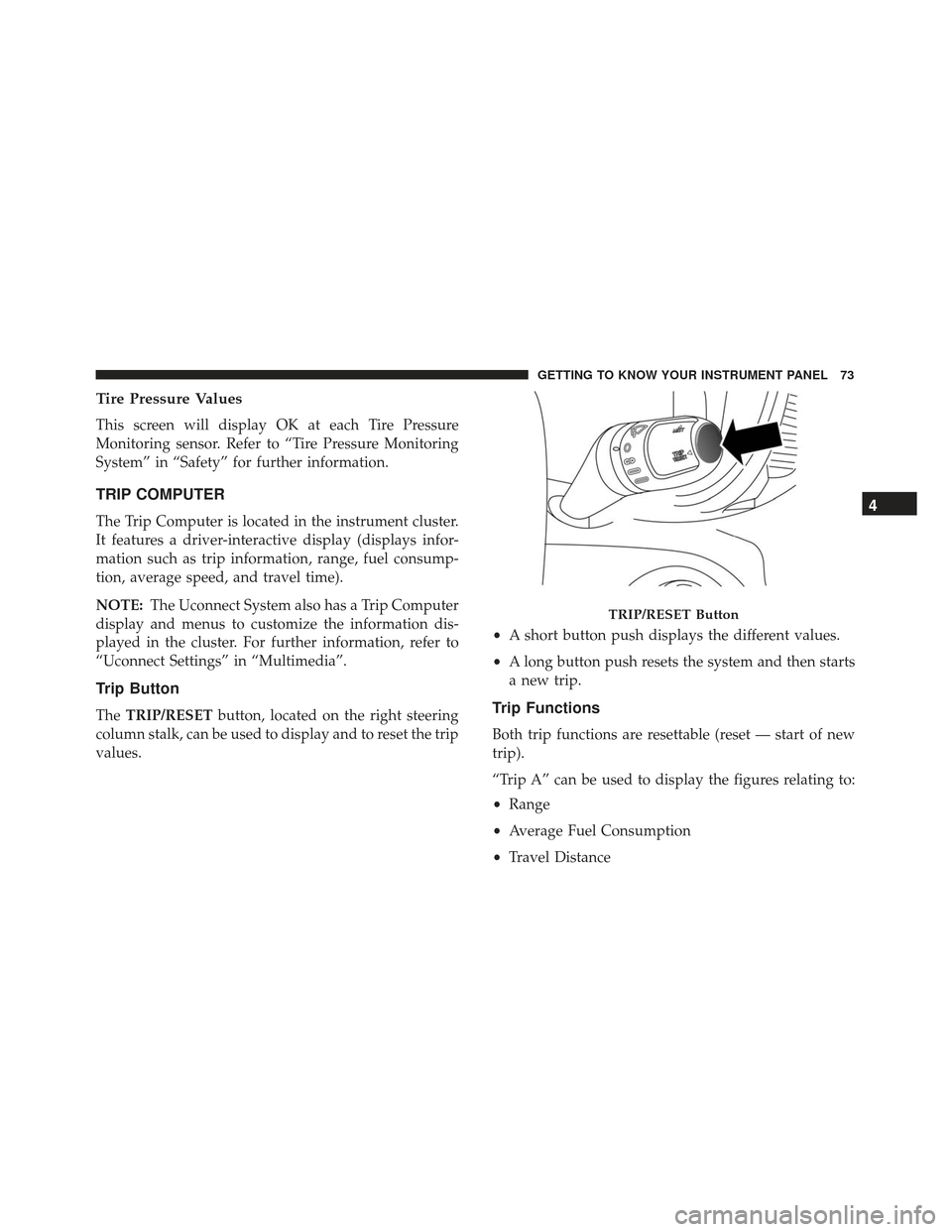
The TRIP/RESET button, located on the right steering
column stalk, can be used to display and to reset the trip
values. •
A short button push displays the different values.
• A long button push resets the system and then starts
a new trip.Trip Functions
Both trip functions are resettable (reset — start of new
trip).
“Trip A” can be used to display the figures relating to:
• Range
• Average Fuel Consumption
• Travel Distance
TRIP/RESET Button
4
GETTING TO KNOW YOUR INSTRUMENT PANEL 73
Page 76 of 292
•Current Fuel Consumption
• Average Speed
• Travel Time
“Trip B” can be used to display the figures relating to:
• Average Fuel Consumption
• Travel Distance
• Average Speed
• Travel Time
NOTE: “Trip B” functions may be excluded (see “Trip
B Data”). “Range” and “Instantaneous Fuel Consump-
tion” cannot be reset.
New Trip
To reset:
• Push and hold the TRIPbutton to reset the system
manually.
• When the “Trip distance” reaches 99999.9 kilometers
(621370 miles) or when the “Travel time” reaches
99.59 (99 hours and 59 minutes), the system is reset
automatically. •
Disconnecting/Reconnecting the battery resets the
system.
NOTE: If the reset operation occurs in the presence of
the screens concerning Trip A or Trip B, only the
information associated with Trip A or Trip B functions
will be reset.
Start Of Trip Procedure
With the ignition on, push and hold the TRIPbutton for
over two seconds to reset trip information.
Exit Trip
To exit the Trip function, wait until all the values have
been displayed or hold the MENUbutton for longer
than one second.
Briefly push and release the MENUbutton to go back to
the menu screen or push and hold the MENU(approxi-
mately one second) to go back to the main screen
without storing settings.
WARNING LIGHTS AND MESSAGES
The warning/indicator lights will illuminate in the
instrument panel together with a dedicated message
and/or acoustic signal when applicable. These indica-
tions are indicative and precautionary and as such must
74 GETTING TO KNOW YOUR INSTRUMENT PANEL
Page 80 of 292
vehicle. If the temperature reading does not return to
normal, turn the engine off immediately and call for
service.
Refer to “If Your Engine Overheats” in “In Case Of
Emergency” for further information.
Yellow Warning Lights
— Tire Pressure Monitoring System (TPMS)
Warning Light
The warning light switches on and a message is dis-
played to indicate that the tire pressure is lower than
the recommended value and/or that slow pressure loss
is occurring. In these cases, optimal tire duration and
fuel consumption may not be guaranteed.
Should one or more tires be in the condition mentioned
above, the display will show the indications corre-
sponding to each tire.
CAUTION!
Do not continue driving with one or more flat tires
as handling may be compromised. Stop the vehicle,
(Continued)
CAUTION! (Continued)
avoiding sharp braking and steering. If a tire punc-
ture occurs, repair immediately using the dedicated
tire repair kit and contact an authorized dealer as
soon as possible.
Each tire, including the spare (if provided), should be
checked monthly when cold and inflated to the inflation
pressure recommended by the vehicle manufacturer on
the vehicle placard or tire inflation pressure label. (If
your vehicle has tires of a different size than the size
indicated on the vehicle placard or tire inflation pres-
sure label, you should determine the proper tire infla-
tion pressure for those tires.)
As an added safety feature, your vehicle has been
equipped with a Tire Pressure Monitoring System
(TPMS) that illuminates a low tire pressure telltale
when one or more of your tires is significantly under-
inflated. Accordingly, when the low tire pressure telltale
illuminates, you should stop and check your tires as
soon as possible, and inflate them to the proper pres-
sure. Driving on a significantly under-inflated tire
causes the tire to overheat and can lead to tire failure.
78 GETTING TO KNOW YOUR INSTRUMENT PANEL
Page 81 of 292
Under-inflation also reduces fuel efficiency and tire
tread life, and may affect the vehicle’s handling and
stopping ability.
Please note that the TPMS is not a substitute for proper
tire maintenance, and it is the driver ’s responsibility to
maintain correct tire pressure, even if under-inflation
has not reached the level to trigger illumination of the
TPMS low tire pressure telltale.
Your vehicle has also been equipped with a TPMS
malfunction indicator to indicate when the system is
not operating properly. The TPMS malfunction indica-
tor is combined with the low tire pressure telltale. When
the system detects a malfunction, the telltale will flash
for approximately one minute and then remain continu-
ously illuminated. This sequence will continue upon
subsequent vehicle start-ups as long as the malfunction
exists. When the malfunction indicator is illuminated,
the system may not be able to detect or signal low tire
pressure as intended. TPMS malfunctions may occur for
a variety of reasons, including the installation of re-
placement or alternate tires or wheels on the vehicle
that prevent the TPMS from functioning properly. Al-
ways check the TPMS malfunction telltale after replac-
ing one or more tires or wheels on your vehicle toensure that the replacement or alternate tires and
wheels allow the TPMS to continue to function prop-
erly.
CAUTION!
The TPMS has been optimized for the original
equipment tires and wheels. TPMS pressures and
warning have been established for the tire size
equipped on your vehicle. Undesirable system op-
eration or sensor damage may result when using
replacement equipment that is not of the same size,
type, and/or style. Aftermarket wheels can cause
sensor damage. Using aftermarket tire sealants may
cause the Tire Pressure Monitoring System (TPMS)
sensor to become inoperable. After using an after-
market tire sealant it is recommended that you take
your vehicle to your authorized dealer to have your
sensor function checked.
— Anti-Lock Brake (ABS) Warning Light
This light monitors the Anti-Lock Brake System (ABS).
The light will turn on when the ignition is placed in the
ON/RUN or MAR/ON/RUN position and may stay
on for as long as four seconds.
4
GETTING TO KNOW YOUR INSTRUMENT PANEL 79