fuel Alfa Romeo Giulia 2016 User Guide
[x] Cancel search | Manufacturer: ALFA ROMEO, Model Year: 2016, Model line: Giulia, Model: Alfa Romeo Giulia 2016Pages: 204, PDF Size: 4.95 MB
Page 62 of 204
Symbol What it means
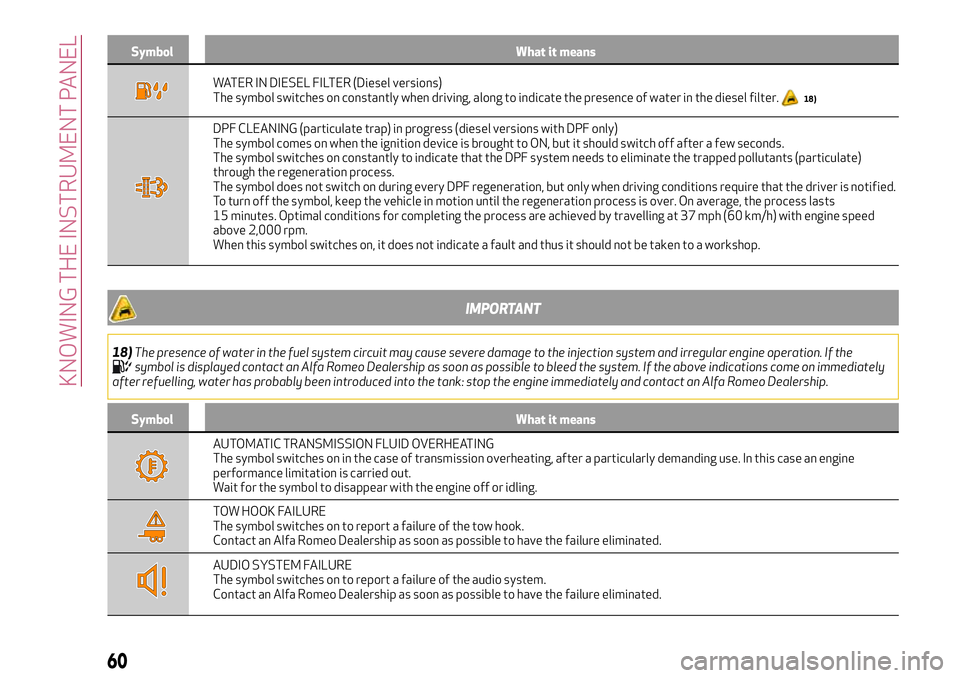
WATER IN DIESEL FILTER (Diesel versions)
The symbol switches on constantly when driving, along to indicate the presence of water in the diesel filter.18)
DPF CLEANING (particulate trap) in progress (diesel versions with DPF only)
The symbol comes on when the ignition device is brought to ON, but it should switch off after a few seconds.
The symbol switches on constantly to indicate that the DPF system needs to eliminate the trapped pollutants (particulate)
through the regeneration process.
The symbol does not switch on during every DPF regeneration, but only when driving conditions require that the driver is notified.
To turn off the symbol, keep the vehicle in motion until the regeneration process is over. On average, the process lasts
15 minutes. Optimal conditions for completing the process are achieved by travelling at 37 mph (60 km/h) with engine speed
above 2,000 rpm.
When this symbol switches on, it does not indicate a fault and thus it should not be taken to a workshop.
IMPORTANT
18)The presence of water in the fuel system circuit may cause severe damage to the injection system and irregular engine operation. If thesymbol is displayed contact an Alfa Romeo Dealership as soon as possible to bleed the system. If the above indications come on immediately
after refuelling, water has probably been introduced into the tank: stop the engine immediately and contact an Alfa Romeo Dealership.
Symbol What it means
AUTOMATIC TRANSMISSION FLUID OVERHEATING
The symbol switches on in the case of transmission overheating, after a particularly demanding use. In this case an engine
performance limitation is carried out.
Wait for the symbol to disappear with the engine off or idling.
TOW HOOK FAILURE
The symbol switches on to report a failure of the tow hook.
Contact an Alfa Romeo Dealership as soon as possible to have the failure eliminated.
AUDIO SYSTEM FAILURE
The symbol switches on to report a failure of the audio system.
Contact an Alfa Romeo Dealership as soon as possible to have the failure eliminated.
60
KNOWING THE INSTRUMENT PANEL
Page 63 of 204
Symbol What it means
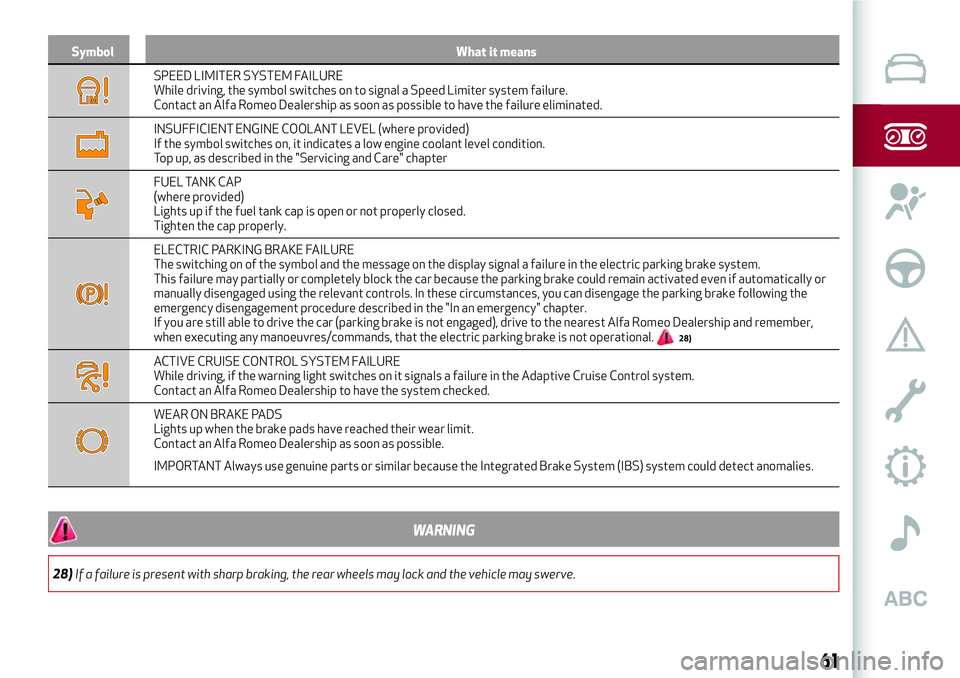
SPEED LIMITER SYSTEM FAILURE
While driving, the symbol switches on to signal a Speed Limiter system failure.
Contact an Alfa Romeo Dealership as soon as possible to have the failure eliminated.
INSUFFICIENT ENGINE COOLANT LEVEL (where provided)
If the symbol switches on, it indicates a low engine coolant level condition.
Top up, as described in the "Servicing and Care" chapter
FUEL TANK CAP
(where provided)
Lights up if the fuel tank cap is open or not properly closed.
Tighten the cap properly.
ELECTRIC PARKING BRAKE FAILURE
The switching on of the symbol and the message on the display signal a failure in the electric parking brake system.
This failure may partially or completely block the car because the parking brake could remain activated even if automatically or
manually disengaged using the relevant controls. In these circumstances, you can disengage the parking brake following the
emergency disengagement procedure described in the "In an emergency" chapter.
If you are still able to drive the car (parking brake is not engaged), drive to the nearest Alfa Romeo Dealership and remember,
when executing any manoeuvres/commands, that the electric parking brake is not operational.
28)
ACTIVE CRUISE CONTROL SYSTEM FAILURE
While driving, if the warning light switches on it signals a failure in the Adaptive Cruise Control system.
Contact an Alfa Romeo Dealership to have the system checked.
WEAR ON BRAKE PADS
Lights up when the brake pads have reached their wear limit.
Contact an Alfa Romeo Dealership as soon as possible.
IMPORTANT Always use genuine parts or similar because the Integrated Brake System (IBS) system could detect anomalies.
WARNING
28)If a failure is present with sharp braking, the rear wheels may lock and the vehicle may swerve.
61
Page 68 of 204
ACTIVE SAFETYSYSTEMS
The vehicle may be equipped with the
following active safety devices:
ABS (Anti-Lock Brakes);
DTC (Drive Train Control);
ESC (Electronic Stability Control);
TC (Traction Control);
PBA (Panic Brake Assist);
HSA (Hill Start Assist);
AST (Alfa™ Steering Torque);
ATV (Alfa™ Active Torque Vectoring).
For the operation of the systems, see the
following pages.
ABS (Anti-lock Braking System)
This system, which is an integral part of
the braking system, prevents one or more
wheels from locking and slipping in all
road surface conditions, irrespective of
the intensity of the braking action,
ensuring that the vehicle can be
controlled even during emergency
braking and optimising stopping
distances.
The system intervenes during braking
when the wheels are about to lock,
typically in emergency braking or
low-grip conditions, when locking may be
more frequent.
The system also improves control and
stability of the vehicle when braking on a
surface where the grip of the left and
right wheels varies, or on corners.The Electronic Braking Force Distribution
(EBD) system completes the system
allowing the brake force to be distributed
between the front and rear wheels.
System intervention
The ABS equipped on this vehicle is
provided with the "Brake by wire"
(Integrated Brake System - IBS) function.
With this system, the brake pedal command
given by pressing the brake pedal is not
transmitted hydraulically but electronically,
therefore, the light pulsation that could be
felt on the pedal with the traditional system
is no longer perceptible.
30) 31) 32) 33) 34) 35)
DTC (Drive Train Control)SYSTEM(where provided)
Some versions of this vehicle are
equipped with a four-wheel drive system
(AWD), activated on request, which offers
an optimal drive for countless driving
conditions and road surfaces. The system
reduces the slipping of the tyres to a
minimum, automatically redistributing
the torque to the front and rear wheels,
as needed.
To maximize fuel savings, the vehicle with
AWD automatically passes to rear
four-wheel drive (RWD) when the road
and environmental conditions are such
that they wouldn't cause the tyres to slip.
When the road and environmentalconditions require better traction, the
vehicle automatically goes to AWD mode.
36)
The driving mode, RWD or AWD, is shown
on the instrument panel display.
IMPORTANT If the system failure symbol
switches on, after starting the engine or
while driving, it means that the AWD
system is not working properly. If the
warning message activates frequently, it
is recommended to carry out the
maintenance operations.
37)
ESC (Electronic Stability Control)
SYSTEM
The ESC system improves the directional
control and stability of the car in various
driving conditions.
The ESC system corrects the car’s
understeer and oversteer, distributing
the brake force on the appropriate
wheels. The torque supplied by the
engine can also be reduced in order to
maintain control of the vehicle.
The ESC system uses sensors installed
on the car to determine the trajectory
that the driver intends to follow and
compares it with the car’s effective
trajectory. When the real trajectory
deviates from the desired trajectory, the
ESC system intervenes to counter the
vehicle’s understeer or oversteer.
66
SAFETY
Page 103 of 204
Let’s get to the core of the vehicle: seeing how you can exploit all
of its potential to the full. We’ll look at how to drive it safely in any
situation, so that it can be a welcome companion, with our comfort
and our wallets in mind.
STARTING AND DRIVING
STARTING THE ENGINE..........................102
ELECTRIC PARKING BRAKE . ......................103
MANUAL GEARBOX . ...........................105
AUTOMATIC TRANSMISSION......................106
"ALFA DNA™" SYSTEM..........................109
START&STOPEVO............................110
SPEED LIMITER..............................111
CRUISE CONTROL.............................112
PARK SENSORS SYSTEM........................113
LANE DEPARTURE WARNING (LDW) SYSTEM............116
REAR BACK-UP CAMERA / DYNAMIC GRIDLINES . ........117
REFUELLING THE VEHICLE . . .....................118
Page 105 of 204
31)When the engine stopped never leave
the ignition device in the ON position to
prevent useless current draw from draining
the battery.
32)Warning light
will flash after starting
or during prolonged cranking to indicate a
fault with the glow plug heating system. If
the engine starts, the vehicle can be regularly
used, but an Alfa Romeo Dealership must be
contacted as soon as possible.
33)A quick burst on the accelerator before
turning off the engine serves absolutely no
practical purpose; it wastes fuel and is
damaging for the engine.
ELECTRIC PARKING BRAKE
The vehicle is equipped with electric
parking brake to guarantee better use
and optimal performance compared to a
manually operated parking brake.
The electric parking brake features a
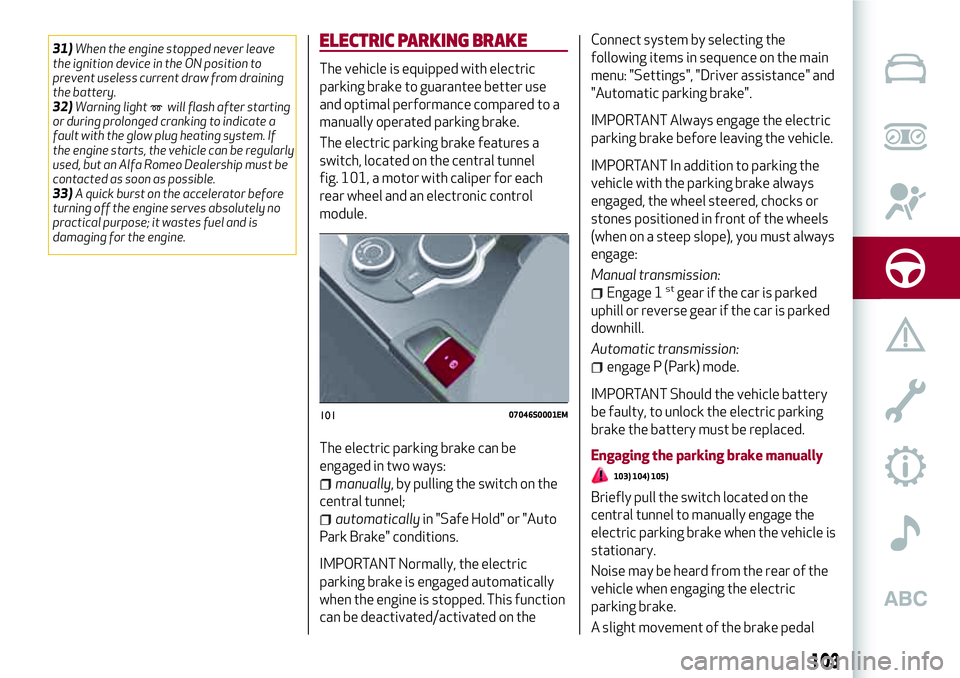
switch, located on the central tunnel
fig. 101, a motor with caliper for each
rear wheel and an electronic control
module.
The electric parking brake can be
engaged in two ways:
manually, by pulling the switch on the
central tunnel;
automaticallyin "Safe Hold" or "Auto
Park Brake" conditions.
IMPORTANT Normally, the electric
parking brake is engaged automatically
when the engine is stopped. This function
can be deactivated/activated on theConnect system by selecting the
following items in sequence on the main
menu: "Settings", "Driver assistance" and
"Automatic parking brake".
IMPORTANT Always engage the electric
parking brake before leaving the vehicle.
IMPORTANT In addition to parking the
vehicle with the parking brake always
engaged, the wheel steered, chocks or
stones positioned in front of the wheels
(when on a steep slope), you must always
engage:
Manual transmission:
Engage 1stgear if the car is parked
uphill or reverse gear if the car is parked
downhill.
Automatic transmission:
engage P (Park) mode.
IMPORTANT Should the vehicle battery
be faulty, to unlock the electric parking
brake the battery must be replaced.
Engaging the parking brake manually
103) 104) 105)
Briefly pull the switch located on the
central tunnel to manually engage the
electric parking brake when the vehicle is
stationary.
Noise may be heard from the rear of the
vehicle when engaging the electric
parking brake.
A slight movement of the brake pedal
10107046S0001EM
103
Page 111 of 204
"ALFA DNA™"SYSTEM
"ALFA DNA™"SYSTEM
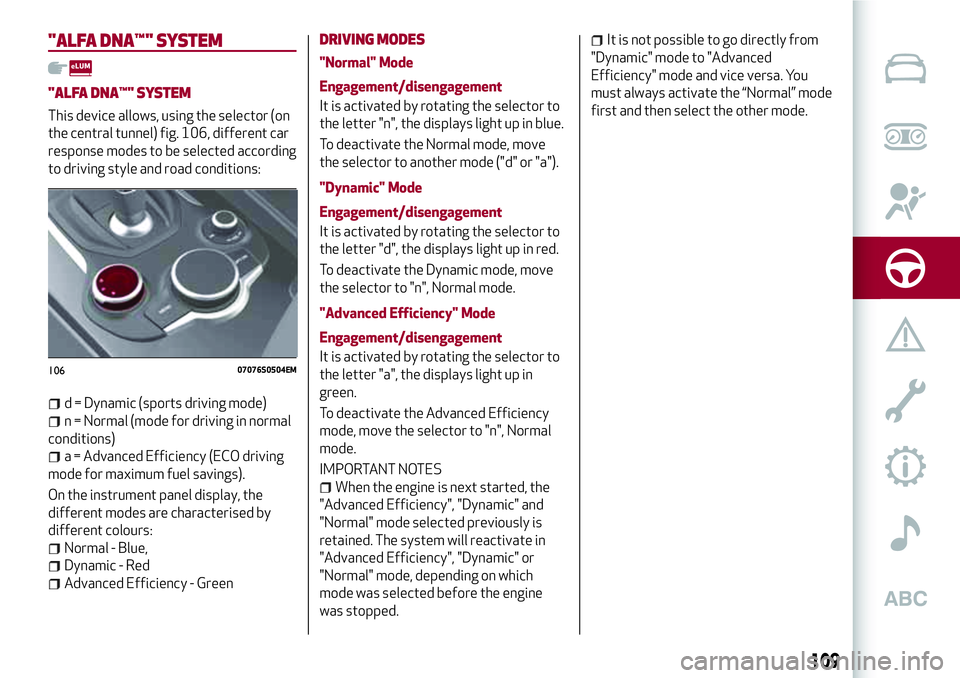
This device allows, using the selector (on
the central tunnel) fig. 106, different car
response modes to be selected according
to driving style and road conditions:
d = Dynamic (sports driving mode)
n = Normal (mode for driving in normal
conditions)
a = Advanced Efficiency (ECO driving
mode for maximum fuel savings).
On the instrument panel display, the
different modes are characterised by
different colours:
Normal - Blue,
Dynamic - Red
Advanced Efficiency - Green
DRIVING MODES
"Normal" Mode
Engagement/disengagement
It is activated by rotating the selector to
the letter "n", the displays light up in blue.
To deactivate the Normal mode, move
the selector to another mode ("d" or "a").
"Dynamic" Mode
Engagement/disengagement
It is activated by rotating the selector to
the letter "d", the displays light up in red.
To deactivate the Dynamic mode, move
the selector to "n", Normal mode.
"Advanced Efficiency" Mode
Engagement/disengagement
It is activated by rotating the selector to
the letter "a", the displays light up in
green.
To deactivate the Advanced Efficiency
mode, move the selector to "n", Normal
mode.
IMPORTANT NOTES
When the engine is next started, the
"Advanced Efficiency", "Dynamic" and
"Normal" mode selected previously is
retained. The system will reactivate in
"Advanced Efficiency", "Dynamic" or
"Normal" mode, depending on which
mode was selected before the engine
was stopped.
It is not possible to go directly from
"Dynamic" mode to "Advanced
Efficiency" mode and vice versa. You
must always activate the “Normal” mode
first and then select the other mode.
10607076S0504EM
109
Page 120 of 204
The table below shows the approximate
distances for each area fig. 115:
ZoneDistance from the
rear of the vehicle
Red 0 ÷ 11.8 in (30 cm)
Yellow11.8 in
(30 cm) ÷ 3.3
ft (1 m)
Green 3.3 ft (1 m) or more
IMPORTANT When parking, take the
utmost care over obstacles that may be
above or under the camera range. of the
video cam.
WARNING
115)Parking and other potentially
dangerous manoeuvres are, however,
always the driver’s responsibility. While
carrying out these manoeuvres, always
make sure that no people (especially
children) or animals are in the area
concerned. The camera is an aid for the
driver, but the driver must never allow
his/her attention to lapse during potentially
dangerous manoeuvres, even those
executed at low speeds. Always keep a slow
speed, so as to promptly brake in the case of
obstacles.
IMPORTANT
47)It is vital, for correct operation, that the
camera is always kept clean and free from
any mud, dirt, snow or ice. Be careful not to
scratch or damage the camera while cleaning
it. Avoid using dry, rough or hard cloths. The
camera must be washed using clean water,
with the addition of car shampoo if
necessary. In washing stations which use
steam or high-pressure jets, clean the
camera quickly, keeping the nozzle more
than 10 cm away from the sensors. Also, do
not apply stickers to the camera.
REFUELLING THE VEHICLE
Always stop the engine before refuelling.
PETROL ENGINES
Only use unleaded petrol with a number
of octanes (R.O.N.) not lower than 95
(EN228 specification).
116) 117) 118)
DIESEL ENGINES
Only use Diesel for motor vehicles
(EN590 specification).
REFUELLING PROCEDURE
The fuel flap is unlocked when the central
door locking system is released, while it
is automatically locked when the central
locking system is applied.
Opening the flap
To refuel proceed as follows:
open flap fig. 116, pressing on the
point shown by the arrow;
remove the closing cap;
introduce the dispenser in the filler
and refuel;
118
STARTING AND DRIVING
Page 121 of 204
after refuelling, before removing the
dispenser, wait for at least 10 seconds in
order for the fuel to flow inside the tank;
then remove the dispenser from the
filler, close the plug and then close the
flap.
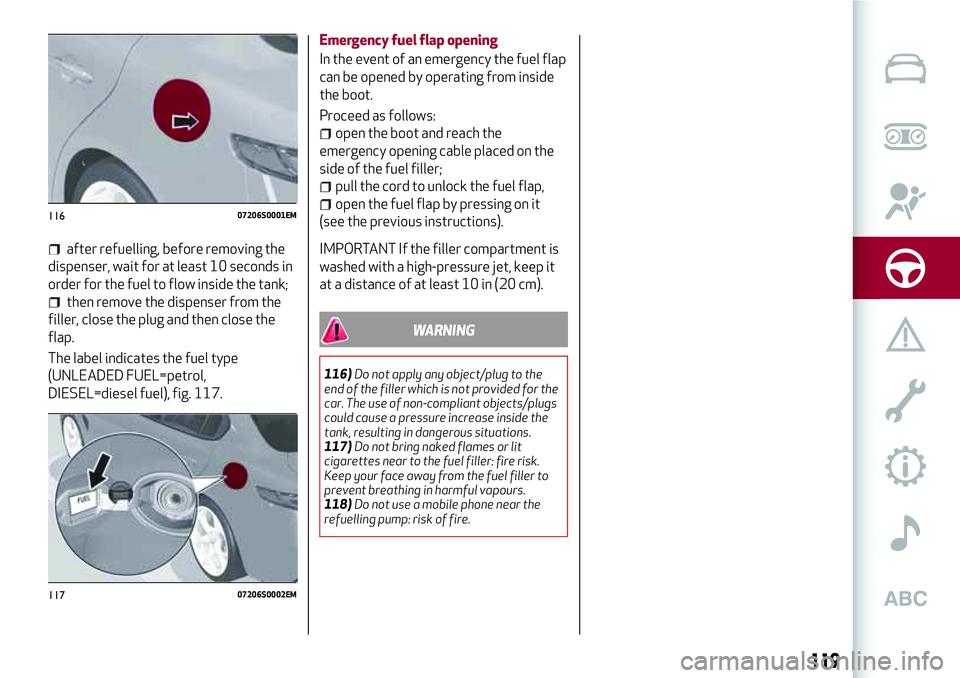
The label indicates the fuel type
(UNLEADED FUEL=petrol,
DIESEL=diesel fuel), fig. 117.Emergency fuel flap opening
In the event of an emergency the fuel flap
can be opened by operating from inside
the boot.
Proceed as follows:
open the boot and reach the
emergency opening cable placed on the
side of the fuel filler;
pull the cord to unlock the fuel flap,
open the fuel flap by pressing on it
(see the previous instructions).
IMPORTANT If the filler compartment is
washed with a high-pressure jet, keep it
at a distance of at least 10 in (20 cm).
WARNING
116)Do not apply any object/plug to the
end of the filler which is not provided for the
car. The use of non-compliant objects/plugs
could cause a pressure increase inside the
tank, resulting in dangerous situations.
117)Do not bring naked flames or lit
cigarettes near to the fuel filler: fire risk.
Keep your face away from the fuel filler to
prevent breathing in harmful vapours.
118)Do not use a mobile phone near the
refuelling pump: risk of fire.
11607206S0001EM
11707206S0002EM
119
Page 123 of 204
A punctured tyre or a burnt-out bulb?
At times, a problem may interfere with our journey.
The pages on emergencies can help you to deal with critical
situations independently and with calm.
In an emergency we recommend that you call the freephone
number found in the Warranty Booklet.
It is also possible to call the national or international universal
freephone number to search for the nearest Alfa Romeo
Dealership.
IN AN EMERGENCY
HAZARD WARNING LIGHTS.......................122
REPLACING A BULB............................122
REPLACING FUSES . ...........................127
TIRE REPAIR KIT . .............................132
EMERGENCY STARTING.........................134
FUEL CUT-OFF SYSTEM.........................137
BROKEN-DOWN VEHICLE TOWING . . ................138
TOWING THE VEHICLE ..........................138
Page 138 of 204
Cable connection
54)
Proceed as follows to carry out a jump
starting:
connect a terminal on the end of the
positive cable from the remote positive
pole (+) of the car with flat battery;
connect the terminal on the opposite
end of the positive (+) cable to the
positive (+) pole of the auxiliary battery;
connect a negative cable end terminal
to the negative (-) pole of the auxiliary
battery;
connect the terminal on the opposite
end of the negative (-) cable to the earth
point (-) on the vehicle with the battery
flat;
start the engine of the car with an
auxiliary battery, let it run for some
minutes at idle and then start the engine
of the car with flat battery. In case a
portable battery is used, before starting
the vehicle, wait a few seconds after
completing the connection.
Cable disconnection
Once the engine is started, remove the
connection cables in reverse sequence,
as shown below:
disconnect the negative cable end
terminal (-) from the earth point (-) of the
car with flat battery;
disconnect the terminal on the
opposite end of the negative cable fromthe negative (-) pole of the auxiliary
battery;
disconnect the terminal on the
opposite end of the positive (+) cable
from the positive (+) pole of the auxiliary
battery;
disconnect the terminal on the end of
the positive cable from the remote
positive pole (+) of the car with flat
battery.
WARNING
136)Do not get too close to the radiator
cooling fan: the electric fan may start;
danger of injury. Scarves, ties and other
loose clothing might be pulled by moving
parts.
137)Remove any metal objects (e.g. rings,
watches, bracelets), that might cause an
accidental electrical contact and cause
serious injury.
138)The batteries contain acid that can
burn skin or eyes. Batteries produce
hydrogen, which is easily flammable and
explosive. Thus keep away flames or devices
which may cause sparks.
IMPORTANT
53)Never use a fast battery-charger to
start the engine as this could damage the
electronic systems of your vehicle,
particularly the ignition and engine fuel
supply control units.54)Do not connect the cable to the negative
terminal (–) of the flat battery. The following
spark could lead to battery explosion and
cause serious harm. Only use the specific
earth point; do not use any other exposed
metallic part.
136
IN AN EMERGENCY