sensor Alfa Romeo Giulia 2016 User Guide
[x] Cancel search | Manufacturer: ALFA ROMEO, Model Year: 2016, Model line: Giulia, Model: Alfa Romeo Giulia 2016Pages: 204, PDF Size: 4.95 MB
Page 76 of 204
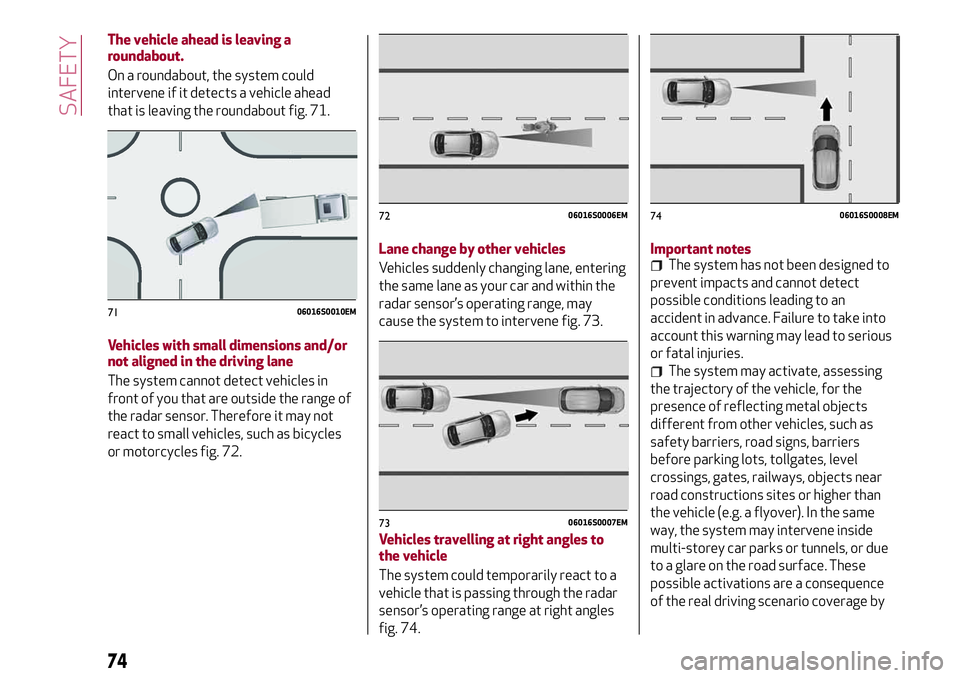
The vehicle ahead is leaving a
roundabout.
On a roundabout, the system could
intervene if it detects a vehicle ahead
that is leaving the roundabout fig. 71.
Vehicles with small dimensions and/or
not aligned in the driving lane
The system cannot detect vehicles in
front of you that are outside the range of
the radar sensor. Therefore it may not
react to small vehicles, such as bicycles
or motorcycles fig. 72.Lane change by other vehicles
Vehicles suddenly changing lane, entering
the same lane as your car and within the
radar sensor’s operating range, may
cause the system to intervene fig. 73.
Vehicles travelling at right angles to
the vehicle
The system could temporarily react to a
vehicle that is passing through the radar
sensor’s operating range at right angles
fig. 74.Important notes
The system has not been designed to
prevent impacts and cannot detect
possible conditions leading to an
accident in advance. Failure to take into
account this warning may lead to serious
or fatal injuries.
The system may activate, assessing
the trajectory of the vehicle, for the
presence of reflecting metal objects
different from other vehicles, such as
safety barriers, road signs, barriers
before parking lots, tollgates, level
crossings, gates, railways, objects near
road constructions sites or higher than
the vehicle (e.g. a flyover). In the same
way, the system may intervene inside
multi-storey car parks or tunnels, or due
to a glare on the road surface. These
possible activations are a consequence
of the real driving scenario coverage by
7106016S0010EM
7206016S0006EM
7306016S0007EM
7406016S0008EM
74
SAFETY
Page 77 of 204
the system and must not be regarded as
faults.
The system has been designed for
road use only. If the vehicle is driven on a
track, the system must be deactivated to
avoid unnecessary warnings. Automatic
deactivation is signalled by the dedicated
warning light/symbol switching on in the
instrument panel (see the instructions in
the "Warning lights and messages"
paragraph, "Knowing the instrument
panel" chapter).
TPMS (Tyre Pressure Monitoring
System)
60) 61) 62) 63) 64) 65) 66)
28)
The car is equipped with Tyre Pressure
Monitoring System (TPMS), which can
advise the driver in the event of
insufficient tyre pressure on the basis of
the pressure when cold indicated in the
"Technical specifications" chapter.
The system comprises a radio-frequency
transmitter sensor fitted to each wheel
(on the rim inside the tyre), which is able
to send information on the inflation
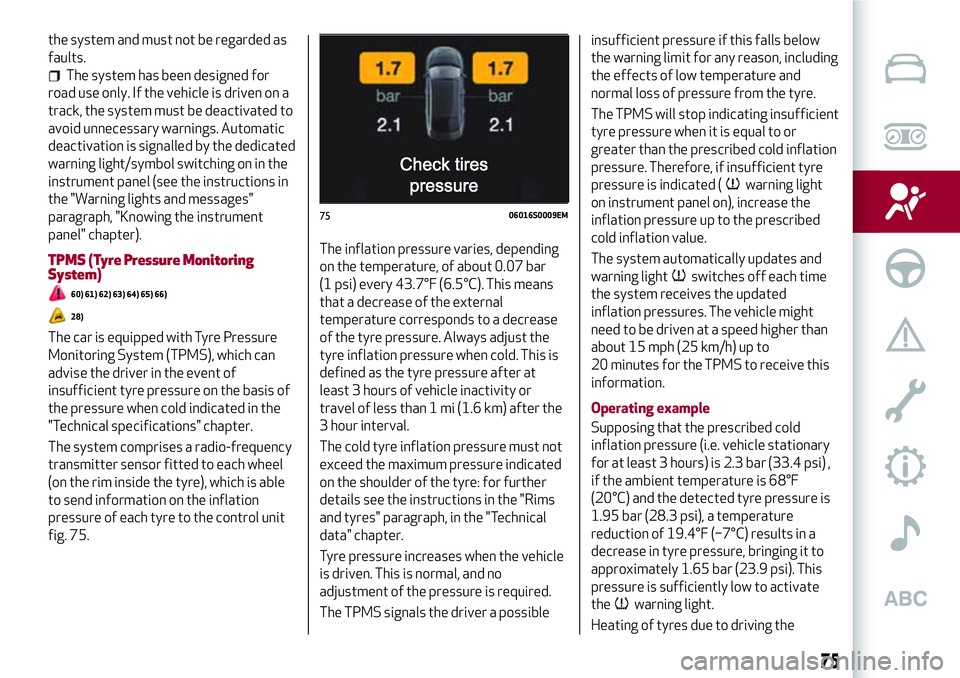
pressure of each tyre to the control unit
fig. 75.The inflation pressure varies, depending
on the temperature, of about 0.07 bar
(1 psi) every 43.7°F (6.5°C). This means
that a decrease of the external
temperature corresponds to a decrease
of the tyre pressure. Always adjust the
tyre inflation pressure when cold. This is
defined as the tyre pressure after at
least 3 hours of vehicle inactivity or
travel of less than 1 mi (1.6 km) after the
3 hour interval.
The cold tyre inflation pressure must not
exceed the maximum pressure indicated
on the shoulder of the tyre: for further
details see the instructions in the "Rims
and tyres" paragraph, in the "Technical
data" chapter.
Tyre pressure increases when the vehicle
is driven. This is normal, and no
adjustment of the pressure is required.
The TPMS signals the driver a possibleinsufficient pressure if this falls below
the warning limit for any reason, including
the effects of low temperature and
normal loss of pressure from the tyre.
The TPMS will stop indicating insufficient
tyre pressure when it is equal to or
greater than the prescribed cold inflation
pressure. Therefore, if insufficient tyre
pressure is indicated (
warning light
on instrument panel on), increase the
inflation pressure up to the prescribed
cold inflation value.
The system automatically updates and
warning light
switches off each time
the system receives the updated
inflation pressures. The vehicle might
need to be driven at a speed higher than
about 15 mph (25 km/h) up to
20 minutes for the TPMS to receive this
information.
Operating example
Supposing that the prescribed cold
inflation pressure (i.e. vehicle stationary
for at least 3 hours) is 2.3 bar (33.4 psi) ,
if the ambient temperature is 68°F
(20°C) and the detected tyre pressure is
1.95 bar (28.3 psi), a temperature
reduction of 19.4°F (−7°C) results in a
decrease in tyre pressure, bringing it to
approximately 1.65 bar (23.9 psi). This
pressure is sufficiently low to activate
the
warning light.
Heating of tyres due to driving the
7506016S0009EM
75
Page 78 of 204
vehicle may increase tyre pressure up to
approximately 1.95 bar (28.3 psi), but
the
warning light will stay on. In this
situation, the warning light will switch off
only after the tyres are inflated to the
prescribed cold pressure value for the
car.
IMPORTANT The TPMS is designed for
original tyres and wheels. The prescribed
pressures and consequent alarm
thresholds set in the TPMS are based on
the dimensions of the tyres fitted on the
vehicle. Using spare wheels of a size, type
and/or design different from the original
ones may cause an irregular operation of
the system and damage the sensors.
Aftermarket fitted wheels may damage
the sensors. Using aftermarket tyre
sealants may damage the Tyre Pressure
Monitoring System (TPMS) sensor. If
aftermarket tyre sealant is used it is
recommended to go to an Alfa Romeo
Dealership to have the sensors checked.
After checking or adjusting the tyre
pressure, always refit the valve cap to
prevent humidity and dirt from entering,
these may damage the Tyre Pressure
Monitoring System sensor.
INSUFFICIENT TYRE PRESSURE
INDICATION
If an insufficient pressure value is
detected on one or more tyres, the
warning light on the instrument panelswitches on and the dedicated messages
are shown on the display. The system also
highlights the tyre or tyres with
insufficient pressure graphically. An
acoustic signal is also emitted.
In this case, stop the car, check the
inflation pressure of each tyre and inflate
them to the correct cold inflation
pressure value, shown on the display or in
the dedicated TPMS menu.
TPMS TEMPORARILY DISABLED
TPMS check message
If a system failure is present, the
warning light flashes for about
75 seconds and then stays on solid. An
acoustic signal is also emitted.
A dedicated message and dashes "– –"
instead of the pressure value are shown
on the display, to indicate that detection
is impossible.
When the ignition device is set to STOP
and then back to ON, the indication
sequence repeats provided that the
failure is still resent.
The
warning light switches off when
the failure condition disappears and the
pressure value is displayed again in place
of the dashes.
A fault in the system could occur in the
following cases:
strong radio-frequency noises could
hinder the regular operation of the TPMS.This condition will be indicated by a
dedicated message on the display. The
message will disappear automatically as
soon as the radio-frequency interference
ceases to affect the system;
aftermarket application of coloured
films on the windows that interfere with
the radio waves emitted by the TPMS;
accumulation of layers of snow or ice
on the wheels or the wheel arches;
using snow chains;
use of rim/tyre assemblies without
sensors for TPMS;
After the punctured tyre has been
repaired with the original tyre sealant
contained in the TireKit, the previous
condition must be restored, so that the
warning light is off during normal
driving.
TPMS deactivation
The TPMS can be deactivated by
replacing the wheels equipped with
TPMS with others that are not (e.g. upon
replacement of the wheel assemblies in
winter) and if compatible with the
country of purchase that makes this
possibility available. Then drive for at
least 20 minutes at a speed higher than
about 15 mph (25 km/h).
The TPMS will emit an acoustic warning,
the
warning light will flash for about
75 seconds, then will stay on constantly
and the instrument panel will display the
76
SAFETY
Page 79 of 204
"TPMS check" message with some
dashes (– –) instead of the pressure
values.
From the following ignition cycle, the
TPMS will not emit any acoustic signal
and the display will not show the
message "TPMS check", but the dashes
will be still displayed instead of the
pressure value.
WARNING
54)The system is an aid for vehicle driving,
it DOES NOT warn the driver about incoming
vehicles outside of the detection areas. The
driver must always maintain a sufficient
level of attention to the traffic and road
conditions and for controlling the trajectory
of the vehicle.
55)The Forward Collision Warning (FCW)
system is automatically deactivated when
RACE mode is selected.
56)The system is an aid for the driver, who
must always pay full attention while driving.
The responsibility always rests with the
driver, who must take into account the
traffic conditions in order to drive in
complete safety. The driver must always
maintain a safe distance from the vehicle in
front.
57)If the driver depresses the brake pedal
fully or carries out a fast steering during
system operation, the automatic braking
function may stop (e.g. to allow a possible
manoeuvre to avoid the obstacle).58)The system intervenes on vehicles
travelling in the same lane. People, animals
and things (e.g. pushchairs) are not taken
into consideration.
59)If the car must be placed on a roller
bench for maintenance interventions or if it
is washed in an automatic roller washing
tunnel with an obstacle in the front part (e.g.
another car, a wall or another obstacle), the
system may detect its presence and
activate. In this case the system must be
deactivated through the settings of the
Connect system.
60)The presence of the TPMS does not
permit the driver to neglect regular checks
of the tyre pressure, including for the spare
tyre, and correct maintenance: the system is
not used to signalling a possible tyre fault.
61)Tyre pressure must be checked with
tyres rested and cold. Should it become
necessary for whatever reason to check
pressure with warm tyres, do not reduce
pressure even though it is higher than the
prescribed value. Repeat the check when the
tyres are cold.
62)Should one or more wheels be fitted
without sensors, the system will no longer be
available and a warning message will be
shown on the display, until wheels with
sensors are fitted again.
63)The TPMS cannot indicate sudden tyre
pressure drops (e.g. if a tyre bursts). In this
case, stop the vehicle, braking with caution
and avoiding abrupt steering.
64)Changes in outside temperature may
cause tyre pressures to vary. The system
may temporarily indicate insufficient
pressure. In this case, check the tyre
pressure when cold and, if necessary,
restore the inflation values.65)Replacing standard tyres with winter
tyres and vice versa requires TPMS system
adjustment that must only be performed by
Alfa Romeo Dealerships.
66)When a tyre is removed, it is advisable
to replace the rubber valve seal as well:
contact an Alfa Romeo Dealership. The
fitting/removal of the tyres and/or rims
require special care. To avoid damaging or
fitting the sensors incorrectly, tyre and/or
rim fitting/removal operations should only
be carried out by specialised staff. Contact
an Alfa Romeo Dealership.IMPORTANT
19)The system may have limited or absent
operation due to weather conditions such as:
heavy rain, hail, thick fog, heavy snow.
20)The section of the bumper before the
sensor must not be covered with adhesives,
auxiliary headlights or any other object.
21)System intervention might be
unexpected or delayed when other vehicles
transport loads projecting from the side,
above or from the rear, with respect to the
normal size of the vehicle.
22)Operation can be adversely affected by
any structural change made to the vehicle,
such as a modification to the front geometry,
tyre change, or a heavier load than the
standard load of the vehicle.
23)Incorrect repairs made on the front part
of the vehicle (e.g. bumper, chassis) may alter
the position of the radar sensor, and
adversely affect its operation. Go to an Alfa
Romeo Dealership for any operation of this
type.
77
Page 80 of 204
24)Do not tamper with nor carry out any
intervention on the radar sensor or on the
camera on the windscreen. In the event of a
sensor failure, contact an Alfa Romeo
Dealership.
25)Do not wash with high-pressure jets in
the bumper lower area: in particular do not
operate on the system's electrical connector.
26)Be careful in the case of repairs and new
paintings in the area around the sensor
(panel covering the sensor on the left side of
the bumper). In the event of a frontal impact
the sensor may automatically deactivate
and display a warning to indicate that the
sensor needs to be repaired. Even without a
malfunction warning, deactivate the system
operation if you think that the position of the
radar sensor has changed (e.g. due to
low-speed frontal impact as during parking
manoeuvres). In these cases, go to an Alfa
Romeo Dealership to have the radar sensor
realigned or replaced.
27)When towing a trailer, a vehicle or during
loading manoeuvres on a vehicle transporter
(or in vehicle for transport), the system must
be deactivated via the Connect system.
28)The Tire Repair Kit, provided with the
vehicle, is compatible with the TPMS
sensors. Using sealants different from that
in the original kit may compromise its
operation. If sealants not equivalent with the
original ones are used, it is recommended to
have the TPMS sensor operation checked by
a qualified repair centre.OCCUPANT PROTECTION
SYSTEMS
Some of the most important safety
equipment of the vehicle comprise the
following protection systems:
seat belts;
SBA (Seat Belt Alert) System;
head restraints;
child restraint systems;
Front airbags and side bags.
Read the information given the following
pages with the utmost care. It is of
fundamental importance that the
protection systems are used in the
correct way to guarantee the maximum
possible safety level for the driver and
the passengers.
For the description of the head restraint
adjustment see the "Head restraints"
paragraph in the "Knowing your vehicle"
chapter.
SEAT BELTS
All the seatbelts have three anchoring
points each with its own retractor.
The retractor mechanism operates
locking the belt in the event of sharp
braking or strong deceleration due to an
impact. This allows the belt strap to slide
freely and to adapt to the body of the
occupant. In the event of an accident, the
belt will lock reducing the risk of impact
inside the passenger compartment and
of being projected outside the vehicle.
The driver is responsible for respecting,
and ensuring that all the other occupants
of the vehicle also respect, the local laws
in force in relation to the use of the seat
belts.
Always fasten the seat belts before
setting off.
USING THE SEAT BELTS
The seat belt should be worn keeping the
chest straight and rested against the
backrest.
To fasten the seat belts, hold the tongue
1 fig. 76 and insert it into the buckle 2,
until it clicks into place.
78
SAFETY
Page 103 of 204
Let’s get to the core of the vehicle: seeing how you can exploit all
of its potential to the full. We’ll look at how to drive it safely in any
situation, so that it can be a welcome companion, with our comfort
and our wallets in mind.
STARTING AND DRIVING
STARTING THE ENGINE..........................102
ELECTRIC PARKING BRAKE . ......................103
MANUAL GEARBOX . ...........................105
AUTOMATIC TRANSMISSION......................106
"ALFA DNA™" SYSTEM..........................109
START&STOPEVO............................110
SPEED LIMITER..............................111
CRUISE CONTROL.............................112
PARK SENSORS SYSTEM........................113
LANE DEPARTURE WARNING (LDW) SYSTEM............116
REAR BACK-UP CAMERA / DYNAMIC GRIDLINES . ........117
REFUELLING THE VEHICLE . . .....................118
Page 115 of 204
RECALLING THE SPEED
For versions with automatic transmission
operating in D mode (Drive - automatic),
press and release the RES
fig. 108 button to recall the previously
set speed.
For versions with manual gearbox or
automatic transmission in Autostick
(sequential) mode, before recalling the
previously set speed you should
accelerate until getting close to it, then
press and release the RES button.
DEACTIVATING THE DEVICE
Lightly pressing the brake pedal
deactivates the Cruise Control without
deleting the stored speed.
The Cruise Control may be deactivated
also by applying the electric parking
brake or when the braking system is
operated (e.g. operation of the ESC
system).
The stored speed is deleted in the
following cases:
pressing the on/off button or
switching off the engine;
if there is a malfunction in the Cruise
Control.
DEACTIVATING THE DEVICE
The Cruise Control is deactivated by
pressing the activation/deactivation
button or bringing the ignition device to
the STOP position.
WARNING
111)When travelling with the device active,
never move the gear lever to neutral.
112)In case of a malfunction or failure of
the device, contact an Alfa Romeo
Dealership.
113)The Cruise Control can be dangerous if
the system cannot keep a constant speed. In
specific conditions speed may be excessive,
resulting in the risk of losing control of the
vehicle and causing accidents. Do not use the
device in heavy traffic or on winding, icy,
snowy or slippery roads.
PARK SENSORSSYSTEM
(where provided)
114)
38) 39) 40)
VERSIONS WITH 4 SENSORS
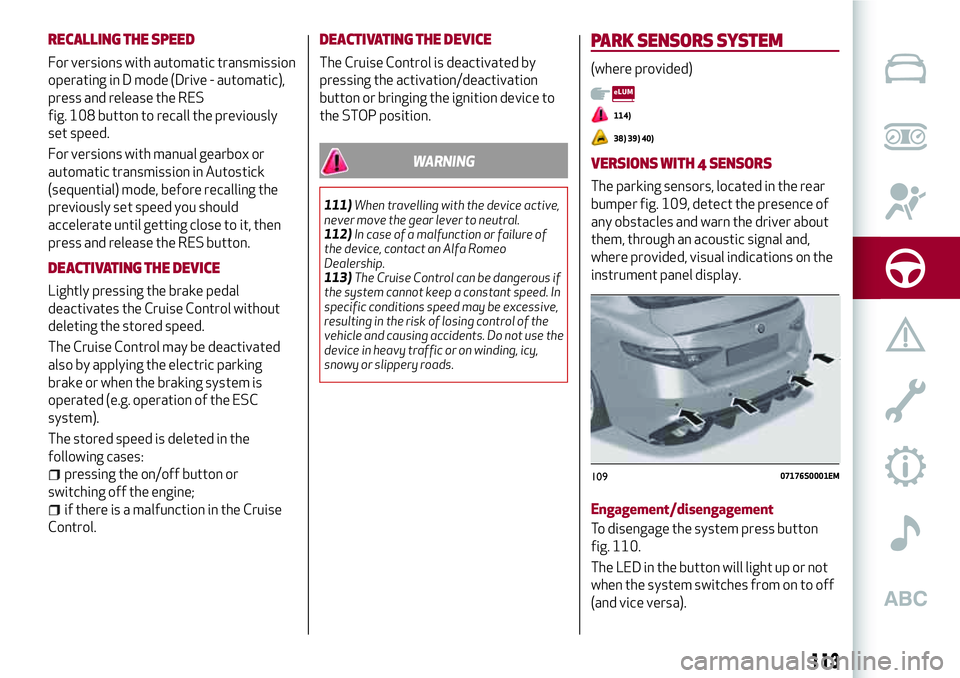
The parking sensors, located in the rear
bumper fig. 109, detect the presence of
any obstacles and warn the driver about
them, through an acoustic signal and,
where provided, visual indications on the
instrument panel display.
Engagement/disengagement
To disengage the system press button
fig. 110.
The LED in the button will light up or not
when the system switches from on to off
(and vice versa).
10907176S0001EM
113
Page 116 of 204
LED off: system activated;
LED light on steady: system
deactivated;
If the button is pressed with a system
failure, the LED flashes for about
5 seconds, then it stays on constantly.
System activation/deactivation
The system, when engaged, is
automatically activated by engaging the
reverse gear, while it is deactivated by
engaging another gear.
Operation with a trailer
The operation of the sensors is
automatically deactivated when the
trailer's electric plug is inserted in the
car's tow hook socket. The sensors are
automatically reactivated when the
trailer's cable plug is removed.
VERSIONS WITH 8 SENSORS
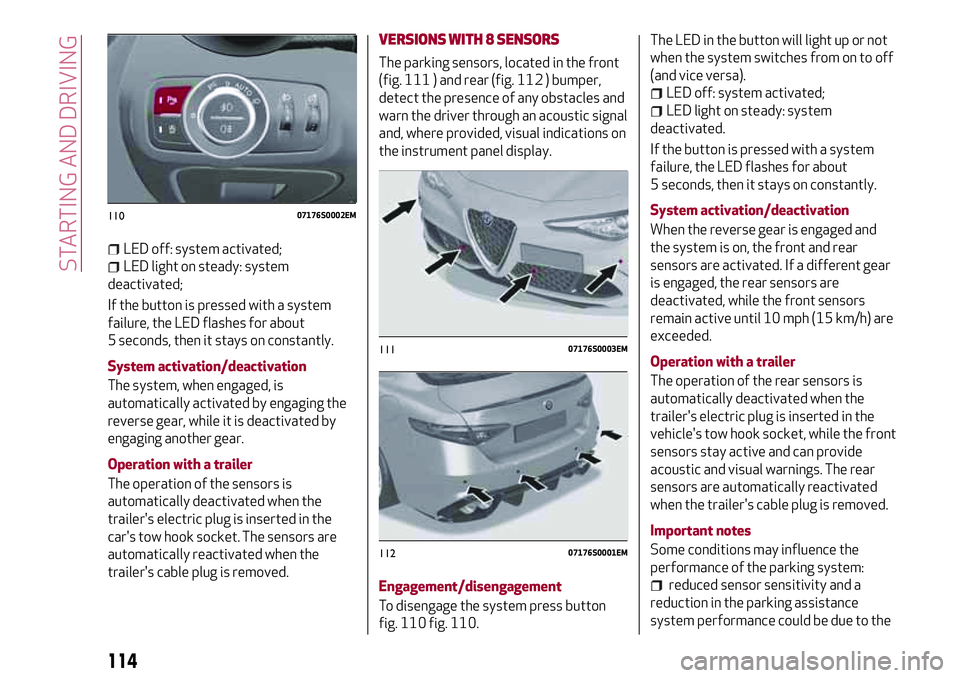
The parking sensors, located in the front
(fig. 111 ) and rear (fig. 112 ) bumper,
detect the presence of any obstacles and
warn the driver through an acoustic signal
and, where provided, visual indications on
the instrument panel display.
Engagement/disengagement
To disengage the system press button
fig. 110 fig. 110.The LED in the button will light up or not
when the system switches from on to off
(and vice versa).
LED off: system activated;
LED light on steady: system
deactivated.
If the button is pressed with a system
failure, the LED flashes for about
5 seconds, then it stays on constantly.
System activation/deactivation
When the reverse gear is engaged and
the system is on, the front and rear
sensors are activated. If a different gear
is engaged, the rear sensors are
deactivated, while the front sensors
remain active until 10 mph (15 km/h) are
exceeded.
Operation with a trailer
The operation of the rear sensors is
automatically deactivated when the
trailer's electric plug is inserted in the
vehicle's tow hook socket, while the front
sensors stay active and can provide
acoustic and visual warnings. The rear
sensors are automatically reactivated
when the trailer's cable plug is removed.
Important notes
Some conditions may influence the
performance of the parking system:
reduced sensor sensitivity and a
reduction in the parking assistance
system performance could be due to the
11007176S0002EM
11107176S0003EM
11207176S0001EM
114
STARTING AND DRIVING
Page 117 of 204
presence of: ice, snow, mud, thick paint,
on the surface of the sensor;
the sensor may detect a non-existent
obstacle ("echo interference") due to
mechanical interference, for example
when washing the vehicle, in rain (strong
wind), hail;
the signals sent by the sensor can also
be altered by the presence of ultrasonic
systems (e.g. pneumatic brake systems
of trucks or pneumatic drills) near the
vehicle;
parking assistance system
performance can also be influenced by
the position of the sensors, for example
due to a change in the ride setting
(caused by wear to the shock absorbers,
suspension), or by changing tyres,
overloading the vehicle or carrying out
specific tuning operations that require
the vehicle to be lowered;
the presence of a tow hook without
trailer, which may interfere with the
correct operation of the parking sensors.
Before using the Park Sensors system, it
is recommended to remove the
removable tow hook ball assembly and
the relevant attachment from the vehicle
when the latter is not used for towing
operations. Failure to comply with this
prescription may cause personal injuries
or damage to vehicles or obstacles since,
when the continuous acoustic signal is
emitted, the tow hook ball is already in aposition that is much closer to the
obstacle than the rear bumper. If you
wish to leave the tow hook fitted without
towing a trailer, it is advisable to contact
an Alfa Romeo Dealership for the Park
Sensors system update operations
because the tow hook could be detected
as an obstacle by the central sensors.
the presence of adhesives on the
sensors. Therefore, take care not to place
adhesives on the sensors.
WARNING
114)Parking and other potentially
dangerous manoeuvres are, however,
always the driver’s responsibility. When
performing these operations, always make
sure that there are no other people
(especially children) or animals on the route
you want to take. The parking sensors are an
aid for the driver, but the driver must never
allow their attention to lapse during
potentially dangerous manoeuvres, even
those executed at low speeds.
IMPORTANT
38)The sensors must be clean of mud, dirt,
snow or ice in order for the system to
operate correctly. Be careful not to scratch
or damage the sensors while cleaning them.
Avoid using dry, rough or hard cloths. The
sensors should be washed using clean water
with the addition of car shampoo if
necessary. When using special washing
equipment such as high pressure jets or
steam cleaning, clean the sensors very
quickly keeping the jet more than 10 cm
away.
39)Have interventions on the bumper in the
area of the sensors carried out only by an
Alfa Romeo Dealership. Interventions on the
bumper that are not carried out properly
may compromise the operation of the
parking sensors.
40)Only have the bumpers repainted or any
retouches to the paintwork in the area of the
sensors carried out by an Alfa Romeo
Dealership. Incorrect paint application could
affect the operation of the parking sensors.
115
Page 120 of 204
The table below shows the approximate
distances for each area fig. 115:
ZoneDistance from the
rear of the vehicle
Red 0 ÷ 11.8 in (30 cm)
Yellow11.8 in
(30 cm) ÷ 3.3
ft (1 m)
Green 3.3 ft (1 m) or more
IMPORTANT When parking, take the
utmost care over obstacles that may be
above or under the camera range. of the
video cam.
WARNING
115)Parking and other potentially
dangerous manoeuvres are, however,
always the driver’s responsibility. While
carrying out these manoeuvres, always
make sure that no people (especially
children) or animals are in the area
concerned. The camera is an aid for the
driver, but the driver must never allow
his/her attention to lapse during potentially
dangerous manoeuvres, even those
executed at low speeds. Always keep a slow
speed, so as to promptly brake in the case of
obstacles.
IMPORTANT
47)It is vital, for correct operation, that the
camera is always kept clean and free from
any mud, dirt, snow or ice. Be careful not to
scratch or damage the camera while cleaning
it. Avoid using dry, rough or hard cloths. The
camera must be washed using clean water,
with the addition of car shampoo if
necessary. In washing stations which use
steam or high-pressure jets, clean the
camera quickly, keeping the nozzle more
than 10 cm away from the sensors. Also, do
not apply stickers to the camera.
REFUELLING THE VEHICLE
Always stop the engine before refuelling.
PETROL ENGINES
Only use unleaded petrol with a number
of octanes (R.O.N.) not lower than 95
(EN228 specification).
116) 117) 118)
DIESEL ENGINES
Only use Diesel for motor vehicles
(EN590 specification).
REFUELLING PROCEDURE
The fuel flap is unlocked when the central
door locking system is released, while it
is automatically locked when the central
locking system is applied.
Opening the flap
To refuel proceed as follows:
open flap fig. 116, pressing on the
point shown by the arrow;
remove the closing cap;
introduce the dispenser in the filler
and refuel;
118
STARTING AND DRIVING