warning Alfa Romeo Giulia 2017 Owner's Manual
[x] Cancel search | Manufacturer: ALFA ROMEO, Model Year: 2017, Model line: Giulia, Model: Alfa Romeo Giulia 2017Pages: 268, PDF Size: 18.64 MB
Page 213 of 268
Engine Coolant Fluid
If the level is too low, unscrew the cap
of reservoir and add the fluid described
in the "Technical Specifications"
chapter.
Washer Fluid For
Windshield/Headlights
The windshield and headlights washer
fluid reservoir (if equipped) has a
telescopic filler.
If the level is too low, remove reservoir
cap and lift the filler. Then, add the fluid
described in the "Technical
Specifications" chapter.
Note:
The headlight washing system will not
work if the liquid level is low (situation
indicated by the symbol on the
instrument panel display). The
windshield washer will keep working.
On vehicles equipped with headlight
washers, if equipped, there is a
reference notch on the dipstick: ONLY
the windshield/rear window washer
operates with the level below this
reference.
Brake Fluid
Check that the fluid is at the maximum
level. If the fluid level in the tank is low,
contact your authorized dealer to have
the system checked.
Automatic Transmission
Activation System Oil
The transmission control oil level should
only be checked at your authorized
dealer.
Useful Advice For
Extending The Life Of
Your Battery
To avoid draining your battery and
make it last longer, observe the
following instructions:
When you park the car, ensure that
the doors and trunk are closed properly
to prevent any lights from remaining on
inside the passenger's compartment.
Do not keep accessories (e.g. radio,
hazard warning lights, etc.) switched on
for a long time when the engine is not
running.
Before performing any operation on
the electrical system, disconnect the
negative battery cable.
If, after purchasing the car, you wish to
install electrical accessories that require
permanent electrical supply (e.g. alarm,
etc.), or accessories which influence the
electrical supply requirements, contact
your authorized dealer, whose qualified
staff will evaluate the overall electrical
consumption.
Caution!
If the charge level remains under 50% for a
long time, the battery may be damaged by
sulphation, reducing its capacity and
efficiency at start the vehicle. The battery is
also more prone to the risk of freezing (at
temperatures as high as 14°F (-10°C).
Note:
After the battery is disconnected, the
steering must be initialized. The
warning light on the instrument
panel switches on to indicate this. To
carry out this procedure, simply turn the
steering wheel all the way from one end
to the other, and then turn it back to the
central position.
211
Page 214 of 268

Battery
The battery does not require the
electrolyte to be topped up with distilled
water. A periodic check carried out at
an authorized dealer, however, is
necessary to check efficiency.
Follow the battery manufacturer's
instructions for maintenance.
Replacing The Battery
If necessary, replace the battery with
another original battery with the same
specifications. Follow the battery
manufacturer’s instructions for
maintenance.
Warning!
Battery fluid is a corrosive acid solution
and can burn or even blind you. Do not
allow battery fluid to contact your eyes,
skin, or clothing. Do not lean over a battery
when attaching clamps. If acid splashes in
eyes or on skin, flush the area immediately
with large amounts of water. Refer to
“Emergency Starting” in “In Case Of
Emergency” for further information.
Battery gas is flammable and explosive.
Keep flame or sparks away from the
battery. Do not use a booster battery or
any other booster source with an output
greater than 12 Volts. Do not allow cable
clamps to touch each other.
Battery posts, terminals, and related
accessories contain lead and lead
compounds. Wash hands after handling.
Note:
It will not be possible to open the trunk
with a key or by pressing the button in
the passenger compartment when the
battery is disconnected. So, always
position the manual trunk opening strap
on the trunk lock before disconnecting
the battery. The procedure is described
in the "Storing The Vehicle" paragraph
in this chapter.
BATTERY
RECHARGING
Important Notes
Warning!
Never charge or recharge a frozen
battery: it may explode because of the
nitrogen trapped inside the ice crystals.
At all times while charging or recharging
the battery, make sure that any sparks or
open flames are kept sufficiently far away
from the battery.
Note:
Before using the charging device,
always make sure that it is appropriate
for the installed battery, with constant
voltage (below 14.8 V) and low
amperage (maximum 15 A).
Recharge the battery in a well
ventilated environment.
Before using any devices to charge
or to maintain the charge of the
battery, carefully follow the instructions
provided with the device in order to
properly and safely connect it to the
car battery.
212
SERVICING AND MAINTENANCE
Page 217 of 268
Warning!
Use only refrigerants and compressor
lubricants approved by the manufacturer
for your air conditioning system. Some
unapproved refrigerants are flammable and
can explode, injuring you. Other
unapproved refrigerants or lubricants can
cause the system to fail, requiring costly
repairs. Refer to Warranty Information
Book, located in your owner’s information
kit, for further warranty information.
Lubricating Moving
Parts Of The Bodywork
Ensure that the locks and bodywork
junction points, including components
such as the seat guides, door hinges
(and rollers), trunk and hood are
periodically lubricated with
lithium-based grease to ensure correct,
silent operation and to protect them
from rust and wear.
Thoroughly clean the components,
eliminating every trace of dirt and dust.
After lubricating, eliminate excess oil
and grease. Also pay particular
attention to the hood closing devices,
to ensure correct operation. During
operations on the hood, to be carried
out with the engine cold, also
remember to check, clean and lubricate
the locking, release and safety devices.Lubricate the external lock barrels twice
a year. Apply a small amount of
high-quality lubricant directly into the
lock barrel.
If necessary, contact your authorized
dealer as soon as possible.
Windshield Wiper
Periodically clean the windshield and
rear window and rubber profile of the
windshield wiper blades, using a
sponge or a soft cloth and a
non-abrasive detergent. This eliminates
the salt or impurities accumulated when
driving.
Prolonged operation of the windshield
window wipers with dry glass may
cause the deterioration of the blades, in
addition to abrasion of the surface of
the glass. To eliminate the impurities on
the dry glass, always operate the
windshield washers.
In the event of very low outdoor
temperatures, below zero degrees,
ensure that the movement of the rubber
part in contact with the glass is not
obstructed. Use a suitable deicing
product to release it if required.
Avoid using the windshield wipers to
remove frost or ice.
Also avoid contact of the rubber profile
of the blades with petroleum derivatives
such as engine oil, gas, etc.
Warning!
Driving with worn windshield wiper blades
is a serious hazard, because visibility is
reduced in bad weather conditions.
Note:
The life of the windshield wiper blades
varies according to the usage
frequency. In any case, it is advised to
replace the blades approximately once
a year. When the blades are worn,
noise, marks on the glass or streaks of
water may be noticed. In the presence
of these conditions, clean the
windshield wiper blades or, if necessary,
replace them.
Raising The Windshield Wiper
Blades ("Service Position"
Function)
The "service position" function allows
the driver to replace the windshield
wiper blades more easily. It is also
recommended to activate this function
when it is snowing and to make it easier
to remove any dirt deposits in the area
where the blades are normally
positioned, when washing.
Activation Of The Function
To activate this function, disable the
windshield wiper before setting the
ignition device to STOP.
215
Page 219 of 268
bodywork areas checked at your
authorized dealer to identify any
components which are broken,
damaged, worn or have moved from
their correct fitting position.
Open welding or loose connections
may permit exhaust gas to enter the
passenger compartment.
Have the exhaust system checked
every time the vehicle is raised. Replace
the components where necessary (for
these operations, contact an authorized
dealer).
In normal operating conditions, the
catalytic converter does not require
maintenance. To ensure that it operates
correctly, however, and prevent it from
getting damaged, it is extremely
important that the engine operates
perfectly.
To minimize the risk of damaging the
catalytic converter, proceed as follows:
Do not stop the engine or deactivate
the ignition with gear engaged and
vehicle in motion.
Do not attempt to start the engine
by bump starting.
Do not persist in using the vehicle if
idling is very irregular or the operating
conditions are very notably irregular.
Warning!
Exhaust gases can injure or kill. They
contain carbon monoxide (CO), which is
colorless and odorless. Breathing it can
make you unconscious and can eventually
poison you.
A hot exhaust system can start a fire if
you park over materials that can burn.
Such materials might be grass or leaves
coming into contact with your exhaust
system. Do not park or operate your
vehicle in areas where your exhaust system
can contact anything that can burn.
Cooling System
Warning!
Turn vehicle off and disconnect the fan
motor lead before working near the radiator
cooling fan.
You or others can be badly burned by
hot engine coolant (antifreeze) or steam
from your radiator. If you see or hear steam
coming from under the hood, do not open
the hood until the radiator has had time to
cool. Never open a cooling system
pressure cap when the radiator or coolant
bottle is hot.
Keep hands, tools, clothing, and jewelry
away from the radiator cooling fan when
the hood is raised. The fan starts
automatically and may start at any time,
whether the engine is running or not.
When working near the radiator cooling
fan, disconnect the fan motor lead or turn
the ignition to the OFF mode. The fan is
temperature controlled and can start at any
time the ignition is in the ON mode.
You or others can be badly burned by
hot engine coolant (antifreeze) or steam
from your radiator. If you see or hear steam
coming from under the hood, do not open
the hood until the radiator has had time to
cool. Never try to open a cooling system
pressure cap when the radiator is hot.
Engine Coolant Check
Check the engine coolant level every oil
change or before long trips.
If there are impurities in the engine
coolant, the system must be drained,
flushed and refilled: contact an
authorized dealer.
Check the front part of the condenser
to check for any build-up of insects,
leaves or other debris. Should it be
dirty, clean it by spraying delicately with
water.
Check the hoses of the engine cooling
system to ensure that the rubber has
not deteriorated and that there are no
cracks, tears, cuts or obstructions in
the expansion tank side and radiator
side connectors. Should there be any
217
Page 220 of 268
doubt regarding leaks from the system
(e.g. if frequent top ups are required),
have the seal checked at an authorized
dealer.
With the engine off and at normal
operating temperature, check that the
cooling system radiator cap is closed
properly.
Warning!
Do not open hot engine cooling system.
Never add engine coolant (antifreeze) when
the engine is overheated. Do not loosen or
remove the cap to cool an overheated
engine. Heat causes pressure to build up in
the cooling system. To prevent scalding or
injury, do not remove the pressure cap
while the system is hot or under pressure.
Do not use a pressure cap other than
the one specified for your vehicle. Personal
injury or engine damage may result.
Note:
Before removing the engine coolant
reservoir cap, wait for the system to
cool down. Topping Up / Draining / Flushing
The Engine Coolant
If the engine coolant (antifreeze) is dirty,
have cleaning and flushing carried out
at an authorized dealer.
See the "Maintenance Plan" for the
correct servicing intervals.
Note:
For topping up, use a fluid with the
same characteristics as those
indicated in the "Fluids And
Lubricants" table (see "Technical
Specifications" chapter).
Do not use pure water,
alcohol-based coolants, corrosions
inhibitors or additional anti-rust
products because they may be
incompatible with the engine coolant
and cause the clogging of the radiator.
The use of propylene glycol-based
coolant is also not recommended.
Engine Cooling System Cap
To prevent loss of engine coolant, make
sure that the expansion tank cap is
closed. If it is open, screw it completely
until you reach/hear the click.
Periodically check the cap and clean it
from any foreign bodies that may have
deposited on the external surface.
Warning!
Never add coolant with the engine hot
or overheated.
Do not attempt to cool an overheated
engine by loosening or removing the cap.
The heat causes a considerable increase in
pressure in the cooling system.
To prevent damage to the engine, only
use the engine cooling circuit caps
provided.
Disposal of Used Engine Coolant
Disposal of engine coolant is subject to
legal requirements: contact the
appropriate body to determine local
regulations.
Note:
To prevent the fluid from being
ingested by children or animals, do
not keep it in open containers or pour
it on the ground. If ingested, contact a
doctor immediately. Eliminate any
traces of fluid from the ground
immediately.
When the vehicle stops after a short
trip, steam may be seen coming out
from front of the hood. This is a
normal phenomenon which is due to
the presence of rain, snow or a lot of
moisture on the surface of the radiator.
218
SERVICING AND MAINTENANCE
Page 221 of 268
With engine and system cold, do
not top up with coolant beyond the
maximum level indicated on the
reservoir in the engine compartment.
Braking System
In order to guarantee the efficiency of
the braking system, periodically check
its components; for this operation,
contact an authorized dealer.
See the "Maintenance Plan" for the
correct servicing intervals.
Note: Driving with your foot resting on
the brake pedal may compromise its
efficiency, increasing the risk of
accidents. When driving, never keep
your foot on the brake pedal and don’t
put unnecessary strain on it to prevent
the brakes from overheating: excess
pad wear may cause damage to the
braking system.
When an insufficient oil level is
detected, contact an authorized dealer
to have the system checked.
Always keep the cap of the brake
fluid reservoir (in the engine
compartment) completely closed.
Warning!
Use only manufacturer's recommended
brake fluid. Refer to “Fluids And Lubricants”
in “Technical Specifications” for further
information. Using the wrong type of brake
fluid can severely damage your brake
system and/or impair its performance. The
proper type of brake fluid for your vehicle is
also identified on the original factory
installed hydraulic master cylinder reservoir.
To avoid contamination from foreign
matter or moisture, use only new brake
fluid or fluid that has been in a tightly
closed container. Keep the master cylinder
reservoir cap secured at all times. Brake
fluid in a open container absorbs moisture
from the air resulting in a lower boiling
point. This may cause it to boil
unexpectedly during hard or prolonged
braking, resulting in sudden brake failure.
This could result in a collision.
Overfilling the brake fluid reservoir can
result in spilling brake fluid on hot engine
parts, causing the brake fluid to catch fire.
Brake fluid can also damage painted and
vinyl surfaces, care should be taken to
avoid its contact with these surfaces.
Do not allow petroleum based fluid to
contaminate the brake fluid. Brake seal
components could be damaged, causing
partial or complete brake failure. This could
result in a collision.
Automatic Transmission
Use only a transmission oil with the
same characteristics as those indicated
in the "Fluids and Lubricants" table (see
"Technical Specifications" chapter).
Special Additives
Do not use any type of additive with the
automatic transmission oil. The
automatic transmission oil is a product
designed specially for this vehicle and
its performance may be compromised
through the use of further additives.
Caution!
Do not use chemical flushes in your
transmission as the chemicals can damage
your transmission components. Such
damage is not covered by the New Vehicle
Limited Warranty.
219
Page 227 of 268
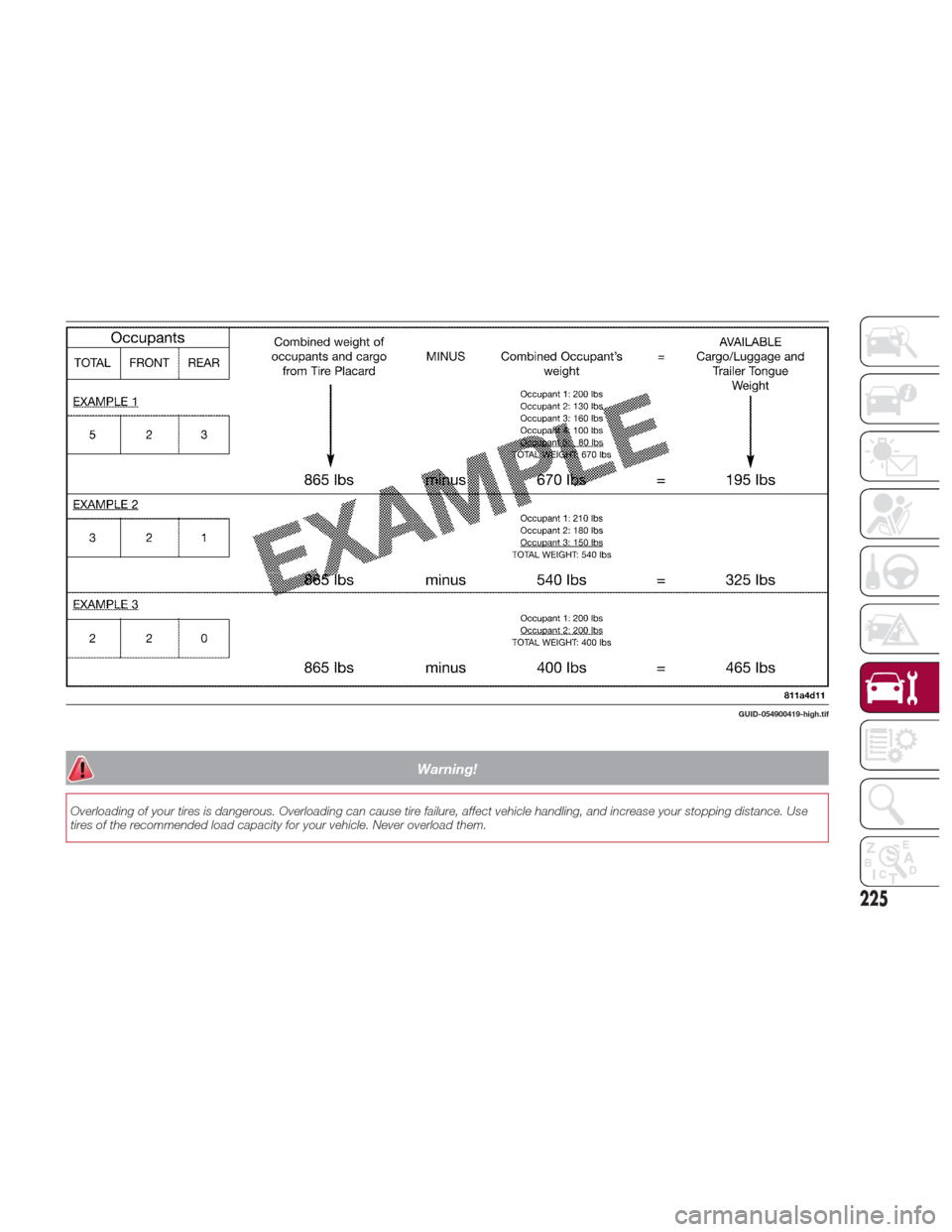
Warning!
Overloading of your tires is dangerous. Overloading can cause tire failure, affect vehicle handling, and increase your stopping distance. Use
tires of the recommended load capacity for your vehicle. Never overload them.
GUID-054900419-high.tif
225
Page 228 of 268
Spare Tires — If
Equipped
Note:
For vehicles equipped with Tire Repair
Kit instead of a spare tire, please refer
to “Tire Repair Kit” in “In Case Of
Emergency” for further information.
Caution!
Because of the reduced ground clearance,
do not take your vehicle through an
automatic car wash with a compact or
limited use temporary spare installed.
Damage to the vehicle may result.
Spare Tire Matching Original
Equipped Tire And Wheel — If
Equipped
Your vehicle may be equipped with a
spare tire and wheel equivalent in look
and function to the original equipment
tire and wheel found on the front or rear
axle of your vehicle. This spare tire may
be used in the tire rotation for your
vehicle. If your vehicle has this option,
refer to an authorized tire dealer for the
recommended tire rotation pattern.
Compact Spare Tire — If
Equipped
The compact spare is for temporary
emergency use only. You can identify if
your vehicle is equipped with a
compact spare by looking at the spare
tire description on the Tire and Loading
Information Placard located on the
driver’s side door opening or on the
sidewall of the tire. Compact spare tire
descriptions begin with the letter “T” or
“S” preceding the size designation.
Example: T145/80D18 103M.
T,S=Temporary Spare Tire
Since this tire has limited tread life, the
original equipment tire should be
repaired (or replaced) and reinstalled on
your vehicle at the first opportunity.
Do not install a wheel cover or attempt
to mount a conventional tire on the
compact spare wheel, since the wheel
is designed specifically for the compact
spare tire. Do not install more than one
compact spare tire and wheel on the
vehicle at any given time.
Warning!
Compact and collapsible spares are for
temporary emergency use only. With these
spares, do not drive more than 50 mph
(80 km/h). Temporary use spares have
limited tread life. When the tread is worn to
the tread wear indicators, the temporary
use spare tire needs to be replaced. Be
sure to follow the warnings, which apply to
your spare. Failure to do so could result in
spare tire failure and loss of vehicle control.
Full Size Spare — If Equipped
The full size spare is for temporary
emergency use only. This tire may look
like the originally equipped tire on the
front or rear axle of your vehicle, but it is
not. This spare tire may have limited
tread life. When the tread is worn to the
tread wear indicators, the temporary
use full size spare tire needs to be
replaced. Since it is not the same as
your original equipment tire, replace (or
repair) the original equipment tire and
reinstall on the vehicle at the first
opportunity.
226
SERVICING AND MAINTENANCE
Page 229 of 268
Limited Use Spare — If
Equipped
The limited use spare tire is for
temporary emergency use only. This tire
is identified by a label located on the
limited use spare wheel. This label
contains the driving limitations for this
spare. This tire may look like the original
equipped tire on the front or rear axle of
your vehicle, but it is not. Installation of
this limited use spare tire affects vehicle
handling. Since it is not the same as
your original equipment tire, replace (or
repair) the original equipment tire and
reinstall on the vehicle at the first
opportunity.
Warning!
Limited use spares are for emergency use
only. Installation of this limited use spare
tire affects vehicle handling. With this tire,
do not drive more than the speed listed on
the limited use spare wheel. Keep inflated
to the cold tire inflation pressures listed on
your Tire and Loading Information Placard
located on the driver’s side B-Pillar or the
rear edge of the driver’s side door. Replace
(or repair) the original equipment tire at the
first opportunity and reinstall it on your
vehicle. Failure to do so could result in loss
of vehicle control.
Wheel And Wheel Trim
Care
All wheels and wheel trim, especially
aluminum and chrome plated wheels,
should be cleaned regularly using mild
(neutral Ph) soap and water to maintain
their luster and to prevent corrosion.
Wash wheels with the same soap
solution recommended for the body of
the vehicle.
Your wheels are susceptible to
deterioration caused by salt, sodium
chloride, magnesium chloride, calcium
chloride, etc., and other road chemicals
used to melt ice or control dust on dirt
roads. Use a soft cloth or sponge and
mild soap to wipe away promptly. Do
not use harsh chemicals or a stiff brush.
They can damage the wheel’s
protective coating that helps keep them
from corroding and tarnishing.
Note:
Many aftermarket wheel cleaners
contain strong acids or strong alkaline
additives that can harm the wheel
surface.
Caution!
Avoid products or automatic car washes
that use acidic solutions or strong alkaline
additives or harsh brushes. These products
and automatic car washes may damage
the wheel's protective finish. Such damage
is not covered by the New Vehicle Limited
Warranty. Only car wash soap, MOPAR
Wheel Cleaner or equivalent is
recommended.
When cleaning extremely dirty wheels
including excessive brake dust, care
must be taken in the selection of tire
and wheel cleaning chemicals and
equipment to prevent damage to the
wheels. Mopar Wheel Treatment or
Mopar Chrome Cleaner or their
equivalent is recommended or select a
non-abrasive, non-acidic cleaner for
aluminum or chrome wheels. Do not
use any products on Dark Vapor or
Black Satin Chrome Wheels. They will
permanently damage this finish and
such damage is not covered by the
New Vehicle Limited Warranty.
227
Page 230 of 268
Caution!
Do not use scouring pads, steel wool, a
bristle brush, metal polishes or oven cleaner.
These products may damage the wheel's
protective finish. Such damage is not covered
by the New Vehicle Limited Warranty. Only
car wash soap, MOPAR Wheel Cleaner or
equivalent is recommended.
Note:
If you intend parking or storing your
vehicle for an extended period after
cleaning the wheels with wheel cleaner,
drive your vehicle for a few minutes
before doing so. Driving the vehicle and
applying the brakes when stopping will
reduce the risk of brake rotor corrosion.
Dark Vapor Or Black Satin Chrome
Wheels
Caution!
If your vehicle is equipped with Dark Vapor
or Black Satin Chrome wheels DO NOT USE
wheel cleaners, abrasives or polishing
compounds. They will permanently damage
this finish and such damage is not covered
by the New Vehicle Limited Warranty. USE
ONLY MILD SOAP AND WATER WITH A
SOFT CLOTH. Used on a regular basis; this
is all that is required to maintain this finish.
Tire Types
All Season Tires — If Equipped
All Season tires provide traction for all
seasons (Spring, Summer, Fall, and
Winter). Traction levels may vary
between different all season tires. All
season tires can be identified by the
M+S, M&S, M/S or MS designation on
the tire sidewall. Use all season tires
only in sets of four; failure to do so may
adversely affect the safety and handling
of your vehicle.
Summer Or Three Season Tires
— If Equipped
Summer tires provide traction in both
wet and dry conditions, and are not
intended to be driven in snow or on ice.
If your vehicle is equipped with Summer
tires, be aware these tires are not
designed for Winter or cold driving
conditions. Install Winter tires on your
vehicle when ambient temperatures are
less than 40°F (5°C) or if roads are
covered with ice or snow. For more
information, contact an authorized
dealer.
Summer tires do not contain the all
season designation or mountain/
snowflake symbol on the tire sidewall.
Use Summer tires only in sets of four;
failure to do so may adversely affect the
safety and handling of your vehicle.
Warning!
Do not use Summer tires in snow/ice
conditions. You could lose vehicle control,
resulting in severe injury or death. Driving
too fast for conditions also creates the
possibility of loss of vehicle control.
Snow Tires
Some areas of the country require the
use of snow tires during the Winter.
Snow tires can be identified by a
“mountain/snowflake” symbol on the
tire sidewall.If you need snow tires,
select tires equivalent
in size and type to the
original equipment
tires. Use snow tires
only in sets of four;
failure to do so may
adversely affect the safety and handling
of your vehicle.
Snow tires generally have lower speed
ratings than what was originally
equipped with your vehicle and should
not be operated at sustained speeds
over 75 mph (120 km/h). For speeds
above 75 mph (120 km/h) refer to
original equipment or an authorized tire
dealer for recommended safe operating
speeds, loading and cold tire inflation
pressures.
228
SERVICING AND MAINTENANCE