child lock Alfa Romeo Giulia 2017 User Guide
[x] Cancel search | Manufacturer: ALFA ROMEO, Model Year: 2017, Model line: Giulia, Model: Alfa Romeo Giulia 2017Pages: 268, PDF Size: 18.64 MB
Page 131 of 268
Center Seat LATCH
Warning!
Do not install a child restraint in the
center position using the LATCH system.
This position is not approved for installing
child seats using the LATCH attachments.
You must use the seat belt and tether
anchor to install a child seat in the center
seating position.
Never use the same lower anchorage to
attach more than one child restraint. Please
refer to “Installing The LATCH-Compatible
Child Restraint System” for typical
installation instructions.
Always follow the directions of the child
restraint manufacturer when installing
your child restraint. Not all child restraint
systems will be installed as described
here.
To Install A LATCH-Compatible
Child Restraint
If the selected seating position has a
Switchable Automatic Locking
Retractor (ALR) seat belt, stow the seat
belt, following the instructions below.
See the section “Installing Child
Restraints Using The Vehicle Seat Belt”
to check what type of seat belt each
seating position has. 1. Loosen the adjusters on the lower
straps and on the tether strap of the
child seat so that you can more easily
attach the hooks or connectors to the
vehicle anchorages.
2. Place the child seat between the
lower anchorages for that seating
position. For some second row seats,
you may need to recline the seat and /
or raise the head restraint to get a
better fit. If the rear seat can be moved
forward and rearward in the vehicle, you
may wish to move it to its rear-most
position to make room for the child
seat. You may also move the front seat
forward to allow more room for the child
seat.
3. Attach the lower hooks or
connectors of the child restraint to the
lower anchorages in the selected
seating position.
4. If the child restraint has a tether
strap, connect it to the top tether
anchorage. See the section “Installing
Child Restraints Using The Top Tether
Anchorage” for directions to attach a
tether anchor.
5. Tighten all of the straps as you push
the child restraint rearward and
downward into the seat. Remove slack
in the straps according to the child
restraint manufacturer’s instructions.
6. Test that the child restraint is
installed tightly by pulling back and forth
on the child seat at the belt path. It
should not move more than 1 inch
(25.4 mm) in any direction.
How To Stow An Unused
Switchable-ALR (ALR) Seat Belt
When using the LATCH attaching
system to install a child restraint, stow
all ALR seat belts that are not being
used by other occupants or being used
to secure child restraints. An unused
belt could injure a child if they play with
it and accidentally lock the seat belt
retractor. Before installing a child
restraint using the LATCH system,
buckle the seat belt behind the child
restraint and out of the child’s reach. If
the buckled seat belt interferes with the
child restraint installation, instead of
buckling it behind the child restraint,
route the seat belt through the child
restraint belt path and then buckle it.
Do not lock the seat belt. Remind all
children in the vehicle that the seat belts
are not toys and that they should not
play with them.
129
Page 132 of 268
Warning!
Improper installation of a child restraint
to the LATCH anchorages can lead to
failure of the restraint. The child could be
badly injured or killed. Follow the child
restraint manufacturer’s directions exactly
when installing an infant or child restraint.
Child restraint anchorages are designed
to withstand only those loads imposed by
correctly-fitted child restraints. Under no
circumstances are they to be used for adult
seat belts, harnesses, or for attaching other
items or equipment to the vehicle.
Installing Child Restraints Using
The Vehicle Seat Belt
Child restraint systems are designed to
be secured in vehicle seats by lap belts
or the lap belt portion of a lap/shoulder
belt.
Warning!
Improper installation or failure to properly
secure a child restraint can lead to failure of
the restraint. The child could be badly
injured or killed.
Follow the child restraint manufacturer’s
directions exactly when installing an infant
or child restraint.
The seat belts in the passenger seating
positions are equipped with a
Switchable Automatic Locking
Retractor (ALR) that is designed to
keep the lap portion of the seat belt
tight around the child restraint so that it
is not necessary to use a locking clip.
The ALR retractor can be “switched”
into a locked mode by pulling all of the
webbing out of the retractor and then
letting the webbing retract back into the retractor. If it is locked, the ALR will
make a clicking noise while the
webbing is pulled back into the
retractor. Refer to the “Automatic
Locking Mode” description in
“Switchable Automatic Locking
Retractors (ALR)” under “Occupant
Restraint Systems” for additional
information on ALR.
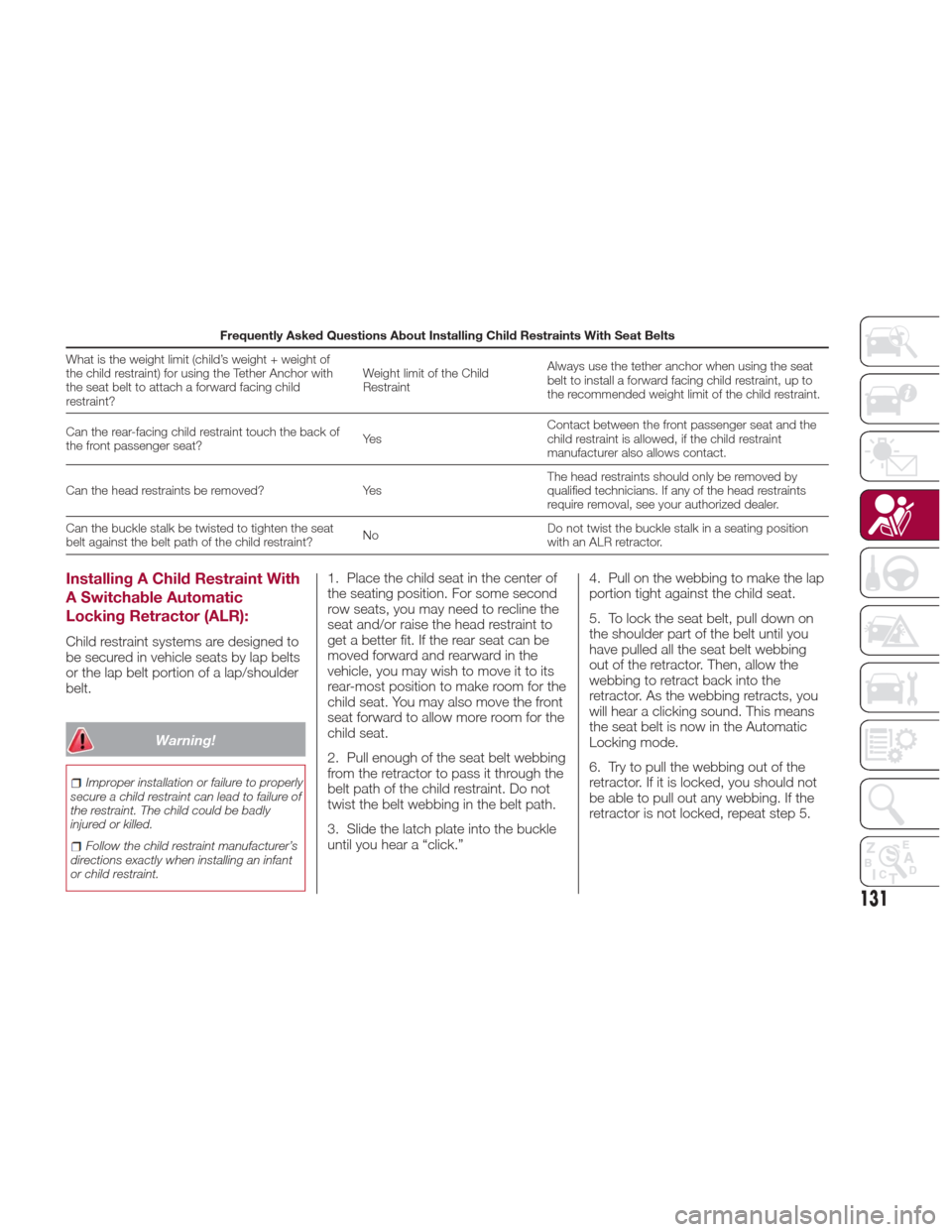
Lap/Shoulder Belt Systems For
Installing Child Restraints In
This Vehicle
GUID-06086S0102NAAutomatic Locking Retractor (ALR)
Locations
ALR = Switchable Automatic Locking
Retractor
Top Tether Anchorage Symbol
130
SAFETY
Page 133 of 268
Frequently Asked Questions About Installing Child Restraints With Seat Belts
What is the weight limit (child’s weight + weight of
the child restraint) for using the Tether Anchor with
theseatbelttoattachaforwardfacingchild
restraint? Weight limit of the Child
Restraint
Always use the tether anchor when using the seat
belt to install a forward facing child restraint, up to
the recommended weight limit of the child restraint.
Can the rear-facing child restraint touch the back of
the front passenger seat? Ye sContact between the front passenger seat and the
child restraint is allowed, if the child restraint
manufacturer also allows contact.
Can the head restraints be removed? YesThe head restraints should only be removed by
qualified technicians. If any of the head restraints
require removal, see your authorized dealer.
Can the buckle stalk be twisted to tighten the seat
belt against the belt path of the child restraint? NoDo not twist the buckle stalk in a seating position
with an ALR retractor.
Installing A Child Restraint With
A Switchable Automatic
Locking Retractor (ALR):
Child restraint systems are designed to
be secured in vehicle seats by lap belts
or the lap belt portion of a lap/shoulder
belt.
Warning!
Improper installation or failure to properly
secure a child restraint can lead to failure of
the restraint. The child could be badly
injured or killed.
Follow the child restraint manufacturer’s
directions exactly when installing an infant
or child restraint.
1. Place the child seat in the center of
the seating position. For some second
row seats, you may need to recline the
seat and/or raise the head restraint to
get a better fit. If the rear seat can be
moved forward and rearward in the
vehicle, you may wish to move it to its
rear-most position to make room for the
child seat. You may also move the front
seat forward to allow more room for the
child seat.
2. Pull enough of the seat belt webbing
from the retractor to pass it through the
belt path of the child restraint. Do not
twist the belt webbing in the belt path.
3. Slide the latch plate into the buckle
until you hear a “click.” 4. Pull on the webbing to make the lap
portion tight against the child seat.
5. To lock the seat belt, pull down on
the shoulder part of the belt until you
have pulled all the seat belt webbing
out of the retractor. Then, allow the
webbing to retract back into the
retractor. As the webbing retracts, you
will hear a clicking sound. This means
the seat belt is now in the Automatic
Locking mode.
6. Try to pull the webbing out of the
retractor. If it is locked, you should not
be able to pull out any webbing. If the
retractor is not locked, repeat step 5.
131
Page 137 of 268
STARTING THE
ENGINE
Starting The Engine
Before starting the engine, be sure to
adjust the seat, the interior rear view
mirrors, and the door mirrors, and
fasten the seat belt correctly.
Never press the accelerator pedal
before starting the engine.
If necessary, messages indicating the
starting procedure can be shown in the
display.
Warning!
When leaving the vehicle, always remove
the key fob from the vehicle and lock your
vehicle.
Never leave children alone in a vehicle,
or with access to an unlocked vehicle.
Allowing children to be in a vehicle
unattended is dangerous for a number of
reasons. A child or others could be
seriously or fatally injured. Children should
be warned not to touch the parking brake,
brake pedal or the transmission gear
selector.
Do not leave the key fob in or near the
vehicle, or in a location accessible to
children. A child could operate power
windows, other controls, or move the
vehicle.
Do not leave children or animals inside
parked vehicles in hot weather. Interior heat
build-up may cause serious injury or death.
Starting Procedure
Proceed as follows:
1. Apply the electric park brake and set
the gear selector to PARK (P) or
NEUTRAL (N).
2. Fully depress the brake pedal
without touching the accelerator.
3. Briefly push the ignition button.
4. If the engine doesn't start within a
few seconds, you need to repeat the
procedure.
If the problem persists, contact an
authorized dealer.
Warning!
Never pour fuel or other flammable liquid
into the throttle body air inlet opening in an
attempt to start the vehicle. This could
result in flash fire causing serious personal
injury.
Do not attempt to push or tow your
vehicle to get it started. Vehicles equipped
with an automatic transmission cannot be
started this way. Unburned fuel could enter
the catalytic converter and once the engine
has started, ignite and damage the
converter and vehicle.
If the vehicle has a discharged battery,
booster cables may be used to obtain a
start from a booster battery or the battery
in another vehicle. This type of start can be
dangerous if done improperly. Refer to
“Emergency Starting” in “In Case Of
Emergency” for further information.
Caution!
To prevent damage to the starter, do not
continuously crank the engine for more
than 25 seconds at a time. Wait
60 seconds before trying again.
Remote Starting System
— If Equipped
This system uses the key fob to start
the engine conveniently from outside
the vehicle while still maintaining
security. The system has a range of at
least 300 feet (91 meters).
The remote starting system also
activates the climate control (if
equipped), the heated seats (if
equipped), and the heated steering
wheel (if equipped), depending on
temperatures outside and inside of the
car.
Note:
The vehicle must be equipped with
an automatic transmission in order to
include remote start.
Obstructions between the vehicle
and key fob may reduce this range.
135
Page 141 of 268
several times to slow down the vehicle,
may cause severe damage to the
braking system.
Disengaging The Electric Park
Brake Manually
In order to manually release the park
brake, the ignition should be in the ON
mode. Press the brake pedal, and then
press the switch on the center console
briefly.
Noise may be heard from the rear of the
vehicle, and a slight movement of the
brake pedal may be detected during
disengagement.
After disengaging the electric parking
brake, the BRAKE warning light on the
instrument panel and the light on the
switch will turn off.
If the BRAKE warning light on the
instrument panel remains on with the
electric parking brake disengaged, this
indicates a fault: in this case, contact an
authorized dealer.
Warning!
Never leave children alone in a vehicle,
or with access to an unlocked vehicle.
Allowing children to be in a vehicle
unattended is dangerous for a number of
reasons. A child or others could be
seriously or fatally injured. Children should
be warned not to touch the park brake,
brake pedal or the gear selector.
Do not leave the key fob in or near the
vehicle or in a location accessible to
children. A child could operate power
windows, other controls, or move the
vehicle.
Be sure the park brake is fully
disengaged before driving; failure to do so
can lead to brake failure and a collision.
Always fully apply the park brake when
leaving your vehicle, or it may roll and
cause damage or injury.
Caution!
Never use gear position PARK (P) instead
of the electric parking brake. Always
engage the electric parking brake when
parking the vehicle to prevent injury or
damage caused by the unexpected
movement of the vehicle.
Electric Park Brake
Operating Modes
The electric park brake may operate as
follows:
"Dynamic Operating Mode": this
mode is activated by pulling the switch
repeatedly while driving.
"Static Engagement and Release
Mode": with the vehicle stationary, the
electric park brake can be activated by
pulling the switch on the central tunnel
once. On the other hand, push the switch and the brake pedal at the same
time to disengage the brake.
"Drive Away Release" — if equipped:
the electric park brake will automatically
disengage with the driver side seat belt
fastened and the detection of an action
performed by the driver to move the
vehicle (forward gear or reverse gear).
"Safe Hold": if the vehicle speed is
lower than 1.9 mph (3 km/h), the gear
selector is not in PARK (P) position and
the driver's intention of leaving the
vehicle is detected, the electric park
brake will automatically engage to hold
the vehicle in safety conditions.
"Auto Park Brake": if the vehicle
speed is below 1.9 mph (3 km/h), the
electric park brake will automatically
engage when the gear selector is in
PARK (P) position. The light on the
switch located on the center console
switches on together with the BRAKE
warning light on the instrument panel
when the park brake is engaged and
applied to the wheels. Each automatic
park brake engagement can be
cancelled by pressing the switch on the
center console and at the same time
moving the gear selector for the
transmission to position PARK (P).
139
Page 142 of 268
Safe Hold
Safe Hold is a safety function that
automatically engages the electric park
brake in the event of a dangerous
condition for the vehicle.
The electric park brake engages
automatically to prevent vehicle
movement if:
The vehicle speed is below 2 mph
(3 km/h).
A transmission operating mode
different from PARK (P) is activated.
The driver's seat belt is not fastened.
The driver side door is open.
No attempts to apply pressure on the
brake pedal have been detected.
The “Safe Hold” function can be
temporarily disabled by pressing the
switch located on the central console
and the brake pedal at the same time,
with the vehicle stationary and the
driver side door open.
Once disabled, the function will activate
again when the vehicle speed reaches
12 mph (20 km/h) or the ignition is
cycled to STOP and then to ON.
AUTOMATIC
TRANSMISSION
Automatic Transmission
Operation
The vehicle can be equipped with an
electronically controlled 8-speed
automatic transmission where gear
shifting automatically takes place,
depending on the vehicle usage
instantaneous parameters (vehicle
speed, grade, and accelerator pedal
position).
The new transmission is an absolute
innovation, as it can match the
Stop/Start Evo system with the
traditional automatic transmissions with
built-in torque converter. For further
information, refer to the “Stop/Start
Evo” section within this chapter.
Manual gear shifting can still occur
thanks to the "sequential mode"
position for the gear selector.
Warning!
It is dangerous to shift out of PARK or
NEUTRAL if the engine speed is higher
than idle speed. If your foot is not firmly
pressing the brake pedal, the vehicle could
accelerate quickly forward or in reverse.
You could lose control of the vehicle and hit
someone or something. Only shift into gear
when the engine is idling normally and your
foot is firmly pressing the brake pedal.
Unintended movement of a vehicle
could injure those in or near the vehicle. As
with all vehicles, you should never exit a
vehicle while the engine is running. Before
exiting a vehicle, always apply the park
brake, shift the transmission into PARK,
and turn the ignition STOP/OFF. When the
ignition is in the STOP/OFF mode, the
transmission is locked in PARK, securing
the vehicle against unwanted movement.
When leaving the vehicle, always make
sure the ignition is in the STOP/OFF mode,
remove the key fob from the vehicle, and
lock the vehicle.
Never leave children alone in a vehicle,
or with access to an unlocked vehicle.
Allowing children to be in a vehicle
unattended is dangerous for a number of
reasons. A child or others could be
seriously or fatally injured. Children should
be warned not to touch the parking brake,
brake pedal or the transmission gear
selector.
Do not leave the key fob in or near the
vehicle (or in a location accessible to
children), and do not leave the ignition in
the AVV or ON mode. A child could
operate power windows, other controls, or
move the vehicle.
140
STARTING AND OPERATING
Page 145 of 268
When leaving the vehicle, always make
sure the ignition is in the STOP/OFF mode,
remove the key fob from the vehicle, and
lock the vehicle.
Never leave children alone in a vehicle,
or with access to an unlocked vehicle.
Allowing children to be in a vehicle
unattended is dangerous for a number of
reasons. A child or others could be
seriously or fatally injured. Children should
be warned not to touch the park brake,
brake pedal or the transmission gear
selector.
Do not leave the key fob in or near the
vehicle (or in a location accessible to
children), and do not leave the ignition in
the ON mode. A child could operate power
windows, other controls, or move the
vehicle.
Caution!
Before moving the transmission gear
selector out of PARK, you must press the
ignition button to cycle from STOP/OFF
mode to the ON mode, and also press the
brake pedal. Otherwise, damage to the
gear selector could result.
DO NOT race the engine when shifting
from PARK or NEUTRAL into another gear
range, as this can damage the drivetrain.
REVERSE (R)
Select this mode only with the vehicle at
a standstill.
NEUTRAL (N)
Use this range when the vehicle is
standing for prolonged periods with the
engine running. The engine may be
started in this range. Apply the electric
park brake and shift the transmission
into PARK (P) if you must leave the
vehicle.
Warning!
Do not coast in NEUTRAL and never turn
off the ignition to coast down a hill. These
are unsafe practices that limit your
response to changing traffic or road
conditions. You might lose control of the
vehicle and have a collision.
DRIVE (D)
Use this mode in normal driving
conditions.
Shifting from DRIVE (D) to PARK (P) or
REVERSE (R) modes must take place
only after releasing the accelerator
pedal, with vehicle at a standstill and
brake pedal pressed.
This mode ensures automatic
engagement of the most suitable gears
for driving needs and maximum fuel
economy in terms of consumption. In this position, the transmission shifts
the gears automatically, selecting the
most suitable for forward driving among
those available as you go. In this way
the vehicle's optimal driving
characteristics are provided for all
conditions.
AutoStick
In the case of frequent shifting (e.g. for
sport driving, when the vehicle is driven
with a heavy load, on slopes, when
towing heavy trailers), it is
recommended to use the Autostick
(sequential shifting) mode to select and
keep a lower fixed ratio.
In these conditions, the use of a lower
gear improves vehicle performance,
preventing overheating.
It is possible to shift from DRIVE (D)
mode to sequential mode regardless of
vehicle speed.
Activation
Starting from DRIVE (D) mode, to
activate the sequential drive mode,
move the selector to the left (– and +
indication of the trim). The gear
engaged will be shown on the display.
Shifting is made by moving the gear
selector forwards, towards symbol – or
backwards, towards symbol +.
143
Page 147 of 268
Brake/Transmission
Shift Interlock System
This vehicle is equipped with a Brake
Transmission Shift Interlock system
(BTSI) that holds the gear selector in
PARK (P) unless the brakes are applied.
This system prevents you from moving
the gear selector from position PARK
(P) unless the brakes are applied.
To shift the transmission out of PARK
(P), the ignition must be cycled to the
AVV mode (engine running or not) and
the brake pedal must be pressed.
Brake/Transmission Shift Interlock
Disabling
Only if strictly necessary (e.g. pushing
the vehicle, conveyor vehicle washing
systems) inhibit the automatic activation
of PARK (P) mode when stopping the
engine, or proceed as described below:
1. Car at a standstill.
2. NEUTRAL (N) mode activated.
3. Push the ignition button for at least
three seconds.
The automatic park brake engagement
function when the engine is stopped
can also be deactivated on the Connect
system by selecting the following
functions on the main menu: "Settings",
"Driver Assistance" and "Automatic
Parking Brake".
Important Notes
Failure to comply with what is reported
below may damage the transmission:
Shift into PARK (P) mode only with
the vehicle at a standstill.
Select REVERSE (R) mode, or pass
from REVERSE to another mode only
with the vehicle at a standstill and
engine idling.
Do not change between PARK (P),
REVERSE (R), NEUTRAL (N) or DRIVE
(D) modes with engine running at a
speed above idling.
Before activating any transmission
operating mode, fully depress the brake
pedal.
Note: The unexpected movement of
the vehicle can injure the occupants or
people nearby. Do not leave the vehicle
with engine running: before getting out
of the passenger compartment always
engage the electric park brake, select
the PARK (P) mode, stop the engine.
With the ignition device in the STOP
position, the transmission is locked in
the PARK (P) position in order to
prevent accidental vehicle movement. If
equipped with keyless ignition, do not
leave the key fob near the vehicle (or in
a place accessible to children), and do
not leave the ignition on. A child could activate the electric
windows, other controls, or even start
the engine; it is dangerous to select a
mode other than PARK (P) or NEUTRAL
(N) at an engine speed higher than
idling.
If the brake pedal is not fully depressed,
the vehicle could rapidly accelerate.
Only engage the gear with engine at
idling while fully depressing the brake
pedal. If the transmission temperature
exceeds the normal operating limits, the
transmission control unit may change
the gear engagement order and reduce
the drive torque. If the transmission
overheats, the display shows the
symbol. In this case, the
transmission could operate incorrectly
until it cools down.
When using the vehicle with extremely
low external temperatures, the
transmission operation may change
depending on the engine and
transmission temperature, as well as
vehicle speed. Activation of the torque
converter clutch and of the eighth or
ninth gear is inhibited until the
transmission oil is correctly warmed up.
Complete operation of the transmission
will be enabled as soon as the fluid
temperature reaches the predefined
value.
145
Page 262 of 268
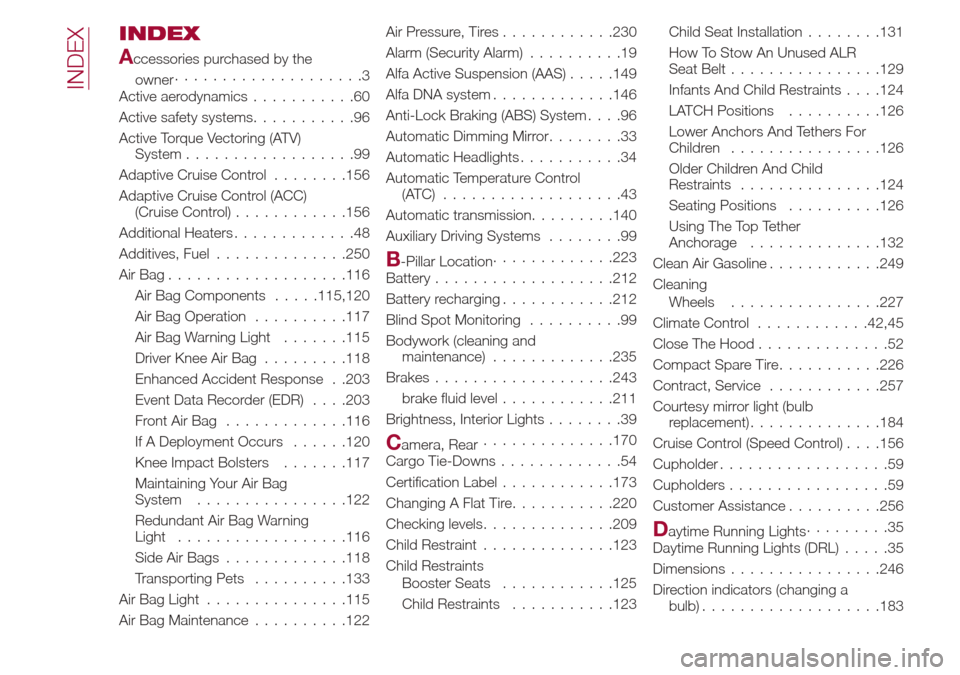
INDEX
Accessories purchased by theowner ....................3
Active aerodynamics ...........60
Active safety systems ...........96
Active Torque Vectoring (ATV) System ..................99
Adaptive Cruise Control ........156
Adaptive Cruise Control (ACC) (Cruise Control) ............156
Additional Heaters .............48
Additives, Fuel ..............250
AirBag.................. .116
Air Bag Components .....115,120
Air Bag Operation ..........117
Air Bag Warning Light .......115
Driver Knee Air Bag .........118
Enhanced Accident Response . .203
Event Data Recorder (EDR) . . . .203
FrontAirBag ............ .116
If A Deployment Occurs ......120
Knee Impact Bolsters .......117
Maintaining Your Air Bag
System ............... .122
Redundant Air Bag Warning
Light ................. .116
Side Air Bags .............118
Transporting Pets ..........133
Air Bag Light ...............115
Air Bag Maintenance ..........122Air Pressure, Tires
............230
Alarm (Security Alarm) ..........19
Alfa Active Suspension (AAS) .....149
Alfa DNA system .............146
Anti-Lock Braking (ABS) System ....96
Automatic Dimming Mirror ........33
Automatic Headlights ...........34
Automatic Temperature Control (ATC) ...................43
Automatic transmission.........140
Auxiliary Driving Systems ........99
B-Pillar Location.............223
Battery .................. .212
Battery recharging ............212
Blind Spot Monitoring ..........99
Bodywork (cleaning and maintenance) .............235
Brakes .................. .243
brake fluid level ............211
Brightness, Interior Lights ........39
Camera, Rear..............170
Cargo Tie-Downs .............54
Certification Label ............173
Changing A Flat Tire ...........220
Checking levels ..............209
Child Restraint ..............123
Child Restraints Booster Seats ............125
Child Restraints ...........123 Child Seat Installation
........131
How To Stow An Unused ALR
Seat Belt ............... .129
Infants And Child Restraints . . . .124
LATCH Positions ..........126
Lower Anchors And Tethers For
Children ............... .126
Older Children And Child
Restraints ...............124
Seating Positions ..........126
Using The Top Tether
Anchorage ..............132
Clean Air Gasoline ............249
Cleaning Wheels ............... .227
Climate Control ............42,45
Close The Hood ..............52
Compact Spare Tire ...........226
Contract, Service ............257
Courtesy mirror light (bulb replacement) ..............184
Cruise Control (Speed Control) . . . .156
Cupholder ..................59
Cupholders .................59
Customer Assistance ..........256
Daytime Running Lights .........35
Daytime Running Lights (DRL) .....35
Dimensions ............... .246
Direction indicators (changing a bulb) .................. .183
INDEX
Page 263 of 268
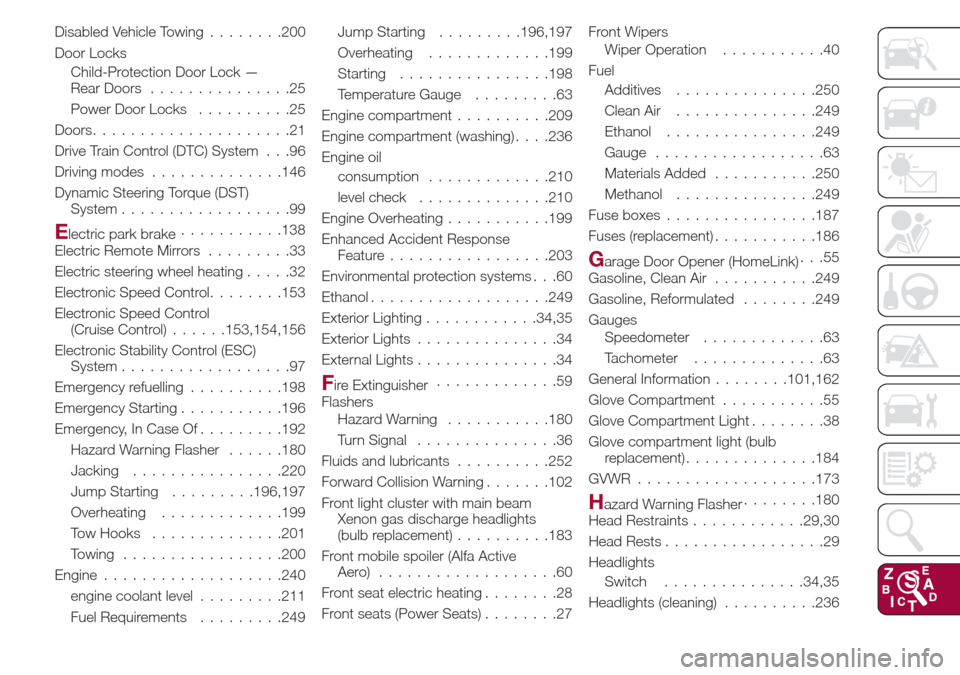
Disabled Vehicle Towing........200
Door Locks Child-Protection Door Lock —
Rear Doors ...............25
Power Door Locks ..........25
Doors .....................21
Drive Train Control (DTC) System . . .96
Driving modes ..............146
Dynamic Steering Torque (DST) System ..................99
Electric park brake ...........138
Electric Remote Mirrors .........33
Electric steering wheel heating .....32
Electronic Speed Control ........153
Electronic Speed Control (Cruise Control) ......153,154,156
Electronic Stability Control (ESC) System ..................97
Emergency refuelling ..........198
Emergency Starting ...........196
Emergency, In Case Of .........192
Hazard Warning Flasher ......180
Jacking ............... .220
Jump Starting .........196,197
Overheating .............199
Tow Hooks ..............201
Towing ................ .200
Engine .................. .240
engine coolant level .........211
Fuel Requirements .........249 Jump Starting
.........196,197
Overheating .............199
Starting ............... .198
Temperature Gauge .........63
Engine compartment ..........209
Engine compartment (washing) . . . .236
Engine oil consumption .............210
level check ..............210
Engine Overheating ...........199
Enhanced Accident Response Feature ................ .203
Environmental protection systems . . .60
Ethanol .................. .249
Exterior Lighting ............34,35
Exterior Lights ...............34
External Lights ...............34
Fire Extinguisher .............59
Flashers Hazard Warning ...........180
Turn Signal ...............36
Fluids and lubricants ..........252
Forward Collision Warning .......102
Front light cluster with main beam Xenon gas discharge headlights
(bulb replacement) ..........183
Front mobile spoiler (Alfa Active Aero) ...................60
Front seat electric heating ........28
Front seats (Power Seats) ........27Front Wipers
Wiper Operation ...........40
Fuel Additives ...............250
Clean Air ...............249
Ethanol ............... .249
Gauge ..................63
Materials Added ...........250
Methanol ...............249
Fuse boxes ............... .187
Fuses (replacement) ...........186
Garage Door Opener (HomeLink) . . .55
Gasoline, Clean Air ...........249
Gasoline, Reformulated ........249
Gauges Speedometer .............63
Tachometer ..............63
General Information ........101,162
Glove Compartment ...........55
Glove Compartment Light ........38
Glove compartment light (bulb replacement) ..............184
GVWR .................. .173
Hazard Warning Flasher........180
Head Restraints ............29,30
Head Rests .................29
Headlights Switch ...............34,35
Headlights (cleaning) ..........236