Transmission Alfa Romeo Giulia 2017 Owner's Guide
[x] Cancel search | Manufacturer: ALFA ROMEO, Model Year: 2017, Model line: Giulia, Model: Alfa Romeo Giulia 2017Pages: 268, PDF Size: 18.64 MB
Page 149 of 268
The "Performance" screen graphically
reproduces some parameters closely
linked to the efficiency of the driving
style, with a view to limiting
consumption.
"Dynamic" Mode
Activation
It is activated by rotating the selector to
the letter "d", the displays light up in
red.ESC and ASR systems: intervention
thresholds that ensure more enjoyable,
sportier driving while guaranteeing the
stability of the car.
Engine and transmission: adoption of
sports mapping.
Note:
In "Dynamic", the sensitivity of the
accelerator pedal increases
considerably. Consequently, driving is
less fluid and comfortable.
07116S0001EMNormal Mode Performance Display
07116S0003EMDynamic Mode07116S0006EMDynamic Mode Performance
Display
The "Performance" screen displays
parameters related to vehicle stability,
the graphs illustrate the trend of the
longitudinal/lateral accelerations
(G-meter information), considering
gravity acceleration as a reference unit.
Lateral acceleration peaks are displayed
on the right.
147
Page 150 of 268
“Race” Mode — If Equipped
Activation
It is activated by rotating the selector to
position "Race", the displays light up in
yellow.
Engine and transmission: adoption of
sports mapping.
Note:
It is recommended to activate this
mode at the track.
In "Race", the sensitivity of the
accelerator pedal increases
considerably. Consequently, driving is
less fluid and comfortable. The "Performance" screen displays
parameters related to vehicle stability,
the graphs illustrate the trend of the
longitudinal/lateral accelerations
(G-meter information), considering
gravity acceleration as a reference unit.
The screen displays the lateral and
longitudinal acceleration peaks.
Note:
If the brake system overheats,
this is communicated by the Connect
system. In this case, allow the system
to cool for a few minutes by driving the
vehicle normally without operating the
brakes. "Advanced Efficiency" Mode
Activation
It is activated by rotating the selector to
the letter "a", the displays light up in
green.
ESC and ASR systems: intervention
thresholds aimed at ensuring maximum
safety in low-grip driving conditions. It is
advisable to select "Advanced
Efficiency" mode in the presence of
low-grip road surfaces.
Engine and transmission: standard
response.
The "Performance" screen graphically
displays some parameters closely
related to the vehicle consumption.
07116S0004EMRace Mode
05036S0014EMRace Mode Performance Display
07116S0005EMAdvanced Efficiency Mode
148
STARTING AND OPERATING
Page 157 of 268
Increasing/Decreasing
Speed
Increasing Speed
Once the Electronic Speed Control has
been activated, the speed can be
increased by pushing the SET switch
upward.
By keeping the button pushed, the set
speed will increase until the button is
released. The new speed will then be
set.
At every movement of the SET switch,
the set speed can fine-adjusted.
Decreasing Speed
When the feature is active, to reduce
the speed, push the SET switch
downward.
By keeping the button pushed, the set
speed will decrease until the button is
released. The new speed will then be
set.
At every movement of the SET switch,
the set speed can fine-adjusted.
Note:Moving the SET switch allows to
adjust the speed according to the
selected unit of measurement set on
the Connect system (see dedicated
supplement). Accelerating When Overtaking
Press the accelerator as you would
normally. When the pedal is released,
the vehicle will return to the set speed.
Use Of The Feature On Hilly Routes
With an automatic transmission, the
feature can automatically downshift to
keep the set speed when driving on hilly
routes.
On steep grades, the loss or gain in
speed may be considerable and is
advisable to deactivate the Electronic
Speed Control.
Note:
The feature keeps the speed set
even uphill and downhill. A slight
variation in the speed on slight rises is
completely normal.
Recalling The Speed
Note: Before returning to the
previously set speed, you must
accelerate to a speed close to that
speed, then push the RES button and
release it.
If equipped with an automatic
transmission, while operating in DRIVE
(D), push and release the RES button to
recall the previously set speed. If equipped with automatic transmission
in Autostick (sequential) mode, before
recalling the previously set speed, you
should accelerate until you are close to
that speed. Then, push and release the
RES button.
Deactivating
Lightly pressing the brake pedal
deactivates the speed control without
deleting the set speed.
The speed control may also be
deactivated by applying the electric
parking brake or when the braking
system is operated (e.g. operation of
the ESC system).
The set speed is deleted in the
following cases:
Pushing the on/off button.
Turning the engine to the STOP
position.
If there is a malfunction with the
Electronic Speed Control.
07146S0003EMResume Button Location
155
Page 160 of 268

While the accelerator pedal is pressed,
the system will not be able to control
the distance between the vehicle and
the one ahead. In this case, the speed
will be determined only by the position
of the accelerator pedal.
The system will return to normal
operation as soon as the accelerator
pedal is released.
The systemcannotbe set:
When pressing the brake pedal.
When the brakes are overheated.
When the electric park brake has
been operated.
When either P (PARK), R (REVERSE)
or N (NEUTRAL) is engaged.
When the engine rpm is above a
maximum threshold.
When the vehicle speed is not within
the operational speed range.
When the ESC (or ABS or other
stability control systems) are operating
or have just operated.
When the ESC system is off.
When the Forward Collision Warning
Plus system (if equipped) is braking
automatically.
In the event of system failure.
When the engine is off.
In case of obstruction of the radar
sensor (in this case the bumper area
where it is located must be cleaned).
If the system is set, the conditions
described above also cause a
cancellation or deactivation of the
system. These situations may vary
according to the conditions.
Note:
The system will not be deactivated
when speeds higher than those set are
reached by pressing the accelerator
pedal above 110 mph (180 km/h). In
these situations, the system may not
work correctly and it is recommended
to deactivate it.
Changing Speed
Increasing speed
Once the system has been activated,
you can increase the speed by lifting
the SET switch. Each time it is
operated, the speed increases by
1 mph.
By holding the button up, the set speed
will increase in increments of five mph
until the button is released. Then, the
new speed will be set.
Decreasing speed
Once the system has been activated,
you can decrease the speed by
lowering the SET switch. Each time it is
operated, the speed decreases by
1 mph. By holding the button down, the set
speed will decrease in increments of
five mph until the button is released.
Then, the new speed will be set.
Note:
Moving the SET switch allows you
to adjust the speed according to the
selected unit of measurement ("US" or
"metric") set on the Connect system
(see dedicated supplement).
When the unit of measurement is
set to metric, holding the SET switch
the speed will change in 10 km/h
increments.
By keeping the accelerator pedal
depressed, the vehicle can continue to
accelerate beyond the set speed. In this
case, use the SET switch to set the
speed to the vehicle’s current speed.
When you push the SET button to
reduce the speed, the braking system
intervenes automatically if the engine
brake does not slow the vehicle down
sufficiently to reach the set speed. The
device holds the set speed uphill and
downhill; however a slight variation is
entirely normal, particularly on slight
inclines.
The transmission could change to a
lower gear when driving downhill, or
when accelerating. This is normal and
necessary to maintain the set speed.
The system will disable while driving
if the brakes overheat.
158
STARTING AND OPERATING
Page 189 of 268
Warning!
When replacing a blown fuse, always
use an appropriate replacement fuse with
the same amp rating as the original fuse.
Never replace a fuse with another fuse of
higher amp rating. Never replace a blown
fuse with metal wires or any other material.
Failure to use proper fuses may result in
serious personal injury, fire and/or property
damage.
Before replacing a fuse, make sure that
the ignition is off and that all the other
services are switched off and/or
disengaged.
If the replaced fuse blows again, contact
an authorized dealer.
If a general protection fuse for safety
systems (air bag system, braking system),
power unit systems (engine system,
transmission system) or steering system
blows, contact an authorized dealer.
Fuse Location
The fuses, which can be replaced by
the user, are grouped in two boxes
below the passenger side foot board
and inside the trunk.
Control Unit Under
Passenger Side
Footboard
To access the fuses, proceed as
follows:
1. Lift the upper end of the footboard
on the passenger side, pulling to
release the two buttons.
Release Buttons On Footboard
1 — Footboard
2. Unscrewing the two hooks, remove
the panel pulling downward. Release Hooks On Footboard
2 — Panel
The fuses are freely accessible on the
control unit.
After replacing the fuse, make sure that
panel and footboard are correctly
locked.
Luggage Compartment
Fuse Box
To access the fuses, proceed as
follows:
1. Lift the luggage compartment cover.
2. Remove the control unit cover.
08036S0010EM
08036S0011EM
187
Page 200 of 268
4. Disconnect the positive (+) end of
the jumper cable from the positive (+)
post of the vehicle with the discharged
battery.
If frequent jump-starting is required to
start your vehicle, you should have the
battery and charging system inspected
at your authorized dealer.
Caution!
Accessories plugged into the vehicle power
outlets draw power from the vehicle’s
battery, even when not in use (i.e., cellular
phones, etc.). Eventually, if plugged in long
enough without engine operation, the
vehicle’s battery will discharge sufficiently
to degrade battery life and/or prevent the
engine from starting.
Bump Starting
Never jump start the engine by pushing,
towing or coasting downhill.
Note:
You cannot start a vehicle with an
automatic transmission by pushing it.
Caution!
Accessories plugged into the vehicle power
outlets draw power from the vehicle’s
battery, even when not in use (i.e., cellular
phones, etc.). Eventually, if plugged in long
enough without engine operation, the
vehicle’s battery will discharge sufficiently
to degrade battery life and/or prevent the
engine from starting.
REFUELING IN
EMERGENCY
Refueling in an emergency is described
in "Refueling The Vehicle" in "Starting
And Operating".
198
IN CASE OF EMERGENCY
Page 201 of 268
ENGINE
OVERHEATING
Engine overheating may occur in
situations of extreme environmental
temperatures, frequent engine
stops/starts, or driving in heavy traffic. If
the engine becomes overheated, the
Engine Temperature Warning Light in
the instrument cluster will illuminate
along with a dedicated message. Refer
to "Warning Lights And Messages" in
the "Getting To Know Your Instrument
Panel" for more information.
In any of the following situations, you
can reduce the potential for overheating
by taking the appropriate action.
On the highways — slow down.
In city traffic — while stopped, place
the transmission in NEUTRAL, but do
not increase engine idle speed.
Note:
There are steps that you can take to
slow down an impending overheat
condition:
If your air conditioner (A/C) is on,
turn it off. The A/C system adds heat
to the engine cooling system and
turning the A/C off can help remove
this heat.
You can also turn the temperature
control to maximum heat, the mode
control to floor and the blower control
to high. This allows the heater core to
act as a supplement to the radiator
and aids in removing heat from the
engine cooling system.
Warning!
You or others can be badly burned by hot
engine coolant (antifreeze) or steam from
your radiator. If you see or hear steam
coming from under the hood, do not open
the hood until the radiator has had time to
cool. Never try to open a cooling system
pressure cap when the radiator or coolant
bottle is hot.
Caution!
Driving with a hot cooling system could
damage your vehicle. If temperature gauge
reads “H”, pull over and stop the vehicle.
Idle the vehicle with the air conditioner
turned off until the pointer drops back into
the normal range. If the pointer remains on
the “H”, turn the engine off immediately,
and call for service.
If Steam Is Coming From The
Engine Compartment
Do not go near the front of the vehicle.
Stop the engine. Wait until the steam
dissipates. Then, open the hood and
start the engine.
If Neither Coolant Nor Steam Is
Escaping
Open the hood and idle the engine until
it cools.
Note:
If the cooling fan does not operate
while the engine is running, the engine
temperature will increase. Stop the
engine and contact your authorized
dealer.
If the engine continues to overheat
or frequently overheats, have the
cooling system inspected. The engine
could be seriously damaged unless
repairs are made. Contact your
authorized dealer.
199
Page 202 of 268
TOWING A
DISABLED VEHICLE
This section describes procedures for
towing a disabled vehicle using a
commercial towing service.
Caution!
The vehicle should be transported with
all four wheels OFF the ground on the
flatbed of a roadside assistance vehicle.
Avoid towing with only the front (or rear)
wheels lifted. When towing with only the
front (or rear) wheels lifted, in addition to
damaging the body, it could damage the
transmission.
Do not use sling-type equipment when
towing. Vehicle damage may occur.
When securing the vehicle to a flatbed
truck, do not attach to front or rear
suspension components. Damage to your
vehicle may result from improper towing.
Ensure that the Electric Park Brake is
released, and remain released, while being
towed.
Damage from improper towing is not
covered under the New Vehicle Limited
Warranty.
The operators of the assistance vehicle
must be informed of your vehicle's
minimum required height from the
ground, in order to avoid contact
between the ends of the bumpers and
the equipment of the breakdown truck.
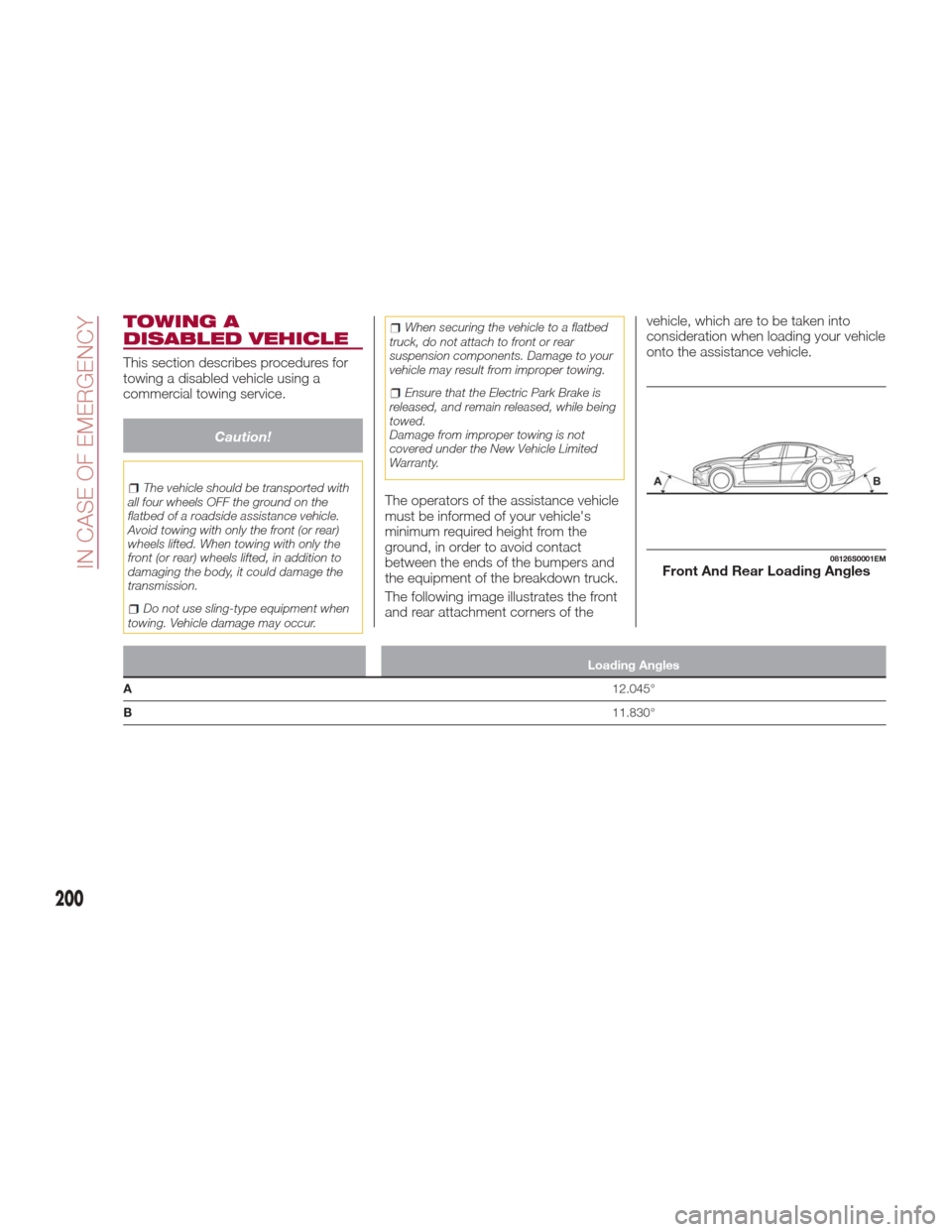
The following image illustrates the front
and rear attachment corners of the vehicle, which are to be taken into
consideration when loading your vehicle
onto the assistance vehicle.
Loading Angles
A 12.045°
B 11.830°
08126S0001EMFront And Rear Loading Angles
200
IN CASE OF EMERGENCY
Page 203 of 268
Rear Wheel Drive (RWD)
Models
It is recommended to tow the vehicle
with all four wheels OFF the ground on
the flatbed of a roadside assistance
vehicle.
Caution!
Do not use sling type equipment when
towing. Vehicle damage may occur.
When securing the vehicle to a flat bed
truck, do not attach to front or rear
suspension components. Damage to your
vehicle may result from improper towing.
Ensure that the Electric Park Brake is
released, and remains released, while
being towed.
If an assistance vehicle with a flatbed is
not available, the vehicle must be
towed with the rear wheels lifted from
the ground using a trailer or special
equipment allowing lifting of the rear
wheels.
Four-Wheel Drive (AWD)
Models
It is recommended to tow the vehicle
with all four wheels OFF the ground on
the flatbed of a roadside assistance
vehicle.
Caution!
DO NOT flat tow this vehicle. Damage to
the drivetrain will result.
DO NOT dolly tow this vehicle. Use of a
towing dolly can cause significant damage
to your vehicle.
Towing this vehicle in violation of the above
requirements can cause severe
transmission damage. Damage from
improper towing is not covered under the
New Vehicle Limited Warranty.
TOW HOOKS
If the vehicle has been in an accident or
has broken down, a tow hook is
provided in the tools container located
inside the luggage compartment for
vehicle towing. Towing is meant only for
short distances on a paved road
surface.
Proceed as follows to use the tow
hook:
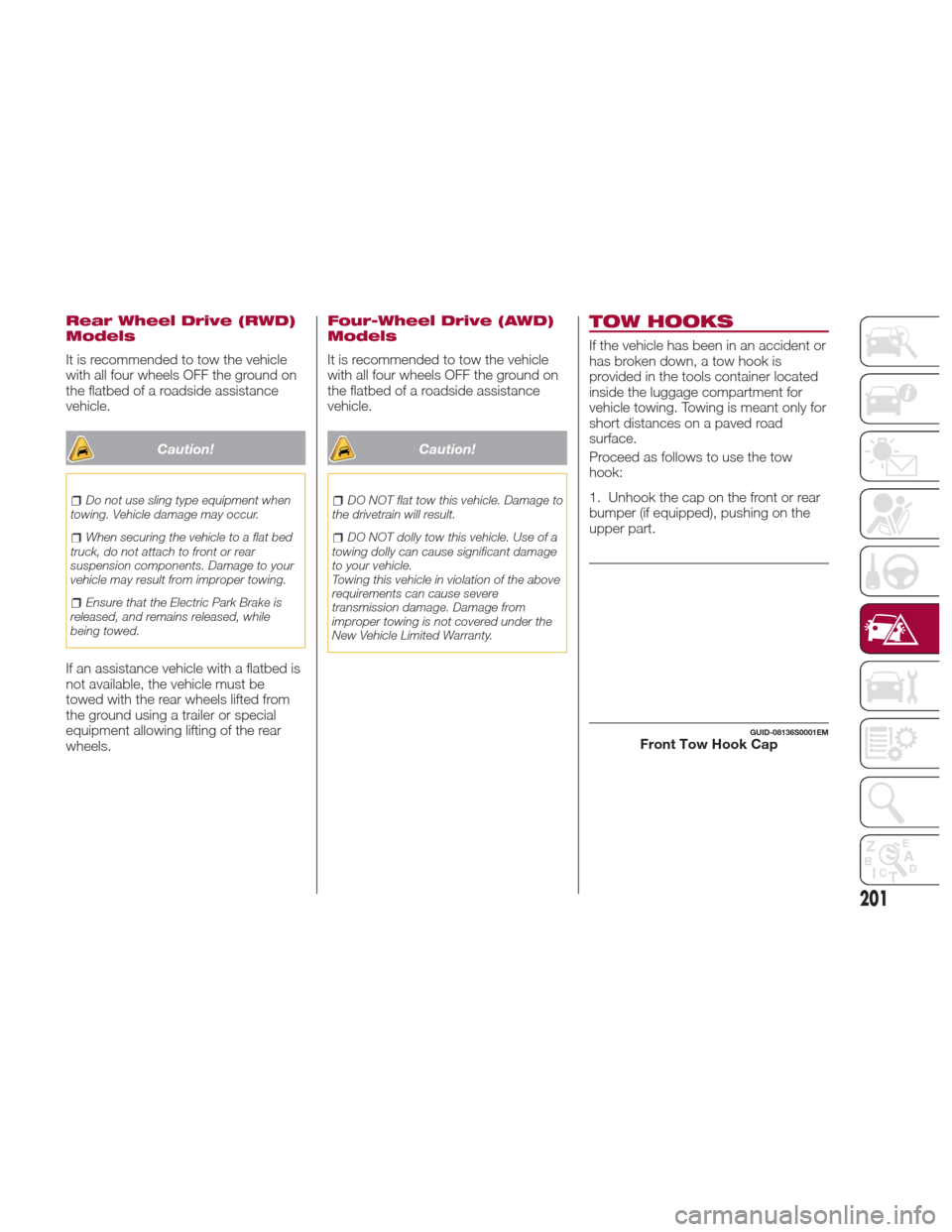
1. Unhook the cap on the front or rear
bumper (if equipped), pushing on the
upper part.
GUID-08136S0001EMFront Tow Hook Cap
201
Page 207 of 268
SCHEDULED
SERVICING
Correct servicing is crucial for
guaranteeing a long life for the vehicle
under the best conditions.
For this reason, Alfa Romeo has
planned a series of checks and services
for your vehicle at fixed intervals based
on distance and time, as described in
the Scheduled Servicing Plan.
Before each service, it is always
necessary to carefully follow the
instructions in the Scheduled Servicing
Plan (e.g. periodically check level of
fluids, tire pressure, etc.).
Scheduled Servicing is offered by an
authorized dealer according to a set
time schedule. If, during each
operation, in addition to the ones
scheduled, the need arises for further
replacements or repairs, these may be
carried out with owners explicit consent
only.
Note:
Scheduled Servicing intervals are
required by the Manufacturer. Failure to
have them carried out may invalidate
the New Vehicle Limited Warranty.
You are advised to inform your
authorized dealer of any small operating
irregularities without waiting for the next
service.
Periodic Checks
Every month or every600miles
( 1,000 km) or before long trips check
and, if necessary, top off:
Engine coolant level.
Brake fluid level (if insufficient, see
your authorized dealer as soon as
possible).
Windshield washer fluid level.
Tire inflation pressure and condition.
Operation of lighting system
(headlights, direction indicators, hazard
warning lights, etc.).
Operation of windshield
washing/wiping system and
positioning/wear of wiper blades.
Every 2,000 miles ( 3,000km), check
and top off if required:
Engine oil level.
Heavy Usage Of The Car
If the vehicle is used under one of the
following conditions:
Dusty roads.
Short, repeated journeys less than
4 miles (7-8 km) at sub-zero outside
temperatures.
Engine often idling or driving long
distances at low speeds or long periods
of inactivity.
In the event of a long period of
inactivity. The following checks must be carried
out more often than indicated in the
Scheduled Servicing Plan:
Check cleanliness of hood and trunk
locks, cleanliness and lubrication of
linkage.
Visually inspect conditions of: engine,
transmission, pipes and hoses
(exhaust/fuel system/brakes) and
rubber elements (sleeves/bushes, etc.).
Check battery charge and battery
fluid level (electrolyte).
Visually inspect conditions of the
accessory drive belts.
Check and, if necessary, change
engine oil and replace oil filter.
Check and, if necessary, replace
cabin air filter.
Check and, if necessary, replace air
cleaner.
Severe Duty All Models
Change Engine Oil at 4,000 miles
(6,500 km) if the vehicle is operated in a
dusty and off-road environment or is
operated predominately at idle or only
very low engine RPM’s. This type of
vehicle use is considered Severe Duty.
205