belt Alfa Romeo Giulia 2017 Owner's Guide
[x] Cancel search | Manufacturer: ALFA ROMEO, Model Year: 2017, Model line: Giulia, Model: Alfa Romeo Giulia 2017Pages: 268, PDF Size: 18.64 MB
Page 126 of 268
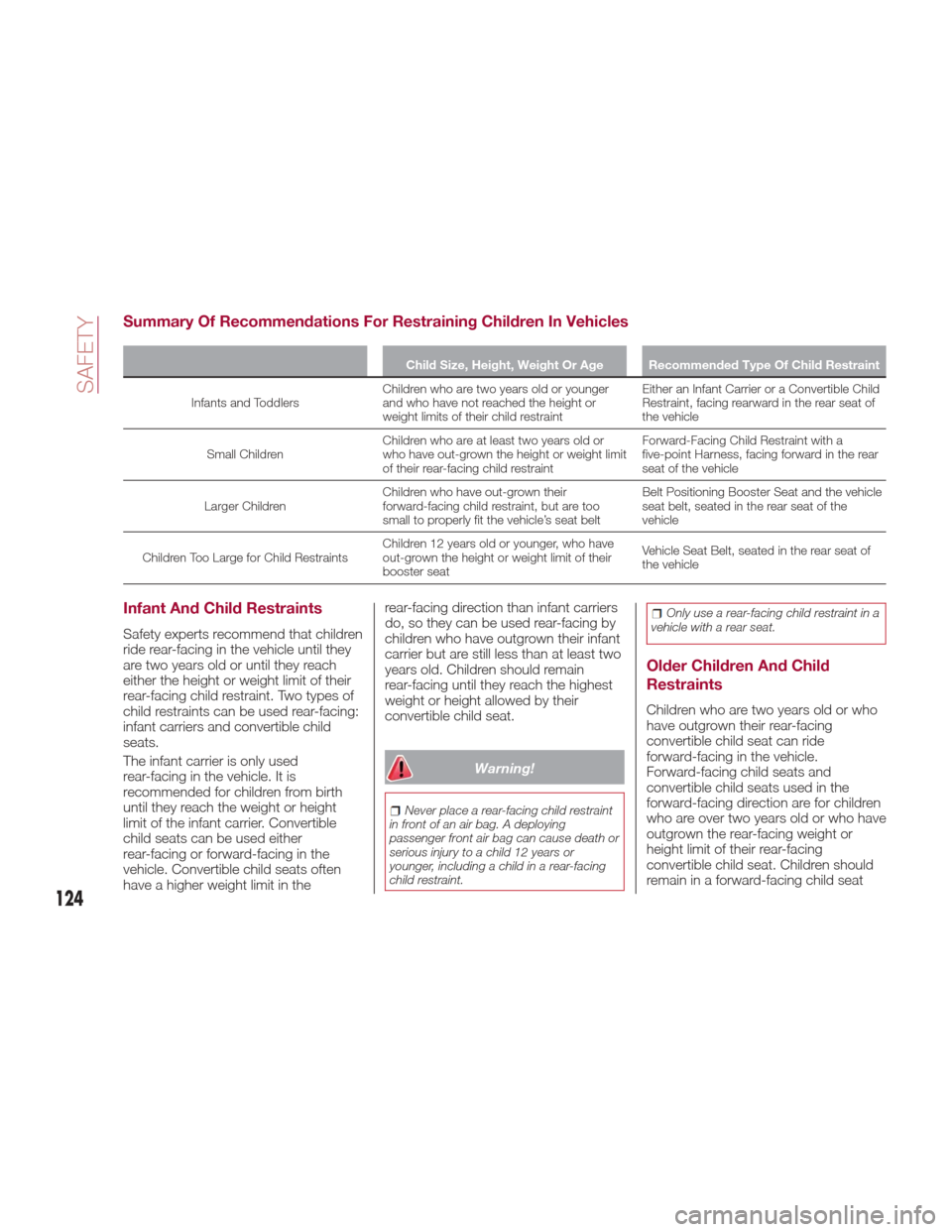
Summary Of Recommendations For Restraining Children In Vehicles
Child Size, Height, Weight Or Age Recommended Type Of Child Restraint
Infants and Toddlers Childr
en who are two years old or younger
and who have not reached the height or
weight limits of their child restraint Either an Infant Carrier or a Convertible Child
Restraint, facing rearward in the rear seat of
the vehicle
Small Children Children who are at least two years old or
who have out-grown the height or weight limit
of their rear-facing child restraint Forward-Facing Child Restraint with a
five-point Harness, facing forward in the rear
seat of the vehicle
Larger Children Children who have out-grown their
forward-facing child restraint, but are too
small to properly fit the vehicle’s seat belt Belt Positioning Booster Seat and the vehicle
seat belt, seated in the rear seat of the
vehicle
Children Too Large for Child Restraints Children 12 years old or younger, who have
out-grown the height or weight limit of their
booster seat Vehicle Seat Belt, seated in the rear seat of
the vehicle
Infant And Child Restraints
Safety experts recommend that children
ride rear-facing in the vehicle until they
are two years old or until they reach
either the height or weight limit of their
rear-facing child restraint. Two types of
child restraints can be used rear-facing:
infant carriers and convertible child
seats.
The infant carrier is only used
rear-facing in the vehicle. It is
recommended for children from birth
until they reach the weight or height
limit of the infant carrier. Convertible
child seats can be used either
rear-facing or forward-facing in the
vehicle. Convertible child seats often
have a higher weight limit in therear-facing direction than infant carriers
do, so they can be used rear-facing by
children who have outgrown their infant
carrier but are still less than at least two
years old. Children should remain
rear-facing until they reach the highest
weight or height allowed by their
convertible child seat.
Warning!
Never place a rear-facing child restraint
in front of an air bag. A deploying
passenger front air bag can cause death or
serious injury to a child 12 years or
younger, including a child in a rear-facing
child restraint.
Only use a rear-facing child restraint in a
vehicle with a rear seat.
Older Children And Child
Restraints
Children who are two years old or who
have outgrown their rear-facing
convertible child seat can ride
forward-facing in the vehicle.
Forward-facing child seats and
convertible child seats used in the
forward-facing direction are for children
who are over two years old or who have
outgrown the rear-facing weight or
height limit of their rear-facing
convertible child seat. Children should
remain in a forward-facing child seat
124
SAFETY
Page 127 of 268
with a harness for as long as possible,
up to the highest weight or height
allowed by the child seat.
All children whose weight or height is
above the forward-facing limit for the
child seat should use a belt-positioning
booster seat until the vehicle’s seat
belts fit properly. If the child cannot sit
with knees bent over the vehicle’s seat
cushion while the child’s back is against
the seatback, they should use a
belt-positioning booster seat. The child
and belt-positioning booster seat are
held in the vehicle by the seat belt.
Warning!
Improper installation can lead to failure
of an infant or child restraint. It could come
loose in a collision. The child could be
badly injured or killed. Follow the child
restraint manufacturer’s directions exactly
when installing an infant or child restraint.
After a child restraint is installed in the
vehicle, do not move the vehicle seat
forward or rearward because it can loosen
the child restraint attachments. Remove
the child restraint before adjusting the
vehicle seat position. When the vehicle seat
has been adjusted, reinstall the child
restraint.
When your child restraint is not in use,
secure it in the vehicle with the seat belt or
LATCH anchorages, or remove it from the
vehicle. Do not leave it loose in the vehicle.
In a sudden stop or accident, it could strike
the occupants or seatbacks and cause
serious personal injury.
Children Too Large For Booster
Seats
Children who are large enough to wear
the shoulder belt comfortably, and
whose legs are long enough to bend
over the front of the seat when their
back is against the seatback, should
use the seat belt in a rear seat. Use this
simple 5-step test to decide whether
the child can use the vehicle’s seat belt
alone:
1. Can the child sit all the way back
against the back of the vehicle seat?
2. Do the child’s knees bend
comfortably over the front of the vehicle
seat – while they are still sitting all the
way back?
3. Does the shoulder belt cross the
child’s shoulder between their neck and
arm? 4. Is the lap part of the belt as low as
possible, touching the child’s thighs and
not their stomach?
5. Can the child stay seated like this for
the whole trip?
If the answer to any of these questions
was “no,” then the child still needs to
use a booster seat in this vehicle. If the
child is using the lap/shoulder belt,
check seat belt fit periodically and make
sure the seat belt buckle is latched. A
child’s squirming or slouching can move
the belt out of position. If the shoulder
belt contacts the face or neck, move
the child closer to the center of the
vehicle, or use a booster seat to
position the seat belt on the child
correctly.
Warning!
Never allow a child to put the shoulder belt
under an arm or behind their back. In a
crash, the shoulder belt will not protect a
child properly, which may result in serious
injury or death. A child must always wear
both the lap and shoulder portions of the
seat belt correctly.
125
Page 128 of 268
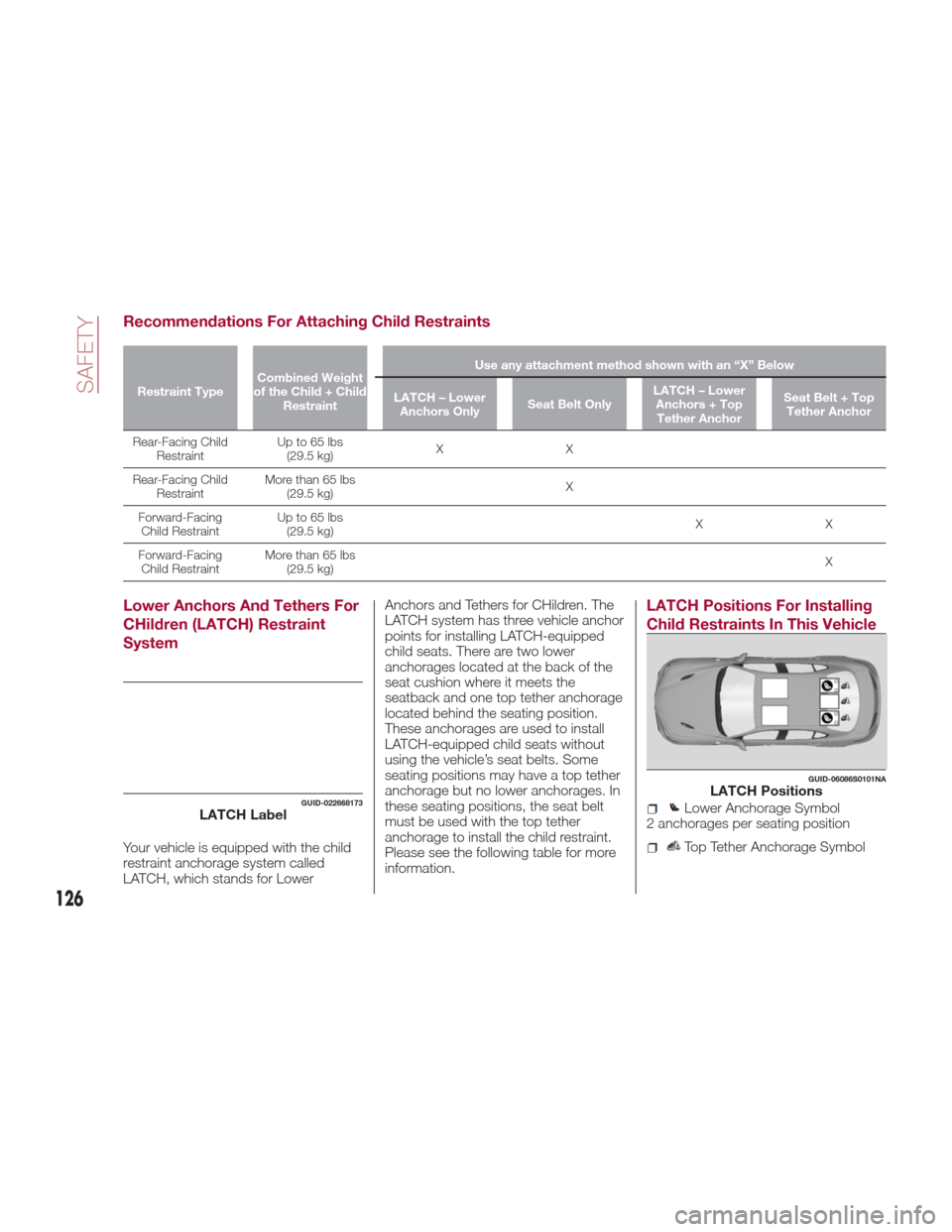
Recommendations For Attaching Child Restraints
Restraint TypeCombined Weight
of the Child + Child Restraint Use any attachment method shown with an “X” Below
LATCH – Lower Anchors Only Seat Belt OnlyLATCH – Lower
Anchors + TopTether Anchor Seat Belt + Top
Tether Anchor
Rear-Facing Child Restraint Up
to 65 lbs
(29.5 kg) XX
Rear-Facing Child Restraint More than 65 lbs
(29.5 kg) X
Forward-Facing Child Restraint Up to 65 lbs
(29.5 kg) XX
Forward-Facing Child Restraint More than 65 lbs
(29.5 kg) X
Lower Anchors And Tethers For
CHildren (LATCH) Restraint
System
Your vehicle is equipped with the child
restraint anchorage system called
LATCH, which stands for LowerAnchors and Tethers for CHildren. The
LATCH system has three vehicle anchor
points for installing LATCH-equipped
child seats. There are two lower
anchorages located at the back of the
seat cushion where it meets the
seatback and one top tether anchorage
located behind the seating position.
These anchorages are used to install
LATCH-equipped child seats without
using the vehicle’s seat belts. Some
seating positions may have a top tether
anchorage but no lower anchorages. In
these seating positions, the seat belt
must be used with the top tether
anchorage to install the child restraint.
Please see the following table for more
information.
LATCH Positions For Installing
Child Restraints In This Vehicle
GUID-022668173LATCH Label
GUID-06086S0101NALATCH Positions
Lower Anchorage Symbol
2 anchorages per seating position
Top Tether Anchorage Symbol
126
SAFETY
Page 129 of 268
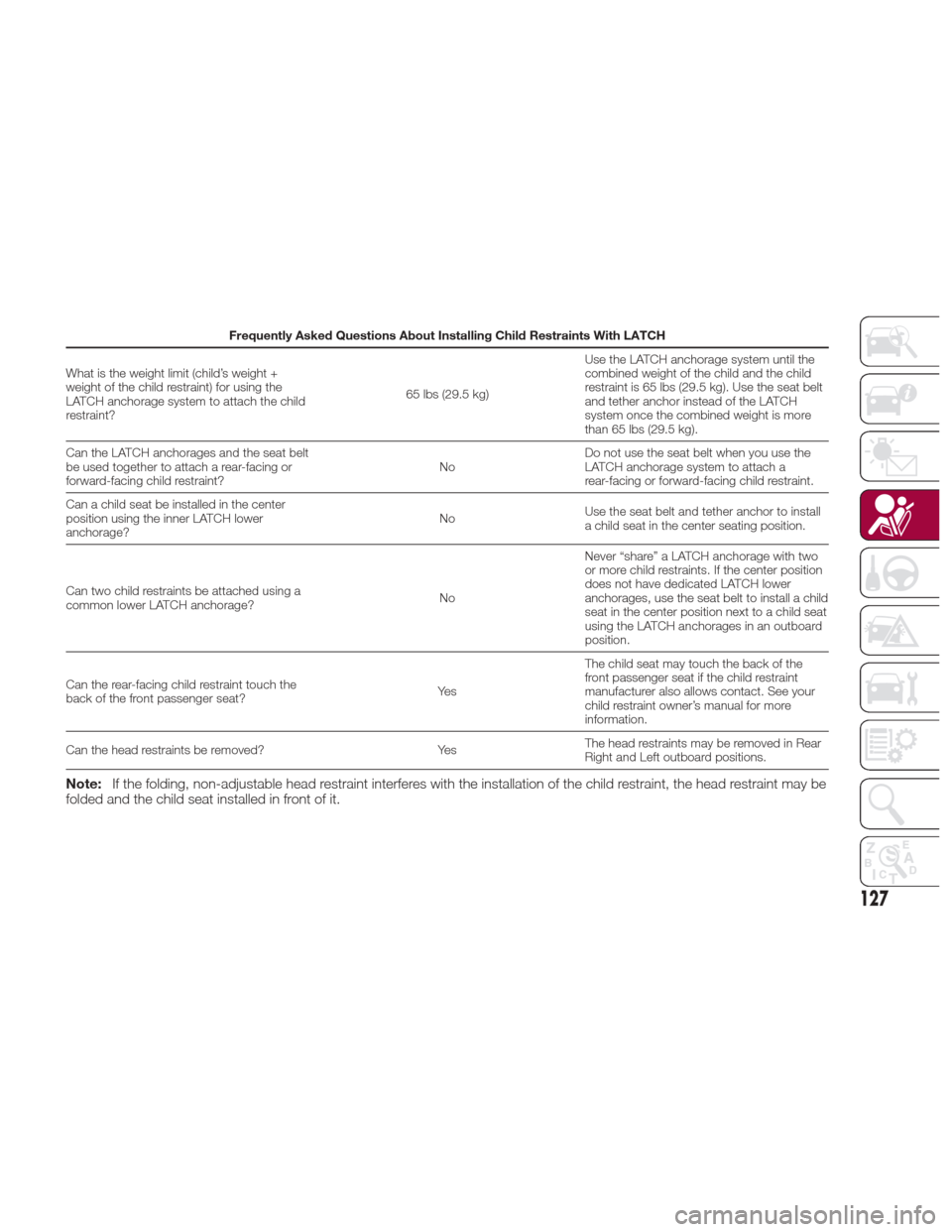
Frequently Asked Questions About Installing Child Restraints With LATCH
What is the weight limit (child’s weight +
weight of the child restraint) for using the
LATCH anchorage system to attach the child
restraint? 65 lbs (29.5 kg)Use the LATCH anchorage system until the
combined weight of the child and the child
restraint is 65 lbs (29.5 kg). Use the seat belt
and tether anchor instead of the LATCH
system once the combined weight is more
than 65 lbs (29.5 kg).
Can the LATCH anchorages and the seat belt
be used together to attach a rear-facing or
forward-facing child restraint? NoDo not use the seat belt when you use the
LATCH anchorage system to attach a
rear-facing or forward-facing child restraint.
Can a child seat be installed in the center
position using the inner LATCH lower
anchorage? No
Use the seat belt and tether anchor to install
a child seat in the center seating position.
Can two child restraints be attached using a
common lower LATCH anchorage? NoNever “share” a LATCH anchorage with two
or more child restraints. If the center position
does not have dedicated LATCH lower
anchorages, use the seat belt to install a child
seat in the center position next to a child seat
using the LATCH anchorages in an outboard
position.
Can the rear-facing child restraint touch the
back of the front passenger seat? Ye sThe child seat may touch the back of the
front passenger seat if the child restraint
manufacturer also allows contact. See your
child restraint owner’s manual for more
information.
Can the head restraints be removed? Yes The head restraints may be removed in Rear
Right and Left outboard positions.
Note:
If the folding, non-adjustable head restraint interferes with the installation of the child restraint, the head restraint may be
folded and the child seat installed in front of it.
127
Page 131 of 268
Center Seat LATCH
Warning!
Do not install a child restraint in the
center position using the LATCH system.
This position is not approved for installing
child seats using the LATCH attachments.
You must use the seat belt and tether
anchor to install a child seat in the center
seating position.
Never use the same lower anchorage to
attach more than one child restraint. Please
refer to “Installing The LATCH-Compatible
Child Restraint System” for typical
installation instructions.
Always follow the directions of the child
restraint manufacturer when installing
your child restraint. Not all child restraint
systems will be installed as described
here.
To Install A LATCH-Compatible
Child Restraint
If the selected seating position has a
Switchable Automatic Locking
Retractor (ALR) seat belt, stow the seat
belt, following the instructions below.
See the section “Installing Child
Restraints Using The Vehicle Seat Belt”
to check what type of seat belt each
seating position has. 1. Loosen the adjusters on the lower
straps and on the tether strap of the
child seat so that you can more easily
attach the hooks or connectors to the
vehicle anchorages.
2. Place the child seat between the
lower anchorages for that seating
position. For some second row seats,
you may need to recline the seat and /
or raise the head restraint to get a
better fit. If the rear seat can be moved
forward and rearward in the vehicle, you
may wish to move it to its rear-most
position to make room for the child
seat. You may also move the front seat
forward to allow more room for the child
seat.
3. Attach the lower hooks or
connectors of the child restraint to the
lower anchorages in the selected
seating position.
4. If the child restraint has a tether
strap, connect it to the top tether
anchorage. See the section “Installing
Child Restraints Using The Top Tether
Anchorage” for directions to attach a
tether anchor.
5. Tighten all of the straps as you push
the child restraint rearward and
downward into the seat. Remove slack
in the straps according to the child
restraint manufacturer’s instructions.
6. Test that the child restraint is
installed tightly by pulling back and forth
on the child seat at the belt path. It
should not move more than 1 inch
(25.4 mm) in any direction.
How To Stow An Unused
Switchable-ALR (ALR) Seat Belt
When using the LATCH attaching
system to install a child restraint, stow
all ALR seat belts that are not being
used by other occupants or being used
to secure child restraints. An unused
belt could injure a child if they play with
it and accidentally lock the seat belt
retractor. Before installing a child
restraint using the LATCH system,
buckle the seat belt behind the child
restraint and out of the child’s reach. If
the buckled seat belt interferes with the
child restraint installation, instead of
buckling it behind the child restraint,
route the seat belt through the child
restraint belt path and then buckle it.
Do not lock the seat belt. Remind all
children in the vehicle that the seat belts
are not toys and that they should not
play with them.
129
Page 132 of 268
Warning!
Improper installation of a child restraint
to the LATCH anchorages can lead to
failure of the restraint. The child could be
badly injured or killed. Follow the child
restraint manufacturer’s directions exactly
when installing an infant or child restraint.
Child restraint anchorages are designed
to withstand only those loads imposed by
correctly-fitted child restraints. Under no
circumstances are they to be used for adult
seat belts, harnesses, or for attaching other
items or equipment to the vehicle.
Installing Child Restraints Using
The Vehicle Seat Belt
Child restraint systems are designed to
be secured in vehicle seats by lap belts
or the lap belt portion of a lap/shoulder
belt.
Warning!
Improper installation or failure to properly
secure a child restraint can lead to failure of
the restraint. The child could be badly
injured or killed.
Follow the child restraint manufacturer’s
directions exactly when installing an infant
or child restraint.
The seat belts in the passenger seating
positions are equipped with a
Switchable Automatic Locking
Retractor (ALR) that is designed to
keep the lap portion of the seat belt
tight around the child restraint so that it
is not necessary to use a locking clip.
The ALR retractor can be “switched”
into a locked mode by pulling all of the
webbing out of the retractor and then
letting the webbing retract back into the retractor. If it is locked, the ALR will
make a clicking noise while the
webbing is pulled back into the
retractor. Refer to the “Automatic
Locking Mode” description in
“Switchable Automatic Locking
Retractors (ALR)” under “Occupant
Restraint Systems” for additional
information on ALR.
Lap/Shoulder Belt Systems For
Installing Child Restraints In
This Vehicle
GUID-06086S0102NAAutomatic Locking Retractor (ALR)
Locations
ALR = Switchable Automatic Locking
Retractor
Top Tether Anchorage Symbol
130
SAFETY
Page 133 of 268
Frequently Asked Questions About Installing Child Restraints With Seat Belts
What is the weight limit (child’s weight + weight of
the child restraint) for using the Tether Anchor with
theseatbelttoattachaforwardfacingchild
restraint? Weight limit of the Child
Restraint
Always use the tether anchor when using the seat
belt to install a forward facing child restraint, up to
the recommended weight limit of the child restraint.
Can the rear-facing child restraint touch the back of
the front passenger seat? Ye sContact between the front passenger seat and the
child restraint is allowed, if the child restraint
manufacturer also allows contact.
Can the head restraints be removed? YesThe head restraints should only be removed by
qualified technicians. If any of the head restraints
require removal, see your authorized dealer.
Can the buckle stalk be twisted to tighten the seat
belt against the belt path of the child restraint? NoDo not twist the buckle stalk in a seating position
with an ALR retractor.
Installing A Child Restraint With
A Switchable Automatic
Locking Retractor (ALR):
Child restraint systems are designed to
be secured in vehicle seats by lap belts
or the lap belt portion of a lap/shoulder
belt.
Warning!
Improper installation or failure to properly
secure a child restraint can lead to failure of
the restraint. The child could be badly
injured or killed.
Follow the child restraint manufacturer’s
directions exactly when installing an infant
or child restraint.
1. Place the child seat in the center of
the seating position. For some second
row seats, you may need to recline the
seat and/or raise the head restraint to
get a better fit. If the rear seat can be
moved forward and rearward in the
vehicle, you may wish to move it to its
rear-most position to make room for the
child seat. You may also move the front
seat forward to allow more room for the
child seat.
2. Pull enough of the seat belt webbing
from the retractor to pass it through the
belt path of the child restraint. Do not
twist the belt webbing in the belt path.
3. Slide the latch plate into the buckle
until you hear a “click.” 4. Pull on the webbing to make the lap
portion tight against the child seat.
5. To lock the seat belt, pull down on
the shoulder part of the belt until you
have pulled all the seat belt webbing
out of the retractor. Then, allow the
webbing to retract back into the
retractor. As the webbing retracts, you
will hear a clicking sound. This means
the seat belt is now in the Automatic
Locking mode.
6. Try to pull the webbing out of the
retractor. If it is locked, you should not
be able to pull out any webbing. If the
retractor is not locked, repeat step 5.
131
Page 134 of 268
7. Finally, pull up on any excess
webbing to tighten the lap portion
around the child restraint while you
push the child restraint rearward and
downward into the vehicle seat.
8. If the child restraint has a top tether
strap and the seating position has a top
tether anchorage, connect the tether
strap to the anchorage and tighten the
tether strap. See the section “Installing
Child Restraints Using the Top Tether
Anchorage” for directions to attach a
tether anchor.
9. Test that the child restraint is
installed tightly by pulling back and forth
on the child seat at the belt path. It
should not move more than 1 inch
(25.4 mm) in any direction.
Any seat belt system will loosen with
time, so check the belt occasionally,
and pull it tight if necessary.Installing Child Restraints Using
The Top Tether Anchorage:
Warning!
Do not attach a tether strap for a
rear-facing car seat to any location in front
of the car seat, including the seat frame or
a tether anchorage. Only attach the tether
strap of a rear-facing car seat to the tether
anchorage that is approved for that seating
position, located behind the top of the
vehicle seat. See the section “Lower
Anchors and Tethers for CHildren (LATCH)
Restraint System” for the location of
approved tether anchorages in your
vehicle.
1. Look behind the seating position
where you plan to install the child
restraint to find the tether anchorage.
You may need to move the seat forward
to provide better access to the tether
anchorage. If there is no top tether
anchorage for that seating position,
move the child restraint to another
position in the vehicle if one is available.2. Rotate or lift the cover to access the
anchor directly behind the seat where
you are placing the child restraint.
3. Route the tether strap to provide the
most direct path for the strap between
the anchor and the child seat. If your
vehicle is equipped with adjustable rear
head restraints, raise the head restraint,
and where possible, route the tether
strap under the head restraint and
between the two posts. If not possible,
lower the head restraint and pass the
tether strap around the outboard side of
the head restraint.
4. Attach the tether strap hook of the
child restraint to the top tether
anchorage as shown in the diagram.
06086S0104NAUpper Tether Anchorage Location
132
SAFETY
Page 135 of 268
5. Remove slack in the tether strap
according to the child restraint
manufacturer’s instructions.
Warning!
An incorrectly anchored tether strap
could lead to increased head motion and
possible injury to the child. Use only the
anchorage position directly behind the child
seat to secure a child restraint top tether
strap.
If your vehicle is equipped with a split
rear seat, make sure the tether strap does
not slip into the opening between the
seatbacks as you remove slack in the
strap.
Transporting Pets
Air Bags deploying in the front seat
could harm your pet. An unrestrained
pet will be thrown about and possibly
injured, or injure a passenger during
panic braking or in a collision.
Pets should be restrained in the rear
seat in pet harnesses or pet carriers
that are secured by seat belts.
133
Page 137 of 268
STARTING THE
ENGINE
Starting The Engine
Before starting the engine, be sure to
adjust the seat, the interior rear view
mirrors, and the door mirrors, and
fasten the seat belt correctly.
Never press the accelerator pedal
before starting the engine.
If necessary, messages indicating the
starting procedure can be shown in the
display.
Warning!
When leaving the vehicle, always remove
the key fob from the vehicle and lock your
vehicle.
Never leave children alone in a vehicle,
or with access to an unlocked vehicle.
Allowing children to be in a vehicle
unattended is dangerous for a number of
reasons. A child or others could be
seriously or fatally injured. Children should
be warned not to touch the parking brake,
brake pedal or the transmission gear
selector.
Do not leave the key fob in or near the
vehicle, or in a location accessible to
children. A child could operate power
windows, other controls, or move the
vehicle.
Do not leave children or animals inside
parked vehicles in hot weather. Interior heat
build-up may cause serious injury or death.
Starting Procedure
Proceed as follows:
1. Apply the electric park brake and set
the gear selector to PARK (P) or
NEUTRAL (N).
2. Fully depress the brake pedal
without touching the accelerator.
3. Briefly push the ignition button.
4. If the engine doesn't start within a
few seconds, you need to repeat the
procedure.
If the problem persists, contact an
authorized dealer.
Warning!
Never pour fuel or other flammable liquid
into the throttle body air inlet opening in an
attempt to start the vehicle. This could
result in flash fire causing serious personal
injury.
Do not attempt to push or tow your
vehicle to get it started. Vehicles equipped
with an automatic transmission cannot be
started this way. Unburned fuel could enter
the catalytic converter and once the engine
has started, ignite and damage the
converter and vehicle.
If the vehicle has a discharged battery,
booster cables may be used to obtain a
start from a booster battery or the battery
in another vehicle. This type of start can be
dangerous if done improperly. Refer to
“Emergency Starting” in “In Case Of
Emergency” for further information.
Caution!
To prevent damage to the starter, do not
continuously crank the engine for more
than 25 seconds at a time. Wait
60 seconds before trying again.
Remote Starting System
— If Equipped
This system uses the key fob to start
the engine conveniently from outside
the vehicle while still maintaining
security. The system has a range of at
least 300 feet (91 meters).
The remote starting system also
activates the climate control (if
equipped), the heated seats (if
equipped), and the heated steering
wheel (if equipped), depending on
temperatures outside and inside of the
car.
Note:
The vehicle must be equipped with
an automatic transmission in order to
include remote start.
Obstructions between the vehicle
and key fob may reduce this range.
135