towing Alfa Romeo Giulia 2017 Owner's Manual
[x] Cancel search | Manufacturer: ALFA ROMEO, Model Year: 2017, Model line: Giulia, Model: Alfa Romeo Giulia 2017Pages: 268, PDF Size: 18.64 MB
Page 136 of 268

STARTING AND OPERATING
Let’s get to the core of the vehicle, and
see how you can explore its fullest
potential. We’ll look at how to drive
safely in any situation, making it a
welcome companion with our comfort
and wallets in mind.STARTINGTHEENGINE .......135
ELECTRIC PARK BRAKE.......138
AUTOMATIC TRANSMISSION . . . .140
ALFA DNA PRO SYSTEM .......146
ALFA ACTIVE SUSPENSION
(AAS) — IF EQUIPPED .........149
STOP/START EVO ...........150
SPEED LIMITER .............152
ELECTRONIC SPEED
CONTROL ................153
ADAPTIVE CRUISE CONTROL
(ACC) — IF EQUIPPED ........156PARKSENSE SYSTEM —
IF EQUIPPED
...............163
LANE DEPARTURE WARNING
(LDW) SYSTEM .............167
REAR BACK-UP
CAMERA / DYNAMIC
GRIDLINES — IF EQUIPPED . . . .170
REFUELING THE VEHICLE ......172
VEHICLE LOADING ..........173
TRAILER TOWING ...........175
SUGGESTIONS FOR DRIVING. . . .175
134
STARTING AND OPERATING
Page 145 of 268
When leaving the vehicle, always make
sure the ignition is in the STOP/OFF mode,
remove the key fob from the vehicle, and
lock the vehicle.
Never leave children alone in a vehicle,
or with access to an unlocked vehicle.
Allowing children to be in a vehicle
unattended is dangerous for a number of
reasons. A child or others could be
seriously or fatally injured. Children should
be warned not to touch the park brake,
brake pedal or the transmission gear
selector.
Do not leave the key fob in or near the
vehicle (or in a location accessible to
children), and do not leave the ignition in
the ON mode. A child could operate power
windows, other controls, or move the
vehicle.
Caution!
Before moving the transmission gear
selector out of PARK, you must press the
ignition button to cycle from STOP/OFF
mode to the ON mode, and also press the
brake pedal. Otherwise, damage to the
gear selector could result.
DO NOT race the engine when shifting
from PARK or NEUTRAL into another gear
range, as this can damage the drivetrain.
REVERSE (R)
Select this mode only with the vehicle at
a standstill.
NEUTRAL (N)
Use this range when the vehicle is
standing for prolonged periods with the
engine running. The engine may be
started in this range. Apply the electric
park brake and shift the transmission
into PARK (P) if you must leave the
vehicle.
Warning!
Do not coast in NEUTRAL and never turn
off the ignition to coast down a hill. These
are unsafe practices that limit your
response to changing traffic or road
conditions. You might lose control of the
vehicle and have a collision.
DRIVE (D)
Use this mode in normal driving
conditions.
Shifting from DRIVE (D) to PARK (P) or
REVERSE (R) modes must take place
only after releasing the accelerator
pedal, with vehicle at a standstill and
brake pedal pressed.
This mode ensures automatic
engagement of the most suitable gears
for driving needs and maximum fuel
economy in terms of consumption. In this position, the transmission shifts
the gears automatically, selecting the
most suitable for forward driving among
those available as you go. In this way
the vehicle's optimal driving
characteristics are provided for all
conditions.
AutoStick
In the case of frequent shifting (e.g. for
sport driving, when the vehicle is driven
with a heavy load, on slopes, when
towing heavy trailers), it is
recommended to use the Autostick
(sequential shifting) mode to select and
keep a lower fixed ratio.
In these conditions, the use of a lower
gear improves vehicle performance,
preventing overheating.
It is possible to shift from DRIVE (D)
mode to sequential mode regardless of
vehicle speed.
Activation
Starting from DRIVE (D) mode, to
activate the sequential drive mode,
move the selector to the left (– and +
indication of the trim). The gear
engaged will be shown on the display.
Shifting is made by moving the gear
selector forwards, towards symbol – or
backwards, towards symbol +.
143
Page 177 of 268
TRAILER TOWING
Trailer Towing — If
Equipped
Trailer towing is not recommended for
this vehicle.
SUGGESTIONS FOR
DRIVING
Saving Fuel
Below are some suggestions which
may help you save fuel and lower the
amount of harmful emissions released
into the atmosphere.
Vehicle maintenance
Checks and operations should be
carried out in accordance with the
"Scheduled Servicing" (see chapter
"Servicing And Maintenance").
Tires
Check the tire pressures at least once
every four weeks: if the pressure is too
low, consumption levels increase as
resistance to rolling is higher.
Unnecessary loads
Do not travel with an overloaded trunk.
The weight of the vehicle and its
arrangement greatly affect fuel
consumption and stability.
Electric devices
Use electrical systems only for the
amount of time needed. The rear
window defroster, additional headlights,
windshield wipers and heater blower
fan require a considerable amount of
energy; increasing the current uptake
increases fuel consumption (by up to
+25% when city driving).Climate control system
Using the climate control system will
increase consumption: use standard
ventilation when the temperature
outside permits.
Devices for aerodynamic control
The use of non-certified devices for
aerodynamic control may adversely
affect air drag and consumption levels.
Driving Style
Starting
Do not warm up the engine at low or
high revs when the vehicle is stationary;
this causes the engine to warm up
more slowly, thereby increasing fuel
consumption and emissions. It is
therefore advisable to drive off
immediately, slowly, avoiding high
speeds: by doing this the engine will
warm up more quickly.
Unnecessary Actions
Avoid revving up when starting at traffic
lights or before stopping the engine.
This action is unnecessary and causes
increased fuel consumption and
pollution.
Gear Selection
Use a high gear when traffic and road
conditions allow it. Using a low gear for
faster acceleration will increase fuel
consumption. Improper use of a high
gear increases consumption, emissions
and engine wear.
175
Page 181 of 268
IN CASE OF EMERGENCY
Have a flat tire or a burnt-out bulb?
At times, a problem such as these may
interfere with your driving experience.
The pages on emergencies can help
you to deal with critical situations
independently and with calm.
In an emergency, we recommend that
you call the phone number found in the
Warranty Book.
You may also consider contacting your
nearest authorized dealer.HAZARD WARNING LIGHTS . . . .180
BULB REPLACEMENT.........180
FUSES .................. .186
TIRE REPAIR KIT —
IF EQUIPPED ..............192
EMERGENCYSTARTING ......196
REFUELING IN EMERGENCY . . . .198
ENGINE OVERHEATING .......199
TOWING A DISABLED VEHICLE . .200
TOW HOOKS ..............201
ENHANCED ACCIDENT
RESPONSE SYSTEM (EARS) . . . .203
EVENT DATA RECORDER (EDR) . .203
179
Page 200 of 268
4. Disconnect the positive (+) end of
the jumper cable from the positive (+)
post of the vehicle with the discharged
battery.
If frequent jump-starting is required to
start your vehicle, you should have the
battery and charging system inspected
at your authorized dealer.
Caution!
Accessories plugged into the vehicle power
outlets draw power from the vehicle’s
battery, even when not in use (i.e., cellular
phones, etc.). Eventually, if plugged in long
enough without engine operation, the
vehicle’s battery will discharge sufficiently
to degrade battery life and/or prevent the
engine from starting.
Bump Starting
Never jump start the engine by pushing,
towing or coasting downhill.
Note:
You cannot start a vehicle with an
automatic transmission by pushing it.
Caution!
Accessories plugged into the vehicle power
outlets draw power from the vehicle’s
battery, even when not in use (i.e., cellular
phones, etc.). Eventually, if plugged in long
enough without engine operation, the
vehicle’s battery will discharge sufficiently
to degrade battery life and/or prevent the
engine from starting.
REFUELING IN
EMERGENCY
Refueling in an emergency is described
in "Refueling The Vehicle" in "Starting
And Operating".
198
IN CASE OF EMERGENCY
Page 202 of 268
TOWING A
DISABLED VEHICLE
This section describes procedures for
towing a disabled vehicle using a
commercial towing service.
Caution!
The vehicle should be transported with
all four wheels OFF the ground on the
flatbed of a roadside assistance vehicle.
Avoid towing with only the front (or rear)
wheels lifted. When towing with only the
front (or rear) wheels lifted, in addition to
damaging the body, it could damage the
transmission.
Do not use sling-type equipment when
towing. Vehicle damage may occur.
When securing the vehicle to a flatbed
truck, do not attach to front or rear
suspension components. Damage to your
vehicle may result from improper towing.
Ensure that the Electric Park Brake is
released, and remain released, while being
towed.
Damage from improper towing is not
covered under the New Vehicle Limited
Warranty.
The operators of the assistance vehicle
must be informed of your vehicle's
minimum required height from the
ground, in order to avoid contact
between the ends of the bumpers and
the equipment of the breakdown truck.
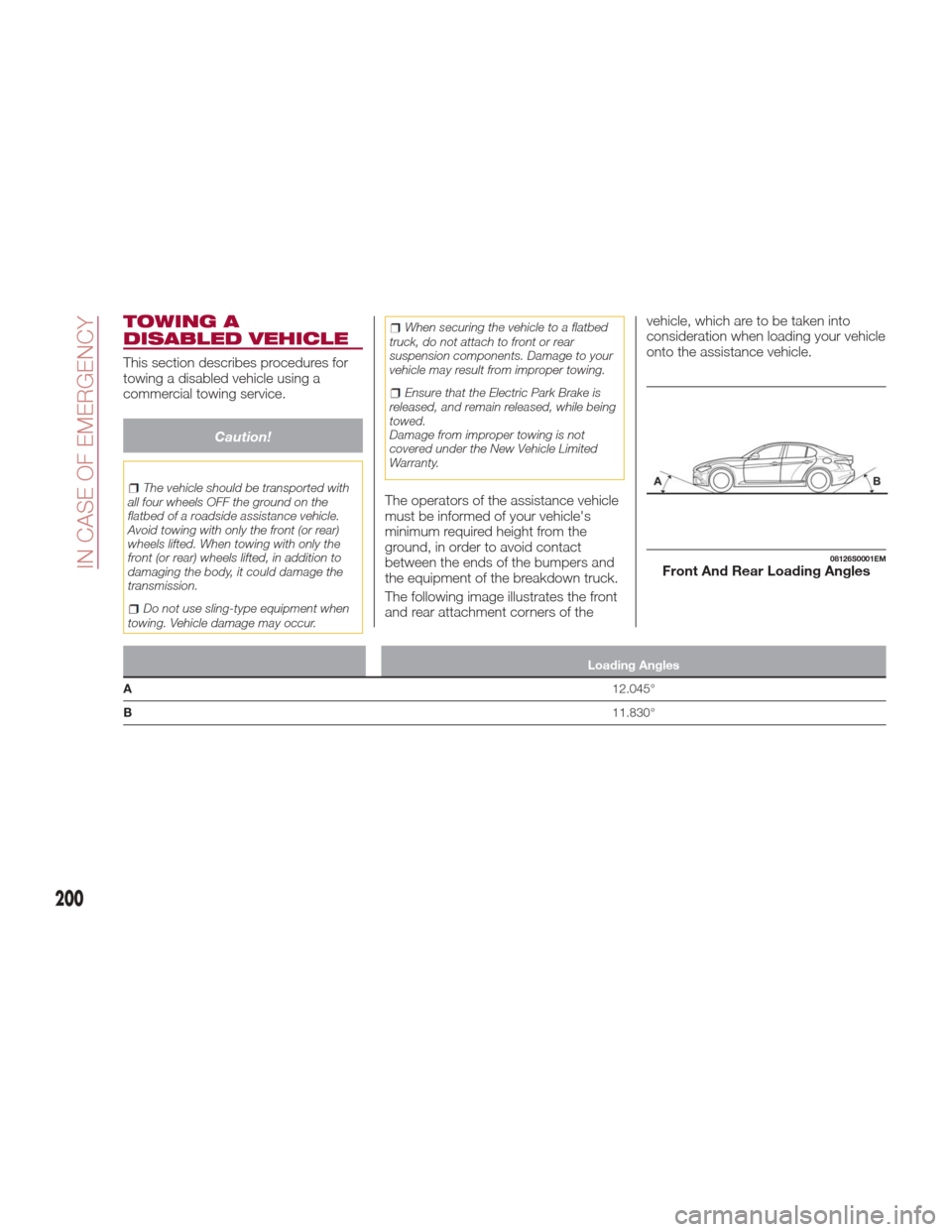
The following image illustrates the front
and rear attachment corners of the vehicle, which are to be taken into
consideration when loading your vehicle
onto the assistance vehicle.
Loading Angles
A 12.045°
B 11.830°
08126S0001EMFront And Rear Loading Angles
200
IN CASE OF EMERGENCY
Page 203 of 268
Rear Wheel Drive (RWD)
Models
It is recommended to tow the vehicle
with all four wheels OFF the ground on
the flatbed of a roadside assistance
vehicle.
Caution!
Do not use sling type equipment when
towing. Vehicle damage may occur.
When securing the vehicle to a flat bed
truck, do not attach to front or rear
suspension components. Damage to your
vehicle may result from improper towing.
Ensure that the Electric Park Brake is
released, and remains released, while
being towed.
If an assistance vehicle with a flatbed is
not available, the vehicle must be
towed with the rear wheels lifted from
the ground using a trailer or special
equipment allowing lifting of the rear
wheels.
Four-Wheel Drive (AWD)
Models
It is recommended to tow the vehicle
with all four wheels OFF the ground on
the flatbed of a roadside assistance
vehicle.
Caution!
DO NOT flat tow this vehicle. Damage to
the drivetrain will result.
DO NOT dolly tow this vehicle. Use of a
towing dolly can cause significant damage
to your vehicle.
Towing this vehicle in violation of the above
requirements can cause severe
transmission damage. Damage from
improper towing is not covered under the
New Vehicle Limited Warranty.
TOW HOOKS
If the vehicle has been in an accident or
has broken down, a tow hook is
provided in the tools container located
inside the luggage compartment for
vehicle towing. Towing is meant only for
short distances on a paved road
surface.
Proceed as follows to use the tow
hook:
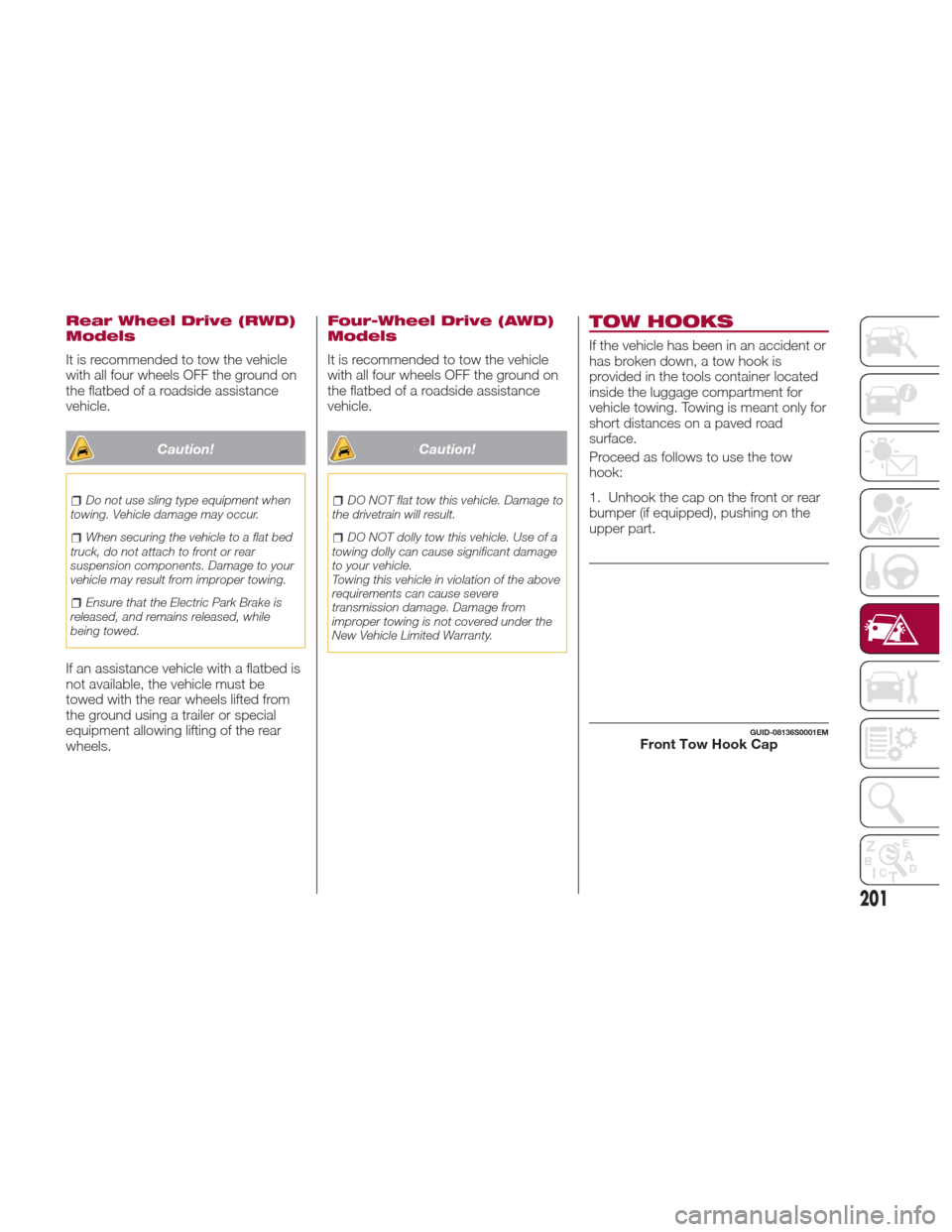
1. Unhook the cap on the front or rear
bumper (if equipped), pushing on the
upper part.
GUID-08136S0001EMFront Tow Hook Cap
201
Page 204 of 268
2. Remove the tow hook from its
housing in the trunk and carefully clean
the threaded housing on the vehicle
before using it.
3. Tighten the vehicle's tow hook in
place (about 11 turns).
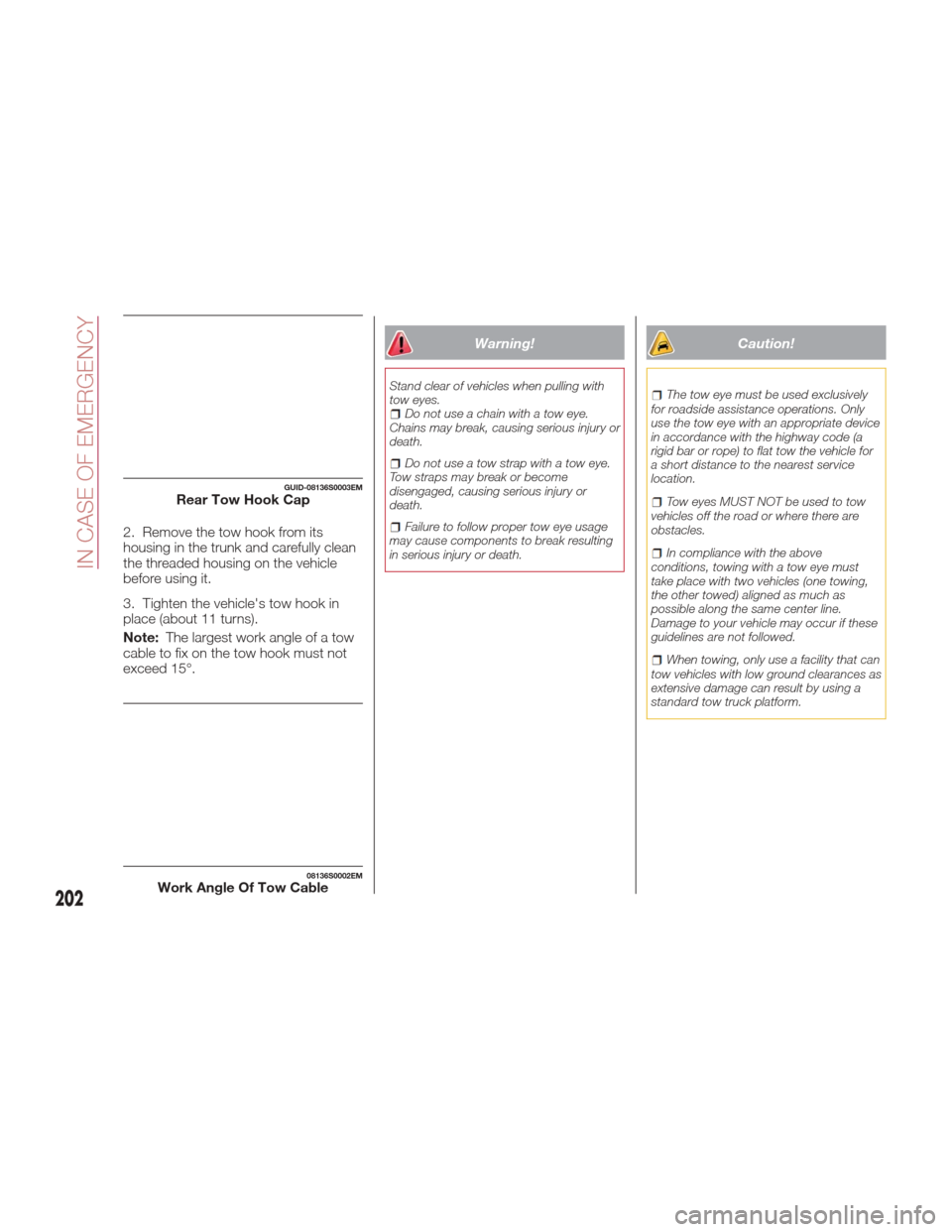
Note:The largest work angle of a tow
cable to fix on the tow hook must not
exceed 15°.
Warning!
Stand clear of vehicles when pulling with
tow eyes.
Do not use a chain with a tow eye.
Chains may break, causing serious injury or
death.
Do not use a tow strap with a tow eye.
Tow straps may break or become
disengaged, causing serious injury or
death.
Failure to follow proper tow eye usage
may cause components to break resulting
in serious injury or death.
Caution!
The tow eye must be used exclusively
for roadside assistance operations. Only
use the tow eye with an appropriate device
in accordance with the highway code (a
rigid bar or rope) to flat tow the vehicle for
a short distance to the nearest service
location.
Tow eyes MUST NOT be used to tow
vehicles off the road or where there are
obstacles.
In compliance with the above
conditions, towing with a tow eye must
take place with two vehicles (one towing,
the other towed) aligned as much as
possible along the same center line.
Damage to your vehicle may occur if these
guidelines are not followed.
When towing, only use a facility that can
tow vehicles with low ground clearances as
extensive damage can result by using a
standard tow truck platform.
GUID-08136S0003EMRear Tow Hook Cap
08136S0002EMWork Angle Of Tow Cable202
IN CASE OF EMERGENCY
Page 225 of 268
Tire Loading And Tire Pressure
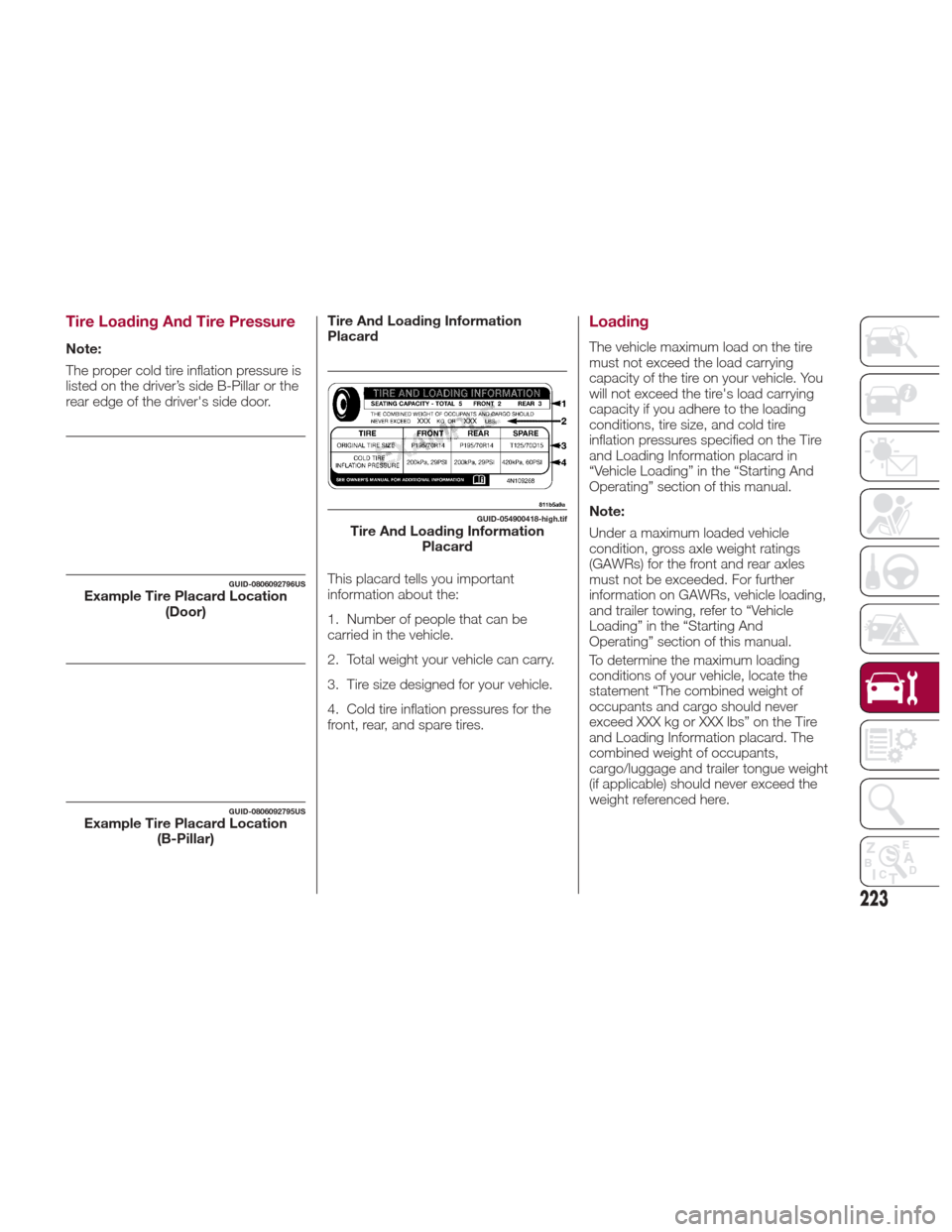
Note:
The proper cold tire inflation pressure is
listed on the driver’s side B-Pillar or the
rear edge of the driver's side door.Tire And Loading Information
Placard
This placard tells you important
information about the:
1. Number of people that can be
carried in the vehicle.
2. Total weight your vehicle can carry.
3. Tire size designed for your vehicle.
4. Cold tire inflation pressures for the
front, rear, and spare tires.
Loading
The vehicle maximum load on the tire
must not exceed the load carrying
capacity of the tire on your vehicle. You
will not exceed the tire's load carrying
capacity if you adhere to the loading
conditions, tire size, and cold tire
inflation pressures specified on the Tire
and Loading Information placard in
“Vehicle Loading” in the “Starting And
Operating” section of this manual.
Note:
Under a maximum loaded vehicle
condition, gross axle weight ratings
(GAWRs) for the front and rear axles
must not be exceeded. For further
information on GAWRs, vehicle loading,
and trailer towing, refer to “Vehicle
Loading” in the “Starting And
Operating” section of this manual.
To determine the maximum loading
conditions of your vehicle, locate the
statement “The combined weight of
occupants and cargo should never
exceed XXX kg or XXX lbs” on the Tire
and Loading Information placard. The
combined weight of occupants,
cargo/luggage and trailer tongue weight
(if applicable) should never exceed the
weight referenced here.
GUID-0806092796USExample Tire Placard Location
(Door)
GUID-0806092795USExample Tire Placard Location(B-Pillar)
GUID-054900418-high.tifTire And Loading InformationPlacard
223
Page 226 of 268
Steps For Determining Correct
Load Limit—
(1) Locate the statement “The
combined weight of occupants and
cargo should never exceed XXX kg
or XXX lbs.” on your vehicle's
placard.
(2) Determine the combined weight
of the driver and passengers that
will be riding in your vehicle.
(3) Subtract the combined weight of
the driver and passengers from XXX
kg or XXX lbs.
(4) The resulting figure equals the
available amount of cargo and
luggage load capacity. For
example, if “XXX” amount equals
1400 lbs. and there will be five
150 lb passengers in your vehicle,
the amount of available cargo and
luggage load capacity is 650 lbs.
(1400-750 (5x150) = 650 lbs.)(5) Determine the combined weight
of luggage and cargo being loaded
on the vehicle. That weight may not
safely exceed the available cargo
and luggage load capacity
calculated in Step 4.
(6) If your vehicle will be towing a
trailer, load from your trailer will be
transferred to your vehicle. Consult
this manual to determine how this
reduces the available cargo and
luggage load capacity of your
vehicle.
Metric Example For Load Limit
For example, if “XXX” amount equals
635 kg and there will be five 68 kg
passengers in your vehicle, the amount
of available cargo and luggage load
capacity is 295 kg (635-340 (5x68) =
295 kg) as shown in step 4.
Note:
If your vehicle will be towing a trailer,
load from your trailer will be transferred
to your vehicle. The following table
shows examples on how to calculate
total load, cargo/luggage, and towing
capacities of your vehicle with varying
seating configurations and number and
size of occupants. This table is for
illustration purposes only and may not
be accurate for the seating and load
carry capacity of your vehicle.
For the following example, the
combined weight of occupants and
cargo should never exceed 865 lbs
(392 kg).
224
SERVICING AND MAINTENANCE