engine Alfa Romeo Giulia 2018 Owner's Manual
[x] Cancel search | Manufacturer: ALFA ROMEO, Model Year: 2018, Model line: Giulia, Model: Alfa Romeo Giulia 2018Pages: 260, PDF Size: 6 MB
Page 209 of 260
Note:
To prevent the fluid from being
ingested by children or animals, do not
keep it in open containers or pour it on
the ground. If ingested, contact a doctor
immediately. Eliminate any traces of
fluid from the ground immediately.
When the vehicle stops after a short
trip, steam may be seen coming out from
front of the hood. This is a normal
phenomenon which is due to the
presence of rain, snow or a lot of
moisture on the surface of the radiator.
With engine and system cold, do not
top up with coolant beyond the
maximum level indicated on the
reservoir in the engine compartment.
Braking System
In order to guarantee the efficiency of
the braking system, periodically check its
components; for this operation, contact
an authorized dealer.
See the "Maintenance Plan" for the
correct servicing intervals.
Note: Driving with your foot resting on
the brake pedal may compromise its
efficiency, increasing the risk of
accidents. When driving, never keep your
foot on the brake pedal and don’t put
unnecessary strain on it to prevent the brakes from overheating: excess pad
wear may cause damage to the braking
system.
When an insufficient oil level is
detected, contact an authorized dealer
to have the system checked.
Always keep the cap of the brake
fluid reservoir (in the engine
compartment) completely closed.
Warning!
Use only manufacturer's recommended
brake fluid. Refer to “Fluids And Lubricants”
in “Technical Specifications” for further
information. Using the wrong type of brake
fluid can severely damage your brake
system and/or impair its performance. The
proper type of brake fluid for your vehicle is
also identified on the original factory
installed hydraulic master cylinder
reservoir.
To avoid contamination from foreign
matter or moisture, use only new brake fluid
or fluid that has been in a tightly closed
container. Keep the master cylinder
reservoir cap secured at all times. Brake
fluid in a open container absorbs moisture
from the air resulting in a lower boiling point.
This may cause it to boil unexpectedly
during hard or prolonged braking, resulting
in sudden brake failure. This could result in a
collision.
Overfilling the brake fluid reservoir can
result in spilling brake fluid on hot engine
parts, causing the brake fluid to catch fire.
Brake fluid can also damage painted and
vinyl surfaces, care should be taken to avoid
its contact with these surfaces.
Do not allow petroleum based fluid to
contaminate the brake fluid. Brake seal
components could be damaged, causing
partial or complete brake failure. This could
result in a collision.
Automatic Transmission
Use only a transmission oil with the same
characteristics as those indicated in the
"Fluids and Lubricants" table (see
"Technical Specifications" chapter).
Special Additives
Do not use any type of additive with the
automatic transmission oil. The
automatic transmission oil is a product
designed specially for this vehicle and its
performance may be compromised
through the use of further additives.
Caution!
Do not use chemical flushes in your
transmission as the chemicals can damage
your transmission components. Such
damage is not covered by the New Vehicle
Limited Warranty.
207
Page 225 of 260
equipment or an authorized tire dealer
for recommended safe operating speeds,
loading and cold tire inflation pressures.
While studded tires improve
performance on ice, skid and traction
capability on wet or dry surfaces may be
poorer than that of non-studded tires.
Some states prohibit studded tires;
therefore, local laws should be checked
before using these tire types.
Tire Chains (Traction Devices)
Use of traction devices require sufficient
tire-to-body clearance. Follow these
recommendations to guard against
damage.
Note:
Traction device must be of proper
size for the tire, as recommended by the
traction device manufacturer
Use on Rear Tires Only
Due to limited clearance, the
following traction devices are
recommended:
For a 265/35R19 98V tire, use of a
zero-clearance snow traction device
recommended.
It is not possible to install traction
devices on 285/30R19 tires.
Caution!
To avoid damage to your vehicle or tires,
observe the following precautions:
Because of restricted traction device
clearance between tires and other
suspension components, it is important that
only traction devices in good condition are
used. Broken devices can cause serious
damage. Stop the vehicle immediately if
noise occurs that could indicate device
breakage. Remove the damaged parts of
the device before further use.
Install device as tightly as possible and
then retighten after driving about ½ mile
(0.8 km).
Do not exceed 30 mph (48 km/h).
Drive cautiously and avoid severe turns
and large bumps, especially with a loaded
vehicle.
Do not drive for a prolonged period on dry
pavement.
Observe the traction device
manufacturer’s instructions on the method
of installation, operating speed, and
conditions for use. Always use the
suggested operating speed of the device
manufacturer’s if it is less than 30 mph
(48 km/h).
Do not use traction devices on a compact
spare tire.
Tire Rotation Recommendations
Tire Rotations - Do Not Rotate Tires
Due to different size tires and wheels on
front and rear axles tire rotation is not
possible for:
2.9 L V6 Engine Equipped with 19”
tires and wheels
Caution!
Damage to the vehicle may occur if 19” front
and rear tires are rotated
In the case of irregular wear of the tires
identify the cause and correct it as soon
as possible, by contacting an authorized
dealer.
223
Page 227 of 260
STORING THE VEHICLE
If the vehicle is left inactive for longer
than a month, the following precautions
should be observed:
Park the vehicle in an area that is
covered and dry, and well-ventilated if
possible. Slightly open the windows.
Check that the electric park brake is
not activated.
Carry out the procedure: “manual trunk
opening device” procedure described in
this paragraph.
Disconnect the negative battery
terminal and check the battery charge.
Repeat this check once every three
months during storage.
If the battery is not disconnected from
the electrical system, check its state of
charge every thirty days.
Clean and protect the painted parts
using protective wax.
Clean and protect the shiny metal
parts using special compounds available
commercially.
Sprinkle talcum powder on the
windshield wiper rubber blades, and lift
them off the glass.
Cover the vehicle with a fabric or
perforated plastic sheet, paying
particular care not to damage the painted
surface by dragging any dust that may
have accumulated on it. Do not use
compact plastic sheets, as they do not
allow humidity to evaporate from the
surface of the vehicle .
Inflate tires to +7.25 psi (+0.5 bar)
above the standard prescribed pressure
and check it periodically.
Do not drain the engine cooling
system.
Any time the vehicle is left inactive for
two weeks or more, operate the air
conditioning system with engine idling
for at least five minutes, setting external
air and with fan set to maximum speed.
This operation will ensure appropriate
lubrication for the system, thus
minimizing the possibility of damage to
the compressor when the system is
operated again.
Note: After cycling the ignition to STOP
and having closed the driver side door,
wait at least one minute before
disconnecting the electrical supply from
the battery. When reconnecting the
electrical supply to the battery, make
sure that the ignition is in the STOP
position and the driver side door is
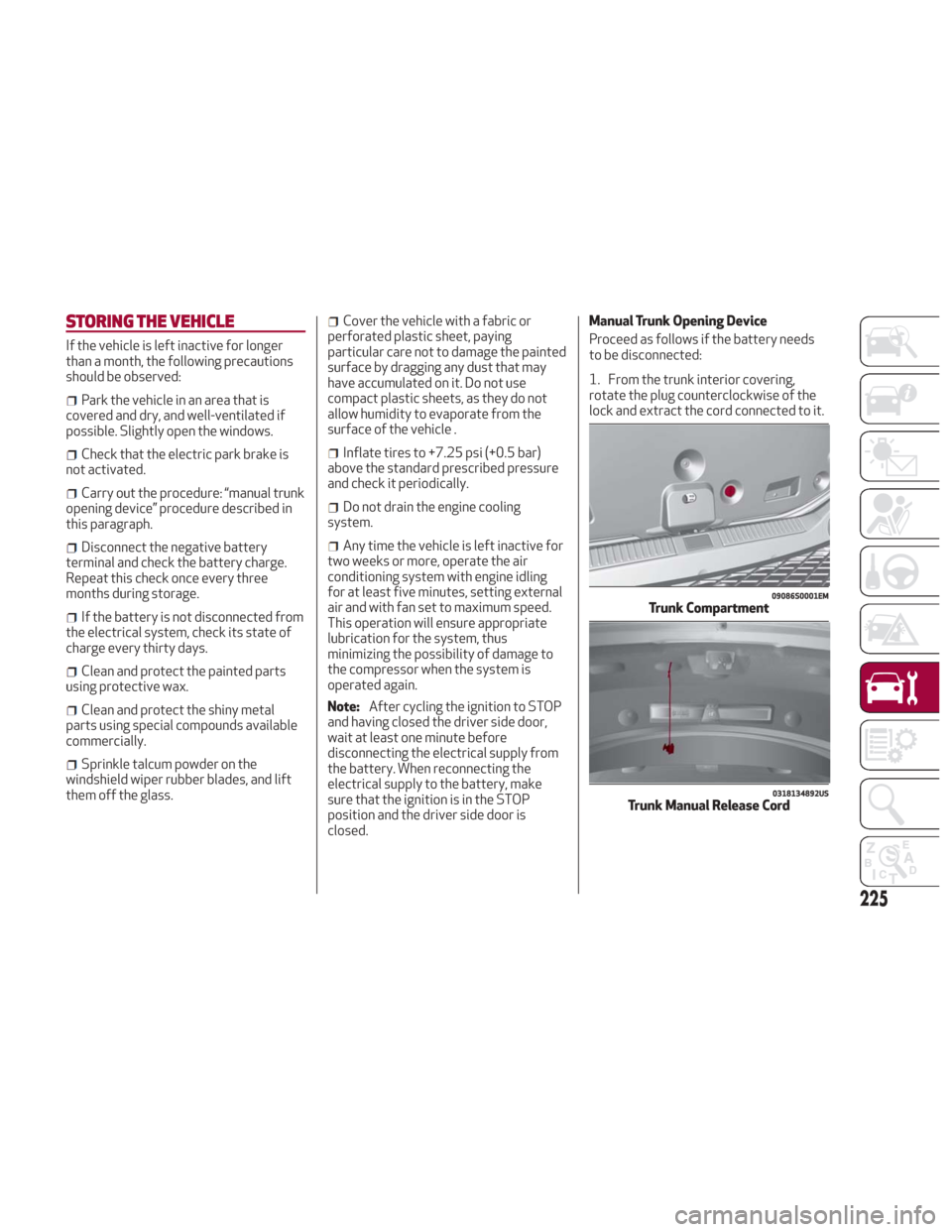
closed. Manual Trunk Opening Device
Proceed as follows if the battery needs
to be disconnected:
1. From the trunk interior covering,
rotate the plug counterclockwise of the
lock and extract the cord connected to it.
09086S0001EMTrunk Compartment
0318134892USTrunk Manual Release Cord
225
Page 229 of 260
Wash the bodywork using a low
pressure jet of water if possible.
Wipe a sponge with a slightly soapy
solution over the bodywork, frequently
rinsing the sponge.
Rinse well with water and dry with a
leather chamois.
Dry the less visible parts (e.g. door
frames, hood, headlight frames, etc.) with
special care, as water may stagnate more
easily in these areas. Do not wash the car
after it has been left in the sun or with the
hood hot: this may alter the shine of the
paintwork.
Exterior plastic parts must be cleaned in
the same way as the rest of the vehicle.
If washing the car in a service that moves
the car, for cars with automatic
transmissions, PARK (P) must be cut out.
You have to shut off the engine in the
following conditions: car stopped,
transmission in NEUTRAL (N), push the
starter button for at least three seconds.
Note: Avoid parking under trees; the
resin dropped by trees makes the
paintwork go opaque and increases the
possibility of corrosion. Windows
Use specific detergents and clean cloths
to prevent scratching or altering the
transparency.Caution!
Wipe the rear window inside gently with a
cloth following the direction of the filaments
to avoid damaging the heating device.
Front Headlights
Use a soft cloth soaked in water and
detergent for washing cars.
Note:
Never use aromatic substances (e.g.
gasoline) or ketones (e.g. acetone) for
cleaning the plastic lenses of the
headlights.
When cleaning with a pressure
washer, keep the pressure washer at
least eight inches (20 cm) away from the
headlights. Engine Compartment
At the end of every winter, wash the
engine compartment thoroughly, taking
care not to aim the jet of water directly at
the electronic control units or at the
windshield wiper motors. Have this
operation performed at a specialized
workshop.
Note:
The washing should take place
with the engine cold and the ignition
device in the STOP position. After the
washing operation, make sure that the
various protections (e.g. rubber caps and
guards) have not been removed or
damaged.
227
Page 231 of 260
TECHNICAL SPECIFICATIONS
For the enthusiasts, the technician, or
those who just want to know every detail
of their vehicle, useful information on
understanding how your vehicle works is
contained in this chapter and illustrated
with data, tables and graphics.IDENTIFICATION DATA.........230
ENGINE ................. .231
POWER SUPPLY .............232
TRANSMISSION .............233
BRAKES ................. .234
SUSPENSION ............. .235
STEERING SYSTEM ...........236
DIMENSIONS .............. .237
WEIGHTS ................ .238
FUEL REQUIREMENTS ........239
FLUID CAPACITIES ...........241
FLUIDS AND LUBRICANTS ......242
PERFORMANCE .............243
229
Page 232 of 260
IDENTIFICATION DATA
Vehicle Identification Number
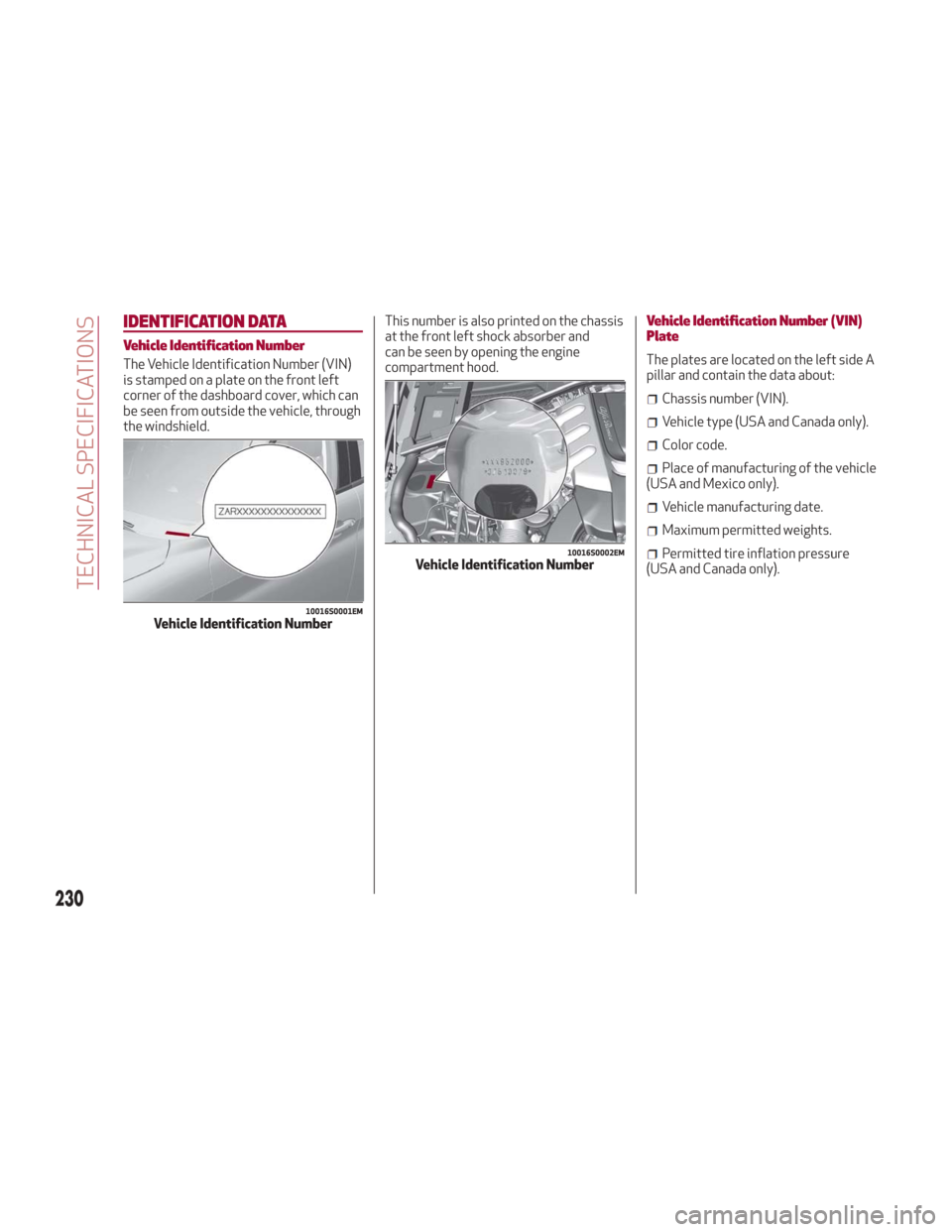
The Vehicle Identification Number (VIN)
is stamped on a plate on the front left
corner of the dashboard cover, which can
be seen from outside the vehicle, through
the windshield.This number is also printed on the chassis
at the front left shock absorber and
can be seen by opening the engine
compartment hood.
Vehicle Identification Number (VIN)
Plate
The plates are located on the left side A
pillar and contain the data about:
Chassis number (VIN).
Vehicle type (USA and Canada only).
Color code.
Place of manufacturing of the vehicle
(USA and Mexico only).
Vehicle manufacturing date.
Maximum permitted weights.
Permitted tire inflation pressure
(USA and Canada only).
10016S0001EMVehicle Identification Number
10016S0002EMVehicle Identification Number
230
TECHNICAL SPECIFICATIONS
Page 233 of 260
ENGINE
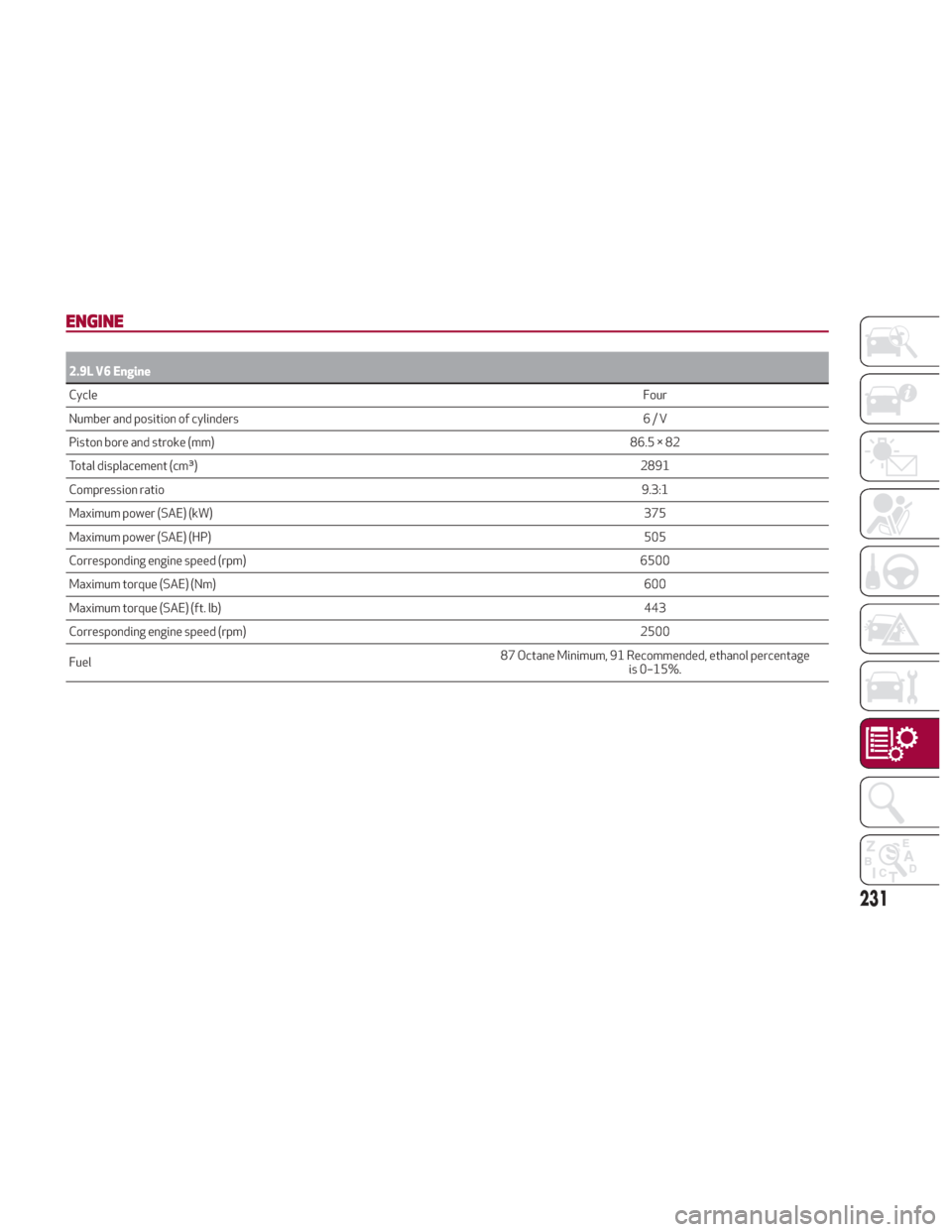
2.9L V6 Engine
CycleFo
ur
Number and position of cylinders 6/V
Piston bore and stroke (mm) 86.5 × 82
Total displacement (cm³) 2891
Compression ratio 9.3:1
Maximum power (SAE) (kW) 375
Maximum power (SAE) (HP) 505
Corresponding engine speed (rpm) 6500
Maximum torque (SAE) (Nm) 600
Maximum torque (SAE) (ft. lb) 443
Corresponding engine speed (rpm) 2500
Fuel 87 Octane Minimum, 91 Recommended, ethanol percentage
is 0–15%.
231
Page 234 of 260
POWER SUPPLY
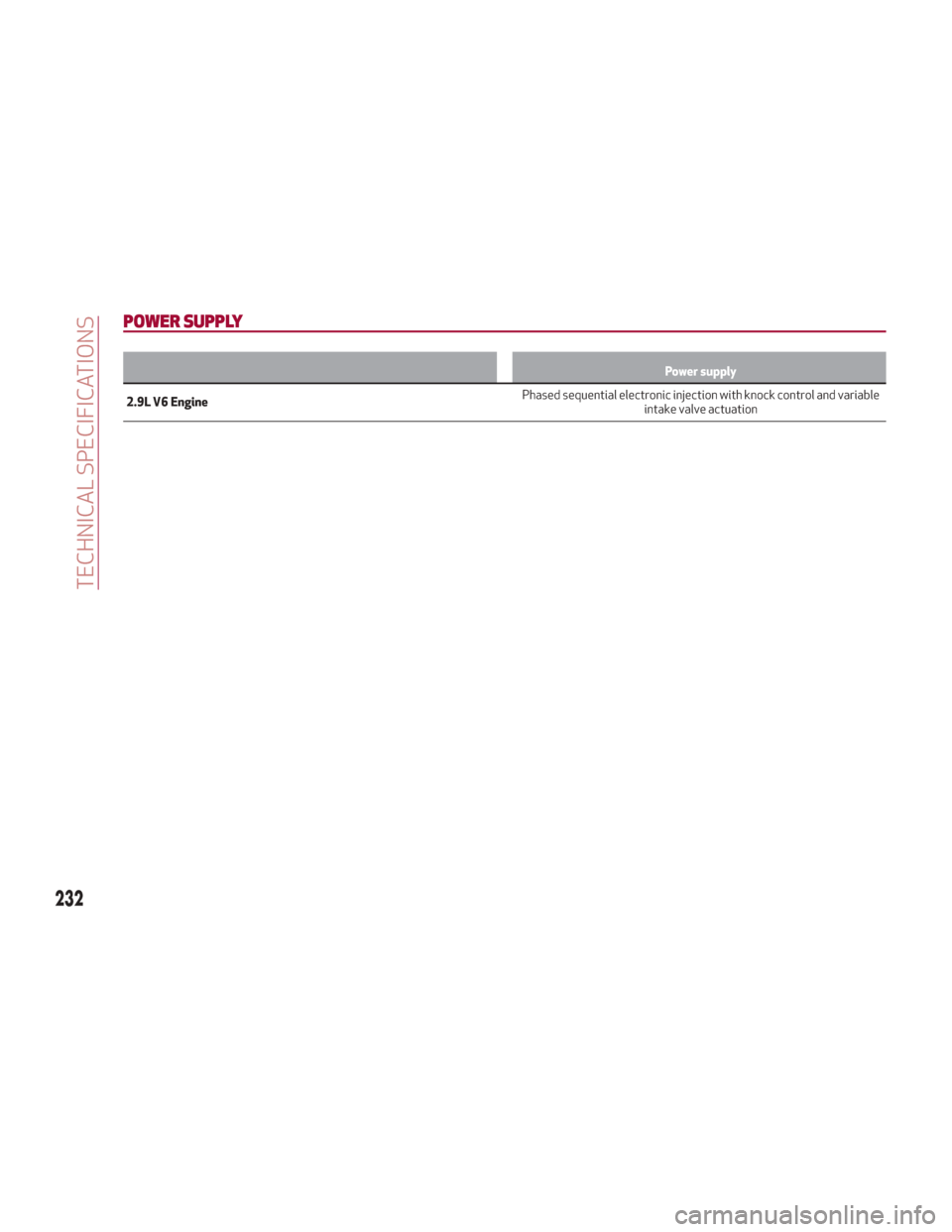
Power supply
2.9L V6 Engine Phased
sequential electronic injection with knock control and variable
intake valve actuation
232
TECHNICAL SPECIFICATIONS
Page 235 of 260
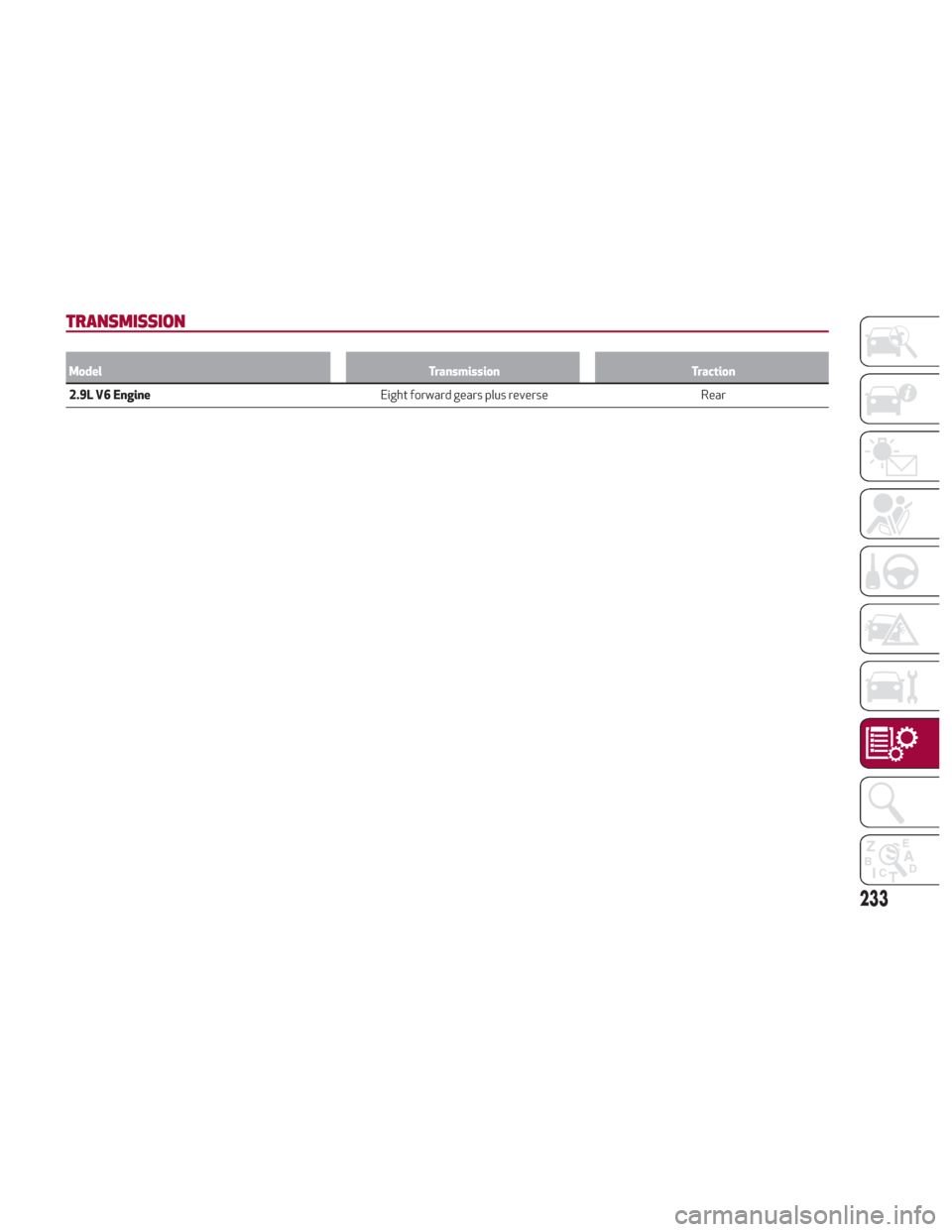
TRANSMISSION
ModelTransmissionTraction
2.9L V6 Engine Eight
forward gears plus reverseRear
233
Page 236 of 260
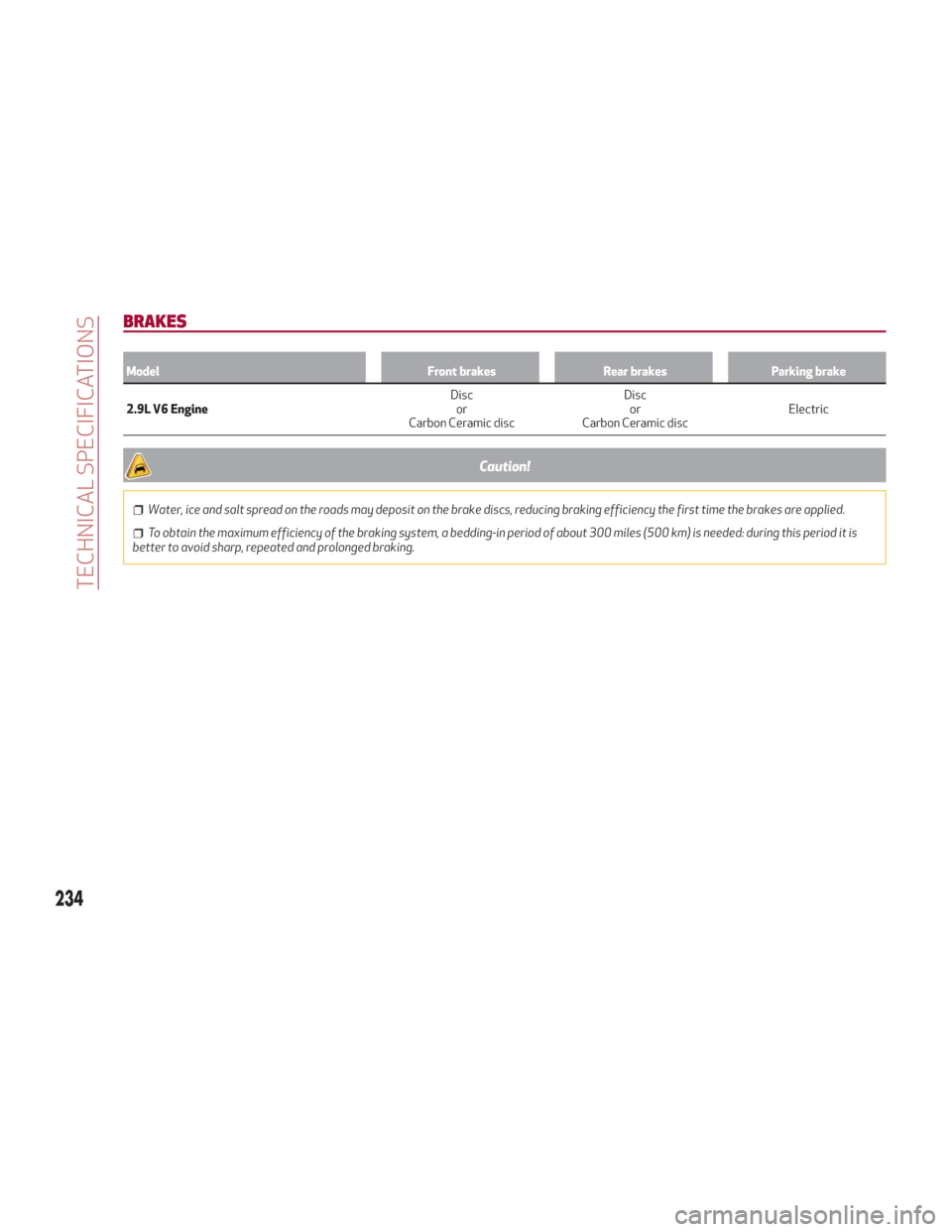
BRAKES
ModelFront brakesRear brakesParking brake
2.9L V6 Engine Disc
or
Carbon
Ceramic discDisc
or
Carbon Ceramic disc Electric
Caution!
Water, ice and salt spread on the roads may deposit on the brake discs, reducing braking efficiency the first time the brakes are applied.
To obtain the maximum efficiency of the braking system, a bedding-in period of about 300 miles (500 km) is needed: during this period it is
better to avoid sharp, repeated and prolonged braking.
234
TECHNICAL SPECIFICATIONS