Park Alfa Romeo Giulia 2019 User Guide
[x] Cancel search | Manufacturer: ALFA ROMEO, Model Year: 2019, Model line: Giulia, Model: Alfa Romeo Giulia 2019Pages: 232, PDF Size: 4.87 MB
Page 66 of 232
Symbol What it means
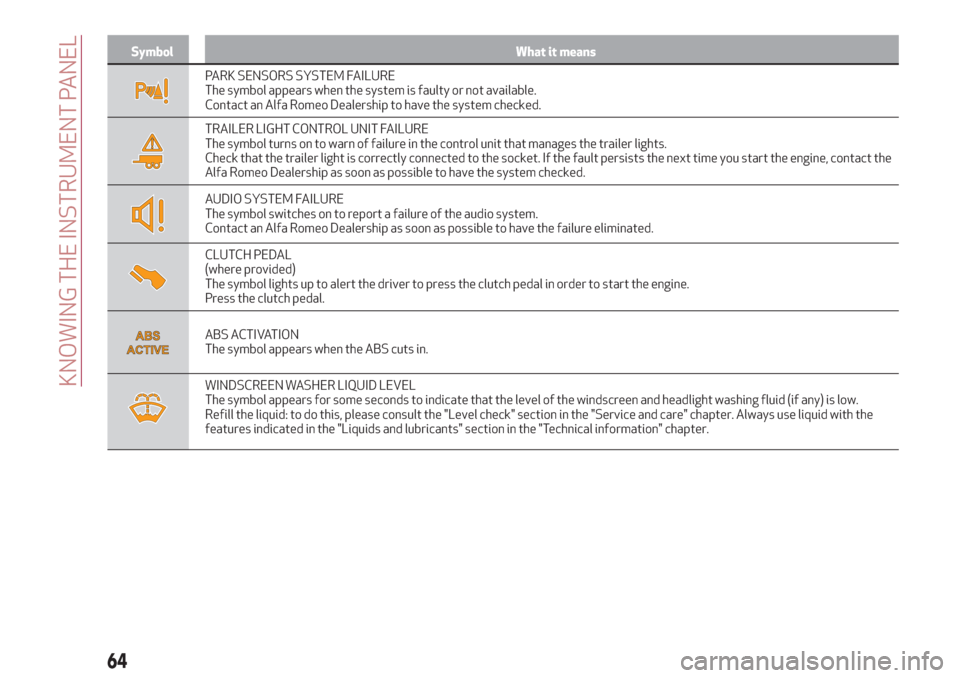
PARK SENSORS SYSTEM FAILURE
The symbol appears when the system is faulty or not available.
Contact an Alfa Romeo Dealership to have the system checked.
TRAILER LIGHT CONTROL UNIT FAILURE
The symbol turns on to warn of failure in the control unit that manages the trailer lights.
Check that the trailer light is correctly connected to the socket. If the fault persists the next time you start the engine, contact the
Alfa Romeo Dealership as soon as possible to have the system checked.
AUDIO SYSTEM FAILURE
The symbol switches on to report a failure of the audio system.
Contact an Alfa Romeo Dealership as soon as possible to have the failure eliminated.
CLUTCH PEDAL
(where provided)
The symbol lights up to alert the driver to press the clutch pedal in order to start the engine.
Press the clutch pedal.
ABS ACTIVATION
The symbol appears when the ABS cuts in.
WINDSCREEN WASHER LIQUID LEVEL
The symbol appears for some seconds to indicate that the level of the windscreen and headlight washing fluid (if any) is low.
Refill the liquid: to do this, please consult the "Level check" section in the "Service and care" chapter. Always use liquid with the
features indicated in the "Liquids and lubricants" section in the "Technical information" chapter.
64
KNOWING THE INSTRUMENT PANEL
Page 69 of 232
Symbol What it means
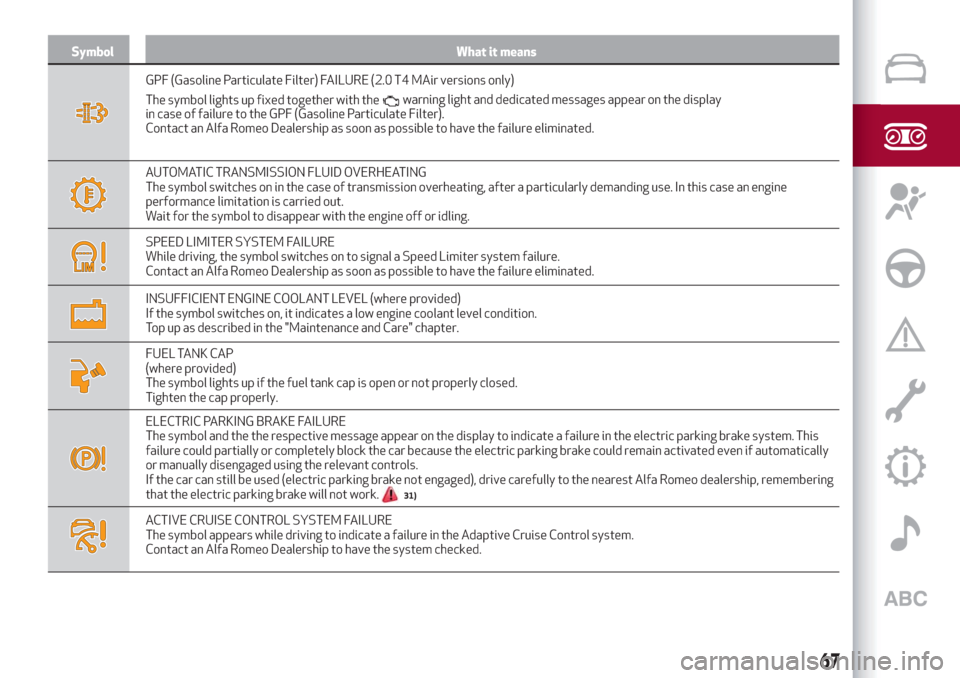
GPF (Gasoline Particulate Filter) FAILURE (2.0 T4 MAir versions only)
The symbol lights up fixed together with the
in case of failure to the GPF (Gasoline Particulate Filter).
Contact an Alfa Romeo Dealership as soon as possible to have the failure eliminated.
AUTOMATIC TRANSMISSION FLUID OVERHEATING
The symbol switches on in the case of transmission overheating, after a particularly demanding use. In this case an engine
performance limitation is carried out.
Wait for the symbol to disappear with the engine off or idling.
SPEED LIMITER SYSTEM FAILURE
While driving, the symbol switches on to signal a Speed Limiter system failure.
Contact an Alfa Romeo Dealership as soon as possible to have the failure eliminated.
INSUFFICIENT ENGINE COOLANT LEVEL (where provided)
If the symbol switches on, it indicates a low engine coolant level condition.
Top up as described in the "Maintenance and Care" chapter.
FUEL TANK CAP
(where provided)
The symbol lights up if the fuel tank cap is open or not properly closed.
Tighten the cap properly.
ELECTRIC PARKING BRAKE FAILURE
The symbol and the the respective message appear on the display to indicate a failure in the electric parking brake system. This
failure could partially or completely block the car because the electric parking brake could remain activated even if automatically
or manually disengaged using the relevant controls.
If the car can still be used (electric parking brake not engaged), drive carefully to the nearest Alfa Romeo dealership, remembering
that the electric parking brake will not work.
31)
ACTIVE CRUISE CONTROL SYSTEM FAILURE
The symbol appears while driving to indicate a failure in the Adaptive Cruise Control system.
Contact an Alfa Romeo Dealership to have the system checked.
67
warning light and dedicated messages appear on the display
Page 77 of 232
48)The TC system cannot overrule the
natural laws of physics, and cannot increase
the grip available according to the condition
of the road.
49)The TC system cannot prevent
accidents, including those due to excessive
speed on corners, driving on low-grip
surfaces or aquaplaning.
50)The capability of the TC must never be
tested irresponsibly and dangerously, in
such a way as to compromise personal
safety and the safety of others.
51)The PBA system cannot overrule the
natural laws of physics, and cannot increase
the grip available according to the condition
of the road.
52)The PBA system cannot prevent
accidents, including those due to excessive
speed on corners, driving on low-grip
surfaces or aquaplaning.
53)The capability of the PBA system must
never be tested irresponsibly and
dangerously, in such a way as to compromise
the safety of the driver, the other occupants
of the vehicle or any other road user.
54)The HSA system is not a parking brake;
therefore, never leave the vehicle without
having engaged the electric parking brake,
turned the engine off and engaged first gear,
so that it is parked in safe conditions (for
further information read the "Parking"
paragraph in the "Starting and driving"
chapter).
55)There may be situations on small
gradients (less than 8%), with vehicle laden,
in which the Hill Start Assist system may not
activate, causing a slight reversing motion
and increasing the risk of collision with
another vehicle or object. The driver is, in any
case, responsible for safe driving.56)The AST system is an aid for driving and
does not relieve the driver of responsibility
for driving the vehicle.DRIVING ASSISTANCE
SYSTEMS
The vehicle can feature the following
driving assistance systems:
BSM (Blind Spot Monitoring);
FCW (Forward Collision Warning);
TPMS (Tyre Pressure Monitoring
System).
For the operation of the systems, see the
following pages.
BSM (Blind Spot Monitoring)SYSTEM
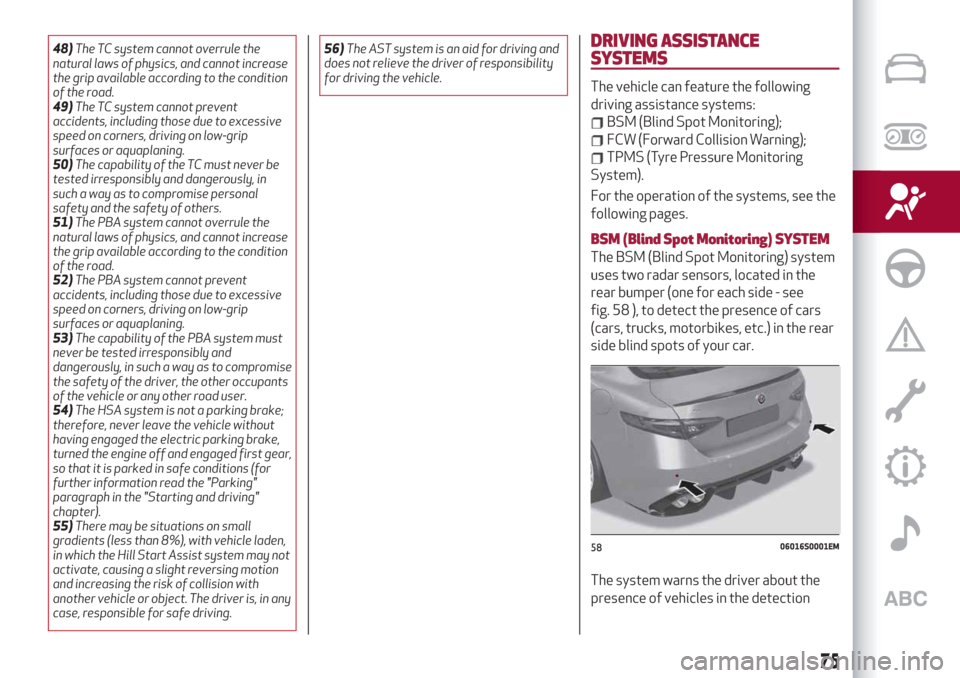
The BSM (Blind Spot Monitoring) system
uses two radar sensors, located in the
rear bumper (one for each side - see
fig. 58 ), to detect the presence of cars
(cars, trucks, motorbikes, etc.) in the rear
side blind spots of your car.
The system warns the driver about the
presence of vehicles in the detection
5806016S0001EM
75
Page 78 of 232
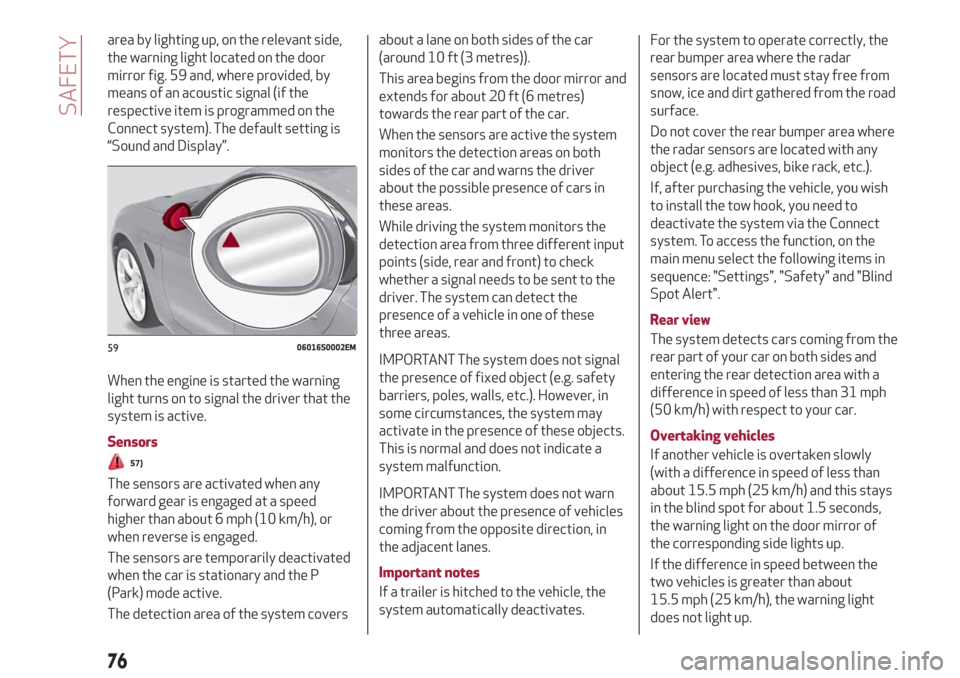
area by lighting up, on the relevant side,
the warning light located on the door
mirror fig. 59 and, where provided, by
means of an acoustic signal (if the
respective item is programmed on the
Connect system). The default setting is
“Sound and Display”.
When the engine is started the warning
light turns on to signal the driver that the
system is active.
Sensors
57)
The sensors are activated when any
forward gear is engaged at a speed
higher than about 6 mph (10 km/h), or
when reverse is engaged.
The sensors are temporarily deactivated
when the car is stationary and the P
(Park) mode active.
The detection area of the system coversabout a lane on both sides of the car
(around 10 ft (3 metres)).
This area begins from the door mirror and
extends for about 20 ft (6 metres)
towards the rear part of the car.
When the sensors are active the system
monitors the detection areas on both
sides of the car and warns the driver
about the possible presence of cars in
these areas.
While driving the system monitors the
detection area from three different input
points (side, rear and front) to check
whether a signal needs to be sent to the
driver. The system can detect the
presence of a vehicle in one of these
three areas.
IMPORTANT The system does not signal
the presence of fixed object (e.g. safety
barriers, poles, walls, etc.). However, in
some circumstances, the system may
activate in the presence of these objects.
This is normal and does not indicate a
system malfunction.
IMPORTANT The system does not warn
the driver about the presence of vehicles
coming from the opposite direction, in
the adjacent lanes.
Important notes
If a trailer is hitched to the vehicle, the
system automatically deactivates.For the system to operate correctly, the
rear bumper area where the radar
sensors are located must stay free from
snow, ice and dirt gathered from the road
surface.
Do not cover the rear bumper area where
the radar sensors are located with any
object (e.g. adhesives, bike rack, etc.).
If, after purchasing the vehicle, you wish
to install the tow hook, you need to
deactivate the system via the Connect
system. To access the function, on the
main menu select the following items in
sequence: "Settings", "Safety" and "Blind
Spot Alert".
Rear view
The system detects cars coming from the
rear part of your car on both sides and
entering the rear detection area with a
difference in speed of less than 31 mph
(50 km/h) with respect to your car.
Overtaking vehicles
If another vehicle is overtaken slowly
(with a difference in speed of less than
about 15.5 mph (25 km/h) and this stays
in the blind spot for about 1.5 seconds,
the warning light on the door mirror of
the corresponding side lights up.
If the difference in speed between the
two vehicles is greater than about
15.5 mph (25 km/h), the warning light
does not light up.
5906016S0002EM
76
SAFETY
Page 79 of 232
RCP (Rear Cross Path detection) system
This system helps the driver during
reverse manoeuvres in the case of
reduced visibility.
The RCP system monitors the rear
detection areas on both sides of the car,
to detect objects moving towards the
sides of the car at a minimum speed
between about 0.6 mph and 2 mph
(1 km/h and 3 km/h) and objects moving
at a maximum speed of 22 mph
(35 km/h), as generally happens in
parking areas.
The system activation is signalled to the
driver by means of a visual and acoustic
warning.
IMPORTANT If the sensors are covered
by objects or vehicles, the system will not
warn the driver.
Operating mode
The system may be activated/
deactivated via the Connect system. To
access the function, on the main menu
select the following items in sequence:
"Settings", "Safety" and "Blind Spot
Alert"."Blind spot alert", "Visual" mode
When the system is enabled, a visual
warning is sent to the door mirror on the
side of the detected object.
The visual warning on the mirror will blink
if the driver switches on the direction
indicators, thus indicating the intention
to change lane.
The warning will be fixed if the driver
stays on the same lane.
"Blind spot alert" function deactivation
When the system is deactivated ("Blind
Spot Alert" mode at "OFF"), the BSM or
RCP systems will not emit neither
acoustic warnings.
The BSM system will store the operating
mode running when the engine was
stopped. Each time the engine is started,
the operating mode stored previously will
be recalled and used.
FORWARD COLLISION WARNING (FCW)
SYSTEM
57) 58) 59) 60) 61) 62)
22) 23) 24) 25) 26) 27) 28) 29) 30)
This is a driving assistance system
composed of a radar located behind the
front bumper fig. 60 and a camera
located in the middle of the windscreen
fig. 61.
6006016S0003EM
6106016S0004EM
77
Page 83 of 232
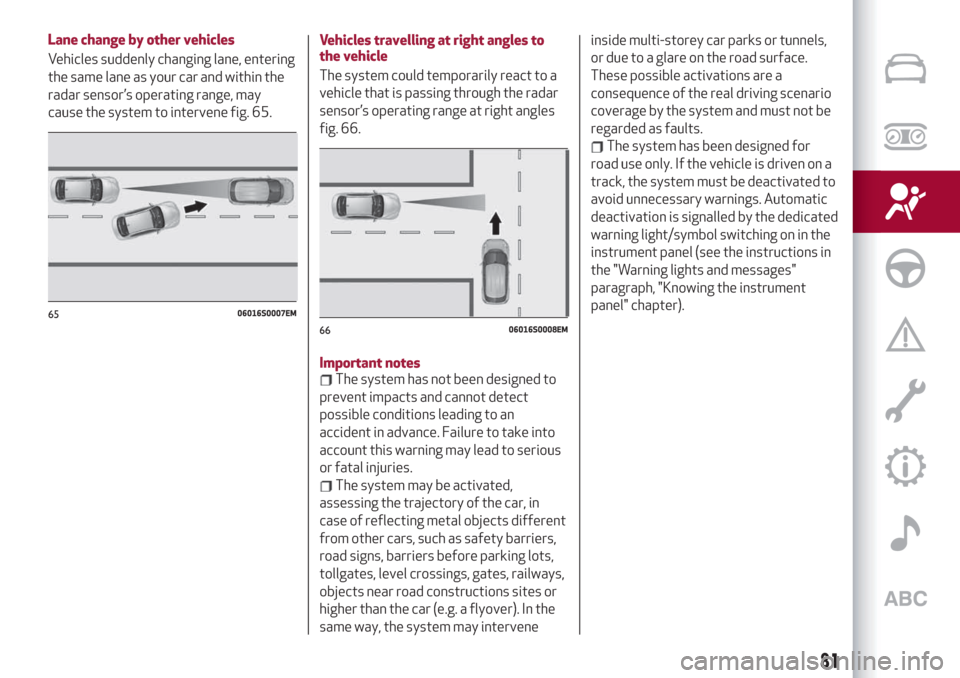
Lane change by other vehicles
Vehicles suddenly changing lane, entering
the same lane as your car and within the
radar sensor’s operating range, may
cause the system to intervene fig. 65.Vehicles travelling at right angles to
the vehicle
The system could temporarily react to a
vehicle that is passing through the radar
sensor’s operating range at right angles
fig. 66.
Important notes
The system has not been designed to
prevent impacts and cannot detect
possible conditions leading to an
accident in advance. Failure to take into
account this warning may lead to serious
or fatal injuries.
The system may be activated,
assessing the trajectory of the car, in
case of reflecting metal objects different
from other cars, such as safety barriers,
road signs, barriers before parking lots,
tollgates, level crossings, gates, railways,
objects near road constructions sites or
higher than the car (e.g. a flyover). In the
same way, the system may interveneinside multi-storey car parks or tunnels,
or due to a glare on the road surface.
These possible activations are a
consequence of the real driving scenario
coverage by the system and must not be
regarded as faults.
The system has been designed for
road use only. If the vehicle is driven on a
track, the system must be deactivated to
avoid unnecessary warnings. Automatic
deactivation is signalled by the dedicated
warning light/symbol switching on in the
instrument panel (see the instructions in
the "Warning lights and messages"
paragraph, "Knowing the instrument
panel" chapter).
6506016S0007EM
6606016S0008EM
81
Page 87 of 232
27)Do not tamper with nor carry out any
intervention on the radar sensor or on the
camera on the windscreen. In the event of a
sensor failure, contact an Alfa Romeo
Dealership.
28)Do not wash with high-pressure jets in
the bumper lower area: in particular do not
operate on the system's electrical connector.
29)Be careful in the case of repairs and new
paintings in the area around the sensor
(panel covering the sensor on the left side of
the bumper). In the event of a frontal impact
the sensor may automatically deactivate
and display a warning to indicate that the
sensor needs to be repaired. Even without a
malfunction warning, deactivate the system
operation if you think that the position of the
radar sensor has changed (e.g. due to
low-speed frontal impact as during parking
manoeuvres). In these cases, go to an Alfa
Romeo Dealership to have the radar sensor
realigned or replaced.
30)When towing a trailer, a vehicle or during
loading manoeuvres on a vehicle transporter
(or in vehicle for transport), the system must
be deactivated via the Connect system.
31)The Tire Repair Kit, provided with the
vehicle, is compatible with the TPMS
sensors. Using sealants different from that
in the original kit may compromise its
operation. If sealants not equivalent with the
original ones are used, it is recommended to
have the TPMS sensor operation checked by
a qualified repair centre.OCCUPANT PROTECTION
SYSTEMS
Some of the most important safety
equipment of the vehicle comprise the
following protection systems:
seat belts;
SBA (Seat Belt Alert) System;
head restraints;
child restraint systems;
Front airbags and side bags.
Read the information given the following
pages with the utmost care. It is of
fundamental importance that the
protection systems are used in the
correct way to guarantee the maximum
possible safety level for the driver and
the passengers.
For the description of the head restraint
adjustment see the "Head restraints"
paragraph in the "Knowing your vehicle"
chapter.
SEAT BELTS
All the seatbelts have three anchoring
points each with its own retractor.
The retractor mechanism operates
locking the belt in the event of sharp
braking or strong deceleration due to an
impact. This allows the belt strap to slide
freely and to adapt to the body of the
occupant. In the event of an accident, the
belt will lock reducing the risk of impact
inside the passenger compartment and
of being projected outside the vehicle.
The driver is responsible for respecting,
and ensuring that all the other occupants
of the vehicle also respect, the local laws
in force in relation to the use of the seat
belts.
Always fasten the seat belts before
setting off.
USING THE SEAT BELTS
The seat belt should be worn keeping the
chest straight and rested against the
backrest.
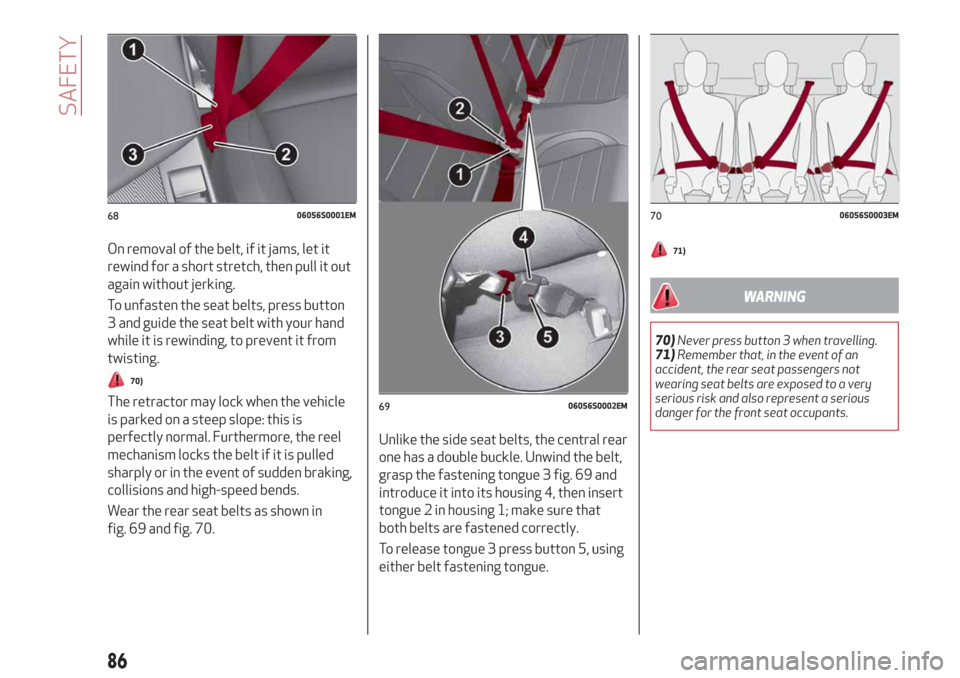
To fasten the seat belts, hold the tongue
1 fig. 68 and insert it into the buckle 2,
until it clicks into place.
85
Page 88 of 232
On removal of the belt, if it jams, let it
rewind for a short stretch, then pull it out
again without jerking.
To unfasten the seat belts, press button
3 and guide the seat belt with your hand
while it is rewinding, to prevent it from
twisting.
70)
The retractor may lock when the vehicle
is parked on a steep slope: this is
perfectly normal. Furthermore, the reel
mechanism locks the belt if it is pulled
sharply or in the event of sudden braking,
collisions and high-speed bends.
Wear the rear seat belts as shown in
fig. 69 and fig. 70.Unlike the side seat belts, the central rear
one has a double buckle. Unwind the belt,
grasp the fastening tongue 3 fig. 69 and
introduce it into its housing 4, then insert
tongue 2 in housing 1; make sure that
both belts are fastened correctly.
To release tongue 3 press button 5, using
either belt fastening tongue.
71)
WARNING
70)Never press button 3 when travelling.
71)Remember that, in the event of an
accident, the rear seat passengers not
wearing seat belts are exposed to a very
serious risk and also represent a serious
danger for the front seat occupants.
6806056S0001EM
6906056S0002EM
7006056S0003EM
86
SAFETY
Page 111 of 232
Let’s get to the core of the vehicle: seeing how you can exploit all
of its potential to the full. We’ll look at how to drive it safely in any
situation, so that it can be a welcome companion, with our comfort
and our wallets in mind.
STARTING AND DRIVING
STARTING THE ENGINE..........................110
PARKING THE VEHICLE..........................111
MANUAL GEARBOX............................114
AUTOMATIC TRANSMISSION . .....................114
"ALFA DNA™" SYSTEM..........................117
START&STOPEVO............................118
SPEED LIMITER..............................119
CRUISE CONTROL.............................120
ACTIVE CRUISE CONTROL........................121
PARK SENSORS SYSTEM........................128
LANE DEPARTURE WARNING (LDW) SYSTEM............130
REAR BACK-UP CAMERA / DYNAMIC GRIDLINES . ........131
REFUELLING THE VEHICLE . . .....................132
AdBlue® (UREA) ADDITIVE FOR DIESEL EMISSIONS........136
SUGGESTIONS FOR DRIVING......................136
TOWING TRAILERS............................138
Page 112 of 232
STARTING THE ENGINE
STARTING THE ENGINE
Before starting the engine, adjust the
seat, the interior rear view mirrors, the
door mirrors and fasten the seat belt
correctly.
Never press the accelerator pedal for
starting the engine.
If necessary, messages indicating the
starting procedure can be shown on the
display.
103) 104) 105)
33) 34) 35)
Versions with manual gearbox
Proceed as follows:
engage the parking brake and set the
gear in neutral, on diesel versions turn the
ignition switch to ON, the
symbol will
appear on the instrument panel: wait until
it goes off;
fully depress the clutch pedal, without
touching the accelerator;
briefly press the ignition button;
if the engine doesn't start within a few
seconds, you need to repeat the
procedure.
if the problem persists, contact an Alfa
Romeo Dealership.Versions with automatic transmission
Proceed as follows:
engage the electric parking brake and
set the gear lever to P (Park) or N
(Neutral),
fully depress the brake pedal without
touching the accelerator;
briefly press the ignition button;
if the engine doesn't start within a few
seconds, you need to repeat the
procedure.
if the problem persists, contact an Alfa
Romeo Dealership.
ENGINE STARTING FAILURE
Starting the engine with electronic key
battery (Keyless Start) run down or flat
If the ignition device does not respond
when the relevant button is pressed the
electronic key battery might be run down
or flat. Therefore, the system does not
detect the presence of the electronic key
on board the car and displays a dedicated
message.
In this case, follow the instructions in
paragraph "Starting with flat key battery"
in the "Knowing your car" chapter and
start the engine normally.
STOPPING THE ENGINE
36)
To stop the engine, proceed as follows:
park the car in a position that is not
dangerous for oncoming traffic;
engage a gear (versions with manual
gearbox) or activate P (Park) mode
(versions with automatic transmission);
with engine idling, press the start
button.
Cars with electronic key (Keyless Start)
If the car speed is above 5 mph (8 km/h),
it is still possible to stop the engine if a
gear operating mode other than P (Park)
is selected. To switch off the engine in
this situation, hold down the ignition
device button for a while or press it
3 times in a row within a few seconds.
WARNING
103)It is dangerous to run the engine in
enclosed areas. The engine takes in oxygen
and releases carbon dioxide, carbon
monoxide and other toxic gases.
104)The electro-hydraulic braking system
is not active until the engine starts running.
So, the brake pedal travel will be longer than
normal. This does not indicate a fault.
105)Do not start the engine by pushing,
towing or driving downhill. These
manoeuvres may damage the catalytic
converter.
110
STARTING AND DRIVING