fuel Alfa Romeo Giulia 2019 User Guide
[x] Cancel search | Manufacturer: ALFA ROMEO, Model Year: 2019, Model line: Giulia, Model: Alfa Romeo Giulia 2019Pages: 232, PDF Size: 4.87 MB
Page 111 of 232
Let’s get to the core of the vehicle: seeing how you can exploit all
of its potential to the full. We’ll look at how to drive it safely in any
situation, so that it can be a welcome companion, with our comfort
and our wallets in mind.
STARTING AND DRIVING
STARTING THE ENGINE..........................110
PARKING THE VEHICLE..........................111
MANUAL GEARBOX............................114
AUTOMATIC TRANSMISSION . .....................114
"ALFA DNA™" SYSTEM..........................117
START&STOPEVO............................118
SPEED LIMITER..............................119
CRUISE CONTROL.............................120
ACTIVE CRUISE CONTROL........................121
PARK SENSORS SYSTEM........................128
LANE DEPARTURE WARNING (LDW) SYSTEM............130
REAR BACK-UP CAMERA / DYNAMIC GRIDLINES . ........131
REFUELLING THE VEHICLE . . .....................132
AdBlue® (UREA) ADDITIVE FOR DIESEL EMISSIONS........136
SUGGESTIONS FOR DRIVING......................136
TOWING TRAILERS............................138
Page 113 of 232
IMPORTANT
33)We recommend that during the initial
period, or during the first 1600 km
(1000 miles), you do not drive to full car
performance (e.g. excessive acceleration,
long journeys at top speed, sharp braking,
etc.).
34)When the engine stopped never leave
the ignition device in the ON position to
prevent useless current draw from draining
the battery.
35)Warning light
will flash after starting
or during prolonged cranking to indicate a
fault with the glow plug heating system. If
the engine starts, the vehicle can be regularly
used, but an Alfa Romeo Dealership must be
contacted as soon as possible.
36)A quick burst on the accelerator before
turning off the engine serves absolutely no
practical purpose; it wastes fuel and is
damaging for the engine.
PARKING THE VEHICLE
106) 107) 108)
IMPORTANT In addition to parking the
vehicle with the parking brake always
engaged, the wheel steered, chocks or
stones positioned in front of the wheels
(when on a steep slope), you must always
engage:
Manual transmission:
Engage 1stgear if the car is parked
uphill or reverse gear if the car is parked
downhill.
Automatic transmission:
engage P (Park) mode;
always take the key with you when
leaving the vehicle.
IMPORTANT Always engage the electric
parking brake before leaving the vehicle.
ELECTRIC PARKING BRAKE
The car is equipped with electric parking
brake to guarantee better use and
optimal performance compared to a
manually operated parking brake.
The electric parking brake features a
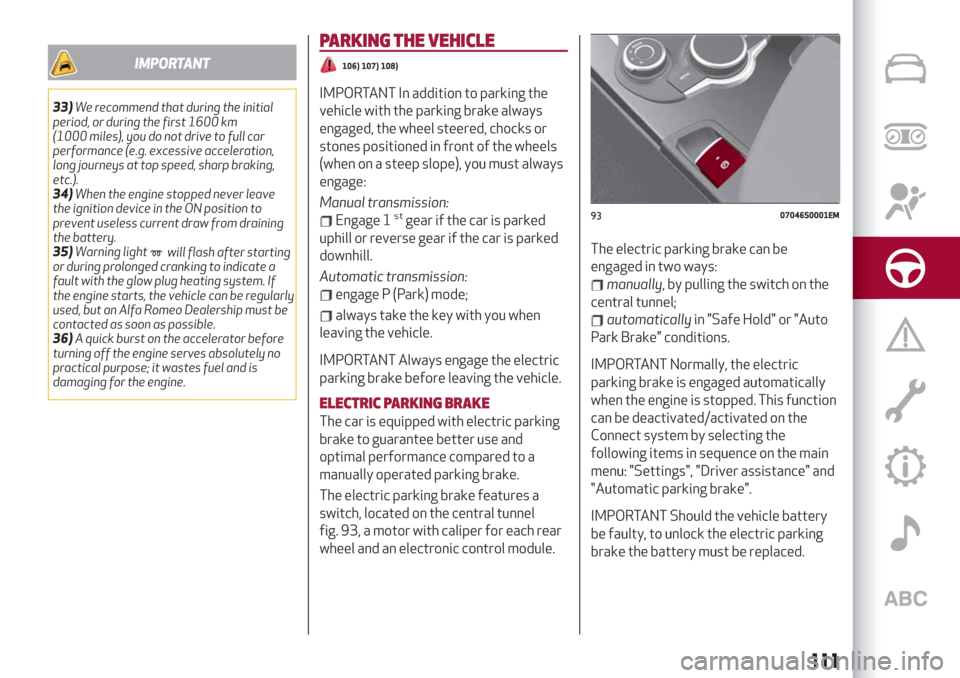
switch, located on the central tunnel
fig. 93, a motor with caliper for each rear
wheel and an electronic control module.The electric parking brake can be
engaged in two ways:
manually, by pulling the switch on the
central tunnel;
automaticallyin "Safe Hold" or "Auto
Park Brake" conditions.
IMPORTANT Normally, the electric
parking brake is engaged automatically
when the engine is stopped. This function
can be deactivated/activated on the
Connect system by selecting the
following items in sequence on the main
menu: "Settings", "Driver assistance" and
"Automatic parking brake".
IMPORTANT Should the vehicle battery
be faulty, to unlock the electric parking
brake the battery must be replaced.
9307046S0001EM
111
Page 119 of 232
112)Do not shift the gear lever to N
(Neutral) and do not stop the engine when
driving on a downhill road. This type of
driving is dangerous and reduces the
possibility of intervening in the case of
variation of the road traffic or surface. You
risk losing control of your vehicle and
causing accidents.
IMPORTANT
38)Before selecting P (Park) mode, bring the
ignition device to position ON and press the
brake pedal. Otherwise, the gear lever may
get damaged.
39)Engage reverse only with the car
stationary, engine at idling speed and
accelerator fully released.
"ALFA DNA™"SYSTEM
"ALFA DNA™"SYSTEM
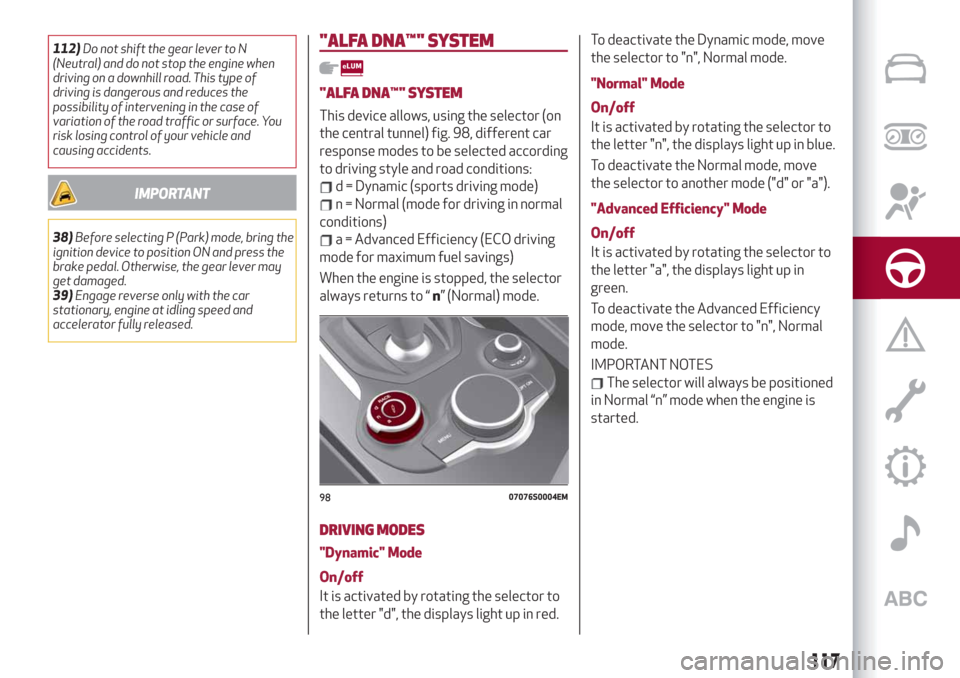
This device allows, using the selector (on
the central tunnel) fig. 98, different car
response modes to be selected according
to driving style and road conditions:
d = Dynamic (sports driving mode)
n = Normal (mode for driving in normal
conditions)
a = Advanced Efficiency (ECO driving
mode for maximum fuel savings)
When the engine is stopped, the selector
always returns to “n” (Normal) mode.
DRIVING MODES
"Dynamic" Mode
On/off
It is activated by rotating the selector to
the letter "d", the displays light up in red.To deactivate the Dynamic mode, move
the selector to "n", Normal mode.
"Normal" Mode
On/off
It is activated by rotating the selector to
the letter "n", the displays light up in blue.
To deactivate the Normal mode, move
the selector to another mode ("d" or "a").
"Advanced Efficiency" Mode
On/off
It is activated by rotating the selector to
the letter "a", the displays light up in
green.
To deactivate the Advanced Efficiency
mode, move the selector to "n", Normal
mode.
IMPORTANT NOTES
The selector will always be positioned
in Normal “n” mode when the engine is
started.
9807076S0004EM
117
Page 134 of 232
The table below shows the approximate
distances for each area fig. 114:
AreaDistance from the
rear part of the car
Red 0-1ft(0–30cm)
Y
ellow 1 - 3.3 ft (30 cm-1m)
Green 3.3 ft (1 m) or more
IMPORTANT When parking, take the
utmost care over obstacles that may be
above or under the camera range.
WARNING
124)Parking and other potentially
dangerous manoeuvres are, however,
always the driver’s responsibility. While
carrying out these manoeuvres, always
make sure that no people (especially
children) or animals are in the area
concerned. The camera is an aid for the
driver, but the driver must never allow
his/her attention to lapse during potentially
dangerous manoeuvres, even those
executed at low speeds. Always keep a slow
speed, so as to promptly brake in the case of
obstacles.
IMPORTANT
57)It is vital, for correct operation, that the
camera is always kept clean and free from
any mud, dirt, snow or ice. Be careful not to
scratch or damage the camera while cleaning
it. Avoid using dry, rough or hard cloths. The
camera must be washed using clean water,
with the addition of car shampoo if
necessary. In washing stations which use
steam or high-pressure jets, clean the
camera quickly, keeping the nozzle more
than 10 cm away from the sensors. Also, do
not apply stickers to the camera.
REFUELLING THE VEHICLE
125) 126) 127)
Always stop the engine before refuelling.
PETROL ENGINES
Only use unleaded petrol with a number
of octanes (R.O.N.) not lower than 91
(EN228 specification).
DIESEL ENGINES
Only use automotive diesel fuel
(EN590 and EN16734 specifications).
Operation at low temperatures
If the outside temperature is very low,
Diesel thickens due to the formation of
paraffin clots with consequent defective
operation of the fuel supply system.
In order to avoid these problems,
different types of diesel are distributed
according to the season: summer type,
winter type and arctic type (cold,
mountain areas).
In the event of refuelling with diesel
which is unsuitable for the operating
temperature, it is advisable to mix the
diesel with a specific additive,
introducing it to the tank before the
anti-freeze and then the diesel.
132
STARTING AND DRIVING
Page 135 of 232
REFUELLING PROCEDURE
The fuel flap is unlocked when the central
door locking system is released, while it
is automatically locked when the central
locking system is applied.
Opening the flap
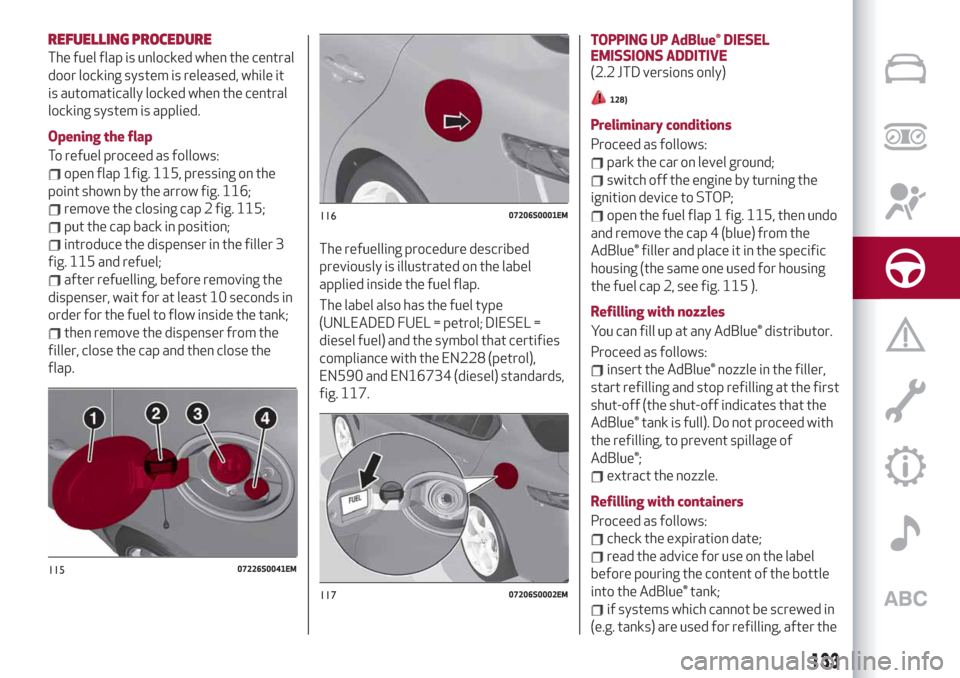
To refuel proceed as follows:
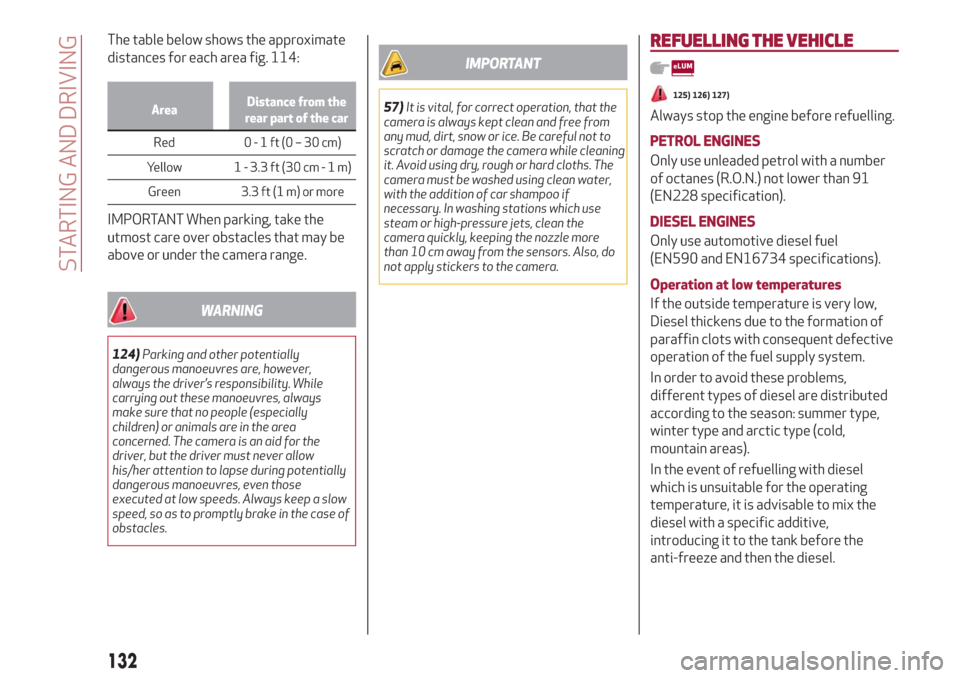
open flap 1fig. 115, pressing on the
point shown by the arrow fig. 116;
remove the closing cap 2 fig. 115;
put the cap back in position;
introduce the dispenser in the filler 3
fig. 115 and refuel;
after refuelling, before removing the
dispenser, wait for at least 10 seconds in
order for the fuel to flow inside the tank;
then remove the dispenser from the
filler, close the cap and then close the
flap.The refuelling procedure described
previously is illustrated on the label
applied inside the fuel flap.
The label also has the fuel type
(UNLEADED FUEL = petrol; DIESEL =
diesel fuel) and the symbol that certifies
compliance with the EN228 (petrol),
EN590 and EN16734 (diesel) standards,
fig. 117.TOPPING UP AdBlue® DIESEL
EMISSIONS ADDITIVE
(2.2 JTD versions only)
128)
Preliminary conditions
Proceed as follows:
park the car on level ground;
switch off the engine by turning the
ignition device to STOP;
open the fuel flap 1 fig. 115, then undo
and remove the cap 4 (blue) from the
AdBlue® filler and place it in the specific
housing (the same one used for housing
the fuel cap 2, see fig. 115 ).
Refilling with nozzles
You can fill up at any AdBlue® distributor.
Proceed as follows:
insert the AdBlue® nozzle in the filler,
start refilling and stop refilling at the first
shut-off (the shut-off indicates that the
AdBlue® tank is full). Do not proceed with
the refilling, to prevent spillage of
AdBlue®;
extract the nozzle.
Refilling with containers
Proceed as follows:
check the expiration date;
read the advice for use on the label
before pouring the content of the bottle
into the AdBlue® tank;
if systems which cannot be screwed in
(e.g. tanks) are used for refilling, after the
11507226S0041EM
11607206S0001EM
11707206S0002EM
133
Page 136 of 232
indication appears on the instrument
panel display (see “Warning lights and
messages" paragraph in the “Knowing the
instrument panel” chapter), fill the
AdBlue® tank with at least 1.11 UK gal –
5 litres;
if containers which can be screwed to
the filler are used, the reservoir is full
when the AdBlue® level in the container
stops pouring out. Do not proceed
further.
Operations after refilling
Proceed as follows:
fit the cap 4 fig. 115 back on the
AdBlue®filler by turning it clockwise and
screwing it completely;
set the ignition device to ON (it is not
necessary to start the engine);
wait for the indication on the
instrument panel to switch off before
moving the car. The indication may stay
on for a few seconds to approximately
half a minute. If the engine is started and
the car is moved, the indication will
remain on for longer. This will not
compromise engine operation;
if the AdBlue® was topped up when the
tank was empty, see the “Refuelling ”
paragraph in the “Technical
Specifications” chapter and wait for
2 minutes before starting the engine.
IMPORTANT If AdBlue® is spilled out of
the filler neck, clean up well the area andproceed to filling up again. If the liquid
crystallises, eliminate it with a sponge
and warm water.
IMPORTANT
If AdBlue® is spilled on painted
surfaces or aluminium, immediately
clean the area with water and use
absorbent material to collect the fluid
that has been spilled on the ground.
Do not try to start the engine if
AdBlue® was accidentally added to the
Diesel fuel tank, this can result in
serious engine damage, contact an Alfa
Romeo Dealership.
Do not add additives or other fluids
to AdBlue®, doing so could damage the
system.
The use of non-conforming or
degraded AdBlue® may lead to
indications appearing on the
instrument panel display (see “Warning
lights and messages" paragraph in the
“Knowing the instrument panel”
chapter).
Never pour AdBlue® into another
container: it could be contaminated.
In case of damage to the sewage
system of exhaust gas resulting from
the use of additives / tap water, the
introduction of diesel fuel, or at least
by not fulfilling the requirements, the
warranty expires.
If the AdBlue® runs out, see “Warning
lights and messages" paragraph in the
“Knowing the instrument panel”
chapter to continue using the car
normally.
The AdBlue® level is not updated if
the car is parked on a sloping road.
Fuels - identification of vehicle
compatibility. Graphic symbol for
consumer information in accordance
with EN16942
The symbols, shown below, make it easier
to recognise the correct fuel type to use
with your car.
Before refuelling, check the symbols
(where provided) inside the fuel filler flap
and compare them with the symbols
shown on the fuel pump (where provided).
Symbols for petrol powered cars
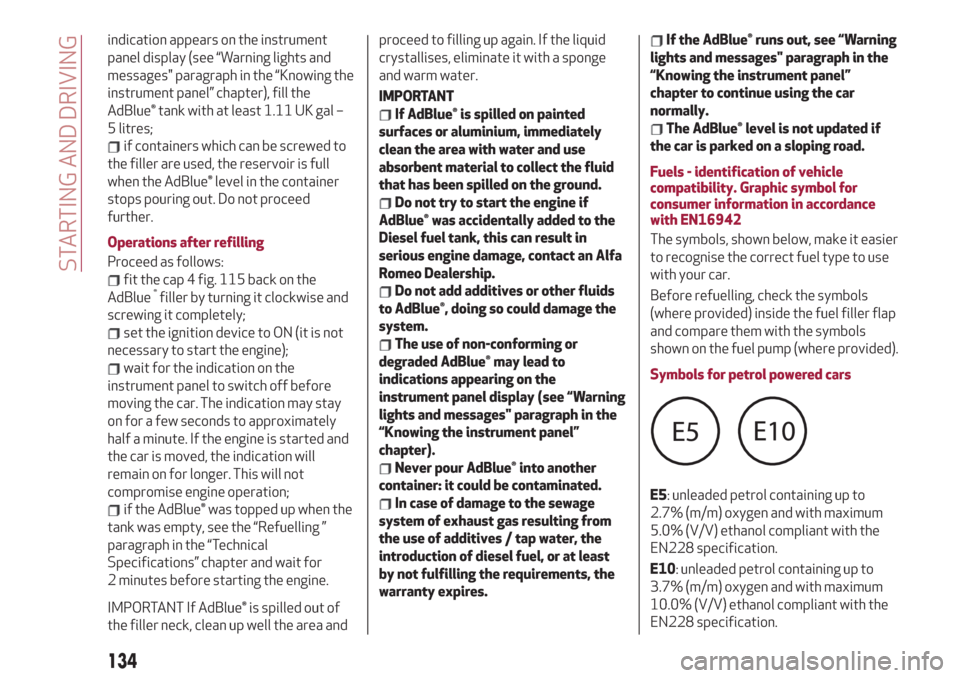
E5: unleaded petrol containing up to
2.7% (m/m) oxygen and with maximum
5.0% (V/V) ethanol compliant with the
EN228 specification.
E10: unleaded petrol containing up to
3.7% (m/m) oxygen and with maximum
10.0% (V/V) ethanol compliant with the
EN228 specification.
134
STARTING AND DRIVING
Page 137 of 232
Symbols for diesel powered cars
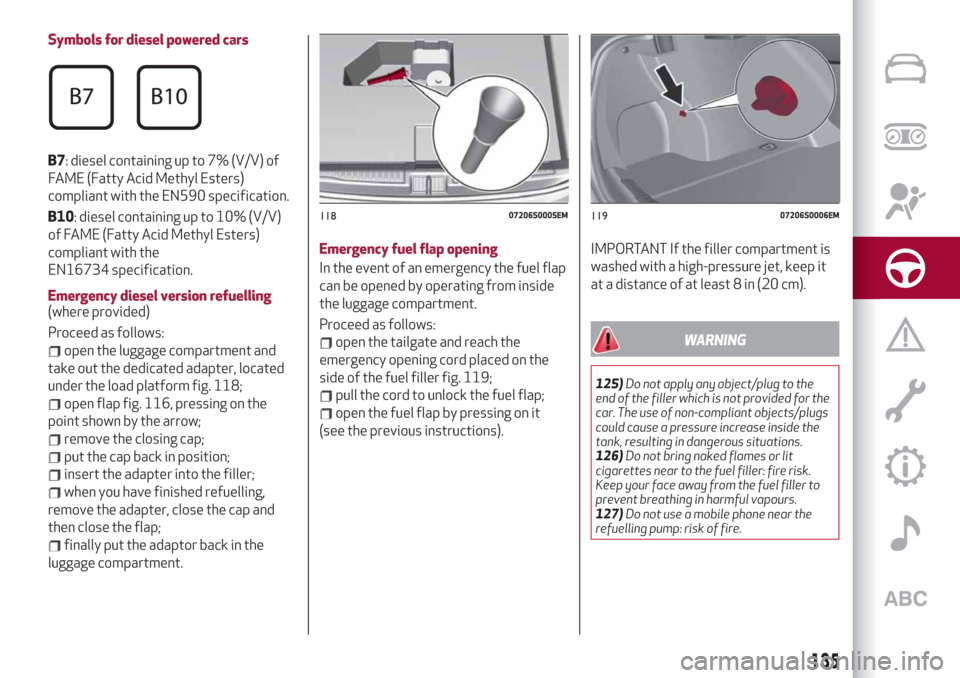
B7: diesel containing up to 7% (V/V) of
FAME (Fatty Acid Methyl Esters)
compliant with the EN590 specification.
B10: diesel containing up to 10% (V/V)
of FAME (Fatty Acid Methyl Esters)
compliant with the
EN16734 specification.
Emergency diesel version refuelling
(where provided)
Proceed as follows:
open the luggage compartment and
take out the dedicated adapter, located
under the load platform fig. 118;
open flap fig. 116, pressing on the
point shown by the arrow;
remove the closing cap;
put the cap back in position;
insert the adapter into the filler;
when you have finished refuelling,
remove the adapter, close the cap and
then close the flap;
finally put the adaptor back in the
luggage compartment.Emergency fuel flap opening
In the event of an emergency the fuel flap
can be opened by operating from inside
the luggage compartment.
Proceed as follows:
open the tailgate and reach the
emergency opening cord placed on the
side of the fuel filler fig. 119;
pull the cord to unlock the fuel flap;
open the fuel flap by pressing on it
(see the previous instructions).
IMPORTANT If the filler compartment is
washed with a high-pressure jet, keep it
at a distance of at least 8 in (20 cm).
WARNING
125)Do not apply any object/plug to the
end of the filler which is not provided for the
car. The use of non-compliant objects/plugs
could cause a pressure increase inside the
tank, resulting in dangerous situations.
126)Do not bring naked flames or lit
cigarettes near to the fuel filler: fire risk.
Keep your face away from the fuel filler to
prevent breathing in harmful vapours.
127)Do not use a mobile phone near the
refuelling pump: risk of fire.
11807206S0005EM11907206S0006EM
135
Page 138 of 232
128)If the AdBlue overheats for a
prolonged period inside the tank to over 50
°C (for example, due to direct solar
irradiation), the AdBlue may decompose and
produce ammonia vapours. Ammonia
vapours have a pungent odour when the cap
of the AdBlue tank is unscrewed, therefore
be careful not to inhale any ammonia
vapours in the tank outlet. In this
concentration, however, the ammonia
vapors are not harmful or dangerous to
health.AdBlue® (UREA) ADDITIVE FOR
DIESEL EMISSIONS
(2.2 JTD versions only)
The car is equipped with an UREA
injection system and Selective Catalytic
Reduction to meet emission standards.
These two systems ensure compliance
with the diesel emissions requirements;
at the same time, they ensure
fuel-efficiency, handling, torque and
power. For messages and system
warnings, refer to the "Warning lights and
messages" paragraph in the "Knowing the
instrument panel" chapter.
AdBlue® (UREA) is considered a very
stable product with a long shelf life.
Stored at temperatures LOWER than
89.6° F (32 °C), it has a shelf life of at
least one year.
For more information on the AdBlue®
liquid type, see the “Fluids and lubricants”
paragraph in the “Technical
specifications” chapter.
The car is provided with an automatic
AdBlue® heating system when the engine
starts allowing the system to work
correctly at temperatures lower than
-11 °C.
IMPORTANT AdBlue® freezes at
temperatures lower than 12.2 °F (-11 °C).
SUGGESTIONS FOR DRIVING
SAVING FUEL
Below are some suggestions which may
help you save fuel and thus lower the
amount of harmful emissions released
into the atmosphere.
Vehicle maintenance
Checks and operations should be carried
out in accordance with the "Scheduled
Servicing Plan" (see chapter
"Maintenance and care").
Tyres
Check the tyre pressures at least once
every four weeks: if the pressure is too
low, consumption levels increase as
resistance to rolling is higher.
Unnecessary loads
Do not travel with an overloaded boot.
The weight of the vehicle and its
arrangement greatly affect fuel
consumption and stability.
Electric devices
Use electrical devices only for the
amount of time needed. The heated rear
window, additional headlights, screen
wipers and heater fan require a
considerable amount of energy;
increasing the current uptake increases
fuel consumption (by up to +25% in an
urban cycle).
136
STARTING AND DRIVING
Page 139 of 232
Climate control system
Using the climate control system will
increase consumption: use standard
ventilation when the temperature
outside permits.
Devices for aerodynamic control
The use of non-certified devices for
aerodynamic control may adversely
affect air drag and consumption levels.
DRIVING STYLE
Starting
Do not warm up the engine at low or high
revs when the vehicle is stationary; this
causes the engine to warm up more
slowly, thereby increasing fuel
consumption and emissions. It is
therefore advisable to move off
immediately, slowly, avoiding high
speeds: in this way the engine will warm
up more quickly.
Unnecessary actions
Avoid revving up when starting at traffic
lights or before stopping the engine. The
latter action, as well as double-
declutching, is unnecessary and causes
increased fuel consumption and
pollution.Gear selection
Use a high gear when traffic and road
conditions allow it. Using a low gear for
faster acceleration will increase fuel
consumption. In the same way, improper
use of a high gear increases consumption,
emissions and engine wear.
Max. speed
Fuel consumption considerably increases
as speed increases. Maintain a constant
speed, avoiding unnecessary braking and
acceleration, which cost in terms of both
fuel consumption and emissions.
Acceleration
Accelerating violently severely affects
consumption and emissions: acceleration
should be gradual and should not exceed
the maximum torque.
CONDITIONS OF USE
Cold starting
Short journeys and frequent cold starts
do not allow the engine to reach optimum
operating temperature. This results in a
significant increase in consumption
levels (from +15 to +30% on the urban
cycle) and emissions.
Traffic and road conditions
High fuel consumption is caused by heavy
traffic, for instance when travelling in a
queue with frequent use of low gears or
in cities with many traffic lights. Winding
mountain roads and rough road surfaces
also adversely affect consumption.
Stops in traffic
During prolonged hold-ups (e.g. level
crossings) switch off the engine.
137
Page 141 of 232
A punctured tyre or a burnt-out bulb?
At times, a problem may interfere with our journey.
The pages on emergencies can help you to deal with critical
situations independently and with calm.
In an emergency we recommend that you call the freephone
number found in the Warranty Booklet.
It is also possible to call the national or international universal
freephone number to search for the nearest Alfa Romeo
Dealership.
IN AN EMERGENCY
HAZARD WARNING LIGHTS.......................140
CHANGING A BULB............................140
REPLACING FUSES . ...........................146
TIRE REPAIR KIT . .............................151
RUN FLAT TYRES.............................153
EMERGENCY STARTING . . .......................154
FUEL CUT-OFF SYSTEM . ........................156
AUTOMATIC TRANSMISSION GEAR LEVER UNLOCKING.....156
BROKEN-DOWN VEHICLE TOWING..................157
TOWING THE VEHICLE..........................157