warning lights Alfa Romeo Giulia 2019 User Guide
[x] Cancel search | Manufacturer: ALFA ROMEO, Model Year: 2019, Model line: Giulia, Model: Alfa Romeo Giulia 2019Pages: 232, PDF Size: 4.87 MB
Page 54 of 232
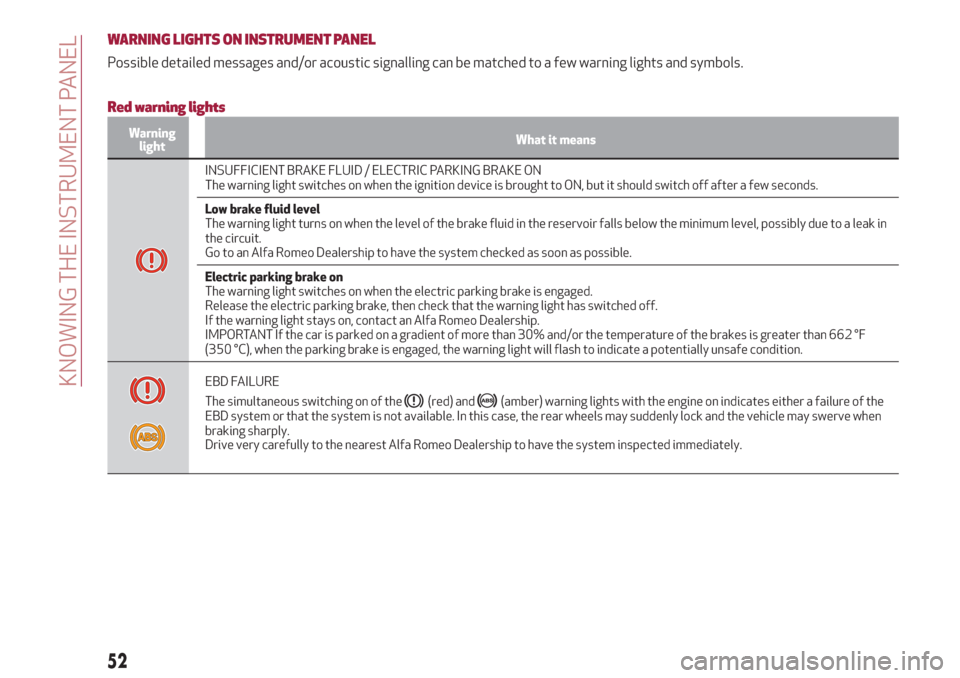
WARNING LIGHTS ON INSTRUMENT PANEL
Possible detailed messages and/or acoustic signalling can be matched to a few warning lights and symbols.
Red warning lights
Warning
lightWhat it means
INSUFFICIENT BRAKE FLUID / ELECTRIC PARKING BRAKE ON
The warning light switches on when the ignition device is brought to ON, but it should switch off after a few seconds.
Low brake fluid level
The warning light turns on when the level of the brake fluid in the reservoir falls below the minimum level, possibly due to a leak in
the circuit.
Go to an Alfa Romeo Dealership to have the system checked as soon as possible.
Electric parking brake on
The warning light switches on when the electric parking brake is engaged.
Release the electric parking brake, then check that the warning light has switched off.
If the warning light stays on, contact an Alfa Romeo Dealership.
IMPORTANT If the car is parked on a gradient of more than 30% and/or the temperature of the brakes is greater than 662 °F
(350 °C), when the parking brake is engaged, the warning light will flash to indicate a potentially unsafe condition.
EBD FAILURE
The simultaneous switching on of the
(red) and(amber) warning lights with the engine on indicates either a failure of the
EBD system or that the system is not available. In this case, the rear wheels may suddenly lock and the vehicle may swerve when
braking sharply.
Drive very carefully to the nearest Alfa Romeo Dealership to have the system inspected immediately.
52
KNOWING THE INSTRUMENT PANEL
Page 56 of 232
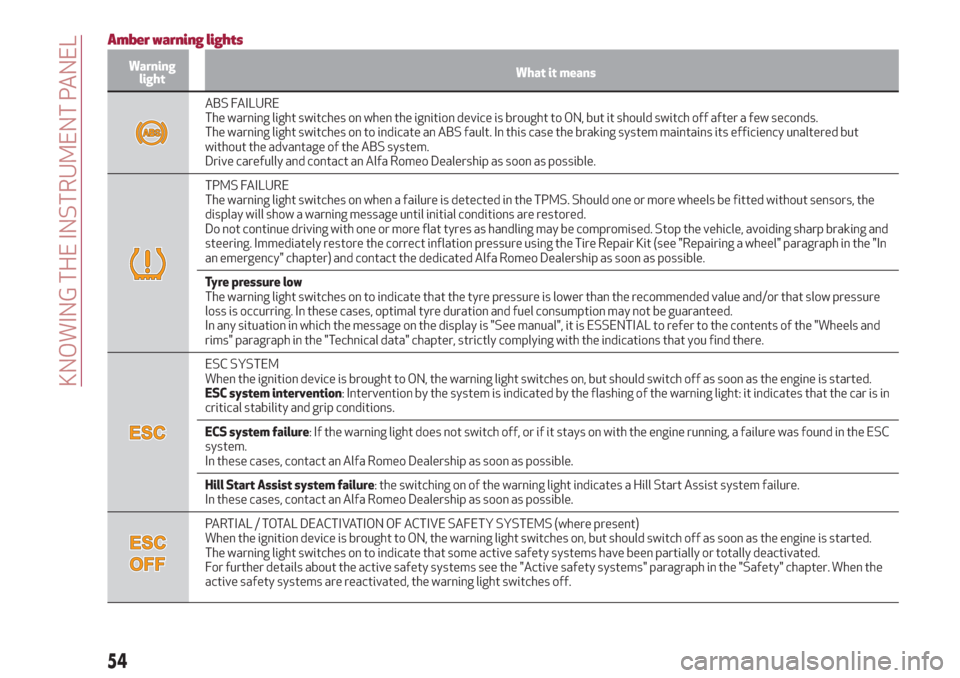
Amber warning lights
Warning
lightWhat it means
ABS FAILURE
The warning light switches on when the ignition device is brought to ON, but it should switch off after a few seconds.
The warning light switches on to indicate an ABS fault. In this case the braking system maintains its efficiency unaltered but
without the advantage of the ABS system.
Drive carefully and contact an Alfa Romeo Dealership as soon as possible.
TPMS FAILURE
The warning light switches on when a failure is detected in the TPMS. Should one or more wheels be fitted without sensors, the
display will show a warning message until initial conditions are restored.
Do not continue driving with one or more flat tyres as handling may be compromised. Stop the vehicle, avoiding sharp braking and
steering. Immediately restore the correct inflation pressure using the Tire Repair Kit (see "Repairing a wheel" paragraph in the "In
an emergency" chapter) and contact the dedicated Alfa Romeo Dealership as soon as possible.
Tyre pressure low
The warning light switches on to indicate that the tyre pressure is lower than the recommended value and/or that slow pressure
loss is occurring. In these cases, optimal tyre duration and fuel consumption may not be guaranteed.
In any situation in which the message on the display is "See manual", it is ESSENTIAL to refer to the contents of the "Wheels and
rims" paragraph in the "Technical data" chapter, strictly complying with the indications that you find there.
ESC SYSTEM
When the ignition device is brought to ON, the warning light switches on, but should switch off as soon as the engine is started.
ESC system intervention: Intervention by the system is indicated by the flashing of the warning light: it indicates that the car is in
critical stability and grip conditions.
ECS system failure: If the warning light does not switch off, or if it stays on with the engine running, a failure was found in the ESC
system.
In these cases, contact an Alfa Romeo Dealership as soon as possible.
Hill Start Assist system failure: the switching on of the warning light indicates a Hill Start Assist system failure.
In these cases, contact an Alfa Romeo Dealership as soon as possible.
PARTIAL / TOTAL DEACTIVATION OF ACTIVE SAFETY SYSTEMS (where present)
When the ignition device is brought to ON, the warning light switches on, but should switch off as soon as the engine is started.
The warning light switches on to indicate that some active safety systems have been partially or totally deactivated.
For further details about the active safety systems see the "Active safety systems" paragraph in the "Safety" chapter. When the
active safety systems are reactivated, the warning light switches off.
54
KNOWING THE INSTRUMENT PANEL
Page 59 of 232
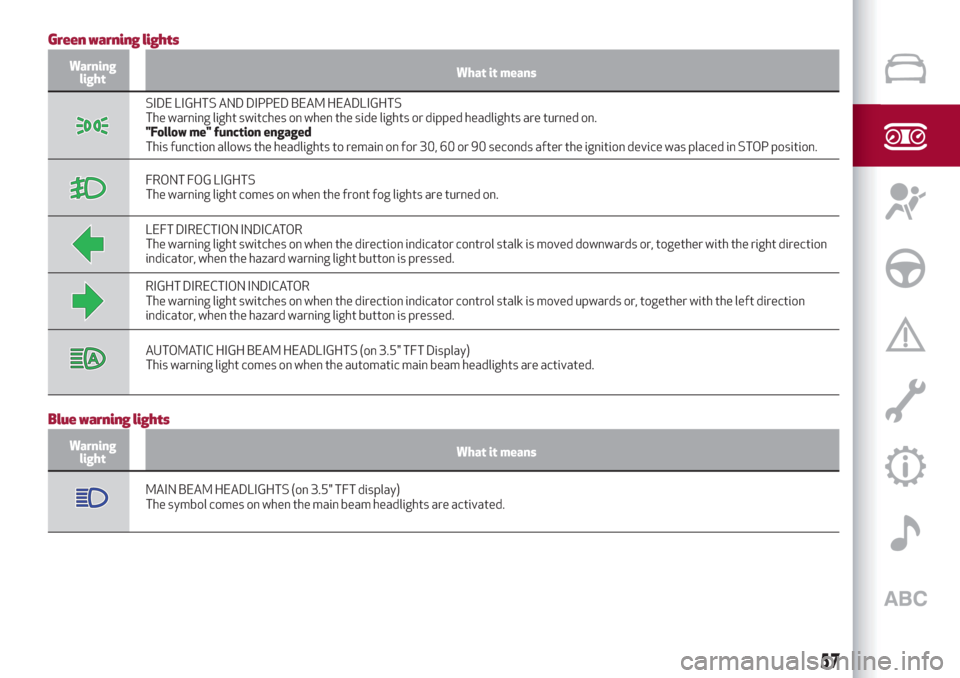
Green warning lights
Warning
lightWhat it means
SIDE LIGHTS AND DIPPED BEAM HEADLIGHTS
The warning light switches on when the side lights or dipped headlights are turned on.
"Follow me" function engaged
This function allows the headlights to remain on for 30, 60 or 90 seconds after the ignition device was placed in STOP position.
FRONT FOG LIGHTS
The warning light comes on when the front fog lights are turned on.
LEFT DIRECTION INDICATOR
The warning light switches on when the direction indicator control stalk is moved downwards or, together with the right direction
indicator, when the hazard warning light button is pressed.
RIGHT DIRECTION INDICATOR
The warning light switches on when the direction indicator control stalk is moved upwards or, together with the left direction
indicator, when the hazard warning light button is pressed.
AUTOMATIC HIGH BEAM HEADLIGHTS (on 3.5" TFT Display)
This warning light comes on when the automatic main beam headlights are activated.
Blue warning lights
Warning
lightWhat it means
MAIN BEAM HEADLIGHTS (on 3.5" TFT display)
The symbol comes on when the main beam headlights are activated.
57
Page 61 of 232
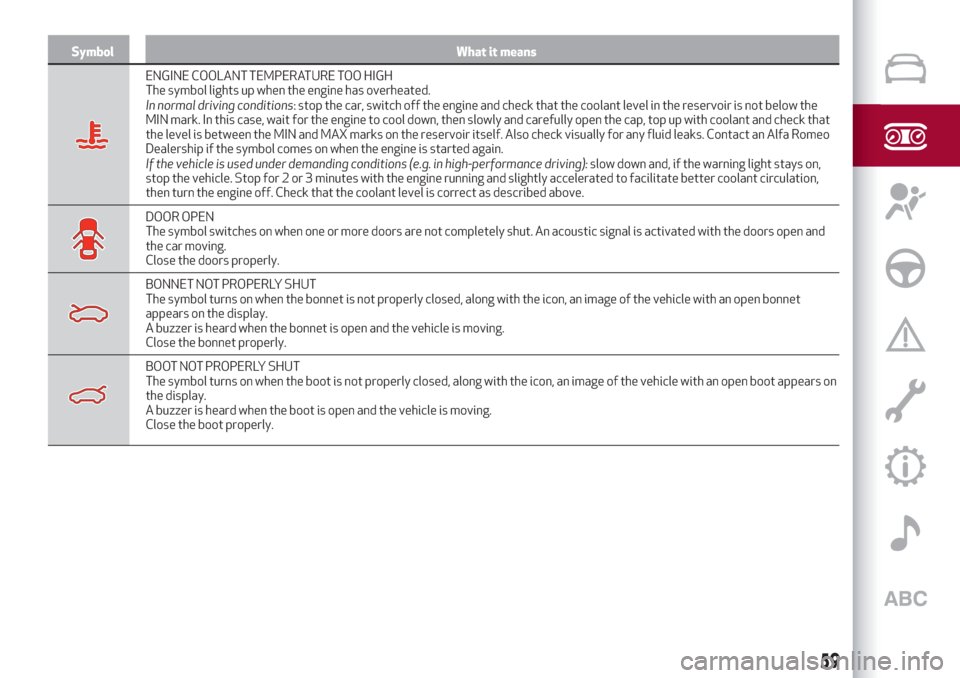
Symbol What it means
ENGINE COOLANT TEMPERATURE TOO HIGH
The symbol lights up when the engine has overheated.
In normal driving conditions: stop the car, switch off the engine and check that the coolant level in the reservoir is not below the
MIN mark. In this case, wait for the engine to cool down, then slowly and carefully open the cap, top up with coolant and check that
the level is between the MIN and MAX marks on the reservoir itself. Also check visually for any fluid leaks. Contact an Alfa Romeo
Dealership if the symbol comes on when the engine is started again.
If the vehicle is used under demanding conditions (e.g. in high-performance driving):slow down and, if the warning light stays on,
stop the vehicle. Stop for 2 or 3 minutes with the engine running and slightly accelerated to facilitate better coolant circulation,
then turn the engine off. Check that the coolant level is correct as described above.
DOOR OPEN
The symbol switches on when one or more doors are not completely shut. An acoustic signal is activated with the doors open and
the car moving.
Close the doors properly.
BONNET NOT PROPERLY SHUT
The symbol turns on when the bonnet is not properly closed, along with the icon, an image of the vehicle with an open bonnet
appears on the display.
A buzzer is heard when the bonnet is open and the vehicle is moving.
Close the bonnet properly.
BOOT NOT PROPERLY SHUT
The symbol turns on when the boot is not properly closed, along with the icon, an image of the vehicle with an open boot appears on
the display.
A buzzer is heard when the boot is open and the vehicle is moving.
Close the boot properly.
59
Page 65 of 232
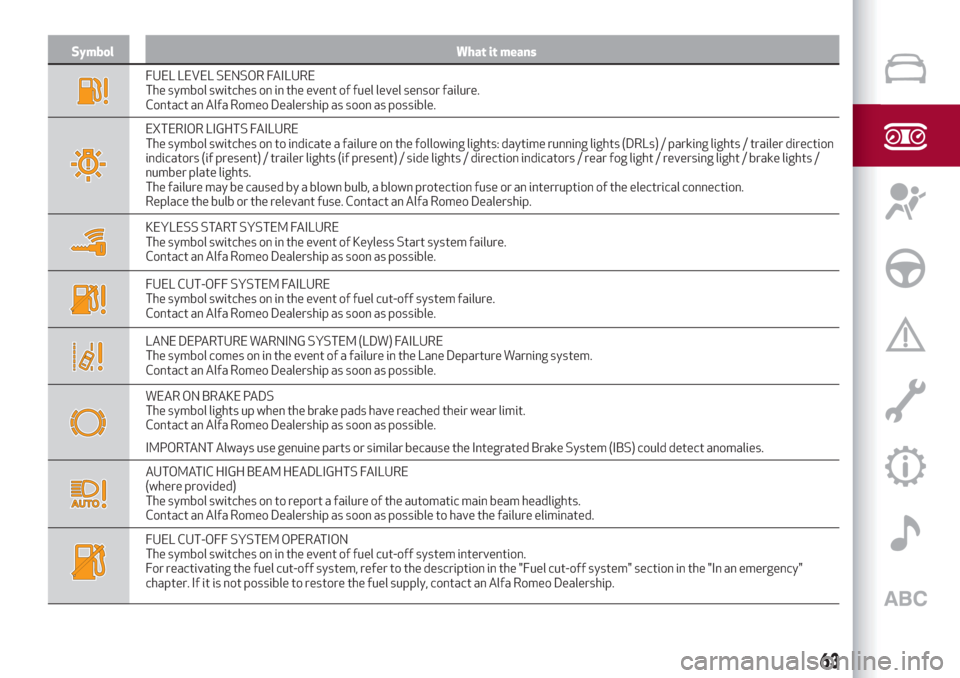
Symbol What it means
FUEL LEVEL SENSOR FAILURE
The symbol switches on in the event of fuel level sensor failure.
Contact an Alfa Romeo Dealership as soon as possible.
EXTERIOR LIGHTS FAILURE
The symbol switches on to indicate a failure on the following lights: daytime running lights (DRLs) / parking lights / trailer direction
indicators (if present) / trailer lights (if present) / side lights / direction indicators / rear fog light / reversing light / brake lights /
number plate lights.
The failure may be caused by a blown bulb, a blown protection fuse or an interruption of the electrical connection.
Replace the bulb or the relevant fuse. Contact an Alfa Romeo Dealership.
KEYLESS START SYSTEM FAILURE
The symbol switches on in the event of Keyless Start system failure.
Contact an Alfa Romeo Dealership as soon as possible.
FUEL CUT-OFF SYSTEM FAILURE
The symbol switches on in the event of fuel cut-off system failure.
Contact an Alfa Romeo Dealership as soon as possible.
LANE DEPARTURE WARNING SYSTEM (LDW) FAILURE
The symbol comes on in the event of a failure in the Lane Departure Warning system.
Contact an Alfa Romeo Dealership as soon as possible.
WEAR ON BRAKE PADS
The symbol lights up when the brake pads have reached their wear limit.
Contact an Alfa Romeo Dealership as soon as possible.
IMPORTANT Always use genuine parts or similar because the Integrated Brake System (IBS) could detect anomalies.
AUTOMATIC HIGH BEAM HEADLIGHTS FAILURE
(where provided)
The symbol switches on to report a failure of the automatic main beam headlights.
Contact an Alfa Romeo Dealership as soon as possible to have the failure eliminated.
FUEL CUT-OFF SYSTEM OPERATION
The symbol switches on in the event of fuel cut-off system intervention.
For reactivating the fuel cut-off system, refer to the description in the "Fuel cut-off system" section in the "In an emergency"
chapter. If it is not possible to restore the fuel supply, contact an Alfa Romeo Dealership.
63
Page 67 of 232
Symbol What it means
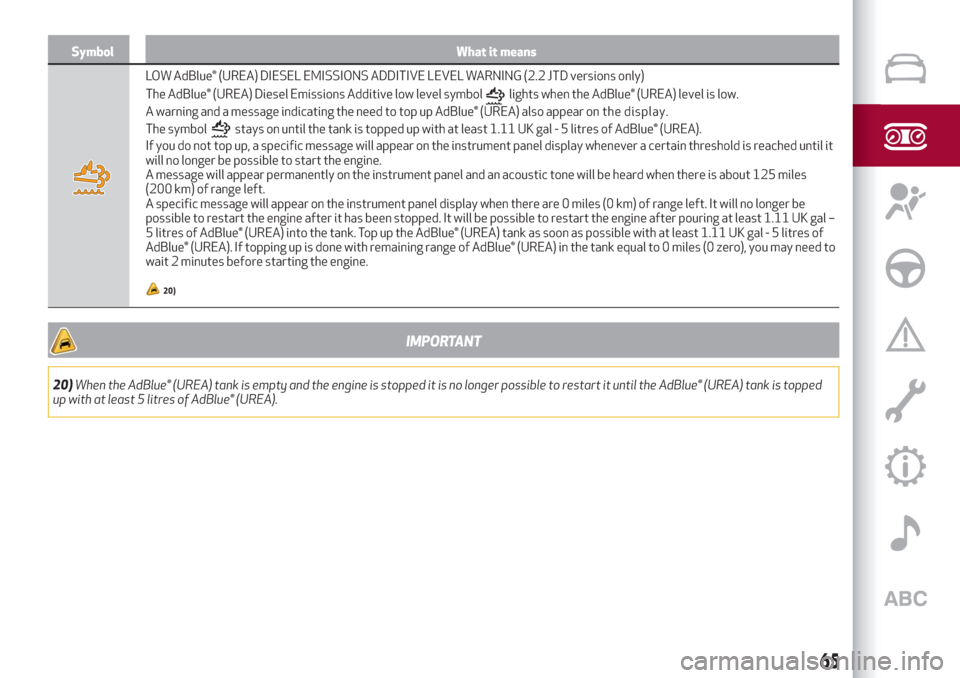
LOW AdBlue® (UREA) DIESEL EMISSIONS ADDITIVE LEVEL WARNING (2.2 JTD versions only)
The AdBlue® (UREA) Diesel Emissions Additive low level symbol
A warning and a message indicating the need to top up AdBlue® (UREA) also appear on the display.
The symbol
stays on until the tank is topped up with at least 1.11 UK gal - 5 litres of AdBlue® (UREA).
If you do not top up, a specific message will appear on the instrument panel display whenever a certain threshold is reached until it
will no longer be possible to start the engine.
A message will appear permanently on the instrument panel and an acoustic tone will be heard when there is about 125 miles
(200 km) of range left.
A specific message will appear on the instrument panel display when there are 0 miles (0 km) of range left. It will no longer be
possible to restart the engine after it has been stopped. It will be possible to restart the engine after pouring at least 1.11 UK gal –
5 litres of AdBlue® (UREA) into the tank. Top up the AdBlue® (UREA) tank as soon as possible with at least 1.11 UK gal - 5 litres of
AdBlue® (UREA). If topping up is done with remaining range of AdBlue® (UREA) in the tank equal to 0 miles (0 zero), you may need to
wait 2 minutes before starting the engine.
20)
IMPORTANT
20)When the AdBlue® (UREA) tank is empty and the engine is stopped it is no longer possible to restart it until the AdBlue® (UREA) tank is topped
up with at least 5 litres of AdBlue® (UREA).
65
lights when the AdBlue® (UREA) level is low.
Page 69 of 232
Symbol What it means
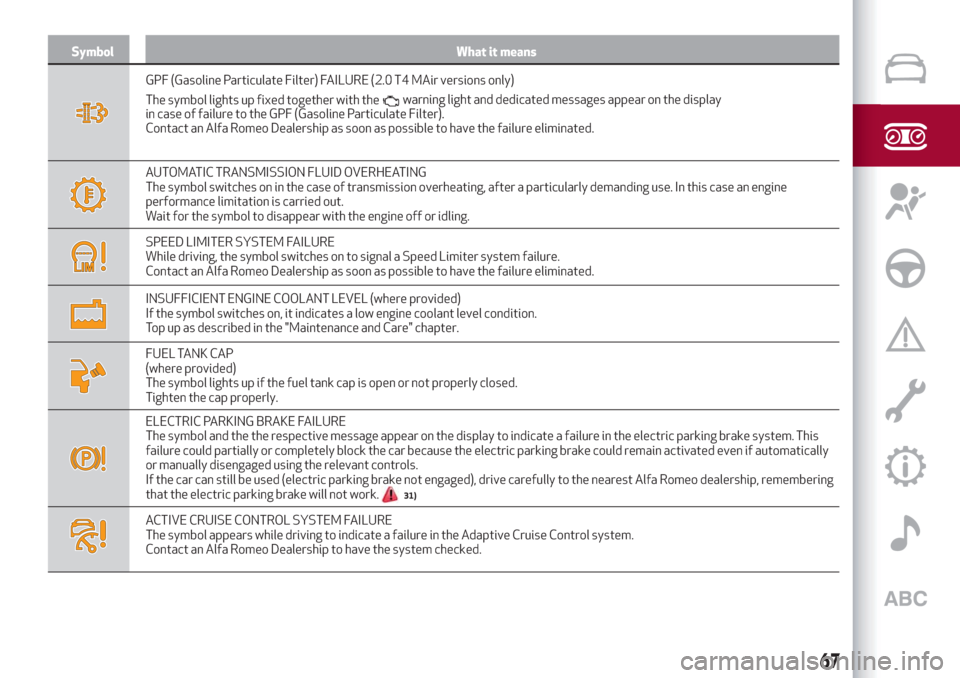
GPF (Gasoline Particulate Filter) FAILURE (2.0 T4 MAir versions only)
The symbol lights up fixed together with the
in case of failure to the GPF (Gasoline Particulate Filter).
Contact an Alfa Romeo Dealership as soon as possible to have the failure eliminated.
AUTOMATIC TRANSMISSION FLUID OVERHEATING
The symbol switches on in the case of transmission overheating, after a particularly demanding use. In this case an engine
performance limitation is carried out.
Wait for the symbol to disappear with the engine off or idling.
SPEED LIMITER SYSTEM FAILURE
While driving, the symbol switches on to signal a Speed Limiter system failure.
Contact an Alfa Romeo Dealership as soon as possible to have the failure eliminated.
INSUFFICIENT ENGINE COOLANT LEVEL (where provided)
If the symbol switches on, it indicates a low engine coolant level condition.
Top up as described in the "Maintenance and Care" chapter.
FUEL TANK CAP
(where provided)
The symbol lights up if the fuel tank cap is open or not properly closed.
Tighten the cap properly.
ELECTRIC PARKING BRAKE FAILURE
The symbol and the the respective message appear on the display to indicate a failure in the electric parking brake system. This
failure could partially or completely block the car because the electric parking brake could remain activated even if automatically
or manually disengaged using the relevant controls.
If the car can still be used (electric parking brake not engaged), drive carefully to the nearest Alfa Romeo dealership, remembering
that the electric parking brake will not work.
31)
ACTIVE CRUISE CONTROL SYSTEM FAILURE
The symbol appears while driving to indicate a failure in the Adaptive Cruise Control system.
Contact an Alfa Romeo Dealership to have the system checked.
67
warning light and dedicated messages appear on the display
Page 78 of 232
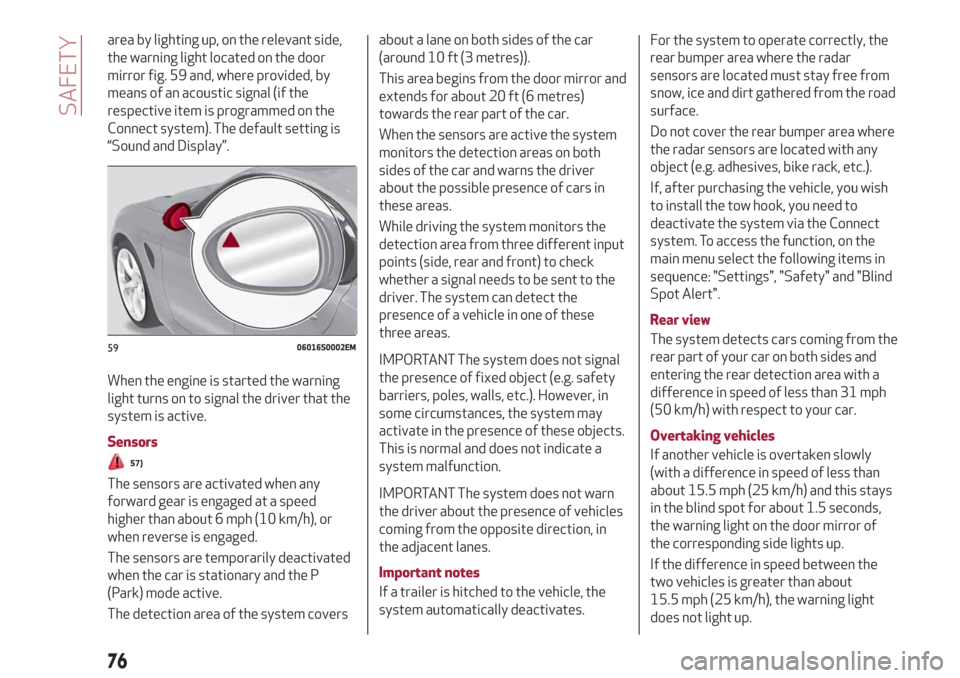
area by lighting up, on the relevant side,
the warning light located on the door
mirror fig. 59 and, where provided, by
means of an acoustic signal (if the
respective item is programmed on the
Connect system). The default setting is
“Sound and Display”.
When the engine is started the warning
light turns on to signal the driver that the
system is active.
Sensors
57)
The sensors are activated when any
forward gear is engaged at a speed
higher than about 6 mph (10 km/h), or
when reverse is engaged.
The sensors are temporarily deactivated
when the car is stationary and the P
(Park) mode active.
The detection area of the system coversabout a lane on both sides of the car
(around 10 ft (3 metres)).
This area begins from the door mirror and
extends for about 20 ft (6 metres)
towards the rear part of the car.
When the sensors are active the system
monitors the detection areas on both
sides of the car and warns the driver
about the possible presence of cars in
these areas.
While driving the system monitors the
detection area from three different input
points (side, rear and front) to check
whether a signal needs to be sent to the
driver. The system can detect the
presence of a vehicle in one of these
three areas.
IMPORTANT The system does not signal
the presence of fixed object (e.g. safety
barriers, poles, walls, etc.). However, in
some circumstances, the system may
activate in the presence of these objects.
This is normal and does not indicate a
system malfunction.
IMPORTANT The system does not warn
the driver about the presence of vehicles
coming from the opposite direction, in
the adjacent lanes.
Important notes
If a trailer is hitched to the vehicle, the
system automatically deactivates.For the system to operate correctly, the
rear bumper area where the radar
sensors are located must stay free from
snow, ice and dirt gathered from the road
surface.
Do not cover the rear bumper area where
the radar sensors are located with any
object (e.g. adhesives, bike rack, etc.).
If, after purchasing the vehicle, you wish
to install the tow hook, you need to
deactivate the system via the Connect
system. To access the function, on the
main menu select the following items in
sequence: "Settings", "Safety" and "Blind
Spot Alert".
Rear view
The system detects cars coming from the
rear part of your car on both sides and
entering the rear detection area with a
difference in speed of less than 31 mph
(50 km/h) with respect to your car.
Overtaking vehicles
If another vehicle is overtaken slowly
(with a difference in speed of less than
about 15.5 mph (25 km/h) and this stays
in the blind spot for about 1.5 seconds,
the warning light on the door mirror of
the corresponding side lights up.
If the difference in speed between the
two vehicles is greater than about
15.5 mph (25 km/h), the warning light
does not light up.
5906016S0002EM
76
SAFETY
Page 83 of 232
Lane change by other vehicles
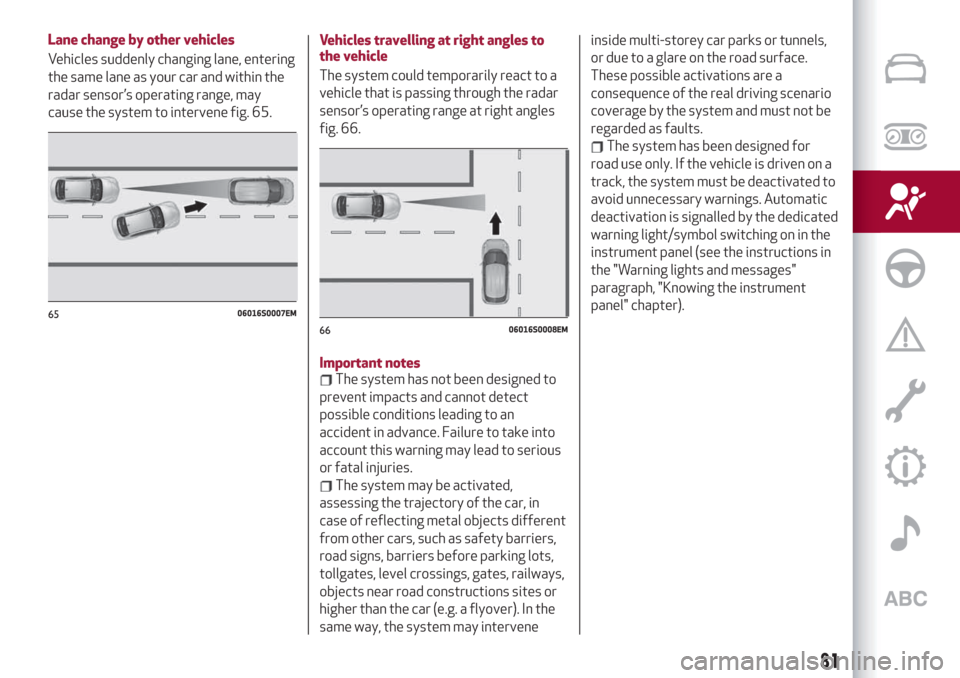
Vehicles suddenly changing lane, entering
the same lane as your car and within the
radar sensor’s operating range, may
cause the system to intervene fig. 65.Vehicles travelling at right angles to
the vehicle
The system could temporarily react to a
vehicle that is passing through the radar
sensor’s operating range at right angles
fig. 66.
Important notes
The system has not been designed to
prevent impacts and cannot detect
possible conditions leading to an
accident in advance. Failure to take into
account this warning may lead to serious
or fatal injuries.
The system may be activated,
assessing the trajectory of the car, in
case of reflecting metal objects different
from other cars, such as safety barriers,
road signs, barriers before parking lots,
tollgates, level crossings, gates, railways,
objects near road constructions sites or
higher than the car (e.g. a flyover). In the
same way, the system may interveneinside multi-storey car parks or tunnels,
or due to a glare on the road surface.
These possible activations are a
consequence of the real driving scenario
coverage by the system and must not be
regarded as faults.
The system has been designed for
road use only. If the vehicle is driven on a
track, the system must be deactivated to
avoid unnecessary warnings. Automatic
deactivation is signalled by the dedicated
warning light/symbol switching on in the
instrument panel (see the instructions in
the "Warning lights and messages"
paragraph, "Knowing the instrument
panel" chapter).
6506016S0007EM
6606016S0008EM
81
Page 85 of 232
the sensors. Using aftermarket tyre
sealants may damage the Tyre Pressure
Monitoring System (TPMS) sensor. If
aftermarket tyre sealant is used it is
recommended to go to an Alfa Romeo
Dealership to have the sensors checked.
After checking or adjusting the tyre
inflation pressure, always refit the valve
cap to prevent humidity and dirt from
entering, these may damage the Tyre
Pressure Monitoring System sensor.
LOW TYRE PRESSURE WARNING
If an insufficient pressure value is
detected on one or more tyres, the
warning light on the instrument panel
switches on and the dedicated messages
are shown on the display. The system also
highlights the tyre or tyres with
insufficient pressure graphically. An
acoustic warning is also emitted.
In this case, stop the car, check the
inflation pressure of each tyre and inflate
them to the correct cold inflation
pressure value, shown on the display or in
the dedicated TPMS menu.TPMS TEMPORARILY DISABLED
TPMS check message
If a system failure is present, the
warning light flashes for about
75 seconds and then stays on solid. An
acoustic warning is also emitted.
A dedicated message and dashes "– –"
instead of the pressure value are shown
on the display, to indicate that detection
is impossible.
When the ignition device is set to STOP
and then back to ON, the indication
sequence repeats provided that the
failure is still resent.
The
warning light switches off when
the failure condition disappears and the
pressure value is displayed again in place
of the dashes.
A fault in the system could occur in the
following cases:
intense radio-frequency interference
may prevent the correct operation of the
TPMS. This condition will be indicated by
a dedicated message on the display. The
warning will disappear automatically as
soon as the radio-frequency interference
ceases to affect the system;
aftermarket application of coloured
films on the windows that interfere with
the radio waves emitted by the TPMS;
accumulation of layers of snow or ice
on the wheels or the wheel arches;
using snow chains;
using a rim/tyre assembly without
sensors for the TPMS system.
After the punctured tyre has been
repaired with the original tyre sealant
contained in the TireKit, the previous
condition must be restored, so that the
warning light is off during normal
driving.
Deactivating TPMS messages
(for markets where provided)
When replacing the standard wheels with
others that do not have TPMS sensors
(for example when substituting the
rim/tyre assembly for the winter season)
and depending on the country of sale, the
messages only can be disabled
automatically at the next start-up after
the fault.
The TPMS will emit an acoustic warning,
the
warning light will flash for about
75 seconds, then it will stay on
continuously and the instrument panel
will display the "TPMS check" message
with dashes (– –) instead of the pressure
values on the Connect system display.
From the following ignition cycle, the
TPMS will not emit any acoustic warning
and the display will not show the
message "TPMS check", but the dashes
will be still displayed instead of the
pressure value.
The system will only resume normal
83