light Alfa Romeo Giulia 2019 Repair Manual
[x] Cancel search | Manufacturer: ALFA ROMEO, Model Year: 2019, Model line: Giulia, Model: Alfa Romeo Giulia 2019Pages: 232, PDF Size: 4.87 MB
Page 118 of 232
Steering wheel stalks
(where provided)
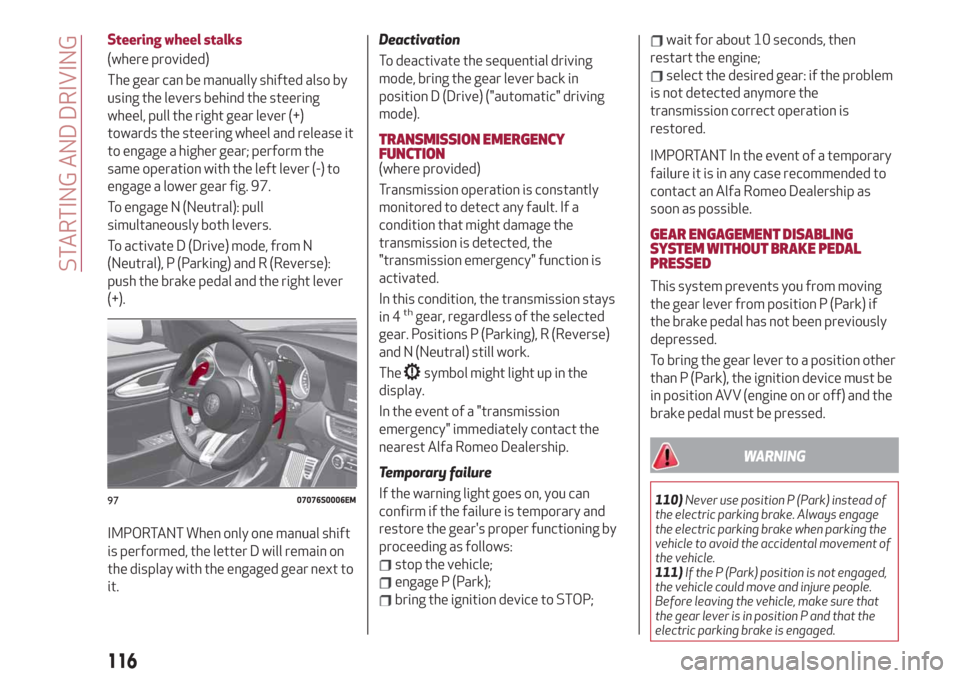
The gear can be manually shifted also by
using the levers behind the steering
wheel, pull the right gear lever (+)
towards the steering wheel and release it
to engage a higher gear; perform the
same operation with the left lever (-) to
engage a lower gear fig. 97.
To engage N (Neutral): pull
simultaneously both levers.
To activate D (Drive) mode, from N
(Neutral), P (Parking) and R (Reverse):
push the brake pedal and the right lever
(+).
IMPORTANT When only one manual shift
is performed, the letter D will remain on
the display with the engaged gear next to
it.
Deactivation
To deactivate the sequential driving
mode, bring the gear lever back in
position D (Drive) ("automatic" driving
mode).
TRANSMISSION EMERGENCY
FUNCTION
(where provided)
Transmission operation is constantly
monitored to detect any fault. If a
condition that might damage the
transmission is detected, the
"transmission emergency" function is
activated.
In this condition, the transmission stays
in 4
thgear, regardless of the selected
gear. Positions P (Parking), R (Reverse)
and N (Neutral) still work.
The
symbol might light up in the
display.
In the event of a "transmission
emergency" immediately contact the
nearest Alfa Romeo Dealership.
Temporary failure
If the warning light goes on, you can
confirm if the failure is temporary and
restore the gear's proper functioning by
proceeding as follows:
stop the vehicle;
engage P (Park);
bring the ignition device to STOP;
wait for about 10 seconds, then
restart the engine;
select the desired gear: if the problem
is not detected anymore the
transmission correct operation is
restored.
IMPORTANT In the event of a temporary
failure it is in any case recommended to
contact an Alfa Romeo Dealership as
soon as possible.
GEAR ENGAGEMENT DISABLING
SYSTEM WITHOUT BRAKE PEDAL
PRESSED
This system prevents you from moving
the gear lever from position P (Park) if
the brake pedal has not been previously
depressed.
To bring the gear lever to a position other
than P (Park), the ignition device must be
in position AVV (engine on or off) and the
brake pedal must be pressed.
WARNING
110)Never use position P (Park) instead of
the electric parking brake. Always engage
the electric parking brake when parking the
vehicle to avoid the accidental movement of
the vehicle.
111)If the P (Park) position is not engaged,
the vehicle could move and injure people.
Before leaving the vehicle, make sure that
the gear lever is in position P and that the
electric parking brake is engaged.9707076S0006EM
116
STARTING AND DRIVING
Page 119 of 232
112)Do not shift the gear lever to N
(Neutral) and do not stop the engine when
driving on a downhill road. This type of
driving is dangerous and reduces the
possibility of intervening in the case of
variation of the road traffic or surface. You
risk losing control of your vehicle and
causing accidents.
IMPORTANT
38)Before selecting P (Park) mode, bring the
ignition device to position ON and press the
brake pedal. Otherwise, the gear lever may
get damaged.
39)Engage reverse only with the car
stationary, engine at idling speed and
accelerator fully released.
"ALFA DNA™"SYSTEM
"ALFA DNA™"SYSTEM
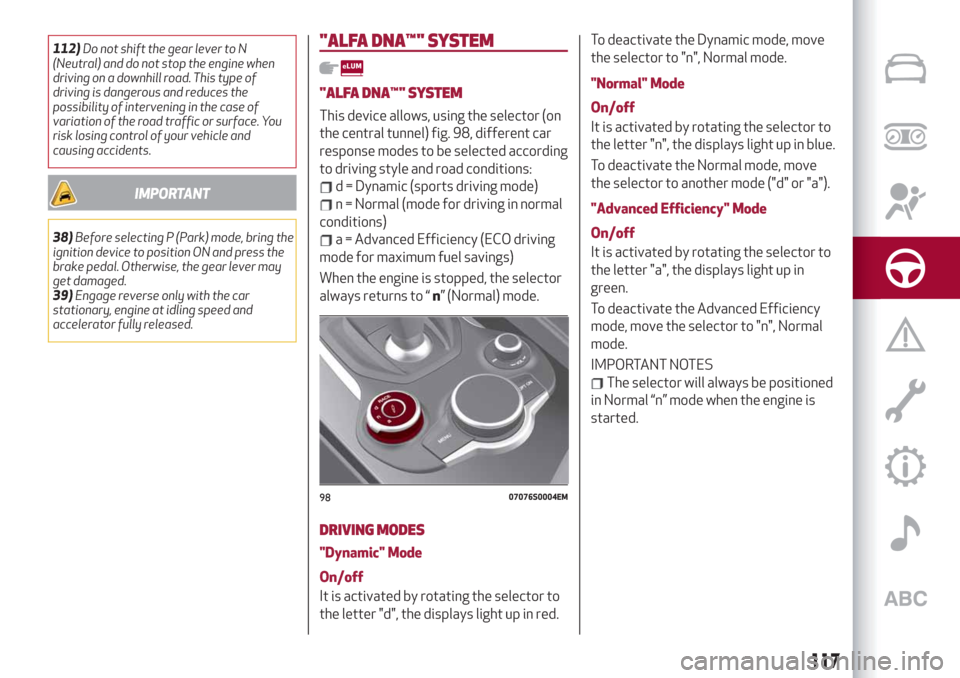
This device allows, using the selector (on
the central tunnel) fig. 98, different car
response modes to be selected according
to driving style and road conditions:
d = Dynamic (sports driving mode)
n = Normal (mode for driving in normal
conditions)
a = Advanced Efficiency (ECO driving
mode for maximum fuel savings)
When the engine is stopped, the selector
always returns to “n” (Normal) mode.
DRIVING MODES
"Dynamic" Mode
On/off
It is activated by rotating the selector to
the letter "d", the displays light up in red.To deactivate the Dynamic mode, move
the selector to "n", Normal mode.
"Normal" Mode
On/off
It is activated by rotating the selector to
the letter "n", the displays light up in blue.
To deactivate the Normal mode, move
the selector to another mode ("d" or "a").
"Advanced Efficiency" Mode
On/off
It is activated by rotating the selector to
the letter "a", the displays light up in
green.
To deactivate the Advanced Efficiency
mode, move the selector to "n", Normal
mode.
IMPORTANT NOTES
The selector will always be positioned
in Normal “n” mode when the engine is
started.
9807076S0004EM
117
Page 120 of 232
START & STOP EVO
The Start & Stop Evo system
automatically stops the engine each time
the vehicle is stationary and starts it
again when the driver wants to move off.
In this way, the vehicle efficiency is
increased, by reducing consumption,
dangerous gas emissions and sound
pollution.
OPERATING MODE
Stopping the engine
Versions with manual transmission
With the car stopped, the engine stops
with gearbox in neutral and clutch pedal
released.
Versions with automatic transmission
With car at a standstill and brake pedal
pressed, the engine switches off if the
gear lever is in a position other than R.
The system does not operate when the
gear lever is in R, for making parking
manoeuvres easier.
In the event of stops uphill, engine
switching off is disabled to make the "Hill
Start Assist" function available (works
only with running engine).
NOTE The engine can only be
automatically stopped after having run at
about 6.2 mph (10 km/h). After anautomatic restart, to stop the engine you
only need to move the car (exceed a
speed of 0.3 mph (0.5 km/h).
Engine stopping is signalled by the
symbol lighting up on the instrument
panel display.
Restarting the engine
Versions with manual transmission
To restart the engine, press the clutch
pedal.
If the car does not start when the clutch
is pressed, place the gear lever in neutral
and repeat the procedure. If the problem
persists, contact an Alfa Romeo
Dealership.
Versions with automatic transmission
To restart the engine, release the brake
pedal.
With the brake pressed and the
transmission in automatic mode D
(Drive), the engine will restart by shifting
to R (Reverse gear), for petrol engine
versions only, to "AutoStick".
With brake pressed, also for versions
with petrol engines, if the gear lever is in
"AutoStick" mode, the engine can be
restarted by moving the lever to + or -.
SYSTEM MANUAL ACTIVATION/
DEACTIVATION
113)
40)
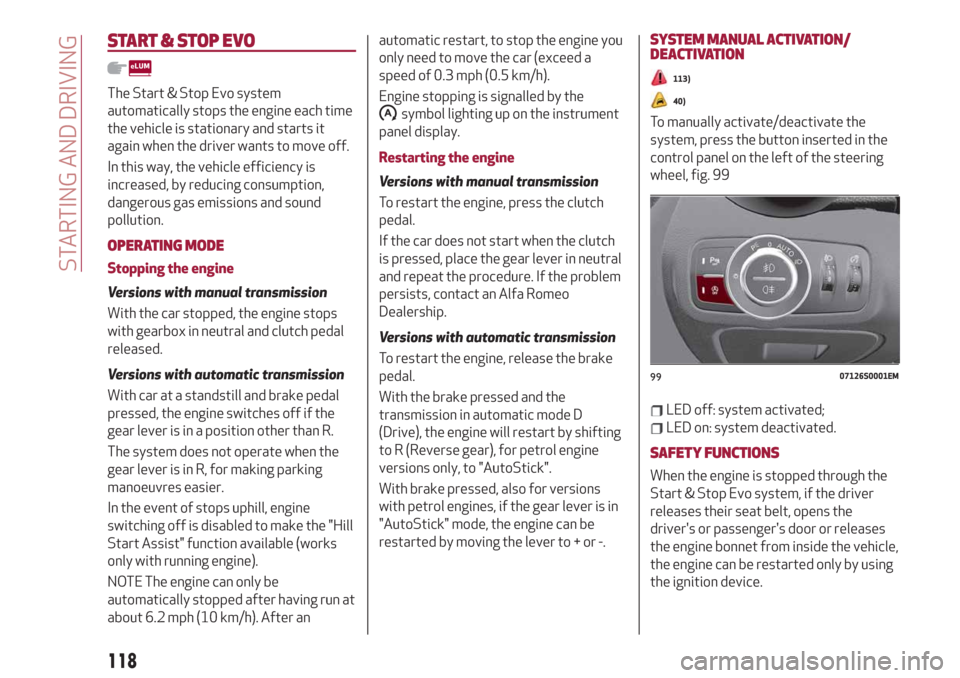
To manually activate/deactivate the
system, press the button inserted in the
control panel on the left of the steering
wheel, fig. 99
LED off: system activated;
LED on: system deactivated.
SAFETY FUNCTIONS
When the engine is stopped through the
Start & Stop Evo system, if the driver
releases their seat belt, opens the
driver's or passenger's door or releases
the engine bonnet from inside the vehicle,
the engine can be restarted only by using
the ignition device.
9907126S0001EM
118
STARTING AND DRIVING
Page 122 of 232
CRUISE CONTROL
This is an electronically controlled driving
assistance device that allows the desired
car speed to be maintained, without
having to press the accelerator pedal.
This device can be used at a speed above
25 mph (40 km/h) on long stretches of
dry, straight roads with few variations
(e.g. motorways).
It is therefore not recommended to use
this device on extra-urban roads with
traffic. Do not use the device in town.
Travelling downhill, the system could
brake the car to keep the set speed
unvaried.
ACTIVATING THE DEVICE
114) 115) 116)
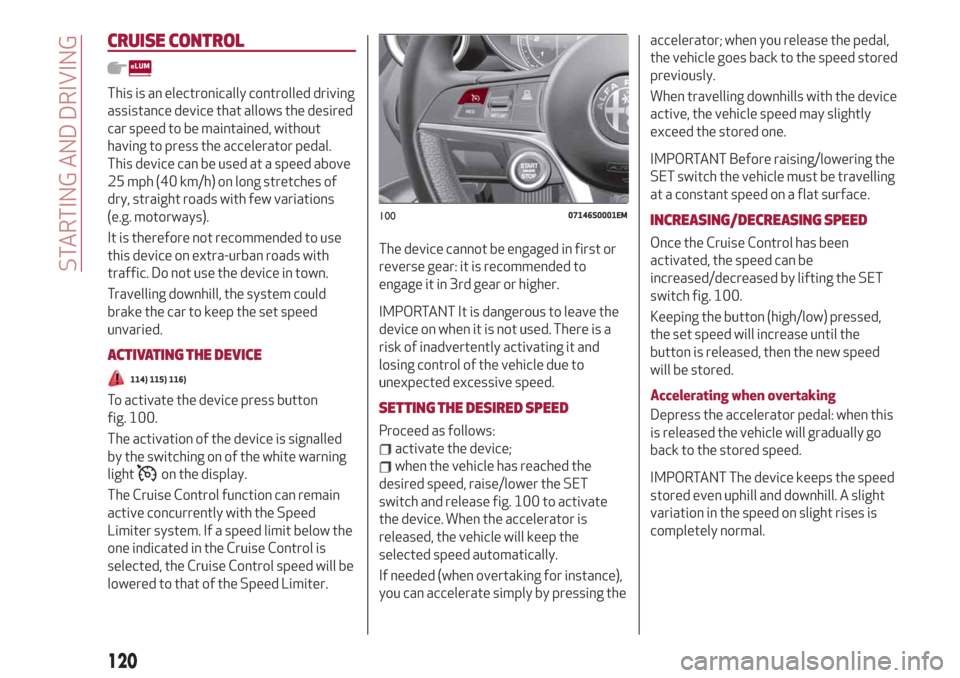
To activate the device press button
fig. 100.
The activation of the device is signalled
by the switching on of the white warning
light
on the display.
The Cruise Control function can remain
active concurrently with the Speed
Limiter system. If a speed limit below the
one indicated in the Cruise Control is
selected, the Cruise Control speed will be
lowered to that of the Speed Limiter.The device cannot be engaged in first or
reverse gear: it is recommended to
engage it in 3rd gear or higher.
IMPORTANT It is dangerous to leave the
device on when it is not used. There is a
risk of inadvertently activating it and
losing control of the vehicle due to
unexpected excessive speed.
SETTING THE DESIRED SPEED
Proceed as follows:
activate the device;
when the vehicle has reached the
desired speed, raise/lower the SET
switch and release fig. 100 to activate
the device. When the accelerator is
released, the vehicle will keep the
selected speed automatically.
If needed (when overtaking for instance),
you can accelerate simply by pressing theaccelerator; when you release the pedal,
the vehicle goes back to the speed stored
previously.
When travelling downhills with the device
active, the vehicle speed may slightly
exceed the stored one.
IMPORTANT Before raising/lowering the
SET switch the vehicle must be travelling
at a constant speed on a flat surface.
INCREASING/DECREASING SPEED
Once the Cruise Control has been
activated, the speed can be
increased/decreased by lifting the SET
switch fig. 100.
Keeping the button (high/low) pressed,
the set speed will increase until the
button is released, then the new speed
will be stored.
Accelerating when overtaking
Depress the accelerator pedal: when this
is released the vehicle will gradually go
back to the stored speed.
IMPORTANT The device keeps the speed
stored even uphill and downhill. A slight
variation in the speed on slight rises is
completely normal.
10007146S0001EM
120
STARTING AND DRIVING
Page 123 of 232
RECALLING THE SPEED
For versions with automatic transmission
operating in D mode (Drive - automatic),
press and release the RES
fig. 100 button to recall the previously
set speed.
For versions with manual gearbox or
automatic transmission in Autostick
(sequential) mode, before recalling the
previously set speed you should
accelerate until getting close to it, then
press and release the RES button.
DEACTIVATING THE DEVICE
Lightly pressing the brake pedal
deactivates the Cruise Control without
deleting the stored speed.
The Cruise Control may be deactivated
also by applying the electric parking
brake or when the braking system is
operated (e.g. operation of the ESC
system).
The stored speed is deleted in the
following cases:
pressing the on/off button or
switching off the engine;
if there is a malfunction in the Cruise
Control.
DEACTIVATING THE DEVICE
The Cruise Control is deactivated by
pressing the activation/deactivation
button or bringing the ignition device to
the STOP position.
WARNING
114)When travelling with the device active,
never move the gear lever to neutral.
115)In case of a malfunction or failure of
the device, contact an Alfa Romeo
Dealership.
116)The Cruise Control can be dangerous if
the system cannot keep a constant speed. In
specific conditions speed may be excessive,
resulting in the risk of losing control of the
vehicle and causing accidents. Do not use the
device in heavy traffic or on winding, icy,
snowy or slippery roads.
ACTIVE CRUISE CONTROL
(where provided)
117) 118) 119) 120) 121) 122)
41) 42) 43) 44) 45) 46) 47)
The Active Cruise Control (ACC) is a
driver assist device which combines the
Cruise Control functions with one for
controlling the distance from the vehicle
ahead.
The device allows to hold the vehicle at
the desired speed without needing to
press the accelerator. It also allows to
hold a given distance from the vehicle
ahead (the distance can be set by the
driver).
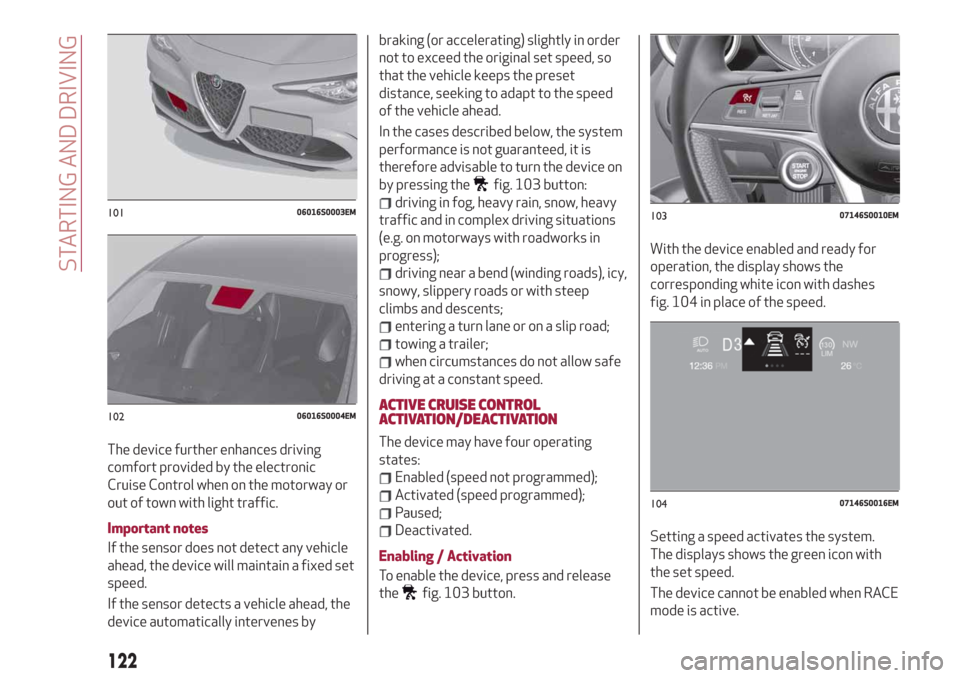
The Active Cruise Control (ACC) uses a
radar sensor, located behind the front
bumper fig. 101 and a camera, located in
the middle area of the windscreen
fig. 102, to detect the presence of a
vehicle close ahead.
121
Page 124 of 232
The device further enhances driving
comfort provided by the electronic
Cruise Control when on the motorway or
out of town with light traffic.
Important notes
If the sensor does not detect any vehicle
ahead, the device will maintain a fixed set
speed.
If the sensor detects a vehicle ahead, the
device automatically intervenes bybraking (or accelerating) slightly in order
not to exceed the original set speed, so
that the vehicle keeps the preset
distance, seeking to adapt to the speed
of the vehicle ahead.
In the cases described below, the system
performance is not guaranteed, it is
therefore advisable to turn the device on
by pressing the
fig. 103 button:
driving in fog, heavy rain, snow, heavy
traffic and in complex driving situations
(e.g. on motorways with roadworks in
progress);
driving near a bend (winding roads), icy,
snowy, slippery roads or with steep
climbs and descents;
entering a turn lane or on a slip road;
towing a trailer;
when circumstances do not allow safe
driving at a constant speed.
ACTIVE CRUISE CONTROL
ACTIVATION/DEACTIVATION
The device may have four operating
states:
Enabled (speed not programmed);
Activated (speed programmed);
Paused;
Deactivated.
Enabling / Activation
To enable the device, press and release
the
fig. 103 button.With the device enabled and ready for
operation, the display shows the
corresponding white icon with dashes
fig. 104 in place of the speed.
Setting a speed activates the system.
The displays shows the green icon with
the set speed.
The device cannot be enabled when RACE
mode is active.
10106016S0003EM
10206016S0004EM
10307146S0010EM
10407146S0016EM
122
STARTING AND DRIVING
Page 126 of 232
until the button is released, then the new
speed will be stored.
Decreasing speed
Once the device has been activated, you
can decrease the speed by lowering the
SET switch. Each time it is operated, the
speed decreases by 1 mph (1 km/h).
By holding the button down, the set
speed will decrease in steps of 6 mph
(10 km/h) until the button is released,
then the new speed will be stored.
IMPORTANT Moving the SET switch
allows you to adjust the speed according
to the selected unit of measurement
("metric" or "imperial") set on the
Connect system (see dedicated
supplement).
Important notes
By keeping the accelerator pedal
depressed, the car can continue to
accelerate beyond the set speed. In this
case, use the SET switch to set the speed
to the vehicle’s current speed.
When the SET button is pressed to
reduce the speed, the braking system
intervenes automatically if the engine
brake does not slow the car down
sufficiently to reach the set speed. The
device holds the set speed uphill and
downhill; however a slight variation is
entirely normal, particularly on slight
gradients.The automatic transmission could change
to a lower gears when driving downhill or
when accelerating. This is normal and
necessary to maintain the set speed.
The device is switched off while driving if
the brakes overheat.
ACCELERATING WHEN OVERTAKING
When driving with the device active and
following a vehicle, the device provides
additional acceleration to facilitate
overtaking, when travelling over a given
speed and switches on the left direction
indicator (of the right indicator for
right-hand drive versions).
In left-hand traffic, the overtaking assist
function is only active when the left-hand
lane is used for overtaking the vehicle
ahead (the opposite activation logic is
used in right-hand traffic countries).
The device detects the direction of
traffic automatically when the vehicle
passes from left-hand traffic to
right-hand traffic. In this case, the
overtaking assist function is only active
when the reference vehicle is overtaken
on the right. The additional acceleration
is activated when the driver uses the
right direction indicator.
In this condition, the device no longer
provides the overtaking assist function
on the left-hand side until it determinesthat the vehicle has returned to left-hand
traffic conditions.
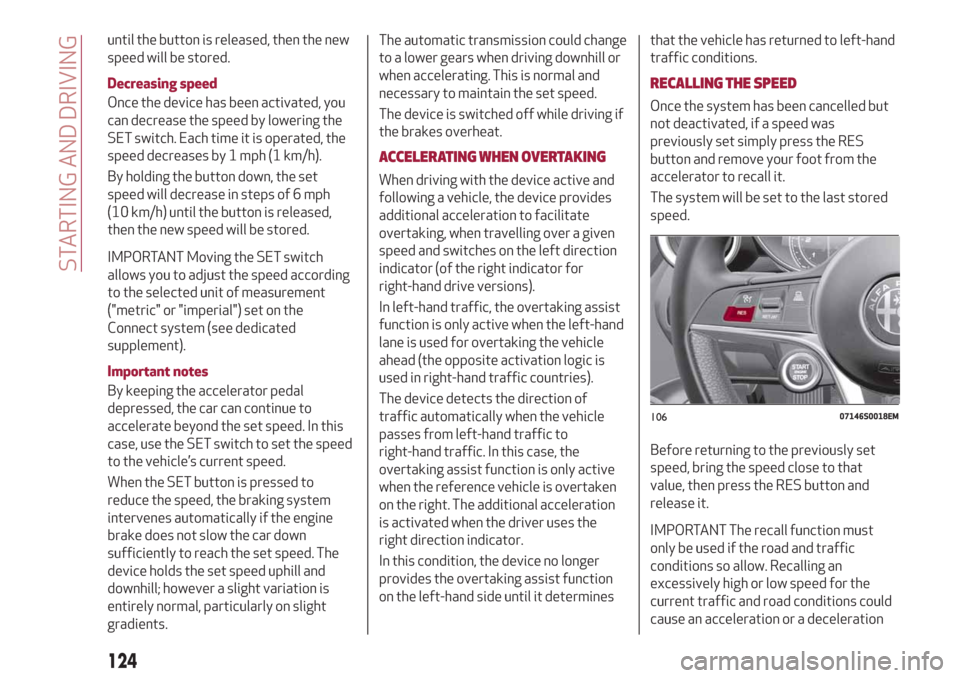
RECALLING THE SPEED
Once the system has been cancelled but
not deactivated, if a speed was
previously set simply press the RES
button and remove your foot from the
accelerator to recall it.
The system will be set to the last stored
speed.
Before returning to the previously set
speed, bring the speed close to that
value, then press the RES button and
release it.
IMPORTANT The recall function must
only be used if the road and traffic
conditions so allow. Recalling an
excessively high or low speed for the
current traffic and road conditions could
cause an acceleration or a deceleration
10607146S0018EM
124
STARTING AND DRIVING
Page 129 of 232
Small cars
Some narrow cars (e.g. bicycles and
motorcycles) travelling near the outer
edges of the lane or which enter the lane
from kerbside are not detected until they
are fully in the lane.
Sufficient distance from the cars ahead
may not be guaranteed in these cases.
Stationary objects and vehicles
The device cannot detect the presence of
stationary vehicles or objects. For
example, the device will not operate if
the vehicle ahead leaves the lane and a
vehicle ahead of that one is standing on
the lane. Pay the utmost attention at all
times and be always ready to press the
brakes if needed.
Objects and cars moving in opposite or
crosswise direction
The device cannot detect the presence of
objects or vehicles travelling in opposite
or at right-angles and consequently will
not be operated.
WARNING
117)Pay the utmost attention while driving
at all times and be always ready to press the
brakes if needed.118)The system is an aid for the driver, who
must always pay full attention while driving.
The responsibility always rests with the
driver, who must take into account the
traffic conditions in order to drive in
complete safety. The driver must always
maintain a safe distance from the vehicle in
front.
119)The device is not activated in presence
of pedestrians, oncoming vehicles in the
opposite direction of travel or moving in the
crosswise direction and stationary objects
(e.g. a vehicle standing in a queue or a broken
down vehicle).
120)The device cannot take account of
road, traffic and weather conditions, and
conditions of poor visibility (e.g. fog).
121)The device does not always fully
recognise complex driving conditions that
could cause it to determine the safe distance
to be held incorrectly or not at all.
122)The device cannot apply the maximum
braking force: the car will not be stopped
completely.
IMPORTANT
41)The system may have limited or absent
operation due to weather conditions such as:
heavy rain, hail, thick fog, heavy snow.
42)The section of the bumper before the
sensor must not be covered with adhesives,
auxiliary headlights or any other object.
43)Operation can be adversely affected by
any structural change made to the vehicle,
such as a modification to the front geometry,
tyre change, or a heavier load than the
standard load of the vehicle.44)Incorrect repairs made on the front part
of the vehicle (e.g. bumper, chassis) may alter
the position of the radar sensor, and
adversely affect its operation. Go to an Alfa
Romeo Dealership for any operation of this
type.
45)Do not tamper with nor carry out any
intervention on the radar sensor or on the
camera on the windscreen. In the event of a
sensor failure, contact an Alfa Romeo
Dealership.
46)Do not wash with high-pressure jets in
the bumper lower area: in particular do not
operate on the system's electrical connector.
47)Be careful in the case of repairs and new
paintings in the area around the sensor
(panel covering the sensor on the left side of
the bumper). In the event of a frontal impact
the sensor may automatically deactivate
and display a warning to indicate that the
sensor needs to be repaired. Even without a
malfunction warning, deactivate the system
operation if you think that the position of the
radar sensor has changed (e.g. due to
low-speed frontal impact as during parking
manoeuvres). In these cases, go to an Alfa
Romeo Dealership to have the radar sensor
realigned or replaced.
127
Page 130 of 232
PARK SENSORSSYSTEM
(where provided)
123)
48) 49) 50)
VERSIONS WITH 4/8 SENSORS
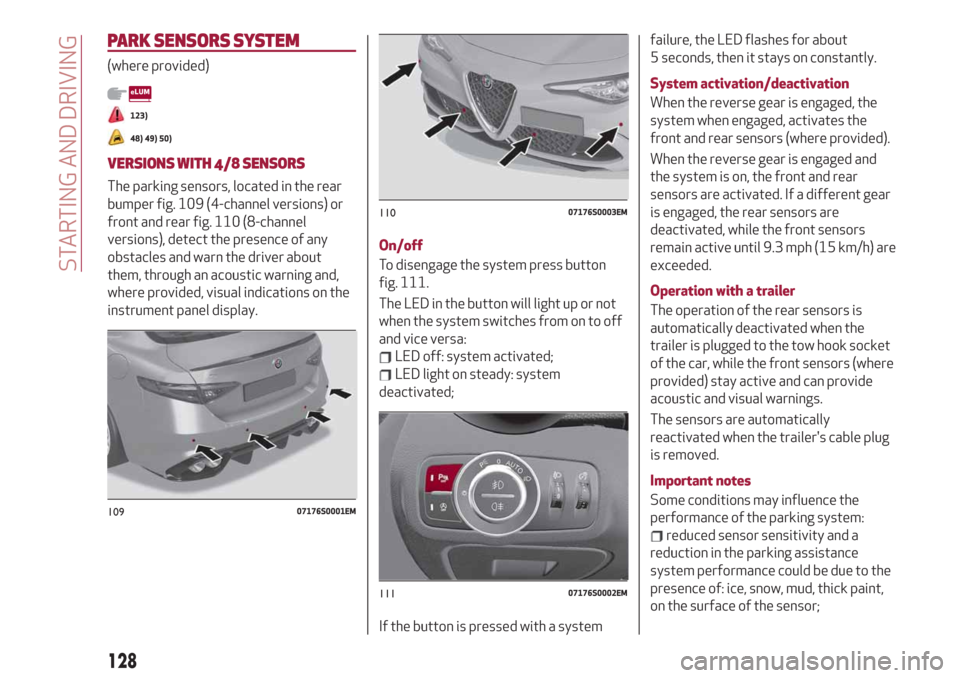
The parking sensors, located in the rear
bumper fig. 109 (4-channel versions) or
front and rear fig. 110 (8-channel
versions), detect the presence of any
obstacles and warn the driver about
them, through an acoustic warning and,
where provided, visual indications on the
instrument panel display.On/off
To disengage the system press button
fig. 111.
The LED in the button will light up or not
when the system switches from on to off
and vice versa:
LED off: system activated;
LED light on steady: system
deactivated;
If the button is pressed with a systemfailure, the LED flashes for about
5 seconds, then it stays on constantly.
System activation/deactivation
When the reverse gear is engaged, the
system when engaged, activates the
front and rear sensors (where provided).
When the reverse gear is engaged and
the system is on, the front and rear
sensors are activated. If a different gear
is engaged, the rear sensors are
deactivated, while the front sensors
remain active until 9.3 mph (15 km/h) are
exceeded.
Operation with a trailer
The operation of the rear sensors is
automatically deactivated when the
trailer is plugged to the tow hook socket
of the car, while the front sensors (where
provided) stay active and can provide
acoustic and visual warnings.
The sensors are automatically
reactivated when the trailer's cable plug
is removed.
Important notes
Some conditions may influence the
performance of the parking system:
reduced sensor sensitivity and a
reduction in the parking assistance
system performance could be due to the
presence of: ice, snow, mud, thick paint,
on the surface of the sensor;
10907176S0001EM
11007176S0003EM
11107176S0002EM
128
STARTING AND DRIVING
Page 132 of 232
LANE DEPARTURE WARNING
(LDW) SYSTEM
DESCRIPTION
51) 52) 53) 54) 55) 56)
The Lane Departure Warning system
makes use of a camera located on the
windscreen to detect the lane limits and
calculate the position of the vehicle
within such limits, in order to make sure
that it remains inside the lane.
When one or both lane limits are
detected and the vehicle passes over one
without the driver's say-so (direction
indicator not turned on), the system
emits an acoustic signal.
If the vehicle continues to go beyond the
line of the lane without any intervention
from the driver, the surpassed line will
light up on the display (left or right) to
urge the driver to bring the vehicle back
into the limits of the lane.
SYSTEM ON/OFF
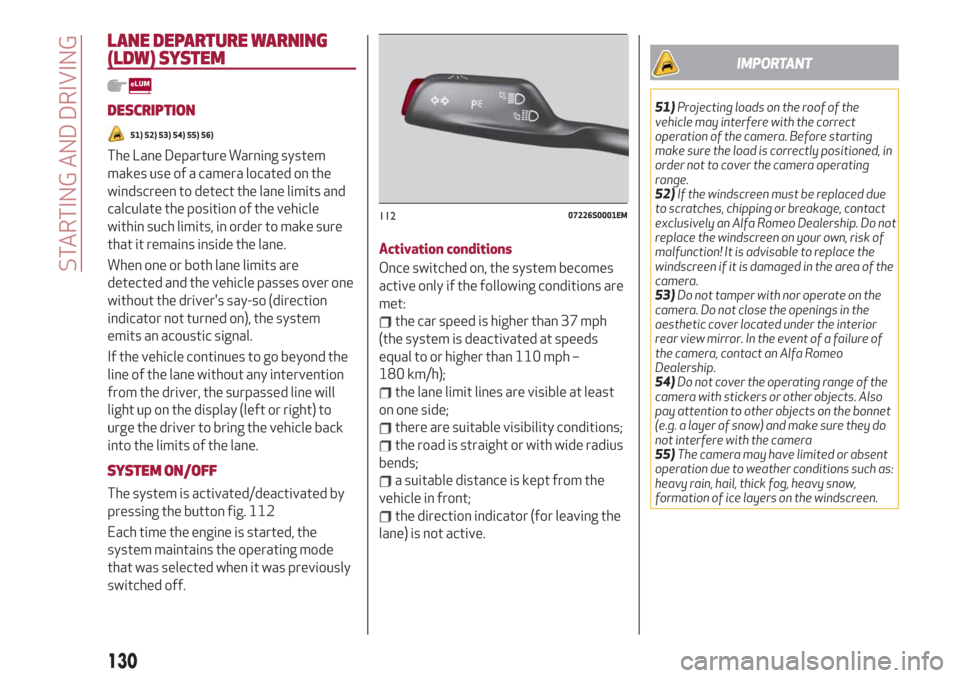
The system is activated/deactivated by
pressing the button fig. 112
Each time the engine is started, the
system maintains the operating mode
that was selected when it was previously
switched off.Activation conditions
Once switched on, the system becomes
active only if the following conditions are
met:
the car speed is higher than 37 mph
(the system is deactivated at speeds
equal to or higher than 110 mph –
180 km/h);
the lane limit lines are visible at least
on one side;
there are suitable visibility conditions;
the road is straight or with wide radius
bends;
a suitable distance is kept from the
vehicle in front;
the direction indicator (for leaving the
lane) is not active.
IMPORTANT
51)Projecting loads on the roof of the
vehicle may interfere with the correct
operation of the camera. Before starting
make sure the load is correctly positioned, in
order not to cover the camera operating
range.
52)If the windscreen must be replaced due
to scratches, chipping or breakage, contact
exclusively an Alfa Romeo Dealership. Do not
replace the windscreen on your own, risk of
malfunction! It is advisable to replace the
windscreen if it is damaged in the area of the
camera.
53)Do not tamper with nor operate on the
camera. Do not close the openings in the
aesthetic cover located under the interior
rear view mirror. In the event of a failure of
the camera, contact an Alfa Romeo
Dealership.
54)Do not cover the operating range of the
camera with stickers or other objects. Also
pay attention to other objects on the bonnet
(e.g. a layer of snow) and make sure they do
not interfere with the camera
55)The camera may have limited or absent
operation due to weather conditions such as:
heavy rain, hail, thick fog, heavy snow,
formation of ice layers on the windscreen.
11207226S0001EM
130
STARTING AND DRIVING