brake light Alfa Romeo Giulia 2019 Owner's Manual
[x] Cancel search | Manufacturer: ALFA ROMEO, Model Year: 2019, Model line: Giulia, Model: Alfa Romeo Giulia 2019Pages: 232, PDF Size: 4.87 MB
Page 15 of 232
IGNITION DEVICE
OPERATION
1) 2) 3) 4) 5)
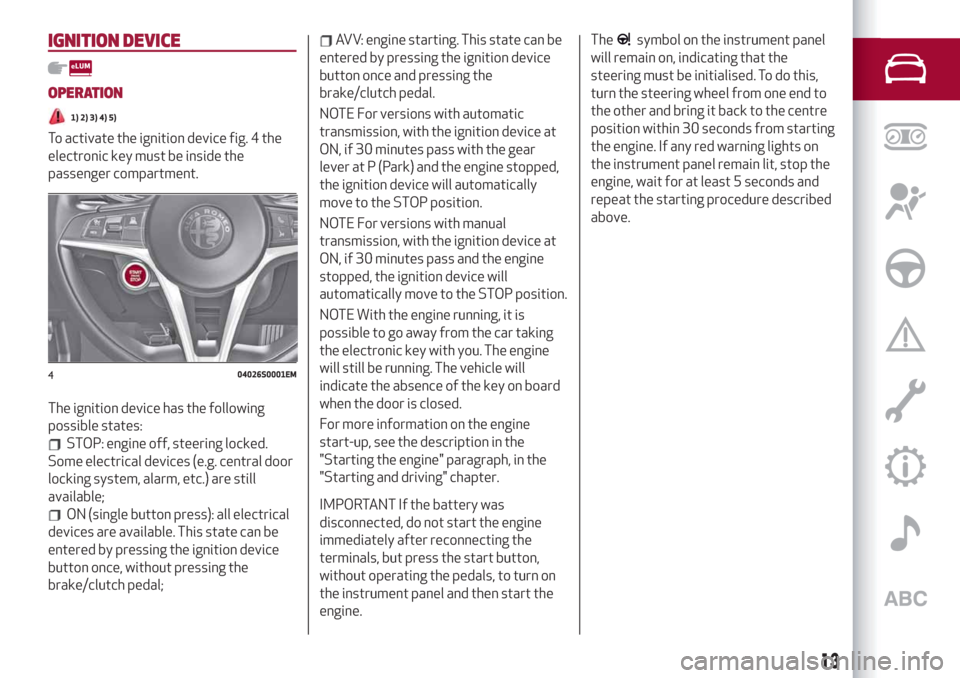
To activate the ignition device fig. 4 the
electronic key must be inside the
passenger compartment.
The ignition device has the following
possible states:
STOP: engine off, steering locked.
Some electrical devices (e.g. central door
locking system, alarm, etc.) are still
available;
ON (single button press): all electrical
devices are available. This state can be
entered by pressing the ignition device
button once, without pressing the
brake/clutch pedal;
AVV: engine starting. This state can be
entered by pressing the ignition device
button once and pressing the
brake/clutch pedal.
NOTE For versions with automatic
transmission, with the ignition device at
ON, if 30 minutes pass with the gear
lever at P (Park) and the engine stopped,
the ignition device will automatically
move to the STOP position.
NOTE For versions with manual
transmission, with the ignition device at
ON, if 30 minutes pass and the engine
stopped, the ignition device will
automatically move to the STOP position.
NOTE With the engine running, it is
possible to go away from the car taking
the electronic key with you. The engine
will still be running. The vehicle will
indicate the absence of the key on board
when the door is closed.
For more information on the engine
start-up, see the description in the
"Starting the engine" paragraph, in the
"Starting and driving" chapter.
IMPORTANT If the battery was
disconnected, do not start the engine
immediately after reconnecting the
terminals, but press the start button,
without operating the pedals, to turn on
the instrument panel and then start the
engine.The
symbol on the instrument panel
will remain on, indicating that the
steering must be initialised. To do this,
turn the steering wheel from one end to
the other and bring it back to the centre
position within 30 seconds from starting
the engine. If any red warning lights on
the instrument panel remain lit, stop the
engine, wait for at least 5 seconds and
repeat the starting procedure described
above.
404026S0001EM
13
Page 40 of 232
BONNET
OPENING
22) 23)
Proceed as follows:
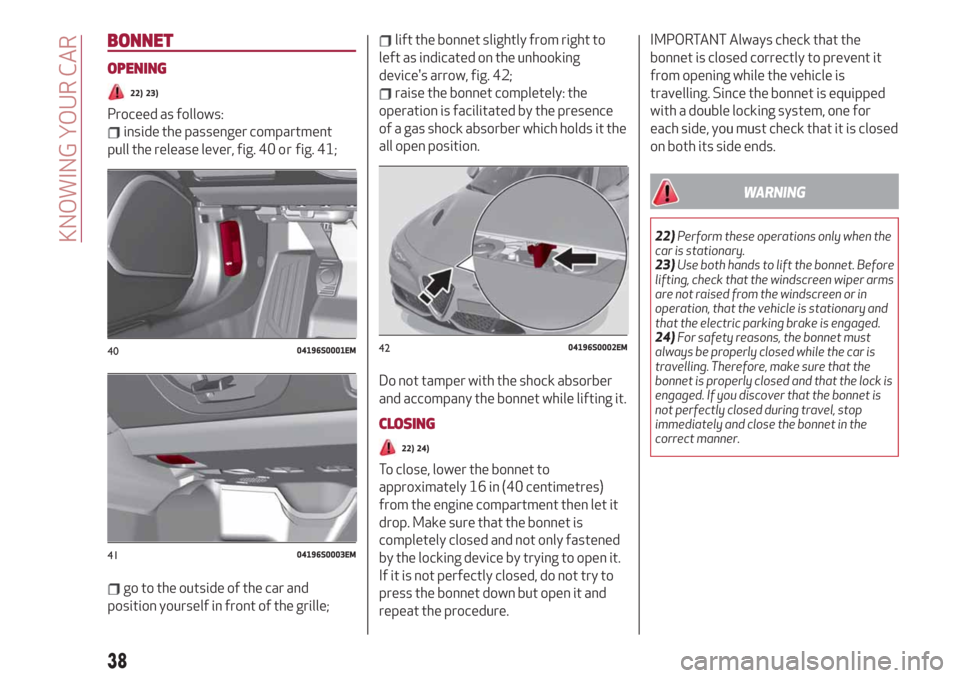
inside the passenger compartment
pull the release lever, fig. 40 or fig. 41;
go to the outside of the car and
position yourself in front of the grille;
lift the bonnet slightly from right to
left as indicated on the unhooking
device's arrow, fig. 42;
raise the bonnet completely: the
operation is facilitated by the presence
of a gas shock absorber which holds it the
all open position.
Do not tamper with the shock absorber
and accompany the bonnet while lifting it.
CLOSING
22) 24)
To close, lower the bonnet to
approximately 16 in (40 centimetres)
from the engine compartment then let it
drop. Make sure that the bonnet is
completely closed and not only fastened
by the locking device by trying to open it.
If it is not perfectly closed, do not try to
press the bonnet down but open it and
repeat the procedure.
IMPORTANT Always check that the
bonnet is closed correctly to prevent it
from opening while the vehicle is
travelling. Since the bonnet is equipped
with a double locking system, one for
each side, you must check that it is closed
on both its side ends.
WARNING
22)Perform these operations only when the
car is stationary.
23)Use both hands to lift the bonnet. Before
lifting, check that the windscreen wiper arms
are not raised from the windscreen or in
operation, that the vehicle is stationary and
that the electric parking brake is engaged.
24)For safety reasons, the bonnet must
always be properly closed while the car is
travelling. Therefore, make sure that the
bonnet is properly closed and that the lock is
engaged. If you discover that the bonnet is
not perfectly closed during travel, stop
immediately and close the bonnet in the
correct manner.
4004196S0001EM
4104196S0003EM
4204196S0002EM
38
KNOWING YOUR CAR
Page 54 of 232
WARNING LIGHTS ON INSTRUMENT PANEL
Possible detailed messages and/or acoustic signalling can be matched to a few warning lights and symbols.
Red warning lights
Warning
lightWhat it means
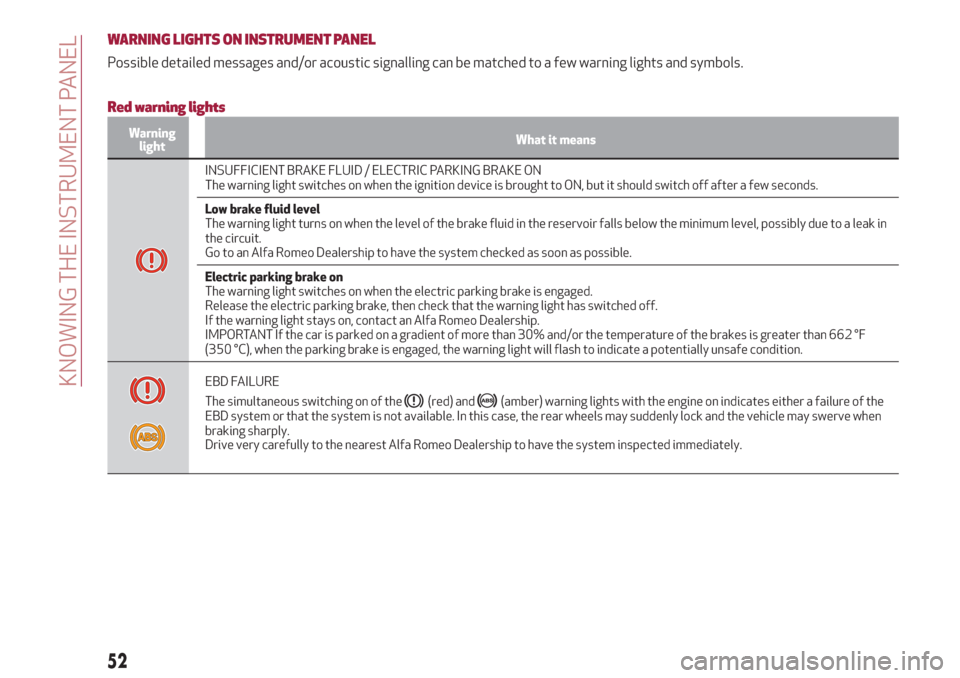
INSUFFICIENT BRAKE FLUID / ELECTRIC PARKING BRAKE ON
The warning light switches on when the ignition device is brought to ON, but it should switch off after a few seconds.
Low brake fluid level
The warning light turns on when the level of the brake fluid in the reservoir falls below the minimum level, possibly due to a leak in
the circuit.
Go to an Alfa Romeo Dealership to have the system checked as soon as possible.
Electric parking brake on
The warning light switches on when the electric parking brake is engaged.
Release the electric parking brake, then check that the warning light has switched off.
If the warning light stays on, contact an Alfa Romeo Dealership.
IMPORTANT If the car is parked on a gradient of more than 30% and/or the temperature of the brakes is greater than 662 °F
(350 °C), when the parking brake is engaged, the warning light will flash to indicate a potentially unsafe condition.
EBD FAILURE
The simultaneous switching on of the
(red) and(amber) warning lights with the engine on indicates either a failure of the
EBD system or that the system is not available. In this case, the rear wheels may suddenly lock and the vehicle may swerve when
braking sharply.
Drive very carefully to the nearest Alfa Romeo Dealership to have the system inspected immediately.
52
KNOWING THE INSTRUMENT PANEL
Page 65 of 232
Symbol What it means
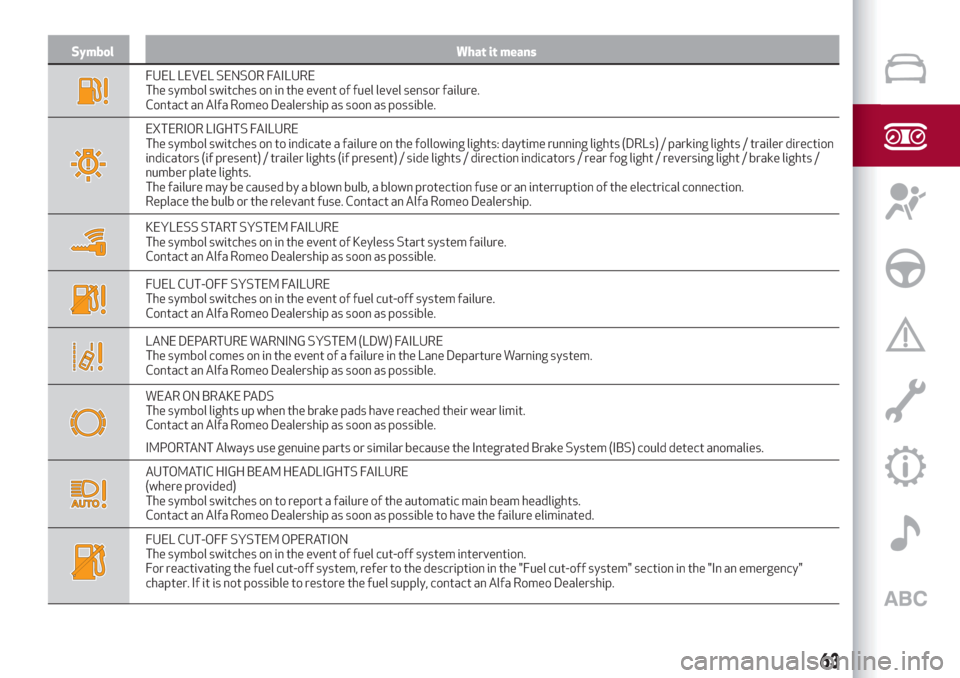
FUEL LEVEL SENSOR FAILURE
The symbol switches on in the event of fuel level sensor failure.
Contact an Alfa Romeo Dealership as soon as possible.
EXTERIOR LIGHTS FAILURE
The symbol switches on to indicate a failure on the following lights: daytime running lights (DRLs) / parking lights / trailer direction
indicators (if present) / trailer lights (if present) / side lights / direction indicators / rear fog light / reversing light / brake lights /
number plate lights.
The failure may be caused by a blown bulb, a blown protection fuse or an interruption of the electrical connection.
Replace the bulb or the relevant fuse. Contact an Alfa Romeo Dealership.
KEYLESS START SYSTEM FAILURE
The symbol switches on in the event of Keyless Start system failure.
Contact an Alfa Romeo Dealership as soon as possible.
FUEL CUT-OFF SYSTEM FAILURE
The symbol switches on in the event of fuel cut-off system failure.
Contact an Alfa Romeo Dealership as soon as possible.
LANE DEPARTURE WARNING SYSTEM (LDW) FAILURE
The symbol comes on in the event of a failure in the Lane Departure Warning system.
Contact an Alfa Romeo Dealership as soon as possible.
WEAR ON BRAKE PADS
The symbol lights up when the brake pads have reached their wear limit.
Contact an Alfa Romeo Dealership as soon as possible.
IMPORTANT Always use genuine parts or similar because the Integrated Brake System (IBS) could detect anomalies.
AUTOMATIC HIGH BEAM HEADLIGHTS FAILURE
(where provided)
The symbol switches on to report a failure of the automatic main beam headlights.
Contact an Alfa Romeo Dealership as soon as possible to have the failure eliminated.
FUEL CUT-OFF SYSTEM OPERATION
The symbol switches on in the event of fuel cut-off system intervention.
For reactivating the fuel cut-off system, refer to the description in the "Fuel cut-off system" section in the "In an emergency"
chapter. If it is not possible to restore the fuel supply, contact an Alfa Romeo Dealership.
63
Page 69 of 232
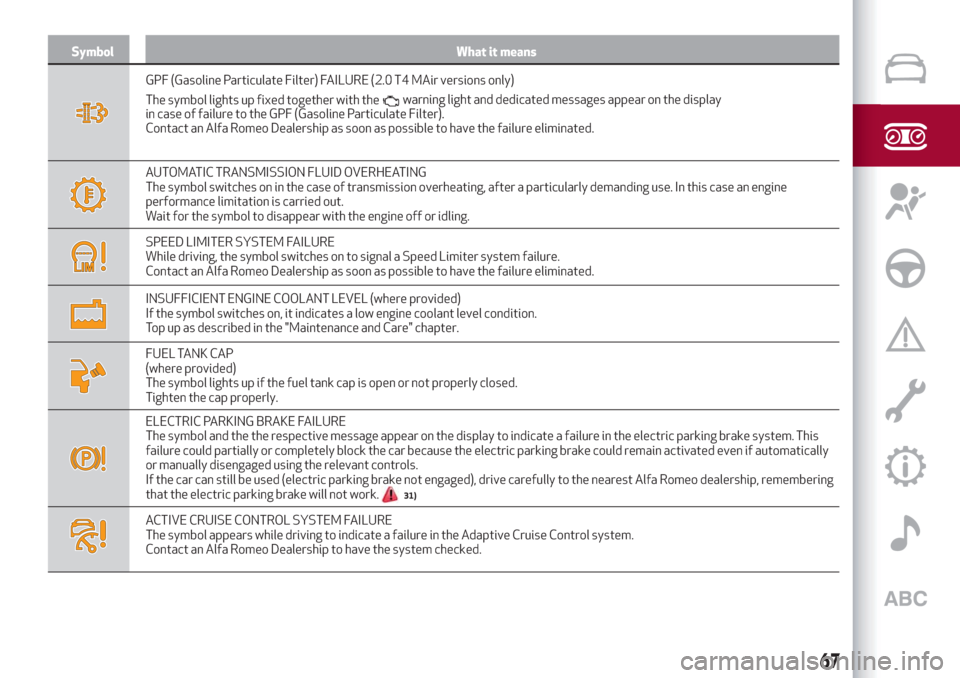
Symbol What it means
GPF (Gasoline Particulate Filter) FAILURE (2.0 T4 MAir versions only)
The symbol lights up fixed together with the
in case of failure to the GPF (Gasoline Particulate Filter).
Contact an Alfa Romeo Dealership as soon as possible to have the failure eliminated.
AUTOMATIC TRANSMISSION FLUID OVERHEATING
The symbol switches on in the case of transmission overheating, after a particularly demanding use. In this case an engine
performance limitation is carried out.
Wait for the symbol to disappear with the engine off or idling.
SPEED LIMITER SYSTEM FAILURE
While driving, the symbol switches on to signal a Speed Limiter system failure.
Contact an Alfa Romeo Dealership as soon as possible to have the failure eliminated.
INSUFFICIENT ENGINE COOLANT LEVEL (where provided)
If the symbol switches on, it indicates a low engine coolant level condition.
Top up as described in the "Maintenance and Care" chapter.
FUEL TANK CAP
(where provided)
The symbol lights up if the fuel tank cap is open or not properly closed.
Tighten the cap properly.
ELECTRIC PARKING BRAKE FAILURE
The symbol and the the respective message appear on the display to indicate a failure in the electric parking brake system. This
failure could partially or completely block the car because the electric parking brake could remain activated even if automatically
or manually disengaged using the relevant controls.
If the car can still be used (electric parking brake not engaged), drive carefully to the nearest Alfa Romeo dealership, remembering
that the electric parking brake will not work.
31)
ACTIVE CRUISE CONTROL SYSTEM FAILURE
The symbol appears while driving to indicate a failure in the Adaptive Cruise Control system.
Contact an Alfa Romeo Dealership to have the system checked.
67
warning light and dedicated messages appear on the display
Page 71 of 232
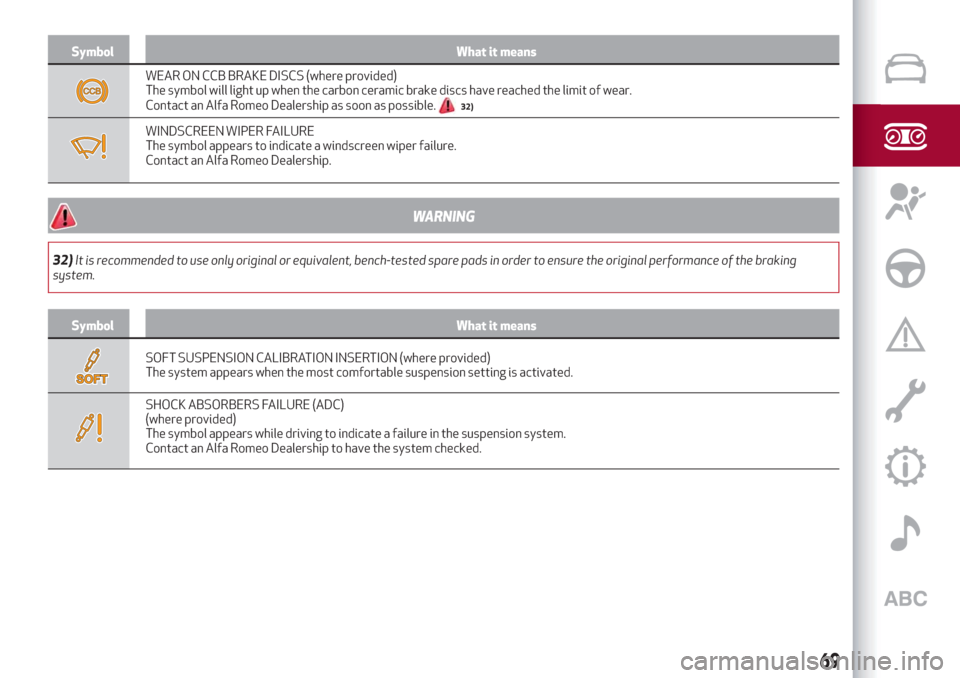
Symbol What it means
WEAR ON CCB BRAKE DISCS (where provided)
The symbol will light up when the carbon ceramic brake discs have reached the limit of wear.
Contact an Alfa Romeo Dealership as soon as possible.
32)
WINDSCREEN WIPER FAILURE
The symbol appears to indicate a windscreen wiper failure.
Contact an Alfa Romeo Dealership.
WARNING
32)It is recommended to use only original or equivalent, bench-tested spare pads in order to ensure the original performance of the braking
system.
Symbol What it means
SOFT SUSPENSION CALIBRATION INSERTION (where provided)
The system appears when the most comfortable suspension setting is activated.
SHOCK ABSORBERS FAILURE (ADC)
(where provided)
The symbol appears while driving to indicate a failure in the suspension system.
Contact an Alfa Romeo Dealership to have the system checked.
69
Page 74 of 232
ACTIVE SAFETYSYSTEMS
The vehicle may be equipped with the
following active safety devices:
ABS (Anti-Lock Brakes);
DTC (Drive Train Control);
ESC (Electronic Stability Control);
TC (Traction Control);
PBA (Panic Brake Assist);
HSA (Hill Start Assist);
AST (Alfa™ Steering Torque);
ATV (Alfa™ Active Torque Vectoring).
For the operation of the systems, see the
following pages.
ABS (Anti-lock Braking System)
This system, which is an integral part of
the braking system, prevents one or more
wheels from locking and slipping in all
road surface conditions, irrespective of
the intensity of the braking action,
ensuring that the vehicle can be
controlled even during emergency
braking and optimising stopping
distances.
The system intervenes during braking
when the wheels are about to lock,
typically in emergency braking or
low-grip conditions, when locking may be
more frequent.
The system also improves control and
stability of the vehicle when braking on a
surface where the grip of the left and
right wheels varies, or on corners.The Electronic Braking Force Distribution
(EBD) system completes the system
allowing the brake force to be distributed
between the front and rear wheels.
System intervention
The ABS equipped on this vehicle is
provided with the "Brake by wire"
(Integrated Brake System - IBS) function.
With this system, the brake pedal
command given by pressing the brake
pedal is not transmitted hydraulically but
electronically, therefore, the light
pulsation that could be felt on the pedal
with the traditional system is no longer
perceptible.33) 34) 35) 36) 37) 38)
DTC (Drive Train Control)SYSTEM(where provided)
Some versions of this vehicle are
equipped with an automatically
activated/deactivated four-wheel drive
system (AWD), which offers an optimal
drive for countless driving conditions and
road surfaces. The system reduces the
slipping of the tyres to a minimum,
automatically redistributing the torque
to the front and rear wheels, as needed.
To maximize fuel savings, the car with
AWD automatically passes to rear-wheel
drive (RWD) when the road and
environmental conditions are such that
they would not cause the tyres to slip.When the road and environmental
conditions require better traction, the
vehicle automatically goes to AWD mode.
39)
IMPORTANT If the system failure symbol
switches on, after starting the engine or
while driving, it means that the AWD
system is not working properly. If the
warning message activates frequently, it
is recommended to carry out the
maintenance operations.
40)
ESC (Electronic Stability Control)
SYSTEM
The ESC system improves the directional
control and stability of the car in various
driving conditions.
The ESC system corrects the car’s
understeer and oversteer, distributing
the brake force on the appropriate
wheels. The torque supplied by the
engine can also be reduced in order to
maintain control of the vehicle.
The ESC system uses sensors installed
on the car to determine the trajectory
that the driver intends to follow and
compares it with the car’s effective
trajectory. When the real trajectory
deviates from the desired trajectory, the
ESC system intervenes to counter the
vehicle’s understeer or oversteer.
Oversteer: occurs when the car is
72
SAFETY
Page 75 of 232
turning more than it should according to
the angle of the steering wheel.
Understeer: occurs when the vehicle is
turning less than it should according to
the angle of the steering wheel.
System intervention
The intervention of the system is
indicated by the flashing of the ESC
warning light on the instrument panel, to
inform the driver that the vehicle
stability and grip are critical.
41) 42) 43) 44) 45)
TC (Traction Control)SYSTEM
The system automatically operates in the
event of slipping, loss of grip on wet
roads (aquaplaning) and acceleration on
slippery, snowy or icy roads, etc. on one
or both drive wheels. Depending on the
slipping conditions, two different control
systems are activated:
if the slipping involves both drive
wheels, the system intervenes, reducing
the power transmitted by the engine;
if the slipping only involves one of the
drive wheels, the BLD (Brake Limited
Differential) function is activated,
automatically braking the wheel which is
slipping (the behaviour of a self-locking
differential is simulated). This will
increase the engine torque transferred to
the wheel which isn't slipping.System intervention
The intervention of the system is
indicated by the flashing of the ESC
warning light on the instrument panel, to
inform the driver that the vehicle
stability and grip are critical.
46) 47) 48) 49) 50)
PBA (Panic Brake Assist)SYSTEM
The PBA system is designed to improve
the vehicle’s braking capacity during
emergency braking.
The system detects emergency braking
by monitoring the speed and force with
which the brake pedal is pressed, and
consequently applies the optimal brake
pressure. This can reduce the braking
distance: the PBA system therefore
complements the ABS.
Maximum assistance from the PBA
system is obtained by pressing the brake
pedal very quickly. In addition, the brake
pedal should be pressed continuously
during braking, avoiding intermittent
presses, to get the most out of the
system. Do not reduce pressure on the
brake pedal until braking is no longer
necessary.
The PBA system is deactivated when the
brake pedal is released.
51) 52) 53)
HSA (Hill Start Assist)SYSTEM
This is an integral part of the ESC system
and facilitates starting on slopes,
activating automatically in the following
cases:
uphill: vehicle stationary on a road
with a gradient higher than 5%, engine
running, brake pressed and transmission
in neutral or gear other than reverse
engaged;
downhill: vehicle stationary on a road
with a gradient higher than 5%, engine
running, brake pressed and reverse gear
engaged.
When setting off, the ESC system control
unit maintains the braking pressure on
the wheels until the engine torque
necessary for starting is reached, or in
any case for a maximum of 2 seconds,
allowing your right foot to be moved
easily from the brake pedal to the
accelerator.
When two seconds have elapsed, without
starting, the system is automatically
deactivated, gradually releasing the
braking pressure. During this release
stage it is possible to hear a typical
mechanical brake release noise,
indicating the imminent movement of the
car.
54) 55)
73
Page 77 of 232
48)The TC system cannot overrule the
natural laws of physics, and cannot increase
the grip available according to the condition
of the road.
49)The TC system cannot prevent
accidents, including those due to excessive
speed on corners, driving on low-grip
surfaces or aquaplaning.
50)The capability of the TC must never be
tested irresponsibly and dangerously, in
such a way as to compromise personal
safety and the safety of others.
51)The PBA system cannot overrule the
natural laws of physics, and cannot increase
the grip available according to the condition
of the road.
52)The PBA system cannot prevent
accidents, including those due to excessive
speed on corners, driving on low-grip
surfaces or aquaplaning.
53)The capability of the PBA system must
never be tested irresponsibly and
dangerously, in such a way as to compromise
the safety of the driver, the other occupants
of the vehicle or any other road user.
54)The HSA system is not a parking brake;
therefore, never leave the vehicle without
having engaged the electric parking brake,
turned the engine off and engaged first gear,
so that it is parked in safe conditions (for
further information read the "Parking"
paragraph in the "Starting and driving"
chapter).
55)There may be situations on small
gradients (less than 8%), with vehicle laden,
in which the Hill Start Assist system may not
activate, causing a slight reversing motion
and increasing the risk of collision with
another vehicle or object. The driver is, in any
case, responsible for safe driving.56)The AST system is an aid for driving and
does not relieve the driver of responsibility
for driving the vehicle.DRIVING ASSISTANCE
SYSTEMS
The vehicle can feature the following
driving assistance systems:
BSM (Blind Spot Monitoring);
FCW (Forward Collision Warning);
TPMS (Tyre Pressure Monitoring
System).
For the operation of the systems, see the
following pages.
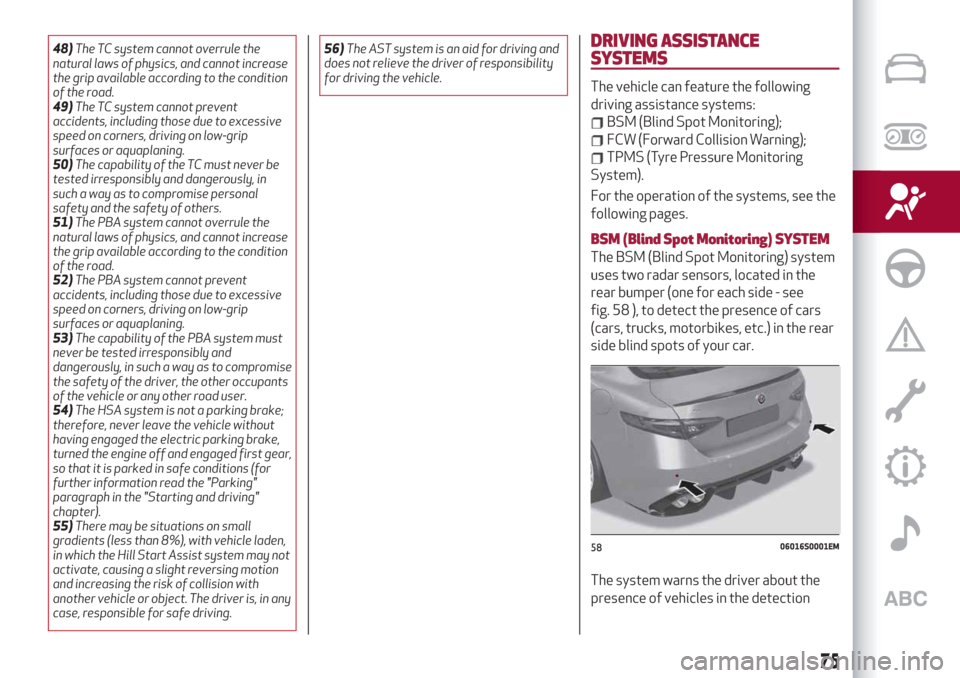
BSM (Blind Spot Monitoring)SYSTEM
The BSM (Blind Spot Monitoring) system
uses two radar sensors, located in the
rear bumper (one for each side - see
fig. 58 ), to detect the presence of cars
(cars, trucks, motorbikes, etc.) in the rear
side blind spots of your car.
The system warns the driver about the
presence of vehicles in the detection
5806016S0001EM
75
Page 80 of 232
In the event of an imminent collision the
system intervenes by automatically
braking the car to prevent the impact or
reduce its effects.
The system provides the driver with
acoustic and visual signals through
specific messages on the instrument
panel display.
The acoustic and visual signals before the
system cuts in depend on the car speed.
No acoustic/visual signal is generated at
speeds slower than 30 km/h.
Acoustic/visual signal is generated at
speeds faster than 30 km/h, instead.
The system may lightly brake to warn the
driver if a possible frontal accident is
detected (limited braking). Signals and
limited braking are intended to allow the
driver to react promptly, in order to
prevent or reduce the effects of a
potential accident.
In situations with the risk of collision, if
the system detects no intervention by
the driver, it provides automatic braking
to help slow the car and mitigate the
potential frontal accident (automatic
braking). If intervention by the driver on
the brake pedal is detected but not
deemed sufficient, the system may
intervene in order to improve the
reaction of the braking system, therefore
reducing vehicle speed further
(additional assistance in braking stage).The system will intervene automatically
in case of imminent collision or impact
against a pedestrian crossing the road
(speed under 31 mph (50 km/h)).
IMPORTANT For safety reasons, when
the car has stopped, the brake callipers
may remain blocked for about 2 seconds.
Make sure you press the brake pedal if
the vehicle moves slightly forwards.
Engagement/disengagement
The Forward Collision Warning system
can be deactivated (and then reactivated)
via the Connect system. To access the
function, on the main menu select the
following items in sequence: "Settings",
"Safety", "Forward Collision Warning" and
"Status".
The system can be deactivated even with
the ignition device ON.
IMPORTANT The system status can be
changed with vehicle at a standstill only.
Activation/deactivation
The Forward Collision Warning system is
activated whenever the engine is started
regardless of the Connect system
setting.
After deactivation, the system will not
warn the driver about a possible collision
with the vehicle ahead, regardless of the
setting selected with the Connect
system.
IMPORTANT Each time the engine is
started, the system is activated
regardless of where was when it was
previously switched off.
This function is not active at a speed
lower than 4.3 mph (7 km/h) or higher
than 124 mph (200 km/h).
The system is active when:
each time the engine is started;
is active (ON) in the Connect system;
the ignition device is at ON;
- the vehicle speed is between 4.3 and
124 mph (7 and 200 km/h);
the front seat belts are fastened;
the "Alfa DNA™ Pro" selector is not in
RACE position (where present).
Changing the system sensitivity
The sensitivity of the system can be
changed through the Connect system
menu, choosing from one of the following
three options: "Near", "Med" or "Far". See
the description in the Connect system
supplement for how to change the
settings.
The default option is "Med". With this
setting, the system warns the driver of a
possible collision with the vehicle in front
when that vehicle is at a standard
distance, between that of the other two
settings.
With the system sensitivity set to "Far",
the system will warn the driver of a
possible accident with the vehicle in front
78
SAFETY