spare wheel Alfa Romeo Giulia 2019 Owner's Manual
[x] Cancel search | Manufacturer: ALFA ROMEO, Model Year: 2019, Model line: Giulia, Model: Alfa Romeo Giulia 2019Pages: 232, PDF Size: 4.87 MB
Page 84 of 232
TPMS (Tyre Pressure Monitoring
System)
63) 64) 65) 66) 67) 68) 69)
31)
The car is equipped with Tyre Pressure
Monitoring System (TPMS), which can
advise the driver in the event of
insufficient tyre pressure on the basis of
the pressure when cold indicated in the
"Technical specifications" chapter.
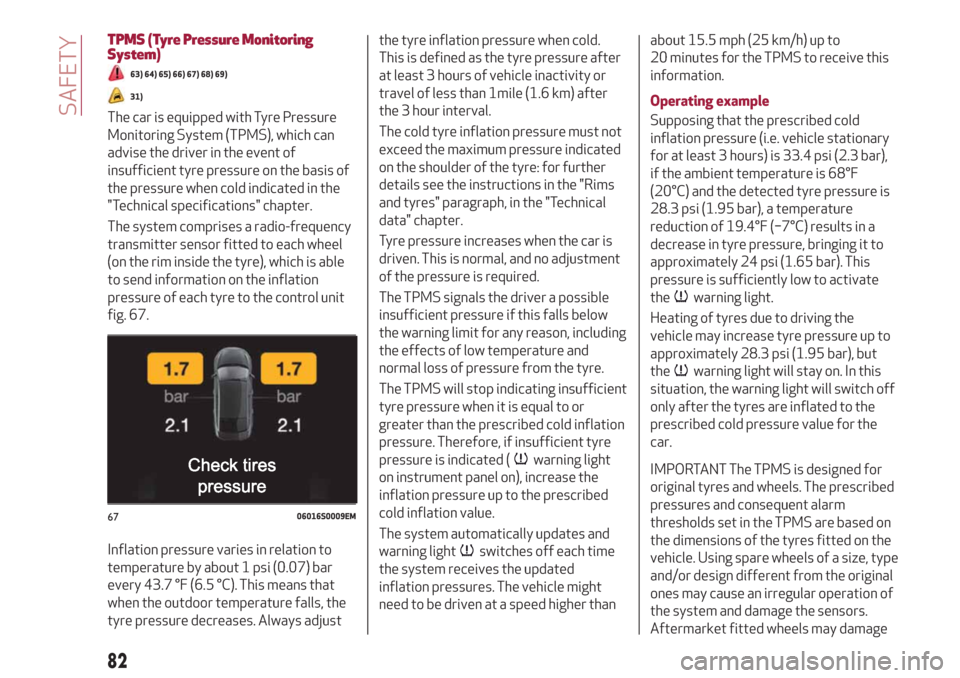
The system comprises a radio-frequency
transmitter sensor fitted to each wheel
(on the rim inside the tyre), which is able
to send information on the inflation
pressure of each tyre to the control unit
fig. 67.
Inflation pressure varies in relation to
temperature by about 1 psi (0.07) bar
every 43.7 °F (6.5 °C). This means that
when the outdoor temperature falls, the
tyre pressure decreases. Always adjustthe tyre inflation pressure when cold.
This is defined as the tyre pressure after
at least 3 hours of vehicle inactivity or
travel of less than 1mile (1.6 km) after
the 3 hour interval.
The cold tyre inflation pressure must not
exceed the maximum pressure indicated
on the shoulder of the tyre: for further
details see the instructions in the "Rims
and tyres" paragraph, in the "Technical
data" chapter.
Tyre pressure increases when the car is
driven. This is normal, and no adjustment
of the pressure is required.
The TPMS signals the driver a possible
insufficient pressure if this falls below
the warning limit for any reason, including
the effects of low temperature and
normal loss of pressure from the tyre.
The TPMS will stop indicating insufficient
tyre pressure when it is equal to or
greater than the prescribed cold inflation
pressure. Therefore, if insufficient tyre
pressure is indicated (
warning light
on instrument panel on), increase the
inflation pressure up to the prescribed
cold inflation value.
The system automatically updates and
warning light
switches off each time
the system receives the updated
inflation pressures. The vehicle might
need to be driven at a speed higher thanabout 15.5 mph (25 km/h) up to
20 minutes for the TPMS to receive this
information.
Operating example
Supposing that the prescribed cold
inflation pressure (i.e. vehicle stationary
for at least 3 hours) is 33.4 psi (2.3 bar),
if the ambient temperature is 68°F
(20°C) and the detected tyre pressure is
28.3 psi (1.95 bar), a temperature
reduction of 19.4°F (−7°C) results in a
decrease in tyre pressure, bringing it to
approximately 24 psi (1.65 bar). This
pressure is sufficiently low to activate
the
warning light.
Heating of tyres due to driving the
vehicle may increase tyre pressure up to
approximately 28.3 psi (1.95 bar), but
the
warning light will stay on. In this
situation, the warning light will switch off
only after the tyres are inflated to the
prescribed cold pressure value for the
car.
IMPORTANT The TPMS is designed for
original tyres and wheels. The prescribed
pressures and consequent alarm
thresholds set in the TPMS are based on
the dimensions of the tyres fitted on the
vehicle. Using spare wheels of a size, type
and/or design different from the original
ones may cause an irregular operation of
the system and damage the sensors.
Aftermarket fitted wheels may damage
6706016S0009EM
82
SAFETY
Page 86 of 232
operation when all the pressure sensors
have been detected again.
IMPORTANT If wheels without pressure
sensors (e.g. wheels with winter tyres)
have been installed on the vehicle and the
standard wheels (with sensors) are
stored close the vehicle, the system
could detect the pressures of the latter
and consequently display the fault cycle
again once its has left the sensitive area.
WARNING
57)The system is an aid for vehicle driving,
it DOES NOT warn the driver about incoming
vehicles outside of the detection areas. The
driver must always maintain a sufficient
level of attention to the traffic and road
conditions and for controlling the trajectory
of the vehicle.
58)The Forward Collision Warning (FCW)
system is automatically deactivated when
RACE mode is selected.
59)The system is an aid for the driver, who
must always pay full attention while driving.
The responsibility always rests with the
driver, who must take into account the
traffic conditions in order to drive in
complete safety. The driver must always
maintain a safe distance from the vehicle in
front.
60)If the driver depresses the brake pedal
fully or carries out a fast steering during
system operation, the automatic braking
function may stop (e.g. to allow a possible
manoeuvre to avoid the obstacle).61)The system intervenes on vehicles
travelling in the same lane. People, animals
and things (e.g. pushchairs) are not taken
into consideration.
62)If the car must be placed on a roller
bench for maintenance interventions or if it
is washed in an automatic roller washing
tunnel with an obstacle in the front part (e.g.
another car, a wall or another obstacle), the
system may detect its presence and
activate. In this case the system must be
deactivated through the settings of the
Connect system.
63)The presence of the TPMS does not
permit the driver to neglect regular checks
of the tyre pressure, including for the spare
tyre, and correct maintenance: the system is
not used to signalling a possible tyre fault.
64)Tyre pressure must be checked with
tyres rested and cold. Should it become
necessary for whatever reason to check
pressure with warm tyres, do not reduce
pressure even though it is higher than the
prescribed value. Repeat the check when the
tyres are cold.
65)Should one or more wheels be fitted
without sensors, the system will no longer be
available and a warning message will be
shown on the display, until wheels with
sensors are fitted again.
66)The TPMS cannot indicate sudden tyre
pressure drops (e.g. if a tyre bursts). In this
case, stop the vehicle, braking with caution
and avoiding abrupt steering.
67)Changes in outside temperature may
cause tyre pressures to vary. The system
may temporarily indicate insufficient
pressure. In this case, check the tyre
pressure when cold and, if necessary,
restore the inflation values.68)Replacing standard tyres with winter
tyres and vice versa requires TPMS system
adjustment that must only be performed by
Alfa Romeo Dealerships.
69)When a tyre is removed, it is advisable
to replace the rubber valve seal as well:
contact an Alfa Romeo Dealership. The
fitting/removal of the tyres and/or rims
require special care. To avoid damaging or
fitting the sensors incorrectly, tyre and/or
rim fitting/removal operations should only
be carried out by specialised staff. Contact
an Alfa Romeo Dealership.
IMPORTANT
22)The system may have limited or absent
operation due to weather conditions such as:
heavy rain, hail, thick fog, heavy snow.
23)The section of the bumper before the
sensor must not be covered with adhesives,
auxiliary headlights or any other object.
24)System intervention might be
unexpected or delayed when other vehicles
transport loads projecting from the side,
above or from the rear, with respect to the
normal size of the vehicle.
25)Operation can be adversely affected by
any structural change made to the vehicle,
such as a modification to the front geometry,
tyre change, or a heavier load than the
standard load of the vehicle.
26)Incorrect repairs made on the front part
of the vehicle (e.g. bumper, chassis) may alter
the position of the radar sensor, and
adversely affect its operation. Go to an Alfa
Romeo Dealership for any operation of this
type.
84
SAFETY