trunk ALFA ROMEO GIULIA 2021 Owner's Manual
[x] Cancel search | Manufacturer: ALFA ROMEO, Model Year: 2021, Model line: GIULIA, Model: ALFA ROMEO GIULIA 2021Pages: 284, PDF Size: 8.87 MB
Page 191 of 284
189
Exhaust Gas The best protection against carbon monoxide
entry into the vehicle body is a properly main-
tained engine exhaust system.
Whenever a change is noticed in the sound of
the exhaust system, when exhaust fumes can
be detected inside the vehicle, or when the
underside or rear of the vehicle is damaged,
have an authorized dealer inspect the
complete exhaust system and adjacent body
areas for broken, damaged, deteriorated, or
mispositioned parts. Open seams or loose
connections could permit exhaust fumes to
seep into the passenger compartment. In
addition, inspect the exhaust system each
time the vehicle is raised for lubrication or oil
change. Replace as required.Carbon Monoxide Warnings
WARNING!
Exhaust gases can injure or kill. They
contain carbon monoxide (CO), which is
colorless and odorless. Breathing it can
make you unconscious and can eventually
poison you. To avoid breathing (CO), follow
these safety tips:
Do not run the engine in a closed garage
or in confined areas any longer than
needed to move your vehicle in or out of
the area.
If you are required to drive with the trunk/
liftgate/rear doors open, make sure that
all windows are closed and the climate
control BLOWER switch is set at high
speed. DO NOT use the recirculation
mode.
If it is necessary to sit in a parked vehicle
with the engine running, adjust your
heating or cooling controls to force
outside air into the vehicle. Set the blower
at high speed.
WARNING!
Carbon monoxide (CO) in exhaust gases is
deadly. Follow the precautions below to
prevent carbon monoxide poisoning:
Do not inhale exhaust gases. They contain
carbon monoxide, a colorless and odor -
less gas, which can kill. Never run the
engine in a closed area, such as a garage,
and never sit in a parked vehicle with the
engine running for an extended period. If
the vehicle is stopped in an open area with
the engine running for more than a short
period, adjust the ventilation system to
force fresh, outside air into the vehicle.
Guard against carbon monoxide with
proper maintenance. Have the exhaust
system inspected every time the vehicle is
raised. Have any abnormal conditions
repaired promptly. Until repaired, drive
with all side windows fully open.
21_GA_OM_EN_USC_t.book Page 189
Page 196 of 284
IN CASE OF EMERGENCY
194
TIRE SERVICE KIT
Description
If a tire is punctured, you can make an emer-
gency repair using the Tire Service Kit located
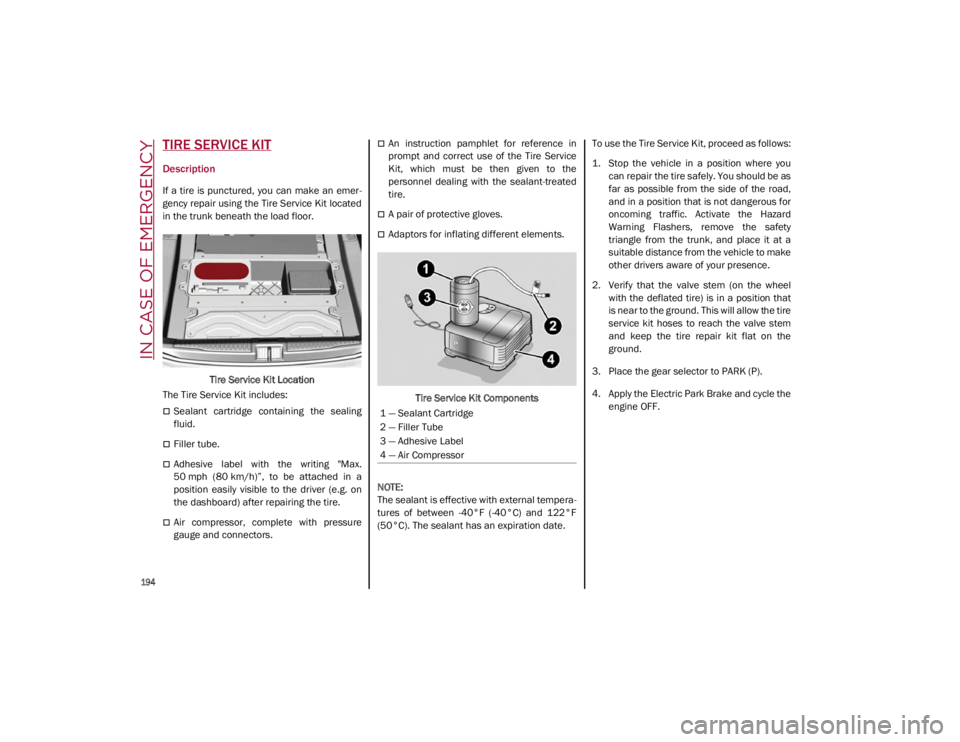
in the trunk beneath the load floor.
Tire Service Kit Location
The Tire Service Kit includes:
Sealant cartridge containing the sealing
fluid.
Filler tube.
Adhesive label with the writing "Max.
50 mph (80 km/h)”, to be attached in a
position easily visible to the driver (e.g. on
the dashboard) after repairing the tire.
Air compressor, complete with pressure
gauge and connectors.
An instruction pamphlet for reference in
prompt and correct use of the Tire Service
Kit, which must be then given to the
personnel dealing with the sealant-treated
tire.
A pair of protective gloves.
Adaptors for inflating different elements.
Tire Service Kit Components
NOTE:
The sealant is effective with external tempera -
tures of between -40°F (-40°C) and 122°F
(50°C). The sealant has an expiration date. To use the Tire Service Kit, proceed as follows:
1. Stop the vehicle in a position where you
can repair the tire safely. You should be as
far as possible from the side of the road,
and in a position that is not dangerous for
oncoming traffic. Activate the Hazard
Warning Flashers, remove the safety
triangle from the trunk, and place it at a
suitable distance from the vehicle to make
other drivers aware of your presence.
2. Verify that the valve stem (on the wheel with the deflated tire) is in a position that
is near to the ground. This will allow the tire
service kit hoses to reach the valve stem
and keep the tire repair kit flat on the
ground.
3. Place the gear selector to PARK (P).
4. Apply the Electric Park Brake and cycle the engine OFF.
1 — Sealant Cartridge
2 — Filler Tube
3 — Adhesive Label
4 — Air Compressor
21_GA_OM_EN_USC_t.book Page 194
Page 205 of 284
203
(Continued)
2. Remove the tow eye from its housing in thetrunk and carefully clean the threaded
housing on the vehicle before using it.
3. Tighten the vehicle's tow eye in place (about 11 turns).
NOTE:
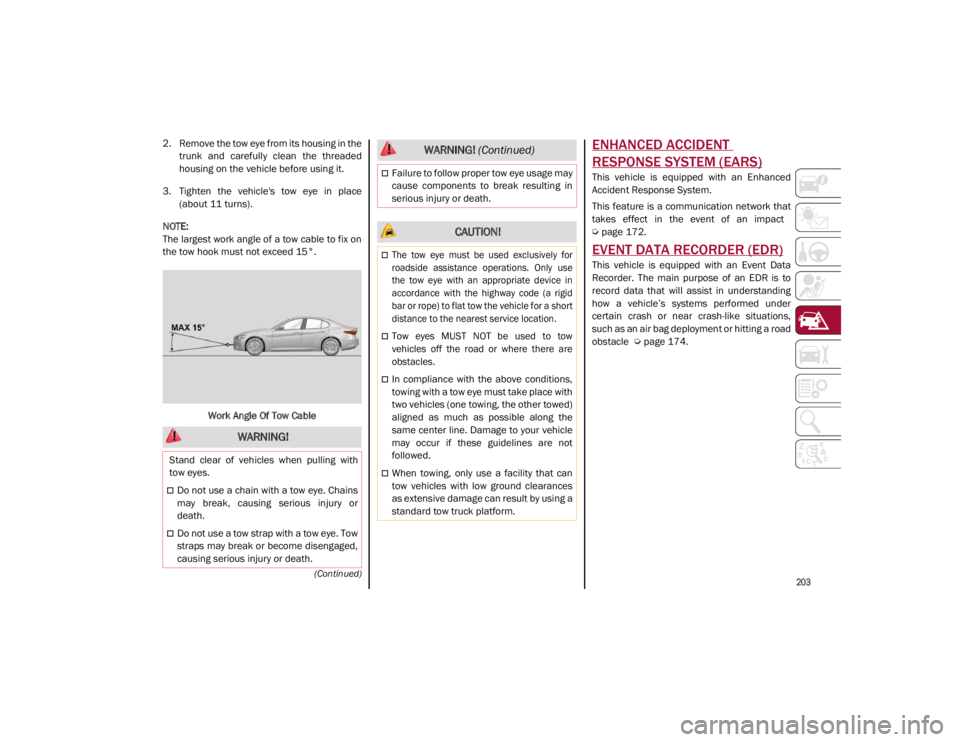
The largest work angle of a tow cable to fix on
the tow hook must not exceed 15°.
Work Angle Of Tow CableENHANCED ACCIDENT
RESPONSE SYSTEM (EARS)
This vehicle is equipped with an Enhanced
Accident Response System.
This feature is a communication network that
takes effect in the event of an impact
Ú
page 172.
EVENT DATA RECORDER (EDR)
This vehicle is equipped with an Event Data
Recorder. The main purpose of an EDR is to
record data that will assist in understanding
how a vehicle’s systems performed under
certain crash or near crash-like situations,
such as an air bag deployment or hitting a road
obstacle
Ú
page 174.
WARNING!
Stand clear of vehicles when pulling with
tow eyes.
Do not use a chain with a tow eye. Chains
may break, causing serious injury or
death.
Do not use a tow strap with a tow eye. Tow
straps may break or become disengaged,
causing serious injury or death.
Failure to follow proper tow eye usage may
cause components to break resulting in
serious injury or death.
CAUTION!
The tow eye must be used exclusively for
roadside assistance operations. Only use
the tow eye with an appropriate device in
accordance with the highway code (a rigid
bar or rope) to flat tow the vehicle for a short
distance to the nearest service location.
Tow eyes MUST NOT be used to tow
vehicles off the road or where there are
obstacles.
In compliance with the above conditions,
towing with a tow eye must take place with
two vehicles (one towing, the other towed)
aligned as much as possible along the
same center line. Damage to your vehicle
may occur if these guidelines are not
followed.
When towing, only use a facility that can
tow vehicles with low ground clearances
as extensive damage can result by using a
standard tow truck platform.
WARNING! (Continued)
21_GA_OM_EN_USC_t.book Page 203
Page 206 of 284

204
SERVICING AND MAINTENANCE
Correct servicing permits the performance of
the vehicle to be maintained over time, as well
as limited running costs and safeguarding the
efficiency of the safety systems.
This chapter explains how.
SCHEDULED SERVICING
Correct servicing is crucial for guaranteeing a
long life for the vehicle under the best condi-
tions.
For this reason, Alfa Romeo has planned a
series of checks and services for your vehicle
at fixed intervals based on distance and time,
as described in the Scheduled Servicing Plan.
Before each service, it is always necessary to
carefully follow the instructions in the Sched -
uled Servicing Plan (e.g. periodically check
level of fluids, tire pressure, etc.).
Scheduled Servicing is offered by an autho -
rized dealer according to a set time schedule.
If, during each operation, in addition to the
ones scheduled, the need arises for further
replacements or repairs, these may be carried
out with the owner’s explicit consent only.
NOTE:
Scheduled Servicing intervals are required by
FCA US LLC. Failure to have them carried out
may invalidate the New Vehicle Limited
Warranty.
You are advised to inform an authorized
dealer of any small operating irregularities
without waiting for the next service.
Periodic Checks
Every month or every 600 miles (1,000 km) or
before long trips check and, if necessary, top
off:
Engine coolant level.
Brake fluid level (if insufficient, see an
authorized dealer as soon as possible).
Windshield washer fluid level.
Tire inflation pressure and condition.
Operation of lighting system (headlights,
direction indicators, hazard warning lights,
etc.).
Operation of windshield washing/wiping
system and positioning/wear of wiper
blades.
Inspect the CV/Universal joints.
Oil consumption of the engine depends on
conditions and driving style. For this reason,
the engine oil level must be checked every
1,860 miles (3,000 km), and top off if neces -
sary
Ú
page 213.
Heavy Usage Of The Vehicle
If the vehicle is used under one of the following
conditions:
Dusty roads.
Short, repeated journeys less than 4 miles
(7 km) at sub-zero outside temperatures.
Engine often idling or driving long distances
at low speeds or long periods of inactivity.
In the event of a long period of inactivity.
The following checks must be carried out more
often than indicated in the Scheduled
Servicing Plan:
Check cleanliness of hood and trunk locks,
cleanliness and lubrication of linkage.
Visually inspect conditions of: engine, trans -
mission, pipes and hoses (exhaust/fuel
system/brakes) and rubber elements
(sleeves/bushes, etc.).
Check battery charge and battery fluid level
(electrolyte).
Visually inspect conditions of the accessory
drive belts.
Check and, if necessary, change engine oil
and replace oil filter.
Check and, if necessary, replace cabin air
filter.
Check and, if necessary, replace engine air
cleaner.
Severe Duty All Models
Vehicles that are operated in a dusty and
off-road environment, or predominately at idle
or very low engine RPM are known as Severe
Duty vehicles. It is recommended that you
change engine oil at 4,000 miles (6,500 km)
or 350 hours of engine run time.
21_GA_OM_EN_USC_t.book Page 204
Page 207 of 284
205
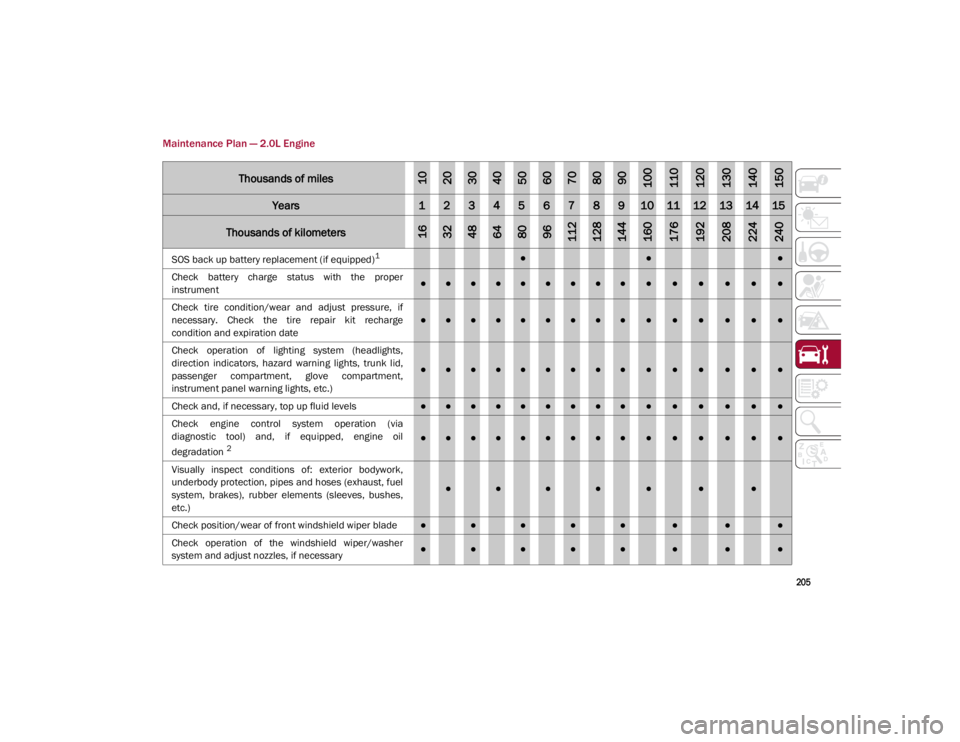
Maintenance Plan — 2.0L Engine
Thousands of miles102030405060708090100110120130140150
Years123456789101112131415
Thousands of kilometers163248648096112128144160176192208224240
SOS back up battery replacement (if equipped)1●●●
Check battery charge status with the proper
instrument
●●●●●●●●●●●●●●●
Check tire condition/wear and adjust pressure, if
necessary. Check the tire repair kit recharge
condition and expiration date
●●●●●●●●●●●●●●●
Check operation of lighting system (headlights,
direction indicators, hazard warning lights, trunk lid,
passenger compartment, glove compartment,
instrument panel warning lights, etc.)
●●●●●●●●●●●●●●●
Check and, if necessary, top up fluid levels
●●●●●●●●●●●●●●●
Check engine control system operation (via
diagnostic tool) and, if equipped, engine oil
degradation
2●●●●●●●●●●●●●●●
Visually inspect conditions of: exterior bodywork,
underbody protection, pipes and hoses (exhaust, fuel
system, brakes), rubber elements (sleeves, bushes,
etc.)
●●●●●●●
Check position/wear of front windshield wiper blade●●●●●●●●
Check operation of the windshield wiper/washer
system and adjust nozzles, if necessary
●●●●●●●●
21_GA_OM_EN_USC_t.book Page 205
Page 210 of 284
SERVICING AND MAINTENANCE
208
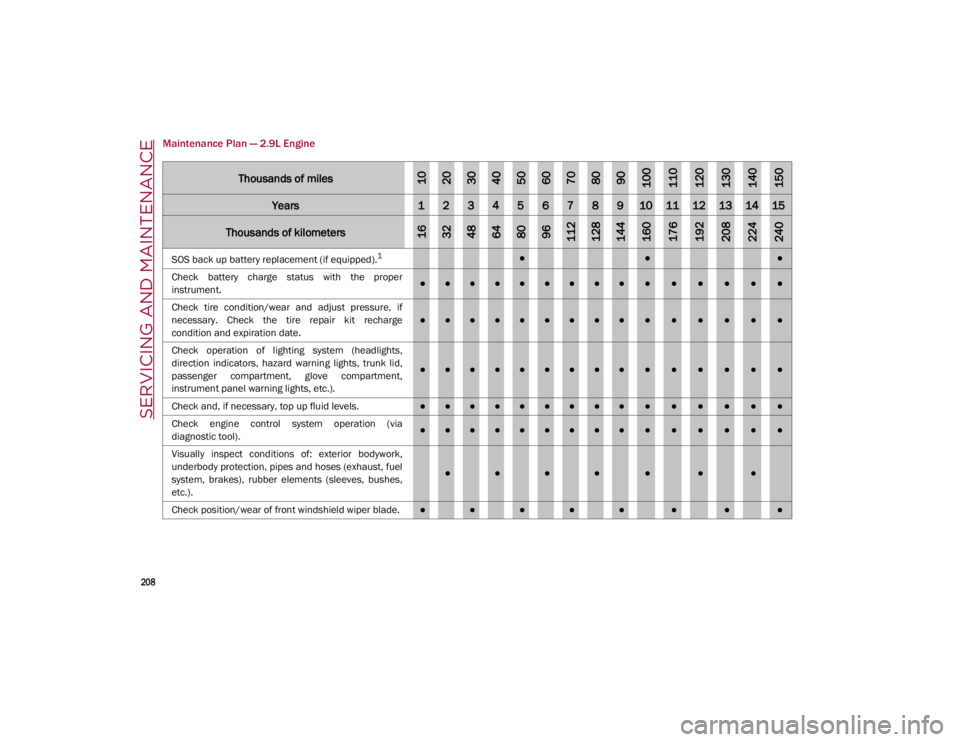
Maintenance Plan — 2.9L Engine
Thousands of miles102030405060708090100110120130140150
Years123456789101112131415
Thousands of kilometers163248648096112128144160176192208224240
SOS back up battery replacement (if equipped).1●●●
Check battery charge status with the proper
instrument.
●●●●●●●●●●●●●●●
Check tire condition/wear and adjust pressure, if
necessary. Check the tire repair kit recharge
condition and expiration date.
●●●●●●●●●●●●●●●
Check operation of lighting system (headlights,
direction indicators, hazard warning lights, trunk lid,
passenger compartment, glove compartment,
instrument panel warning lights, etc.).
●●●●●●●●●●●●●●●
Check and, if necessary, top up fluid levels.
●●●●●●●●●●●●●●●
Check engine control system operation (via
diagnostic tool).
●●●●●●●●●●●●●●●
Visually inspect conditions of: exterior bodywork,
underbody protection, pipes and hoses (exhaust, fuel
system, brakes), rubber elements (sleeves, bushes,
etc.).
●●●●●●●
Check position/wear of front windshield wiper blade.●●●●●●●●
21_GA_OM_EN_USC_t.book Page 208
Page 216 of 284
SERVICING AND MAINTENANCE
214
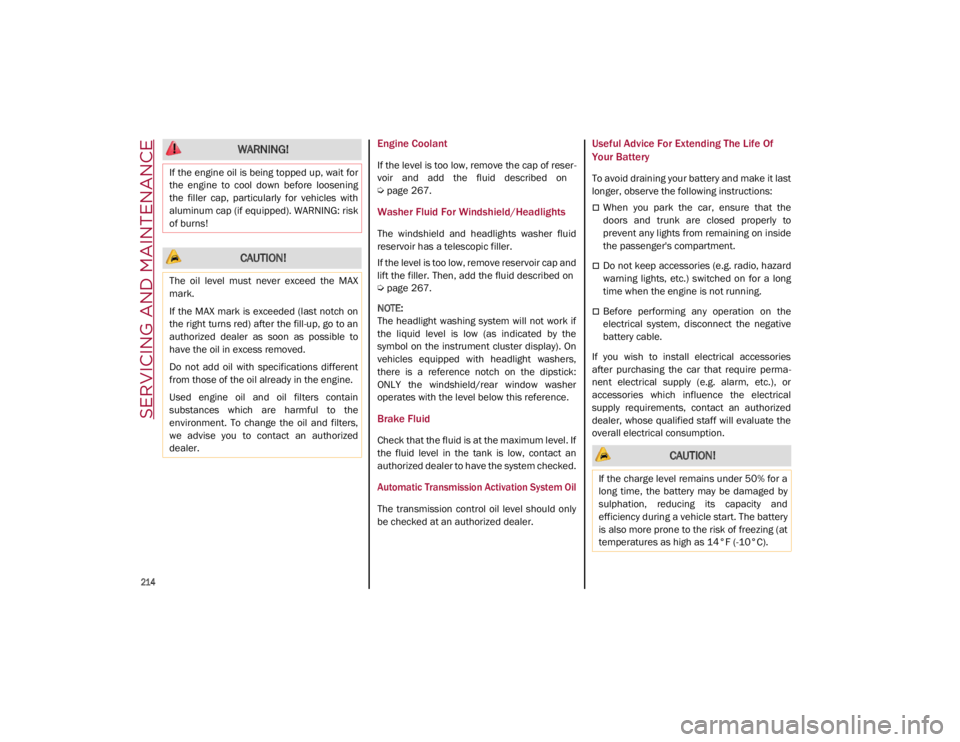
Engine Coolant
If the level is too low, remove the cap of reser-
voir and add the fluid described on
Ú
page 267.
Washer Fluid For Windshield/Headlights
The windshield and headlights washer fluid
reservoir has a telescopic filler.
If the level is too low, remove reservoir cap and
lift the filler. Then, add the fluid described on
Ú
page 267.
NOTE:
The headlight washing system will not work if
the liquid level is low (as indicated by the
symbol on the instrument cluster display). On
vehicles equipped with headlight washers,
there is a reference notch on the dipstick:
ONLY the windshield/rear window washer
operates with the level below this reference.
Brake Fluid
Check that the fluid is at the maximum level. If
the fluid level in the tank is low, contact an
authorized dealer to have the system checked.
Automatic Transmission Activation System Oil
The transmission control oil level should only
be checked at an authorized dealer.
Useful Advice For Extending The Life Of
Your Battery
To avoid draining your battery and make it last
longer, observe the following instructions:
When you park the car, ensure that the
doors and trunk are closed properly to
prevent any lights from remaining on inside
the passenger's compartment.
Do not keep accessories (e.g. radio, hazard
warning lights, etc.) switched on for a long
time when the engine is not running.
Before performing any operation on the
electrical system, disconnect the negative
battery cable.
If you wish to install electrical accessories
after purchasing the car that require perma -
nent electrical supply (e.g. alarm, etc.), or
accessories which influence the electrical
supply requirements, contact an authorized
dealer, whose qualified staff will evaluate the
overall electrical consumption.
WARNING!
If the engine oil is being topped up, wait for
the engine to cool down before loosening
the filler cap, particularly for vehicles with
aluminum cap (if equipped). WARNING: risk
of burns!
CAUTION!
The oil level must never exceed the MAX
mark.
If the MAX mark is exceeded (last notch on
the right turns red) after the fill-up, go to an
authorized dealer as soon as possible to
have the oil in excess removed.
Do not add oil with specifications different
from those of the oil already in the engine.
Used engine oil and oil filters contain
substances which are harmful to the
environment. To change the oil and filters,
we advise you to contact an authorized
dealer.
CAUTION!
If the charge level remains under 50% for a
long time, the battery may be damaged by
sulphation, reducing its capacity and
efficiency during a vehicle start. The battery
is also more prone to the risk of freezing (at
temperatures as high as 14°F (-10°C).
21_GA_OM_EN_USC_t.book Page 214
Page 217 of 284
215
(Continued)
NOTE:
After the battery is disconnected, the steering
must be initialized. The warning light on the
instrument panel switches on to indicate this.
To carry out this procedure, simply turn the
steering wheel all the way from one end to the
other, and then turn it back to the central posi-
tion.
Battery
The battery does not require the electrolyte to
be topped up with distilled water. A periodic
check carried out at an authorized dealer,
however, is necessary to check efficiency.
Follow the battery manufacturer's instructions
for maintenance.
Replacing The Battery
If necessary, replace the battery with another
original battery with the same specifications.
Follow the battery manufacturer’s instructions
for maintenance.
NOTE:
It will not be possible to open the trunk with a
key or by pushing the button in the passenger
compartment when the battery is discon
-
nected. So, always position the manual trunk
opening strap on the trunk lock before discon -
necting the battery
Ú
page 250.
Pressure Washing
Cleaning the engine compartment with a high
pressure washer is not recommended.
BATTERY RECHARGING
Important Notes
NOTE:
Before using the charging device, always
make sure that it is appropriate for the
installed battery, with constant voltage
(below 14.8 Volts) and low amperage
(maximum 15 Amps).
Recharge the battery in a well ventilated
environment.
Before using any devices to charge or to
maintain the charge of the battery, carefully
follow the instructions provided with the
device in order to properly and safely
connect it to the car battery.
WARNING!
Battery acid is a corrosive solution and
can burn or even blind you. Do not allow
battery acid to contact your eyes, skin, or
clothing. Do not lean over a battery when
attaching clamps
Ú
page 199. If acid
splashes in eyes or on skin, flush the area
immediately with large amounts of water.
Battery gas is flammable and explosive.
Keep flame or sparks away from the
battery. Do not use a booster battery or
any other booster source with an output
greater than 12 Volts. Do not allow cable
clamps to touch each other.
Battery posts, terminals, and related
accessories contain lead and lead
compounds. Wash hands after handling.
CAUTION!
Precautions have been taken to safeguard
all parts and connections however, the
pressures generated by these machines is
such that complete protection against
water ingress cannot be guaranteed.
WARNING! (Continued)
WARNING!
Never charge or recharge a frozen battery:
it may explode because of the nitrogen
trapped inside the ice crystals.
At all times while charging or recharging
the battery, make sure that any sparks or
open flames are kept sufficiently far away
from the battery.
21_GA_OM_EN_USC_t.book Page 215
Page 218 of 284

SERVICING AND MAINTENANCE
216
You can recharge the battery without discon-
necting the wires of the vehicle's electrical
system.
To reach the battery, remove the access
panel inside the trunk.
Battery Access Panel
Remove the protective cover and connect
the positive cable terminal of the charger
(usually red) to the positive terminal (+) of
the battery.
Connect the negative terminal of the
charger (usually black) to nut next to the
negative terminal (-) of the battery. Battery
The vehicle is equipped with an IBS (Intelligent
Battery Sensor), which is able to measure the
charge and discharge voltage and calculate
the charge level and the general condition of
the battery. The sensor is placed next to the
negative terminal (-) of the battery. For a correct charge/discharge procedure, the
charge voltage must go through the IBS
sensor.
1. Turn the charger on and follow the instruc
-
tions on the user's manual to completely
recharge the battery.
2. When the battery is charged, turn the charger off before disconnecting it from
the battery.
3. Disconnect the black cable terminal of the battery charger and then the red cable
terminal.
4. Refit the protective cover of the positive terminal of the battery and the access
cover to the battery compartment.
NOTE:
If a “quick-type” battery charger is used with
the battery fitted on the vehicle, before
connecting it disconnect both cables of the
battery itself. Do not use a “quick-type” battery
charger to provide the starting voltage.
1 — Protective Cover
2 — Negative Post (Nut)
21_GA_OM_EN_USC_t.book Page 216
Page 220 of 284
SERVICING AND MAINTENANCE
218
Replace The Cabin Air Cleaner
For the correct servicing intervals
Ú
page 204. For cabin air cleaner replace -
ment, contact an authorized dealer.
Lubricating Moving Parts Of The Bodywork
Ensure that the locks and bodywork junction
points, including components such as the seat
guides, door hinges (and rollers), trunk and hood
are periodically lubricated with lithium-based
grease to ensure correct, silent operation and to
protect them from rust and wear.
Thoroughly clean the components, eliminating
every trace of dirt and dust. After lubricating,
eliminate excess oil and grease. Also pay
particular attention to the hood closing
devices, to ensure correct operation. During
operations on the hood, to be carried out with
the engine cold, also remember to check,
clean and lubricate the locking, release and
safety devices. Lubricate the external lock barrels twice a
year. Apply a small amount of high-quality
lubricant directly into the lock barrel.
If necessary, contact an authorized dealer as
soon as possible.
Windshield Wiper
Periodically clean the windshield and rear
window and rubber profile of the windshield
wiper blades, using a sponge or a soft cloth
and a non-abrasive detergent. This eliminates
the salt or impurities accumulated when
driving.
Prolonged operation of the windshield window
wipers with dry glass may cause the deteriora
-
tion of the blades, in addition to abrasion of
the surface of the glass. To eliminate the impu -
rities on the dry glass, always operate the
windshield washers.
In the event of very low outdoor temperatures,
below 0°F (-17.8°C) , ensure that the move -
ment of the rubber part in contact with the
glass is not obstructed. Use a suitable deicing
product to release it if required.
Avoid using the windshield wipers to remove
frost or ice.
Also avoid contact of the rubber profile of the
blades with petroleum derivatives such as
engine oil, gas, etc.
NOTE:
The life of the windshield wiper blades varies
according to the usage frequency. In any case,
it is advised to replace the blades approxi
-
mately once a year. When the blades are worn,
noise, marks on the glass or streaks of water
may be noticed. In the presence of these
conditions, clean the windshield wiper blades
or, if necessary, replace them.
Raising The Windshield Wiper Blades
(“Service Position” Function)
The “service position” function allows the
driver to replace the windshield wiper blades
more easily. It is also recommended to acti -
vate this function when it is snowing and to
make it easier to remove any dirt deposits in
the area where the blades are normally posi -
tioned, when washing.
Activation Of The Function
To activate this function, disable the wind -
shield wiper before setting the ignition device
to OFF.
This function can only be activated within two
minutes of placing the ignition in OFF.
WARNING!
Use only refrigerants and compressor lubricants
approved by FCA US LLC for your air conditioning
system. Some unapproved refrigerants are
flammable and can explode, injuring you. Other
unapproved refrigerants or lubricants can cause
the system to fail, requiring costly repairs. Refer
to Warranty Information Book, located in your
owner’s information kit, for further warranty
information.
WARNING!
Driving with worn windshield wiper blades
is a serious hazard, because visibility is
reduced in bad weather conditions.
21_GA_OM_EN_USC_t.book Page 218