cooling ALFA ROMEO GIULIA 2023 User Guide
[x] Cancel search | Manufacturer: ALFA ROMEO, Model Year: 2023, Model line: GIULIA, Model: ALFA ROMEO GIULIA 2023Pages: 248, PDF Size: 9.62 MB
Page 222 of 248
SERVICING AND MAINTENANCE
220
actual conditions of their use, however,
and may depart significantly from the
norm due to variations in driving habits,
service practices, and differences in
road characteristics and climate.
TRACTION GRADES
The Traction grades, from highest to
lowest, are AA, A, B, and C. These
grades represent the tire's ability to
stop on wet pavement, as measured
under controlled conditions on
specified government test surfaces of
asphalt and concrete. A tire marked C
may have poor traction performance.
TEMPERATURE GRADES
The temperature grades are A (the
highest), B, and C, representing the
tire's resistance to the generation of
heat and its ability to dissipate heat,
when tested under controlled
conditions on a specified indoor
laboratory test wheel. Sustained high
temperature can cause the material of
the tire to degenerate and reduce tire life, and excessive temperature can
lead to sudden tire failure. The grade C
corresponds to a level of performance,
which all passenger vehicle tires must
meet under the Federal Motor Vehicle
Safety Standard No. 109. Grades B and
A represent higher levels of
performance on the laboratory test
wheel, than the minimum required by
law.
STORING THE VEHICLE
If the vehicle is left inactive for longer than a
month, the following precautions should be
observed:
Park the vehicle in an area that is covered and
dry, and well-ventilated if possible. Slightly
open the windows.
Check that the Electric Park Brake is not
activated.
Carry out the procedure: “manual trunk
opening device” procedure described in this
paragraph.
Disconnect the negative battery terminal and
check the battery charge. Repeat this check
once every three months during storage.
If the battery is not disconnected from the
electrical system, check its state of charge
every 30 days.
Clean and protect the painted parts using
protective wax.
Clean and protect the shiny metal parts using
special compounds available commercially.
Sprinkle talcum powder on the windshield wiper
rubber blades, and lift them off the glass.
Cover the vehicle with a fabric or perforated
plastic sheet, paying particular care not to
damage the painted surface by dragging any
dust that may have accumulated on it. Do not
use compact plastic sheets, as they do not
allow humidity to evaporate from the surface
of the vehicle.
Inflate tires to +7.25 psi (+0.5 bar) above the
standard prescribed pressure and check it
periodically.
Do not drain the engine cooling system.
Any time the vehicle is left inactive for two
weeks or more, operate the air conditioning
system with engine idling for at least five
minutes, setting external air and with fan set to
maximum speed. This operation will ensure
appropriate lubrication for the system, thus
minimizing the possibility of damage to the
compressor when the system is operated again.
NOTE:
After placing the ignition in STOP and having
closed the driver side door, wait at least one
minute before disconnecting the electrical supply
from the battery. When reconnecting the elec
-
trical supply to the battery, make sure that the
ignition is in the STOP position and the driver side
door is closed.
WARNING!
The traction grade assigned to this tire is
based on straight-ahead braking traction
tests, and does not include acceleration,
cornering, hydroplaning, or peak traction
characteristics.
WARNING!
The temperature grade for this tire is
established for a tire that is properly inflated
and not overloaded. Excessive speed,
underinflation, or excessive loading, either
separately or in combination, can cause heat
buildup and possible tire failure.
23_GA_OM_EN_USC_t.book Page 220
Page 233 of 248
231
FUEL SYSTEM CAUTIONS
NOTE:
Intentional tampering with the emissions control system can result in civil penalties being assessed against you.
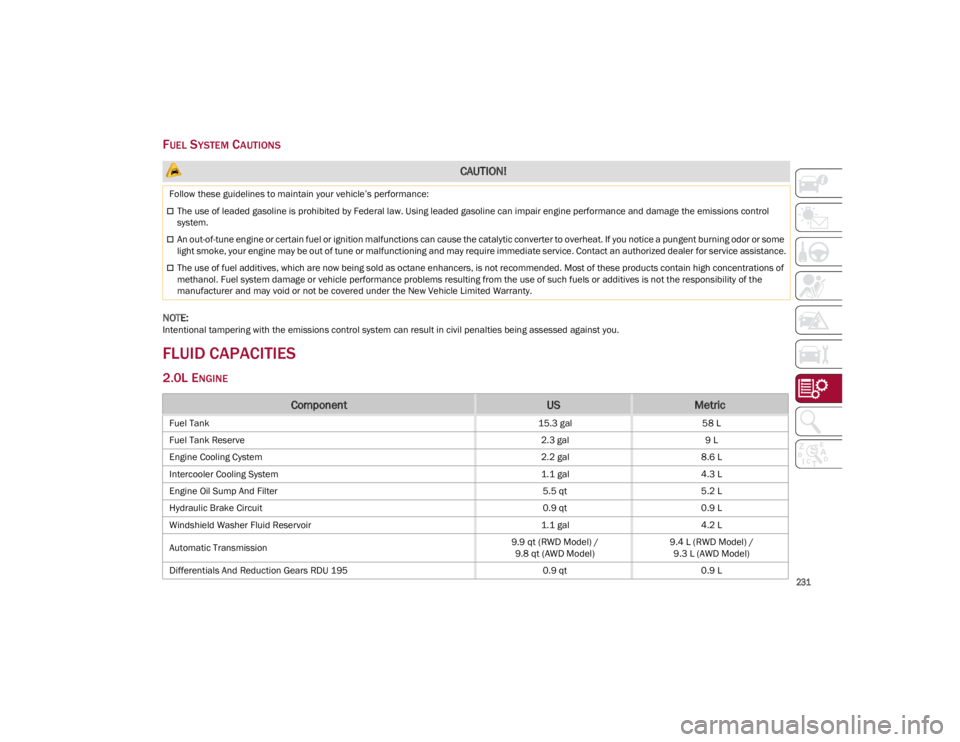
FLUID CAPACITIES
2.0L ENGINE
CAUTION!
Follow these guidelines to maintain your vehicle’s performance:
The use of leaded gasoline is prohibited by Federal law. Using leaded gasoline can impair engine performance and damage the emissions control
system.
An out-of-tune engine or certain fuel or ignition malfunctions can cause the catalytic converter to overheat. If you notice a pungent burning odor or some
light smoke, your engine may be out of tune or malfunctioning and may require immediate service. Contact an authorized dealer for service assistance.
The use of fuel additives, which are now being sold as octane enhancers, is not recommended. Most of these products contain high concentrations of
methanol. Fuel system damage or vehicle performance problems resulting from the use of such fuels or additives is not the responsibility of the
manufacturer and may void or not be covered under the New Vehicle Limited Warranty.
ComponentUSMetric
Fuel Tank15.3 gal58 L
Fuel Tank Reserve 2.3 gal9 L
Engine Cooling Cystem 2.2 gal8.6 L
Intercooler Cooling System 1.1 gal4.3 L
Engine Oil Sump And Filter 5.5 qt5.2 L
Hydraulic Brake Circuit 0.9 qt0.9 L
Windshield Washer Fluid Reservoir 1.1 gal4.2 L
Automatic Transmission 9.9 qt (RWD Model) /
9.8 qt (AWD Model) 9.4 L (RWD Model) /
9.3 L (AWD Model)
Differentials And Reduction Gears RDU 195 0.9 qt0.9 L
23_GA_OM_EN_USC_t.book Page 231
Page 234 of 248
TECHNICAL SPECIFICATIONS
232
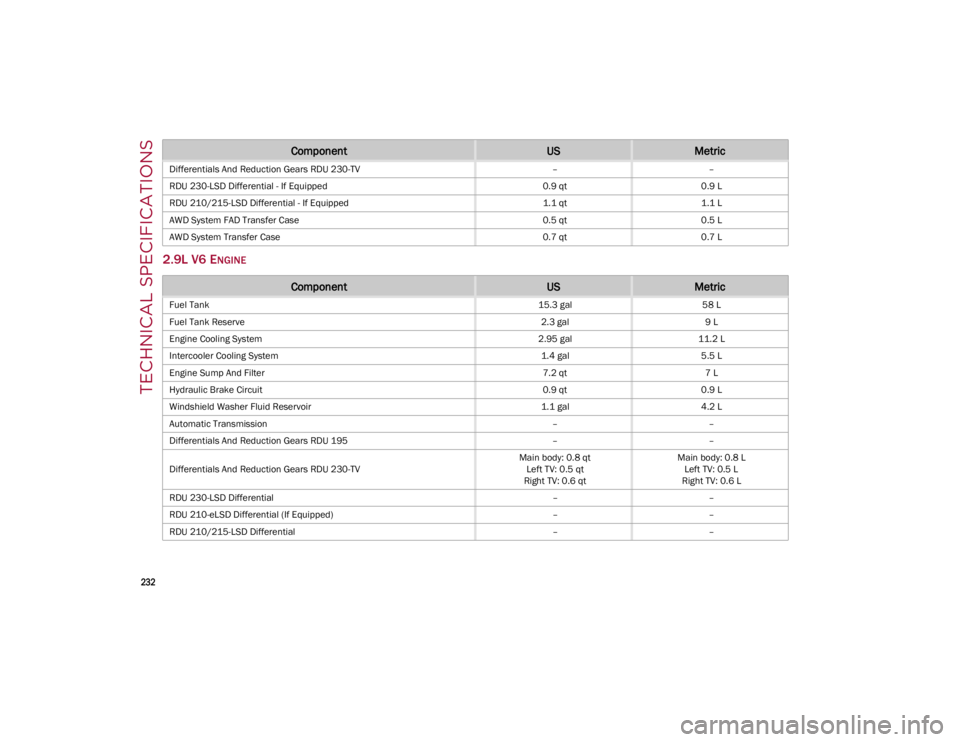
2.9L V6 ENGINE
Differentials And Reduction Gears RDU 230-TV––
RDU 230-LSD Differential - If Equipped 0.9 qt0.9 L
RDU 210/215-LSD Differential - If Equipped 1.1 qt1.1 L
AWD System FAD Transfer Case 0.5 qt0.5 L
AWD System Transfer Case 0.7 qt0.7 L
ComponentUSMetric
Fuel Tank 15.3 gal58 L
Fuel Tank Reserve 2.3 gal9 L
Engine Cooling System 2.95 gal11.2 L
Intercooler Cooling System 1.4 gal5.5 L
Engine Sump And Filter 7.2 qt7 L
Hydraulic Brake Circuit 0.9 qt0.9 L
Windshield Washer Fluid Reservoir 1.1 gal4.2 L
Automatic Transmission ––
Differentials And Reduction Gears RDU 195 ––
Differentials And Reduction Gears RDU 230-TV Main body: 0.8 qt
Left TV: 0.5 qt
Right TV: 0.6 qt Main body: 0.8 L
Left TV: 0.5 L
Right TV: 0.6 L
RDU 230-LSD Differential ––
RDU 210-eLSD Differential (If Equipped) ––
RDU 210/215-LSD Differential ––
ComponentUSMetric
23_GA_OM_EN_USC_t.book Page 232