maintenance ALFA ROMEO GIULIA 2023 Owner's Manual
[x] Cancel search | Manufacturer: ALFA ROMEO, Model Year: 2023, Model line: GIULIA, Model: ALFA ROMEO GIULIA 2023Pages: 248, PDF Size: 9.62 MB
Page 187 of 248
185
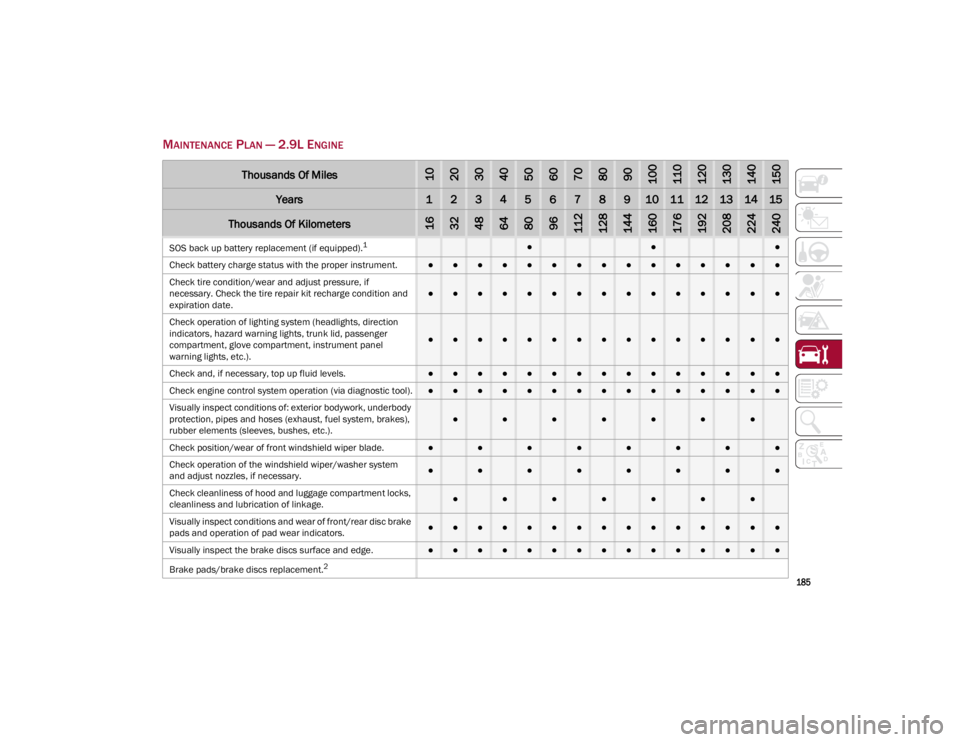
MAINTENANCE PLAN — 2.9L ENGINE
Thousands Of Miles102030405060708090100110120130140150
Years123456789101112131415
Thousands Of Kilometers163248648096112128144160176192208224240
SOS back up battery replacement (if equipped).1●●●
Check battery charge status with the proper instrument.
●●●●●●●●●●●●●●●
Check tire condition/wear and adjust pressure, if
necessary. Check the tire repair kit recharge condition and
expiration date.
●●●●●●●●●●●●●●●
Check operation of lighting system (headlights, direction
indicators, hazard warning lights, trunk lid, passenger
compartment, glove compartment, instrument panel
warning lights, etc.).
●●●●●●●●●●●●●●●
Check and, if necessary, top up fluid levels.
●●●●●●●●●●●●●●●
Check engine control system operation (via diagnostic tool).
●●●●●●●●●●●●●●●
Visually inspect conditions of: exterior bodywork, underbody
protection, pipes and hoses (exhaust, fuel system, brakes),
rubber elements (sleeves, bushes, etc.).
●●●●●●●
Check position/wear of front windshield wiper blade.●●●●●●●●
Check operation of the windshield wiper/washer system
and adjust nozzles, if necessary.
●●●●●●●●
Check cleanliness of hood and luggage compartment locks,
cleanliness and lubrication of linkage.
●●●●●●●
Visually inspect conditions and wear of front/rear disc brake
pads and operation of pad wear indicators.●●●●●●●●●●●●●●●
Visually inspect the brake discs surface and edge.
●●●●●●●●●●●●●●●
Brake pads/brake discs replacement.
2
23_GA_OM_EN_USC_t.book Page 185
Page 188 of 248
SERVICING AND MAINTENANCE
186
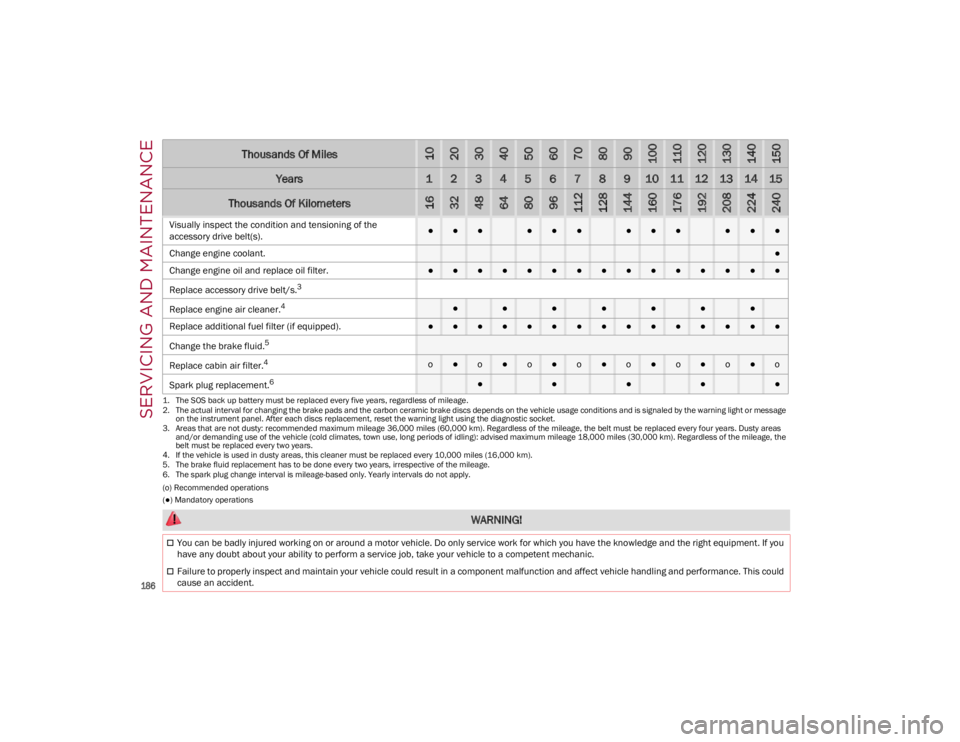
(o) Recommended operations
(●) Mandatory operations
Visually inspect the condition and tensioning of the
accessory drive belt(s).●●●●●●●●●●●●
Change engine coolant.
●
Change engine oil and replace oil filter.
●●●●●●●●●●●●●●●
Replace accessory drive belt/s.
3
Repla
ce engine air cleaner.
4●●●●●●●
Replace additional fuel filter (if equipped).●●●●●●●●●●●●●●●
Change the brake fluid.
5
Repla
ce cabin air filter.
4o●o●o●o●o●o●o●o
Spark plug replacement.
6●●●●●
1. The SOS back up battery must be replaced every five years, regardless of mileage.
2. The actual interval for changing the brake pads and the carbon ceramic brake discs depends on the vehicle usage conditions and is signaled by the warning light or message on the instrument panel. After each discs replacement, reset the warning light using the diagnostic socket.
3. Areas that are not dusty: recommended maximum mileage 36,000 miles (60,000 km). Regardless of the mileage, the belt must be replaced every four years. Dusty areas and/or demanding use of the vehicle (cold climates, town use, long periods of idling): advised maximum mileage 18,000 miles (30,000 km). Regardless of the mileage, the
belt must be replaced every two years.
4. If the vehicle is used in dusty areas, this cleaner must be replaced every 10,000 miles (16,000 km).
5. The brake fluid replacement has to be done every two years, irrespective of the mileage.
6. The spark plug change interval is mileage-based only. Yearly intervals do not apply.
Thousands Of Miles102030405060708090100110120130140150
Years123456789101112131415
Thousands Of Kilometers163248648096112128144160176192208224240
WARNING!
You can be badly injured working on or around a motor vehicle. Do only service work for which you have the knowledge and the right equipment. If you
have any doubt about your ability to perform a service job, take your vehicle to a competent mechanic.
Failure to properly inspect and maintain your vehicle could result in a component malfunction and affect vehicle handling and performance. This could
cause an accident.
23_GA_OM_EN_USC_t.book Page 186
Page 190 of 248
SERVICING AND MAINTENANCE
188
CHECKING LEVELS — 2.9L ENGINE
E
NGINE OIL
The engine oil level can be seen on the
instrument cluster display every time the engine
is started, or on the Information and
Entertainment system display by activating on
the main menu (MENU button) the following
functions in sequence: “Vehicle Information”;
“Engine Oil”. Check on the display using the 6 notches that the
oil level is between the MIN and MAX level:
1 notch MIN level, 6 notches MAX level.
NOTE:
Use care when filling under hood fluids such as
engine oil, windshield washer fluid, antifreeze
etc. to minimize spillage onto the top of the
engine. Any excess fluid that is spilled onto the
top of the engine should be removed using
compressed air or an absorbent cloth.If the oil level is close to or below the MIN mark,
add oil gradually through the filler, (refer to
“Top-Up And Oil Level Indication Update On
Display” in this section) considering that each
notch shown on the display corresponds to
approximately 8.8 fl oz (250 ml).
The oil level can also be checked manually on
2.9L Engines.
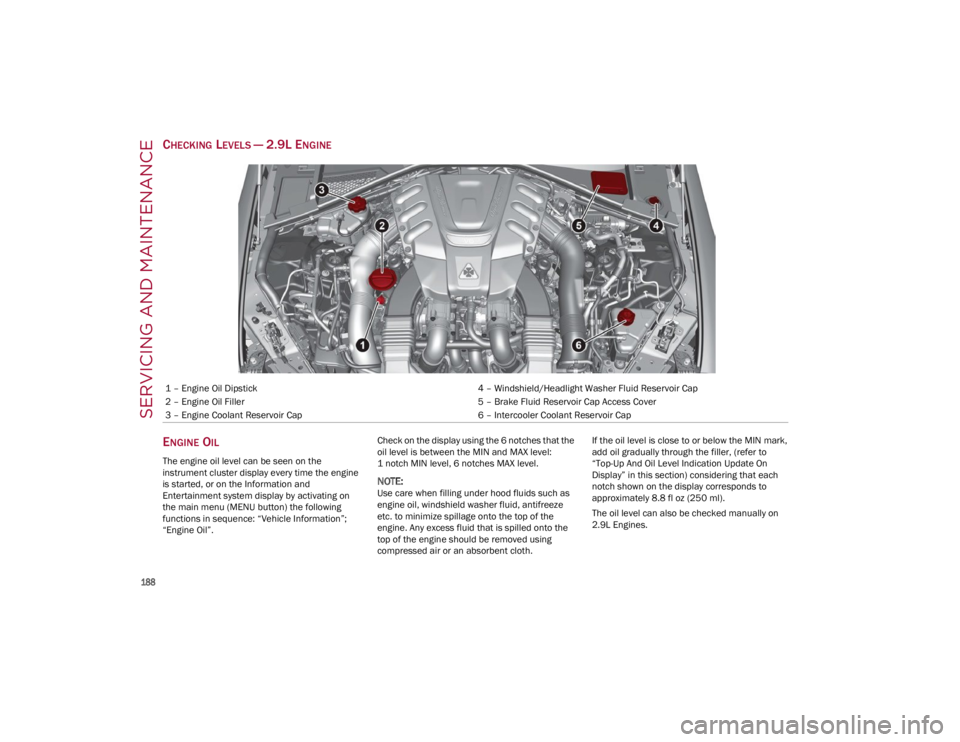
1 – Engine Oil Dipstick
4 – Windshield/Headlight Washer Fluid Reservoir Cap
2 – Engine Oil Filler 5 – Brake Fluid Reservoir Cap Access Cover
3 – Engine Coolant Reservoir Cap 6 – Intercooler Coolant Reservoir Cap
23_GA_OM_EN_USC_t.book Page 188
Page 192 of 248
SERVICING AND MAINTENANCE
190
NOTE:
The headlight washing system will not work if the
liquid level is low (as indicated by the symbol on
the instrument cluster display). On vehicles
equipped with headlight washers, there is a refer-
ence notch on the dipstick: ONLY the windshield/
rear window washer operates with the level below
this reference.
BRAKE FLUID
Check that the fluid is at the maximum level. If
the fluid level in the tank is low, contact an
authorized dealer to have the system checked.
AUTOMATIC TRANSMISSION ACTIVATION
S
YSTEM OIL
The transmission control oil level should only be
checked at an authorized dealer.
USEFUL ADVICE FOR EXTENDING THE
L
IFE OF YOUR BATTERY
To avoid draining your battery and make it last
longer, observe the following instructions:
When you park the car, ensure that the doors
and trunk are closed properly to prevent any
lights from remaining on inside the
passenger's compartment.
Do not keep accessories (e.g. radio, hazard
warning lights, etc.) switched on for a long time
when the engine is not running.
Before performing any operation on the
electrical system, disconnect the negative
battery cable. If you wish to install electrical accessories after
purchasing the car that require permanent
electrical supply (e.g. alarm, etc.), or accessories
which influence the electrical supply
requirements, contact an authorized dealer,
whose qualified staff will evaluate the overall
electrical consumption.
NOTE:
After the battery is disconnected, the steering
must be initialized. The warning light on the
instrument panel switches on to indicate this. To
carry out this procedure, simply turn the steering
wheel all the way from one end to the other, and
then turn it back to the central position.
BATTERY
The battery does not require the electrolyte to be
topped up with distilled water. A periodic check
carried out at an authorized dealer, however, is
necessary to check efficiency.
Follow the battery manufacturer's instructions for
maintenance.
Replacing The Battery
If necessary, replace the battery with another
original battery with the same specifications.
Follow the battery manufacturer’s instructions for
maintenance.
NOTE:
It will not be possible to open the trunk with a key
or by pushing the button in the passenger
compartment when the battery is disconnected.
So, always position the manual trunk opening
strap on the trunk lock before disconnecting the
battery
Ú
page 220.
CAUTION!
If the charge level remains under 50% for a
long time, the battery may be damaged by
sulphation, reducing its capacity and
efficiency during a vehicle start. The battery is
also more prone to the risk of freezing (at
temperatures as high as 14°F (-10°C).
WARNING!
Battery acid is a corrosive solution and can
burn or even blind you. Do not allow battery
acid to contact your eyes, skin, or clothing.
Do not lean over a battery when attaching
clamps
Ú
page 177. If acid splashes in eyes
or on skin, flush the area immediately with
large amounts of water.
Battery gas is flammable and explosive.
Keep flame or sparks away from the battery.
Do not use a booster battery or any other
booster source with an output greater than
12 Volts. Do not allow cable clamps to touch
each other.
Battery posts, terminals, and related
accessories contain lead and lead
compounds. Wash hands after handling.
23_GA_OM_EN_USC_t.book Page 190
Page 194 of 248
SERVICING AND MAINTENANCE
192
4. Refit the protective cover of the positive terminal of the battery and the access cover
to the battery compartment.
NOTE:
If a “quick-type” battery charger is used with the
battery fitted on the vehicle, before connecting it
disconnect both cables of the battery itself. Do
not use a “quick-type” battery charger to provide
the starting voltage.
VEHICLE MAINTENANCE
The following pages contain instructions on the
required maintenance from the technical
personnel who designed the vehicle.
In addition to these specific maintenance
instructions specified for routine scheduled
servicing, there are other components which may
require periodic maintenance or replacement
over the vehicle’s life cycle.
ENGINE OIL
Engine Oil Level Check
To ensure correct engine lubrication, the oil must
always be kept at the appropriate level.
Check the oil level at regular intervals, for
example every 1,864 miles (3,000 km).
It must be checked once full operating
temperature is reached.
The vehicle must also be parked on as level a
surface as possible.
The engine oil level can be checked using the
Information and Entertainment system. To
access the function, activate the main menu
(MENU button) and select the following options in
sequence: “Vehicle Information”; “Engine Oil”. Changing The Engine Oil
For the correct servicing intervals
Ú
page 182.
Choice Of Engine Oil Type
To ensure optimal performance and maximum
protection in all operating conditions, it is
advisable to only use certified engine oils
Ú
page 233.
Additives For Engine Oil
It is strongly recommended not to use additives
(other than leak detection dyes) with the engine
oil.
The engine oil is a product designed especially for
the vehicle and its performance may be deteri -
orated through the use of further additives.
Disposal Of Used Engine Oil And Filters
For disposal of used engine oil and filters, consult
the appropriate local regulations.
NOTE:
Inappropriate disposal of used engine oil may
seriously harm the environment.
ENGINE OIL FILTER
The engine oil filter should be replaced with a
new filter at every engine oil change.
Engine Oil Filter Selection
A full-flow type disposable oil filter should be used
for replacement. The quality of replacement
filters varies considerably. Only high quality
Mopar® certified filters should be used.
ENGINE AIR CLEANER
Engine Air Cleaner Filter Selection
The quality of replacement filters varies consid -
erably. Only high quality Mopar® certified filters
should be used.
AIR CONDITIONING SYSTEM
M
AINTENANCE
To ensure the best possible performance, the air
conditioning system must be checked and
undergo maintenance at an authorized dealer at
the beginning of the summer.
Replace The Cabin Air Cleaner
For the correct servicing intervals
Ú
page 182.
For cabin air cleaner replacement, contact an
authorized dealer.
CAUTION!
Do not use chemicals to clean the air
conditioning system, since the internal
components may be damaged. This kind of
damage is not covered by warranty.
WARNING!
Use only refrigerants and compressor lubri -
cants approved by the manufacturer for your
air conditioning system. Some unapproved
refrigerants are flammable and can explode,
injuring you. Other unapproved refrigerants or
lubricants can cause the system to fail, requir -
ing costly repairs. Refer to Warranty Informa -
tion Book, located in your owner’s information
kit, for further warranty information.
23_GA_OM_EN_USC_t.book Page 192
Page 196 of 248
SERVICING AND MAINTENANCE
194
Replacing The Windshield Wiper Blades
Proceed as follows:
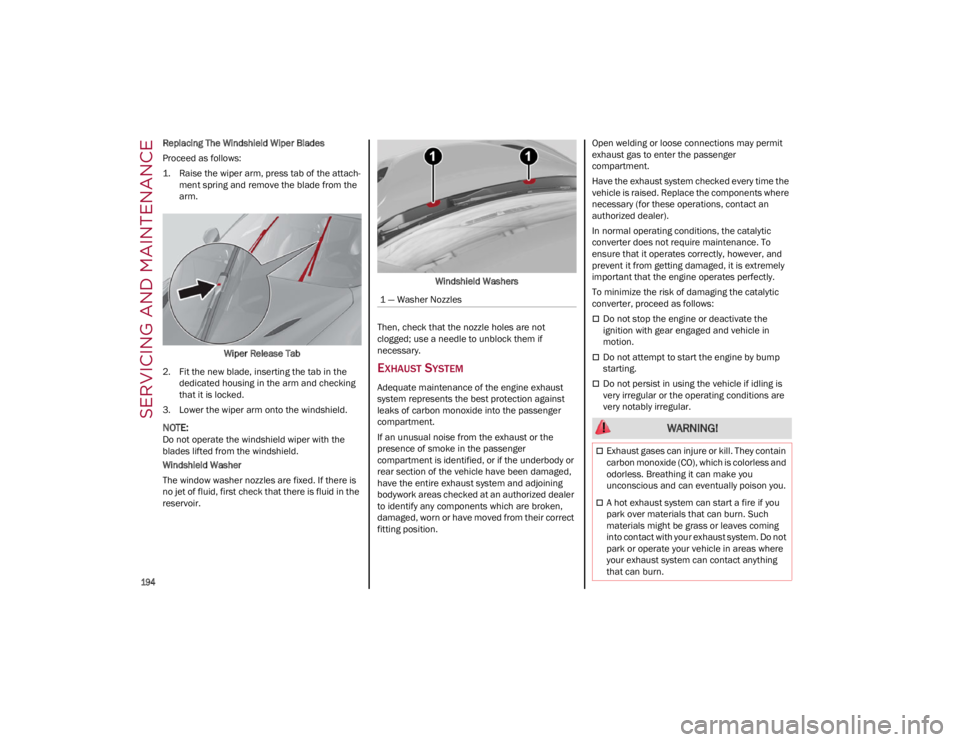
1. Raise the wiper arm, press tab of the attach -
ment spring and remove the blade from the
arm.
Wiper Release Tab
2. Fit the new blade, inserting the tab in the dedicated housing in the arm and checking
that it is locked.
3. Lower the wiper arm onto the windshield.
NOTE:
Do not operate the windshield wiper with the
blades lifted from the windshield.
Windshield Washer
The window washer nozzles are fixed. If there is
no jet of fluid, first check that there is fluid in the
reservoir. Windshield Washers
Then, check that the nozzle holes are not
clogged; use a needle to unblock them if
necessary.
EXHAUST SYSTEM
Adequate maintenance of the engine exhaust
system represents the best protection against
leaks of carbon monoxide into the passenger
compartment.
If an unusual noise from the exhaust or the
presence of smoke in the passenger
compartment is identified, or if the underbody or
rear section of the vehicle have been damaged,
have the entire exhaust system and adjoining
bodywork areas checked at an authorized dealer
to identify any components which are broken,
damaged, worn or have moved from their correct
fitting position. Open welding or loose connections may permit
exhaust gas to enter the passenger
compartment.
Have the exhaust system checked every time the
vehicle is raised. Replace the components where
necessary (for these operations, contact an
authorized dealer).
In normal operating conditions, the catalytic
converter does not require maintenance. To
ensure that it operates correctly, however, and
prevent it from getting damaged, it is extremely
important that the engine operates perfectly.
To minimize the risk of damaging the catalytic
converter, proceed as follows:
Do not stop the engine or deactivate the
ignition with gear engaged and vehicle in
motion.
Do not attempt to start the engine by bump
starting.
Do not persist in using the vehicle if idling is
very irregular or the operating conditions are
very notably irregular.
1 — Washer Nozzles
WARNING!
Exhaust gases can injure or kill. They contain
carbon monoxide (CO), which is colorless and
odorless. Breathing it can make you
unconscious and can eventually poison you.
A hot exhaust system can start a fire if you
park over materials that can burn. Such
materials might be grass or leaves coming
into contact with your exhaust system. Do not
park or operate your vehicle in areas where
your exhaust system can contact anything
that can burn.
23_GA_OM_EN_USC_t.book Page 194
Page 198 of 248
SERVICING AND MAINTENANCE
196
Disposal Of Used Coolant
Disposal of engine/intercooler coolant is subject
to legal requirements: consult the appropriate
local regulations.
NOTE:
To prevent the fluid from being ingested by
children or animals, do not keep it in open
containers or pour it on the ground. If ingested,
contact a doctor immediately. Eliminate any
traces of fluid from the ground immediately.
When the vehicle stops after a short trip,
steam may be seen coming out from front of
the hood. This is a normal phenomenon which
is due to the presence of rain, snow or a lot of
moisture on the surface of the radiator.
With engine and system cold, do not top up
with coolant beyond the maximum level
indicated on the reservoir in the engine
compartment.
BRAKING SYSTEM
In order to guarantee the efficiency of the braking
system, periodically check its components; for
this operation, contact an authorized dealer.
For the correct servicing intervals
Ú
page 182.
NOTE:
Driving with your foot resting on the brake pedal
may compromise its efficiency, increasing the
risk of accidents. When driving, never keep your
foot on the brake pedal and don’t put unneces-
sary strain on it to prevent the brakes from over -
heating: excess pad wear may cause damage to
the braking system.
When an insufficient oil level is detected,
contact an authorized dealer to have the
system checked.
Always keep the cap of the brake fluid
reservoir (in the engine compartment)
completely closed.
AUTOMATIC TRANSMISSION
Use only a transmission oil with the same charac -
teristics as those indicated on
Ú
page 234.
Special Additives
Do not use any type of additive with the
automatic transmission oil. The automatic
transmission oil is a product designed especially
for this vehicle and its performance may be
compromised through the use of further
additives.
Frequency Of Oil Changes
In normal vehicle operating conditions, it is not
necessary to change the transmission oil.
REPLACING THE BATTERY
If necessary, replace the battery with another
battery with the same specifications. It is advised
to contact an authorized dealer for replacement.
WARNING!
Use only the manufacturer recommended
brake fluid
Ú
page 234. Using the wrong
type of brake fluid can severely damage your
brake system and/or impair its performance.
The proper type of brake fluid for your vehicle
is also identified on the original factory
installed hydraulic master cylinder reservoir.
To avoid contamination from foreign matter
or moisture, use only new brake fluid or fluid
that has been in a tightly closed container.
Keep the master cylinder reservoir cap
secured at all times. Brake fluid in an open
container absorbs moisture from the air
resulting in a lower boiling point. This may
cause it to boil unexpectedly during hard or
prolonged braking, resulting in sudden brake
failure. This could result in a collision.
Overfilling the brake fluid reservoir can result
in spilling brake fluid on hot engine parts,
causing the brake fluid to catch fire. Brake
fluid can also damage painted and vinyl
surfaces, care should be taken to avoid its
contact with these surfaces.
Do not allow petroleum-based fluid to
contaminate the brake fluid. Brake seal
components could be damaged, causing
partial or complete brake failure. This could
result in a collision.
CAUTION!
Do not use chemical flushes in your
transmission as the chemicals can damage
your transmission components. Such damage
is not covered by the New Vehicle Limited
Warranty.
CAUTION!
If a transmission fluid leak occurs, visit an
authorized dealer immediately. Severe
transmission damage may occur. An
authorized dealer has the proper tools to
adjust the fluid level accurately.
23_GA_OM_EN_USC_t.book Page 196
Page 199 of 248
197
(Continued)
NOTE:
Each time the 12V battery is reconnected, cycle
the steering wheel all the way to the left. Then
cycle the steering wheel all the way to the right to
allow the steering angle sensor to learn the
steering angle thresholds.
Follow the battery manufacturer's instructions for
maintenance.
NOTE:
It will not be possible to open the trunk with a key
or by pressing the button in the passenger
compartment when the battery is disconnected.
So, always position the manual trunk opening
strap on the trunk lock before disconnecting the
battery
Ú
page 220.
FUSES
General Information
The fuses protect electrical systems against
excessive current.
When a device does not work, you must check the
electrical circuit inside of the fuse for a break/
melt.
Also, please be aware that using power outlets for
extended periods of time with the engine off may
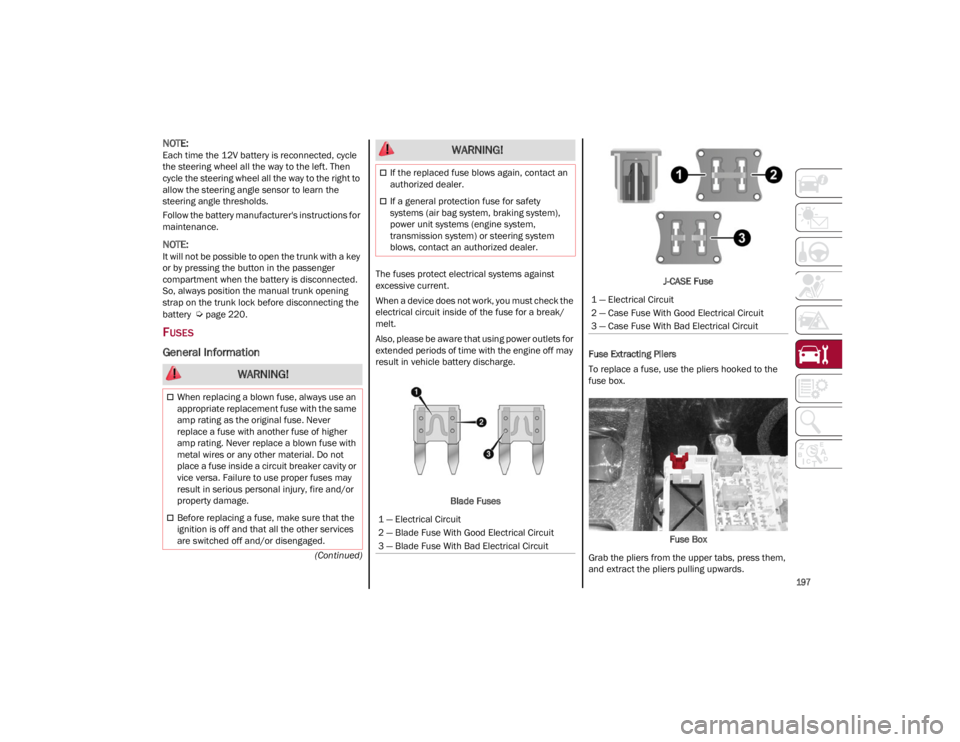
result in vehicle battery discharge.Blade Fuses J-CASE Fuse
Fuse Extracting Pliers
To replace a fuse, use the pliers hooked to the
fuse box.
Fuse Box
Grab the pliers from the upper tabs, press them,
and extract the pliers pulling upwards.
WARNING!
When replacing a blown fuse, always use an
appropriate replacement fuse with the same
amp rating as the original fuse. Never
replace a fuse with another fuse of higher
amp rating. Never replace a blown fuse with
metal wires or any other material. Do not
place a fuse inside a circuit breaker cavity or
vice versa. Failure to use proper fuses may
result in serious personal injury, fire and/or
property damage.
Before replacing a fuse, make sure that the
ignition is off and that all the other services
are switched off and/or disengaged.
If the replaced fuse blows again, contact an
authorized dealer.
If a general protection fuse for safety
systems (air bag system, braking system),
power unit systems (engine system,
transmission system) or steering system
blows, contact an authorized dealer.
1 — Electrical Circuit
2 — Blade Fuse With Good Electrical Circuit
3 — Blade Fuse With Bad Electrical Circuit
WARNING!
1 — Electrical Circuit
2 — Case Fuse With Good Electrical Circuit
3 — Case Fuse With Bad Electrical Circuit
23_GA_OM_EN_USC_t.book Page 197
Page 200 of 248
SERVICING AND MAINTENANCE
198
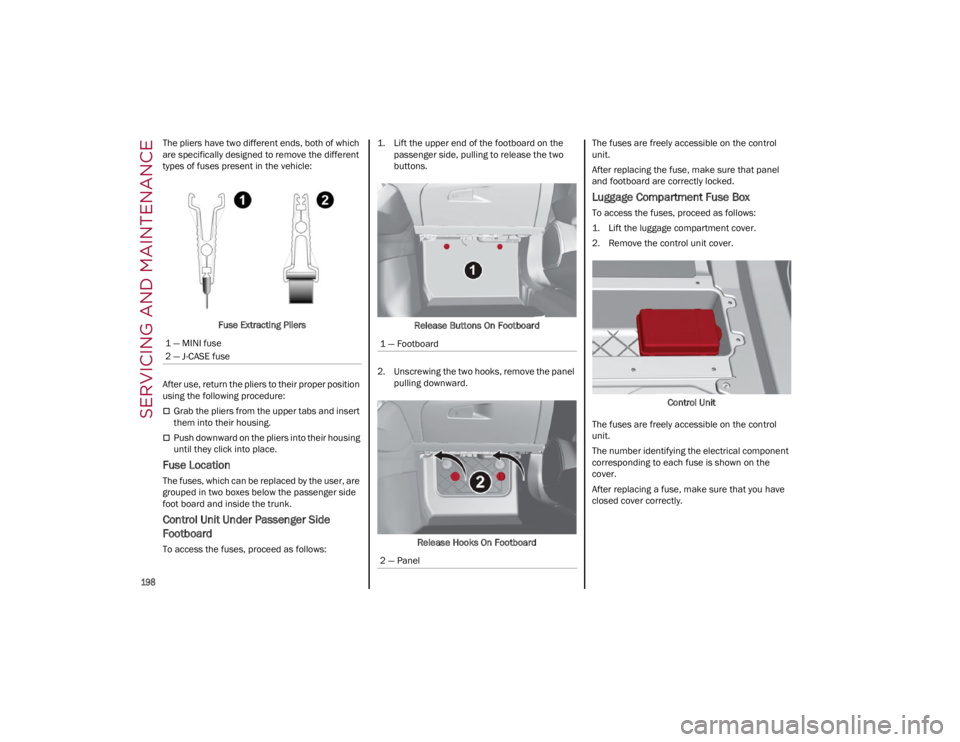
The pliers have two different ends, both of which
are specifically designed to remove the different
types of fuses present in the vehicle:Fuse Extracting Pliers
After use, return the pliers to their proper position
using the following procedure:
Grab the pliers from the upper tabs and insert
them into their housing.
Push downward on the pliers into their housing
until they click into place.
Fuse Location
The fuses, which can be replaced by the user, are
grouped in two boxes below the passenger side
foot board and inside the trunk.
Control Unit Under Passenger Side
Footboard
To access the fuses, proceed as follows: 1. Lift the upper end of the footboard on the
passenger side, pulling to release the two
buttons.
Release Buttons On Footboard
2. Unscrewing the two hooks, remove the panel pulling downward.
Release Hooks On Footboard The fuses are freely accessible on the control
unit.
After replacing the fuse, make sure that panel
and footboard are correctly locked.
Luggage Compartment Fuse Box
To access the fuses, proceed as follows:
1. Lift the luggage compartment cover.
2. Remove the control unit cover.
Control Unit
The fuses are freely accessible on the control
unit.
The number identifying the electrical component
corresponding to each fuse is shown on the
cover.
After replacing a fuse, make sure that you have
closed cover correctly.
1 — MINI fuse
2 — J-CASE fuse
1 — Footboard
2 — Panel
23_GA_OM_EN_USC_t.book Page 198
Page 202 of 248
SERVICING AND MAINTENANCE
200
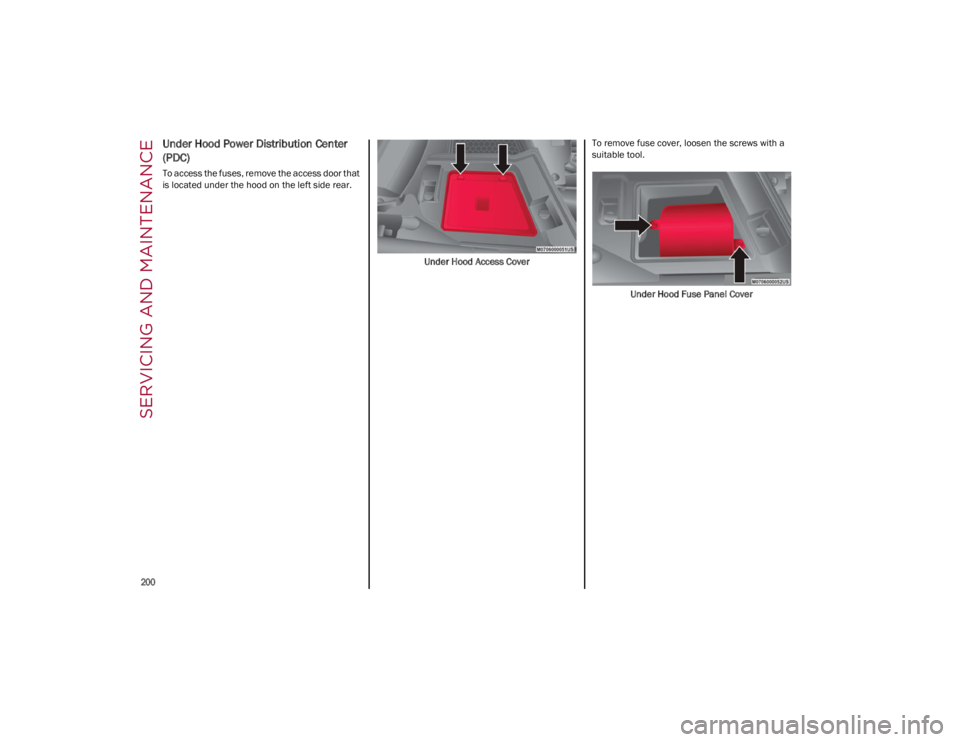
Under Hood Power Distribution Center
(PDC)
To access the fuses, remove the access door that
is located under the hood on the left side rear.Under Hood Access CoverTo remove fuse cover, loosen the screws with a
suitable tool.
Under Hood Fuse Panel Cover
23_GA_OM_EN_USC_t.book Page 200