engine Alfa Romeo Giulietta 2014 Owners Manual
[x] Cancel search | Manufacturer: ALFA ROMEO, Model Year: 2014, Model line: Giulietta, Model: Alfa Romeo Giulietta 2014Pages: 280, PDF Size: 6.65 MB
Page 218 of 280
BATTERYBattery F (see previous pages) does not
require the electrolyte to be topped up
with distilled water. A periodic check
carried out at an Alfa Romeo Dealership
is, however, necessary to check
efficiency.
REPLACING THE
BATTERY
145) 146) 147) 148)36)5)
If necessary, replace the battery with
another original battery with the same
specifications. Follow the battery
manufacturer's instructions for
maintenance.
USEFUL ADVICE FOR
EXTENDING THE LIFE OF
YOUR BATTERY
To avoid draining your battery and
make it last longer, observe the
following instructions:
❒when you park the car, ensure that
the doors, tailgate and bonnet are
closed properly, to prevent any lights
from remaining on inside the
passenger's compartment;❒switch off all roof lights inside the car:
the car is however equipped with a
system which switches all internal
lights off automatically;
❒do not keep accessories (e.g. sound
system, hazard lights, etc.) switched
on for a long time when the engine
is not running;
❒before performing any operation on
the electrical system, disconnect
the negative battery cable.
IMPORTANT After the battery is
disconnected, the steering must be
initialised. The warning light switches
on to indicate this. To carry out this
procedure, simply turn the steering
wheel all the way from one end to the
other or drive in a straight line for about
a hundred metres.
IMPORTANT If the charge level remains
under 50% for a long time, the battery
is damaged by sulphation, reducing
its capacity and efficiency at start-up.
The battery will also be more at risk
of freezing (this can happen as early as
–10°C). Refer to the paragraph "Car
inactivity" in "Starting and driving"
chapter if the car is left parked for a
long time.If, after purchasing the car, you wish to
install electrical accessories which
require permanent electrical supply (e.g.
alarm, etc.) or accessories which
influence the electrical supply
requirements, contact an Alfa Romeo
Dealership, whose qualified staff will
evaluate the overall electrical
consumption.
WARNING
145) Battery liquid is poisonous and
corrosive. Avoid contact with the
skin and eyes. Keep naked flames
and sources of sparks away from
the battery: risk of explosion and
fire.
146) Using the battery with
insufficient fluid irreparably
damages the battery and may
cause an explosion.
147) If the car must remain unused
for a long time at a very low
temperature, remove the battery
and take it to a warm place, to
avoid freezing.
214
SERVICING AND MAINTENANCE
Page 223 of 280
❒remove the aerial from the roof when
using a carwash;
❒if high pressure jets or cleaners are
used to wash the car, keep a
distance of at least 40 cm from the
bodywork to avoid damage or
alteration. Bear in mind that a build
up of water could cause damage
to the car in the long term;
❒wash the bodywork using a low
pressure jet of water;
❒wipe a sponge with a slightly soapy
solution over the bodywork,
frequently rinsing the sponge;
❒rinse well with water and dry with a
jet of air or a chamois leather.
Dry the less visible parts (e.g. door
frames, bonnet, headlight frames, etc.)
with special care, as water may
stagnate more easily in these areas. Do
not wash the car after it has been left
in the sun or with the bonnet hot:
this may alter the shine of the
paintwork.
Exterior plastic parts must be cleaned
in the same way as the rest of the car.IMPORTANT
Avoid parking under trees; the resin
dropped by trees makes the paintwork
go opaque and increases the possibility
of corrosion.
Bird droppings must be washed off
immediately and thoroughly as the acid
they contain is particularly aggressive.
Windows
Use specific detergents and clean
cloths to prevent scratching or altering
the transparency.
IMPORTANT Wipe the rear window
inside gently with a cloth following the
direction of the filaments to avoid
damaging the heating device.
Front headlights
Use a soft cloth soaked in water and
detergent for washing cars.
IMPORTANT Never use aromatic
substances (e.g. petrol) or ketenes (e.g.
acetone) for cleaning the plastic lenses
of the front headlights.
IMPORTANT When cleaning with a
pressure washer, keep the water jet at
least 20 cm away from the headlights.Engine compartment
At the end of every winter, wash the
engine compartment thoroughly, taking
care not to aim the jet of water directly
at the electronic control units or at
the windscreen wiper motors. Have this
operation performed at a specialised
workshop.
IMPORTANT The washing should take
place with the engine cold and the
ignition key in the STOP position. After
the washing operation, make sure
that the various protections (e.g. rubber
caps and guards) have not been
removed or damaged.
IMPORTANT
6) Detergents cause water pollution.
Only wash your car in areas
equipped to collect and treat
wastewater from this type
of activity.
219
Page 227 of 280
TECHNICAL SPECIFICATIONS
Everything you may find useful for
understanding how your car is made
and works is contained in this chapter
and illustrated with data, tables and
graphics. For the enthusiasts and the
technician, but also just for those who
want to know every detail of their
car.IDENTIFICATION DATA....................224
ENGINE CODES - BODYWORK
VERSIONS ......................................22
ENGINE ..........................................227
FUEL SUPPLY .................................231
TRANSMISSION .............................232
BRAKES .........................................233
SUSPENSION .................................23
STEERING SYSTEM .......................235
WHEELS .........................................236
DIMENSIONS ..................................240
PERFORMANCE .............................241
WEIGHTS .......................................242
REFUELLING ..................................244
FLUIDS AND LUBRICANTS ............247
FUEL CONSUMPTION ....................25
CO2 EMISSIONS ............................252
PRESCRIPTIONS FOR HANDLING
THE VEHICLE AT THE END OF ITS
LIFE ................................................253
223
5
4
1
Page 228 of 280
IDENTIFICATION
DATAThe identification data of the car are:
❒V.I.N. plate;
❒Chassis marking;
❒Body paintwork identification plate;
❒Engine marking.
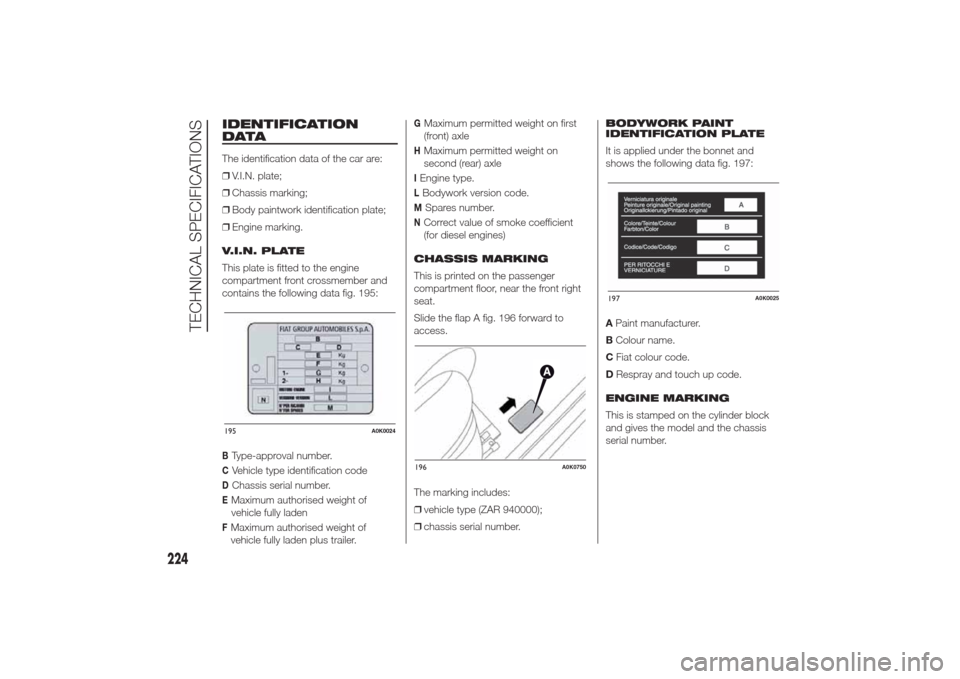
V.I.N. PLATE
This plate is fitted to the engine
compartment front crossmember and
contains the following data fig. 195:BType-approval number.CVehicle type identification codeDChassis serial number.EMaximum authorised weight of
vehicle fully ladenFMaximum authorised weight of
vehicle fully laden plus trailer.
GMaximum permitted weight on first
(front) axleHMaximum permitted weight on
second (rear) axleIEngine type.LBodywork version code.M
Spares number.
NCorrect value of smoke coefficient
(for diesel engines)
CHASSIS MARKING
This is printed on the passenger
compartment floor, near the front right
seat.
Slide the flap A fig. 196 forward to
access.
The marking includes:
❒vehicle type (ZAR 940000);
❒chassis serial number.BODYWORK PAINT
IDENTIFICATION PLATE
It is applied under the bonnet and
shows the following data fig. 197:
APaint manufacturer.
BColour name.
CFiat colour code.
DRespray and touch up code.
ENGINE MARKING
This is stamped on the cylinder block
and gives the model and the chassis
serial number.
195
A0K0024
197
A0K0025
224
TECHNICAL SPECIFICATIONS
196
A0K0750
Page 229 of 280
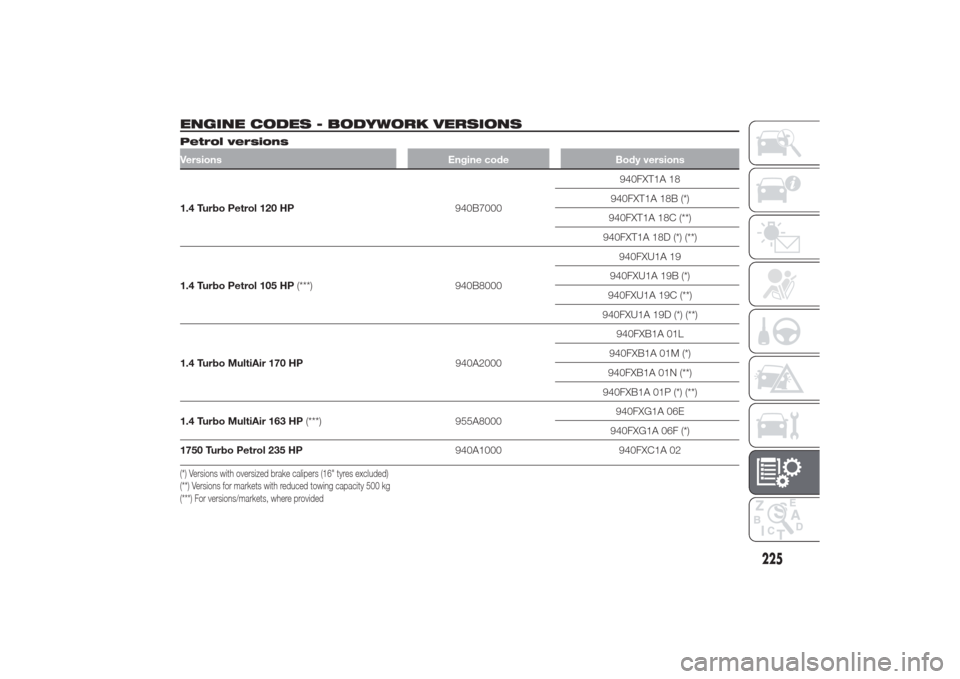
ENGINE CODES - BODYWORK VERSIONSPetrol versionsVersions Engine code Body versions1.4 Turbo Petrol 120 HP940B7000940FXT1A 18
940FXT1A 18B (*)
940FXT1A 18C (**)
940FXT1A 18D (*) (**)
1.4 Turbo Petrol 105 HP(***) 940B8000940FXU1A 19
940FXU1A 19B (*)
940FXU1A 19C (**)
940FXU1A 19D (*) (**)
1.4 Turbo MultiAir 170 HP940A2000940FXB1A 01L
940FXB1A 01M (*)
940FXB1A 01N (**)
940FXB1A 01P (*) (**)
1.4 Turbo MultiAir 163 HP(***) 955A8000940FXG1A 06E
940FXG1A 06F (*)
1750 Turbo Petrol 235 HP940A1000 940FXC1A 02(*) Versions with oversized brake calipers (16" tyres excluded)
(**) Versions for markets with reduced towing capacity 500 kg
(***) For versions/markets, where provided
225
Page 230 of 280
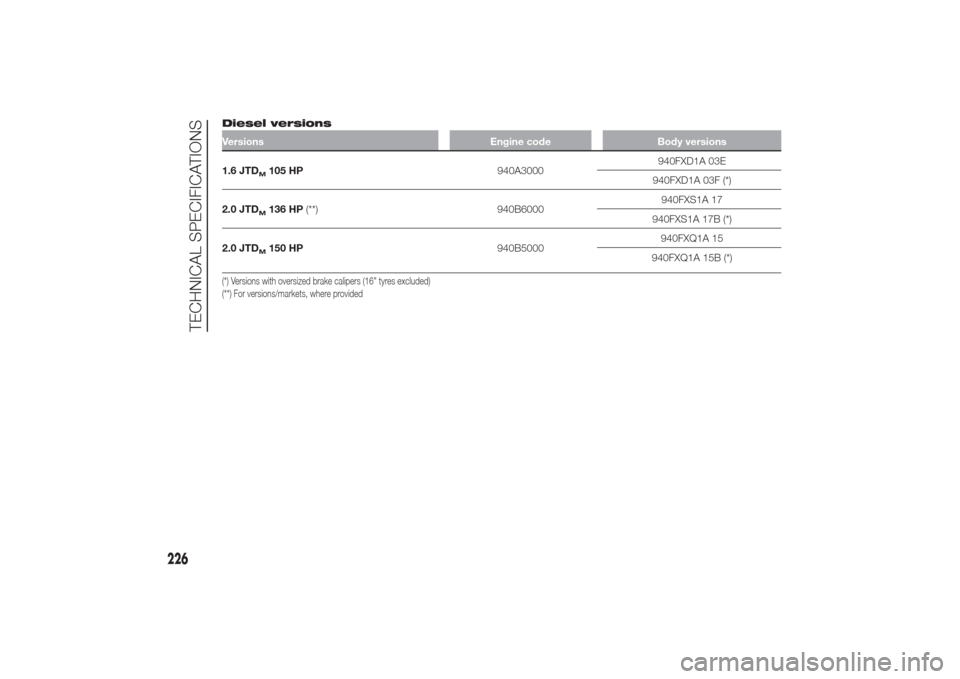
Diesel versionsVersions Engine code Body versions1.6 JTD
M105 HP940A3000940FXD1A 03E
940FXD1A 03F (*)
2.0 JTDM136 HP(**) 940B6000940FXS1A 17
940FXS1A 17B (*)
2.0 JTDM150 HP940B5000940FXQ1A 15
940FXQ1A 15B (*)
(*) Versions with oversized brake calipers (16" tyres excluded)
(**) For versions/markets, where provided
226
TECHNICAL SPECIFICATIONS
Page 231 of 280
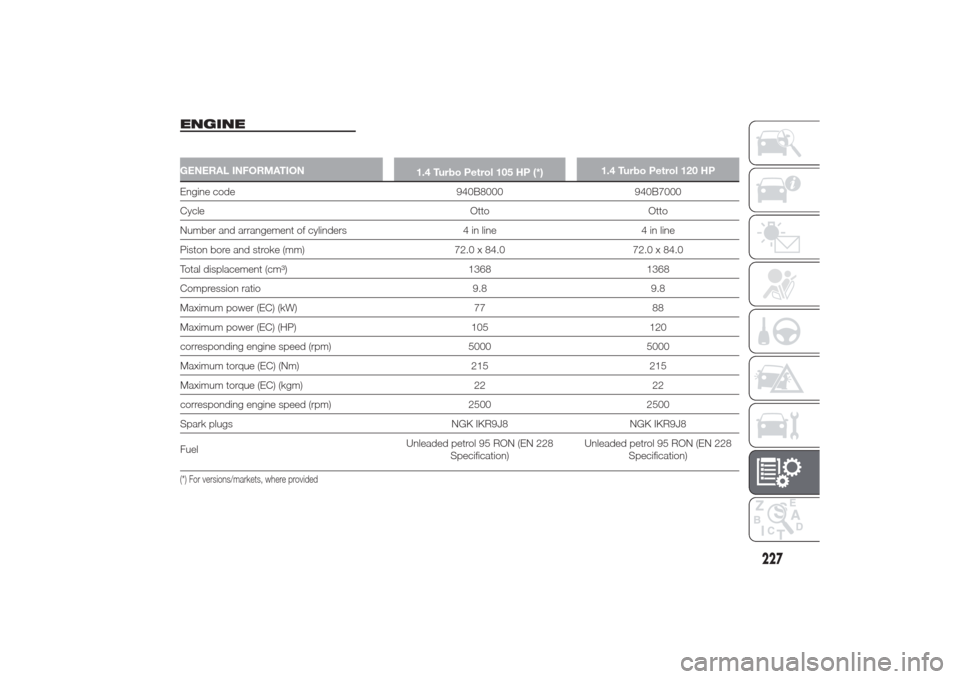
ENGINE
.
GENERAL INFORMATION
1.4 Turbo Petrol 105 HP (*)1.4 Turbo Petrol 120 HPEngine code 940B8000 940B7000
Cycle Otto Otto
Number and arrangement of cylinders 4 in line 4 in line
Piston bore and stroke (mm) 72.0 x 84.0 72.0 x 84.0
Total displacement (cm³) 1368 1368
Compression ratio 9.8 9.8
Maximum power (EC) (kW) 77 88
Maximum power (EC) (HP) 105 120
corresponding engine speed (rpm) 5000 5000
Maximum torque (EC) (Nm) 215 215
Maximum torque (EC) (kgm) 22 22
corresponding engine speed (rpm) 2500 2500
Spark plugs NGK IKR9J8 NGK IKR9J8
FuelUnleaded petrol 95 RON (EN 228
Specification)Unleaded petrol 95 RON (EN 228
Specification)(*) For versions/markets, where provided
227
Page 232 of 280
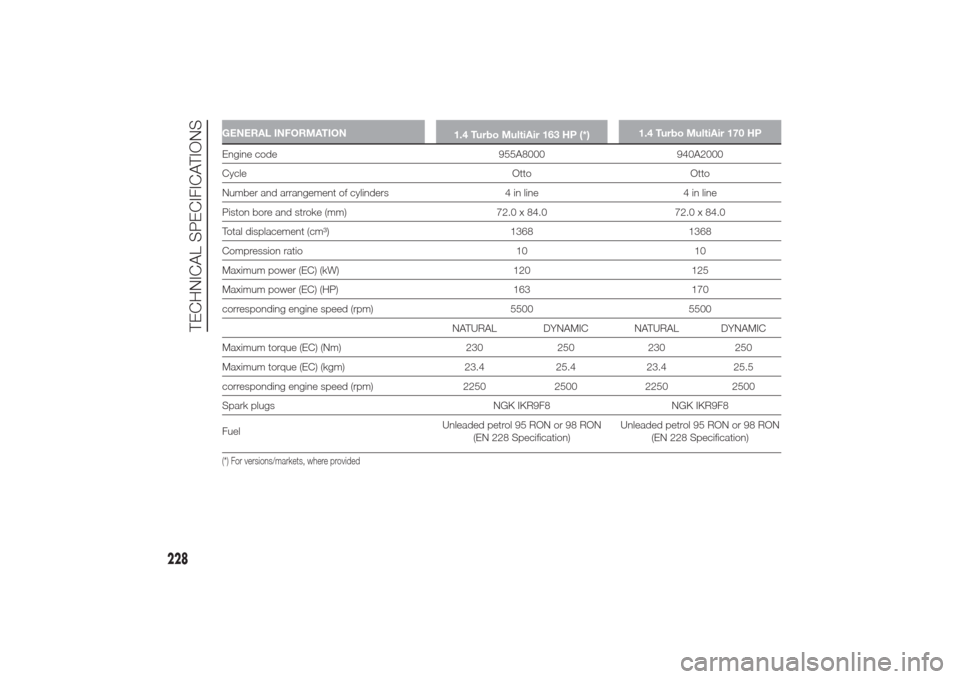
GENERAL INFORMATION
1.4 Turbo MultiAir 163 HP (*)1.4 Turbo MultiAir 170 HPEngine code 955A8000 940A2000
Cycle Otto Otto
Number and arrangement of cylinders 4 in line 4 in line
Piston bore and stroke (mm) 72.0 x 84.0 72.0 x 84.0
Total displacement (cm³) 1368 1368
Compression ratio 10 10
Maximum power (EC) (kW) 120 125
Maximum power (EC) (HP) 163 170
corresponding engine speed (rpm) 5500 5500
NATURAL DYNAMIC NATURAL DYNAMIC
Maximum torque (EC) (Nm) 230 250 230 250
Maximum torque (EC) (kgm) 23.4 25.4 23.4 25.5
corresponding engine speed (rpm) 2250 2500 2250 2500
Spark plugs NGK IKR9F8 NGK IKR9F8
FuelUnleaded petrol 95 RON or 98 RON
(EN 228 Specification)Unleaded petrol 95 RON or 98 RON
(EN 228 Specification)(*) For versions/markets, where provided
228
TECHNICAL SPECIFICATIONS
Page 233 of 280
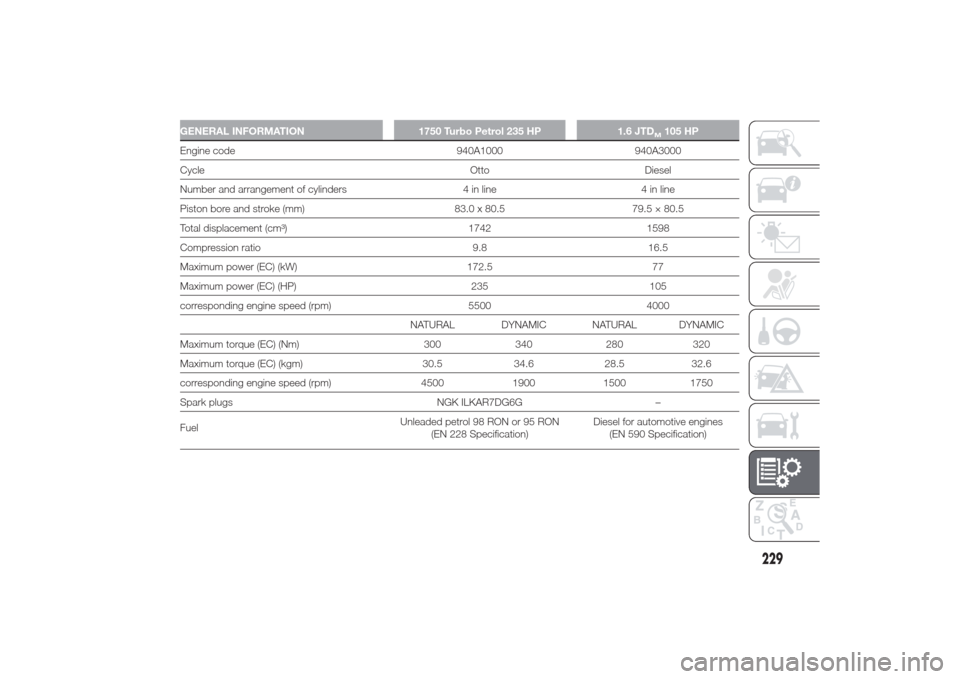
GENERAL INFORMATION 1750 Turbo Petrol 235 HP 1.6 JTD
M105 HP
Engine code 940A1000 940A3000
Cycle Otto Diesel
Number and arrangement of cylinders 4 in line 4 in line
Piston bore and stroke (mm) 83.0 x 80.5 79.5 × 80.5
Total displacement (cm³) 1742 1598
Compression ratio 9.8 16.5
Maximum power (EC) (kW) 172.5 77
Maximum power (EC) (HP) 235 105
corresponding engine speed (rpm) 5500 4000
NATURAL DYNAMIC NATURAL DYNAMIC
Maximum torque (EC) (Nm) 300 340 280 320
Maximum torque (EC) (kgm) 30.5 34.6 28.5 32.6
corresponding engine speed (rpm) 4500 1900 1500 1750
Spark plugs NGK ILKAR7DG6G –
FuelUnleaded petrol 98 RON or 95 RON
(EN 228 Specification)Diesel for automotive engines
(EN 590 Specification)
229
Page 234 of 280
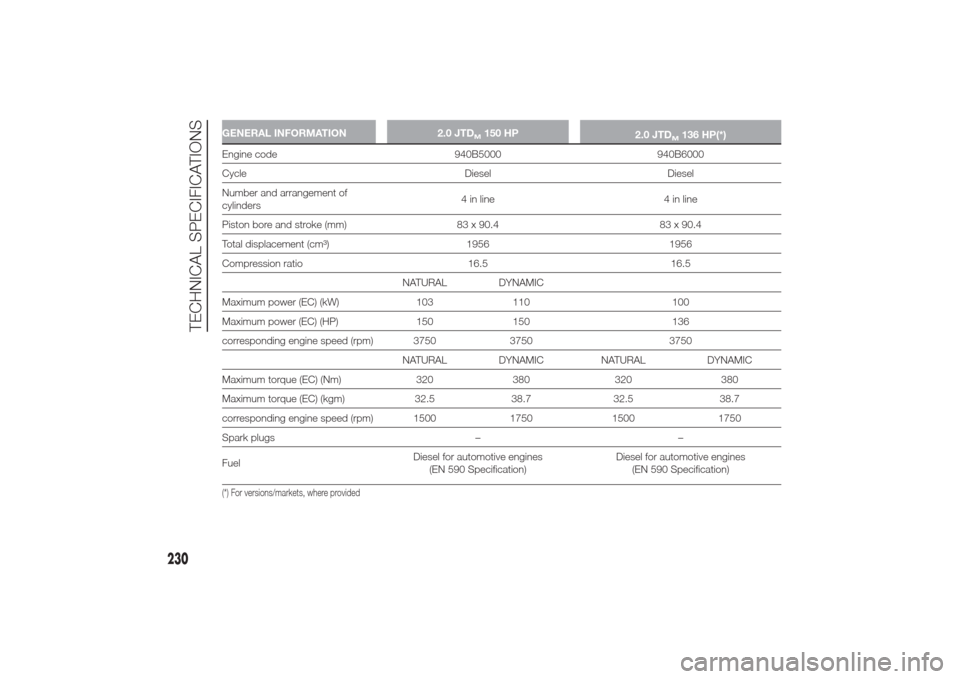
GENERAL INFORMATION 2.0 JTD
M150 HP
2.0 JTD
M136 HP(*)
Engine code 940B5000 940B6000
Cycle Diesel Diesel
Number and arrangement of
cylinders4 in line 4 in line
Piston bore and stroke (mm) 83 x 90.4 83 x 90.4
Total displacement (cm³) 1956 1956
Compression ratio 16.5 16.5
NATURAL DYNAMIC
Maximum power (EC) (kW) 103 110 100
Maximum power (EC) (HP) 150 150 136
corresponding engine speed (rpm) 3750 3750 3750
NATURAL DYNAMIC NATURAL DYNAMIC
Maximum torque (EC) (Nm) 320 380 320 380
Maximum torque (EC) (kgm) 32.5 38.7 32.5 38.7
corresponding engine speed (rpm) 1500 1750 1500 1750
Spark plugs – –
FuelDiesel for automotive engines
(EN 590 Specification)Diesel for automotive engines
(EN 590 Specification)(*) For versions/markets, where provided
230
TECHNICAL SPECIFICATIONS