light Alfa Romeo Giulietta 2014 Owner's Manual
[x] Cancel search | Manufacturer: ALFA ROMEO, Model Year: 2014, Model line: Giulietta, Model: Alfa Romeo Giulietta 2014Pages: 280, PDF Size: 6.65 MB
Page 211 of 280
PERIODIC CHECKSEvery 1,000 km or before long
journeys, check and, if necessary, top
up the following:
❒engine coolant, brake fluid and
windscreen washer fluid level;
❒tyre inflation pressure and condition;
❒operation of lighting system
(headlamps, direction indicators,
hazard warning lights, etc.);
❒operation of window washer/wiper
system and positioning/wear of
windscreen/rear window wiper
blades
Check and top up, if required, the
engine oil level every 3,000 km.
HEAVY-DUTY USE OF
THE CARIf the car is used mainly under one of
the following conditions:
❒towing a trailer or caravan;
❒dusty roads;
❒short, repeated journeys (less than
7-8 km) at sub-zero outside
temperatures;
❒engine often idling or driving long
distances at low speeds or long
periods of idleness;
the following checks must be carried
out more often than indicated in the
Scheduled Servicing Plan:
❒check front disc brake pad
conditions and wear;
❒check cleanliness of bonnet and boot
locks, cleanliness and lubrication of
linkage;
❒visually inspect conditions of: engine,
gearbox, transmission, pipes and
hoses (exhaust - fuel system -
brakes) and rubber elements (boots -
sleeves - bushes - etc.);
❒check battery charge and battery
fluid level (electrolyte);
❒visually inspect condition of the
accessory drive belts;❒check and, if necessary, change
engine oil and replace oil filter;
❒check and, if necessary, replace
pollen filter;
❒check and, if necessary, replace air
cleaner.
207
Page 216 of 280
ENGINE COOLANT
If the level is too low, unscrew reservoir
cap C and add the fluid described in
the "Technical Specifications" section.
34)
140)
WINDSCREEN/REAR
WINDOW WASHER FLUID
If the level is too low, lift reservoir cap D
and add the fluid described in the
chapter "Technical Specifications".
141) 142)
IMPORTANT The headlight washer
system will not operate when the fluid
level is low, even though the
windscreen/rear window washer
continues to operate. For versions/
markets, where provided, there is
a reference notch E on the dipstick (see
previous pages): ONLY the
windscreen/rear window wiper
operates with the level below this
reference.
BRAKE FLUID
Check that the fluid is at the max. level.
If the fluid level in the reservoir is too
low, undo reservoir cap E and add the
fluid described in the chapter "Technical
Specifications".
35)
143) 144)
ALFA TCT ACTIVATION
SYSTEM OIL
(for versions/markets, where provided)
The transmission control oil level should
only be checked at an Alfa Romeo
Dealership.
4)IMPORTANT
31) Be careful not to confuse the
various types of fluids while
topping up: they are not
compatible with each other!
Topping up with an unsuitable
fluid could severely damage your
car.
32) The oil level should never exceed
the MAX mark.
33) Do not add oil with specifications
other than those of the oil already
in the engine.34) PARAFLU
UP
anti-freeze fluid is
used in the engine cooling
system; use the same fluid type as
that already in the cooling system
when topping up. PARAFLU
UP
may not be mixed with other types
of anti-freeze fluids. In the event
of topping up with an unsuitable
product, under no circumstances
start the engine and contact an
Alfa Romeo Dealership.
35) Avoid allowing brake fluid, which
is extremely corrosive, to come
into contact with painted areas.
Should it happen, wash
immediately with water.
WARNING
137) Never smoke when performing
operations in the engine
compartment. Flammable gases
and fumes may be present and
risk igniting.
138) Be very careful when working in
the engine compartment when
the engine is hot: you may get
burned.
212
SERVICING AND MAINTENANCE
Page 218 of 280
BATTERYBattery F (see previous pages) does not
require the electrolyte to be topped up
with distilled water. A periodic check
carried out at an Alfa Romeo Dealership
is, however, necessary to check
efficiency.
REPLACING THE
BATTERY
145) 146) 147) 148)36)5)
If necessary, replace the battery with
another original battery with the same
specifications. Follow the battery
manufacturer's instructions for
maintenance.
USEFUL ADVICE FOR
EXTENDING THE LIFE OF
YOUR BATTERY
To avoid draining your battery and
make it last longer, observe the
following instructions:
❒when you park the car, ensure that
the doors, tailgate and bonnet are
closed properly, to prevent any lights
from remaining on inside the
passenger's compartment;❒switch off all roof lights inside the car:
the car is however equipped with a
system which switches all internal
lights off automatically;
❒do not keep accessories (e.g. sound
system, hazard lights, etc.) switched
on for a long time when the engine
is not running;
❒before performing any operation on
the electrical system, disconnect
the negative battery cable.
IMPORTANT After the battery is
disconnected, the steering must be
initialised. The warning light switches
on to indicate this. To carry out this
procedure, simply turn the steering
wheel all the way from one end to the
other or drive in a straight line for about
a hundred metres.
IMPORTANT If the charge level remains
under 50% for a long time, the battery
is damaged by sulphation, reducing
its capacity and efficiency at start-up.
The battery will also be more at risk
of freezing (this can happen as early as
–10°C). Refer to the paragraph "Car
inactivity" in "Starting and driving"
chapter if the car is left parked for a
long time.If, after purchasing the car, you wish to
install electrical accessories which
require permanent electrical supply (e.g.
alarm, etc.) or accessories which
influence the electrical supply
requirements, contact an Alfa Romeo
Dealership, whose qualified staff will
evaluate the overall electrical
consumption.
WARNING
145) Battery liquid is poisonous and
corrosive. Avoid contact with the
skin and eyes. Keep naked flames
and sources of sparks away from
the battery: risk of explosion and
fire.
146) Using the battery with
insufficient fluid irreparably
damages the battery and may
cause an explosion.
147) If the car must remain unused
for a long time at a very low
temperature, remove the battery
and take it to a warm place, to
avoid freezing.
214
SERVICING AND MAINTENANCE
Page 221 of 280
Replacing the rear
window wiper blade
Proceed as follows:
❒raise cover A fig. 191, undo nut B
and remove arm C;
❒correctly position the new arm, fully
tighten the nut B then lower the
cover A.
NOZZLES
Windscreen washer
The windscreen washer nozzles are
fixed fig. 192.
If there is no jet of fluid, firstly check
that there is some fluid in the reservoir
(see paragraph "Checking fluid levels"
in this chapter).Then check that the nozzle holes are
not clogged, if necessary use a needle.
Rear window washer
The nozzle holder is located on the rear
window fig. 193.
The rear window washer jets are fixed.HEADLIGHT WASHERS
(for versions/markets, where provided)
These are located within the front
bumper fig. 194.
They are activated when the dipped
beam and/or main beam headlights are
on and the windscreen washer is
activated.
Check the correct condition and
cleanliness of nozzles at regular
intervals.
WARNING
153) Driving with worn windscreen/
rear window wiper blades is a
serious hazard, because visibility
is reduced in bad weather.
191
A0K0533
192
A0K0139
193
A0K0102
194
A0K0534
217
Page 223 of 280
❒remove the aerial from the roof when
using a carwash;
❒if high pressure jets or cleaners are
used to wash the car, keep a
distance of at least 40 cm from the
bodywork to avoid damage or
alteration. Bear in mind that a build
up of water could cause damage
to the car in the long term;
❒wash the bodywork using a low
pressure jet of water;
❒wipe a sponge with a slightly soapy
solution over the bodywork,
frequently rinsing the sponge;
❒rinse well with water and dry with a
jet of air or a chamois leather.
Dry the less visible parts (e.g. door
frames, bonnet, headlight frames, etc.)
with special care, as water may
stagnate more easily in these areas. Do
not wash the car after it has been left
in the sun or with the bonnet hot:
this may alter the shine of the
paintwork.
Exterior plastic parts must be cleaned
in the same way as the rest of the car.IMPORTANT
Avoid parking under trees; the resin
dropped by trees makes the paintwork
go opaque and increases the possibility
of corrosion.
Bird droppings must be washed off
immediately and thoroughly as the acid
they contain is particularly aggressive.
Windows
Use specific detergents and clean
cloths to prevent scratching or altering
the transparency.
IMPORTANT Wipe the rear window
inside gently with a cloth following the
direction of the filaments to avoid
damaging the heating device.
Front headlights
Use a soft cloth soaked in water and
detergent for washing cars.
IMPORTANT Never use aromatic
substances (e.g. petrol) or ketenes (e.g.
acetone) for cleaning the plastic lenses
of the front headlights.
IMPORTANT When cleaning with a
pressure washer, keep the water jet at
least 20 cm away from the headlights.Engine compartment
At the end of every winter, wash the
engine compartment thoroughly, taking
care not to aim the jet of water directly
at the electronic control units or at
the windscreen wiper motors. Have this
operation performed at a specialised
workshop.
IMPORTANT The washing should take
place with the engine cold and the
ignition key in the STOP position. After
the washing operation, make sure
that the various protections (e.g. rubber
caps and guards) have not been
removed or damaged.
IMPORTANT
6) Detergents cause water pollution.
Only wash your car in areas
equipped to collect and treat
wastewater from this type
of activity.
219
Page 224 of 280
IMPORTANT
38) In order to preserve the aesthetic
appearance of the paint abrasive
products and/or polishes should
not be used for cleaning the car.39) Avoid washing with rollers
and/or brushes in washing
stations. Wash the car only by
hand using neutral pH detergents;
dry it with a wet chamois leather.
Abrasive products and/or polishes
should not be used for cleaning
the car. Bird droppings must
be washed off immediately and
thoroughly as the acid they
contain is particularly aggressive.
Avoid (if at all possible) parking
the car under trees; remove
vegetable resins immediately as,
when dried, it may only be
possible to remove them with
abrasive products and/or polishes,
which is highly inadvisable as
they could alter the typical opacity
of the paint. Do not use pure
windscreen washer fluid for
cleaning the front windscreen and
rear window; dilute it min. 50%
with water. Only use pure screen
washer fluid when strictly
necessary due to outside
temperature conditions.
INTERIORS
154) 155) 156)
Periodically check the cleanliness of the
interior, beneath the mats, which could
cause oxidation of the sheet metal.
SEATS AND FABRIC
PARTS
Remove dust with a soft brush or a
vacuum cleaner. It is advisable to use a
moist brush on velvet upholstery. Rub
the seats with a sponge moistened with
a solution of water and neutral
detergent.
LEATHER SEATS
(for versions/markets, where provided)
Remove the dry dirt with a slightly
damp buckskin or cloth, without
exercising too much pressure. Remove
any liquid or grease stains using an
absorbent dry cloth, without rubbing.
Then clean with a soft cloth or buckskin
cloth dampened with water and mild
soap. If the stain persists, use specific
products and observe the instructions
carefully.
IMPORTANT Never use alcohol. Make
sure that the cleaning products used
contain no alcohol or alcohol
derivatives, even in small quantities.
220
SERVICING AND MAINTENANCE
Page 225 of 280
PLASTIC AND COATED
PARTS
Clean interior plastic parts with a damp
cloth (if possible made from microfibre),
and a solution of water and neutral,
non-abrasive detergent. To clean oily or
persistent stains, use specific products
free from solvents and designed to
maintain the original appearance and
colour of the components.
Remove any dust using a microfibre
cloth, if necessary moistened with
water. The use of paper tissues is not
recommended as these may leave
residues.
40)
LEATHER PARTS
(for versions/markets, where provided)
Use only water and mild soap to clean
these parts. Never use alcohol or
alcohol-based products. Before using a
specific product for cleaning interiors,
make sure that it does not contain
alcohol and/or alcohol-based
substances.
WARNING
154) Never use flammable products,
such as petroleum ether or
modified petrol, to clean the
inside of the car. The electrostatic
charges which are generated by
rubbing during the cleaning
operation may cause a fire.
155) Do not keep aerosol cans in the
car: they might explode. Aerosol
cans must not be exposed to a
temperature exceeding 50°C.
When the car is exposed to
sunlight, the internal temperature
can greatly exceed this value.
156) There should be no obstacles
on the floor underneath the
pedals; make sure that mats are
always flat and do not interfere
with the pedals.
IMPORTANT
40) Never use alcohol, petrols and
derivatives to clean the dashboard
and instrument panel lens.
221
Page 248 of 280
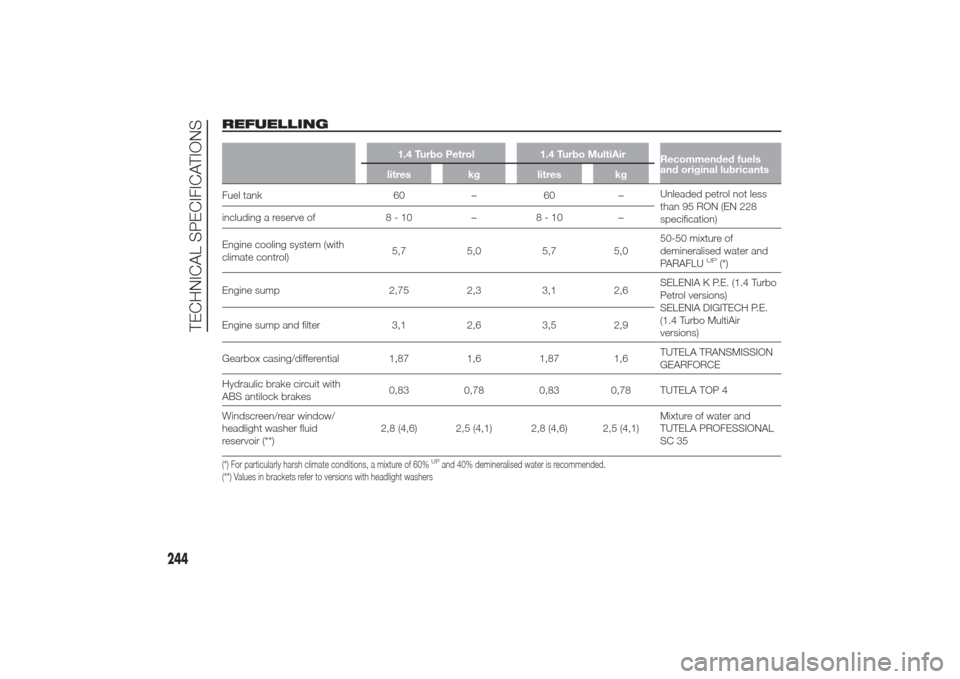
REFUELLING
1.4 Turbo Petrol 1.4 Turbo MultiAir
Recommended fuels
and original lubricants
litres kg litres kg
Fuel tank 60 – 60 –Unleaded petrol not less
than 95 RON (EN 228
specification) including a reserve of 8 - 10 – 8 - 10 –
Engine cooling system (with
climate control)5,7 5,0 5,7 5,050-50 mixture of
demineralised water and
PARAFLU
UP
(*)
Engine sump 2,75 2,3 3,1 2,6SELENIA K P.E. (1.4 Turbo
Petrol versions)
SELENIA DIGITECH P.E.
(1.4 Turbo MultiAir
versions) Engine sump and filter 3,1 2,6 3,5 2,9
Gearbox casing/differential 1,87 1,6 1,87 1,6TUTELA TRANSMISSION
GEARFORCE
Hydraulic brake circuit with
ABS antilock brakes0,83 0,78 0,83 0,78 TUTELA TOP 4
Windscreen/rear window/
headlight washer fluid
reservoir (**)2,8 (4,6) 2,5 (4,1) 2,8 (4,6) 2,5 (4,1)Mixture of water and
TUTELA PROFESSIONAL
SC 35
(*) For particularly harsh climate conditions, a mixture of 60%
UPand 40% demineralised water is recommended.
(**) Values in brackets refer to versions with headlight washers
244
TECHNICAL SPECIFICATIONS
Page 249 of 280
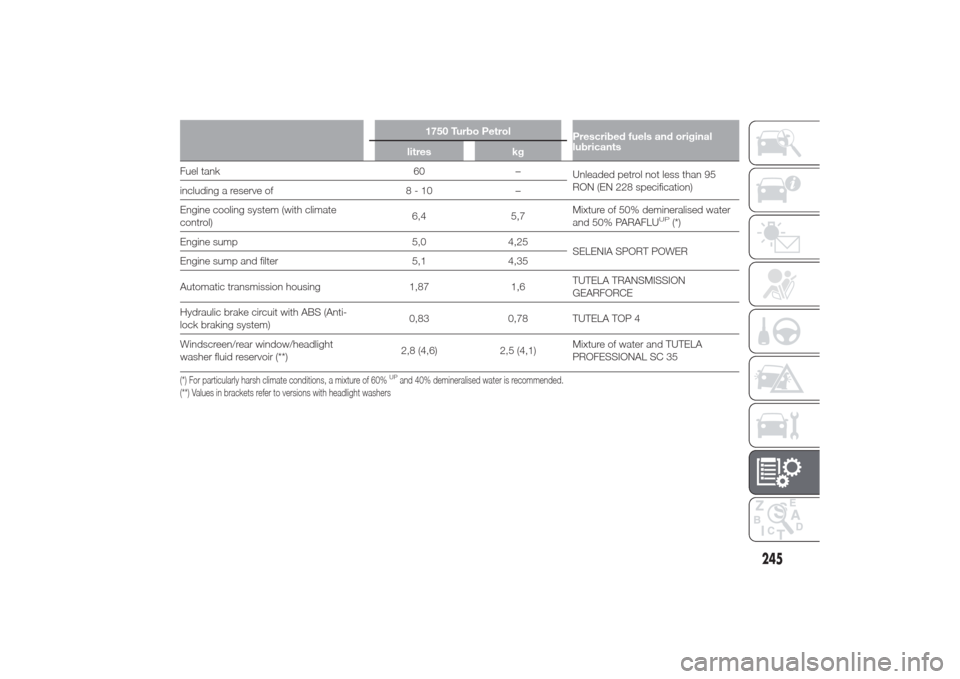
1750 Turbo Petrol
Prescribed fuels and original
lubricants
litres kg
Fuel tank 60 –
Unleaded petrol not less than 95
RON (EN 228 specification)
including a reserve of 8 - 10 –
Engine cooling system (with climate
control)6,4 5,7Mixture of 50% demineralised water
and 50% PARAFLU
UP
(*)
Engine sump 5,0 4,25
SELENIA SPORT POWER
Engine sump and filter 5,1 4,35
Automatic transmission housing 1,87 1,6TUTELA TRANSMISSION
GEARFORCE
Hydraulic brake circuit with ABS (Anti-
lock braking system)0,83 0,78 TUTELA TOP 4
Windscreen/rear window/headlight
washer fluid reservoir (**)2,8 (4,6) 2,5 (4,1)Mixture of water and TUTELA
PROFESSIONAL SC 35
(*) For particularly harsh climate conditions, a mixture of 60%
UPand 40% demineralised water is recommended.
(**) Values in brackets refer to versions with headlight washers
245
Page 250 of 280
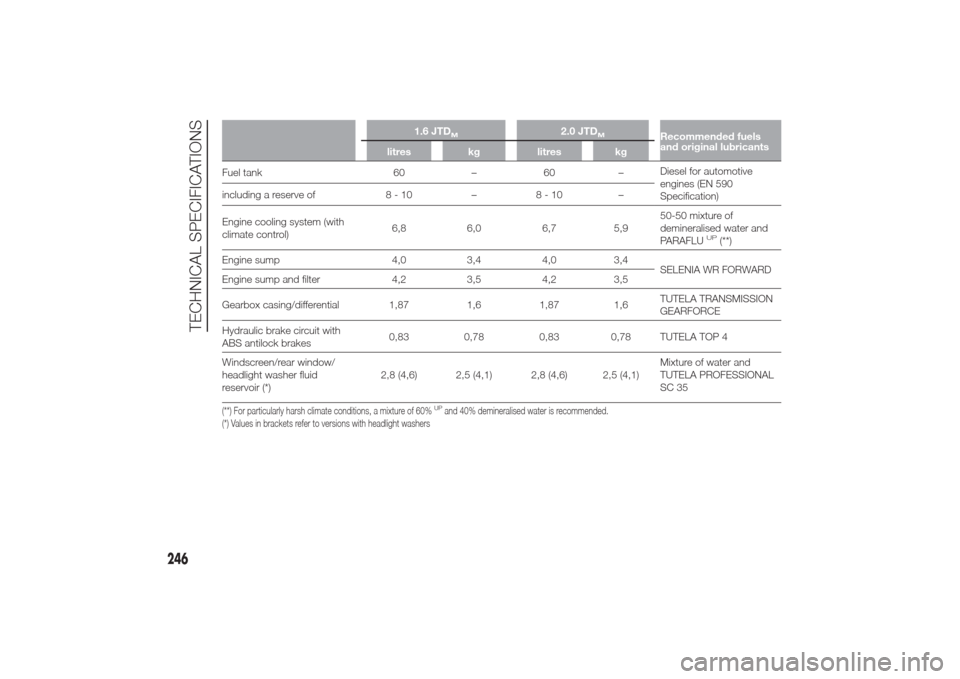
1.6 JTD
M
2.0 JTD
M
Recommended fuels
and original lubricants
litres kg litres kg
Fuel tank 60 – 60 –Diesel for automotive
engines (EN 590
Specification) including a reserve of 8 - 10 – 8 - 10 –
Engine cooling system (with
climate control)6,8 6,0 6,7 5,950-50 mixture of
demineralised water and
PARAFLU
UP
(**)
Engine sump 4,0 3,4 4,0 3,4
SELENIA WR FORWARD
Engine sump and filter 4,2 3,5 4,2 3,5
Gearbox casing/differential 1,87 1,6 1,87 1,6TUTELA TRANSMISSION
GEARFORCE
Hydraulic brake circuit with
ABS antilock brakes0,83 0,78 0,83 0,78 TUTELA TOP 4
Windscreen/rear window/
headlight washer fluid
reservoir (*)2,8 (4,6) 2,5 (4,1) 2,8 (4,6) 2,5 (4,1)Mixture of water and
TUTELA PROFESSIONAL
SC 35
(**) For particularly harsh climate conditions, a mixture of 60%
UPand 40% demineralised water is recommended.
(*) Values in brackets refer to versions with headlight washers
246
TECHNICAL SPECIFICATIONS