consumption Alfa Romeo Giulietta 2014 User Guide
[x] Cancel search | Manufacturer: ALFA ROMEO, Model Year: 2014, Model line: Giulietta, Model: Alfa Romeo Giulietta 2014Pages: 280, PDF Size: 6.65 MB
Page 165 of 280
If, with 1
stgear or reverse (R) engaged,
the following conditions occur:
❒road slope over 5%;
❒clutch overheated;
❒engine torque constant for a given
period (e.g. if the car hits the
pavement or is parked downhill/
uphill);
car movement is achieved by pressing
the accelerator pedal.
IMPORTANT With handbrake released
and brake pedal released, engine at
idling speed and gear lever in position
D, R or sequential, pay the utmost care
because the car can move even
without the operation of the accelerator
pedal. This condition can be used
with the car on a level surface during
tight parking manoeuvres using the
brake pedal only.
AUTOMATIC DRIVING
MODE
D can be selected from sequential
operation in any driving conditions.
In automatic driving mode, the best
ratio is selected by the electronic
transmission control unit depending on
speed, engine load (accelerator pedal
position) and gradient of the road.“Kick-Down” function
To resume speed quickly, when the
accelerator pedal is pressed fully, the
transmission control system downshifts
("Kick-down" function).
IMPORTANT When driving on roads
with poor grip conditions (snow, ice,
etc.) avoid activating the kick-down
function.
Integration with "Alfa
DNA" system
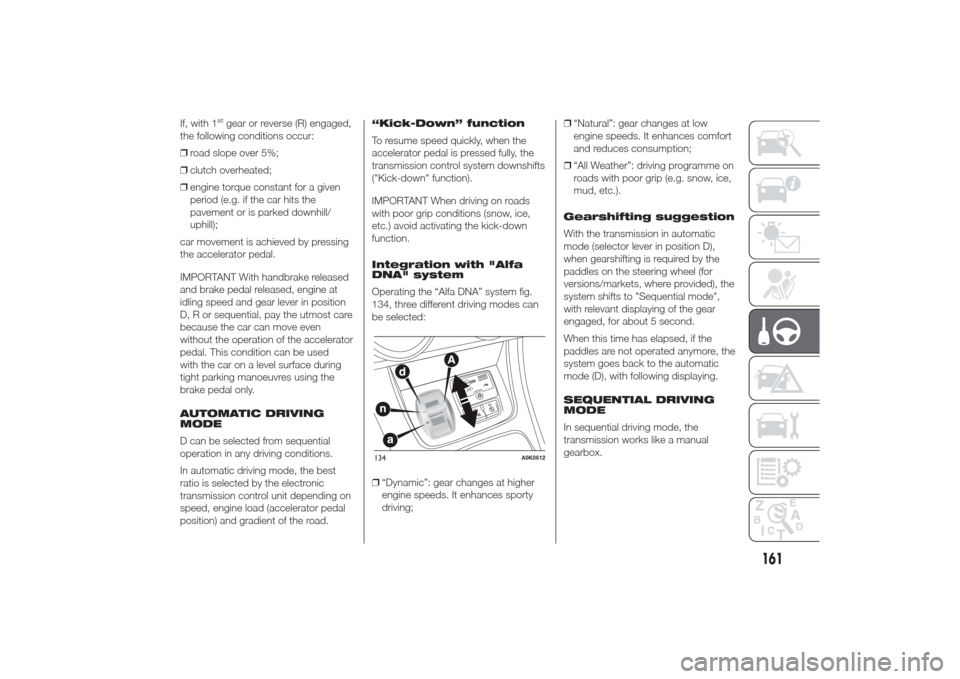
Operating the “Alfa DNA” system fig.
134, three different driving modes can
be selected:
❒“Dynamic”: gear changes at higher
engine speeds. It enhances sporty
driving;❒“Natural”: gear changes at low
engine speeds. It enhances comfort
and reduces consumption;
❒“All Weather”: driving programme on
roads with poor grip (e.g. snow, ice,
mud, etc.).
Gearshifting suggestion
With the transmission in automatic
mode (selector lever in position D),
when gearshifting is required by the
paddles on the steering wheel (for
versions/markets, where provided), the
system shifts to "Sequential mode",
with relevant displaying of the gear
engaged, for about 5 second.
When this time has elapsed, if the
paddles are not operated anymore, the
system goes back to the automatic
mode (D), with following displaying.
SEQUENTIAL DRIVING
MODE
In sequential driving mode, the
transmission works like a manual
gearbox.
134
A0K0612
161
Page 168 of 280
If reverse (R) is engaged, only engage
the 1
stgear (or vice versa) when the car
is completely stopped.
Although it is highly inadvisable, if you
are driving downhill and, for unexpected
reasons, you let the car move forward
with the transmission in neutral (N),
when there is a request to engage
a gear, depending on the speed of the
car, the system will automatically
engage the best gear for the correct
transmission of drive torque to the
wheels.
107)IMPORTANT
21) If the car is on a gradient, always
pull the handbrake BEFORE
placing the gear lever in P.
22) Engage reverse only with the car
stationary, engine at idling speed
and accelerator fully released.
WARNING
106) Using the levers incorrectly
(levers pushed towards the
dashboard, see fig. 137) could
break them.
107) Never leave children
unattended in the car. Always
remove the ignition key when
leaving the car and take the key
with you.
SAVING FUELHere are some suggestions which can
help you to save fuel and lower harmful
emissions.
GENERAL
CONSIDERATIONS
Car maintenance
Checks and adjustments should be
carried out in accordance with the
“Scheduled Servicing Plan” (see
chapter “Maintenance and care”).
Tyres
Check the tyre pressures at least once
every four weeks: if the pressure is
too low, consumption levels increase as
resistance to rolling is higher.
Unnecessary loads
Do not travel with an overloaded boot.
The weight of the car and its
arrangement greatly affect fuel
consumption and stability.
164
STARTING AND DRIVING
Page 169 of 280
Roof rack/ski rack
Remove the roof rack or the ski rack
from the roof after use. These
accessories lower aerodynamic
penetration and adversely affect
consumption levels. When transporting
particularly large objects, use a trailer
if possible.
Electrical devices
Use the electrical devices only for the
necessary amount of time. The heated
rear window, additional headlights,
screen wipers and heater fan require a
considerable amount of energy;
increasing the current uptake increases
fuel consumption (by up to +25% in
an urban cycle).
Climate control system
Using the climate control system will
increase consumption: use the air vents
when the temperature outside permits.
Devices for
aerodynamic control
The use of non-certified devices for
aerodynamic control may adversely
affect air drag and fuel consumption.DRIVING STYLE
Starting
Do not warm up the engine at low or
high revs when the car is stationary;
this causes the engine to warm up
more slowly, thereby increasing fuel
consumption and emissions. It is
therefore advisable to move off
immediately, slowly, avoiding high
speeds: in this way the engine will
warm up more quickly.
Unnecessary actions
Avoid accelerating when stopped at
traffic lights or before switching off the
engine. The latter action, as well as
double-declutching, is unnecessary and
causes increased fuel consumption
and pollution.
Gear selection
Use a high gear when traffic and road
conditions allow it. Using a low gear for
faster acceleration will increase fuel
consumption. In the same way
improper use of a high gear increases
consumption, emissions and engine
wear.Maximum speed
Fuel consumption considerably
increases as speed increases. Maintain
a constant speed, avoiding
unnecessary braking and acceleration,
which cost in terms of both fuel
consumption and emissions.
Acceleration
Accelerating violently severely affects
consumption and emissions:
acceleration should be gradual and
should not exceed the maximum
torque.
165
Page 170 of 280
CONDITIONS OF USE
Cold starting
Short distances and frequent cold
start-ups will prevent the engine from
reaching optimal running temperature.
This results in a significant increase
in consumption levels (from +15 to
+30% on the urban cycle) and
emissions.
Traffic and road
conditions
High fuel consumption is caused by
heavy traffic, for instance when
travelling in a queue with frequent use
of low gears or in large towns with
many traffic lights. Winding mountain
roads and rough road surfaces also
adversely affect consumption.
Stops in traffic
During prolonged hold-ups (e.g. level
crossings) switch off the engine.
TOWING TRAILERSIMPORTANT
The vehicle must be provided with a
type-approved tow hook and adequate
electrical system to tow caravans or
trailers. Installation must be carried out
by a specialist.
Fit any specific and/or additional rear
view mirrors as specified by the
Highway Code.
Remember that when towing a trailer,
steep hills are harder to climb, the
braking spaces increase and overtaking
takes longer depending on the overall
weight.
Engage a low gear when driving
downhill, rather than constantly using
the brake.
The weight of the trailer reduces the
load capacity of the car by the same
amount. Consider the weight at full
load, including accessories and
luggage, to make sure you do not
exceed the maximum towable weight
(shown in the registration document).
Do not exceed the speed limits specific
to each country you are driving in, in
the case of vehicles towing trailers.
In any case do not exceed 100 km/h.INSTALLING A TOW
HOOK
Contact an Alfa Romeo Dealership to
install a tow hook.
108) 109)
WARNING
108) The ABS with which the car is
equipped will not control the
braking system of the trailer.
Particular caution is therefore
required when travelling on
slippery roads.
109) Never modify the braking
system of the car to control the
trailer brake. The trailer braking
system must be fully independent
from the hydraulic system of the
car.
166
STARTING AND DRIVING
Page 215 of 280
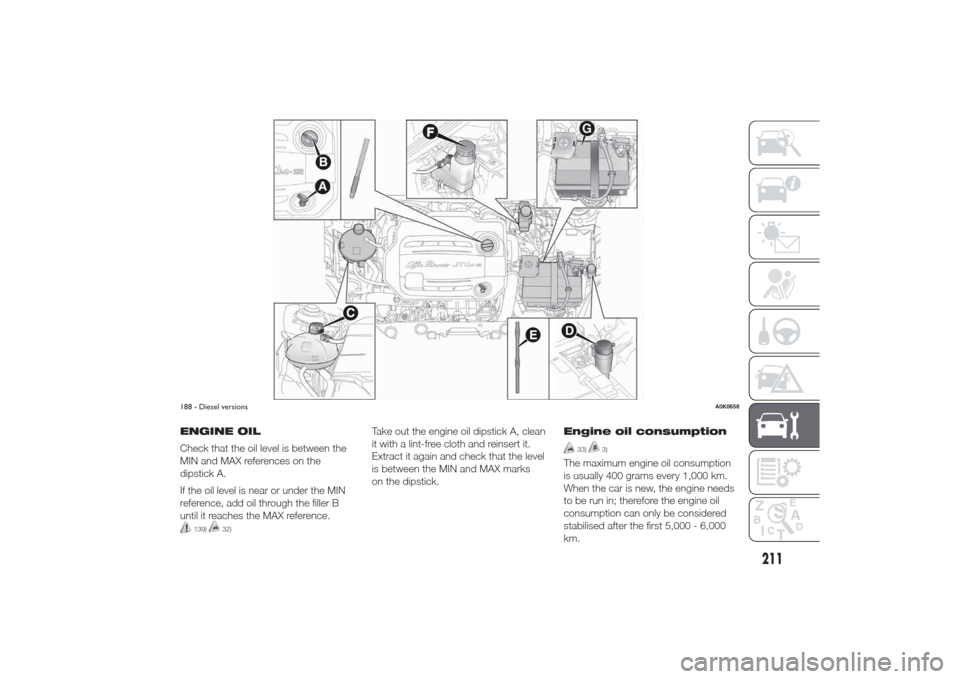
ENGINE OIL
Check that the oil level is between the
MIN and MAX references on the
dipstick A.
If the oil level is near or under the MIN
reference, add oil through the filler B
until it reaches the MAX reference.
139)
32)
Take out the engine oil dipstick A, clean
it with a lint-free cloth and reinsert it.
Extract it again and check that the level
is between the MIN and MAX marks
on the dipstick.Engine oil consumption
33)
3)
The maximum engine oil consumption
is usually 400 grams every 1,000 km.
When the car is new, the engine needs
to be run in; therefore the engine oil
consumption can only be considered
stabilised after the first 5,000 - 6,000
km.
G
188 - Diesel versions
A0K0658
211
Page 218 of 280
BATTERYBattery F (see previous pages) does not
require the electrolyte to be topped up
with distilled water. A periodic check
carried out at an Alfa Romeo Dealership
is, however, necessary to check
efficiency.
REPLACING THE
BATTERY
145) 146) 147) 148)36)5)
If necessary, replace the battery with
another original battery with the same
specifications. Follow the battery
manufacturer's instructions for
maintenance.
USEFUL ADVICE FOR
EXTENDING THE LIFE OF
YOUR BATTERY
To avoid draining your battery and
make it last longer, observe the
following instructions:
❒when you park the car, ensure that
the doors, tailgate and bonnet are
closed properly, to prevent any lights
from remaining on inside the
passenger's compartment;❒switch off all roof lights inside the car:
the car is however equipped with a
system which switches all internal
lights off automatically;
❒do not keep accessories (e.g. sound
system, hazard lights, etc.) switched
on for a long time when the engine
is not running;
❒before performing any operation on
the electrical system, disconnect
the negative battery cable.
IMPORTANT After the battery is
disconnected, the steering must be
initialised. The warning light switches
on to indicate this. To carry out this
procedure, simply turn the steering
wheel all the way from one end to the
other or drive in a straight line for about
a hundred metres.
IMPORTANT If the charge level remains
under 50% for a long time, the battery
is damaged by sulphation, reducing
its capacity and efficiency at start-up.
The battery will also be more at risk
of freezing (this can happen as early as
–10°C). Refer to the paragraph "Car
inactivity" in "Starting and driving"
chapter if the car is left parked for a
long time.If, after purchasing the car, you wish to
install electrical accessories which
require permanent electrical supply (e.g.
alarm, etc.) or accessories which
influence the electrical supply
requirements, contact an Alfa Romeo
Dealership, whose qualified staff will
evaluate the overall electrical
consumption.
WARNING
145) Battery liquid is poisonous and
corrosive. Avoid contact with the
skin and eyes. Keep naked flames
and sources of sparks away from
the battery: risk of explosion and
fire.
146) Using the battery with
insufficient fluid irreparably
damages the battery and may
cause an explosion.
147) If the car must remain unused
for a long time at a very low
temperature, remove the battery
and take it to a warm place, to
avoid freezing.
214
SERVICING AND MAINTENANCE
Page 227 of 280
TECHNICAL SPECIFICATIONS
Everything you may find useful for
understanding how your car is made
and works is contained in this chapter
and illustrated with data, tables and
graphics. For the enthusiasts and the
technician, but also just for those who
want to know every detail of their
car.IDENTIFICATION DATA....................224
ENGINE CODES - BODYWORK
VERSIONS ......................................22
ENGINE ..........................................227
FUEL SUPPLY .................................231
TRANSMISSION .............................232
BRAKES .........................................233
SUSPENSION .................................23
STEERING SYSTEM .......................235
WHEELS .........................................236
DIMENSIONS ..................................240
PERFORMANCE .............................241
WEIGHTS .......................................242
REFUELLING ..................................244
FLUIDS AND LUBRICANTS ............247
FUEL CONSUMPTION ....................25
CO2 EMISSIONS ............................252
PRESCRIPTIONS FOR HANDLING
THE VEHICLE AT THE END OF ITS
LIFE ................................................253
223
5
4
1
Page 251 of 280
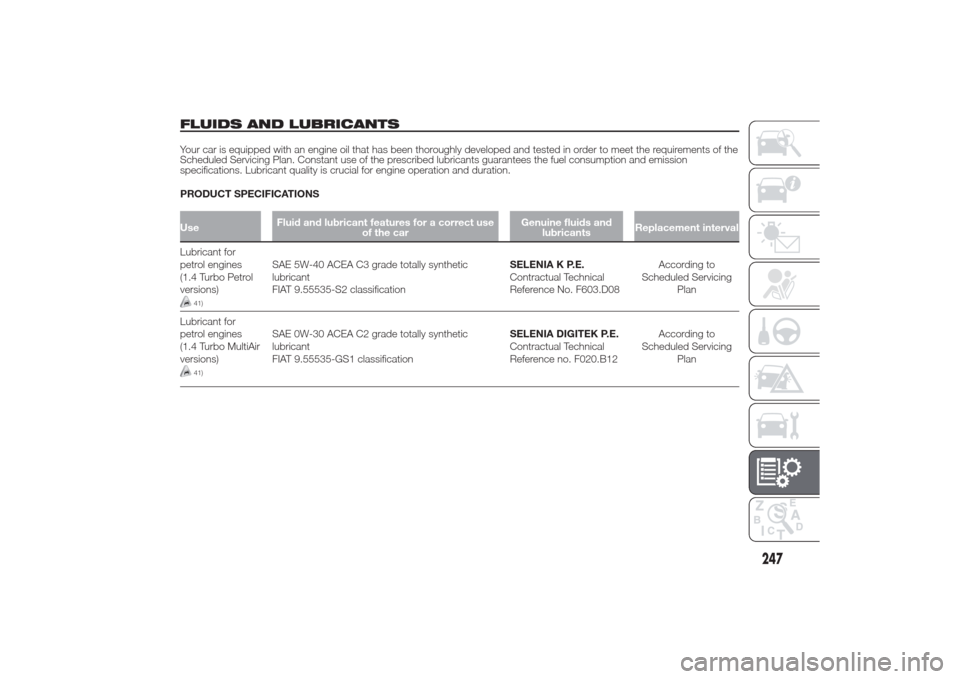
FLUIDS AND LUBRICANTSYour car is equipped with an engine oil that has been thoroughly developed and tested in order to meet the requirements of the
Scheduled Servicing Plan. Constant use of the prescribed lubricants guarantees the fuel consumption and emission
specifications. Lubricant quality is crucial for engine operation and duration.
PRODUCT SPECIFICATIONSUseFluid and lubricant features for a correct use
of the carGenuine fluids and
lubricantsReplacement intervalLubricant for
petrol engines
(1.4 Turbo Petrol
versions)
41)
SAE 5W-40 ACEA C3 grade totally synthetic
lubricant
FIAT 9.55535-S2 classificationSELENIA K P.E.
Contractual Technical
Reference No. F603.D08According to
Scheduled Servicing
Plan
Lubricant for
petrol engines
(1.4 Turbo MultiAir
versions)
41)
SAE 0W-30 ACEA C2 grade totally synthetic
lubricant
FIAT 9.55535-GS1 classificationSELENIA DIGITEK P.E.
Contractual Technical
Reference no. F020.B12According to
Scheduled Servicing
Plan
247
Page 255 of 280
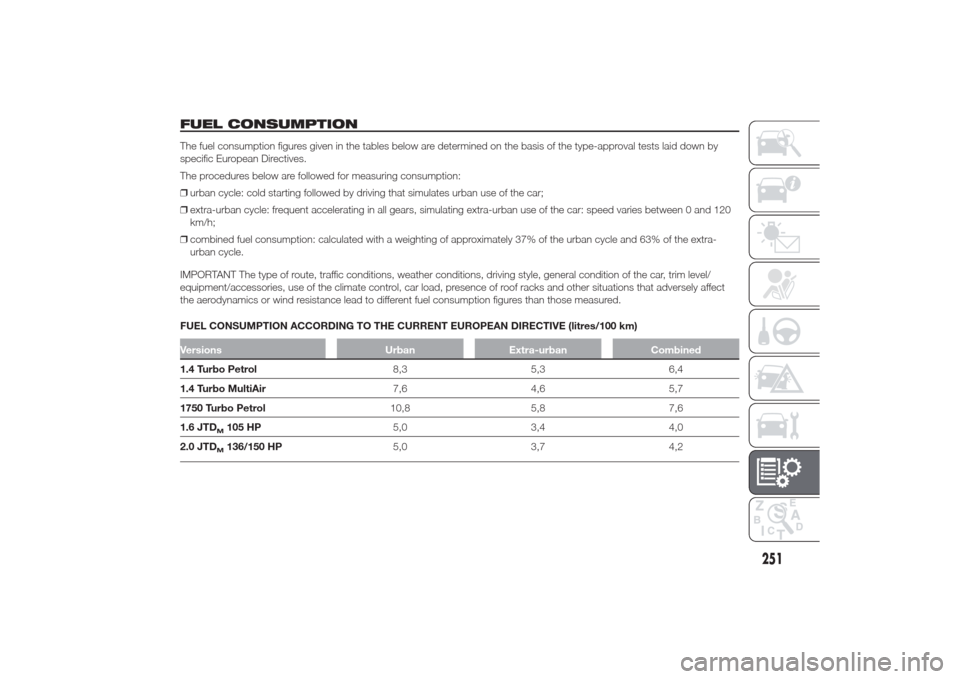
FUEL CONSUMPTIONThe fuel consumption figures given in the tables below are determined on the basis of the type-approval tests laid down by
specific European Directives.
The procedures below are followed for measuring consumption:
❒urban cycle: cold starting followed by driving that simulates urban use of the car;
❒extra-urban cycle: frequent accelerating in all gears, simulating extra-urban use of the car: speed varies between 0 and 120
km/h;
❒combined fuel consumption: calculated with a weighting of approximately 37% of the urban cycle and 63% of the extra-
urban cycle.
IMPORTANT The type of route, traffic conditions, weather conditions, driving style, general condition of the car, trim level/
equipment/accessories, use of the climate control, car load, presence of roof racks and other situations that adversely affect
the aerodynamics or wind resistance lead to different fuel consumption figures than those measured.
FUEL CONSUMPTION ACCORDING TO THE CURRENT EUROPEAN DIRECTIVE (litres/100 km)Versions Urban Extra-urban Combined1.4 Turbo Petrol8,3 5,3 6,4
1.4 Turbo MultiAir7,6 4,6 5,7
1750 Turbo Petrol10,8 5,8 7,6
1.6 JTD
M105 HP5,0 3,4 4,0
2.0 JTDM136/150 HP5,0 3,7 4,2
251
Page 256 of 280
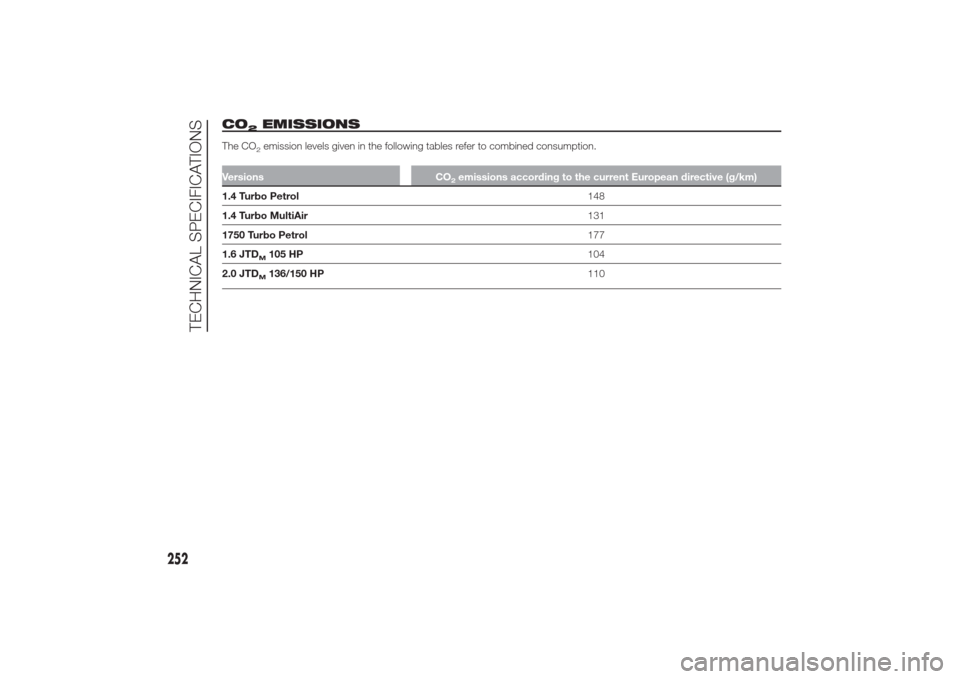
CO
2
EMISSIONS
The CO
2emission levels given in the following tables refer to combined consumption.
Versions CO
2emissions according to the current European directive (g/km)
1.4 Turbo Petrol148
1.4 Turbo MultiAir131
1750 Turbo Petrol177
1.6 JTD
M105 HP104
2.0 JTDM136/150 HP110
252
TECHNICAL SPECIFICATIONS