steering Alfa Romeo Giulietta 2014 Owner's Guide
[x] Cancel search | Manufacturer: ALFA ROMEO, Model Year: 2014, Model line: Giulietta, Model: Alfa Romeo Giulietta 2014Pages: 280, PDF Size: 6.65 MB
Page 129 of 280
Warning lights on
panelWhat it means What to do
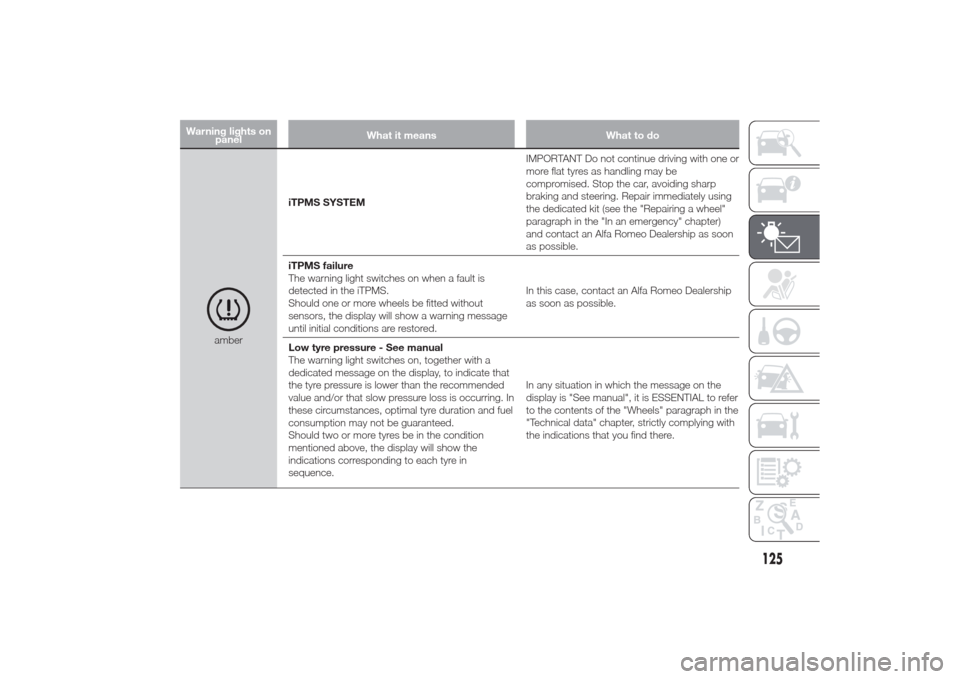
amberiTPMS SYSTEMIMPORTANT Do not continue driving with one or
more flat tyres as handling may be
compromised. Stop the car, avoiding sharp
braking and steering. Repair immediately using
the dedicated kit (see the "Repairing a wheel"
paragraph in the "In an emergency" chapter)
and contact an Alfa Romeo Dealership as soon
as possible.
iTPMS failure
The warning light switches on when a fault is
detected in the iTPMS.
Should one or more wheels be fitted without
sensors, the display will show a warning message
until initial conditions are restored.In this case, contact an Alfa Romeo Dealership
as soon as possible.
Low tyre pressure - See manual
The warning light switches on, together with a
dedicated message on the display, to indicate that
the tyre pressure is lower than the recommended
value and/or that slow pressure loss is occurring. In
these circumstances, optimal tyre duration and fuel
consumption may not be guaranteed.
Should two or more tyres be in the condition
mentioned above, the display will show the
indications corresponding to each tyre in
sequence.In any situation in which the message on the
display is "See manual", it is ESSENTIAL to refer
to the contents of the "Wheels" paragraph in the
"Technical data" chapter, strictly complying with
the indications that you find there.
125
Page 150 of 280

FRONT AIRBAGS“SMART BAG” SYSTEM
(MULTISTAGE FRONT
AIRBAGS)
The car features multistage front
airbags (“Smart bag”) for driver and
passenger.
The front (driver and passenger) airbags
protect occupants in the event of
head-on crashes of medium-high
severity, by placing the a cushion
between the occupant and the steering
wheel or dashboard.
Therefore non-deployment in other
types of impacts (side impacts, rear
shunts, roll-overs, etc.) does not
indicate a system malfunction.
Airbags are not a replacement of but
complementary to the seat belts, which
you are recommended to always wear.
In the event of impact, those not
wearing a seat belt are projected
forwards and may come into contact
with the bag which is still inflating. The
protection offered by the bag is
compromised in these circumstances.
85) 86) 88)
Front airbags may not activate in the
following situations:❒frontal impacts against highly
deformable objects not involving the
front surface of the car (e.g. wing
collision against guard rail, etc.);
❒jamming of the car underneath other
vehicles or protective barriers (e.g.
underneath a truck or a guard rail) as,
in this case, the bags would offer no
additional protection with respect
to the seat belt and their deployment
would be inappropriate. In these
cases, non-deployment does not
indicate a system malfunction.
FRONT DRIVER SIDE
AIRBAG
This consists of an instantly inflating
bag contained in a special
compartment in the centre of the
steering wheel fig. 120.FRONT PASSENGER
AIRBAG
This consists of an instantly inflating
bag contained in a special recess in the
dashboard fig. 121: this bag has a
larger volume than that of the driver's.
87)
120
A0K0364
121
A0K0135
146
SAFETY
Page 153 of 280

WARNING
85) Do not apply stickers or other objects on the steering wheel, on the dashboard in the passenger side airbag area, on
side upholstery on the roof or on the seats. Never put objects (e.g. mobile phones) on the passenger's side dashboard
since they could interfere with correct inflation of the airbag and also cause serious injury to the passengers.
86) Always drive keeping your hands on the steering wheel rim so that the airbag can inflate freely if necessary. Do not
drive with your body bent forward. Keep the back of your seat upright and lean back into it.
87) When an active passenger airbag is fitted, DO NOT install rear facing child restraint systems on the front seat.
Deployment of the airbag in an accident could cause fatal injuries to the child regardless of the severity of the
impact. Therefore, always deactivate the passenger airbag when a rear facing child restraint system is installed on
the front passenger seat. The front passenger seat must also be positioned back as far as possible in order to avoid
the child restraint system from coming into contact with the dashboard. Immediately reactivate the passenger airbag
as soon as the child restraint system has been removed.
88) To deactivate the airbags, see the “Knowing your car” section, “Menu Items” paragraph.
89) When an active passenger airbag is fitted, DO NOT install rear facing child restraint systems on the front seat.
Deployment of the airbag in an accident could cause fatal injuries to the child regardless of the severity of the
impact.
149
Page 163 of 280
Shifting from N to D is free, while
shifting from N to R or P can only be
made by the button on the gear lever.
Drive (D) - Automatic
forward gear
It is the lever position in standard
running conditions.
Shifting from D to N is free, while
shifting from D to R or P can only be
made by the button on the gear lever.
Sequential mode (+ / –)
Shifting the lever from position D on
side in stable position, the transmission
is used in sequential mode.
Shifting the lever in unstable position (+
or −) gears are changed.
Important information
IMPORTANT All movements of the gear
lever must be performed with car
stationary and engine idling only.
The drive wheels are mechanically
locked in position P.
Shifting from P to R is possible with
brake pedal pressed and button on
gear lever pressed.
Shifting from R to N and from N to D is
free.Shifting from D to "Sequential mode" is
free.
Shifting from "Sequential mode" to D is
free.
Shifting from D to N is free.
Shifting from N to R is possible only
with button on gear lever pressed.
Shifting from R to P is possible only
with button on gear lever pressed.
STARTING THE ENGINE
Starting is only permitted with gear
lever in position P or N (with or without
brake pedal pressed).
On starting, the system is at N or P (the
latter means neutral, but with the car’s
wheels locked mechanically).
Start&Stop system
With car at a standstill and Start&Stop
system activated, the engine switches
off if the gear lever is in a position
other than R.
The Start&Stop system does not
operate when the gear lever is in R, for
making parking manoeuvres easier.
In the event of stops uphill, the engine
switching off is disabled to activate
the "Hill Holder" function (works only
with running engine).The engine restarts automatically if:
❒the brake pedal is released (and the
lever is not at N or P)
❒the lever is shifted to an unstable
position: +, − or R
❒the lever is shifted from D to the left
in "Sequential mode"
❒by the "+" or "–" paddles on the
steering wheel (for versions/markets,
where provided)
During the engine stop and start
sequence, the system passes through
the automatic engagement of neutral:
the display shows N.
IMPORTANT In some conditions (for
example with small gradients and brake
pedal not fully depressed), engine
switching off is not deactivated. In this
case, fully depress the brake pedal
to make the "Hill Holder" function
available and restart the engine, using
the gear lever or the paddles on the
steering wheel (for versions/markets,
where provided) as described
previously.
159
Page 165 of 280
If, with 1
stgear or reverse (R) engaged,
the following conditions occur:
❒road slope over 5%;
❒clutch overheated;
❒engine torque constant for a given
period (e.g. if the car hits the
pavement or is parked downhill/
uphill);
car movement is achieved by pressing
the accelerator pedal.
IMPORTANT With handbrake released
and brake pedal released, engine at
idling speed and gear lever in position
D, R or sequential, pay the utmost care
because the car can move even
without the operation of the accelerator
pedal. This condition can be used
with the car on a level surface during
tight parking manoeuvres using the
brake pedal only.
AUTOMATIC DRIVING
MODE
D can be selected from sequential
operation in any driving conditions.
In automatic driving mode, the best
ratio is selected by the electronic
transmission control unit depending on
speed, engine load (accelerator pedal
position) and gradient of the road.“Kick-Down” function
To resume speed quickly, when the
accelerator pedal is pressed fully, the
transmission control system downshifts
("Kick-down" function).
IMPORTANT When driving on roads
with poor grip conditions (snow, ice,
etc.) avoid activating the kick-down
function.
Integration with "Alfa
DNA" system
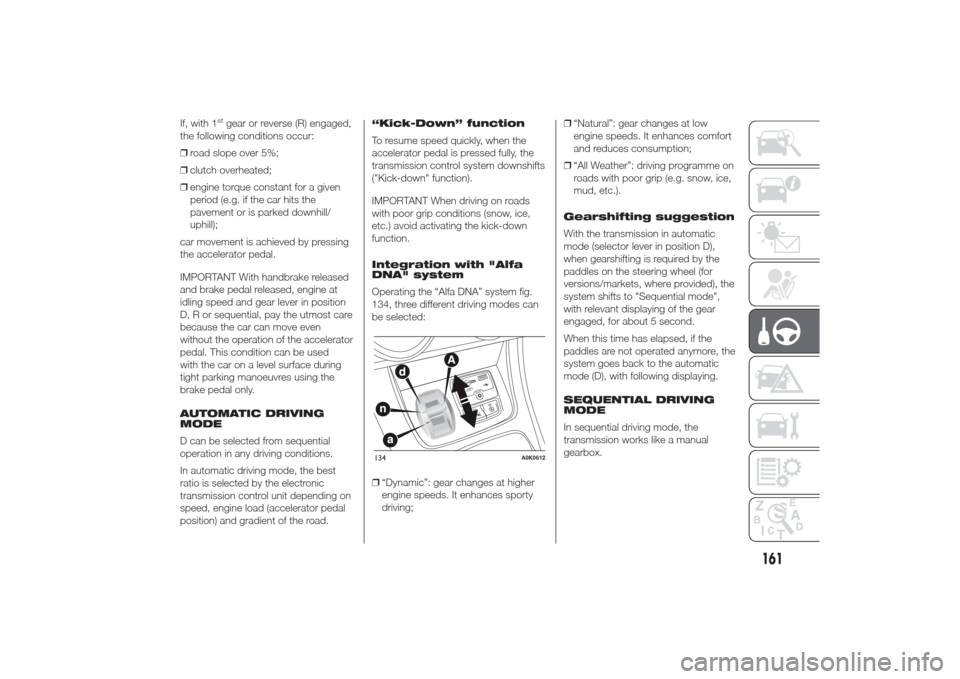
Operating the “Alfa DNA” system fig.
134, three different driving modes can
be selected:
❒“Dynamic”: gear changes at higher
engine speeds. It enhances sporty
driving;❒“Natural”: gear changes at low
engine speeds. It enhances comfort
and reduces consumption;
❒“All Weather”: driving programme on
roads with poor grip (e.g. snow, ice,
mud, etc.).
Gearshifting suggestion
With the transmission in automatic
mode (selector lever in position D),
when gearshifting is required by the
paddles on the steering wheel (for
versions/markets, where provided), the
system shifts to "Sequential mode",
with relevant displaying of the gear
engaged, for about 5 second.
When this time has elapsed, if the
paddles are not operated anymore, the
system goes back to the automatic
mode (D), with following displaying.
SEQUENTIAL DRIVING
MODE
In sequential driving mode, the
transmission works like a manual
gearbox.
134
A0K0612
161
Page 166 of 280

Gearshifting through
gear lever
Move the lever sideways (to the left)
from position D to the sequential
position:
❒lever towards "+": engage higher
gear;
❒lever towards "−": engage lower gear.
The lever correct position in "Sequential
mode" is signalled when the symbols
"+" and "−" switch on and the symbol D
switches off on the display (the gear
engaged only is shown on the display).
Gearshifting through
steering wheel paddles
(for versions/markets, where provided)
On some versions, the steering wheel
paddles can be used to change gear
fig. 135.
106)
To use the paddles on the steering
wheel, the gear lever must be in
"Sequential mode" or in D:
❒steering wheel paddle "+" (pulling
paddle towards driver fig. 136):
engage higher gear;
❒steering wheel paddle "-" (pulling
paddle towards driver fig. 136):
engage lower gear.The engagement of a lower or higher
gear is only permitted if the engine revs
allow it.
If the car is stopped with a higher gear
than 1
stengaged, the transmission
will automatically engage 1
stgear.
"Launch Control"
Function
The "Launch Control" strategy permits
high-performance starting.
With the car stationary, proceed as
follows to activate this function:
❒operate the “Alfa DNA” system and
activate the "Dynamic" driving mode;
❒depress the brake pedal with your left
foot and, simultaneously, fully
depress the accelerator pedal with
your right foot;
❒shift gear using the gear lever or the
steering wheel paddle "−" (pulling
the paddle towards the driver as
previously described): rpm are thus
increased from 2500 to 4500;
❒release the brake pedal: in this way a
more "lively" start is achieved.
135
A0K0266
136
A0K0269
137
A0K0271
162
STARTING AND DRIVING
Page 179 of 280
113) Use your hazard lights, warning
triangle, etc to show that your car
is stationary. Passengers should
get out of the car, particularly if it
is heavily loaded, and wait for
the wheel to be changed away
from the traffic. In the event of a
wheel change on a slope or on
unsurfaced roads, chock the
wheels.
114) Car handling is modified with
the space-saver wheel fitted.
Avoid violent acceleration and
braking, abrupt steering and fast
cornering. The overall duration
of the space-saver wheel is of
about 3000 km, after which the
relevant tyre must be replaced
with another one of the same
type. Never install a traditional
tyre on a rim designed to be used
as a space-saver wheel. Have
the wheel repaired and refitted as
soon as possible. Using two or
more space-saver wheels at the
same time is forbidden. Do not
grease the bolt threads before you
fit them, because they could
suddenly come loose.115) Use the jack only to replace
wheels on the car with which it
is supplied or on other cars of the
same model. Never use the jack
for other purposes, such as lifting
other car models. Never use it
for repair operations under the
car. Incorrect positioning of the
jack may cause the car to fall. Do
not use the jack for loads higher
than those shown on the label.
Never install snow chains on the
space-saver wheel; if a front tyre
(driving wheel) is punctured and
you need to use snow chains, use
a standard wheel from the rear
axle and install the space-saver
wheel on the rear axle. In this
way, with two normal front drive
wheels, it is possible to use snow
chains.
116) Incorrect hub cap assembly
may cause it to come off when the
car is moving. Never tamper with
the inflation valve. Never
introduce tools of any kind
between rim and tyre. Regularly
check the inflation pressure of the
tyres and space-saver wheel
(see chapter "Technical
specifications").
IMPORTANT
26) Contact an Alfa Romeo
Dealership as soon as possible to
have the correct tightening of
the wheel bolts checked.
175
Page 199 of 280
WARNING
129) If the fuse blows again contact an Alfa Romeo Dealership.
130) Never replace a fuse with another with a higher amp rating; DANGER OF FIRE.
131) If a general protection fuse (MAXI-FUSE, MEGA-FUSE, MIDI-FUSE) blows, contact an Alfa Romeo Dealership.
132) Before replacing a fuse, make sure that the ignition key has been removed and that all the other services are
switched off and/or deactivated.
133) Contact an Alfa Romeo Dealership if a safety system (airbags, brakes), power unit system (engine, gearbox) or
steering system general protection fuse blows.
195
Page 201 of 280
RAISING THE CARIf the car needs to be jacked up, go to
an Alfa Romeo Dealership which is
equipped with shop jacks and jack
arms.
IMPORTANT Be careful when
positioning the arm of the lift for
versions with side skirts.
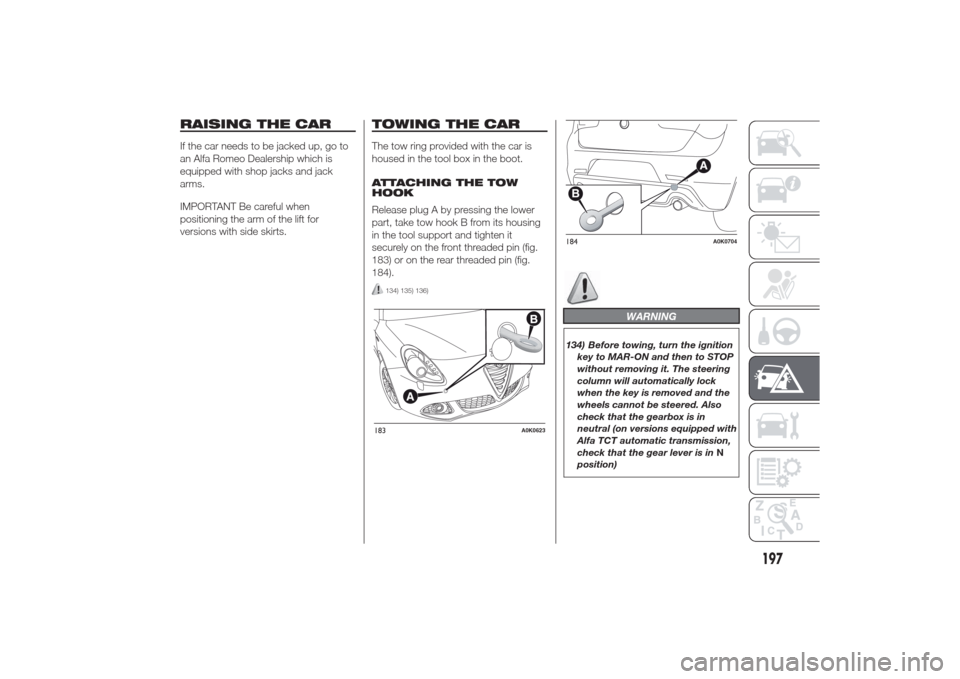
TOWING THE CARThe tow ring provided with the car is
housed in the tool box in the boot.
ATTACHING THE TOW
HOOK
Release plug A by pressing the lower
part, take tow hook B from its housing
in the tool support and tighten it
securely on the front threaded pin (fig.
183) or on the rear threaded pin (fig.
184).
134) 135) 136)
WARNING
134) Before towing, turn the ignition
key to MAR-ON and then to STOP
without removing it. The steering
column will automatically lock
when the key is removed and the
wheels cannot be steered. Also
check that the gearbox is in
neutral (on versions equipped with
Alfa TCT automatic transmission,
check that the gear lever is inN
position)
183
A0K0623
184
A0K0704
197
Page 202 of 280
135) Remember that the brake servo
and the electromechanical power
steering will not work while
towing the car. You will therefore
need to apply more force on the
brake pedal and steering wheel.
Do not use wires for towing. Do
not jerk. During towing, make sure
that the trailer hitch does not
damage any components it
is touching. When towing the car,
you must comply with all specific
traffic regulations and adopt an
appropriate driving behaviour. Do
not start the engine while towing
the car. Before tightening the
ring, clean the threaded housing
thoroughly. Make sure that the
ring is fully fastened in the
housing before towing the car.136) The front and rear tow hooks
should be used only for
emergencies on the road. You are
allowed to tow the vehicle for
short distances using an
appropriate device in accordance
with the highway code (a rigid
bar), to move the vehicle on the
road in readiness for towing or
transport via a tow truck. Tow
hooks MUST NOT be used to tow
vehicles off the road or where
there are obstacles and/or for
towing operations using cables or
other non-rigid devices.
Respecting the above conditions,
towing must take place with two
vehicles (one towing, the other
towed) aligned as much as
possible along the same centre
line.
198
IN AN EMERGENCY