battery Alfa Romeo Giulietta 2015 User Guide
[x] Cancel search | Manufacturer: ALFA ROMEO, Model Year: 2015, Model line: Giulietta, Model: Alfa Romeo Giulietta 2015Pages: 288, PDF Size: 7.34 MB
Page 59 of 288

IMPORTANT With ignition key at STOP
or removed, the electric windows
remain active for about 3 minutes and
are deactivated when a door is opened.
IMPORTANT With the anti-crush
system, when the
button on the
remote control is pressed for longer
than 2 seconds the windows will open,
whilst if the
button is pressed for
longer than 2 seconds the windows will
close.
IMPORTANT
7) The system conforms to the
2000/4/EC standard concerning
the safety of passengers leaning
out of the passenger
compartment.
WARNING
23) Incorrect use of the electric
windows may be dangerous.
Before and during their operation,
ensure that any passengers are
not at risk from the moving glass
either by personal objects getting
caught in the mechanism or by
being hit by it directly. When
leaving the car, always remove
the key from the ignition to
prevent accidental operation of
the electric windows from being a
hazard for those still on board.
Electric window system
initialisation
The system must be re-initialised after
disconnecting the battery or if the
relevant protection fuse is blown.
Initialisation procedure:
❒fully close the window to initialise
manually;
❒after the window has reached the
upper end of travel, hold the up
button pressed for at least one
second.For versions/markets where provided,
after there has been no power supply
for the control units (battery replaced or
disconnected or protection fuses for
the electric window control units
replaced), the automatic operation of
the windows must be restored.
The restoration procedure must be
performed as described below with the
doors closed:
❒completely open the driver's door
window keeping the operating button
pressed for at least three seconds
after the (lower) end of travel position
is reached;
❒completely raise the driver side
window and hold the button down for
at least 3 seconds once the (upper)
end of travel position has been
reached;
❒proceed in the same way as
described in points 1 and 2 for the
passenger side door;
❒make sure that the initialisation is
correct by checking that the windows
work automatically.
55
Page 60 of 288

LUGGAGE
COMPARTMENT
The luggage compartment unlocking is
electrically operated and is deactivated
when the car is in motion.
OPENING
When unlocked, the luggage
compartment can be opened from
outside the car by pressing the electric
logo fig. 63 until a click, which indicates
unlocking, is heard or by pressing the
button on the key.
The direction indicators will blink twice
and an internal light will switch on when
the luggage compartment is opened:
the light will go out automatically when
the luggage compartment is closed.
The light switches off automatically after
a few minutes if the luggage
compartment is left open.Emergency opening
from the inside
To carry out the emergency opening
from the inside of the car, remove
the rear seat head restraints,
completely fold down the rear seats
(see paragraph “Extending the luggage
compartment”), then press on lever A
fig. 64.
CLOSING
Lower the tailgate, pressing near the
lock until you hear it click into place.
There are handles A fig. 65 inside
the tailgate to allow it to be closed more
easily.
IMPORTANT Before closing the
luggage compartment make sure that
you have the keys since the luggage
compartment is automatically locked.LUGGAGE
COMPARTMENT
INITIALISATION
IMPORTANT If the battery is
disconnected or the protection fuse
blows, the luggage compartment
opening/closing mechanism must be
initialised as follows:
❒close all the doors and the luggage
compartment;
❒Press button
on the key;
❒Press button
on the key.63A0K0068
64A0K0583
65A0K0584
56
GETTING TO KNOW YOUR CAR
Page 73 of 288

START&STOP
SYSTEM
(for versions/markets, where provided)
IN BRIEF
The Start&Stop system automatically
stops the engine each time the car
is stationary and starts it again when
the driver wants to move off.
In this way, the efficiency of the car is
increased, by reducing consumption,
emissions of harmful gases and
noise pollution.
OPERATING MODES
Engine stopping mode
With the car stopped, the engine stops
with gearbox in neutral and clutch
pedal released.
NOTE The engine can only be stopped
automatically after exceeding about
10 km/h, to prevent the engine from
being repeatedly stopped when driving
at walking pace.
The
fig. 81 symbol appears on the
display when the engine stops.Restarting the engine
Press the clutch pedal to restart the
engine.
SYSTEM MANUAL
ACTIVATION/
DEACTIVATION
To activate/deactivate the system
manually, press the
button located
on the central tunnel fig. 82.Start&Stop system
activation
A message will be displayed when the
Start&Stop system is activated. In
this condition, the LED on the button
is off.
Turning the Start&Stop
off
❒Versions with multifunction display:a
message is displayed when the
Start&Stop system is deactivated.
❒Versions with reconfigurable
multifunction display:the
symbol
is displayed + a message when
the Start&Stop system is
deactivated.
The LED on the button
switches on
when the system is deactivated.
ENGINE STOPPING
FAILURE CONDITIONS
When the system is active, due to
comfort, emission control and safety
reasons, the engine does not stop
in some conditions, among which
10):
❒engine still cold;
❒especially cold outside temperature;
❒battery not sufficiently charged;
❒particulate filter regeneration (DPF) in
progress (diesel engines only);
81A0K0163
82A0K0613
69
Page 74 of 288
❒driver's door not shut;
❒driver's seat belt not fastened;
❒reverse gear engaged (for example,
for parking manoeuvres);
❒for versions equipped with dual zone
automatic climate control (for
versions/markets, where provided), if
an adequate level of thermal comfort
has not been reached or with
MAX-DEF function activation;
❒during the first period of use, to
initialise the system.
ENGINE RESTARTING
CONDITIONS
Due to comfort, emission control and
safety reasons, the engine can restart
automatically without any action by the
driver, under special conditions, such
as:
❒battery not sufficiently charged;
❒reduced braking system vacuum
(e.g. if the brake pedal is pressed
repeatedly);
❒car moving (e.g. when driving on
roads with a gradient);
❒engine stopping by Start&Stop
system for over 3 minutes;❒for versions equipped with dual zone
automatic climate control system (for
versions/markets, where provided),
if an adequate level of thermal
comfort has not been reached or
MAX-DEF function activation.
With gear engaged, automatic engine
restarting is possible only by fully
depressing the clutch pedal. The driver
is informed by the displaying of a
message on the display and -
for versions/markets, where provided -
by the flashing of the symbol
.
Notes
If the clutch is not pressed, about 3
minutes after the engine stops, the
engine can be restarted only using the
ignition key.
In cases when the engine stops and
this is not desired, due for example to
the clutch pedal being released sharply
with a gear engaged, if the Start&Stop
system is activated, the engine can
be restarted by fully depressing the
clutch pedal or by placing the gear lever
in neutral.SAFETY FUNCTIONS
When the engine is stopped by the
Start&Stop system, if the driver releases
his/her seat belt and opens the driver's
or passenger's door, the engine can
be restarted only using the ignition key.
The driver is informed by a buzzer
and by the flashing of the symbol
on
the display; on some versions, a
message is displayed as well.
"ENERGY SAVING"
FUNCTION
(for versions/markets, where provided)
If, following automatic engine restarting,
the driver does not carry out any
action on the car for over 3 minutes,
the Start&Stop system stops the engine
once and for all, to prevent fuel
consumption. In these cases, the
engine can be restarted only using the
ignition key.
NOTE In any case, it is possible to keep
the engine running by deactivating the
Start&Stop system.
IRREGULAR OPERATION
In the event of malfunction, the
Start&Stop system is deactivated.
70
GETTING TO KNOW YOUR CAR
Page 75 of 288
The driver is informed of the fault by the
flashing
symbol (versions with
multifunction display) or
symbol
(versions with reconfigurable
multifunction display). For versions/
markets where provided, a message is
also displayed.
In this case, contact an Alfa Romeo
Dealership.
CAR INACTIVITY
In the event of car inactivity (or if the
battery is replaced), special attention
must be paid to the disconnection
of the battery power supply.
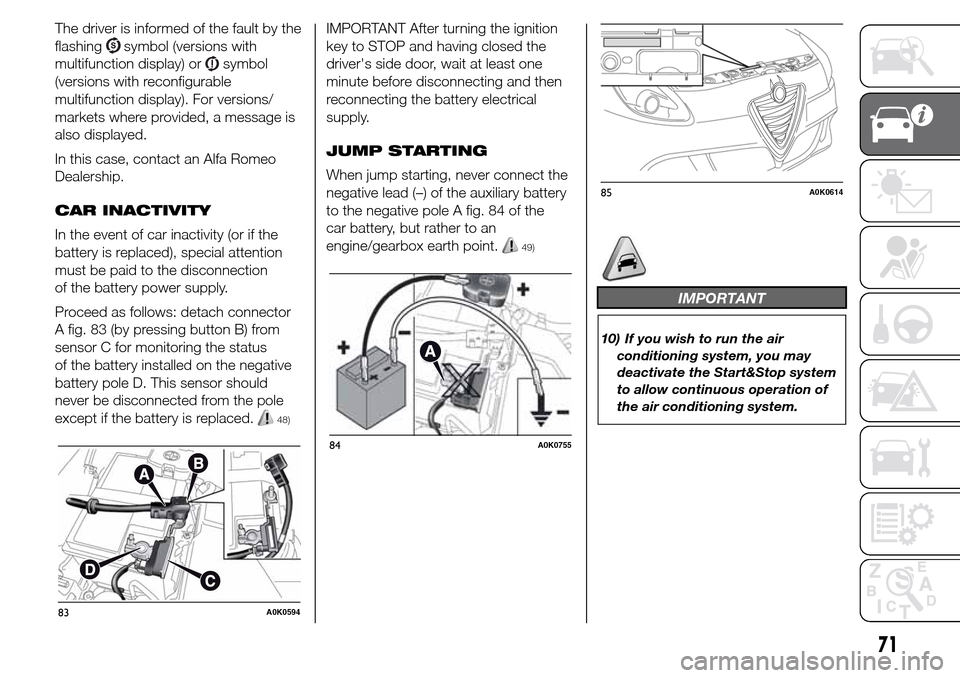
Proceed as follows: detach connector
A fig. 83 (by pressing button B) from
sensor C for monitoring the status
of the battery installed on the negative
battery pole D. This sensor should
never be disconnected from the pole
except if the battery is replaced.
48)
IMPORTANT After turning the ignition
key to STOP and having closed the
driver's side door, wait at least one
minute before disconnecting and then
reconnecting the battery electrical
supply.
JUMP STARTING
When jump starting, never connect the
negative lead (–) of the auxiliary battery
to the negative pole A fig. 84 of the
car battery, but rather to an
engine/gearbox earth point.
49)
IMPORTANT
10) If you wish to run the air
conditioning system, you may
deactivate the Start&Stop system
to allow continuous operation of
the air conditioning system.
83A0K0594
84A0K0755
85A0K0614
71
Page 76 of 288
WARNING
48) When replacing the battery,
always contact an Alfa Romeo
Dealership. The replacement
battery should be of the same
type (HEAVY DUTY) and should
have the same characteristics.
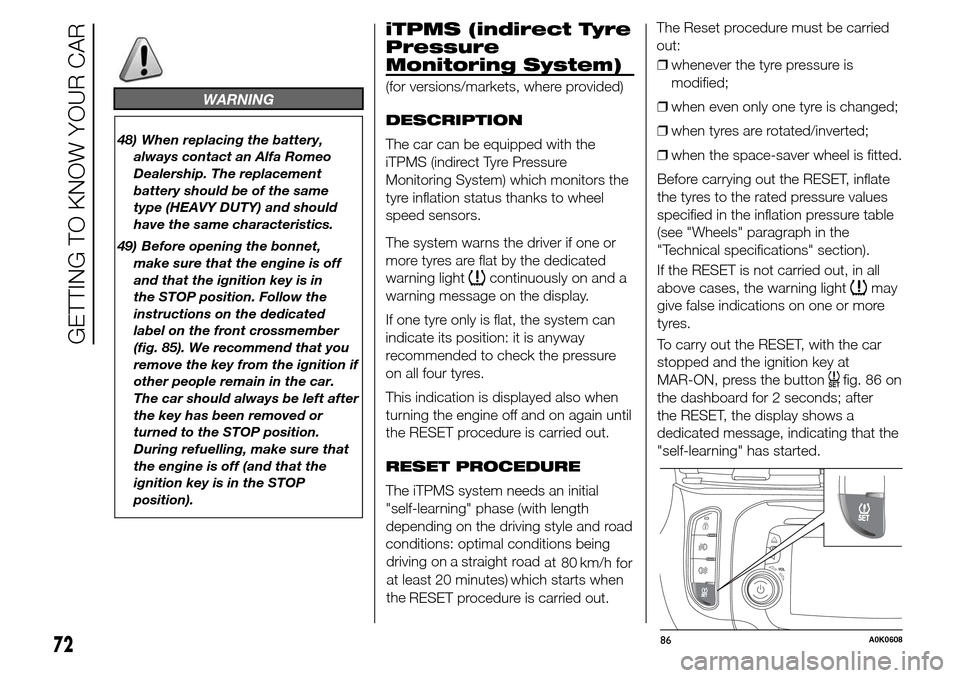
49) Before opening the bonnet,
make sure that the engine is off
and that the ignition key is in
the STOP position. Follow the
instructions on the dedicated
label on the front crossmember
(fig. 85). We recommend that you
remove the key from the ignition if
other people remain in the car.
The car should always be left after
the key has been removed or
turned to the STOP position.
During refuelling, make sure that
the engine is off (and that the
ignition key is in the STOP
position).
iTPMS (indirect Tyre
Pressure
Monitoring System)
(for versions/markets, where provided)
DESCRIPTION
The car can be equipped with the
iTPMS (indirect Tyre Pressure
Monitoring System) which monitors the
tyre inflation status thanks to wheel
speed sensors.
The system warns the driver if one or
more tyres are flat by the dedicated
warning light
continuously on and a
warning message on the display.
If one tyre only is flat, the system can
indicate its position: it is anyway
recommended to check the pressure
on all four tyres.
This indication is displayed also when
turning the engine off and on again until
the RESET procedure is carried out.
RESET PROCEDURE
The iTPMS system needs an initial
"self-learning" phase (with length
depending on the driving style and road
conditions: optimal conditions being
RESET procedure is carried out.❒whenever the tyre pressure is
modified;
❒when even only one tyre is changed;
❒when tyres are rotated/inverted;
❒when the space-saver wheel is fitted.
Before carrying out the RESET, inflate
the tyres to the rated pressure values
specified in the inflation pressure table
(see "Wheels" paragraph in the
"Technical specifications" section).
If the RESET is not carried out, in all
above cases, the warning lightmay
give false indications on one or more
tyres.
To carry out the RESET, with the car
stopped and the ignition key at
MAR-ON, press the button
fig. 86 on
the dashboard for 2 seconds; after
the RESET, the display shows a
dedicated message, indicating that the
"self-learning" has started.
86A0K060872
GETTING TO KNOW YOUR CAR
The Reset procedure must be carried
out:
which starts when driving
on
a
straight
road
at
80
km/h
for
at least 20 minutes)
the
Page 78 of 288
EOBD SYSTEM
(European On
Board Diagnosis)
(for versions/markets, where provided)
Operation
The EOBD system (European On Board
Diagnosis) carries out a continuous
diagnosis of the components of the car
related to emissions.
It also alerts the driver, by switching on
the
warning light on the instrument
panel, together with a message on
the display, when these components
are no longer in peak condition (see
“Warning lights and messages”
paragraph in the "Knowing the
instrument panel" chapter).
The aim of the EOBD system (European
On Board Diagnosis) is to:
❒monitor the system efficiency;
❒indicate an increase in emissions;
❒indicate the need to replace
damaged components.The car also has a connector, which
can interface with appropriate tools,
that makes it possible to read the error
codes stored in the electronic control
units together with a series of specific
parameters for engine operation and
diagnosis. This check can also be
carried out by the traffic control
authorities.
IMPORTANT After eliminating a fault, to
check the system completely, the Alfa
Romeo Dealership is obliged to run
tests and, if necessary, road tests
which may also require a long journey.
DUAL PINION
ACTIVE STEERING
Operation
This only operates with the key turned
to MAR-ON and the engine started.
The steering allows the force required
at the steering wheel to be adjusted
to suit driving conditions. The different
power assistance modes can be
selected via the d, n, a positions of the
“Alfa DNA System” lever (see paragraph
entitled “Alfa DNA System”).
56)
IMPORTANT After the battery is
disconnected, the steering must be
initialised. The warning light switches on
to indicate this. To carry out this
procedure, simply turn the steering
wheel all the way from one end to the
other or drive in a straight line for about
a hundred metres.
74
GETTING TO KNOW YOUR CAR
Page 80 of 288

ACCESSORIES
PURCHASED BY THE
OWNER
If after purchasing the car, you decide
to install electrical accessories that
require a permanent electric supply
(radio, satellite anti-theft system, etc.) or
accessories that in any case burden
the electric supply, contact an Alfa
Romeo Dealership, whose qualified
personnel, besides suggesting the
most suitable devices from
Lineaccessori Alfa Romeo, will also
check whether the car's electrical
system is able to withstand the load
required, or whether it needs to be
integrated with a more powerful battery.
58)
INSTALLING ELECTRICAL
ELECTRONIC DEVICES
Electrical and electronic devices
installed after buying the car in the
context of after-sales service must carry
the following label:fig. 88Fiat Group Automobiles S.p.A.
authorises the installation of transceiver
devices on condition that such
installations are carried out in
a workmanlike fashion, following the
manufacturer’s instructions, at a
specialised centre.
IMPORTANT Traffic police may not
allow the car on the road if devices
have been installed which modify the
features of the car. This may also cause
invalidation of warranty in relation to
faults caused by the change either
directly or indirectly related to it.
Fiat Group Automobiles S.p.A. shall not
be liable for damage caused by the
installation of accessories either not
supplied or recommended by Fiat
Group Automobiles S.p.A. and/or not
installed in compliance with the
provided instructions.
RADIO TRANSMITTERS
AND MOBILE PHONES
Radio transmitter equipment (vehicle
mobile phones, CB radios, amateur
radio etc.) cannot be used inside the
car unless a separate aerial is mounted
on the roof.IMPORTANT The use of these devices
inside the passenger compartment
(without a separate aerial) may cause
the vehicle’s electronic systems to
malfunction. This could compromise
safety in addition to constituting a
potential hazard for passengers' health.
As far as the use of EC-approved
mobile phones is concerned (GSM,
GPRS, UMTS), follow the usage
instructions provided by the mobile
phone manufacturer.
WARNING
58) Take care when fitting additional
spoilers or non-standard alloy
wheels: they could reduce the
ventilation of the brakes and
affect efficiency in sharp,
repeated braking or on long
descents. Make sure that nothing
obstructs the pedal stroke (mats,
etc.).
88DISPOSITIVI-ELETTRONICI
76
GETTING TO KNOW YOUR CAR
/
Page 102 of 288

The icons relating to the various
parameters are the following:
❒
"Range";
❒
"Average consumption A” (if
Trip A is active, or “B” if Trip B is
active);
❒
"Distance" (if Trip A is
active, or “B” if Trip B is active);
❒
"Instantaneous consumption";
❒
"Average speed A” (if Trip A
is active, or “B” if Trip B is active);
❒
"Trip time" (if Trip A is active, or
“B” if Trip B is active);
TRIP BUTTON 0.00
The TRIP 0.00 button is located on the
right hand stalkfig. 105. With the
ignition key turned to MAR-ON, this
button allows you to view the previously
described values and also set them to
zero to begin a new mission:
❒short press: display various values;
❒long press: values reset and start of a
new mission.New mission
This begins after a reset:
❒“manual” resetting by the user, by
pressing the relevant button;
❒“automatic” resetting, when the “trip
distance” reaches 99999.9 km or
when the “Travel time” reaches
999:59 (999 hours and 59 minutes);
❒after disconnection/reconnection of
the battery.IMPORTANT The reset operation when
“Trip A” details are being displayed
only resets the information associated
with this function.
IMPORTANT The reset operation when
“Trip B” details are being displayed
resets only the information associated
with this function.
Start of journey
procedure
With the ignition key at MAR-ON, reset
by pressing the TRIP 0.00 button and
holding it down for more than 2
seconds.
Trip Exit
You can automatically exit the Trip
function once all the values have been
displayed or by holding the SET/
button down for more than1 second.
105A0K0096
98
KNOWING THE INSTRUMENT PANEL
Page 111 of 288

Warning lights on
panelWhat it means What to do
redDUAL PINION ACTIVE STEERING FAILURE
(for versions/markets, where provided)
When the key is turned to MAR-ON, the warning
light switches on but should switch off after a few
seconds.
If the warning light (or symbol on the display)
remains on, you may not have steering assistance
and the effort required to operate the steering
wheel could be notably increased; steering is,
however, possible.
The display shows the dedicated message.Contact an Alfa Romeo Dealership as soon as
possible.
IMPORTANT After the battery is disconnected,
the steering must be initialised. The warning light
switches on to indicate this. To carry out this
procedure, simply turn the steering wheel all the
way from one end to the other or drive in a
straight line for about 100 metres.
Warning lights on
panelWhat it means What to do
amberALFA ROMEO CODE SYSTEM FAILURE/
ALARM FAILURE
(for versions/markets, where provided)
The warning light (or symbol on the display) will
come on (on some versions, with a message on
the display) to indicate an Alfa Romeo CODE
system or alarm failure (for versions/markets,
where provided).Contact an Alfa Romeo Dealership as soon as
possible.
Break-in attempt
If this warning light flashes or, on some versions, if
the symbol appears in the display (together with a
message) this indicates a break-in attempt.Contact an Alfa Romeo Dealership as soon as
possible.
107