seats Alfa Romeo Giulietta 2015 User Guide
[x] Cancel search | Manufacturer: ALFA ROMEO, Model Year: 2015, Model line: Giulietta, Model: Alfa Romeo Giulietta 2015Pages: 288, PDF Size: 7.34 MB
Page 132 of 288
SEAT BELTS
USING THE SEAT BELTS
The belt should be worn keeping the
torso straight and rested against the
backrest.
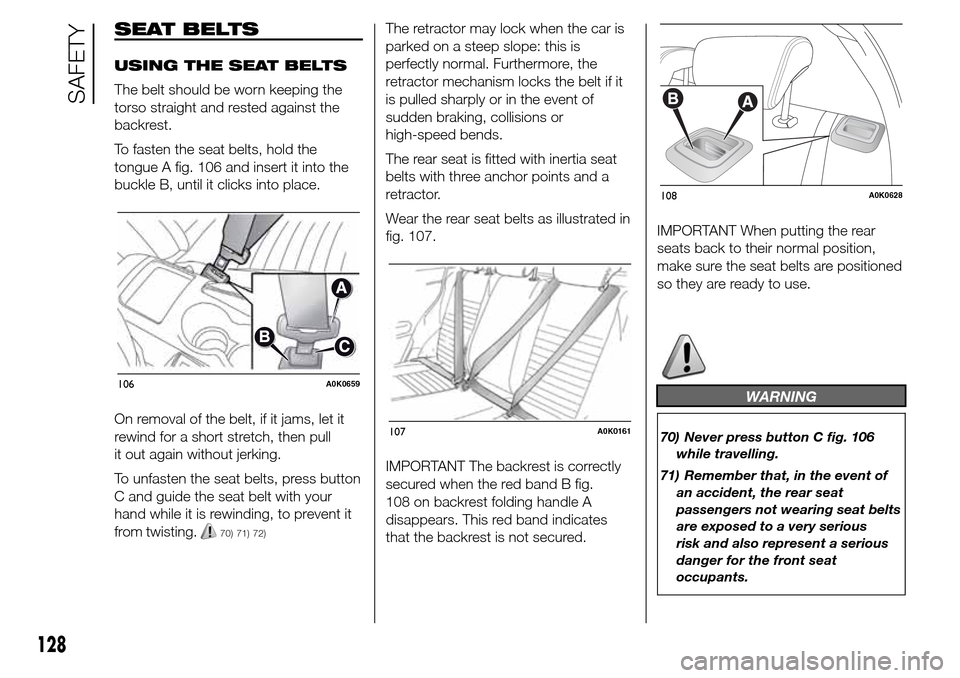
To fasten the seat belts, hold the
tongue A fig. 106 and insert it into the
buckle B, until it clicks into place.
On removal of the belt, if it jams, let it
rewind for a short stretch, then pull
it out again without jerking.
To unfasten the seat belts, press button
C and guide the seat belt with your
hand while it is rewinding, to prevent it
from twisting.
70) 71) 72)
The retractor may lock when the car is
parked on a steep slope: this is
perfectly normal. Furthermore, the
retractor mechanism locks the belt if it
is pulled sharply or in the event of
sudden braking, collisions or
high-speed bends.
The rear seat is fitted with inertia seat
belts with three anchor points and a
retractor.
Wear the rear seat belts as illustrated in
fig. 107.
IMPORTANT The backrest is correctly
secured when the red band B fig.
108 on backrest folding handle A
disappears. This red band indicates
that the backrest is not secured.IMPORTANT When putting the rear
seats back to their normal position,
make sure the seat belts are positioned
so they are ready to use.
WARNING
70) Never press button C fig. 106
while travelling.
71) Remember that, in the event of
an accident, the rear seat
passengers not wearing seat belts
are exposed to a very serious
risk and also represent a serious
danger for the front seat
occupants.
106A0K0659
107A0K0161
108A0K0628
128
SAFETY
Page 134 of 288

Driver
If the driver is the only occupant and
their seat belt is not fastened, when 20
km/h is exceeded or when travelling
at a speed between 10 and 20 km/h for
longer than 5 seconds, an acoustic
signal cycle will be started for the front
seats (continuous acoustic signal for
6 seconds followed by a 90 second
beep). The warning light will flash.
The warning lights will stay on
constantly at the end of the cycle until
the engine is stopped. The acoustic
signal will be interrupted immediately
when the driver’s seat belt is fastened
and the warning light will turn green.
The reminder cycle (acoustic and visual)
will be repeated as described above
and the red warning light will flash if the
seat belt is unfastened again while
travelling.
Passenger
A similar situation applies to the front
passenger, with the difference that the
warning light turns green and the
indication is also interrupted when the
passenger leaves the car.If both front seat belts are unfastened a
few seconds apart while the car is
travelling, the acoustic signal will refer
to the most recent event and the two
warning lights will proceed with the
visual indication independently.
REAR SEATS (warning
light no. 2, no. 3 and no.
4)
For the rear seats, the reminder cycle is
only activated when any seat belt is
unfastened (flashing red).
In this condition, the warning light for
the seat belt which has been
unfastened will flash (red) for
approximately 30 seconds. An acoustic
signal is also emitted.
The visual indication (flashing red) will
start and stop independently for each
warning light if several seat belts are
unfastened. The warning light will
become green when the relevant seat
belt is fastened again.
The rear seat warning lights will switch
off, regardless of the state of the belt
(red or green) approximately 30
seconds after the last signal.IMPORTANT
The warning lights are all off if all seat
belts (front and rear) are already
fastened when the ignition key is turned
to MAR.
All warning lights switch on when at
least one belt changes from fastened to
unfastened or vice versa.
130
SAFETY
FRONT SEATS (warning
light no. 1 = driver and
no. 5 = passenger)
Page 136 of 288

Each seat belt must be used by only
one person. Never travel with a child
sitting on a passenger’s lap and a single
belt to protect them both fig. 112. In
general, do not place any objects
between the person and belt.SEAT BELT
MAINTENANCE
❒Always use the seat belt well
stretched and never twisted; make
sure that it is free to run without
obstructions;
❒replace the belt after an accident of a
certain severity even if it does not
appear to be damaged. Always
replace the belt if the pretensioners
were deployed;
❒hand wash the seat belts with water
and neutral soap, rinse and leave to
dry in the shade. Never use strong
detergents, bleach, paints or any
other substance which could
damage the belt fibres;
❒prevent the retractors from getting
wet: their correct operation is only
guaranteed if water does not get
inside;
❒replace the seat belt when there is
wear or cuts.
WARNING
73) The pretensioner may be used
only once. After its activation,
contact an Alfa Romeo Dealership
to have it replaced.
74) Removing or otherwise
tampering with pretensioner and
seat belt components is strictly
prohibited. Any operations on
these components must be
performed by qualified and
authorised technicians. Always
contact an Alfa Romeo
Dealership.
75) For maximum protection, keep
the backrest upright, lean back
into it and make sure the seat belt
fits closely across your chest
and pelvis. Always fasten the seat
belts for both the front and rear
seats! Travelling without wearing
seat belts will increase the risk
of serious injury and even death in
the event of an accident.
111A0K0012
112A0K0013
132
SAFETY
Page 139 of 288

GROUP 1
79) 80)
Children of weight from 9 to 18 kg may
be carried in child seats facing forwards
fig. 114.
GROUP 2
80)
Children from 15 to 25 kg may use the
car seat belts directly fig. 115.In this case, the child restraint system is
used to position the child correctly
with respect to the seat belts so that
the diagonal belt section crosses the
child’s chest and not the neck, and the
lower part is snug on the pelvis not
the abdomen.
GROUP 3
80)
For children between 22 kg and 36 kg,
there are dedicated restraint systems
that allow the seat belt to be worn
correctly.
fig. 116 shows an example of correct
child seat positioning on the rear seat.
Children over 1.50 m in height can wear
seat belts like adults.
WARNING
79) Child restraint systems with
Isofix attachments are available,
which allow them to be secured to
the seat safely without using the
car seat belts. See paragraph
"Isofix child restraint system
setup" for the fitting instructions.
80) The figure is indicative for fitting
purposes only. Fit the child
restraint system according to the
instructions, which must be
included.
114A0K0129
115A0K0016
116A0K0017
135
Page 140 of 288

SUITABILITY OF PASSENGER SEATS FOR UNIVERSAL CHILD SEAT USE
According to the European Directive 2000/3/EC the suitability of each passenger seat position for the fixing of universal child
seats is shown in the following table:
Group Weight groups Front passenger's seatRear (side and central)
seats
Group 0, 0+ up to 13 kgU (*) U
Group 1 9-18 kgU (*) U
Group 2 15-25 kgU (*) U
Group 3 22-36 kgU (*) U
U (*)With height-adjustable seat, move the backrest to a vertical position.
U= Suitable for child restraint systems in the "Universal" category, according to European Standard EEC-R44 for the specified "Groups".
136
SAFETY
Page 141 of 288

PREPARATION FOR
“ISOFIX” CHILD
SEAT
The car is equipped with ISOFIX
anchorages, a new standard which
makes fitting a child seat quick, simple
and safe.
Isofix systems can be fitted alongside
conventional child seats on different
seats in the same car.
fig. 117 Shows an example of a
Universal Isofix child restraint system for
weight group 1.
81)
The other weight groups are covered
by specific Isofix child seats, which can
be used only if specifically tested for
this car (see list of cars provided with
the child seat).
IMPORTANT The central rear seat is
not approved for any type of Isofix child
seat.
INSTALLING A
UNIVERSAL ISOFIX
CHILD SEAT
Proceed as follows:
❒attach the child restraint system to
the special lower metal rings B fig.
118, located inside the rear seat
backrest (to access the rings lift
hinge A);❒secure the upper belt (available
together with the child restraint
system) to the special attachments C
fig. 119 located in the rear part of
the backrest.
It is possible to have a mixed assembly
of traditional child restraint system
and Universal Isofix ones. Remember
that when using a Universal Isofix child
restraint system, you can only use
type-approved child restraint systems
with the marking ECE R44 (R44/03
or superior) “Universal Isofix”.
The Universal Isofix “Duo Plus” child
seat and the special “G 0/1 S” seat are
available from Lineaccessori Alfa
Romeo.
For any further installation/usage
details, refer to the “Instruction Manual”
provided with the child restraint system.
82) 83) 84)
117A0K0018
118A0K0510
119A0K0511
137
Page 142 of 288

SUITABILITY OF PASSENGER SEATS FOR ISOFIX CHILD SEAT USE
The table below shows the various installation possibilities for Isofix child seats on seats fitted with Isofix attachments in
accordance with European standard ECE 16.
Weight groupChild restraint system
positionIsofix size class Rear side seats
Group 0 up to 10 kg Facing backwards EIL (*)
Group 0+ up to 13 kgFacing backwards EIL (*)
Facing backwards DIL (*)
Facing backwards CIL (*)
Group1from9upto18kgFacing backwards DIL (*)
Facing backwards CIL (*)
Forward facing BIUF
Forward facing BIIUF
Forward facing AIUF
IL suitable for ISOFIX child restraint systems of the categories for "specific vehicles", "restricted" or "semiuniversal"
(*) the Isofix child seat can be installed by adjusting the front seat
IUF: suitable for Isofix child seats to be positioned in forward facing position, universal class (fitted with third upper mounting), type-approvedfor the relevant weight
group.
138
SAFETY
Page 143 of 288

Main recommendations
to carry children safely
❒Install the child restraint systems
on the rear seat, which is the most
protected position in the event of an
accident.
❒Keep children in rear facing child
restraint systems for as long as
possible, until 2 years old.
❒Should a rear facing child restraint
system be installed on the rear seats,
it is advisable to position it as far
forward as the position of the front
seat allows.
❒If the front passenger airbag is
deactivated always check the
permanent switching on of the
warning light in the trim above the
internal rearview mirror to make
sure that it has actually been
deactivated.
❒Carefully follow the instructions
supplied with the child restraint
system itself. Keep the instructions in
the car along with the other
documents and this handbook. Do
not use second-hand child restraint
systems without instructions.
❒Only one child is to be strapped into
each restraint system; never carry
two children simultaneously.❒Always check that the seat belts do
not interfere with the child's throat.
❒Always check that the seat belt
is well fastened by pulling on it.
❒While travelling, do not let the child sit
incorrectly or unfasten the belts.
❒Never allow a child to put the belt's
diagonal section under an arm or
behind their back.
❒Never carry children on your lap,
even newborns. No-one can restrain
a child in the event of an accident.
❒In the event of an accident, replace
the child restraint system with a
new one.
WARNING
81) The figure is indicative for fitting
purposes only. Fit the child
restraint system according to the
instructions, which must be
included.
82) If a Universal Isofix child
restraint system is not fixed to all
three anchorages, it will not be
able to protect the child correctly.
In a crash, the child could be
seriously or fatally injured.83) Fit the child restraint system only
when the car is stationary. The
child restraint system is correctly
secured to the brackets when
you hear the click. Follow the
instructions for assembly,
disassembly and positioning that
the manufacturer must supply
with the child restraint system.
84) Fit the child restraint system
according to the instructions,
which must be included.
139
Page 147 of 288

WARNING
85) Do not apply stickers or other objects on the steering wheel, on the dashboard in the passenger side airbag area, on
side upholstery on the roof or on the seats. Never put objects (e.g. mobile phones) on the passenger's side dashboard
since they could interfere with correct inflation of the airbag and also cause serious injury to the passengers.
86) Always drive keeping your hands on the steering wheel rim so that the airbag can inflate freely if necessary. Do not
drive with your body bent forward. Keep the back of your seat upright and lean back into it.
87) When an active passenger airbag is fitted, DO NOT install rear facing child restraint systems on the front seat.
Deployment of the airbag in an accident could cause fatal injuries to the child regardless of the severity of the
impact. Therefore, always deactivate the passenger airbag when a rear facing child restraint system is installed on
the front passenger seat. The front passenger seat must also be positioned back as far as possible in order to avoid
the child restraint system from coming into contact with the dashboard. Immediately reactivate the passenger airbag
as soon as the child restraint system has been removed.
88) To deactivate the airbags, see the “Knowing your car” section, “Menu Items” paragraph.
89) When an active passenger airbag is fitted, DO NOT install rear facing child restraint systems on the front seat.
Deployment of the airbag in an accident could cause fatal injuries to the child regardless of the severity of the
impact.
143
Page 148 of 288

SIDE AIRBAGS (SIDE
BAGS - WINDOW
BAGS)
To increase protection of occupants in
case of side collision, the car is
equipped with front side bags for pelvis,
chest and shoulder protection (side
bags) for the driver and the passenger
and airbags protecting the head of front
and rear occupants (window bags).
Non-activation of side bags in other
types of collisions (head-on collisions,
rear shunts, roll-overs, etc...) is not
an indication of system malfunction.
FRONT SIDE AIRBAGS
(SIDE BAGS)
These comprise two types of bags
located in the front seat backrests fig.
124 which protect the pelvic, chest and
shoulder area of the occupants in the
event of a side impact of medium-high
severity.
SIDE AIRBAGS FOR
HEAD PROTECTION
(WINDOW BAGS)
This comprises two "curtain" bags
housed behind the roof side linings and
covered by special trims fig. 125.It is designed to protect the head of
front and rear occupants in the event of
a side collision, thanks to the wide
cushion inflation surface.
The deployment of side bags in the
event of side impacts of low severity is
not required.
The airbags are not deployed in the
event of low-severity impacts (for which
the retaining action of the seat belts is
sufficient). It is therefore always
necessary to wear seat belts.In the event of a side impact, the
system provides optimum protection if
the passenger assumes the correct
position on the seat, thus allowing
correct window bag deployment.
IMPORTANT
Do not wash the seats with water or
pressurised steam (by hand or at
automatic seat washing stations).
The front and/or side bags may activate
in the event of sharp knocks to the
underbody of the car (e.g. impact with
steps, pavements, potholes or road
bumps etc.).
124A0K0629
125A0K0035
144
SAFETY