light Alfa Romeo Giulietta 2016 Owner's Manual
[x] Cancel search | Manufacturer: ALFA ROMEO, Model Year: 2016, Model line: Giulietta, Model: Alfa Romeo Giulietta 2016Pages: 288, PDF Size: 7.34 MB
Page 219 of 288
If there is no jet of fluid, firstly check
that there is some fluid in the reservoir
(see paragraph "Checking fluid levels"
in this chapter).
Then check that the nozzle holes are
not clogged, if necessary use a needle.
Rear window washer
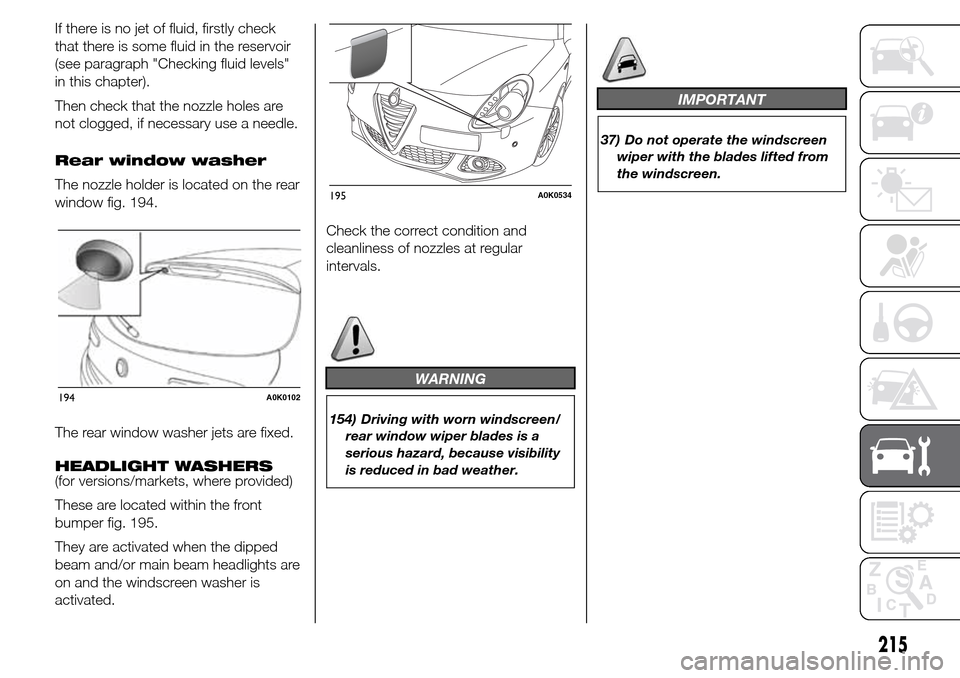
The nozzle holder is located on the rear
window fig. 194.
The rear window washer jets are fixed.
HEADLIGHT WASHERS
(for versions/markets, where provided)
These are located within the front
bumper fig. 195.
They are activated when the dipped
beam and/or main beam headlights are
on and the windscreen washer is
activated.Check the correct condition and
cleanliness of nozzles at regular
intervals.
WARNING
154) Driving with worn windscreen/
rear window wiper blades is a
serious hazard, because visibility
is reduced in bad weather.
IMPORTANT
37) Do not operate the windscreen
wiper with the blades lifted from
the windscreen.
194A0K0102
195A0K0534
215
Page 220 of 288
BODYWORK
PROTECTION AGAINST
ATMOSPHERIC AGENTS
The car is equipped with the best
available technological solutions to
effectively protect the bodywork against
corrosion.
These include:
❒painting products and systems which
give the car resistance to corrosion
and abrasion
❒use of galvanised (or pretreated) steel
sheets, with high resistance to
corrosion;
❒spraying of plastic parts, with a
protective function in the more
exposed points: underdoor, inner
wing, edges, etc;
❒use of “open” boxed sections to
prevent condensation and pockets of
moisture which could favour the
formation of rust inside;
❒use of special films to protect against
abrasion in exposed areas (e.g. rear
wing, doors, etc.).BODY AND UNDERBODY
WARRANTY
Your car is covered by warranty against
perforation due to rust of any original
element of the structure or bodywork.
For the general terms of this warranty,
refer to the Warranty Booklet.
PRESERVING THE
BODYWORK
Paintwork
6)38)
Touch up abrasions and scratches
immediately to prevent the formation of
rust.
Maintenance of paintwork consists of
washing the car: the frequency
depends on the conditions and
environment where the car is used. For
example, it is advisable to wash the
car more often in areas with high levels
of atmospheric pollution or salted
roads.
On some versions the car may be
equipped, on request, with an exclusive
opaque paint on the roof which, in
order to be maintained intact, requires
special care: see the instructions in
the warning.
39)
To correctly wash the car, follow these
instructions:
❒remove the aerial from the roof when
using a carwash;
❒if high pressure jets or cleaners are
used to wash the car, keep a
distance of at least 40 cm from the
bodywork to avoid damage or
alteration. Bear in mind that a build
up of water could cause damage
to the car in the long term;
❒wash the bodywork using a low
pressure jet of water;
❒wipe a sponge with a slightly soapy
solution over the bodywork,
frequently rinsing the sponge;
❒rinse well with water and dry with a
jet of air or a chamois leather.
Dry the less visible parts (e.g. door
frames, bonnet, headlight frames, etc.)
with special care, as water may
stagnate more easily in these areas. Do
not wash the car after it has been left
in the sun or with the bonnet hot:
this may alter the shine of the
paintwork.
Exterior plastic parts must be cleaned
in the same way as the rest of the car.
216
SERVICING AND MAINTENANCE
Page 221 of 288
IMPORTANT
Avoid parking under trees; the resin
dropped by trees makes the paintwork
go opaque and increases the possibility
of corrosion.
Bird droppings must be washed off
immediately and thoroughly as the acid
they contain is particularly aggressive.
Windows
Use specific detergents and clean
cloths to prevent scratching or altering
the transparency.
IMPORTANT Wipe the rear window
inside gently with a cloth following the
direction of the filaments to avoid
damaging the heating device.
Front headlights
Use a soft cloth soaked in water and
detergent for washing cars.
IMPORTANT Never use aromatic
substances (e.g. petrol) or ketenes (e.g.
acetone) for cleaning the plastic lenses
of the front headlights.
IMPORTANT When cleaning with a
pressure washer, keep the water jet at
least 20 cm away from the headlights.Engine compartment
At the end of every winter, wash the
engine compartment thoroughly, taking
care not to aim the jet of water directly
at the electronic control units or at
the windscreen wiper motors. Have this
operation performed at a specialised
workshop.
IMPORTANT The washing should take
place with the engine cold and the
ignition key in the STOP position. After
the washing operation, make sure
that the various protections (e.g. rubber
caps and guards) have not been
removed or damaged.
IMPORTANT
6) Detergents cause water pollution.
Only wash your car in areas
equipped to collect and treat
wastewater from this type
of activity.
IMPORTANT
38) In order to preserve the aesthetic
appearance of the paint abrasive
products and/or polishes should
not be used for cleaning the car.
217
Page 222 of 288
39) Avoid washing with rollers
and/or brushes in washing
stations. Wash the car only by
hand using neutral pH detergents;
dry it with a wet chamois leather.
Abrasive products and/or polishes
should not be used for cleaning
the car. Bird droppings must
be washed off immediately and
thoroughly as the acid they
contain is particularly aggressive.
Avoid (if at all possible) parking
the car under trees; remove
vegetable resins immediately as,
when dried, it may only be
possible to remove them with
abrasive products and/or polishes,
which is highly inadvisable as
they could alter the typical opacity
of the paint. Do not use pure
windscreen washer fluid for
cleaning the front windscreen and
rear window; dilute it min. 50%
with water. Only use pure screen
washer fluid when strictly
necessary due to outside
temperature conditions.INTERIORS
155) 156) 157)
Periodically check the cleanliness of the
interior, beneath the mats, which could
cause oxidation of the sheet metal.
SEATS AND FABRIC
PARTS
Remove dust with a soft brush or a
vacuum cleaner. It is advisable to use a
moist brush on velvet upholstery. Rub
the seats with a sponge moistened with
a solution of water and neutral
detergent.
LEATHER SEATS
(for versions/markets, where provided)
Remove the dry dirt with a slightly
damp buckskin or cloth, without
exercising too much pressure. Remove
any liquid or grease stains using an
absorbent dry cloth, without rubbing.
Then clean with a soft cloth or buckskin
cloth dampened with water and mild
soap. If the stain persists, use specific
products and observe the instructions
carefully.
IMPORTANT Never use alcohol. Make
sure that the cleaning products used
contain no alcohol or alcohol
derivatives, even in small quantities.PLASTIC AND COATED
PARTS
Clean interior plastic parts with a damp
cloth (if possible made from microfibre),
and a solution of water and neutral,
non-abrasive detergent. To clean oily or
persistent stains, use specific products
free from solvents and designed to
maintain the original appearance and
colour of the components.
Remove any dust using a microfibre
cloth, if necessary moistened with
water. The use of paper tissues is not
recommended as these may leave
residues.
40)
LEATHER PARTS
(for versions/markets, where provided)
Use only water and mild soap to clean
these parts. Never use alcohol or
alcohol-based products. Before using a
specific product for cleaning interiors,
make sure that it does not contain
alcohol and/or alcohol-based
substances.
218
SERVICING AND MAINTENANCE
Page 223 of 288
WARNING
155) Never use flammable products,
such as petroleum ether or
modified petrol, to clean the
inside of the car. The electrostatic
charges which are generated by
rubbing during the cleaning
operation may cause a fire.
156) Do not keep aerosol cans in the
car: they might explode. Aerosol
cans must not be exposed to a
temperature exceeding 50°C.
When the car is exposed to
sunlight, the internal temperature
can greatly exceed this value.
157) There should be no obstacles
on the floor underneath the
pedals; make sure that mats are
always flat and do not interfere
with the pedals.
IMPORTANT
40) Never use alcohol, petrols and
derivatives to clean the dashboard
and instrument panel lens.
219
Page 249 of 288
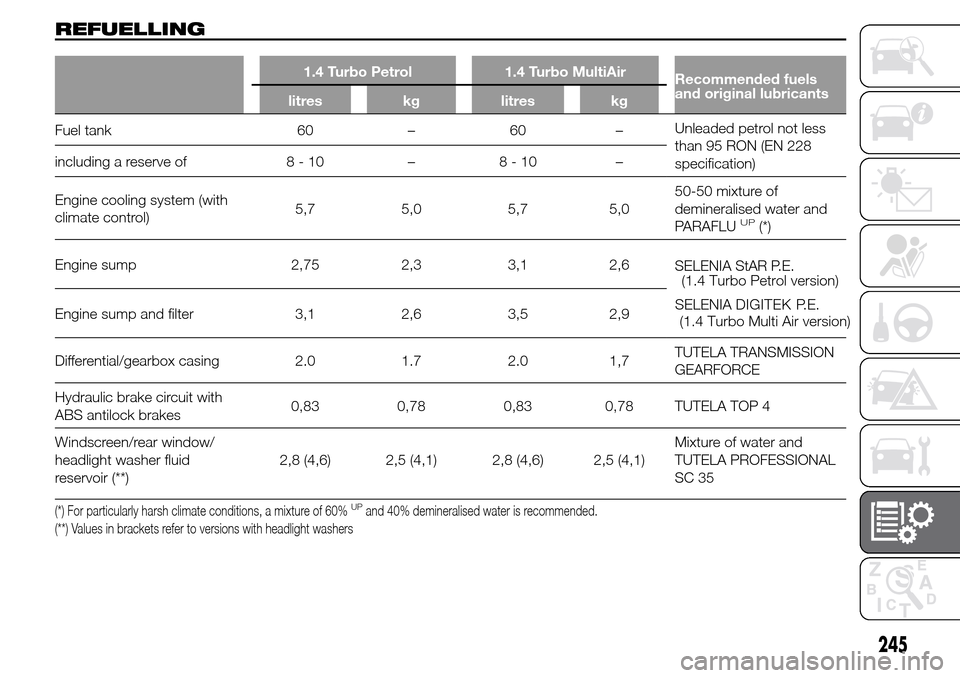
REFUELLING
1.4 Turbo Petrol 1.4 Turbo MultiAir
Recommended fuels
and original lubricants
litres kg litres kg
Fuel tank 60 – 60 –Unleaded petrol not less
than 95 RON (EN 228
specification) including a reserve of 8 - 10 – 8 - 10 –
Engine cooling system (with
climate control)5,7 5,0 5,7 5,050-50 mixture of
demineralised water and
PARAFLU
UP(*)
Engine sump 2,75 2,3 3,1 2,6
SELENIAStAR P.E.
Engine sump and filter 3,1 2,6 3,5 2,9
Differential/gearbox casing 2.0 1.7 2.0 1,7TUTELA TRANSMISSION
GEARFORCE
Hydraulic brake circuit with
ABS antilock brakes0,83 0,78 0,83 0,78 TUTELA TOP 4
Windscreen/rear window/
headlight washer fluid
reservoir (**)2,8 (4,6) 2,5 (4,1) 2,8 (4,6) 2,5 (4,1)Mixture of water and
TUTELA PROFESSIONAL
SC 35
(*) For particularly harsh climate conditions, a mixture of 60%UPand 40% demineralised water is recommended.
(**) Values in brackets refer to versions with headlight washers
245
SELENIADIGITEK P.E.
(1.4 Turbo Petrol version)
(1.4 Turbo l version)Mu ti Air
Page 250 of 288
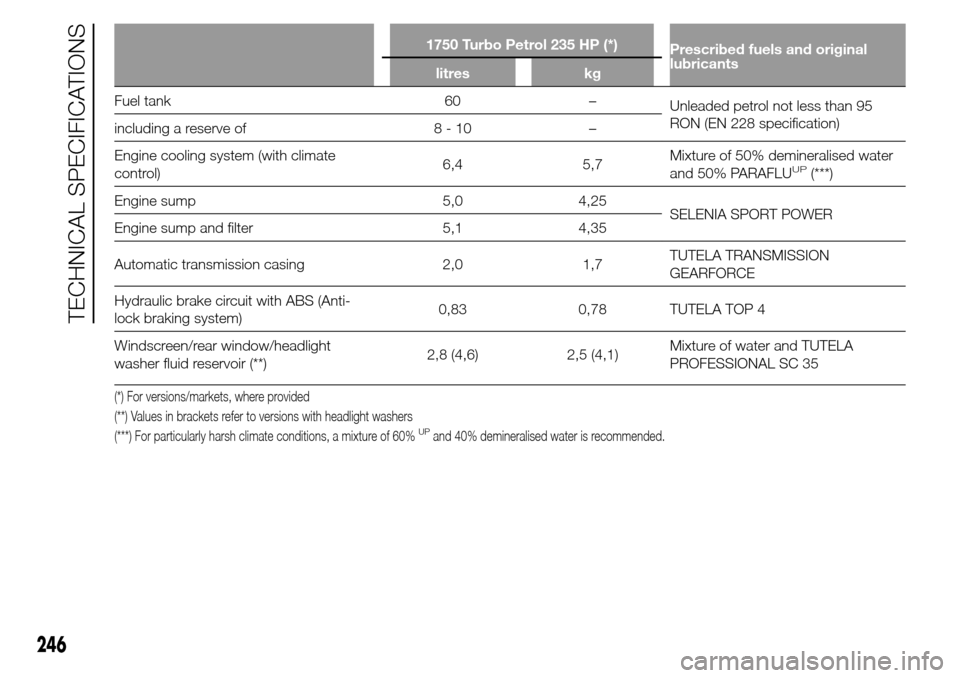
1750 Turbo Petrol 235 HP (*)
Prescribed fuels and original
lubricants
litres kg
Fuel tank 60 –
Unleaded petrol not less than 95
RON (EN 228 specification)
including a reserve of 8 - 10 –
Engine cooling system (with climate
control)6,4 5,7Mixture of 50% demineralised water
and 50% PARAFLU
UP(***)
Engine sump 5,0 4,25
SELENIA SPORT POWER
Engine sump and filter 5,1 4,35
Automatic transmission casing 2,0 1,7TUTELA TRANSMISSION
GEARFORCE
Hydraulic brake circuit with ABS (Anti-
lock braking system)0,83 0,78 TUTELA TOP 4
Windscreen/rear window/headlight
washer fluid reservoir (**)2,8 (4,6) 2,5 (4,1)Mixture of water and TUTELA
PROFESSIONAL SC 35
(*) For versions/markets, where provided
(***) For particularly harsh climate conditions, a mixture of 60%
UPand 40% demineralised water is recommended. (**) Values in brackets refer to versions with headlight washers
246
TECHNICAL SPECIFICATIONS
Page 251 of 288
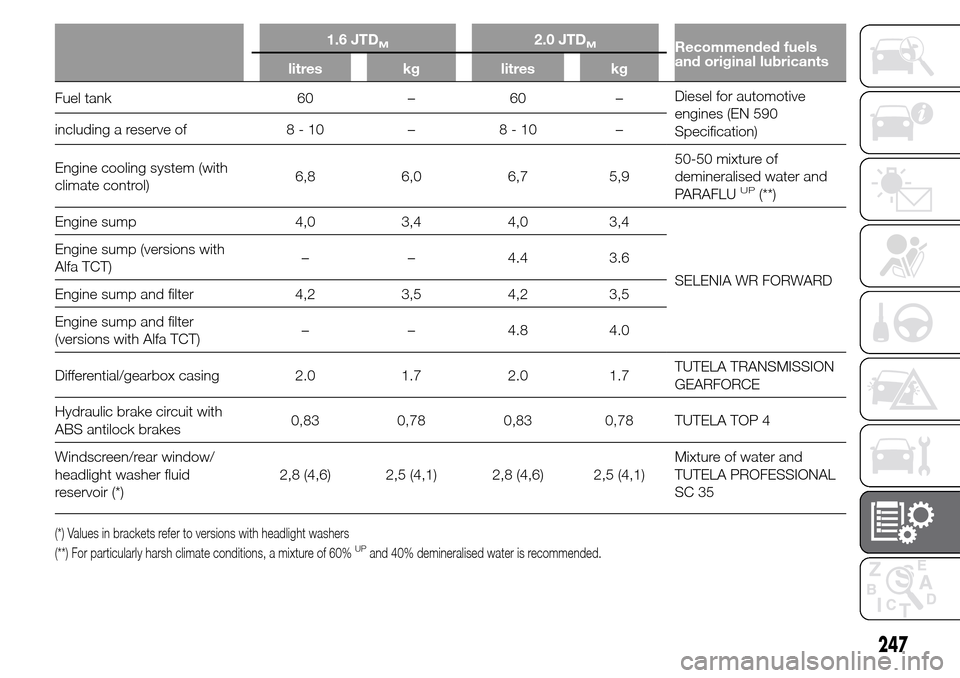
1.6 JTDM2.0 JTDMRecommended fuels
and original lubricants
litres kg litres kg
Fuel tank 60 – 60 –Diesel for automotive
engines (EN 590
Specification) including a reserve of 8 - 10 – 8 - 10 –
Engine cooling system (with
climate control)6,8 6,0 6,7 5,950-50 mixture of
demineralised water and
PARAFLU
UP(**)
Engine sump 4,0 3,4 4,0 3,4
SELENIA WR FORWARD Engine sump (versions with
Alfa TCT)– – 4.4 3.6
Engine sump and filter 4,2 3,5 4,2 3,5
Engine sump and filter
(versions with Alfa TCT)– – 4.8 4.0
Differential/gearbox casing 2.0 1.7 2.0 1.7TUTELA TRANSMISSION
GEARFORCE
Hydraulic brake circuit with
ABS antilock brakes0,83 0,78 0,83 0,78 TUTELA TOP 4
Windscreen/rear window/
headlight washer fluid
reservoir (*)2,8 (4,6) 2,5 (4,1) 2,8 (4,6) 2,5 (4,1)Mixture of water and
TUTELA PROFESSIONAL
SC 35
(**) For particularly harsh climate conditions, a mixture of 60%UPand 40% demineralised water is recommended. (*) Values in brackets refer to versions with headlight washers
247
Page 255 of 288
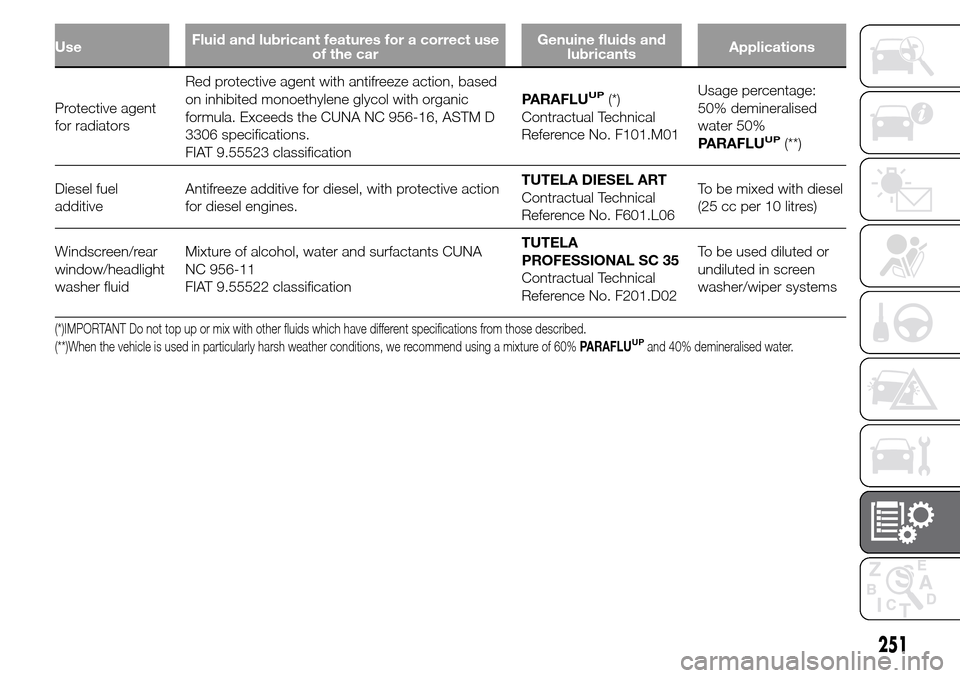
UseFluid and lubricant features for a correct use
of the carGenuine fluids and
lubricantsApplications
Protective agent
for radiatorsRed protective agent with antifreeze action, based
on inhibited monoethylene glycol with organic
formula. Exceeds the CUNA NC 956-16, ASTM D
3306 specifications.
FIAT 9.55523 classificationPARAFLUUP(*)
Contractual Technical
Reference No. F101.M01Usage percentage:
50% demineralised
water 50%
PARAFLU
UP(**)
Diesel fuel
additiveAntifreeze additive for diesel, with protective action
for diesel engines.TUTELA DIESEL ART
Contractual Technical
Reference No. F601.L06To be mixed with diesel
(25 cc per 10 litres)
Windscreen/rear
window/headlight
washer fluidMixture of alcohol, water and surfactants CUNA
NC 956-11
FIAT 9.55522 classificationTUTELA
PROFESSIONAL SC 35
Contractual Technical
Reference No. F201.D02To be used diluted or
undiluted in screen
washer/wiper systems
(*)IMPORTANT Do not top up or mix with other fluids which have different specifications from those described.
(**)When the vehicle is used in particularly harsh weather conditions, we recommend using a mixture of 60%PARAFLUUPand 40% demineralised water.
251
Page 260 of 288
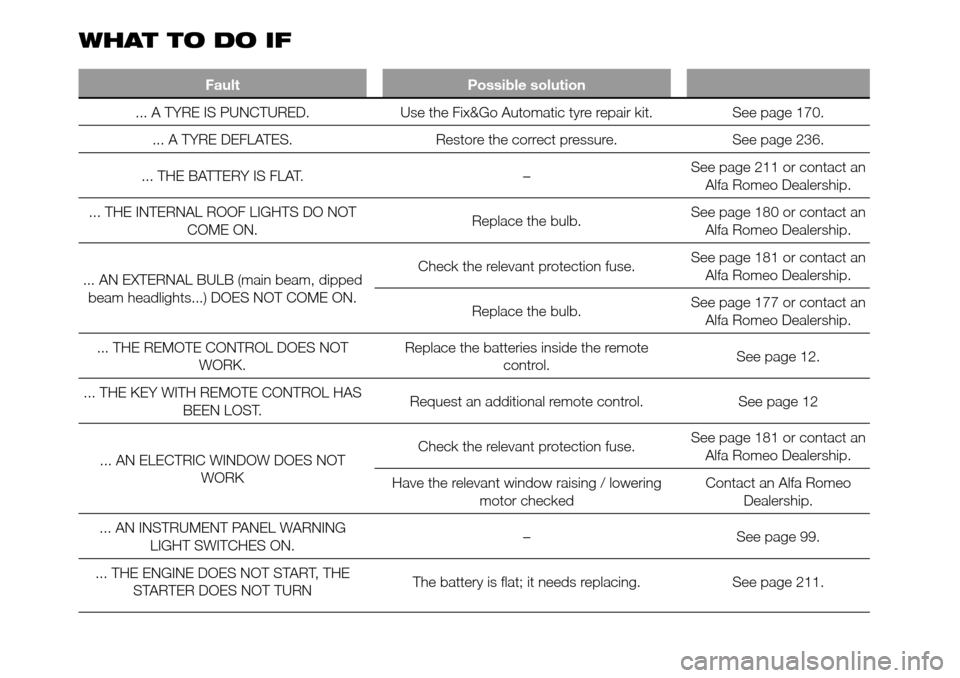
WHATTODOIF
Fault Possible solution
... A TYRE IS PUNCTURED. Use the Fix&Go Automatic tyre repair kit. See page 170.
... A TYRE DEFLATES. Restore the correct pressure. See page 236.
... THE BATTERY IS FLAT. –See page 211 or contact an
Alfa Romeo Dealership.
... THE INTERNAL ROOF LIGHTS DO NOT
COME ON.Replace the bulb.See page 180 or contact an
Alfa Romeo Dealership.
... AN EXTERNAL BULB (main beam, dipped
beam headlights...) DOES NOT COME ON.Check the relevant protection fuse.See page 181 or contact an
Alfa Romeo Dealership.
Replace the bulb.See page 177 or contact an
Alfa Romeo Dealership.
... THE REMOTE CONTROL DOES NOT
WORK.Replace the batteries inside the remote
control.See page 12.
... THE KEY WITH REMOTE CONTROL HAS
BEEN LOST.Request an additional remote control. See page 12
... AN ELECTRIC WINDOW DOES NOT
WORKCheck the relevant protection fuse.See page 181 or contact an
Alfa Romeo Dealership.
Have the relevant window raising / lowering
motor checkedContact an Alfa Romeo
Dealership.
... AN INSTRUMENT PANEL WARNING
LIGHT SWITCHES ON.– See page 99.
... THE ENGINE DOES NOT START, THE
STARTER DOES NOT TURNThe battery is flat; it needs replacing. See page 211.