roof Alfa Romeo Giulietta 2016 User Guide
[x] Cancel search | Manufacturer: ALFA ROMEO, Model Year: 2016, Model line: Giulietta, Model: Alfa Romeo Giulietta 2016Pages: 288, PDF Size: 7.34 MB
Page 79 of 288
WARNING
56) It is absolutely forbidden to carry
out any after-market operation
involving steering system or
steering column modifications
(e.g. installation of anti-theft
device) that could adversely affect
performance and safety,
invalidate the warranty and also
result in non-compliance of the
car with type-approval
requirements.
WIRING FOR RADIO
SYSTEM
(for versions/markets, where provided)
If noUconnect™5" Radio or
Uconnect™6.5" Radio Nav was
requested with the car, it is provided
with a dual storage compartment in the
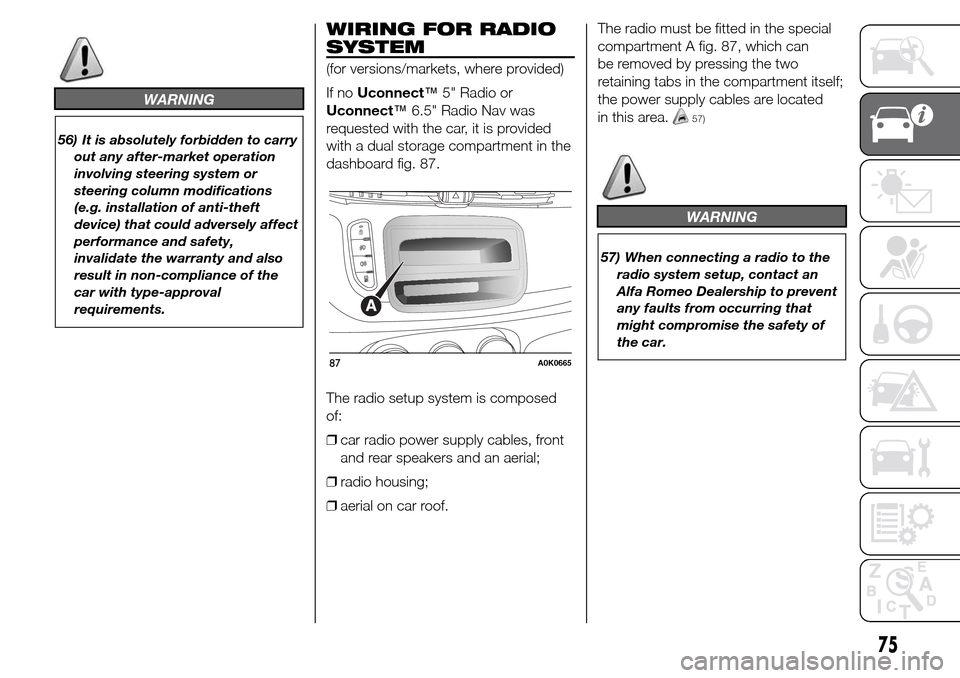
dashboard fig. 87.
The radio setup system is composed
of:
❒car radio power supply cables, front
and rear speakers and an aerial;
❒radio housing;
❒aerial on car roof.The radio must be fitted in the special
compartment A fig. 87, which can
be removed by pressing the two
retaining tabs in the compartment itself;
the power supply cables are located
in this area.
57)
WARNING
57) When connecting a radio to the
radio system setup, contact an
Alfa Romeo Dealership to prevent
any faults from occurring that
might compromise the safety of
the car.
87A0K0665
75
Page 80 of 288

ACCESSORIES
PURCHASED BY THE
OWNER
If after purchasing the car, you decide
to install electrical accessories that
require a permanent electric supply
(radio, satellite anti-theft system, etc.) or
accessories that in any case burden
the electric supply, contact an Alfa
Romeo Dealership, whose qualified
personnel, besides suggesting the
most suitable devices from
Lineaccessori Alfa Romeo, will also
check whether the car's electrical
system is able to withstand the load
required, or whether it needs to be
integrated with a more powerful battery.
58)
INSTALLING ELECTRICAL
ELECTRONIC DEVICES
Electrical and electronic devices
installed after buying the car in the
context of after-sales service must carry
the following label:fig. 88Fiat Group Automobiles S.p.A.
authorises the installation of transceiver
devices on condition that such
installations are carried out in
a workmanlike fashion, following the
manufacturer’s instructions, at a
specialised centre.
IMPORTANT Traffic police may not
allow the car on the road if devices
have been installed which modify the
features of the car. This may also cause
invalidation of warranty in relation to
faults caused by the change either
directly or indirectly related to it.
Fiat Group Automobiles S.p.A. shall not
be liable for damage caused by the
installation of accessories either not
supplied or recommended by Fiat
Group Automobiles S.p.A. and/or not
installed in compliance with the
provided instructions.
RADIO TRANSMITTERS
AND MOBILE PHONES
Radio transmitter equipment (vehicle
mobile phones, CB radios, amateur
radio etc.) cannot be used inside the
car unless a separate aerial is mounted
on the roof.IMPORTANT The use of these devices
inside the passenger compartment
(without a separate aerial) may cause
the vehicle’s electronic systems to
malfunction. This could compromise
safety in addition to constituting a
potential hazard for passengers' health.
As far as the use of EC-approved
mobile phones is concerned (GSM,
GPRS, UMTS), follow the usage
instructions provided by the mobile
phone manufacturer.
WARNING
58) Take care when fitting additional
spoilers or non-standard alloy
wheels: they could reduce the
ventilation of the brakes and
affect efficiency in sharp,
repeated braking or on long
descents. Make sure that nothing
obstructs the pedal stroke (mats,
etc.).
88DISPOSITIVI-ELETTRONICI
76
GETTING TO KNOW YOUR CAR
/
Page 147 of 288
WARNING
85) Do not apply stickers or other objects on the steering wheel, on the dashboard in the passenger side airbag area, on
side upholstery on the roof or on the seats. Never put objects (e.g. mobile phones) on the passenger's side dashboard
since they could interfere with correct inflation of the airbag and also cause serious injury to the passengers.
86) Always drive keeping your hands on the steering wheel rim so that the airbag can inflate freely if necessary. Do not
drive with your body bent forward. Keep the back of your seat upright and lean back into it.
87) When an active passenger airbag is fitted, DO NOT install rear facing child restraint systems on the front seat.
Deployment of the airbag in an accident could cause fatal injuries to the child regardless of the severity of the
impact. Therefore, always deactivate the passenger airbag when a rear facing child restraint system is installed on
the front passenger seat. The front passenger seat must also be positioned back as far as possible in order to avoid
the child restraint system from coming into contact with the dashboard. Immediately reactivate the passenger airbag
as soon as the child restraint system has been removed.
88) To deactivate the airbags, see the “Knowing your car” section, “Menu Items” paragraph.
89) When an active passenger airbag is fitted, DO NOT install rear facing child restraint systems on the front seat.
Deployment of the airbag in an accident could cause fatal injuries to the child regardless of the severity of the
impact.
143
Page 148 of 288

SIDE AIRBAGS (SIDE
BAGS - WINDOW
BAGS)
To increase protection of occupants in
case of side collision, the car is
equipped with front side bags for pelvis,
chest and shoulder protection (side
bags) for the driver and the passenger
and airbags protecting the head of front
and rear occupants (window bags).
Non-activation of side bags in other
types of collisions (head-on collisions,
rear shunts, roll-overs, etc...) is not
an indication of system malfunction.
FRONT SIDE AIRBAGS
(SIDE BAGS)
These comprise two types of bags
located in the front seat backrests fig.
124 which protect the pelvic, chest and
shoulder area of the occupants in the
event of a side impact of medium-high
severity.
SIDE AIRBAGS FOR
HEAD PROTECTION
(WINDOW BAGS)
This comprises two "curtain" bags
housed behind the roof side linings and
covered by special trims fig. 125.It is designed to protect the head of
front and rear occupants in the event of
a side collision, thanks to the wide
cushion inflation surface.
The deployment of side bags in the
event of side impacts of low severity is
not required.
The airbags are not deployed in the
event of low-severity impacts (for which
the retaining action of the seat belts is
sufficient). It is therefore always
necessary to wear seat belts.In the event of a side impact, the
system provides optimum protection if
the passenger assumes the correct
position on the seat, thus allowing
correct window bag deployment.
IMPORTANT
Do not wash the seats with water or
pressurised steam (by hand or at
automatic seat washing stations).
The front and/or side bags may activate
in the event of sharp knocks to the
underbody of the car (e.g. impact with
steps, pavements, potholes or road
bumps etc.).
124A0K0629
125A0K0035
144
SAFETY
Page 162 of 288
WARNING
106) Using the levers incorrectly
(levers pushed towards the
dashboard, see fig. 137) could
break them.
107) Never leave children
unattended in the car. Always
remove the ignition key when
leaving the car and take the key
with you.
108) The Launch control function is
only available in Dynamic mode.
Regardless of what is explicitly
indicated in the description of
these modes, the ESC and ASR
systems are deactivated during
operation of the Launch Control
function. This means that vehicle
dynamic control is the sole
responsibility of the driver.
Therefore pay the utmost
attention when using the Launch
Control. Take into account traffic
and road surface conditions and
during manoeuvres make sure
there is enough room in the area
concerned.
SAVING FUEL
Here are some suggestions which can
help you to save fuel and lower harmful
emissions.
GENERAL
CONSIDERATIONS
Car maintenance
Checks and adjustments should be
carried out in accordance with the
“Scheduled Servicing Plan” (see
chapter “Maintenance and care”).
Tyres
Check the tyre pressures at least once
every four weeks: if the pressure is
too low, consumption levels increase as
resistance to rolling is higher.
Unnecessary loads
Do not travel with an overloaded boot.
The weight of the car and its
arrangement greatly affect fuel
consumption and stability.Roof rack/ski rack
Remove the roof rack or the ski rack
from the roof after use. These
accessories lower aerodynamic
penetration and adversely affect
consumption levels. When transporting
particularly large objects, use a trailer
if possible.
Electrical devices
Use the electrical devices only for the
necessary amount of time. The heated
rear window, additional headlights,
screen wipers and heater fan require a
considerable amount of energy;
increasing the current uptake increases
fuel consumption (by up to +25% in
an urban cycle).
Climate control system
Using the climate control system will
increase consumption: use the air vents
when the temperature outside permits.
Devices for
aerodynamic control
The use of non-certified devices for
aerodynamic control may adversely
affect air drag and fuel consumption.
158
STARTING AND DRIVING
Page 180 of 288
Bulbs Type Power Re. Figure
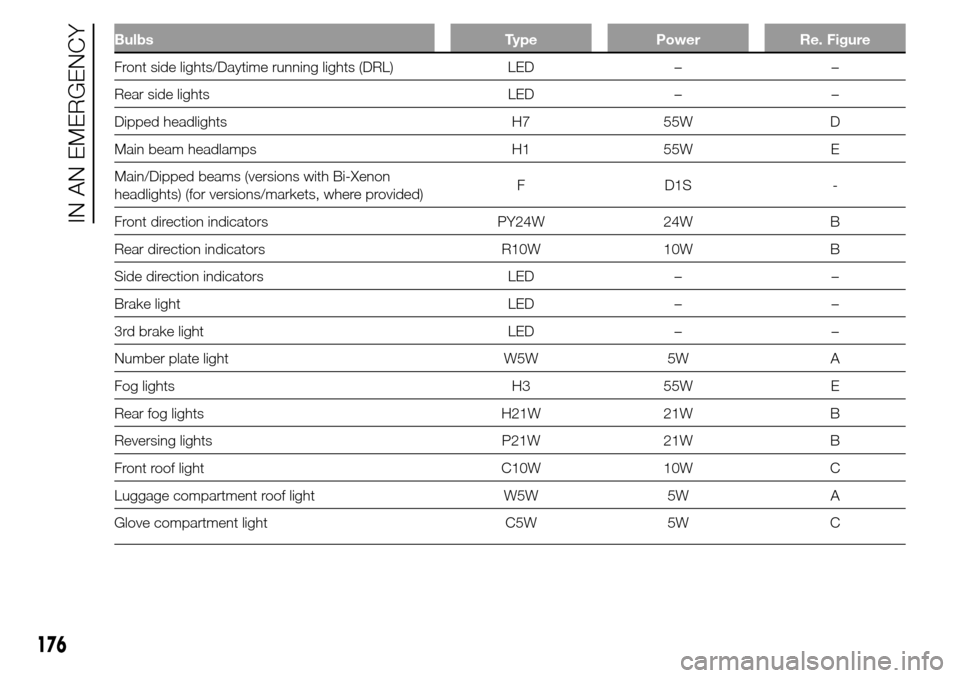
Front side lights/Daytime running lights (DRL) LED – –
Rear side lights LED – –
Dipped headlights H7 55W D
Main beam headlamps H1 55W E
Main/Dipped beams (versions with Bi-Xenon
headlights) (for versions/markets, where provided)F D1S -
Front direction indicators PY24W 24W B
Rear direction indicators R10W 10W B
Side direction indicators LED – –
Brake light LED – –
3rd brake light LED – –
Number plate light W5W 5W A
Fog lights H3 55W E
Rear fog lights H21W 21W B
Reversing lights P21W 21W B
Front roof light C10W 10W C
Luggage compartment roof light W5W 5W A
Glove compartment light C5W 5W C
176
IN AN EMERGENCY
Page 184 of 288

INTERIOR BULB
REPLACEMENT
FRONT ROOF LIGHT
To change the bulb, proceed as follows:
❒remove roof light A fig. 168 working
at the points indicated by the arrows;
❒undo the bulb housings B fig. 169
and remove them by extracting
outwards: then replace bulbs C;
❒correctly fit the new bulbs in the
relevant housings B;
❒fit roof light A fig. 168 in its housing
making sure it is locked.REAR ROOF LIGHT
To change the bulb, proceed as follows:
❒remove roof light A fig. 170 working
at the points indicated by the arrows;
❒open protective flap B fig. 171 and
replace bulb C, releasing it from the
side contacts. Make sure that the
new bulb is correctly secured
between the contacts;❒close protective flap B again and fix
roof light A fig. 170 in its housing,
making sure that it is locked.
LUGGAGE
COMPARTMENT
COURTESY LIGHT
To change the bulb, proceed as follows:
❒open the luggage compartment and
extract courtesy light A fig. 172
working in the point shown by the
arrow;
❒open protection B fig. 173 and
replace the bulb;
❒refit protection B on the lens;
❒refit courtesy light A fig. 172 by
inserting it in its correct position firstly
on one side and then pressing on
the other until it clicks into place.
168A0K0806
169A0K0807
170A0K0643
171A0K0644
180
IN AN EMERGENCY
Page 191 of 288

INSTRUMENT PANEL FUSE BOX
fig. 180
DEVICE PROTECTED FUSE AMPS
Right main beam headlight F91 7,5
Left main beam headlight F90 7,5
Right dipped beam headlight (versions with halogen headlights) F12 7,5
Left dipped beam headlight (versions with halogen headlights) F13 7,5
Right dipped beam headlight (versions with Bi-Xenon headlights) F12 15
Left dipped beam headlight (versions with Bi-Xenon headlights) F13 15
Right fog lightF93 7,5
Left fog lightF92 7,5
Luggage compartment courtesy light/Sun visor courtesy light/Glove
compartment courtesy light/Front and rear roof lightsF32 10
Various devicesF31 5
Rear electric window (left side) F33 20
Rear electric window (right side) F34 20
+30F36 10
Various devicesF37 7,5
Central lockingF38 20
Body Computer supply F42 5
Two-way windscreen washer pump F43 20
Front electric window (driver side) F47 20
187
Page 193 of 288
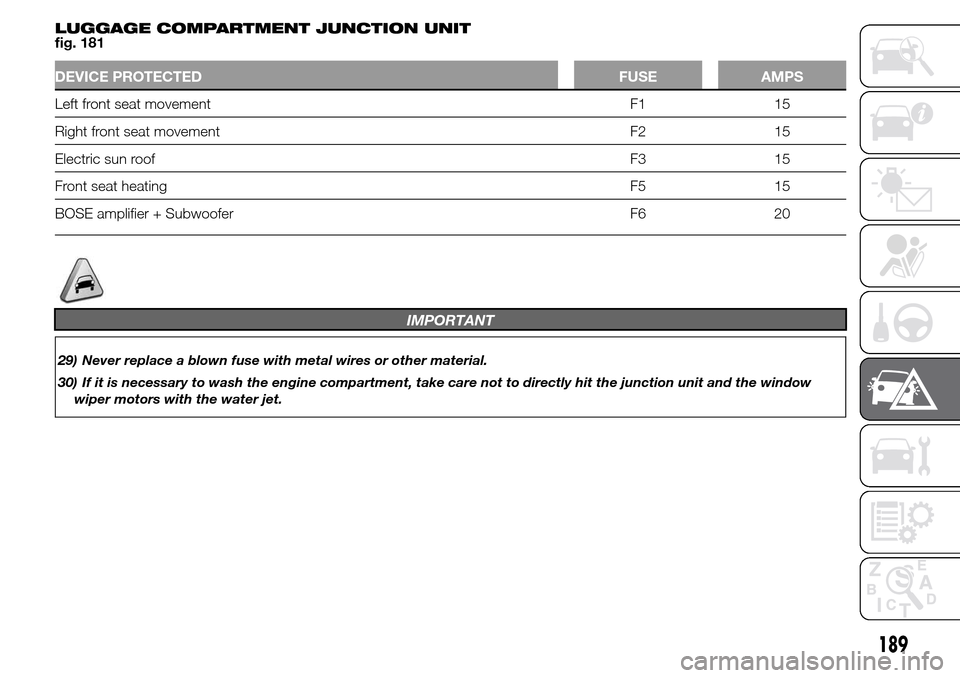
LUGGAGE COMPARTMENT JUNCTION UNIT
fig. 181
DEVICE PROTECTED FUSE AMPS
Left front seat movement F1 15
Right front seat movement F2 15
Electric sun roofF3 15
Front seat heating F5 15
BOSE amplifier + Subwoofer F6 20
IMPORTANT
29) Never replace a blown fuse with metal wires or other material.
30) If it is necessary to wash the engine compartment, take care not to directly hit the junction unit and the window
wiper motors with the water jet.
189
Page 215 of 288
BATTERY
Battery F (see previous pages) does not
require the electrolyte to be topped up
with distilled water. A periodic check
carried out at an Alfa Romeo Dealership
is, however, necessary to check
efficiency.
REPLACING THE
BATTERY
146) 147) 148) 149)
36)
5)
If necessary, replace the battery with
another original battery with the same
specifications. Follow the battery
manufacturer's instructions for
maintenance.
USEFUL ADVICE FOR
EXTENDING THE LIFE OF
YOUR BATTERY
To avoid draining your battery and
make it last longer, observe the
following instructions:
❒when you park the car, ensure that
the doors, tailgate and bonnet are
closed properly, to prevent any lights
from remaining on inside the
passenger's compartment;❒switch off all roof lights inside the car:
the car is however equipped with a
system which switches all internal
lights off automatically;
❒do not keep accessories (e.g. sound
system, hazard lights, etc.) switched
on for a long time when the engine
is not running;
❒before performing any operation on
the electrical system, disconnect
the negative battery cable.
IMPORTANT After the battery is
disconnected, the steering must be
initialised. Thewarning light
switches on to indicate this. To carry
out this procedure, simply turn the
steering wheel all the way from one end
to the other or drive in a straight line
for about a hundred metres.
IMPORTANT If the charge level remains
under 50% for a long time, the battery
is damaged by sulphation, reducing
its capacity and efficiency at start-up.
The battery will also be more at risk
of freezing (this can happen as early as
–10°C). Refer to the paragraph "Car
inactivity" in "Starting and driving"
chapter if the car is left parked for a
long time.If, after purchasing the car, you wish to
install electrical accessories which
require permanent electrical supply (e.g.
alarm, etc.) or accessories which
influence the electrical supply
requirements, contact an Alfa Romeo
Dealership, whose qualified staff will
evaluate the overall electrical
consumption.WARNING
146) Battery liquid is poisonous and
corrosive. Avoid contact with the
skin and eyes. Keep naked flames
and sources of sparks away from
the battery: risk of explosion and
fire.
147) Using the battery with
insufficient fluid irreparably
damages the battery and may
cause an explosion.
148) If the car must remain unused
for a long time at a very low
temperature, remove the battery
and take it to a warm place, to
avoid freezing.
211