dst Alfa Romeo Giulietta 2016 Owner's Manual
[x] Cancel search | Manufacturer: ALFA ROMEO, Model Year: 2016, Model line: Giulietta, Model: Alfa Romeo Giulietta 2016Pages: 288, PDF Size: 7.34 MB
Page 66 of 288
ESC SYSTEM
IN BRIEF
The ESC system improves the
directional control and stability of the
car in various driving conditions.
The ESC system corrects the car’s
understeer and oversteer, distributing
the brake force on the appropriate
wheels. The torque supplied by
the engine can also be reduced in
order to maintain control of the car.
30) 31) 32) 33) 34)
The ESC system uses sensors installed
on the car to determine the trajectory
that the driver intends to follow and
compares it with the car’s effective
trajectory. When the real trajectory
deviates from the desired trajectory, the
ESC system intervenes to counter the
car’s understeer or oversteer.
❒Oversteer: occurs when the car is
turning more than it should according
to the angle of the steering wheel.
❒Understeer: occurs when the car is
turning less than it should according
to the angle of the steering wheel.The ESC system also includes the
following systems:
❒EBD
❒ABS
❒CBC
❒ASR
❒HILL HOLDER
❒HBA
❒MSR
❒DST
❒“ELECTRONIC Q2” (“E-Q2”)
❒"PRE-FILL" (RAB - Ready Alert
Brake)
SYSTEM ACTIVATION
The ESC system switches on
automatically when the engine is
started and cannot be switched off.
SYSTEM INTERVENTION
This is indicated by the flashing of the
warning light on the instrument
panel, to inform the driver that the car is
in critical stability and grip conditions.EBD SYSTEM
The EBD system is an integral part of
the ESC system and intervenes during
braking, distributing the brake force
optimally between front and rear
wheels.
This guarantees greater braking stability
for the car, preventing sudden locking
of the rear wheels and the consequent
instability of the car.
ABS
This system, which is an integral part of
the braking system, prevents one or
more wheels from locking and slipping
in all road surface conditions,
irrespective of the intensity of the
braking action, ensuring that the car
can be controlled even during
emergency braking and optimising
stopping distances.
The system intervenes when braking
and the wheels are about to lock,
typically in emergency braking or
low-grip conditions, when locking may
be more frequent.
The system also improves control and
stability of the car when braking on a
surface where the grip of the left and
right wheels varies, or on corners.
62
GETTING TO KNOW YOUR CAR
Page 68 of 288
IMPORTANT There may be situations
on small gradients (less than 8%),
with car laden, in which the Hill Holder
system may not activate, causing a
slight reversing motion and increasing
the risk of collision with another vehicle
or object. The driver is, in any case,
responsible for safe driving.
HBA (Hydraulic Brake
Assist) SYSTEM
45) 46) 47)
The HBA system is designed to
improve the car's braking capacity
during emergency braking. The system
detects emergency braking by
monitoring the speed and force with
which the brake pedal is pressed, and
consequently applies the optimal brake
pressure. This can reduce the braking
distance: the HBA system therefore
completes the ABS.
Maximum assistance from the HBA
system is obtained by pressing the
brake pedal very quickly. In addition,
the brake pedal should be pressed
continuously during braking, avoiding
intermittent presses, to get the most
out of the system.
Do not reduce pressure on the brake
pedal until braking is not necessary
anymore.The HBA system is deactivated when
the brake pedal is released.
MSR (Motor
Schleppmoment
Regelung) SYSTEM
This system is an integral part of the
ABS, that intervenes, if there is a
sudden downshifting, restoring torque
to the engine, thereby preventing
excessive drive at the drive wheels
which, especially in poor grip
conditions, could lead to a loss in
stability of the car.
DST SYSTEM (Dynamic
Steering Torque)
This function integrates Dual Pinion
active steering into the operation of
ESC. For particular manoeuvres, the
ESC system controls the steering
to actuate a steering torque and assist
the driver in the best possible way.
The system operates the brakes and
steering in a coordinated manner to
increase the suspension and safety
level of the car as a whole. The steering
provides additional torque on the
steering wheel.“ELECTRONIC Q2”
SYSTEM (“E-Q2”)
The "Electronic Q2" system intervenes
during acceleration on corners, braking
the inner drive wheel and thus
increasing the traction of the outer
wheel (which bears more of the car’s
weight): the torque is thus distributed
optimally between the drive wheels
in accordance with the driving
conditions and road surface, permitting
particularly effective, sporty driving.
"PRE-FILL" SYSTEM
(RAB - Ready Alert
Brake)
(only with 'Dynamic" mode activated)
This function activates automatically
if the accelerator pedal is released
rapidly, reducing the brake pad travel
(both at front and back), with the aim of
preparing the braking system and
enhancing its responsiveness, thus
reducing the stopping distance in the
event of subsequent braking.
64
GETTING TO KNOW YOUR CAR
Page 71 of 288
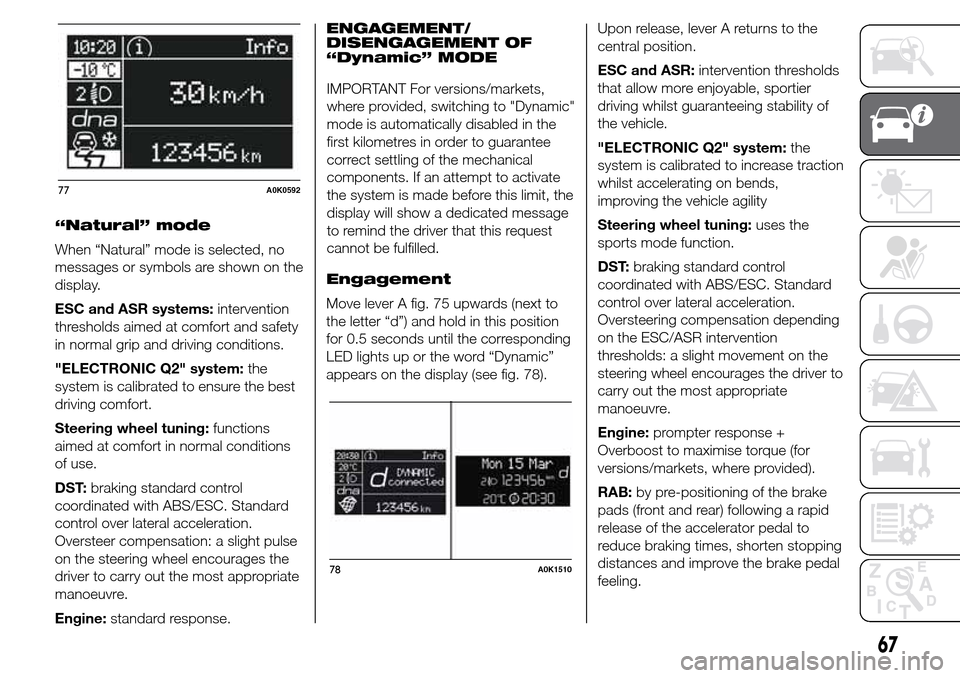
“Natural” mode
When “Natural” mode is selected, no
messages or symbols are shown on the
display.
ESC and ASR systems:intervention
thresholds aimed at comfort and safety
in normal grip and driving conditions.
"ELECTRONIC Q2" system:the
system is calibrated to ensure the best
driving comfort.
Steering wheel tuning:functions
aimed at comfort in normal conditions
of use.
DST:braking standard control
coordinated with ABS/ESC. Standard
control over lateral acceleration.
Oversteer compensation: a slight pulse
on the steering wheel encourages the
driver to carry out the most appropriate
manoeuvre.
Engine:standard response.ENGAGEMENT/
DISENGAGEMENT OF
“Dynamic” MODE
Engagement
Move lever A fig. 75 upwards (next to
the letter “d”) and hold in this position
for 0.5 seconds until the corresponding
LED lights up or the word “Dynamic”
appears on the display (see fig. 78).Upon release, lever A returns to the
central position.
ESC and ASR:intervention thresholds
that allow more enjoyable, sportier
driving whilst guaranteeing stability of
the vehicle.
"ELECTRONIC Q2" system:the
system is calibrated to increase traction
whilst accelerating on bends,
improving the vehicle agility
Steering wheel tuning:uses the
sports mode function.
DST:braking standard control
coordinated with ABS/ESC. Standard
control over lateral acceleration.
Oversteering compensation depending
on the ESC/ASR intervention
thresholds: a slight movement on the
steering wheel encourages the driver to
carry out the most appropriate
manoeuvre.
Engine:prompter response +
Overboost to maximise torque (for
versions/markets, where provided).
RAB:by pre-positioning of the brake
pads (front and rear) following a rapid
release of the accelerator pedal to
reduce braking times, shorten stopping
distances and improve the brake pedal
feeling.
77A0K0592
78A0K1510
67
IMPORTANT For versions/markets,
where provided, switching to "Dynamic"
mode is automatically disabled in the
first kilometres in order to guarantee
correct settling of the mechanical
components. If an attempt to activate
the system is made before this limit, the
display will show a dedicated message
to remind the driver that this request
cannot be fulfilled.
Page 72 of 288
The activation of the Dynamic mode is
also shown by the change in the
instrument panel lighting that, after
decreasing, reaches the highest
luminosity and then returns to the
previously set values.
Disengagement
To deactivate “Dynamic” mode and
return to “Natural”, repeat the same
movement of the lever within the same
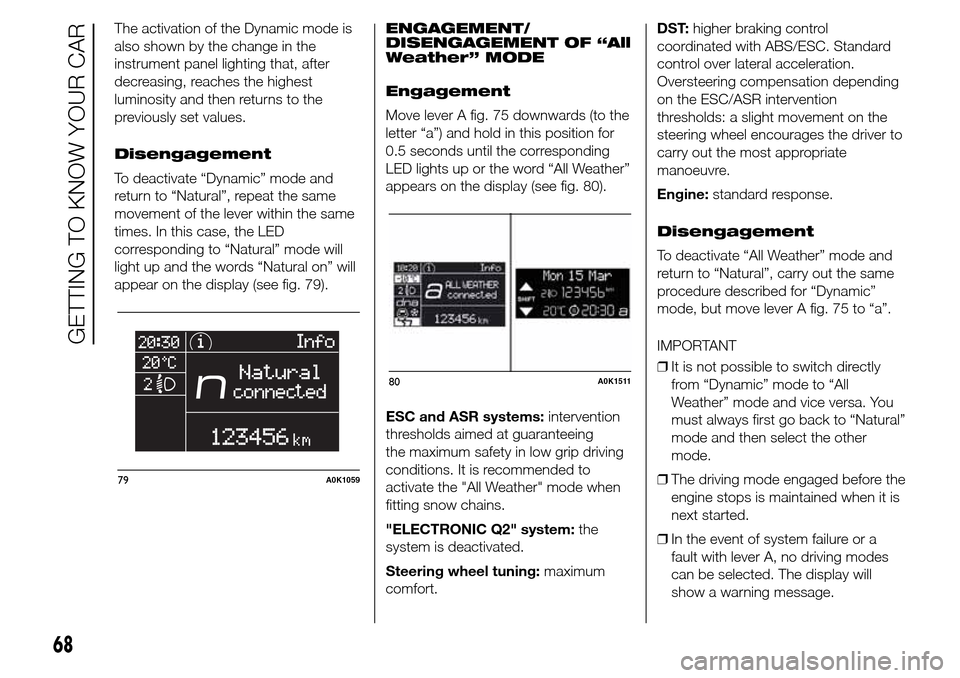
times. In this case, the LED
corresponding to “Natural” mode will
light up and the words “Natural on” will
appear on the display (see fig. 79).ENGAGEMENT/
DISENGAGEMENT OF “All
Weather” MODE
Engagement
Move lever A fig. 75 downwards (to the
letter “a”) and hold in this position for
0.5 seconds until the corresponding
LED lights up or the word “All Weather”
appears on the display (see fig. 80).
ESC and ASR systems:intervention
thresholds aimed at guaranteeing
the maximum safety in low grip driving
conditions. It is recommended to
activate the "All Weather" mode when
fitting snow chains.
"ELECTRONIC Q2" system:the
system is deactivated.
Steering wheel tuning:maximum
comfort.DST:higher braking control
coordinated with ABS/ESC. Standard
control over lateral acceleration.
Oversteering compensation depending
on the ESC/ASR intervention
thresholds: a slight movement on the
steering wheel encourages the driver to
carry out the most appropriate
manoeuvre.
Engine:standard response.
Disengagement
To deactivate “All Weather” mode and
return to “Natural”, carry out the same
procedure described for “Dynamic”
mode, but move lever A fig. 75 to “a”.
IMPORTANT
❒It is not possible to switch directly
from “Dynamic” mode to “All
Weather” mode and vice versa. You
must always first go back to “Natural”
mode and then select the other
mode.
❒The driving mode engaged before the
engine stops is maintained when it is
next started.
❒In the event of system failure or a
fault with lever A, no driving modes
can be selected. The display will
show a warning message.
79A0K1059
80A0K1511
68
GETTING TO KNOW YOUR CAR
Page 157 of 288
Shifting from D to "Sequential mode" is
free.
Shifting from "Sequential mode" to D is
free.
Shifting from D to N is free.
Shifting from N to R is possible only
with button on gear lever pressed.
Shifting from R to P is possible only
with button on gear lever pressed.
STARTING THE ENGINE
Starting is only permitted with gear
lever in position P or N (with or without
brake pedal pressed).
On starting, the system is at N or P (the
latter means neutral, but with the car’s
wheels locked mechanically).
Start&Stop system
With car at a standstill and Start&Stop
system activated, the engine switches
off if the gear lever is in a position
other than R.
The Start&Stop system does not
operate when the gear lever is in R, for
making parking manoeuvres easier.
In the event of stops uphill, the engine
switching off is disabled to activate
the "Hill Holder" function (works only
with running engine).The engine restarts automatically if:
❒the brake pedal is released (and the
lever is not at N or P)
❒the lever is shifted to an unstable
position: +, − or R
❒the lever is shifted from D to the left
in "Sequential mode"
❒by the "+" or "–" paddles on the
steering wheel (for versions/markets,
where provided)
During the engine stop and start
sequence, the system passes through
the automatic engagement of neutral:
the display shows N.
IMPORTANT In some conditions (for
example with small gradients and brake
pedal not fully depressed), engine
switching off is not deactivated. In this
case, fully depress the brake pedal
to make the "Hill Holder" function
available and restart the engine, using
the gear lever or the paddles on the
steering wheel (for versions/markets,
where provided) as described
previously.ENGINE SWITCHING OFF
Engine can be switched off in any
position of the gear lever.
Versions with
Start&Stop system
To switch the engine off, you need to
stop the car by pressing the brake
pedal properly; if the pressure is not
enough, the engine will not be switched
off.
This feature can be exploited so that
the engine does not switch off in
particular traffic conditions.
Ignition key removal
The ignition key can be removed only if
the gear lever is in position P:
❒if the engine is switched off with the
gear lever in position P: the ignition
key can be removed within 30
seconds;
❒if the engine is switched off with the
gear lever in a position other than P:
the P letter on the display and on
the gear lever trim flashes for 5
seconds and an acoustic signal will
be emitted at the same time. Move
the lever to P within 5 seconds; then
it will be possible to remove the
ignition key for about 30 seconds.
153
Page 282 of 288
DST system (Dynamic Steering
Torque)......................................... 64
Dual Pinion active steering ............. 74
Dusk sensor ................................... 36
EBD system .................................. 62
Electric sun roof ............................. 49
Electric windows ............................ 53
– Controls .................................... 53
"Electronic Q2" system ("E-Q2") .... 64
Engine codes - bodywork
versions ....................................... 223
Engine compartment
– washing .................................... 217
Engine coolant temperature
indicator ....................................... 96
Engine............................................ 226
– engine cooling system fluid
level........................................... 209
– marking ..................................... 222
Engine oil
– consumption ............................. 208
– level check ................................ 208
EOBD system ................................ 74
ESC (Electronic Stability Control)
system ......................................... 62
External courtesy lights .................. 38
External lights................................. 35
Extinguisher ................................... 49
Filling the tank ............................... 80
Fitting "Universal" child seat ........... 134Fix&Go Automatic kit...................... 170
Flashing ......................................... 37
Fluids and lubricants ...................... 248
Fog lights ................................. 44-178
"Follow Me Home" device ............. 37
Front airbags................................. 140
Front armrest ................................. 46
Front driver side airbag................... 140
Front passenger airbag .................. 140
Front roof light
– bulb replacement ...................... 180
Fuel consumption .......................... 252
Fuel cut-off system......................... 45
Fuel level gauge ............................. 96
Fuel supply..................................... 231
Fuel tank cap ................................. 80
Fuses (if a fuse blows) .................... 181
Gear Shift Indicator ....................... 85
Glove compartment courtesy
light
– bulb replacement ...................... 181
Handbrake.................................... 149
Hazard warning lights..................... 44
HBA system ................................... 64
Headlights...................................... 61
– Adjusting headlights abroad ...... 61
– bulb replacement ...................... 177
– Headlight alignment corrector.... 61– Light beam direction.................. 61
Headlight washers ......................... 215
Head restraints............................... 18
– "Anti-Whiplash" device .............. 19
– Front headrests ......................... 18
– Rear head restraints .................. 19
Hill Holder system .......................... 63
Identification data
– bodywork paint plate ................. 222
– Chassis marking........................ 222
– engine marking.......................... 222
– identification data plate.............. 222
Ignition device ................................ 15
– Steering lock ............................. 16
Installing a Universal Isofix child
seat.............................................. 137
Installing electrical/electronic
devices ........................................ 76
Interior fittings ................................ 46
Interiors (cleaning) .......................... 218
iTPMS system ................................ 72
Jack.............................................. 165
Light clusters
– front light clusters (changing a
bulb).......................................... 177
– rear light clusters (changing a
bulb).......................................... 178
Luggage compartment courtesy
light
– bulb replacement ...................... 180
INDEX