engine Alfa Romeo Giulietta 2018 Owner's Guide
[x] Cancel search | Manufacturer: ALFA ROMEO, Model Year: 2018, Model line: Giulietta, Model: Alfa Romeo Giulietta 2018Pages: 216, PDF Size: 3.39 MB
Page 51 of 216
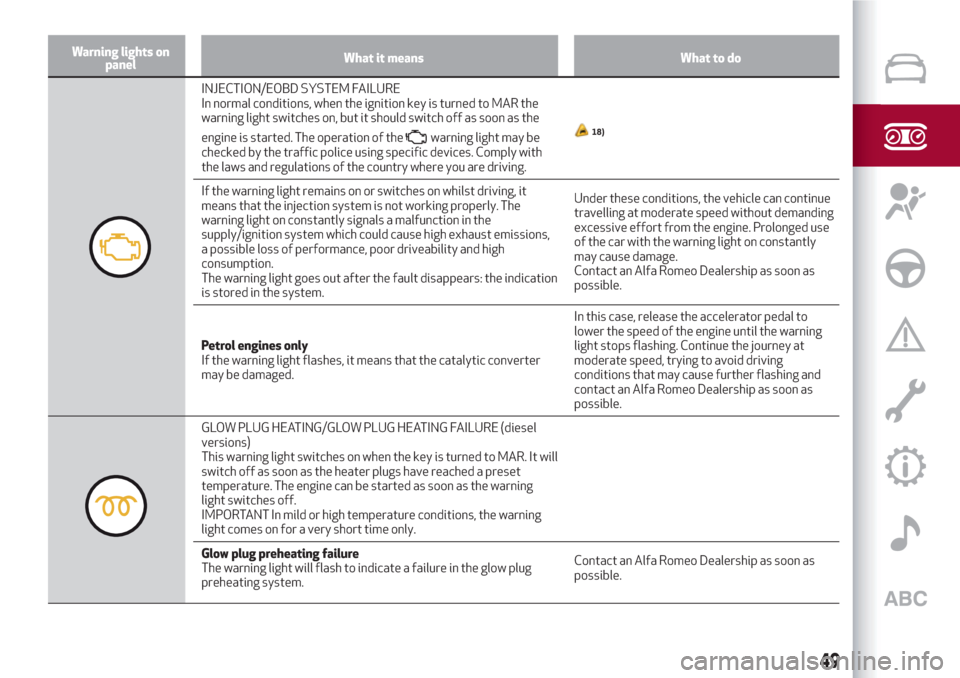
Warning lights on
panelWhat it means What to do
INJECTION/EOBD SYSTEM FAILURE
In normal conditions, when the ignition key is turned to MAR the
warning light switches on, but it should switch off as soon as the
engine is started. The operation of the
warning light may be
checked by the traffic police using specific devices. Comply with
the laws and regulations of the country where you are driving.18)
If the warning light remains on or switches on whilst driving, it
means that the injection system is not working properly. The
warning light on constantly signals a malfunction in the
supply/ignition system which could cause high exhaust emissions,
a possible loss of performance, poor driveability and high
consumption.
The warning light goes out after the fault disappears: the indication
is stored in the system.Under these conditions, the vehicle can continue
travelling at moderate speed without demanding
excessive effort from the engine. Prolonged use
of the car with the warning light on constantly
may cause damage.
Contact an Alfa Romeo Dealership as soon as
possible.
Petrol engines only
If the warning light flashes, it means that the catalytic converter
may be damaged.In this case, release the accelerator pedal to
lower the speed of the engine until the warning
light stops flashing. Continue the journey at
moderate speed, trying to avoid driving
conditions that may cause further flashing and
contact an Alfa Romeo Dealership as soon as
possible.
GLOW PLUG HEATING/GLOW PLUG HEATING FAILURE (diesel
versions)
This warning light switches on when the key is turned to MAR. It will
switch off as soon as the heater plugs have reached a preset
temperature. The engine can be started as soon as the warning
light switches off.
IMPORTANT In mild or high temperature conditions, the warning
light comes on for a very short time only.
Glow plug preheating failure
The warning light will flash to indicate a failure in the glow plug
preheating system.Contact an Alfa Romeo Dealership as soon as
possible.
49
Page 52 of 216
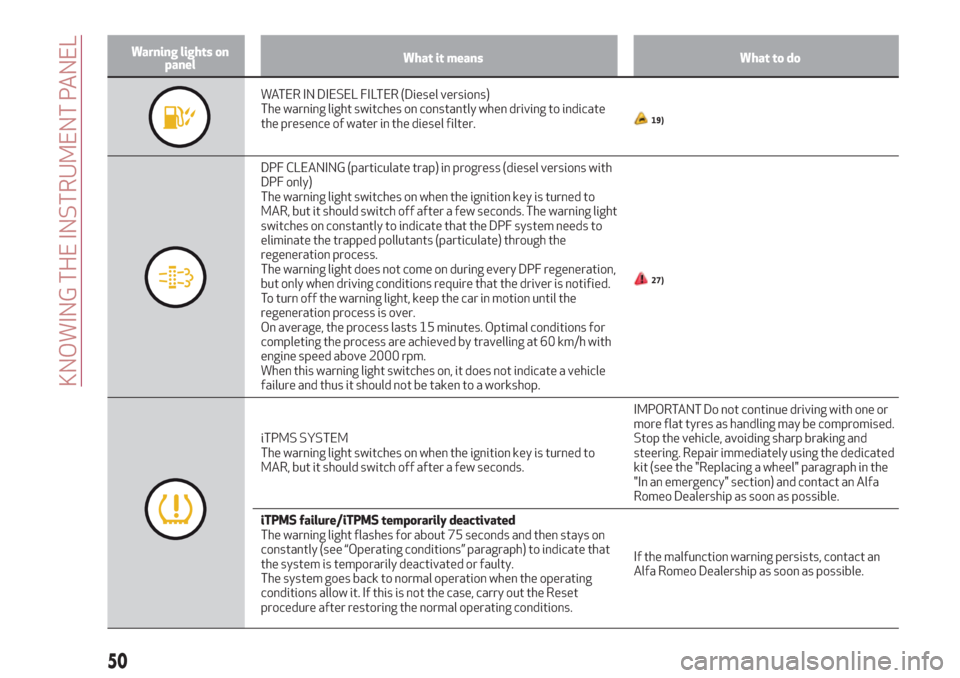
Warning lights on
panelWhat it means What to do
WATER IN DIESEL FILTER (Diesel versions)
The warning light switches on constantly when driving to indicate
the presence of water in the diesel filter.
19)
DPF CLEANING (particulate trap) in progress (diesel versions with
DPF only)
The warning light switches on when the ignition key is turned to
MAR, but it should switch off after a few seconds. The warning light
switches on constantly to indicate that the DPF system needs to
eliminate the trapped pollutants (particulate) through the
regeneration process.
The warning light does not come on during every DPF regeneration,
but only when driving conditions require that the driver is notified.
To turn off the warning light, keep the car in motion until the
regeneration process is over.
On average, the process lasts 15 minutes. Optimal conditions for
completing the process are achieved by travelling at 60 km/h with
engine speed above 2000 rpm.
When this warning light switches on, it does not indicate a vehicle
failure and thus it should not be taken to a workshop.
27)
iTPMS SYSTEM
The warning light switches on when the ignition key is turned to
MAR, but it should switch off after a few seconds.IMPORTANT Do not continue driving with one or
more flat tyres as handling may be compromised.
Stop the vehicle, avoiding sharp braking and
steering. Repair immediately using the dedicated
kit (see the "Replacing a wheel" paragraph in the
"In an emergency" section) and contact an Alfa
Romeo Dealership as soon as possible.
iTPMS failure/iTPMS temporarily deactivated
The warning light flashes for about 75 seconds and then stays on
constantly (see “Operating conditions” paragraph) to indicate that
the system is temporarily deactivated or faulty.
The system goes back to normal operation when the operating
conditions allow it. If this is not the case, carry out the Reset
procedure after restoring the normal operating conditions.If the malfunction warning persists, contact an
Alfa Romeo Dealership as soon as possible.
50
KNOWING THE INSTRUMENT PANEL
Page 53 of 216
Warning lights on
panelWhat it means What to do
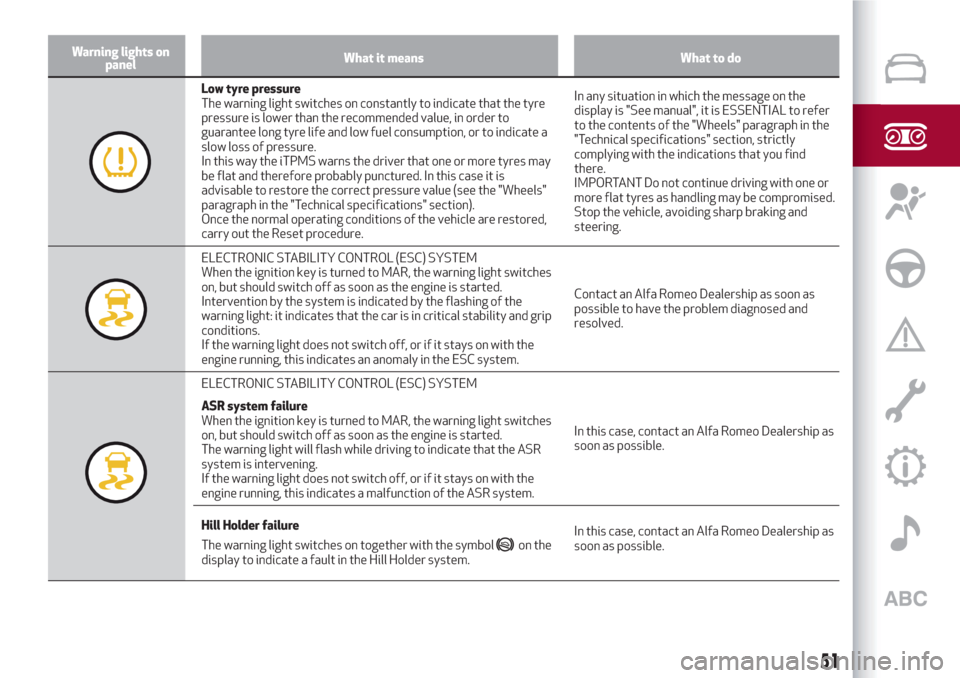
Low tyre pressure
The warning light switches on constantly to indicate that the tyre
pressure is lower than the recommended value, in order to
guarantee long tyre life and low fuel consumption, or to indicate a
slow loss of pressure.
In this way the iTPMS warns the driver that one or more tyres may
be flat and therefore probably punctured. In this case it is
advisable to restore the correct pressure value (see the "Wheels"
paragraph in the "Technical specifications" section).
Once the normal operating conditions of the vehicle are restored,
carry out the Reset procedure.In any situation in which the message on the
display is "See manual", it is ESSENTIAL to refer
to the contents of the "Wheels" paragraph in the
"Technical specifications" section, strictly
complying with the indications that you find
there.
IMPORTANT Do not continue driving with one or
more flat tyres as handling may be compromised.
Stop the vehicle, avoiding sharp braking and
steering.
ELECTRONIC STABILITY CONTROL (ESC) SYSTEM
When the ignition key is turned to MAR, the warning light switches
on, but should switch off as soon as the engine is started.
Intervention by the system is indicated by the flashing of the
warning light: it indicates that the car is in critical stability and grip
conditions.
If the warning light does not switch off, or if it stays on with the
engine running, this indicates an anomaly in the ESC system.Contact an Alfa Romeo Dealership as soon as
possible to have the problem diagnosed and
resolved.
ELECTRONIC STABILITY CONTROL (ESC) SYSTEM
ASR system failure
When the ignition key is turned to MAR, the warning light switches
on, but should switch off as soon as the engine is started.
The warning light will flash while driving to indicate that the ASR
system is intervening.
If the warning light does not switch off, or if it stays on with the
engine running, this indicates a malfunction of the ASR system.In this case, contact an Alfa Romeo Dealership as
soon as possible.
Hill Holder failure
The warning light switches on together with the symbol
on the
display to indicate a fault in the Hill Holder system.In this case, contact an Alfa Romeo Dealership as
soon as possible.
51
Page 58 of 216
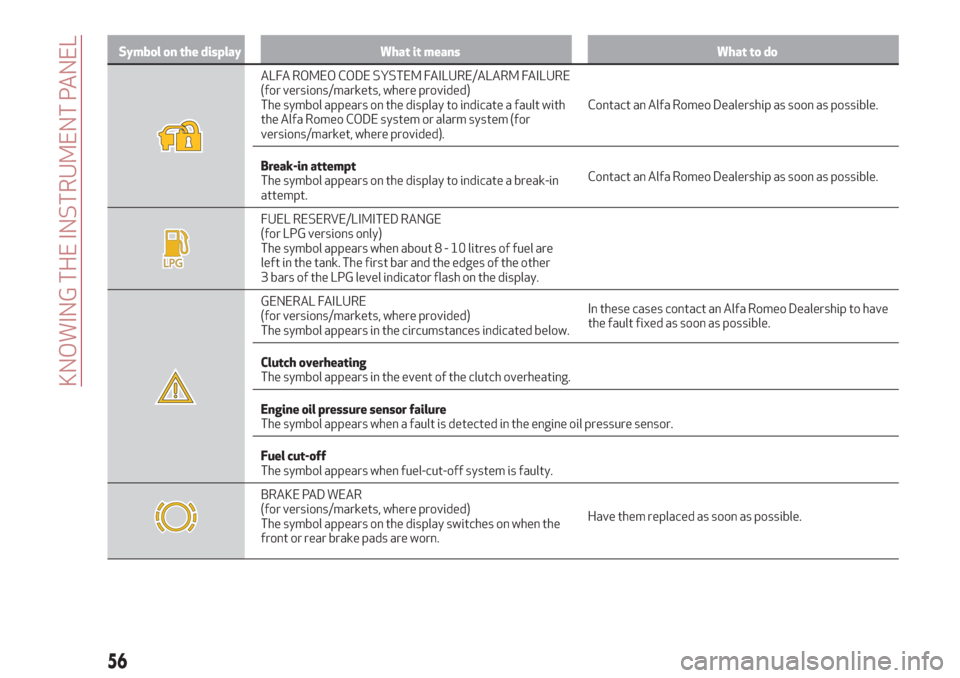
Symbol on the display What it means What to do
ALFA ROMEO CODE SYSTEM FAILURE/ALARM FAILURE
(for versions/markets, where provided)
The symbol appears on the display to indicate a fault with
the Alfa Romeo CODE system or alarm system (for
versions/market, where provided).Contact an Alfa Romeo Dealership as soon as possible.
Break-in attempt
The symbol appears on the display to indicate a break-in
attempt.Contact an Alfa Romeo Dealership as soon as possible.
FUEL RESERVE/LIMITED RANGE
(for LPG versions only)
The symbol appears when about8-10litres of fuel are
left in the tank. The first bar and the edges of the other
3 bars of the LPG level indicator flash on the display.
GENERAL FAILURE
(for versions/markets, where provided)
The symbol appears in the circumstances indicated below.In these cases contact an Alfa Romeo Dealership to have
the fault fixed as soon as possible.
Clutch overheating
The symbol appears in the event of the clutch overheating.
Engine oil pressure sensor failure
The symbol appears when a fault is detected in the engine oil pressure sensor.
Fuel cut-off
The symbol appears when fuel-cut-off system is faulty.
BRAKE PAD WEAR
(for versions/markets, where provided)
The symbol appears on the display switches on when the
front or rear brake pads are worn.Have them replaced as soon as possible.
56
KNOWING THE INSTRUMENT PANEL
Page 60 of 216
WARNING
22)If thewarning light does not switch on when the ignition device is moved to ON or if it stays on when driving (together with the message on
the display), there might be a fault in the restraint systems; in this case, the airbags or pretensioners may not deploy in the event of an accident or,
in a lower number of cases, they could deploy erroneously. Before proceeding, contact an Alfa Romeo Dealership to have the system checked
immediately.
23)A fault with the warning light
is signalled by illumination of the iconon the instrument panel display and by the flashing of passenger
airbag disabled warning light on the rearview mirror. In addition, the airbag system automatically disables the airbag on the passenger's side (for
versions/markets where provided). In this case, the warning light may not indicate any faults with the restraint systems. Before proceeding,
contact an Alfa Romeo Dealership to have the system checked immediately.
24)If the warning light comes on, the exhausted engine oil should be changed as soon as possible, never drive more than 500 km from the first
switching-on of this warning light. Failure to observe the above may result in severe damage to the engine and invalidate the warranty. Remember
that when this warning light comes on, it does not mean that the level of engine oil is low, so if it flashes you must not top up the engine oil.
25)If the warning light flashes with the car in motion, contact an Alfa Romeo Dealership.
26)If the warning light (or the icon on the display) flashes whilst driving, contact an Alfa Romeo Dealership.
27)Always drive at a speed appropriate to the traffic conditions, the weather and traffic regulations. The engine may be switched off even if the
warning light is on: repeated interruptions of the regeneration process could cause an early deterioration of engine oil. For this reason it is
always advisable to wait for the symbol to go off before turning off the engine, following the instructions above. Do not complete the DPF
regeneration process when the vehicle is stopped.
IMPORTANT
17)If thewarning light switches on when driving, stop the engine immediately and contact an Alfa Romeo Dealership.
18)If, turning the ignition device to MAR, the warning lightdoes not turn on or if it turns on steadily or flashing when travelling (on some
versions together with the message on the display), contact an Alfa Romeo Dealership as soon as possible.
19)The presence of water in the fuel system circuit may cause severe damage to the injection system and irregular engine operation. If the
symbol is displayed contact an Alfa Romeo Dealership as soon as possible to bleed the system. If the above indications come on immediately
after refuelling, water has probably been introduced into the tank: stop the engine immediately and contact an Alfa Romeo Dealership.
58
KNOWING THE INSTRUMENT PANEL
Page 62 of 216
ACTIVE SAFETYSYSTEMS
ABS SYSTEM
This system, which is an integral part of
the braking system, prevents one or more
wheels from locking and slipping in all
road surface conditions, irrespective of
the intensity of the braking action,
ensuring that the vehicle can be
controlled even during emergency
braking and optimising stopping
distances.
System intervention
The driver can feel that the ABS system
has come into action because the brake
pedal pulsates slightly and the system
gets noisier: this is entirely normal with
the system operating.
33) 34) 35) 36) 37) 38) 39)
ASR (AntiSlip Regulation)SYSTEM
40) 41) 42)
This is an integral part of the ESC system
and automatically operates in the event
of one or both drive wheels slipping, loss
of grip on wet roads (aquaplaning) and
acceleration on slippery, snowy or icy
roads, etc.System intervention
The system operates on the engine
power and brakes.
This is indicated by the flashing of the
warning light
on the instrument panel,
to inform the driver that the car is in
critical stability and grip conditions.
MSR (Motor Schleppmoment
Regelung)SYSTEM
The system prevents the drive wheels
from possibly locking, which could
happen, for example, if the accelerator
pedal is released suddenly or in the case
of a sudden downshifting in conditions of
poor grip.
In this conditions, the engine braking
effect could cause the drive wheels to
slip, resulting in a loss of vehicle stability.
In these situations, the system
intervenes, restoring torque to the
engine in order to conserve vehicle
stability and increase vehicle safety.
HBA (Hydraulic Brake Assist)SYSTEM
43) 44) 45)
The HBA system is designed to improve
the car’s braking capacity during
emergency braking: the HBA system
therefore completes the ABS system.
Maximum assistance from the HBA
system is obtained by continuously
pressing the brake pedal very quickly.
DST SYSTEM (Dynamic Steering
Torque)
46)
The DST function uses the integration of
the ESC system with the electric power
steering to increase the safety level of
the whole vehicle.
In critical situations (braking on surfaces
with different grip conditions), through
the DST function the ESC system
controls the steering to implement an
additional torque contribution on the
steering wheel, to suggest the most
correct manoeuvre to the driver.
The coordinated action of the brakes and
steering increases the sensation of
safety and control of the vehicle.
EBD SYSTEM
The EBD system is an integral part of the
ESC system and intervenes during
braking, distributing the brake force
optimally between front and rear wheels.
This guarantees greater braking stability
for the car, preventing sudden locking of
the rear wheels and the consequent
instability of the car.
ESC SYSTEM
The ESC system improves the directional
control and stability of the car in various
driving conditions.
60
SAFETY
Page 63 of 216
The ESC system corrects the car’s
understeer and oversteer, distributing
the brake force on the appropriate
wheels. The torque supplied by the
engine can also be reduced in order to
maintain control of the vehicle.
28) 29) 30) 31) 32)
The ESC system comprises the active
safety systems such as: ABS, EBD, ASR,
HILL HOLDER, etc.
The ESC system switches on
automatically when the engine is started
and cannot be switched off.
System intervention
This is indicated by the flashing of the
warning light
on the instrument panel,
to inform the driver that the car is in
critical stability and grip conditions.
CBC (Cornering Brake Control)SYSTEM
This system acts when braking on
corners, optimising the distribution of
brake pressure on the four wheels: the
system prevents the wheels on the inside
of the corner (less affected by the weight
of the car) from locking, ensuring better
stability and direction for the car.
HILL HOLDERSYSTEM
This is an integral part of the ESC system
and facilitates starting on uphill or
downhill slopes by operating the brakes:
IMPORTANT The Hill Holder system is
not a parking brake; therefore, never
leave the car without having engaged the
handbrake, turned the engine off and
engaged first gear, so that it is parked in
safe conditions (for further information
read the "Parking" paragraph in the
"Starting and driving" chapter).
IMPORTANT There may be situations on
small gradients (less than 8%), with car
laden, in which the Hill Holder system
may not activate, causing a slight
reversing motion and increasing the risk
of collision with another vehicle or object.
The driver is, in any case, responsible for
safe driving.
“ELECTRONIC Q2”SYSTEM (“E-Q2”)
The "Electronic Q2" system intervenes
during acceleration on corners, braking
the inner drive wheel and thus increasing
the traction of the outer wheel (which
bears more of the car’s weight): the
torque is thus distributed optimally
between the drive wheels in accordance
with the driving conditions and road
surface, permitting particularly effective,
sporty driving.
"PRE-FILL"SYSTEM (RAB - Ready Alert
Brake)
(only with 'Dynamic" mode activated)
This function activates automatically if
the accelerator pedal is released rapidly,
reducing the brake pad travel (both at
front and back), with the aim of preparing
the braking system and enhancing its
responsiveness, thus reducing the
stopping distance in the event of
subsequent braking.
WARNING
28)The ESC system cannot alter the natural
laws of physics, and cannot increase grip,
which depends on the condition of the road.
29)The ESC system cannot prevent
accidents, including those due to excessive
speed on corners, driving on low-grip
surfaces or aquaplaning.
30)The capability of the ESC system must
never be tested irresponsibly and
dangerously, in such a way as to compromise
personal safety and the safety of others.
31)For the correct operation of the ASR
system, the tyres must of necessity be the
same make and type on all wheels, in perfect
condition and, above all, of the prescribed
type and dimensions.
32)Do not take unnecessary risks, even if
your vehicle is fitted with the ESC and ASR
systems. Your driving style must always be
suited to the road conditions, visibility and
traffic. The driver is always responsible for
road safety.
61
Page 64 of 216
33)When the ABS intervenes and you feel
the brake pedal pulsating, do not reduce the
pressure, but hold it down firmly and
confidently; in doing so you will brake in the
shortest distance possible, depending on the
current road conditions.
34)To obtain the maximum efficiency of the
braking system, a bedding-in period of about
500 km is needed: during this period it is
better to avoid sharp, repeated and
prolonged braking.
35)If the ABS intervenes, this indicates that
the grip of the tyres on the road is nearing its
limit: you must slow down to a speed
compatible with the available grip.
36)The ABS cannot overrule the natural
laws of physics, and cannot increase the grip
available according to the condition of the
road.
37)The ABS cannot prevent accidents,
including those due to excessive speed on
corners, driving on low-grip surfaces or
aquaplaning.
38)The capability of the ABS must never be
tested irresponsibly and dangerously, in
such a way as to compromise personal
safety and the safety of others.
39)For the correct operation of the ABS, the
tyres must of necessity be the same make
and type on all wheels, in perfect condition
and, above all, of the prescribed type and
dimensions.
40)The ASR cannot overrule the natural
laws of physics, and cannot increase the grip
available according to the condition of the
road.
41)The ASR system cannot prevent
accidents, including those due to excessive
speed on corners, driving on low-grip
surfaces or aquaplaning.42)The capability of the ASR must never be
tested irresponsibly and dangerously, in
such a way as to compromise personal
safety and the safety of others.
43)The HBA system can’t overrule the
natural laws of physics, and can’t increase
the grip available according to the condition
of the road.
44)The HBA system cannot prevent
accidents, including those due to excessive
speed on corners, driving on low-grip
surfaces or aquaplaning.
45)The features of the HBA system must
never be tested in imprudent or dangerous
ways, with the possibility of putting the
safety of the driver, occupants or other road
users at risk.
46)DST is an aid for driving and does not
relieve the driver of responsibility for driving
the vehicle.iTPMS System (indirect Tyre
Pressure Monitoring System)
(for versions/markets, where provided)
DESCRIPTION
The car can be equipped with the iTPMS
(indirect Tyre Pressure Monitoring
System) which monitors the tyre inflation
status thanks to wheel speed sensors.
The system warns the driver if one or
more tyres are flat by the dedicated
warning light
continuously on and a
warning message on the display.
If one tyre only is flat, the system can
indicate its position: it is in any case
recommended to check the pressure on
all four tyres.
This indication is displayed also when
turning the engine off and on again until
the RESET procedure is carried out.
RESET PROCEDURE
The iTPMS needs an initial "self-learning"
phase (with length depending on the
driving style and road conditions: optimal
conditions being driving on a straight
road at 80 km/h for at least 20 minutes)
which starts when the RESET procedure
is carried out.
The Reset procedure must be carried out:
each time tyre pressure is modified;
when even only one tyre is changed;
when tyres are rotated/inverted;
62
SAFETY
Page 65 of 216
when the space-saver wheel is fitted.
Before carrying out the RESET, inflate
the tyres to the rated pressure values
specified in the inflation pressure table
(see "Wheels" paragraph in the "Technical
specifications" chapter).
If the RESET is not carried out, in all
above cases, the
warning light may
give false indications on one or more
tyres.
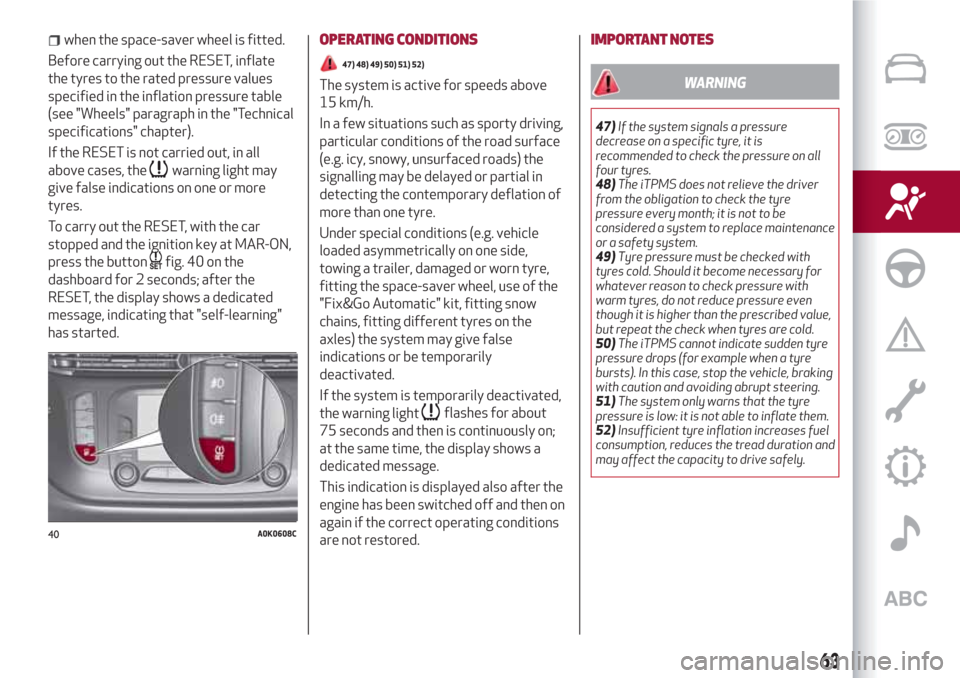
To carry out the RESET, with the car
stopped and the ignition key at MAR-ON,
press the button
fig. 40 on the
dashboard for 2 seconds; after the
RESET, the display shows a dedicated
message, indicating that "self-learning"
has started.
OPERATING CONDITIONS
47) 48) 49) 50) 51) 52)
The system is active for speeds above
15 km/h.
In a few situations such as sporty driving,
particular conditions of the road surface
(e.g. icy, snowy, unsurfaced roads) the
signalling may be delayed or partial in
detecting the contemporary deflation of
more than one tyre.
Under special conditions (e.g. vehicle
loaded asymmetrically on one side,
towing a trailer, damaged or worn tyre,
fitting the space-saver wheel, use of the
"Fix&Go Automatic" kit, fitting snow
chains, fitting different tyres on the
axles) the system may give false
indications or be temporarily
deactivated.
If the system is temporarily deactivated,
the warning light
flashes for about
75 seconds and then is continuously on;
at the same time, the display shows a
dedicated message.
This indication is displayed also after the
engine has been switched off and then on
again if the correct operating conditions
are not restored.
IMPORTANT NOTES
WARNING
47)If the system signals a pressure
decrease on a specific tyre, it is
recommended to check the pressure on all
four tyres.
48)The iTPMS does not relieve the driver
from the obligation to check the tyre
pressure every month; it is not to be
considered a system to replace maintenance
or a safety system.
49)Tyre pressure must be checked with
tyres cold. Should it become necessary for
whatever reason to check pressure with
warm tyres, do not reduce pressure even
though it is higher than the prescribed value,
but repeat the check when tyres are cold.
50)The iTPMS cannot indicate sudden tyre
pressure drops (for example when a tyre
bursts). In this case, stop the vehicle, braking
with caution and avoiding abrupt steering.
51)The system only warns that the tyre
pressure is low: it is not able to inflate them.
52)Insufficient tyre inflation increases fuel
consumption, reduces the tread duration and
may affect the capacity to drive safely.
40A0K0608C
63
Page 67 of 216
SBR SYSTEM (Seat Belt
Reminder)
This system comprises an acoustic
warning which, in conjunction with the
warning lights
flashing on the
instrument panel, warns the front seat
passengers if their seat belt has not been
fastened.
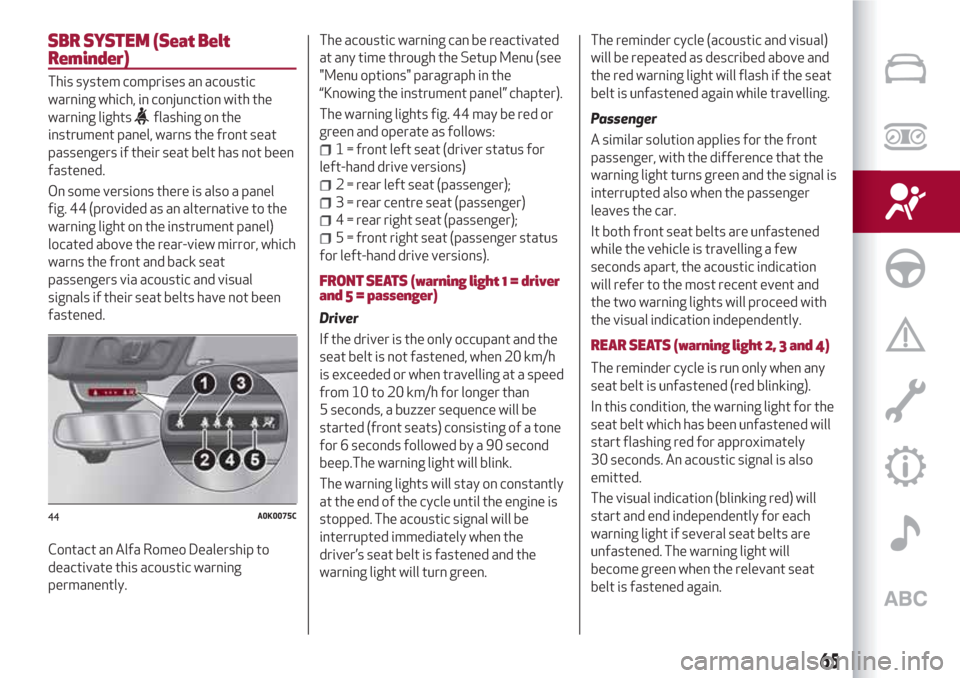
On some versions there is also a panel
fig. 44 (provided as an alternative to the
warning light on the instrument panel)
located above the rear-view mirror, which
warns the front and back seat
passengers via acoustic and visual
signals if their seat belts have not been
fastened.
Contact an Alfa Romeo Dealership to
deactivate this acoustic warning
permanently.The acoustic warning can be reactivated
at any time through the Setup Menu (see
"Menu options" paragraph in the
“Knowing the instrument panel” chapter).
The warning lights fig. 44 may be red or
green and operate as follows:
1 = front left seat (driver status for
left-hand drive versions)
2 = rear left seat (passenger);
3 = rear centre seat (passenger)
4 = rear right seat (passenger);
5 = front right seat (passenger status
for left-hand drive versions).
FRONT SEATS (warning light 1 = driver
and 5 = passenger)
Driver
If the driver is the only occupant and the
seat belt is not fastened, when 20 km/h
is exceeded or when travelling at a speed
from 10 to 20 km/h for longer than
5 seconds, a buzzer sequence will be
started (front seats) consisting of a tone
for 6 seconds followed by a 90 second
beep.The warning light will blink.
The warning lights will stay on constantly
at the end of the cycle until the engine is
stopped. The acoustic signal will be
interrupted immediately when the
driver’s seat belt is fastened and the
warning light will turn green.The reminder cycle (acoustic and visual)
will be repeated as described above and
the red warning light will flash if the seat
belt is unfastened again while travelling.
Passenger
A similar solution applies for the front
passenger, with the difference that the
warning light turns green and the signal is
interrupted also when the passenger
leaves the car.
It both front seat belts are unfastened
while the vehicle is travelling a few
seconds apart, the acoustic indication
will refer to the most recent event and
the two warning lights will proceed with
the visual indication independently.
REAR SEATS (warning light 2, 3 and 4)
The reminder cycle is run only when any
seat belt is unfastened (red blinking).
In this condition, the warning light for the
seat belt which has been unfastened will
start flashing red for approximately
30 seconds. An acoustic signal is also
emitted.
The visual indication (blinking red) will
start and end independently for each
warning light if several seat belts are
unfastened. The warning light will
become green when the relevant seat
belt is fastened again.
44A0K0075C
65