130 Alfa Romeo Giulietta 2018 Owner's Manual
[x] Cancel search | Manufacturer: ALFA ROMEO, Model Year: 2018, Model line: Giulietta, Model: Alfa Romeo Giulietta 2018Pages: 216, PDF Size: 3.39 MB
Page 119 of 216
117)The vehicle's driving characteristics
will be modified with the space-saver wheel
fitted. Avoid violent acceleration and
braking, abrupt steering and fast cornering.
The overall duration of the space-saver
wheel is about 3000 km, after which the
relevant tyre must be replaced with another
one of the same type. Never install a
traditional tyre on a rim designed to be used
as a space-saver wheel. Have the wheel
repaired and refitted as soon as possible.
Using two or more space-saver wheels at the
same time is forbidden. Do not apply grease
to the bolt threads before fitting: they could
come unscrewed.
118)The jack may be used to replace
wheels only on the car that it comes with or
other cars of the same model. Never use the
jack for other purposes, such as lifting other
vehicle models. Never use it for repair
operations under the vehicle. Incorrect
positioning of the jack may cause the vehicle
to fall. Do not use the jack for loads higher
than the one shown on its label. Never install
snow chains on the space-saver wheel; if a
front tyre (driving wheel) is punctured and
you need to use snow chains, use a standard
wheel from the rear axle and install the
space-saver wheel on the rear axle. In this
way, with two normal front drive wheels, it is
possible to use snow chains.
119)Incorrectly fitting the wheel cap may
cause it to fall off when the car is in motion.
Never tamper with the inflation valve. Never
introduce tools of any kind between rim and
tyre. Regularly check the inflation pressure
of the tyres and space-saver wheel (see
chapter "Technical specifications").120)The jack is a tool developed and
designed only for changing a wheel, if a tyre
gets punctured or damaged, on the vehicle
with which it is supplied or on other vehicles
of the same model. Any other use, e.g. to jack
up other vehicle models or different things,
is strictly prohibited. Never use for
maintenance or repair activities under the
car or to exchange the summer/winter
wheels and vice versa. Never go under the
raised vehicle. Should it be necessary to
work under the vehicle, contact an Alfa
Romeo Dealership. Incorrect positioning of
the jack may cause the raised vehicle to fall:
use only in the positions indicated. Do not
use the jack for loads higher than the one
shown on its label. Never start the engine
with vehicle raised. If the vehicle is raised
more than necessary, everything can
become more unstable, with the risk of the
vehicle dropping violently. Thus, lift the
vehicle only as needed in order to access the
spare wheel.
IMPORTANT
35)When turning the jack handle make sure
that it can turn freely without scraping your
hand against the ground. The moving
components of the jack ("worm screw" and
joints) can also cause injuries: avoid touching
them. If you come into contact with
lubricating grease, clean yourself
thoroughly.
36)Contact an Alfa Romeo Dealership as
soon as possible to have the correct
tightening of the wheel bolts checked.
FIX&GO KIT
121) 122)
37)
DESCRIPTION
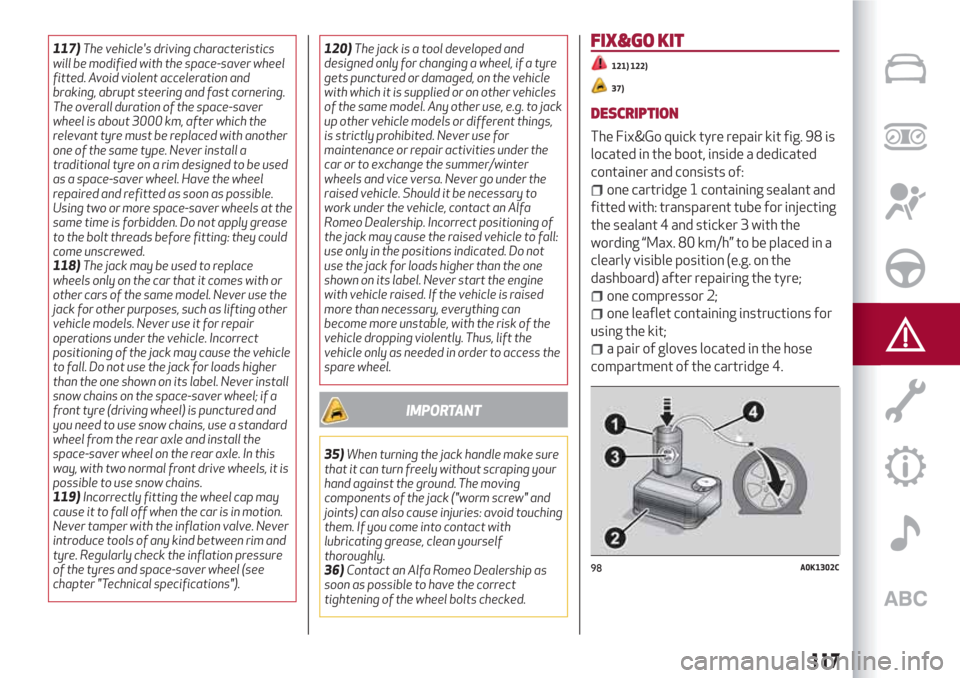
The Fix&Go quick tyre repair kit fig. 98 is
located in the boot, inside a dedicated
container and consists of:
one cartridge 1 containing sealant and
fitted with: transparent tube for injecting
the sealant 4 and sticker 3 with the
wording “Max. 80 km/h” to be placed in a
clearly visible position (e.g. on the
dashboard) after repairing the tyre;
one compressor 2;
one leaflet containing instructions for
using the kit;
a pair of gloves located in the hose
compartment of the cartridge 4.
98A0K1302C
117
Page 120 of 216
REPAIR PROCEDURE
Proceed as follows:
stop the car in a position that is not
dangerous for oncoming traffic where
you can carry out the procedure safely.
The ground must be flat and sufficiently
compact;
stop the engine, engage the hazard
warning lights and the parking brake;
wear the reflective safety jacket
before getting out of the car (anyway
comply with the laws in force in the
country you are driving in);
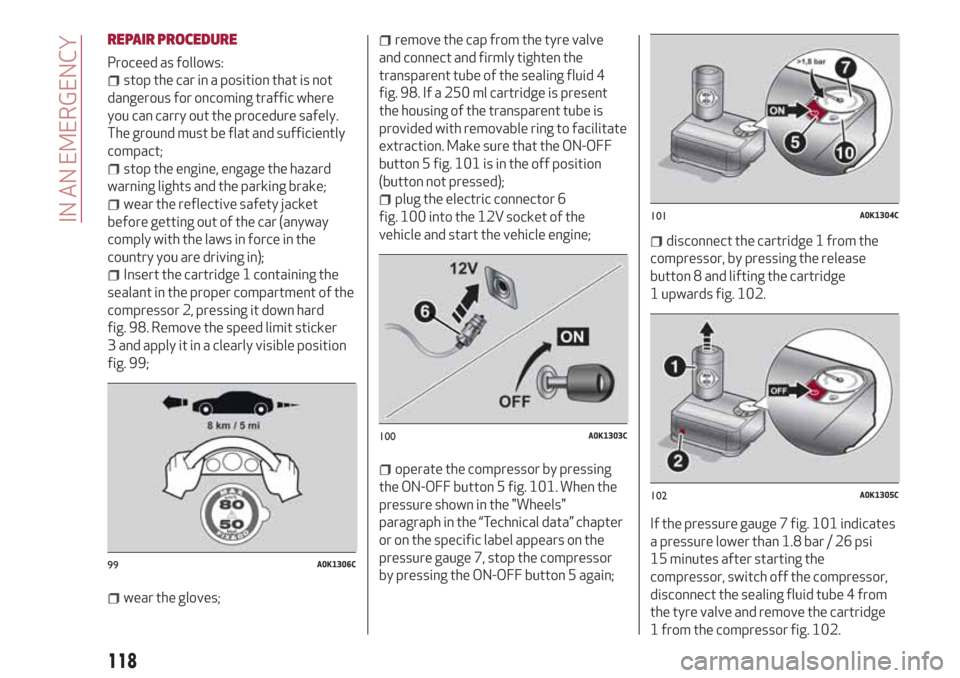
Insert the cartridge 1 containing the
sealant in the proper compartment of the
compressor 2, pressing it down hard
fig. 98. Remove the speed limit sticker
3 and apply it in a clearly visible position
fig. 99;
wear the gloves;
remove the cap from the tyre valve
and connect and firmly tighten the
transparent tube of the sealing fluid 4
fig. 98. If a 250 ml cartridge is present
the housing of the transparent tube is
provided with removable ring to facilitate
extraction. Make sure that the ON-OFF
button 5 fig. 101 is in the off position
(button not pressed);
plug the electric connector 6
fig. 100 into the 12V socket of the
vehicle and start the vehicle engine;
operate the compressor by pressing
the ON-OFF button 5 fig. 101. When the
pressure shown in the "Wheels"
paragraph in the “Technical data” chapter
or on the specific label appears on the
pressure gauge 7, stop the compressor
by pressing the ON-OFF button 5 again;
disconnect the cartridge 1 from the
compressor, by pressing the release
button 8 and lifting the cartridge
1 upwards fig. 102.
If the pressure gauge 7 fig. 101 indicates
a pressure lower than 1.8 bar / 26 psi
15 minutes after starting the
compressor, switch off the compressor,
disconnect the sealing fluid tube 4 from
the tyre valve and remove the cartridge
1 from the compressor fig. 102.
99A0K1306C
100A0K1303C
101A0K1304C
102A0K1305C
118
IN AN EMERGENCY
Page 121 of 216
Move the vehicle by approximately 10 m
to promote the distribution of sealant;
stop the vehicle safely, operate the
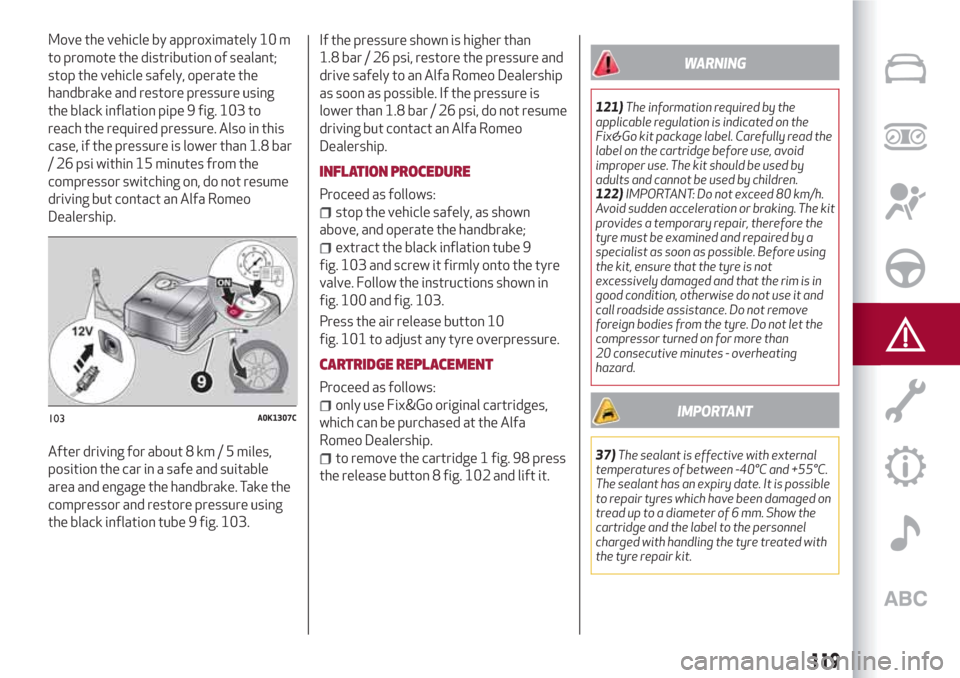
handbrake and restore pressure using
the black inflation pipe 9 fig. 103 to
reach the required pressure. Also in this
case, if the pressure is lower than 1.8 bar
/ 26 psi within 15 minutes from the
compressor switching on, do not resume
driving but contact an Alfa Romeo
Dealership.
After driving for about 8 km / 5 miles,
position the car in a safe and suitable
area and engage the handbrake. Take the
compressor and restore pressure using
the black inflation tube 9 fig. 103.If the pressure shown is higher than
1.8 bar / 26 psi, restore the pressure and
drive safely to an Alfa Romeo Dealership
as soon as possible. If the pressure is
lower than 1.8 bar / 26 psi, do not resume
driving but contact an Alfa Romeo
Dealership.
INFLATION PROCEDURE
Proceed as follows:
stop the vehicle safely, as shown
above, and operate the handbrake;
extract the black inflation tube 9
fig. 103 and screw it firmly onto the tyre
valve. Follow the instructions shown in
fig. 100 and fig. 103.
Press the air release button 10
fig. 101 to adjust any tyre overpressure.
CARTRIDGE REPLACEMENT
Proceed as follows:
only use Fix&Go original cartridges,
which can be purchased at the Alfa
Romeo Dealership.
to remove the cartridge 1 fig. 98 press
the release button 8 fig. 102 and lift it.
WARNING
121)The information required by the
applicable regulation is indicated on the
Fix&Go kit package label. Carefully read the
label on the cartridge before use, avoid
improper use. The kit should be used by
adults and cannot be used by children.
122)IMPORTANT: Do not exceed 80 km/h.
Avoid sudden acceleration or braking. The kit
provides a temporary repair, therefore the
tyre must be examined and repaired by a
specialist as soon as possible. Before using
the kit, ensure that the tyre is not
excessively damaged and that the rim is in
good condition, otherwise do not use it and
call roadside assistance. Do not remove
foreign bodies from the tyre. Do not let the
compressor turned on for more than
20 consecutive minutes - overheating
hazard.
IMPORTANT
37)The sealant is effective with external
temperatures of between -40°C and +55°C.
The sealant has an expiry date. It is possible
to repair tyres which have been damaged on
tread up to a diameter of 6 mm. Show the
cartridge and the label to the personnel
charged with handling the tyre treated with
the tyre repair kit.
103A0K1307C
119
Page 132 of 216
Thousands of miles9 182736455463728190
Thousands of kilometres15 30 45 60 75 90 105 120 135 150
Years12345678910
Replace air cleaner cartridge(7)
Replace filter inside the pressure regulator (1.4 Turbo
Petrol/LPG 120 HP version)
Replace paper filter (LPG in gaseous state) (1.4 Turbo
Petrol/LPG 120 HP version)
Change the brake fluid(8)
Replace the passenger compartment cleaner(7) (o) (●)
(7) If the vehicle is used in dusty areas, this cleaner must be replaced every 15,000 km.
(8) The brake fluid replacement has to be done every two years, irrespective of the mileage.
(o) Recommended operations
(●) Obligatory operations
130
SERVICING AND MAINTENANCE
Page 137 of 216

CHECKING LEVELS
41)
129) 130)
1.4 Turbo Petrol versions
118A0K0655C
135
Page 141 of 216
ENGINE OIL
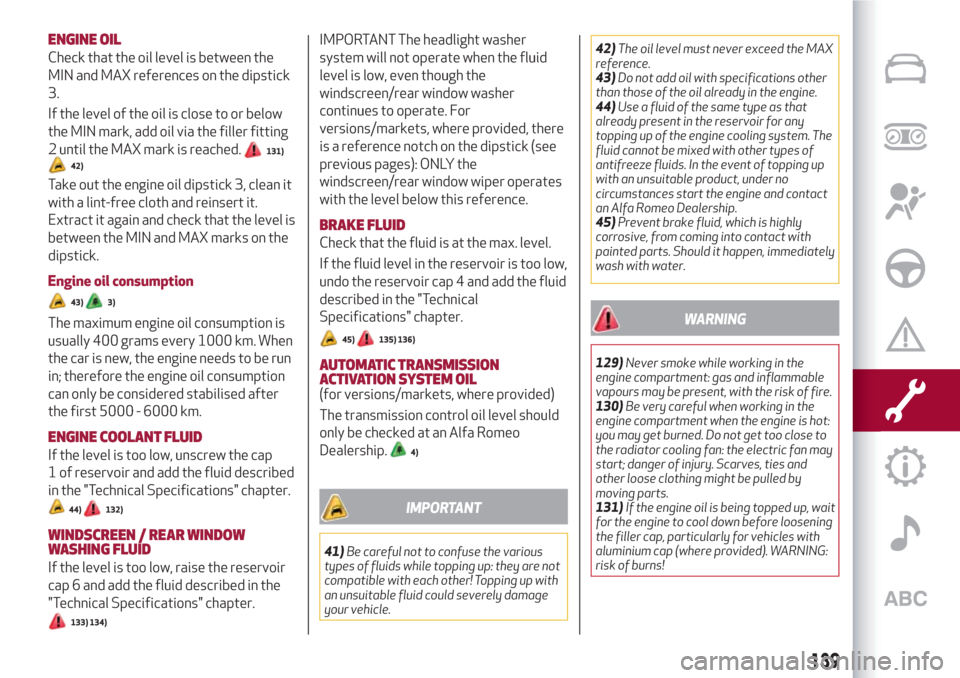
Check that the oil level is between the
MIN and MAX references on the dipstick
3.
If the level of the oil is close to or below
the MIN mark, add oil via the filler fitting
2 until the MAX mark is reached.
131)42)
Take out the engine oil dipstick 3, clean it
with a lint-free cloth and reinsert it.
Extract it again and check that the level is
between the MIN and MAX marks on the
dipstick.
Engine oil consumption
43)3)
The maximum engine oil consumption is
usually 400 grams every 1000 km. When
the car is new, the engine needs to be run
in; therefore the engine oil consumption
can only be considered stabilised after
the first 5000 - 6000 km.
ENGINE COOLANT FLUID
If the level is too low, unscrew the cap
1 of reservoir and add the fluid described
in the "Technical Specifications" chapter.
44)132)
WINDSCREEN / REAR WINDOW
WASHING FLUID
If the level is too low, raise the reservoir
cap 6 and add the fluid described in the
"Technical Specifications" chapter.
133) 134)
IMPORTANT The headlight washer
system will not operate when the fluid
level is low, even though the
windscreen/rear window washer
continues to operate. For
versions/markets, where provided, there
is a reference notch on the dipstick (see
previous pages): ONLY the
windscreen/rear window wiper operates
with the level below this reference.
BRAKE FLUID
Check that the fluid is at the max. level.
If the fluid level in the reservoir is too low,
undo the reservoir cap 4 and add the fluid
described in the "Technical
Specifications" chapter.
45)135) 136)
AUTOMATIC TRANSMISSION
ACTIVATIONSYSTEM OIL
(for versions/markets, where provided)
The transmission control oil level should
only be checked at an Alfa Romeo
Dealership.
4)
IMPORTANT
41)Be careful not to confuse the various
types of fluids while topping up: they are not
compatible with each other! Topping up with
an unsuitable fluid could severely damage
your vehicle.42)The oil level must never exceed the MAX
reference.
43)Do not add oil with specifications other
than those of the oil already in the engine.
44)Use a fluid of the same type as that
already present in the reservoir for any
topping up of the engine cooling system. The
fluid cannot be mixed with other types of
antifreeze fluids. In the event of topping up
with an unsuitable product, under no
circumstances start the engine and contact
an Alfa Romeo Dealership.
45)Prevent brake fluid, which is highly
corrosive, from coming into contact with
painted parts. Should it happen, immediately
wash with water.
WARNING
129)Never smoke while working in the
engine compartment: gas and inflammable
vapours may be present, with the risk of fire.
130)Be very careful when working in the
engine compartment when the engine is hot:
you may get burned. Do not get too close to
the radiator cooling fan: the electric fan may
start; danger of injury. Scarves, ties and
other loose clothing might be pulled by
moving parts.
131)If the engine oil is being topped up, wait
for the engine to cool down before loosening
the filler cap, particularly for vehicles with
aluminium cap (where provided). WARNING:
risk of burns!
139
Page 161 of 216
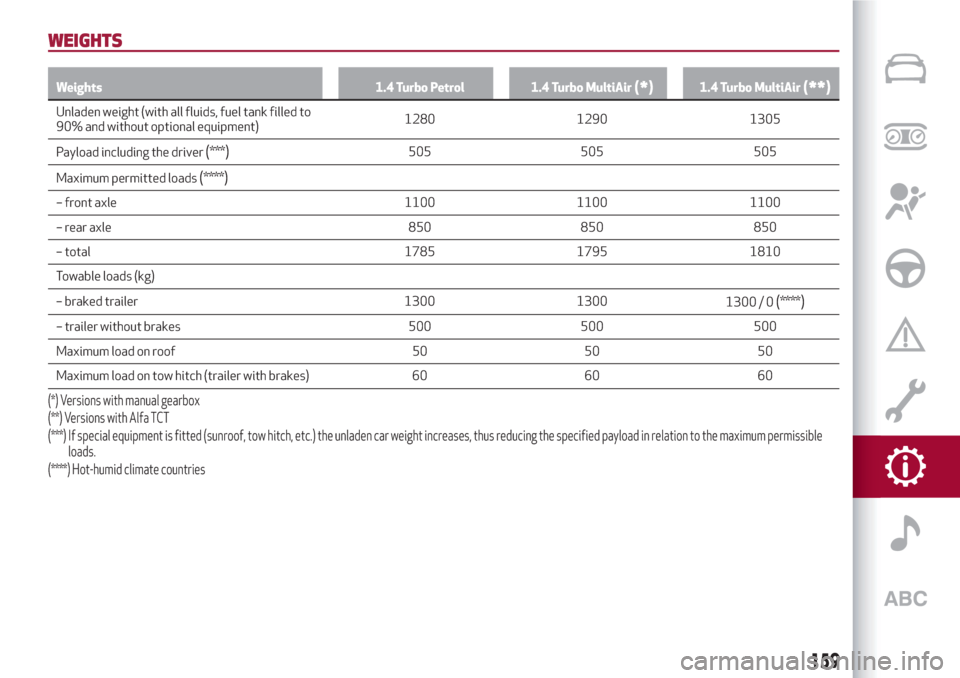
WEIGHTS
Weights 1.4 Turbo Petrol 1.4 Turbo MultiAir(*)1.4 Turbo MultiAir(**)
Unladen weight (with all fluids, fuel tank filled to
90% and without optional equipment)1280 1290 1305
Payload including the driver
(***)505 505 505
Maximum permitted loads
(****)
– front axle 1100 1100 1100
– rear axle 850 850 850
– total 1785 1795 1810
Towable loads (kg)
– braked trailer 1300 1300
1300 / 0
(****)
– trailer without brakes 500 500 500
Maximum load on roof 50 50 50
Maximum load on tow hitch (trailer with brakes) 60 60 60
(*) Versions with manual gearbox
(**) Versions with Alfa TCT
(***) If special equipment is fitted (sunroof, tow hitch, etc.) the unladen car weight increases, thus reducing the specified payload in relation to the maximum permissible
loads.
(****) Hot-humid climate countries
159
Page 162 of 216
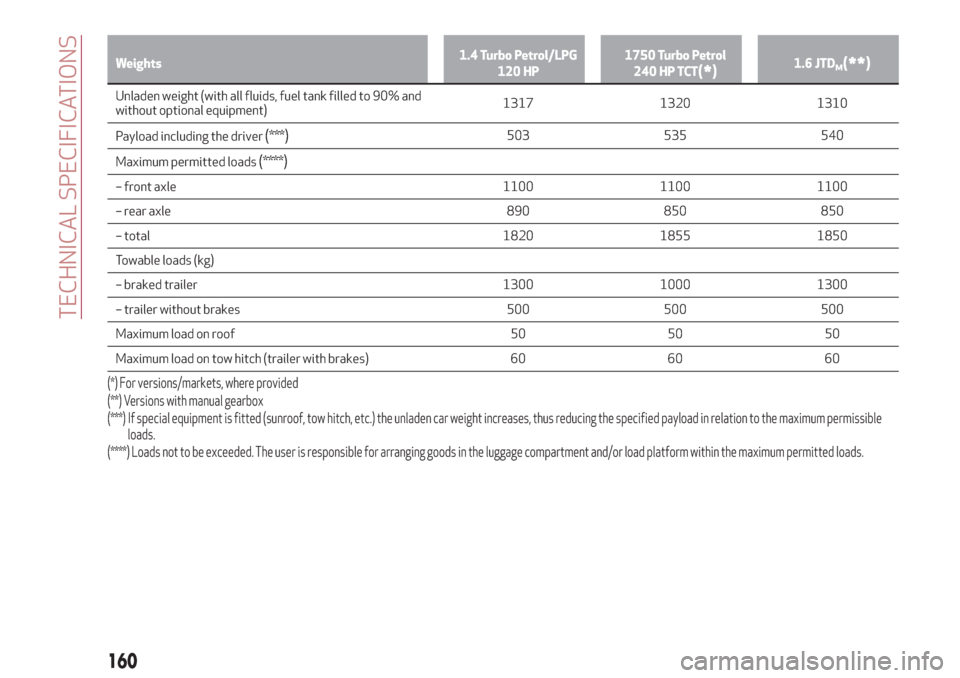
Weights1.4 Turbo Petrol/LPG
120 HP1750 Turbo Petrol
240 HP TCT(*)1.6 JTDM(**)
Unladen weight (with all fluids, fuel tank filled to 90% and
without optional equipment)1317 1320 1310
Payload including the driver
(***)503 535 540
Maximum permitted loads
(****)
– front axle 1100 1100 1100
– rear axle 890 850 850
– total 1820 1855 1850
Towable loads (kg)
– braked trailer 1300 1000 1300
– trailer without brakes 500 500 500
Maximum load on roof 50 50 50
Maximum load on tow hitch (trailer with brakes) 60 60 60
(*) For versions/markets, where provided
(**) Versions with manual gearbox
(***) If special equipment is fitted (sunroof, tow hitch, etc.) the unladen car weight increases, thus reducing the specified payload in relation to the maximum permissible
loads.
(****) Loads not to be exceeded. The user is responsible for arranging goods in the luggage compartment and/or load platform within the maximum permitted loads.
160
TECHNICAL SPECIFICATIONS
Page 163 of 216
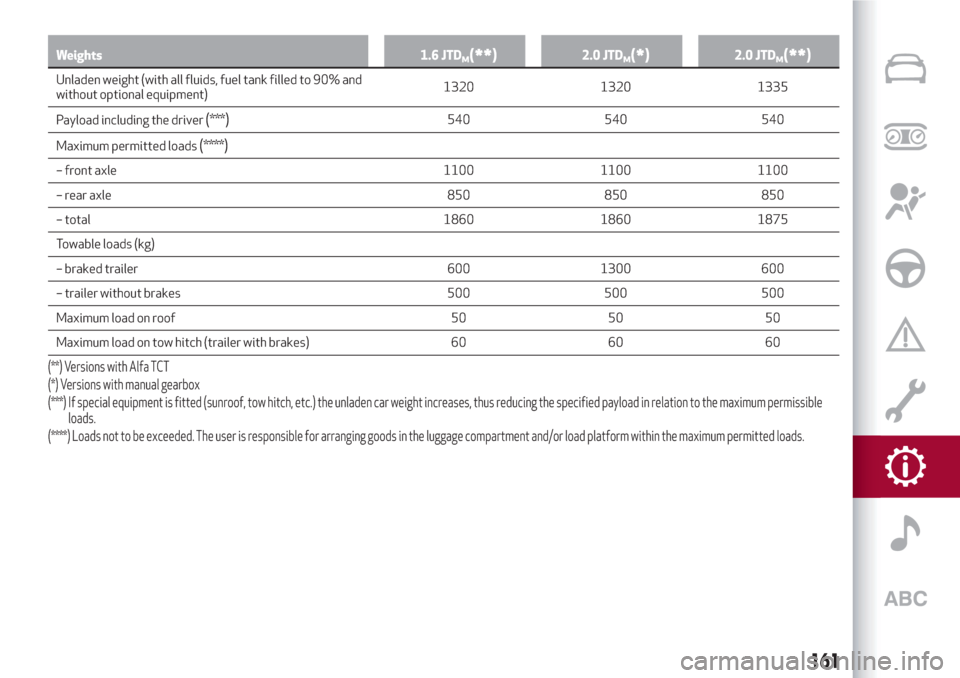
Weights 1.6 JTDM(**)2.0 JTDM(*)2.0 JTDM(**)
Unladen weight (with all fluids, fuel tank filled to 90% and
without optional equipment)1320 1320 1335
Payload including the driver
(***)540 540 540
Maximum permitted loads
(****)
– front axle 1100 1100 1100
– rear axle 850 850 850
– total 1860 1860 1875
Towable loads (kg)
– braked trailer 600 1300 600
– trailer without brakes 500 500 500
Maximum load on roof 50 50 50
Maximum load on tow hitch (trailer with brakes) 60 60 60
(**) Versions with Alfa TCT
(*) Versions with manual gearbox
(***) If special equipment is fitted (sunroof, tow hitch, etc.) the unladen car weight increases, thus reducing the specified payload in relation to the maximum permissible
loads.
(****) Loads not to be exceeded. The user is responsible for arranging goods in the luggage compartment and/or load platform within the maximum permitted loads.
161
Page 193 of 216
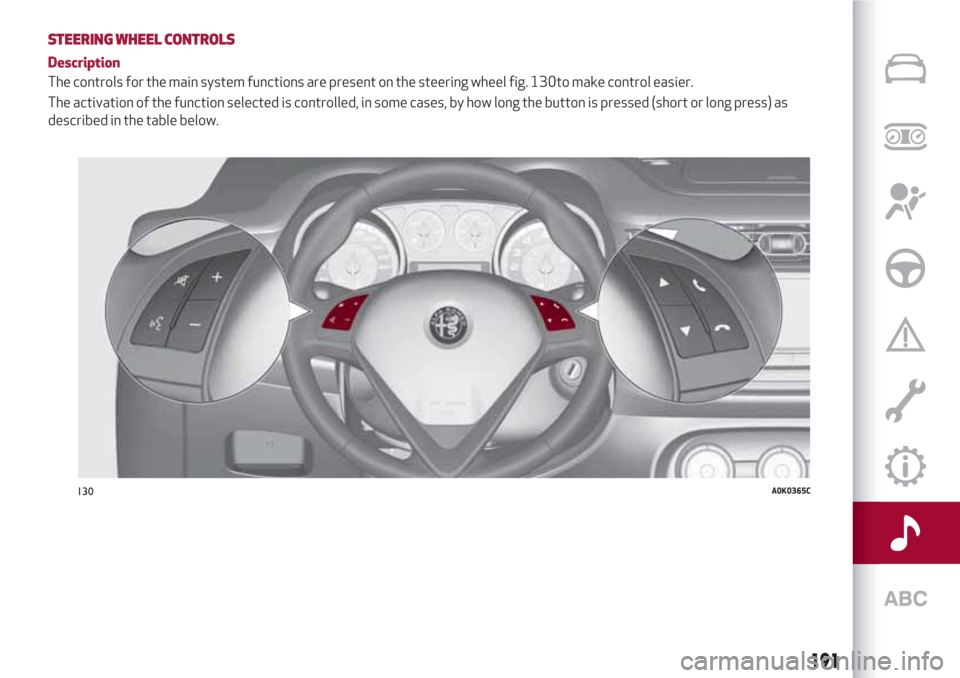
STEERING WHEEL CONTROLS
Description
The controls for the main system functions are present on the steering wheel fig. 130to make control easier.
The activation of the function selected is controlled, in some cases, by how long the button is pressed (short or long press) as
described in the table below.
130A0K0365C
191