remove seats Alfa Romeo Giulietta 2018 Owner's Manual
[x] Cancel search | Manufacturer: ALFA ROMEO, Model Year: 2018, Model line: Giulietta, Model: Alfa Romeo Giulietta 2018Pages: 216, PDF Size: 3.39 MB
Page 16 of 216
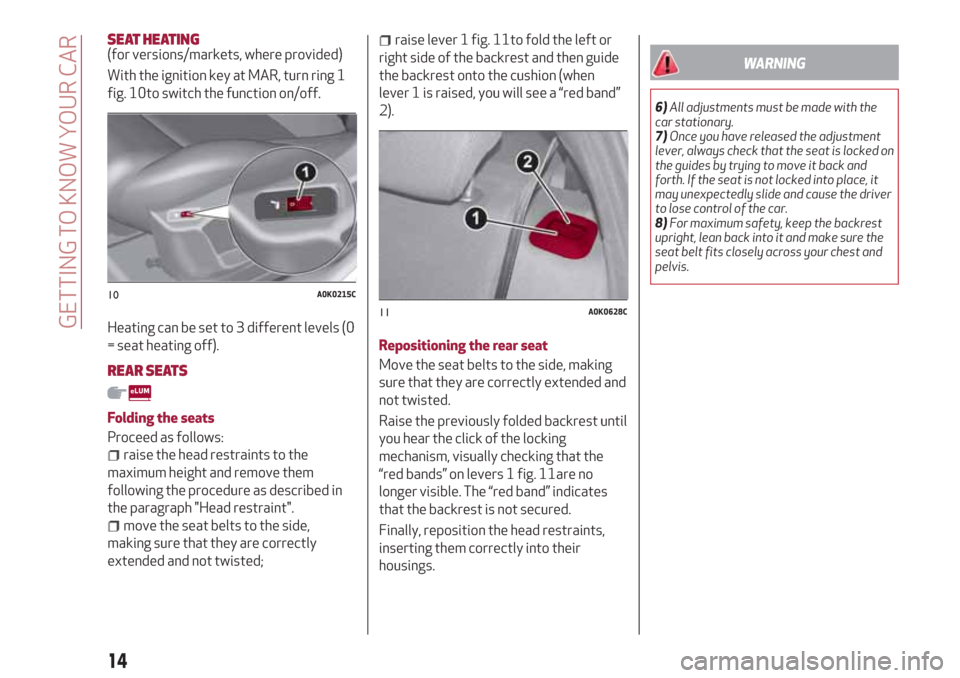
SEAT HEATING(for versions/markets, where provided)
With the ignition key at MAR, turn ring 1
fig. 10to switch the function on/off.
Heating can be set to 3 different levels (0
= seat heating off).
REAR SEATS
Folding the seats
Proceed as follows:
raise the head restraints to the
maximum height and remove them
following the procedure as described in
the paragraph "Head restraint".
move the seat belts to the side,
making sure that they are correctly
extended and not twisted;
raise lever 1 fig. 11to fold the left or
right side of the backrest and then guide
the backrest onto the cushion (when
lever 1 is raised, you will see a “red band”
2).
Repositioning the rear seat
Move the seat belts to the side, making
sure that they are correctly extended and
not twisted.
Raise the previously folded backrest until
you hear the click of the locking
mechanism, visually checking that the
“red bands” on levers 1 fig. 11are no
longer visible. The “red band” indicates
that the backrest is not secured.
Finally, reposition the head restraints,
inserting them correctly into their
housings.
WARNING
6)All adjustments must be made with the
car stationary.
7)Once you have released the adjustment
lever, always check that the seat is locked on
the guides by trying to move it back and
forth. If the seat is not locked into place, it
may unexpectedly slide and cause the driver
to lose control of the car.
8)For maximum safety, keep the backrest
upright, lean back into it and make sure the
seat belt fits closely across your chest and
pelvis.
10A0K0215C
11A0K0628C
14
GETTING TO KNOW YOUR CAR
Page 17 of 216
HEADRESTS
FRONT
These are height-adjustable and lock into
the desired position automatically.
To adjust the height, proceed as follows:
9)
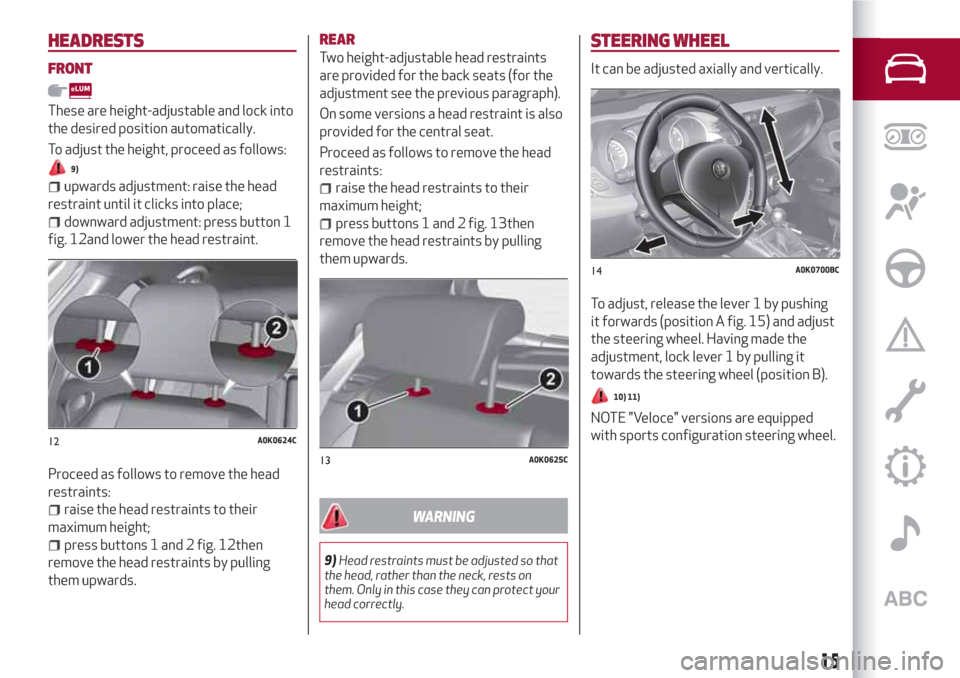
upwards adjustment: raise the head
restraint until it clicks into place;
downward adjustment: press button 1
fig. 12and lower the head restraint.
Proceed as follows to remove the head
restraints:
raise the head restraints to their
maximum height;
press buttons 1 and 2 fig. 12then
remove the head restraints by pulling
them upwards.
REAR
Two height-adjustable head restraints
are provided for the back seats (for the
adjustment see the previous paragraph).
On some versions a head restraint is also
provided for the central seat.
Proceed as follows to remove the head
restraints:
raise the head restraints to their
maximum height;
press buttons 1 and 2 fig. 13then
remove the head restraints by pulling
them upwards.
WARNING
9)Head restraints must be adjusted so that
the head, rather than the neck, rests on
them. Only in this case they can protect your
head correctly.
STEERING WHEEL
It can be adjusted axially and vertically.
To adjust, release the lever 1 by pushing
it forwards (position A fig. 15) and adjust
the steering wheel. Having made the
adjustment, lock lever 1 by pulling it
towards the steering wheel (position B).
10) 11)
NOTE "Veloce" versions are equipped
with sports configuration steering wheel.
12A0K0624C
13A0K0625C
14A0K0700BC
15
Page 33 of 216
Emergency opening from the inside
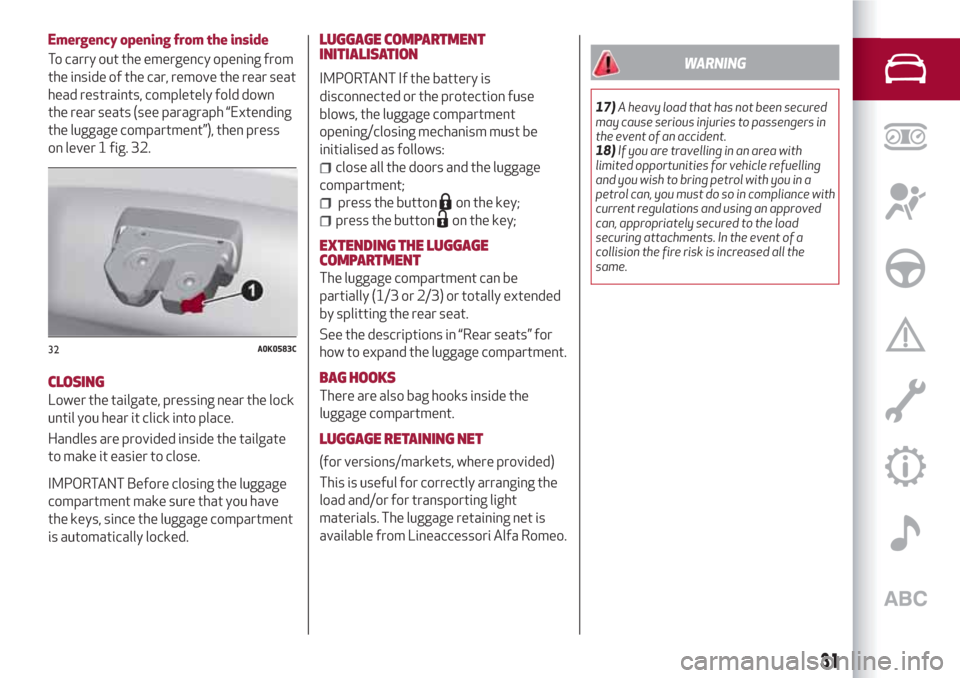
To carry out the emergency opening from
the inside of the car, remove the rear seat
head restraints, completely fold down
the rear seats (see paragraph “Extending
the luggage compartment”), then press
on lever 1 fig. 32.
CLOSING
Lower the tailgate, pressing near the lock
until you hear it click into place.
Handles are provided inside the tailgate
to make it easier to close.
IMPORTANT Before closing the luggage
compartment make sure that you have
the keys, since the luggage compartment
is automatically locked.LUGGAGE COMPARTMENT
INITIALISATION
IMPORTANT If the battery is
disconnected or the protection fuse
blows, the luggage compartment
opening/closing mechanism must be
initialised as follows:
close all the doors and the luggage
compartment;
press the buttonon the key;
press the buttonon the key;
EXTENDING THE LUGGAGE
COMPARTMENT
The luggage compartment can be
partially (1/3 or 2/3) or totally extended
by splitting the rear seat.
See the descriptions in “Rear seats” for
how to expand the luggage compartment.
BAG HOOKS
There are also bag hooks inside the
luggage compartment.
LUGGAGE RETAINING NET
(for versions/markets, where provided)
This is useful for correctly arranging the
load and/or for transporting light
materials. The luggage retaining net is
available from Lineaccessori Alfa Romeo.
WARNING
17)A heavy load that has not been secured
may cause serious injuries to passengers in
the event of an accident.
18)If you are travelling in an area with
limited opportunities for vehicle refuelling
and you wish to bring petrol with you in a
petrol can, you must do so in compliance with
current regulations and using an approved
can, appropriately secured to the load
securing attachments. In the event of a
collision the fire risk is increased all the
same.
32A0K0583C
31
Page 70 of 216
CARRYING CHILDREN SAFELY
For optimal protection in the event of an
impact, all occupants must be seated and
wearing adequate restraint systems,
including newborn and other children!
This prescription is compulsory in all EC
countries according to EC Directive
2003/20/EC.
Children below the height of 1.50 metres
and up to 12 years must be protected
with suitable restraint systems and be
seated on the rear seats. Statistics on
accidents indicate that the rear seats
offer greater safety for children.
Compared with an adult, a child's head is
larger and heavier in proportion to their
body and the child's muscular and bone
structures are not fully developed.
Therefore, correct restraint systems
other than adult seat belts are necessary
to reduce as much as possible the risk of
injuries in case of accident, braking or
sudden manoeuvre.
Children must be seated safely and
comfortably. Depending on the
characteristics of the child restraint
systems used, you are advised to keep
children in rearward facing child restraint
systems for as long as possible (at least
until 3-4 years old), since this is the most
protected position in the event of an
impact.
60) 61) 62) 63)
The choice of the most suitable child
restraint device depends on the weight of
the child; there are various types of child
restraint systems and you are advised
always to choose the one that is most
suitable for the child.
When over 1.50 m in height, from the
point of view of restraint systems,
children are considered as adults and
wear seat belts normally.
In Europe the characteristics of child
restraint systems are ruled by the
regulation ECE-R44, dividing them into
five weight groups:
Group Weight groups
Group 0 up to 10 kg in weight
Group 0+ up to
13 kg in weight
Group 1 9-18 kg
Group 2 15-25 kg
Group 3 22 - 36 kg
All restraint devices must bear the
certification data, together with the
control mark, on a label solidly fixed to
the child restraint system which must
never be removed.
Lineaccessori MOPAR
®includes child
restraint systems for each weight group.
These devices are recommended having
been specifically tested for Alfa Romeo
cars.
WARNING
60)SEVERE DANGER When a front
passenger airbag is fitted, do not install
rearward facing child restraint systems on
the front passenger seat. Deployment of the
airbag in an accident could cause fatal
injuries to the child regardless of the
severity of the collision. It is advisable to
always carry children in a child restraint
system on the rear seat, which is the most
protected position in the event of a collision.
61)On the sun visor there is a label with
suitable symbols reminding the user that it is
compulsory to deactivate the airbag if a
rearward facing child restraint system is
fitted. Always comply with the instructions
on the passenger side sun visor (see the
"Supplementary Restraint System (SRS) -
Airbag" paragraph).
62)Should it be necessary to carry a child on
the passenger side front seat in a rear facing
child restraint system, the passenger side
front airbag and side bag must be
deactivated through the display main menu
(see the "Display" paragraph, "Knowing the
instrument panel" chapter), verifying
deactivation by checking whether the
OFF LED has switched on in the trim
located on the dashboard. Move the
passenger's seat as far back as possible to
avoid contact between the child seat and the
dashboard.
63)Do not move the front or rear seat if a
child is seated on it or on the dedicated child
restraint system
68
SAFETY
Page 72 of 216
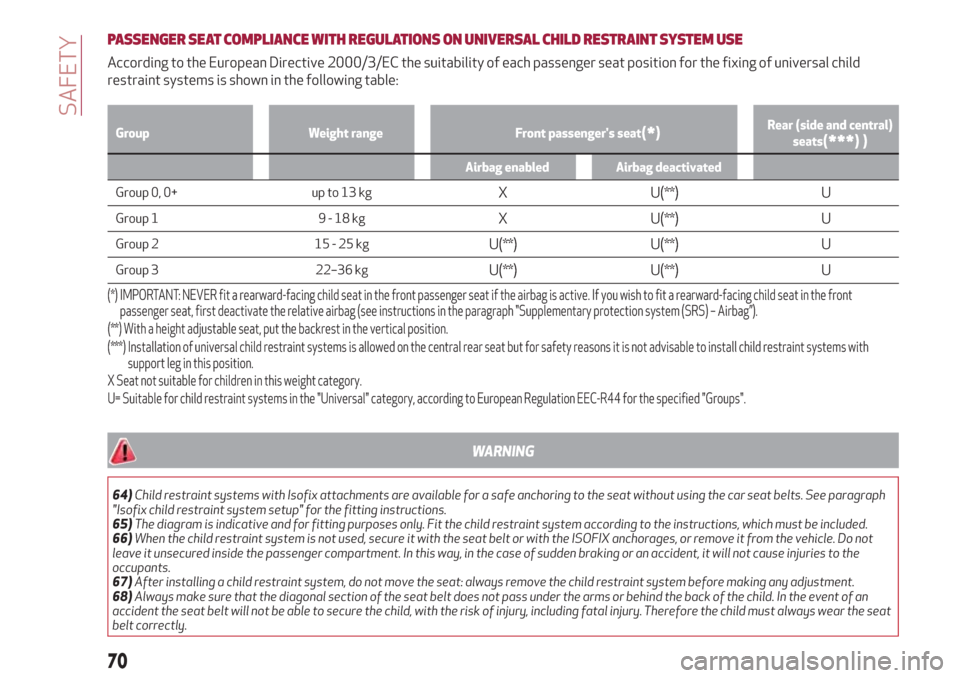
PASSENGER SEAT COMPLIANCE WITH REGULATIONS ON UNIVERSAL CHILD RESTRAINTSYSTEM USE
According to the European Directive 2000/3/EC the suitability of each passenger seat position for the fixing of universal child
restraint systems is shown in the following table:
WARNING
64)Child restraint systems with Isofix attachments are available for a safe anchoring to the seat without using the car seat belts. See paragraph
"Isofix child restraint system setup" for the fitting instructions.
65)The diagram is indicative and for fitting purposes only. Fit the child restraint system according to the instructions, which must be included.
66)When the child restraint system is not used, secure it with the seat belt or with the ISOFIX anchorages, or remove it from the vehicle. Do not
leave it unsecured inside the passenger compartment. In this way, in the case of sudden braking or an accident, it will not cause injuries to the
occupants.
67)After installing a child restraint system, do not move the seat: always remove the child restraint system before making any adjustment.
68)Always make sure that the diagonal section of the seat belt does not pass under the arms or behind the back of the child. In the event of an
accident the seat belt will not be able to secure the child, with the risk of injury, including fatal injury. Therefore the child must always wear the seat
belt correctly.
70
SAFETY
Group Weight range Front passenger's seat(*)Rear (side and central)
seats(***))
Airbag enabled Airbag deactivated
Group 0, 0+ up to 13 kgX U(**) U
Group 1 9 - 18 kgX U(**) U
Group 2 15 - 25 kgU(**) U(**) U
Group 3 22–36 kgU(**) U(**) U
(*) IMPORTANT: NEVER fit a rearward-facing child seat in the front passenger seat if the airbag is active. If you wish to fit a rearward-facing child seat in the front
passenger seat, first deactivate the relative airbag (see instructions in the paragraph "Supplementary protection system (SRS) – Airbag”).
(***) Installation of universal child restraint systems is allowed on the central rear seat but for safety reasons it is not advisable to install childrestraint systems with
support leg in this position.
X Seat not suitable for children in this weight category.
U= Suitable for child restraint systems in the "Universal" category, according to European Regulation EEC-R44 for the specified "Groups". (**) With a height adjustable seat, put the backrest in the vertical position.
Page 78 of 216
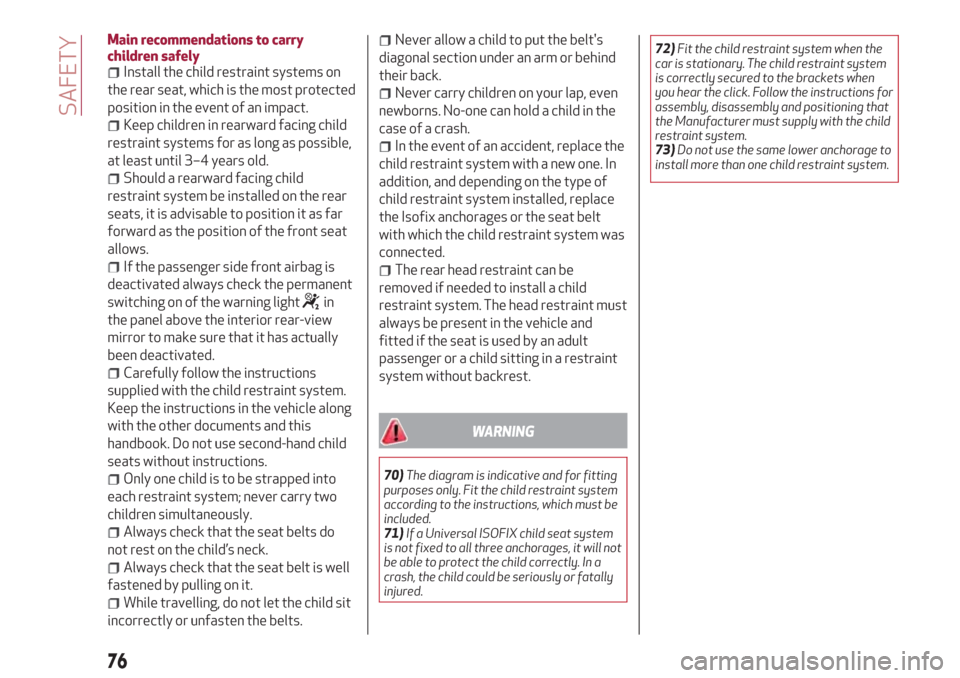
Main recommendations to carry
children safely
Install the child restraint systems on
the rear seat, which is the most protected
position in the event of an impact.
Keep children in rearward facing child
restraint systems for as long as possible,
at least until 3–4 years old.
Should a rearward facing child
restraint system be installed on the rear
seats, it is advisable to position it as far
forward as the position of the front seat
allows.
If the passenger side front airbag is
deactivated always check the permanent
switching on of the warning light
in
the panel above the interior rear-view
mirror to make sure that it has actually
been deactivated.
Carefully follow the instructions
supplied with the child restraint system.
Keep the instructions in the vehicle along
with the other documents and this
handbook. Do not use second-hand child
seats without instructions.
Only one child is to be strapped into
each restraint system; never carry two
children simultaneously.
Always check that the seat belts do
not rest on the child’s neck.
Always check that the seat belt is well
fastened by pulling on it.
While travelling, do not let the child sit
incorrectly or unfasten the belts.
Never allow a child to put the belt's
diagonal section under an arm or behind
their back.
Never carry children on your lap, even
newborns. No-one can hold a child in the
case of a crash.
In the event of an accident, replace the
child restraint system with a new one. In
addition, and depending on the type of
child restraint system installed, replace
the Isofix anchorages or the seat belt
with which the child restraint system was
connected.
The rear head restraint can be
removed if needed to install a child
restraint system. The head restraint must
always be present in the vehicle and
fitted if the seat is used by an adult
passenger or a child sitting in a restraint
system without backrest.
WARNING
70)The diagram is indicative and for fitting
purposes only. Fit the child restraint system
according to the instructions, which must be
included.
71)If a Universal ISOFIX child seat system
is not fixed to all three anchorages, it will not
be able to protect the child correctly. In a
crash, the child could be seriously or fatally
injured.72)Fit the child restraint system when the
car is stationary. The child restraint system
is correctly secured to the brackets when
you hear the click. Follow the instructions for
assembly, disassembly and positioning that
the Manufacturer must supply with the child
restraint system.
73)Do not use the same lower anchorage to
install more than one child restraint system.
76
SAFETY
Page 82 of 216
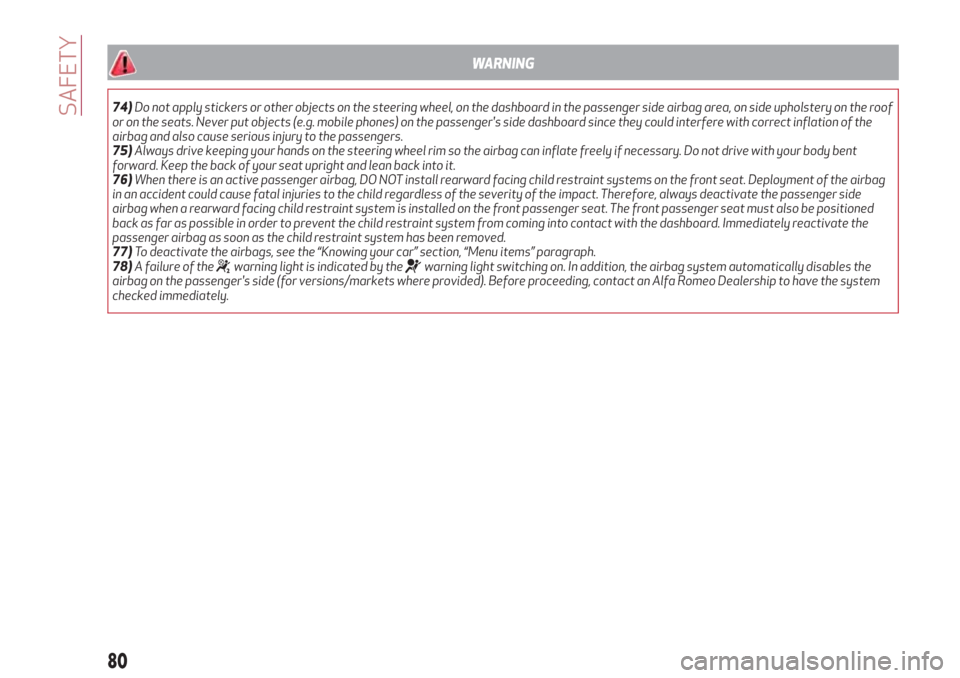
WARNING
74)Do not apply stickers or other objects on the steering wheel, on the dashboard in the passenger side airbag area, on side upholstery on the roof
or on the seats. Never put objects (e.g. mobile phones) on the passenger's side dashboard since they could interfere with correct inflation of the
airbag and also cause serious injury to the passengers.
75)Always drive keeping your hands on the steering wheel rim so the airbag can inflate freely if necessary. Do not drive with your body bent
forward. Keep the back of your seat upright and lean back into it.
76)When there is an active passenger airbag, DO NOT install rearward facing child restraint systems on the front seat. Deployment of the airbag
in an accident could cause fatal injuries to the child regardless of the severity of the impact. Therefore, always deactivate the passenger side
airbag when a rearward facing child restraint system is installed on the front passenger seat. The front passenger seat must also be positioned
back as far as possible in order to prevent the child restraint system from coming into contact with the dashboard. Immediately reactivate the
passenger airbag as soon as the child restraint system has been removed.
77)To deactivate the airbags, see the “Knowing your car” section, “Menu items” paragraph.
78)A failure of the
warning light is indicated by thewarning light switching on. In addition, the airbag system automatically disables the
airbag on the passenger's side (for versions/markets where provided). Before proceeding, contact an Alfa Romeo Dealership to have the system
checked immediately.
80
SAFETY
Page 147 of 216
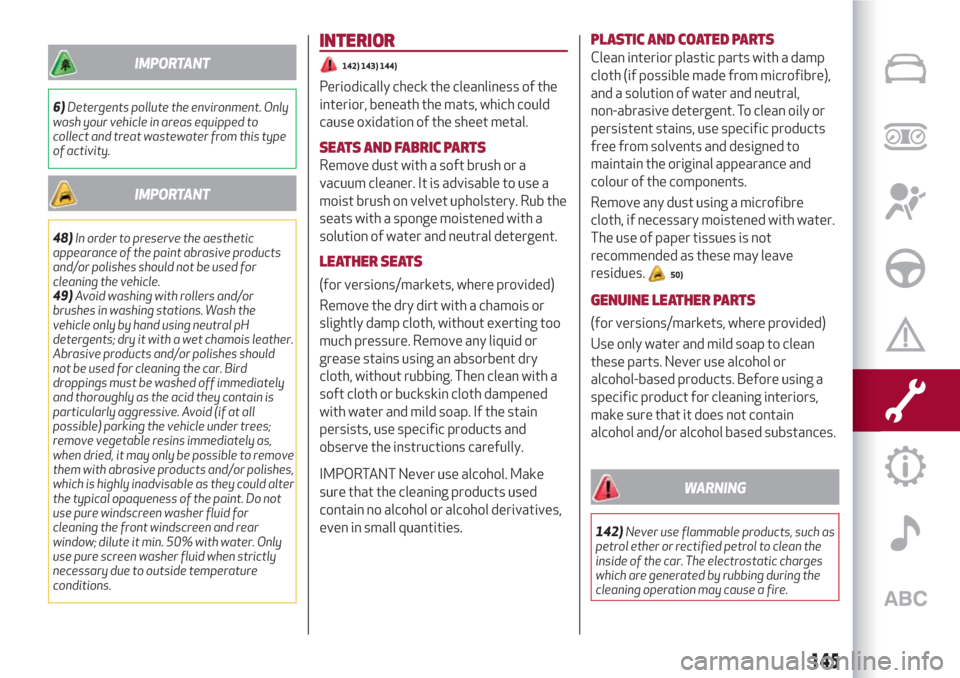
IMPORTANT
6)Detergents pollute the environment. Only
wash your vehicle in areas equipped to
collect and treat wastewater from this type
of activity.
IMPORTANT
48)In order to preserve the aesthetic
appearance of the paint abrasive products
and/or polishes should not be used for
cleaning the vehicle.
49)Avoid washing with rollers and/or
brushes in washing stations. Wash the
vehicle only by hand using neutral pH
detergents; dry it with a wet chamois leather.
Abrasive products and/or polishes should
not be used for cleaning the car. Bird
droppings must be washed off immediately
and thoroughly as the acid they contain is
particularly aggressive. Avoid (if at all
possible) parking the vehicle under trees;
remove vegetable resins immediately as,
when dried, it may only be possible to remove
them with abrasive products and/or polishes,
which is highly inadvisable as they could alter
the typical opaqueness of the paint. Do not
use pure windscreen washer fluid for
cleaning the front windscreen and rear
window; dilute it min. 50% with water. Only
use pure screen washer fluid when strictly
necessary due to outside temperature
conditions.
INTERIOR
142) 143) 144)
Periodically check the cleanliness of the
interior, beneath the mats, which could
cause oxidation of the sheet metal.
SEATS AND FABRIC PARTS
Remove dust with a soft brush or a
vacuum cleaner. It is advisable to use a
moist brush on velvet upholstery. Rub the
seats with a sponge moistened with a
solution of water and neutral detergent.
LEATHER SEATS
(for versions/markets, where provided)
Remove the dry dirt with a chamois or
slightly damp cloth, without exerting too
much pressure. Remove any liquid or
grease stains using an absorbent dry
cloth, without rubbing. Then clean with a
soft cloth or buckskin cloth dampened
with water and mild soap. If the stain
persists, use specific products and
observe the instructions carefully.
IMPORTANT Never use alcohol. Make
sure that the cleaning products used
contain no alcohol or alcohol derivatives,
even in small quantities.PLASTIC AND COATED PARTS
Clean interior plastic parts with a damp
cloth (if possible made from microfibre),
and a solution of water and neutral,
non-abrasive detergent. To clean oily or
persistent stains, use specific products
free from solvents and designed to
maintain the original appearance and
colour of the components.
Remove any dust using a microfibre
cloth, if necessary moistened with water.
The use of paper tissues is not
recommended as these may leave
residues.
50)
GENUINE LEATHER PARTS
(for versions/markets, where provided)
Use only water and mild soap to clean
these parts. Never use alcohol or
alcohol-based products. Before using a
specific product for cleaning interiors,
make sure that it does not contain
alcohol and/or alcohol based substances.
WARNING
142)Never use flammable products, such as
petrol ether or rectified petrol to clean the
inside of the car. The electrostatic charges
which are generated by rubbing during the
cleaning operation may cause a fire.
145