wheel Alfa Romeo GT 2006 Owner handbook (in English)
[x] Cancel search | Manufacturer: ALFA ROMEO, Model Year: 2006, Model line: GT, Model: Alfa Romeo GT 2006Pages: 307, PDF Size: 6.05 MB
Page 54 of 307
GETTING TO KNOW YOUR CAR
52
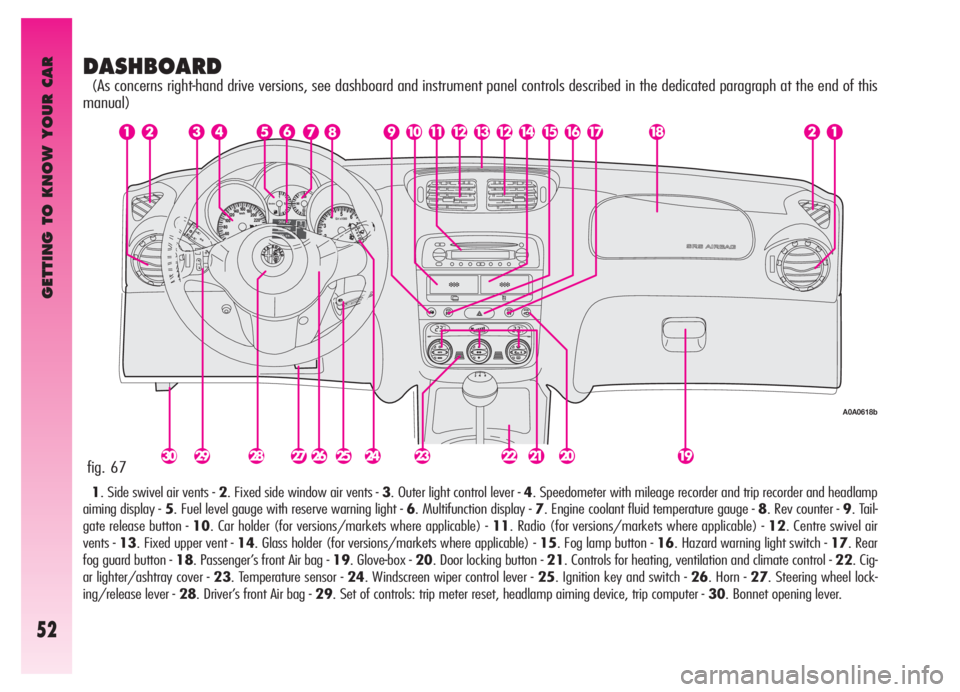
DASHBOARD
(As concerns right-hand drive versions, see dashboard and instrument panel controls described in the dedicated paragraph at the end of this
manual)
1. Side swivel air vents - 2. Fixed side window air vents - 3. Outer light control lever - 4. Speedometer with mileage recorder and trip recorder and headlamp
aiming display - 5. Fuel level gauge with reserve warning light - 6. Multifunction display - 7. Engine coolant fluid temperature gauge - 8. Rev counter - 9. Tail-
gate release button - 10. Car holder (for versions/markets where applicable) - 11. Radio (for versions/markets where applicable) - 12. Centre swivel air
vents - 13. Fixed upper vent - 14. Glass holder (for versions/markets where applicable) - 15. Fog lamp button - 16. Hazard warning light switch - 17. Rear
fog guard button - 18. Passenger’s front Air bag - 19. Glove-box - 20. Door locking button - 21. Controls for heating, ventilation and climate control - 22. Cig-
ar lighter/ashtray cover - 23. Temperature sensor - 24. Windscreen wiper control lever - 25. Ignition key and switch - 26. Horn - 27. Steering wheel lock-
ing/release lever - 28. Driver’s front Air bag - 29. Set of controls: trip meter reset, headlamp aiming device, trip computer - 30. Bonnet opening lever.
fig. 67
A0A0618b
Page 96 of 307
GETTING TO KNOW YOUR CAR
94
Warning
light on dialMessage
on display
>
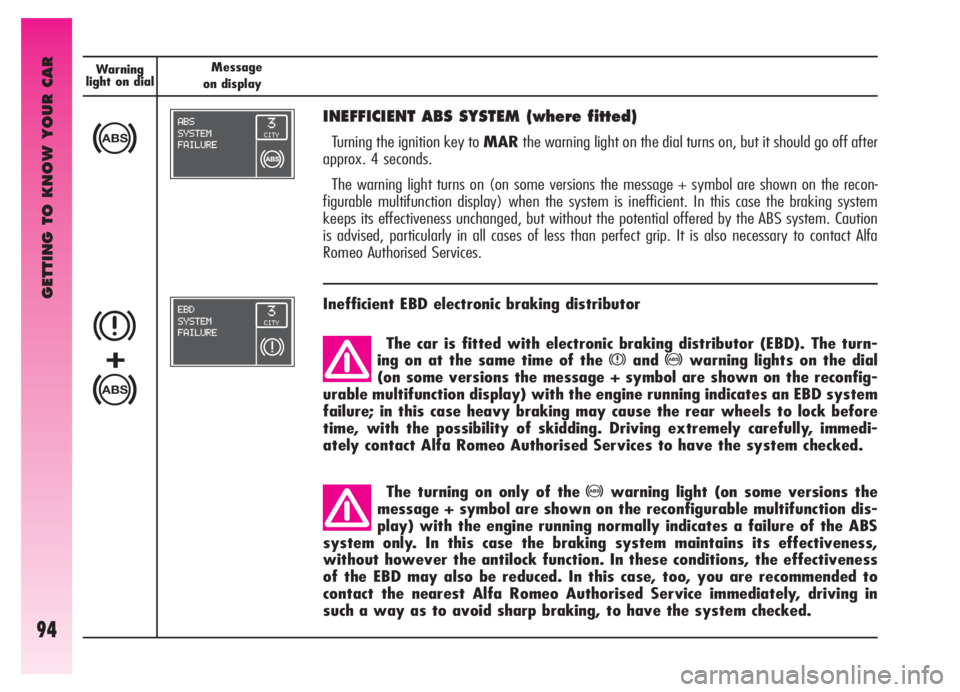
INEFFICIENT ABS SYSTEM (where fitted)
Turning the ignition key to MARthe warning light on the dial turns on, but it should go off after
approx. 4 seconds.
The warning light turns on (on some versions the message + symbol are shown on the recon-
figurable multifunction display) when the system is inefficient. In this case the braking system
keeps its effectiveness unchanged, but without the potential offered by the ABS system. Caution
is advised, particularly in all cases of less than perfect grip. It is also necessary to contact Alfa
Romeo Authorised Services.
The car is fitted with electronic braking distributor (EBD). The turn-
ing on at the same time of the
xand>warning lights on the dial
(on some versions the message + symbol are shown on the reconfig-
urable multifunction display) with the engine running indicates an EBD system
failure; in this case heavy braking may cause the rear wheels to lock before
time, with the possibility of skidding. Driving extremely carefully, immedi-
ately contact Alfa Romeo Authorised Services to have the system checked.
The turning on only of the
>warning light (on some versions the
message + symbol are shown on the reconfigurable multifunction dis-
play) with the engine running normally indicates a failure of the ABS
system only. In this case the braking system maintains its effectiveness,
without however the antilock function. In these conditions, the effectiveness
of the EBD may also be reduced. In this case, too, you are recommended to
contact the nearest Alfa Romeo Authorised Service immediately, driving in
such a way as to avoid sharp braking, to have the system checked.
Inefficient EBD electronic braking distributor
x
>
+
Page 97 of 307

GETTING TO KNOW YOUR CAR
95
Warning
light on dialMessage
on display
F
PASSENGER’S FRONT AIR BAG DEACTIVATED
With the passenger’s front Air bag engaged, turning the ignition key to MARthe warning light
turns on, but it should go off after 4 seconds.
á
VDC SYSTEM (VEHICLE DYNAMICS CONTROL) (where fitted)
Turning the ignition key to MAR, the warning light on the dial turns on and it should go off
after approx. 4 seconds.
If the warning light does not go out or stays on when travelling together with the message +
symbol shown on the reconfigurable multifunction display, contact Alfa Romeo Authorised
Services.
The flashing of the warning light when travelling indicates the cutting in of the VDC system.
ASR – WHEEL ANTISKID SYSTEM (where fitted)
Turning the ignition key to MAR, the warning light on the dial turns on, but is should go off
after approx. 4 seconds. The warning light turns on together with the led on the ASR OFF button
when the system is switched off. The warning light flashes when the system cuts in, to alert the
driver that the system is adapting to the road surface grip conditions. The turning on of the warn-
ing light, together with the message + symbol shown by the reconfigurable multifunction display,
also indicates a failure of the ASR system. In this case contact Alfa Romeo Authorised Services as
soon as possible.
Warning light Findicates also warning light ¬failure. This is indi-
cated by intermittent flashing, over 4 seconds, of warning light
F. In
this event, warning light
¬could be not up to indicate restraint sys-
tem failures, if any. Stop the car and contact Alfa Romeo Authorized Services
to have the system checked immediately.
The warning light turns on when the passenger’s front Air bag is deactivated.
Page 129 of 307

GETTING TO KNOW YOUR CAR
127
To release the hand brake:
– slightly lift the lever (A) and press the
release button (B);
– keeping the button pressed lower the
lever, the warning light
xon the instru-
ment cluster will go out.
To prevent the car from moving acciden-
tally, keep the brake pedal pressed when
engaging the hand brake.
IMPORTANTThe hand brake lever (A)
is fitted with a safety device which prevents
the brake from being released when, with
the lever pulled, button (B) is pressed.
Therefore, to release the brake, in addition
to pressing button (B), it is also necessary
to pull lever (A) further upwards to release
the safety device, then lower the lever com-
pletely.
IMPORTANTOn certain versions a
buzzer sounds to alert the driver if the car
is moved with the hand brake engaged.
GEARSHIFT LEVER (fig. 118)
The position of the single gears is shown
by the pictogram on the gearshift lever
knob.
When shifting gear, always fully depress
the clutch pedal. Before engaging reverse
gear (R) wait for the car to be stationary.
Certain versions are fitted with 6-gear gear-
box.
IMPORTANTReverse gear may only be
engaged with the car completely at a stand-
still. With the engine running, before en-
gaging reverse gear it is necessary to wait
for at least 3 seconds with the clutch pedal
fully depressed to prevent clashing and the
possibility of damaging the gears. The wheels should be
locked after a few clicks of
the hand brake. If it does
not occur contact Alfa Romeo Au-
thorised Services to have the hand
brake adjusted.To change gear smoothly,
the clutch pedal must be
fully depressed. Therefore,
there should be no obstacles on the
floor under the pedal unit: make
sure that any mats are well laid
and do not interfere with the ped-
als.
fig. 118
A0A0684b
Page 130 of 307
GETTING TO KNOW YOUR CAR
128
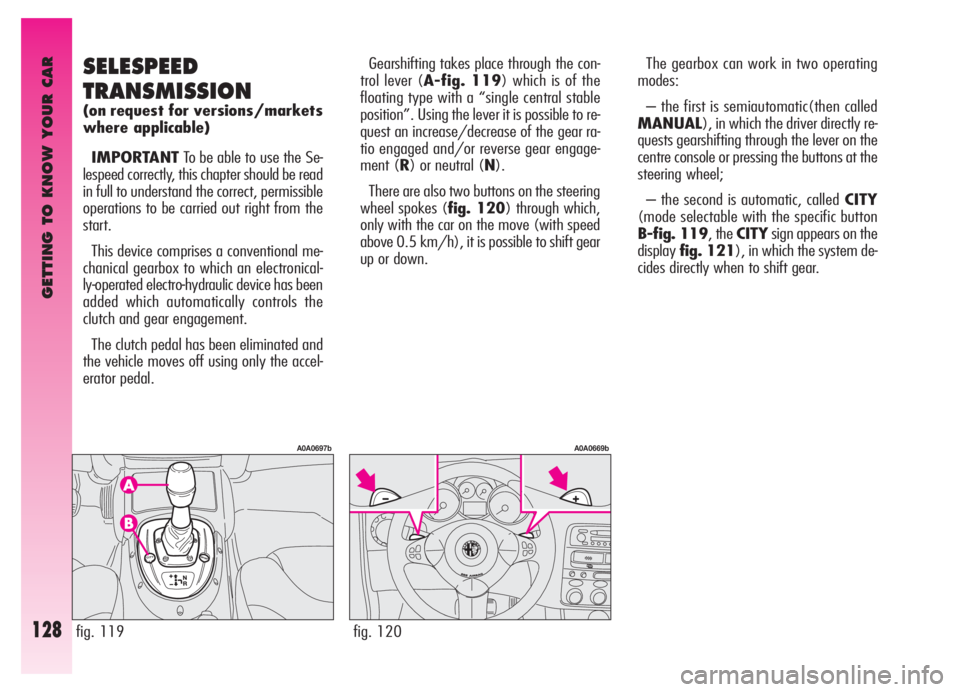
The gearbox can work in two operating
modes:
– the first is semiautomatic(then called
MANUAL), in which the driver directly re-
quests gearshifting through the lever on the
centre console or pressing the buttons at the
steering wheel;
– the second is automatic, calledCITY
(mode selectable with the specific button
B-fig. 119, the CITYsign appears on the
displayfig. 121), in which the system de-
cides directly when to shift gear.SELESPEED
TRANSMISSION
(on request for versions/markets
where applicable)
IMPORTANTTo be able to use the Se-
lespeed correctly, this chapter should be read
in full to understand the correct, permissible
operations to be carried out right from the
start.
This device comprises a conventional me-
chanical gearbox to which an electronical-
ly-operated electro-hydraulic device has been
added which automatically controls the
clutch and gear engagement.
The clutch pedal has been eliminated and
the vehicle moves off using only the accel-
erator pedal.Gearshifting takes place through the con-
trol lever (A-fig. 119) which is of the
floating type with a “single central stable
position”. Using the lever it is possible to re-
quest an increase/decrease of the gear ra-
tio engaged and/or reverse gear engage-
ment (R) or neutral (N).
There are also two buttons on the steering
wheel spokes (fig. 120) through which,
only with the car on the move (with speed
above 0.5 km/h), it is possible to shift gear
up or down.
fig. 119
A0A0697b
fig. 120
A0A0669b
Page 131 of 307
GETTING TO KNOW YOUR CAR
129
SYSTEM ACTIVATION
IMPORTANTWhen the driver’s door is
opened the Selespeed starts the hydraulic
part of the system to prepare it for when the
engine is started. This function (noted by
the turning of the electric pump) is deacti-
vated after 10 door openings/closings not
followed by actual system activation turning
the ignition key.
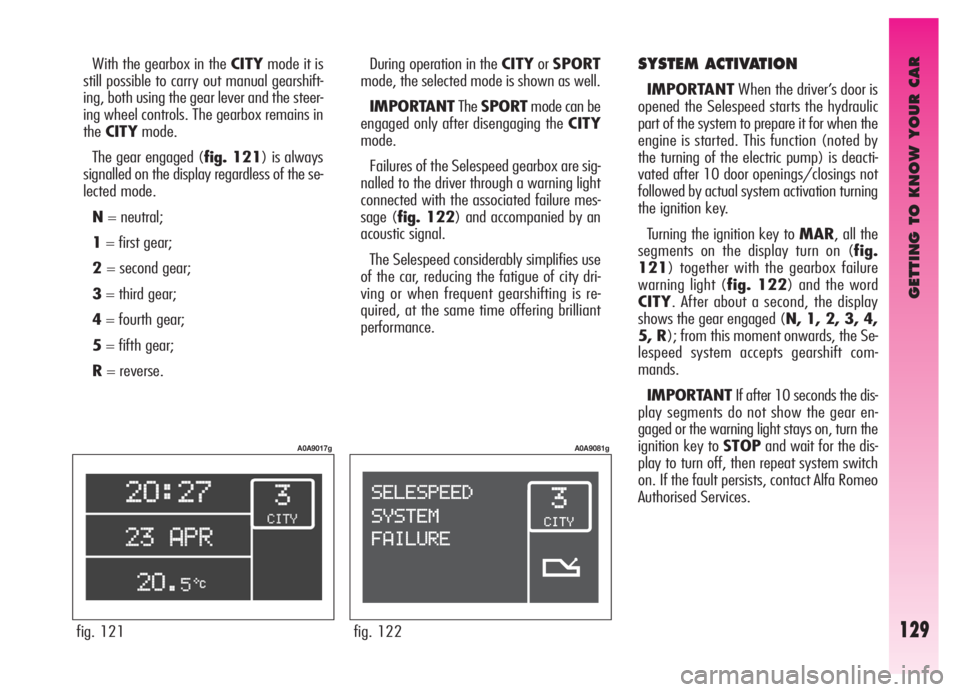
Turning the ignition key to MAR, all the
segments on the display turn on (fig.
121) together with the gearbox failure
warning light (fig. 122) and the word
CITY. After about a second, the display
shows the gear engaged (N, 1, 2, 3, 4,
5, R); from this moment onwards, the Se-
lespeed system accepts gearshift com-
mands.
IMPORTANTIf after 10 seconds the dis-
play segments do not show the gear en-
gaged or the warning light stays on, turn the
ignition key to STOPand wait for the dis-
play to turn off, then repeat system switch
on. If the fault persists, contact Alfa Romeo
Authorised Services. With the gearbox in the CITYmode it is
still possible to carry out manual gearshift-
ing, both using the gear lever and the steer-
ing wheel controls. The gearbox remains in
theCITYmode.
The gear engaged (fig. 121) is always
signalled on the display regardless of the se-
lected mode.
N= neutral;
1= first gear;
2= second gear;
3= third gear;
4= fourth gear;
5= fifth gear;
R= reverse.During operation in the CITYorSPORT
mode, the selected mode is shown as well.
IMPORTANTTheSPORTmode can be
engaged only after disengaging the CITY
mode.
Failures of the Selespeed gearbox are sig-
nalled to the driver through a warning light
connected with the associated failure mes-
sage (fig. 122) and accompanied by an
acoustic signal.
The Selespeed considerably simplifies use
of the car, reducing the fatigue of city dri-
ving or when frequent gearshifting is re-
quired, at the same time offering brilliant
performance.
fig. 121
A0A9017g
fig. 122
A0A9081g
Page 133 of 307
GETTING TO KNOW YOUR CAR
131
Never remove the ignition
key when the car is mov-
ing. In addition to the fact
that the Selespeed system would
not work properly up to stopping
the car, the steering wheel would
lock automatically the first time it
is turned.
STARTING THE ENGINE
The engine can be started either with a
gear engaged or in neutral (N), provided
that the brake pedal is fully depressed.
IMPORTANTKeep the pedal fully de-
pressed during starting. Since the brake ped-
al becomes hard if it is pressed repeatedly
with the engine off, in this situation it is nec-
essary to increase the pressure on the ped-
al itself to start the engine.
After starting, the gearbox sets to neutral
automatically, the display shows the letter
(N) and the system selects the operating
mode memorised before switching off.
If the engine fails to start
with the gear engaged, the
driver is informed of the
potentially dangerous situation due
to the fact that the gearbox is in
neutral by the buzzer and by the
display.
SWITCHING OFF THE ENGINE
AND SYSTEM DEACTIVATION
Turning the ignition key to STOPthe en-
gine turns off but the Selespeed system is
still active waiting for the car to stop com-
pletely. After about 2-4 seconds from when
the key has been turned to STOP, the hy-
draulic part is deactivated and immediately
after the gear sign on the display disappears.
Now the Selespeed system is deactivated.
The gear selected before switching off the
engine remains engaged.
If the engine is stopped with the gearbox
in neutral (N), the buzzer calls the driver’s
attention so that the car can be put in safe-
ty conditions engaging first gear (1) or re-
verse (R). In this case, the ignition key
should be turned to MARand with the
brake pedal pressed, engage first gear (1)
or reverse (R).
NEVER leave the car with
the gears in neutral (N).
It is absolutely necessary
to turn off the engine and
then turn off the Selespeed
system keeping the brake pedal
pressed: ONLY release the pedal
when the display has gone out.
Page 134 of 307

GETTING TO KNOW YOUR CAR
132
This should not be considered a failure be-
cause it is part of the operating logic. For
the same reason, if sticking occurs on re-
verse gear, the system controls partial clutch
closing so that the gear can be engaged;
in this case the engagement of reverse gear
(R) will not be as smooth as usual.
Moving off the car is obtained:
1) releasing the brake pedal;
2) gradually pressing the accelerator pedal.
The more the accelerator is pressed the
higher the pickup torque.
After a request to shift
gear with the car station-
ary, before pressing the ac-
celerator pedal to make the car
move, the driver must always
check the display to see that the
gear engaged is the one required.MOVING OFF THE CAR
With the engine on and the car stationary,
the gears that can be engaged for moving
off are only first (1), second (2) or reverse
(R).
To engage them, keep the brake pedal de-
pressed and operate only the control lever
on the central console, as the steering wheel
levers make it possible to engage the gears
only at speed over 0.5 km/h.
IMPORTANTReverse gear (R) can be
engaged from any of the following other ra-
tios: neutral (N), first (1) or second (2).
If the car is moving, the request is not ac-
cepted, it is necessary to wait for the car
to stop completely and request the en-
gagement of reverse again (R).
The driver is informed of the reverse gear
engaged condition by the display and by the
intermittent sound of a buzzer.
IMPORTANTIf when shifting from re-
verse (R)/first (1) or neutral (N)/first (1)
sticking occurs on first gear, the system au-
tomatically engages second gear (2).IMPORTANTS
– With the car stopped and a gear en-
gaged always keep the brake pedal pressed
until deciding to move off;
– during prolonged halts with the engine
running it is advisable to keep the gearbox
in neutral;
– when the car is parked facing uphill, do
not use the moving off manoeuvre to keep
the car still; use the brake pedal and press
the accelerator pedal only when deciding to
move off;
– use second gear only when more con-
trol is needed for moving off manoeuvres at
low speed;
– if, in reverse gear, first gear is engaged
or vice versa, shift gear only when the car
is stopped completely and with the brake
pedal pressed.
Though highly unadvisable, if when trav-
elling downhill for some unexpected reason
the car is set to neutral (N), when the en-
gagement of a gear is requested the system
automatically engages the best gear in re-
lation to the speed of the car to allow the
correct transmission of torque to the wheels.
Page 136 of 307
GETTING TO KNOW YOUR CAR
134
SEMIAUTOMATIC OPERATION
(MANUAL)
In the MANUAL operating mode, the dis-
play shows the gear engaged.
In this operating mode, the decision to
change gear is left to the driver who decides
the most appropriate moment.The requests to change gear may take
place through:
– the control lever on the centre console
(A-fig. 126);
– the buttons on the steering wheel
(fig. 127), which can be operated only
when the car speed exceeds 0.5 km/h.
TheMANUALoperating mode is set
when, with the CITYmode selected, the
CITYbutton(A-fig. 128) is pressed
again, excluding the previously selected
mode.When changing gear it is not necessary
to release the accelerator pedal because the
Selespeed system directly controls the en-
gine in such a way as to:
– reduce and then increase engine torque;
– adapt the engine speed to the latest
gear engaged.
When downshifting, the engine is accel-
erated automatically to bring it to the speed
necessary with the new gear ratio.
The neutral command (N) is accepted un-
til the vehicle speed exceeds 20 km/h.
The reverse gear engagement command
(R) is accepted only if the vehicle is sta-
tionary.
fig. 127
A0A0669b
fig. 126
A0A0702b
Page 152 of 307

GETTING TO KNOW YOUR CAR
150
ABS
(upon request for
versions/markets where
provided)
The car is fitted with an ABS braking sys-
tem, which prevents the wheels from lock-
ing when braking, makes full use of the grip
and within the limits of the grip available,
keeps the car controllable also in emergency
braking.
When braking a slight pulsing accompa-
nied by noise may be felt on the brake ped-
al due to the action of the ABS system.
This should not be interpreted as a brak-
ing malfunction. It is the signal to the driver
that the ABS has come into action: it is the
warning that the car is travelling at the lim-
it of its grip and therefore the speed should
be adapted to the type of road.
The ABS system is an additional part of the
base braking system; in the event of a fail-
ure it is disabled, leaving the braking sys-
tem in the same conditions as a vehicle with-
out ABS.The ABS better exploits
the grip available, but can-
not increase it; caution is
therefore necessary on slippery
surfaces, without taking unneces-
sary risks.
If the ABS cuts in it means
that the limit of the grip is
being reached between the
tyre and the road surface: it is
therefore necessary to slow down
to adapt driving to the grip avail-
able.
In the event of a system
failure, with the turning on
of the
>warning light on
the instrument cluster, have the car
checked immediately by Alfa
Romeo Authorised Services, to be
able to have the system restored
to fully efficient conditions.
In the case of a failure, the anti-lock action
is no longer present, the braking capacity of
the vehicle is not adversely affected at all.
If you have never previously used cars fit-
ted with ABS, it is advisable to practice a lit-
tle on a slippery surface, naturally in safe-
ty conditions and in accordance with the lo-
cal Highway Code; you are also advised to
read the following instructions carefully.
The advantage of the ABS over a conven-
tional system is that it makes it possible to
obtain the highest degree of handling also
when braking completely under limited grip
conditions, preventing the wheels from lock-
ing.
However, with the ABS do not expect the
braking distance to always shorten: for ex-
ample, on soft surfaces like gravel or fresh
snow or a slippery surface, the space might
increase.
To better exploit the possibilities of the an-
ti-lock system in the case of need, the ad-
vice given below should be followed.