steering wheel Alfa Romeo GT 2006 Owner handbook (in English)
[x] Cancel search | Manufacturer: ALFA ROMEO, Model Year: 2006, Model line: GT, Model: Alfa Romeo GT 2006Pages: 307, PDF Size: 6.05 MB
Page 214 of 307
IN AN EMERGENCY
212
STARTING BY INERTIA
If the car is equipped with “Kit for tyre
repair Fix&Go“, see the instructions con-
tained in the following chapter.
GENERAL INSTRUCTIONS
As an alternative to FIX & GO, the com-
pact spare wheel or a wheel with the nor-
mal size can be supplied upon request;
wheel changing and correct use of the
jack and compact spare wheel call for
some precautions as listed below.
IN THE EVENT OF A PUNCTURE
Never push, tow or
coast start the vehicle.
This could cause fuel to
flow into the catalyst damaging
it irreversibly.
Remember that the
engine brake and power
steering are not opera-
tional until the engine is started,
therefore, much greater effort
than usual is needed on the brake
pedal and steering wheel.
Signal the presence of
the stationary vehicle
according to current regu-
lations: hazard warning lights,
reflecting triangle etc..
Any passengers should leave
the car and wait for the wheel to
be changed out of harm of the
traffic.
If parked on a slope or rough
surface, chock the wheels with
wedges or other suitable devices
to prevent the car from rolling.
Never start the engine
with the car jacked.
When driving with a
trailer, disconnect the trailer
before raising the car.
The compact spare wheel is spe-
cific to your car, do not use it on
other models, or use the spare
wheel of other models on your
vehicle.
Should the type of wheels used
be changed (alloy rims instead of
steel), it is also necessary to
change the whole set of fastening
bolts with others of suitable size.
The compact spare wheel is nar-
rower than normal wheels, it
should be used only for the dis-
tance necessary to reach a service
point to have the punctured tyre
repaired and, during its use, the
car speed must not exceed 80
km/h.
Page 246 of 307

IN AN EMERGENCY
244
IF THE VEHICLE IS TO BE TOWED
The tow ring supplied with the vehicle is
housed in the tool box under the boot
mat.
To install the tow ring, proceed as fol-
lows:
– Take the tow ring from the tool box.
– Remove the cover (A) snap-fitted on
the front (fig. 55) or rear (fig. 56)
bumper. To do this, using the flat-bladed
screwdriver provided, protect the tip with
a soft cloth to avoid damaging the car.– Firmly screw the ring in its housing.
fig. 55 - front
A0A0650b
fig. 56 - rear
A0A0670b
Before tightening the
ring carefully clean the
threaded housing. Before
beginning to tow the car, make
sure that the ring is firmly tight-
ened in its threaded housing.
Before starting to tow,
turn the ignition key to
MAR and back to STOP,
again without removing it.
Removing the key automatically
engages the steering lock result-
ing in the impossibility to steer
the wheels. When towing
remember that without the help
of the engine brake and power
steering greater effort is required
on the pedal and steering wheel.
Do not use flexible cables for
towing and avoid jerks. During
towing operations make sure
that fastening the joint to the car
does not damage the components
in contact with it. When towing
the car, it is compulsory to follow
specific traffic regulations con-
cerning both the towing device
and behaviour on the road.
Page 252 of 307
VEHICLE MAINTENANCE
250
ADDITIONAL
OPERATIONS
Every 1000 kmor before long jour-
neys, check and if necessary top up:
– engine coolant fluid level
– brake/hydraulic clutch control fluid
level
– power steering fluid level
– windscreen and headlamp washer
fluid level
– tyre pressure and conditions.
Every 3000 kmcheck and if necessary
top up the engine oil level.
The use of FL Seleniaproducts is rec-
ommended which have been designed
and made expressly for Alfa Romeo cars
(see “Refuelling” in the “Technical
Specifications” chapter).
ANNUAL INSPECTION
PROGRAMME
For cars with an annual mileage
of below 20,000 km (for exam-
ple about 10,000 km) the follow-
ing yearly inspection programme
is advised:
– Check tyre conditions/wear and if
necessary adjust the pressure (including
spare wheel)
– Check operation of lighting system
(headlights, direction indicators, hazard
warning lights, boot, passenger compart-
ment, glovebox lights, warning lights,
etc.)
– Check operation of windscreen wiper
system, spray jet adjustment
– Check position/wear of windscreen
– Check front disk brake pad conditions
and wear– Sight check for conditions of: engine,
gearbox, transmission, pipes (exhaust -
fuel supply - brakes), rubber parts (boots
- sleeves - bushes etc..), brake and fuel
supply system hoses
– Check for bonnet and boot lock clean-
ness, lever cleanness and lubrication
– Check battery charge
– Sight check for conditions of various
drive belts
– Check and if necessary top up fluid
levels (engine coolant, brakes, wind-
screen washer, battery etc. )
– Change engine oil and engine oil filter
– Change pollen filter.
Page 260 of 307
Oil consumption is very
low; if topping up again is
needed shortly after-
wards, have the system checked
for possible leaks by Alfa Romeo
Authorised Services.
VEHICLE MAINTENANCE
258
When loosening the
reservoir cap do not
allow the fluid to come
into contact with painted parts. If
it does, wash it off immediately
with water. Do not allow the power
steering fluid to touch hot
parts of the engine: it is
inflammable.
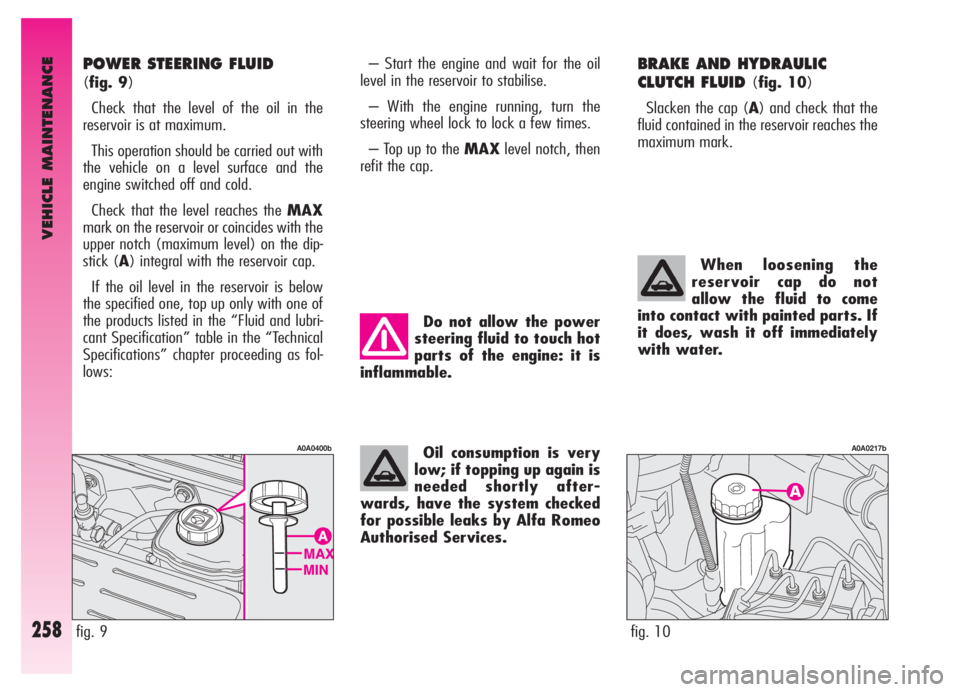
fig. 10
A0A0217b
fig. 9
A0A0400b
BRAKE AND HYDRAULIC
CLUTCH FLUID
(fig. 10)
Slacken the cap (A) and check that the
fluid contained in the reservoir reaches the
maximum mark.
POWER STEERING FLUID
(fig. 9)
Check that the level of the oil in the
reservoir is at maximum.
This operation should be carried out with
the vehicle on a level surface and the
engine switched off and cold.
Check that the level reaches the MAX
mark on the reservoir or coincides with the
upper notch (maximum level) on the dip-
stick (A) integral with the reservoir cap.
If the oil level in the reservoir is below
the specified one, top up only with one of
the products listed in the “Fluid and lubri-
cant Specification” table in the “Technical
Specifications” chapter proceeding as fol-
lows:– Start the engine and wait for the oil
level in the reservoir to stabilise.
– With the engine running, turn the
steering wheel lock to lock a few times.
– Top up to the MAXlevel notch, then
refit the cap.
Page 267 of 307
VEHICLE MAINTENANCE
265
Alloy rim painting
involving temperatures
exceeding 150 °C should
be avoided since wheel mechani-
cal characteristics could be
impaired.Do not cross switch the
tyres, moving them from
the right of the car to the
left and vice versa.Excessive low pressure
causes overheating of the
tyre with the possibility
of serious damage to it.Remember that vehicle
road holding also depends
on correct tyre inflation
pressure.
RUBBER HOSES
As far as the brake system and fuel sup-
ply rubber hoses are concerned, carefully
follow the Scheduled Maintenance
Programme. Indeed, ozone, high temper-
atures and the prolonged lack of fluid in
the system may cause hardening and
cracking of the hoses, with possible leaks.
Careful control is therefore necessary. IMPORTANTS
– Where possible, avoid sudden brak-
ing, tyre squealing starts, violent bumps
against kerbs, potholes or obstacles of var-
ious kinds. Prolonged driving on rough
roads may damage the tyres;
– Routinely check the tyres for cuts on
the sides, swellings or uneven tread wear.
If necessary contact Alfa Romeo
Authorised Services;
– Avoid overloading the vehicle when
travelling: this may cause serious damage
to the wheels and tyres;
– If a tyre is punctured, stop immedi-
ately and change it to avoid damage to
the tyre itself, the rim, suspensions and
steering system;
– Tyres age even if they are not used
much. Cracks in the tread rubber are a
sign of aging. In any case, if the tyres
have been on the vehicle for over 6 years,
they should be checked by specialised per-
sonnel, to see if they can still be used.
Also remember to check the compact
spare wheel;
– In case of replacement, always fit new
tyres, avoiding those of dubious origin;
Page 272 of 307
VEHICLE MAINTENANCE
270
Do not keep aerosol cans
in the car. They might
explode. Aerosol cans
must never be exposed to a tem-
perature above 50°C. The tem-
perature inside the car exposed
to the sun may go well beyond
that figure.
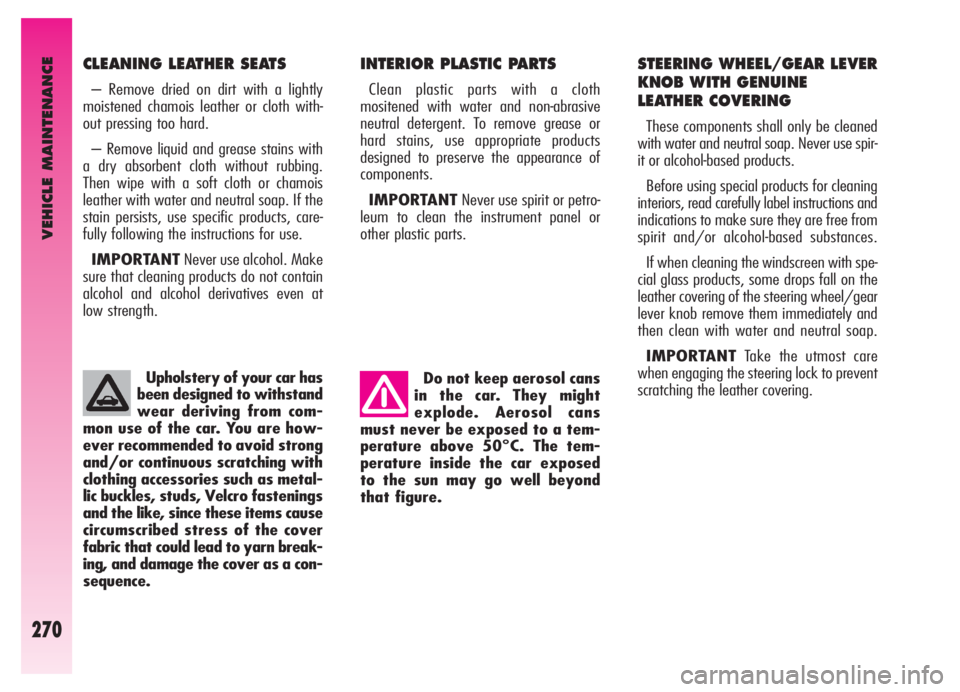
CLEANING LEATHER SEATS
– Remove dried on dirt with a lightly
moistened chamois leather or cloth with-
out pressing too hard.
– Remove liquid and grease stains with
a dry absorbent cloth without rubbing.
Then wipe with a soft cloth or chamois
leather with water and neutral soap. If the
stain persists, use specific products, care-
fully following the instructions for use.
IMPORTANTNever use alcohol. Make
sure that cleaning products do not contain
alcohol and alcohol derivatives even at
low strength.
STEERING WHEEL/GEAR LEVER
KNOB WITH GENUINE
LEATHER COVERING
These components shall only be cleaned
with water and neutral soap. Never use spir-
it or alcohol-based products.
Before using special products for cleaning
interiors, read carefully label instructions and
indications to make sure they are free from
spirit and/or alcohol-based substances.
If when cleaning the windscreen with spe-
cial glass products, some drops fall on the
leather covering of the steering wheel/gear
lever knob remove them immediately and
then clean with water and neutral soap.
IMPORTANTTake the utmost care
when engaging the steering lock to prevent
scratching the leather covering.
INTERIOR PLASTIC PARTS
Clean plastic parts with a cloth
mositened with water and non-abrasive
neutral detergent. To remove grease or
hard stains, use appropriate products
designed to preserve the appearance of
components.
IMPORTANTNever use spirit or petro-
leum to clean the instrument panel or
other plastic parts.
Upholstery of your car has
been designed to withstand
wear deriving from com-
mon use of the car. You are how-
ever recommended to avoid strong
and/or continuous scratching with
clothing accessories such as metal-
lic buckles, studs, Velcro fastenings
and the like, since these items cause
circumscribed stress of the cover
fabric that could lead to yarn break-
ing, and damage the cover as a con-
sequence.
Page 287 of 307
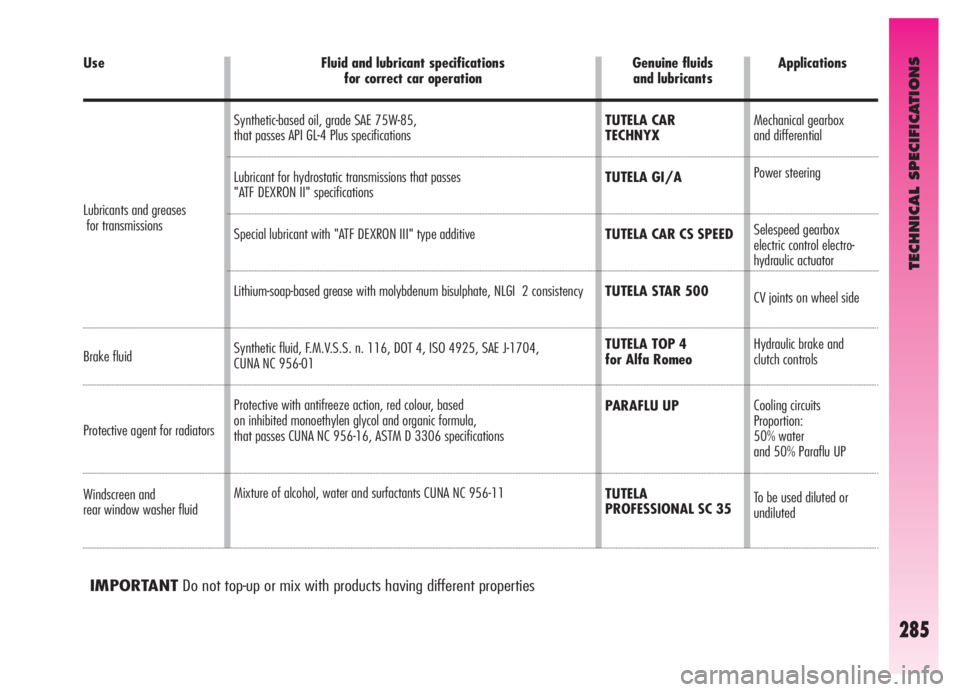
TECHNICAL SPECIFICATIONS
285
UseGenuine fluids
and lubricants
TUTELA CAR
TECHNYX
TUTELA GI/A
TUTELA CAR CS SPEED
TUTELA STAR 500
TUTELA TOP 4
for Alfa Romeo
PARAFLU UP
TUTELA
PROFESSIONAL SC 35Applications
Mechanical gearbox
and differential
Power steering
Selespeed gearbox
electric control electro-
hydraulic actuator
CV joints on wheel side
Hydraulic brake and
clutch controls
Cooling circuits
Proportion:
50% water
and 50% Paraflu UP
To be used diluted or
undiluted Fluid and lubricant specifications
for correct car operation
Synthetic-based oil, grade SAE 75W-85,
that passes API GL-4 Plus specifications
Lubricant for hydrostatic transmissions that passes
"ATF DEXRON II" specifications
Special lubricant with "ATF DEXRON III" type additive
Lithium-soap-based grease with molybdenum bisulphate, NLGI 2 consistency
Synthetic fluid, F.M.V.S.S. n. 116, DOT 4, ISO 4925, SAE J-1704,
CUNA NC 956-01
Protective with antifreeze action, red colour, based
on inhibited monoethylen glycol and organic formula,
that passes CUNA NC 956-16, ASTM D 3306 specifications
Mixture of alcohol, water and surfactants CUNA NC 956-11
IMPORTANTDo not top-up or mix with products having different properties
Lubricants and greases
for transmissions
Brake fluid
Protective agent for radiators
Windscreen and
rear window washer fluid
Page 290 of 307

RIGHT HAND DRIVE VERSIONS
288
fig. 6
A0A0724b
RIGHT HAND DRIVE VERSIONS - DASHBOARD
1.Side swivel air vents - 2.Fixed side window air vents -3.Passenger's air bag - 4.Tailgate release button - 5.Card holder (for versions/markets where
applicable) - 6. Sound system (for versions/markets where applicable) - 7.Centre swivel air vents - 8.Fixed upper vent - 9.Glass holder (for versions/mar-
kets where applicable) - 10.Front fog light button - 11.Hazard light switch - 12.Rear fog light button - 13.Outside light control lever - 14.Speedome-
ter with display for mileage recorder, trip meter and headlamp aiming device - 15.Fuel level gauge with reserve warning light - 16.Multifunction display -
17.Engine coolant temperature gauge - 18.Rev. counter -19.Windscreen wiper control lever - 20.Bonnet opening lever - 21.Set of controls: trip meter
reset, headlamp aiming device, trip computer - 22.Ignition key and switch - 23.Horn - 24.Steering wheel locking/release lever - 25.Driver's air bag -
26.Door locking button - 27.Controls for heating, ventilation and climate control - 28.Cigar lighter/ashtray housing door - 29.Temperature sensor - 30.
Glove box.
Page 295 of 307

INDEX
293
- refuelling ............................... 198
Fuel consumption ........................ 286
Fuel flap .................................... 198
Fuses ........................................ 236
Gearbox lever ............................ 127
Getting to know your car.... 6
Glass holder ......................... 141-142
Glove compartment ..................... 138
Glove compartment light
- changing bulbs ....................... 234
Handbrake ................................ 126
Hazard warning lights .................. 124
Headlamp beam adjustment ......... 148
Headlight washers ................ 49-267
Headlights
- adjustment abroad .................. 148
- beam adjustment .................... 148
- changing bulbs ................. 221-224
- compensation for tilt ......... 148-149
Headrests (front/rear) .......... 18-21Horn ......................................... 52
Hoses ........................................ 265
Ignition device ............................ 14
Ignition switch and steering lock 14-15
In an emergency..................... 210
In the event of an accident ........... 246
Inertial fuel cut off switch ............. 125
Instrument cluster ................. 53-54
Instrument lighting adjustment ...... 59
Intelligent washing (windscreen) ... 47
Interior fittings ............................ 269
Interior lighting
- boot lighting .......................... 146
- dashboard lighting (rheostat) ... 59
- front lighting .................... 138-139
- rear lighting ........................... 140
Jack ......................................... 215
Levers (steering wheel) ............... 44
Lights ........................................ 44Load limiters (seat belts) ............. 29
Low beam headlights
- changing bulbs ................. 225-228
- switching on .................... 44-45
Luggage restrainer net ................. 22
Main beam headlights
- changing bulbs ................. 226-228
- switching on .......................... 45
Maintenance
- additional operations ............... 250
- annual inspection programme ... 250
- checking levels ....................... 253
- precautions and warnings ......... 251
- scheduled maintenance ........... 247
- scheduled maintenance
programme ............................ 248
Manual heater ............................ 102
Mechanical gearbox ..................... 127
Number plate lights
- changing bulbs ........................ 231
Page 297 of 307

INDEX
295
Steering lock .............................. 15
Steering system
- adjustment lever ..................... 22
- technical specifications ............. 275
Steering wheel
- adjustment lever ..................... 22
- horn control ........................... 52
Sun visors .................................. 143
Suspensions (specifications) ......... 275
Tailgate
- opening from inside .......... 124-145
- opening with remote control 8-145
Technical specifications......... 271
Tools ......................................... 214
Towing the car ............................ 244
Towing trailers ............................ 205
Transmission ............................... 274
Tyres
- correct reading ....................... 276
- FIX&GO automatic .................. 217
- in the event of a puncture ........ 212
- inflating pressure .............. 279-304
- snow chains ........................... 208- types of tyres and rims ............ 278
- wear ..................................... 264
- winter ................................... 208
VDC system .............................. 152
Vehicle maintenance............. 247
Volumetric protection ................... 13
Warning lights .......................... 85
Washing the car
- engine compartment ............... 269
- exterior ................................. 268
- interior .................................. 270
Weights ..................................... 280
Wheels
- FIX&GO automatic .................. 217
- geometry .............................. 276
- replacement ........................... 214
- snow chains ........................... 208
- tyre inflating pressure ........ 279-304
- tyres and rims ........................ 278
- warnings ......................... 212-213
Windscreen washer
- operation ............................... 47- spray jets .............................. 267
Windscreen wiper
- blade replacement .................. 266
- operation ............................... 47
- rain sensor ............................. 48
- spray jets .............................. 266