heating Alfa Romeo GT 2009 Owner handbook (in English)
[x] Cancel search | Manufacturer: ALFA ROMEO, Model Year: 2009, Model line: GT, Model: Alfa Romeo GT 2009Pages: 271, PDF Size: 5.34 MB
Page 172 of 271
CORRECT USE OF THE CAR
170
STARTING PROCEDURE
FOR JTD VERSIONS
1) Make sure the handbrake is engaged.
2) Set the gearshift lever to neutral.
3) Turn the ignition key to MAR. The re-
configurable multifunction display will show
the
mwarning light.
4) Wait for the
mto turn off, which
takes place sooner, the warmer the engine.
With the engine very warm the light might
stay on for such a short time as to pass un-
noticed.
5) Fully depress the clutch pedal.
6) Turn the ignition key to AV Vas soon
as the
mwarning light has gone out.
Waiting too long, makes the warming work
of the glow plugs useless.IMPORTANTThe electric devices that
absorb a high amount of energy (climate
control, rearscreen heating, etc.) are cut off
automatically during starting.
If the engine does not start at the first at-
tempt, move the ignition key to STOPbe-
fore repeating starting.
If starting is difficult (with the Alfa Romeo
CODE system working properly), do not in-
sist with prolonged attempts.
Only use an auxiliary battery if the cause
is due to low battery charge. Never use a
battery charger to start the engine.
WARMING THE ENGINE
– Drive off slowly, at medium revs with-
out accelerating abruptly.
– Do not drive at full performance for the
initial kilometres of the journey. Wait until
the engine coolant temperature reaches 50-
60 °C.
Page 174 of 271
CORRECT USE OF THE CAR
172
Never leave children un-
attended in the car. Al-
ways remove the ignition
key when leaving the car and take
it with you.To avoid useless con-
sumption of power and
possible draining of the
battery, never leave the ignition
key in the MAR position when the
engine is not running.
PARKING
When the car is parked, proceed as fol-
lows:
– Switch off the engine.
– Engage the handbrake.
– Engage first gear if the car is faced up-
hill or reverse if the car is facing downhill.
– Turn the front wheels so that the car will
immediately come to a halt if the handbrake
slips.
REDUCING
RUNNING COSTS
AND ENVIRONMENT
POLLUTION
By following a few simple guidelines, it
is possible to save car running costs and re-
duce harmful emissions.
GENERAL CONSIDERATIONS
Car maintenance
To take care of the car maintenance have
the checks and adjustments carried out in
accordance with the “Scheduled Mainte-
nance Programme”.
Tyres
Check the pressure of the tyres routinely
at an interval of no more than 4 weeks: if
the pressure is too low consumption levels
increase as resistance to rolling is higher.
Useless loads
Never travel with an overload in the boot.
The weight of the car (especially in urban
traffic), and its geometry heavily affect con-
sumption levels and stability.Electric services
Use electric devices only for the amount of
time needed. Rearscreen heating, addition-
al headlights, windscreen wipers and heater
fan need a considerable amount of energy,
therefore increasing the requirement of cur-
rent increases fuel consumption (up to
+25% in the urban cycle).
Climate control system
The climate control system is a further load
bearing heavily on the engine inducing high-
er consumption levels(up to +20% on av-
erage). Outside temperature permitting,
preferably use the air vents.
Aerodynamic items
The use of non-certified aerodynamic items
may adversely affect air drag and con-
sumption levels.
Page 190 of 271
IN AN EMERGENCY
188
The compressor shall not
be operated for more than
20 minutes. Risk of over-
heating!. Tyres repaired with the
quick tyre repair kit shall be used
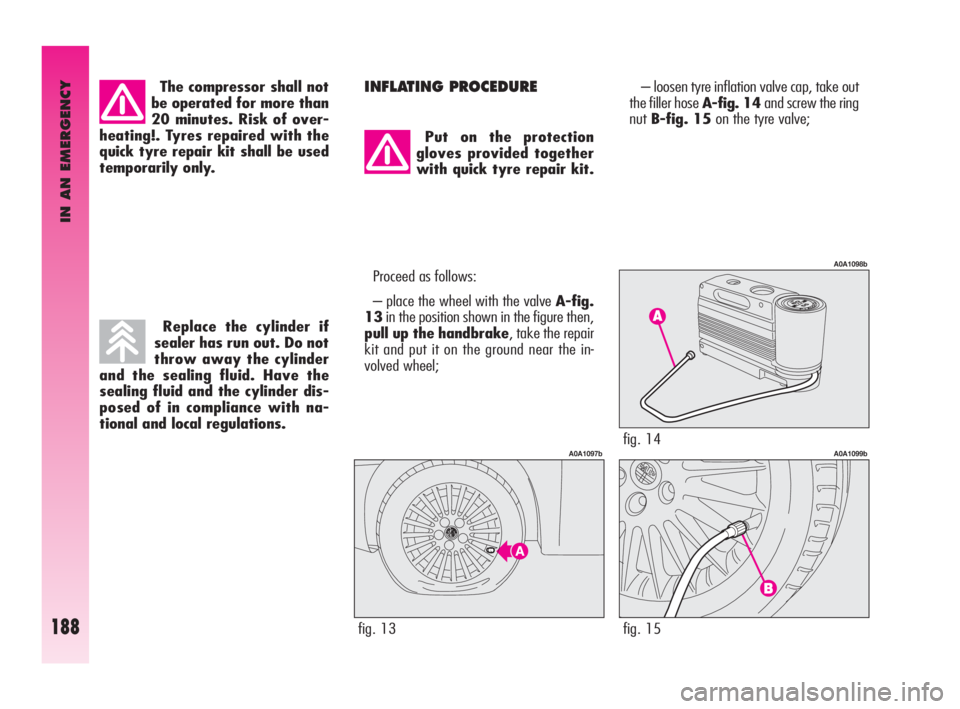
temporarily only.INFLATING PROCEDURE– loosen tyre inflation valve cap, take out
the filler hose A-fig. 14and screw the ring
nutB-fig. 15on the tyre valve;
fig. 13
A0A1097bfig. 14
A0A1098b
fig. 15
A0A1099b
Replace the cylinder if
sealer has run out. Do not
throw away the cylinder
and the sealing fluid. Have the
sealing fluid and the cylinder dis-
posed of in compliance with na-
tional and local regulations.
Put on the protection
gloves provided together
with quick tyre repair kit.
Proceed as follows:
– place the wheel with the valve A-fig.
13in the position shown in the figure then,
pull up the handbrake, take the repair
kit and put it on the ground near the in-
volved wheel;
Page 211 of 271

IN AN EMERGENCY
209
15
15
7.5
15
15
30
30
20
15
7.5
7.5
20
20
15
7.5
15
7.5 F32
F32
F51
F39
F39
F40
F43
F44
F45
F41
F35
F38
F09
F39
F17
F11
F49
SERVICES FIGURE FUSE AMPERES
Key-operated +30
Selespeed transmission
Selespeed transmission
Radio
Navigator
Rearscreen heating
Windscreen - rearscreen washer (pump)
Cigar lighter
Seats with electric heating
Heated wing mirrors – heated nozzles
Cruise control
Central door locking
Headlight washer
Services + 30
Primary services (electronic injection)
Secondary services (electronic injection)
Secondary services52
52
52
52
52
52
52
52
52
52
52
52
53
52
53
53
52
Page 236 of 271
CAR MAINTENANCE
234
Alloy rim painting involv-
ing temperatures exceed-
ing 150 °C should be
avoided since wheel mechanical
characteristics could be impaired. Do not cross switch the
tyres, moving them from
the right of the car to the
left and vice versa.Excessive low pressure
causes overheating of the
tyre with the possibility of
serious damage to it.Remember that car road
holding also depends on
correct tyre inflation pres-
sure.
RUBBER HOSES
As far as the brake system and fuel sup-
ply rubber hoses are concerned, carefully fol-
low the Scheduled Maintenance Pro-
gramme. Indeed, ozone, high temperatures
and the prolonged lack of fluid in the sys-
tem may cause hardening and cracking of
the hoses, with possible leaks. Careful con-
trol is therefore necessary.
IMPORTANT NOTES
– Where possible, avoid sudden braking,
tyre squealing starts, violent bumps against
kerbs, potholes or obstacles of various kinds.
Prolonged driving on rough roads may dam-
age the tyres;
– Routinely check the tyres for cuts on the
sides, swellings or uneven tread wear. If nec-
essary contact Alfa Romeo Authorised Ser-
vices;
– Avoid overloading the car when travel-
ling: this may cause serious damage to the
wheels and tyres;
– If a tyre is punctured, stop immediate-
ly and change it to avoid damage to the tyre
itself, the rim, suspensions and steering sys-
tem;
– Tyres age even if they are not used
much. Cracks in the tread rubber are a sign
of aging. In any case, if the tyres have been
on the car for over 6 years, they should be
checked by specialised personnel, to see if
they can still be used. Also remember to
check the compact spare wheel;
– In case of replacement, always fit new
tyres, avoiding those of dubious origin;
Page 237 of 271

CAR MAINTENANCE
235
SPRAY NOZZLES (fig. 18)
If the jet of fluid is inadequate, firstly check
that there is fluid in the reservoir: see
“Checking levels” in this chapter.
Then check that the nozzle holes are not
clogged, if necessary use a needle.
If necessary, direct the jet of fluid work-
ing on the adjustment screw.
fig. 17
A0A0728b
Changing the windscreen
wiper blade (fig. 17)
How to remove the blade
Proceed as follows:
– raise the windscreen wiper arm (A);
– turn the blade (B) 90° around the pin
(C) set at wiper arm end;
– remove the blade from pin (C).
How to refit the blade
Proceed as follows:
– fit pin (C) into the hole set in the mid-
dle of the blade (B);
– refit the wiper arm with the blade on
the windscreen.
Driving with worn wiper
blades is a serious hazard,
because visibility is re-
duced in bad weather.WINDSCREEN/REAR
SCREEN WIPERS
BLADES
Periodically clean the rubber part using spe-
cial products; TUTELA PROFESSIONAL
SC 35is recommended.
If the rubber blades are bent or worn they
should be replaced. In any case they should
be changed once a year.
A few simple notions can reduce the pos-
sibility of damage to the blades:
– If the temperature falls below zero make
sure that ice has not frozen the rubber
against the glass. If necessary, thaw using
an antifreeze product.
– Remove any snow from the glass: in ad-
dition to protecting the blades, this prevents
effort on the motor and overheating.
– Do not operate the windscreen and
rearscreen wipers on dry glass.
fig. 18
A0A0696b
Page 240 of 271
CAR MAINTENANCE
238
Engine compartment
At the end of the winter the engine com-
partment should be carefully washed, with-
out directing the jet against electronic con-
trol units. Contact a specialised workshop to
have this done.
Detergents cause water
pollution. Therefore the en-
gine compartment should
be washed in areas equipped for
collecting and purifying the liquid
used in the washing process.
IMPORTANTThe car should be washed
with the engine cold and the ignition key at
STOP. After washing make sure that the
various protections (e.g. rubber caps and
various covers) have not been damaged or
removed. Windows
Use specific products to clean the windows.
Use clean cloths to avoid scratching or al-
tering the transparency of the glass.
IMPORTANTThe inside of the
rearscreen should be wiped gently with a
cloth in the direction of the filaments to
avoid damaging the heating device.
Front headlights
IMPORTANTDo not use aromatic sub-
stances (e.g. petroleum) or ketones (e.g.
acetone) to clean the front headlight plas-
tic transparents.
Never use inflammable
products like fuel oil ether
or rectified petrol for clean-
ing inside the car. The electrostat-
ic charges generated when rubbing
to clean may cause fire.
INTERIOR FITTINGS
Periodically check that water is not trapped
under the mats (due to water dripping off
shoes, umbrellas, etc.) which could cause
oxidisation on the sheet metal.
CLEANING SEATS AND FABRIC
AND VELVET PARTS
– Use a soft brush or a vacuum cleaner to
remove dust. Velvet is cleaned better if the
brush is moistened.
– Rub the seat with a sponge moistened
with a solution of water and neutral deter-
gent.
Page 259 of 271

RIGHT HAND DRIVE VERSION
257
DASHBOARD
fig. 1
A0A0724b
1.Adjustable side air vents - 2.Fixed side window air vents -3.Front passenger’s air bag - 4.Tailgate release button - 5.Cards holder (for versions/mar-
kets where applicable) - 6. Sound system (for versions/markets where applicable) -7.Adjustable central air vents - 8.Upper fixed vent - 9.Glass/can
holder (for versions/markets where applicable) - 10.Front fog light button - 11.Hazard light switch - 12.Rear fog light button - 13.External lights con-
trol lever - 14.Instrument panel - 15.Windscreen wiper stalk - 16. Bonnet opening lever - 17.Set of controls - 18.Ignition key and ignition switch - 19.
Horn - 20.Steering wheel locking/release lever - 21.Driver’s air bag - 22.Door locking button - 23.Heating/ventilation/climate controls - 24.Cigar
lighter/ashtray housing lid - 25.Temperature sensor - 26.Glovebox.
Page 263 of 271

ALPHABETICAL INDEX
261
Dashboard ................................ 52
Diesel fuel filter ........................... 229
Diesel particulate filter (DPF) ........ 167
Digital multifunction display .......... 58
Dimensions ................................ 250
Direction indicators
- changing front bulbs ................ 198
- changing rear bulbs ................. 199
- changing side bulbs ................. 198
- switching on .......................... 46
Door locking system .................... 107
Door mirrors ............................... 23
Doors ........................................ 15
Electronic alarm system .............. 11
Emergency starting ...................... 179
- coasting ................................ 181
- starting with an auxiliary
battery .................................. 180
Engine codes/body versions ......... 241
Engine
- identification codes ................. 241
- marking ................................ 241
- specifications ......................... 242
Engine compartment - bonnet .................................. 131
- washing ................................ 238
Engine oil consumption ................ 224
Engine starting ........................... 169
Environmental protection .............. 168
EOBD (system) ........................... 140
External lights (switching on) ....... 44
First-aid kit ................................ 215
Fix &Go Automatic (device) ......... 186
Flashing high beams .................... 45
Fluids and lubricants .................... 253
Follow me home device ............... 46
Foglights
- changing bulbs ....................... 196
- switching on .......................... 106
Front ceiling light ........................ 121
- changing bulbs ....................... 201
Front fog lights
- changing bulbs ....................... 196
- switching on .......................... 106
Fuel consumption ........................ 255
Fuel flap .................................... 167
Fuel supply ................................ 243
Fuses ........................................ 205
Getting to know your car... 6
Glove compartment ..................... 121
Glove compartment light
- changing bulbs ....................... 203
Handbrake ............................... 108
Hazard warning lights
- switching on .......................... 106
Headlamp beam adjustment ......... 108
Headlight washers ................. 49-236
Headlights
- adjustment abroad .................. 133
- compensation for tilt .......... 108-132
Headrests
- front ..................................... 18
- rear ...................................... 21
Heating and climate
control system ......................... 81
Hoses ........................................ 234
Identification data ...................... 240
Ignition device ............................ 14
Ignition switch and
steering lock ....................... 14-15
In an emergency.................... 179