ESP Alfa Romeo MiTo 2014 Owner's Guide
[x] Cancel search | Manufacturer: ALFA ROMEO, Model Year: 2014, Model line: MiTo, Model: Alfa Romeo MiTo 2014Pages: 280, PDF Size: 8.79 MB
Page 110 of 280

Detection distances
❒Central operating range: 140 cm
❒Side operating range: 60 cm
If several obstacles are detected by the sensors, only the nearest one is
considered.OPERATION WITH TRAILERParking sensor operation is deactivated automatically when the trailer
electric cable plug is fitted into the car tow hook socket. The sensors
are automatically enabled again when the trailer's cable plug is
removed.
The sensor must be free of mud, dirt, snow or ice in order
for the system to work. Be careful not to scratch or damage
the sensors while cleaning them. Avoid using dry, rough
or hard cloths. The sensors should be washed using clean water with
the addition of car shampoo if necessary. When using special washing
equipment such as high pressure jets or steam cleaning, clean the
sensors very quickly keeping the jet more than 10 cm away.When repainting the bumpers or touching up paint in
the sensor area, contact Alfa Romeo Authorized
Services only. Incorrect paint application could affect
the operation of the parking sensors.
Parking manoeuvres however are always the driver’s
responsibility. When carrying out such manoeuvres,
always ensure that the manoeuvring area is free of
people (particularly children) and animals. The parking sensor is
designed to assist drivers, who must still never allow their
attention to lapse during potentially dangerous manoeuvres even
if performed at low speed.
GENERAL WARNINGSDuring parking manoeuvres, pay the utmost attention to any obstacles
that could be located above or below the sensors.
Objects located near the rear of the car are not detected under certain
circumstances and could therefore cause damage to the car or be
damaged.
The following conditions may influence the performance of the parking
sensor system:
❒reduced sensor sensitivity and a reduction in the parking assistance
system performance could be due to the presence on the surface of
the sensor of: ice, snow, mud, thick paint
❒the sensors may detect a non-existent obstacle (echo interference)
due to mechanical interference, for example when washing the
car, in rain (strong wind), hail;
❒The signals sent by the sensors can also be altered by the presence
of ultrasonic systems (e.g. pneumatic brake systems or pneumatic
drills) near the vehicle.
106GETTING TO
KNOW YOUR CAR
SAFETY
STARTING AND
DRIVING
IN AN EMERGENCY
SERVICING AND
MAINTENANCE
TECHNICAL
SPECIFICATIONS
INDEX
Page 125 of 280
GROUP 2
The diagram is indicative and for assembly purposes
only. Fit the child seat according to the instructions,
which must be included.
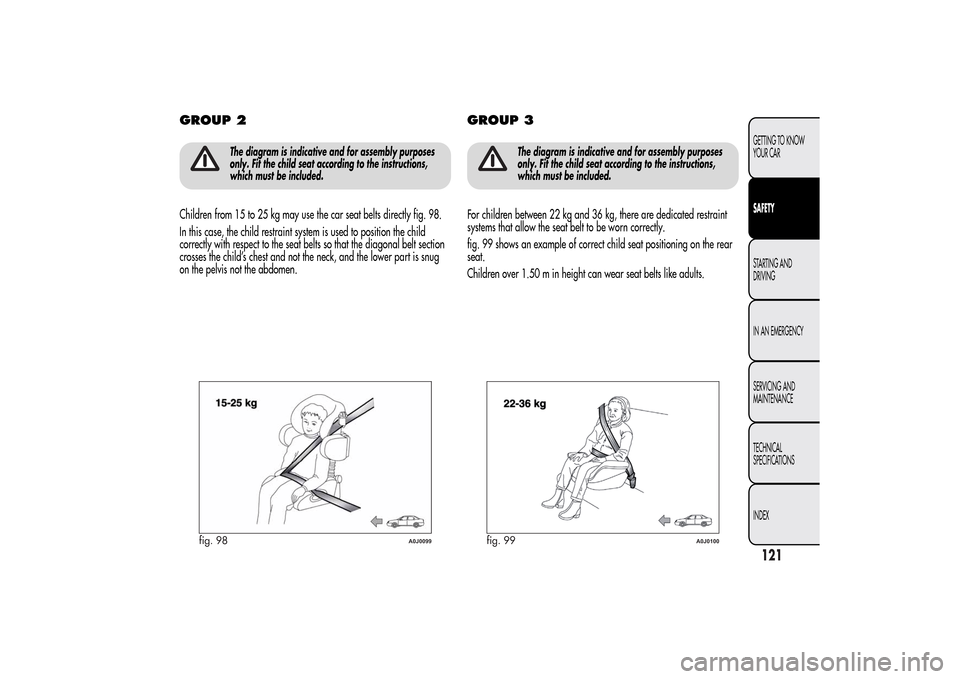
Children from 15 to 25 kg may use the car seat belts directly fig. 98.
In this case, the child restraint system is used to position the child
correctly with respect to the seat belts so that the diagonal belt section
crosses the child’s chest and not the neck, and the lower part is snug
on the pelvis not the abdomen.
GROUP 3
The diagram is indicative and for assembly purposes
only. Fit the child seat according to the instructions,
which must be included.
For children between 22 kg and 36 kg, there are dedicated restraint
systems that allow the seat belt to be worn correctly.
fig. 99 shows an example of correct child seat positioning on the rear
seat.
Children over 1.50 m in height can wear seat belts like adults.
fig. 98
A0J0099
fig. 99
A0J0100
121GETTING TO KNOW
YOUR CARSAFETYSTARTING AND
DRIVING
IN AN EMERGENCY
SERVICING AND
MAINTENANCE
TECHNICAL
SPECIFICATIONS
INDEX
Page 139 of 280
STOPPING THE ENGINETurn the ignition key to STOP while the engine is idling.
IMPORTANT After a demanding drive, before turning the engine off
you should allow it to idle to allow the temperature in the engine
compartment to decrease.
A quick burst on the accelerator before stopping the engine
serves absolutely no practical purpose. It wastes fuel and
is especially damaging to turbocharged engines.
PARKINGSwitch off the engine and pull up the handbrake. Engage a gear (1
stif
the car is facing uphill or reverse if it is facing downhill) and leave
the wheels steered to one side.
If the car is parked on a steep slope block the wheels with a wedge or
stone. Always remove the ignition key when leaving the car.
Never leave children unattended in the car. Always
remove the key from the ignition when leaving the car
and take it with you.
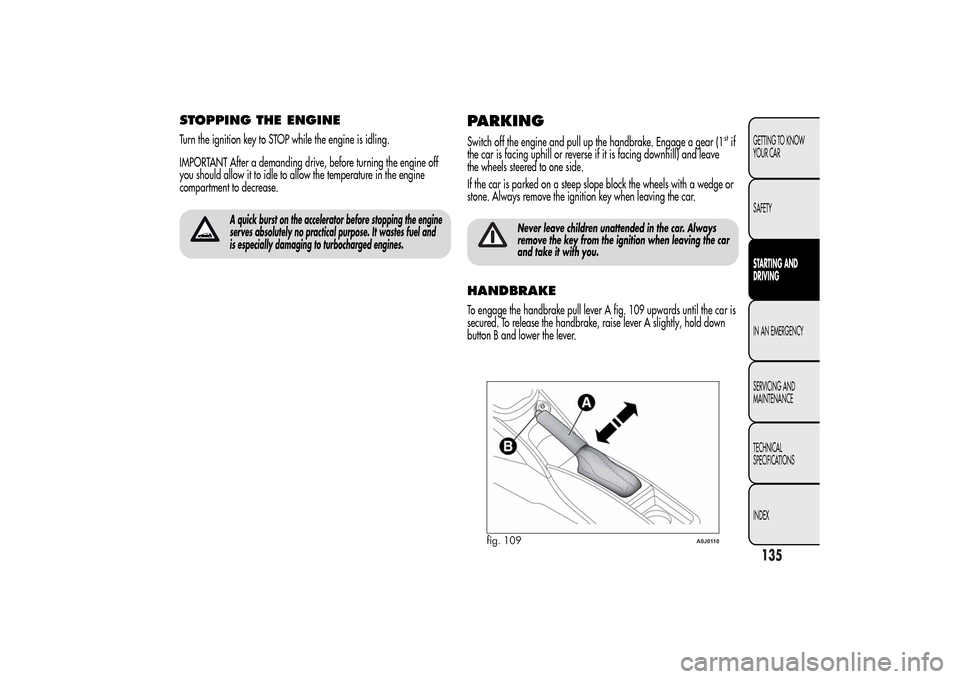
HANDBRAKETo engage the handbrake pull lever A fig. 109 upwards until the car is
secured. To release the handbrake, raise lever A slightly, hold down
button B and lower the lever.
fig. 109
A0J0110
135GETTING TO KNOW
YOUR CAR
SAFETYSTARTING AND
DRIVINGIN AN EMERGENCY
SERVICING AND
MAINTENANCE
TECHNICAL
SPECIFICATIONS
INDEX
Page 143 of 280
Maximum speed
Fuel consumption considerably increases as speed increases. Keep
your speed as even as possible, avoiding unnecessary braking and
acceleration which cause excessive fuel consumption and increased
emissions.
Acceleration
Accelerating violently severely affects consumption and emissions:
acceleration should be gradual and should not exceed the maximum
torque.CONDITIONS OF USECold starting
Short distances and frequent cold start-ups will prevent the engine from
reaching optimal running temperature. This results in a significant
increase in consumption levels (from +15 to +30% on the urban cycle)
and emissions.
Traffic and road conditions
High fuel consumption is caused by heavy traffic, for instance when
travelling in a queue with frequent use of low gears or in large towns
with many traffic lights. Winding mountain roads and rough road
surfaces also adversely affect consumption.
Stops in traffic
During prolonged stops (e.g. level crossings) switch the engine off.
TOWING TRAILERSIMPORTANT
The vehicle must be provided with a type-approved tow hook and
adequate electrical system to tow caravans or trailers. Installation must
be carried out by a specialist.
Fit any specific and/or additional rear view mirrors as specified by the
Highway Code.
Remember that, when towing a trailer, steep hills are harder to climb,
braking distances increase and overtaking takes longer relative to
the overall weight of the trailer.
Engage a low gear when driving downhill, rather than constantly using
the brake.
The weight of the trailer reduces the load capacity of the car by the
same amount. Consider the weight at full load, including accessories
and luggage, to make sure you do not exceed the maximum towable
weight (shown in the registration document).
Respect the speed limits specific to each country for vehicles towing
trailers. In any case do not exceed 100 km/h.
139GETTING TO KNOW
YOUR CAR
SAFETYSTARTING AND
DRIVINGIN AN EMERGENCY
SERVICING AND
MAINTENANCE
TECHNICAL
SPECIFICATIONS
INDEX
Page 147 of 280
This starting procedure must be performed by expert
personnel because incorrect actions could cause
electrical discharge of considerable intensity.
Furthermore, battery fluid is poisonous and corrosive: avoid
contact with skin and eyes. Keep naked flames and lighted
cigarettes away from the battery and do not cause sparks.
BUMP STARTINGNever start the engine by pushing, towing or coasting downhill.
REPLACING A WHEELGENERAL INSTRUCTIONSThe car is equipped with the “Fix&Go Automatic Kit”: see the
paragraph “Fix&Go Automatic Kit” for how to use this device.
As an alternative to the “Fix&Go Automatic Kit” the car may be
equipped with a space-saver wheel: see the instructions on the
following pages for changing the tyre.
The spare wheel is specific for your car. Do not use it
on cars of different models. Do not use spare wheels of
different models on your car. The space-saver wheel
must only be used in case of emergency. It must only be used for
the distance necessary to reach a service point and the car speed
must not exceed 80 km/h. The space-saver wheel has an orange
sticker that summarises the main cautions for use and limitations.
Never remove or cover the label. Never apply any hub cap to
the space-saver spare wheel.Alert other drivers that the car is stationary in
compliance with local regulations: hazard warning
lights, warning triangle, etc. Any passengers on board
should leave the car, especially if it is heavily laden. Passengers
should stay away from on-coming traffic while the wheel is
being changed. In case of steep slopes or rough slopes, place
wedges or other materials suitable to stop the vehicle under the
wheels.
143GETTING TO KNOW
YOUR CAR
SAFETY
STARTING AND
DRIVINGIN AN
EMERGENCYSERVICING AND
MAINTENANCE
TECHNICAL
SPECIFICATIONS
INDEX
Page 157 of 280
CHANGING A BULBGENERAL INSTRUCTIONS❒Before changing a bulb check the contacts for oxidation;
❒blown bulbs must be replaced with others of the same type and
power;
❒after replacing a headlight bulb, always check its alignment;
❒when a light is not working, check that the corresponding fuse is
intact before changing a bulb. For the location of fuses, refer to
the paragraph “Replacing fuses” in this section.
Halogen bulbs must be handled holding the metal part
only. Touching the transparent part of the bulb with your
fingers may reduce the intensity of the emitted light and
even reduce the lifespan of the bulb. In case of accidental contact, wipe
the bulb with a cloth moistened with alcohol and let the bulb dry.Modifications or repairs to the electric system that are
not carried out properly or do not take the system
technical specifications into account can cause
malfunctions leading to the risk of fire.Halogen bulbs contain pressurised gas which may
cause small fragments of glass to be projected
outwards if the bulb is broken.
IMPORTANT When the weather is cold or damp or after heavy rain or
washing, the surface of headlights or rear lights, may steam up and/or
form drops of condensation on the inside. This is a natural
phenomenon due to the difference in temperature and humidity
between the inside and the outside of the glass which does not indicate
a fault and does not compromise the normal operation of lighting
devices. The mist disappears quickly when the lights are turned on,
starting from the centre of the diffuser, extending progressively towards
the edges.
153GETTING TO KNOW
YOUR CAR
SAFETY
STARTING AND
DRIVINGIN AN
EMERGENCYSERVICING AND
MAINTENANCE
TECHNICAL
SPECIFICATIONS
INDEX
Page 168 of 280
FUSE LOCATIONFuses are grouped together in three fuse boxes located in the engine
compartment, dashboard and luggage compartment.
Engine compartment fuse box
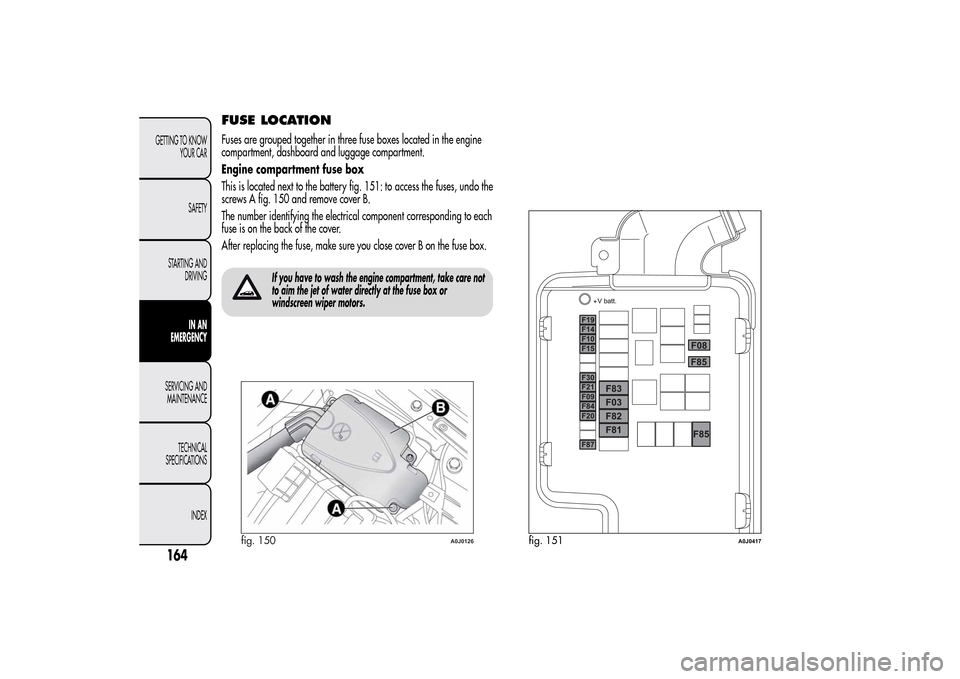
This is located next to the battery fig. 151: to access the fuses, undo the
screws A fig. 150 and remove cover B.
The number identifying the electrical component corresponding to each
fuse is on the back of the cover.
After replacing the fuse, make sure you close cover B on the fuse box.
If you have to wash the engine compartment, take care not
to aim the jet of water directly at the fuse box or
windscreen wiper motors.
fig. 150
A0J0126
fig. 151
A0J0417
164GETTING TO KNOW
YOUR CAR
SAFETY
STARTING AND
DRIVING
IN AN
EMERGENCY
SERVICING AND
MAINTENANCE
TECHNICAL
SPECIFICATIONS
INDEX
Page 176 of 280
Remember that whilst towing it is necessary to exert a
greater force when steering and braking because the
brake servo and electro-mechanical power steering
will be inoperative. Do not use wires for towing. Do not jerk. Be
careful not to damage parts in contact with the car while towing.
When towing the vehicle, you must comply with all specific traffic
regulations and adopt an appropriate driving behaviour. Do not
start the engine while towing the car. Clean the threaded seat
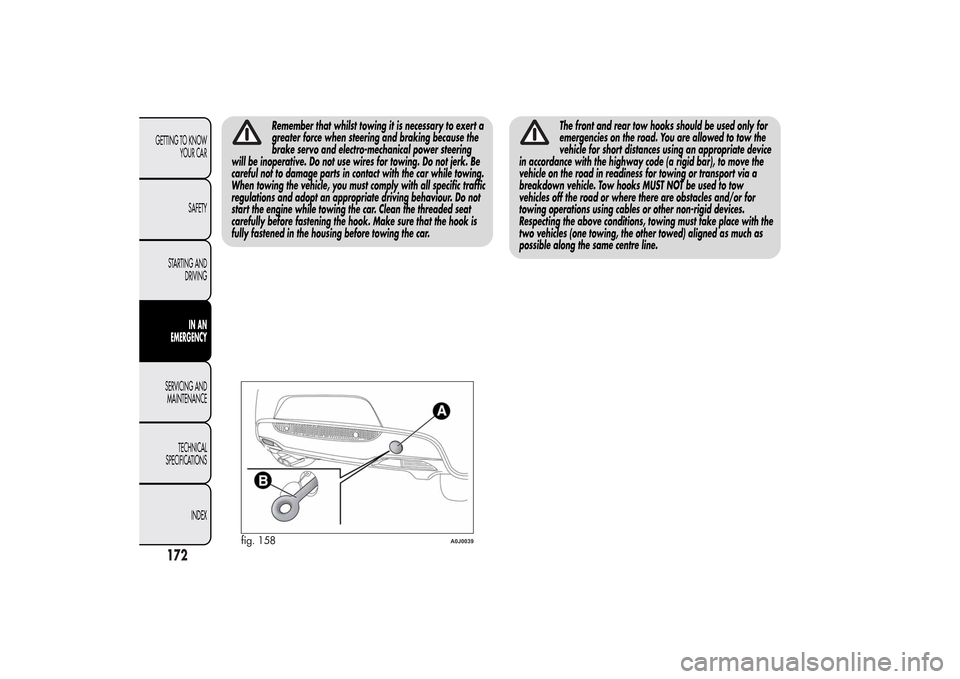
carefully before fastening the hook. Make sure that the hook is
fully fastened in the housing before towing the car.
The front and rear tow hooks should be used only for
emergencies on the road. You are allowed to tow the
vehicle for short distances using an appropriate device
in accordance with the highway code (a rigid bar), to move the
vehicle on the road in readiness for towing or transport via a
breakdown vehicle. Tow hooks MUST NOT be used to tow
vehicles off the road or where there are obstacles and/or for
towing operations using cables or other non-rigid devices.
Respecting the above conditions, towing must take place with the
two vehicles (one towing, the other towed) aligned as much as
possible along the same centre line.
fig. 158
A0J0039
172GETTING TO KNOW
YOUR CAR
SAFETY
STARTING AND
DRIVING
IN AN
EMERGENCY
SERVICING AND
MAINTENANCE
TECHNICAL
SPECIFICATIONS
INDEX
Page 195 of 280
Replacing the wiper bladesProceed as follows:
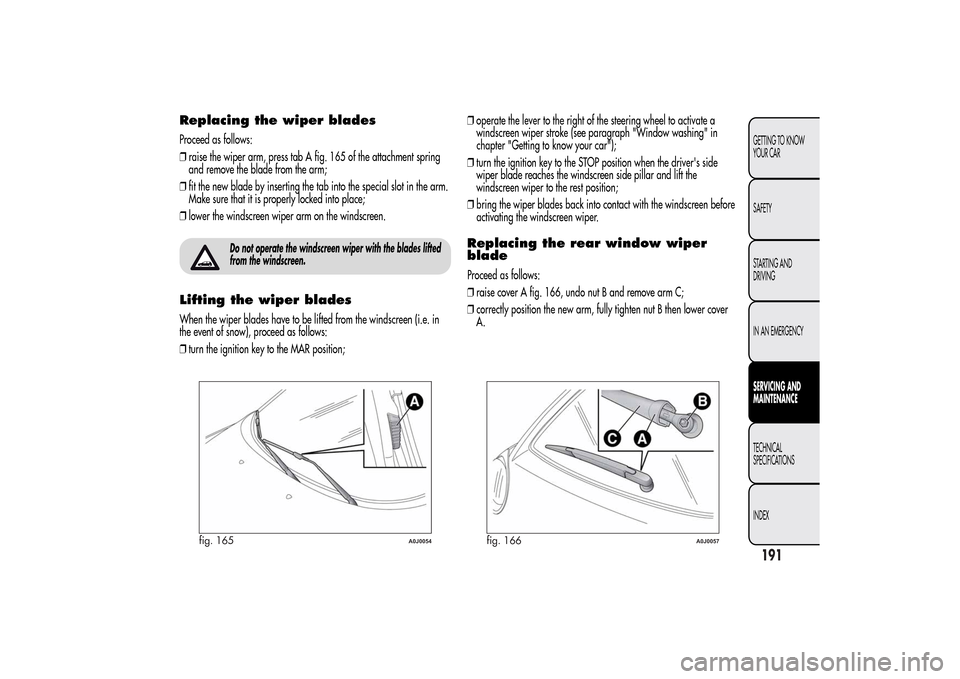
❒raise the wiper arm, press tab A fig. 165 of the attachment spring
and remove the blade from the arm;
❒fit the new blade by inserting the tab into the special slot in the arm.
Make sure that it is properly locked into place;
❒lower the windscreen wiper arm on the windscreen.
Do not operate the windscreen wiper with the blades lifted
from the windscreen.
Lifting the wiper bladesWhen the wiper blades have to be lifted from the windscreen (i.e. in
the event of snow), proceed as follows:
❒turn the ignition key to the MAR position;❒operate the lever to the right of the steering wheel to activate a
windscreen wiper stroke (see paragraph "Window washing" in
chapter "Getting to know your car");
❒turn the ignition key to the STOP position when the driver's side
wiper blade reaches the windscreen side pillar and lift the
windscreen wiper to the rest position;
❒bring the wiper blades back into contact with the windscreen before
activating the windscreen wiper.
Replacing the rear window wiper
bladeProceed as follows:
❒raise cover A fig. 166, undo nut B and remove arm C;
❒correctly position the new arm, fully tighten nut B then lower cover
A.
fig. 165
A0J0054
fig. 166
A0J0057
191GETTING TO KNOW
YOUR CAR
SAFETY
STARTING AND
DRIVING
IN AN EMERGENCYSERVICING AND
MAINTENANCETECHNICAL
SPECIFICATIONS
INDEX
Page 201 of 280
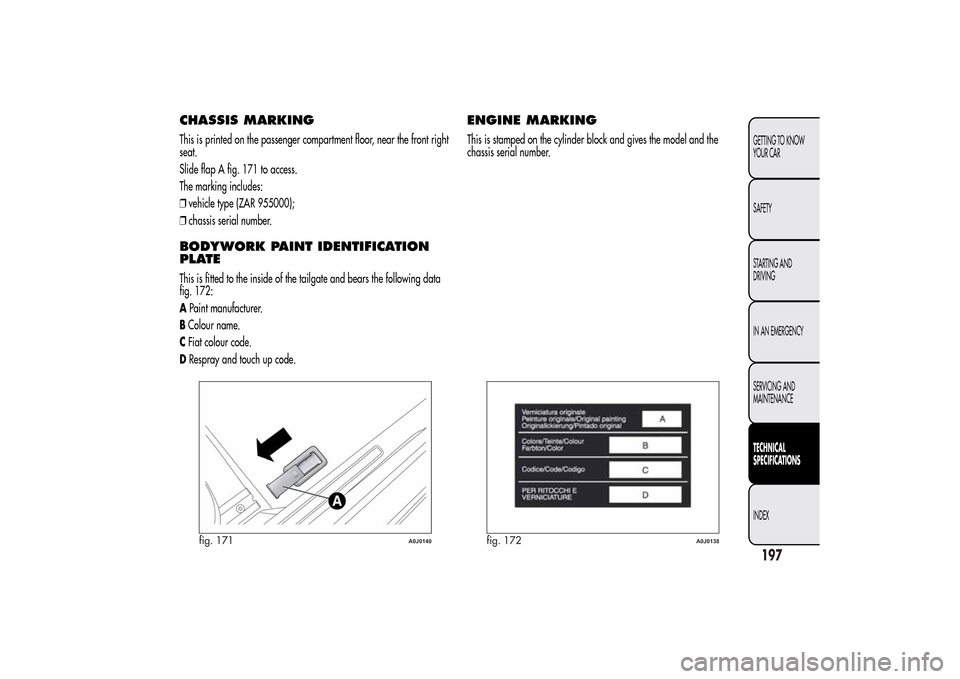
CHASSIS MARKINGThis is printed on the passenger compartment floor, near the front right
seat.
Slide flap A fig. 171 to access.
The marking includes:
❒vehicle type (ZAR 955000);
❒chassis serial number.BODYWORK PAINT IDENTIFICATION
PLATEThis is fitted to the inside of the tailgate and bears the following data
fig. 172:
APaint manufacturer.
BColour name.
CFiat colour code.
DRespray and touch up code.
ENGINE MARKINGThis is stamped on the cylinder block and gives the model and the
chassis serial number.
fig. 171
A0J0140
fig. 172
A0J0138
197GETTING TO KNOW
YOUR CAR
SAFETY
STARTING AND
DRIVING
IN AN EMERGENCY
SERVICING AND
MAINTENANCETECHNICAL
SPECIFICATIONSINDEX