warning light Alfa Romeo MiTo 2015 Owner's Guide
[x] Cancel search | Manufacturer: ALFA ROMEO, Model Year: 2015, Model line: MiTo, Model: Alfa Romeo MiTo 2015Pages: 280, PDF Size: 8.52 MB
Page 115 of 280
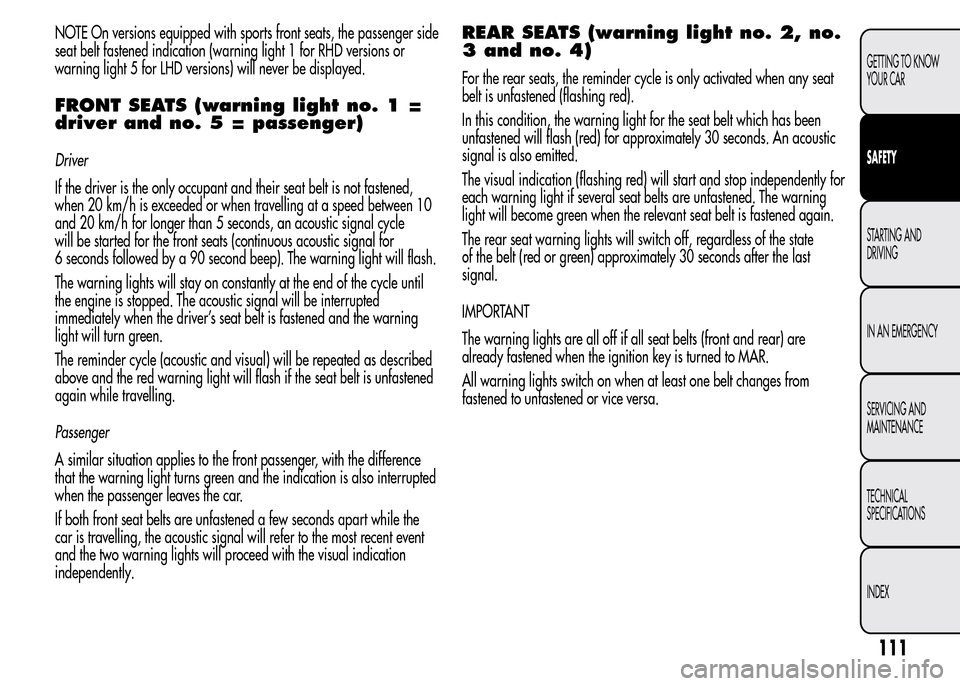
NOTE On versions equipped with sports front seats, the passenger side
seat belt fastened indication (warning light 1 for RHD versions or
warning light 5 for LHD versions) will never be displayed.
FRONT SEATS (warning light no. 1 =
driver and no. 5 = passenger)
Driver
If the driver is the only occupant and their seat belt is not fastened,
when 20 km/h is exceeded or when travelling at a speed between 10
and 20 km/h for longer than 5 seconds, an acoustic signal cycle
will be started for the front seats (continuous acoustic signal for
6 seconds followed by a 90 second beep). The warning light will flash.
The warning lights will stay on constantly at the end of the cycle until
the engine is stopped. The acoustic signal will be interrupted
immediately when the driver’s seat belt is fastened and the warning
light will turn green.
The reminder cycle (acoustic and visual) will be repeated as described
above and the red warning light will flash if the seat belt is unfastened
again while travelling.
Passenger
A similar situation applies to the front passenger, with the difference
that the warning light turns green and the indication is also interrupted
when the passenger leaves the car.
If both front seat belts are unfastened a few seconds apart while the
car is travelling, the acoustic signal will refer to the most recent event
and the two warning lights will proceed with the visual indication
independently.
REAR SEATS (warning light no. 2, no.
3 and no. 4)
For the rear seats, the reminder cycle is only activated when any seat
belt is unfastened (flashing red).
In this condition, the warning light for the seat belt which has been
unfastened will flash (red) for approximately 30 seconds. An acoustic
signal is also emitted.
The visual indication (flashing red) will start and stop independently for
each warning light if several seat belts are unfastened. The warning
light will become green when the relevant seat belt is fastened again.
The rear seat warning lights will switch off, regardless of the state
of the belt (red or green) approximately 30 seconds after the last
signal.
IMPORTANT
The warning lights are all off if all seat belts (front and rear) are
already fastened when the ignition key is turned to MAR.
All warning lights switch on when at least one belt changes from
fastened to unfastened or vice versa.
111
GETTING TO KNOW
YOUR CAR
SAFETY
STARTING AND
DRIVING
IN AN EMERGENCY
SERVICING AND
MAINTENANCE
TECHNICAL
SPECIFICATIONS
INDEX
Page 126 of 280
Fit the child seat according to the instructions, which
must be included.
Main recommendations to carry children safely
❒Install the child seats on the rear seat, which is the most protected
position in the event of an accident.
❒Keep children in rear facing seats for as long as possible, until 2
years old.
❒Should a rear facing child seat be installed on the rear seats, it is
advisable to position it as far forward as the position of the front
seat allows.
❒If the passenger's front airbag is deactivated always check the
permanent switching on of the dedicated warning light on the
instrument panel to make sure that it has actually been deactivated.
❒Carefully follow the instructions supplied with the child seat itself.
Keep the instructions in the car along with the other documents
and this handbook. Do not use second-hand child seats without
instructions.
❒Only one child is to be strapped into each restraint system; never
carry two children simultaneously.
❒Always check that the seat belts do not interfere with the child's
throat.❒Always check that the seat belt is well fastened by pulling on it.
❒While travelling, do not let the child sit incorrectly or unfasten the
belts.
❒Never allow a child to put the belt's diagonal section under an arm
or behind their back.
❒Never carry children on your lap, even newborns. No-one can
restrain a child in the event of an accident.
❒In the event of an accident, replace the child seat with a new one.
122
GETTING TO KNOW
YOUR CAR
SAFETY
STARTING AND
DRIVING
IN AN EMERGENCY
SERVICING AND
MAINTENANCE
TECHNICAL
SPECIFICATIONS
INDEX
Page 130 of 280
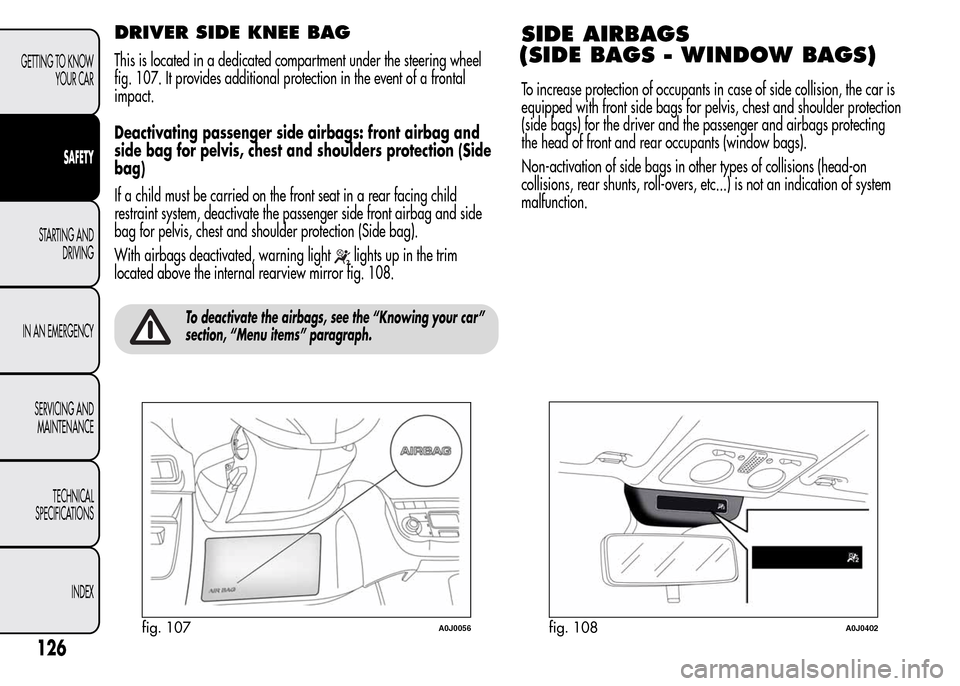
DRIVER SIDE KNEE BAG
This is located in a dedicated compartment under the steering wheel
fig. 107. It provides additional protection in the event of a frontal
impact.
Deactivating passenger side airbags: front airbag and
side bag for pelvis, chest and shoulders protection (Side
bag)
If a child must be carried on the front seat in a rear facing child
restraint system, deactivate the passenger side front airbag and side
bag for pelvis, chest and shoulder protection (Side bag).
With airbags deactivated, warning light
lights up in the trim
located above the internal rearview mirror fig. 108.
To deactivate the airbags, see the “Knowing your car”
section, “Menu items” paragraph.
SIDE AIRBAGS
(SIDE BAGS - WINDOW BAGS)
To increase protection of occupants in case of side collision, the car is
equipped with front side bags for pelvis, chest and shoulder protection
(side bags) for the driver and the passenger and airbags protecting
the head of front and rear occupants (window bags).
Non-activation of side bags in other types of collisions (head-on
collisions, rear shunts, roll-overs, etc...) is not an indication of system
malfunction.
fig. 107A0J0056fig. 108A0J0402
126
GETTING TO KNOW
YOUR CAR
SAFETY
STARTING AND
DRIVING
IN AN EMERGENCY
SERVICING AND
MAINTENANCE
TECHNICAL
SPECIFICATIONS
INDEX
Page 132 of 280
IMPORTANT
Do not wash the seats with water or pressurised steam (by hand or at
automatic seat washing stations).
The front and/or side bags may activate in the event of sharp knocks
to the underbody of the car (e.g. impact with steps, pavements,
potholes or road bumps etc.).
When the airbag deploys it emits a small amount of dust: the dust is
harmless and does not indicate the beginning of a fire. The dust may
irritate the skin and eyes however: in this case, wash with neutral soap
and water.
All operations on airbags (inspection, repair and replacement) must be
carried out by Alfa Romeo Authorized Services.
If the car is to be scrapped, contact Alfa Romeo Authorised Services to
have the airbags deactivated.
Pretensioners and airbags are deployed in different ways, according to
the type of impact. Failure to deploy of one of the devices does not
necessarily indicate a system malfunction.
If thewarning light does not switch on when the
key is turned to MAR-ON, or stays on while driving (on
some versions together with a message on the
display) there may be a fault in the restraint systems. In this
case, airbags or pretensioners may not be activated in the case
of an accident or (in a lesser number of cases) they may be
activated incorrectly. Before proceeding, contact Alfa Romeo
Authorised Services to have the system checked immediately.
Do not travel carrying objects in your lap, in front of
your chest or between your lips (pipe, pencils, etc.):
they could cause severe injury if the airbag is
deployed.
If the car has been subject to theft, attempted theft,
vandalism, or flooding, have the airbag system
inspected at Alfa Romeo Authorised Services.
When the ignition key is in and turned in the MAR-ON
position and the engine is off, the airbags may deploy
if the car is crashed by another moving vehicle.
Therefore, even if the car is stationary, when an active passenger
airbag is fitted, DO NOT install rear facing child restraint systems
on the front passenger seat. Deployment of the airbag following
an impact could cause fatal injuries to the child. Therefore,
always deactivate the passenger airbag when a rear facing child
restraint system is installed on the front passenger seat. The front
passenger seat must also be positioned back as far as possible
in order to avoid the child restraint system from coming into
contact with the dashboard. Immediately reactivate the
passenger airbag as soon as the child restraint system has been
removed. Also remember that, if the key is turned to STOP, none
of the safety devices (airbags or pretensioners) will be deployed
in the event of collision. Non-deployment in such cases does not
indicate a system malfunction.
128
GETTING TO KNOW
YOUR CAR
SAFETY
STARTING AND
DRIVING
IN AN EMERGENCY
SERVICING AND
MAINTENANCE
TECHNICAL
SPECIFICATIONS
INDEX
Page 133 of 280
When the ignition key is turned to MAR, the
warning light (with passenger side front airbag
activated) switches on and flashes for a few seconds to
remind you that the passenger airbag will be deployed in a
crash, after which it should switch off.
The front airbag is designed to be deployed for
impacts of a greater intensity than for the
pretensioners. For impacts whose intensity falls
between the two levels, it is normal for only the pretensioners to
be activated.
The airbag does not replace seat belts but increases
their effectiveness. Because front airbags are not
deployed for low-speed crashes, side collisions,
rear-end shunts or rollovers, occupants are protected, in addition
to any side bags, only by their seat belts, which must therefore
always be fastened.
129
GETTING TO KNOW
YOUR CAR
SAFETY
STARTING AND
DRIVING
IN AN EMERGENCY
SERVICING AND
MAINTENANCE
TECHNICAL
SPECIFICATIONS
INDEX
Page 134 of 280
STARTING AND DRIVING
STARTING THE ENGINE
PROCEDURE FOR PETROL VERSIONS
(excluding Turbo TwinAir versions)
Proceed as follows:
❒engage the handbrake and place the gearbox lever in neutral;
❒fully depress the clutch pedal, without touching the accelerator;
❒turn the ignition key to AVV and release it as soon as the engine
starts.
IMPORTANT
❒If the engine does not start at the first attempt, return the ignition key
to STOP before repeating the starting procedure.
❒If, when the ignition key is at MAR, the instrument panel warning
light
(or the symbol on the display) remains on together with
warning light
, turn the key to STOP and then back to MAR. If
the warning light remains on, try the other keys provided. If you are
still unable to start the engine contact an Alfa Romeo Authorised
Service Provider.
❒Never leave the ignition key at MAR when the engine is stopped.Engine starting for Turbo TwinAir versions
Proceed as follows:
❒Engage the handbrake and place the gear lever in neutral or fully
press the clutch pedal if a gear other than neutral is engaged;
❒turn the ignition key to AVV and release it as soon as the engine
starts.
NoteIf the vehicle does not start at the first attempt, return the ignition
key to STOP and repeat the starting procedure placing the gear lever
in neutral and fully pressing the clutch pedal.
IMPORTANT
❒If, when the ignition key is at MAR, the instrument panel warning
light
(or the symbol on the display) remains on together with
warning light
, turn the key to STOP and then back to MAR. If
the warning light remains on, try the other keys provided. If you are
still unable to start the engine contact an Alfa Romeo Authorised
Service Provider.
❒Never leave the ignition key at MAR when the engine is stopped.
130
GETTING TO KNOW
YOUR CAR
SAFETY
STARTING AND
DRIVING
IN AN EMERGENCY
SERVICING AND
MAINTENANCE
TECHNICAL
SPECIFICATIONS
INDEX
Page 135 of 280
PROCEDURE FOR DIESEL VERSIONS
Proceed as follows:
❒engage the handbrake and place the gearbox lever in neutral;
❒turn the ignition key to MAR-ON: the warning lights
and
(or the symbol on the display) on the instrument panel will
switch on;
❒wait for the warning lights (or the symbol on the display) to switch
off;
❒fully depress the clutch pedal, without touching the accelerator;
❒turn the ignition key to AVV;
warning light switches off.
Waiting too long will waste the heating work carried out by the
glow plugs. Release the key as soon as the engine starts.
If thewarning light flashes for about 1 minute after
starting or during prolonged cranking, this indicates a fault
in the glow plug preheating system. Use the car normally
if the engine starts and go to Alfa Romeo Authorized Services as soon
as possible.
It is dangerous to run the engine in enclosed areas. The
engine takes in oxygen and releases carbon dioxide,
carbon monoxide and other toxic gases.
It is advisable not to demand maximum performance from
your car (e.g. excessive acceleration, long distances at
maximum rpm, excessively intense braking, etc.) when it is
first used.
When the engine is off, do not leave the ignition key turned
to MAR to prevent unnecessary electrical consumption from
draining the battery.
Remember that the brake servo and electromechanical
power steering are not operational until the engine
has been started, therefore much more effort than
usual is required on the brake pedal and steering wheel.
Never start the engine by pushing, towing or driving
downhill. These manoeuvres may damage the catalytic
converter.
131
GETTING TO KNOW
YOUR CAR
SAFETY
STARTING AND
DRIVING
IN AN EMERGENCY
SERVICING AND
MAINTENANCE
TECHNICAL
SPECIFICATIONS
INDEX
Page 143 of 280
IN AN EMERGENCY
In an emergency we recommend that you call the freephone number found in the Warranty Booklet. You can also
consult www.alfaromeo.com to find your nearest Alfa Romeo Authorized Services.
STARTING THE ENGINE
If thewarning light on the instrument panel remains on constantly,
contact Alfa Romeo Authorized Services immediately.
JUMP STARTING
If the battery is flat, the engine may be started using an auxiliary
battery with the same capacity or a little higher than the flat one.
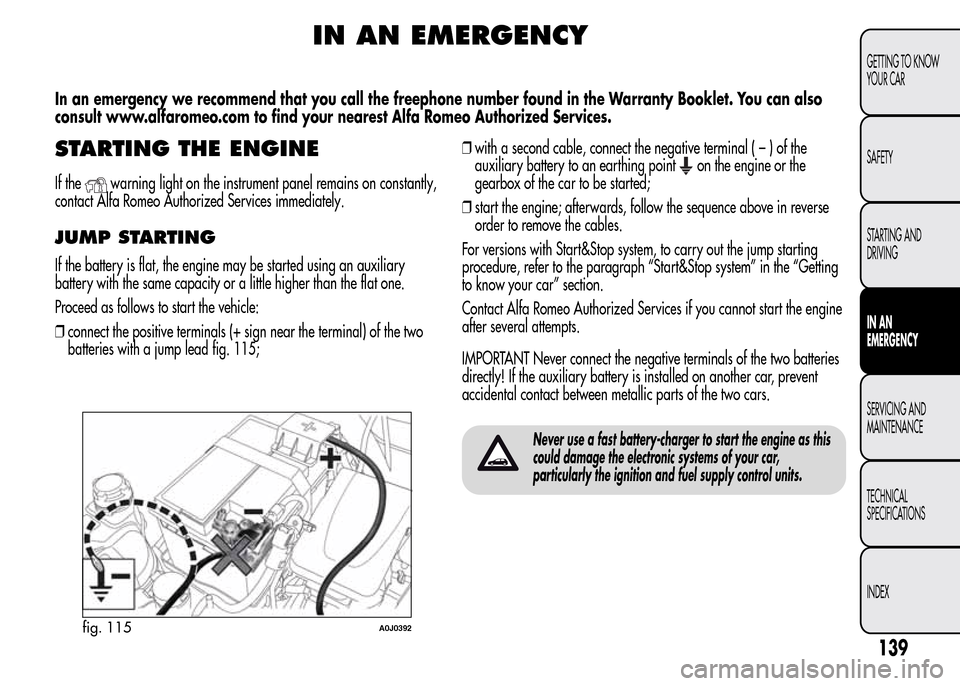
Proceed as follows to start the vehicle:
❒connect the positive terminals (+ sign near the terminal) of the two
batteries with a jump lead fig. 115;❒with a second cable, connect the negative terminal(–)ofthe
auxiliary battery to an earthing point
on the engine or the
gearbox of the car to be started;
❒start the engine; afterwards, follow the sequence above in reverse
order to remove the cables.
For versions with Start&Stop system, to carry out the jump starting
procedure, refer to the paragraph “Start&Stop system” in the “Getting
to know your car” section.
Contact Alfa Romeo Authorized Services if you cannot start the engine
after several attempts.
IMPORTANT Never connect the negative terminals of the two batteries
directly! If the auxiliary battery is installed on another car, prevent
accidental contact between metallic parts of the two cars.
Never use a fast battery-charger to start the engine as this
could damage the electronic systems of your car,
particularly the ignition and fuel supply control units.
fig. 115A0J0392
139
GETTING TO KNOW
YOUR CAR
SAFETY
STARTING AND
DRIVING
IN AN
EMERGENCY
SERVICING AND
MAINTENANCE
TECHNICAL
SPECIFICATIONS
INDEX
Page 144 of 280
This starting procedure must be performed by expert
personnel because incorrect actions could cause
electrical discharge of considerable intensity.
Furthermore, battery fluid is poisonous and corrosive: avoid
contact with skin and eyes. Keep naked flames and lighted
cigarettes away from the battery and do not cause sparks.
BUMP STARTING
Never start the engine by pushing, towing or coasting downhill.
REPLACING A WHEEL
GENERAL INSTRUCTIONS
The car is equipped with the “Fix&Go Automatic Kit”: see the
paragraph “Fix&Go Automatic Kit” for how to use this device.
As an alternative to the “Fix&Go Automatic Kit” the car may be
equipped with a space-saver wheel: see the instructions on the
following pages for changing the tyre.
The spare wheel is specific for your car. Do not use it
on cars of different models. Do not use spare wheels of
different models on your car. The space-saver wheel
must only be used in case of emergency. It must only be used for
the distance necessary to reach a service point and the car speed
must not exceed 80 km/h. The space-saver wheel has an orange
sticker that summarises the main cautions for use and limitations.
Never remove or cover the label. Never apply any hub cap to
the space-saver spare wheel.
Alert other drivers that the car is stationary in
compliance with local regulations: hazard warning
lights, warning triangle, etc. Any passengers on board
should leave the car, especially if it is heavily laden. Passengers
should stay away from on-coming traffic while the wheel is
being changed. In case of steep slopes or rough slopes, place
wedges or other materials suitable to stop the vehicle under the
wheels.
140
GETTING TO KNOW
YOUR CAR
SAFETY
STARTING AND
DRIVING
IN AN
EMERGENCY
SERVICING AND
MAINTENANCE
TECHNICAL
SPECIFICATIONS
INDEX
Page 176 of 280
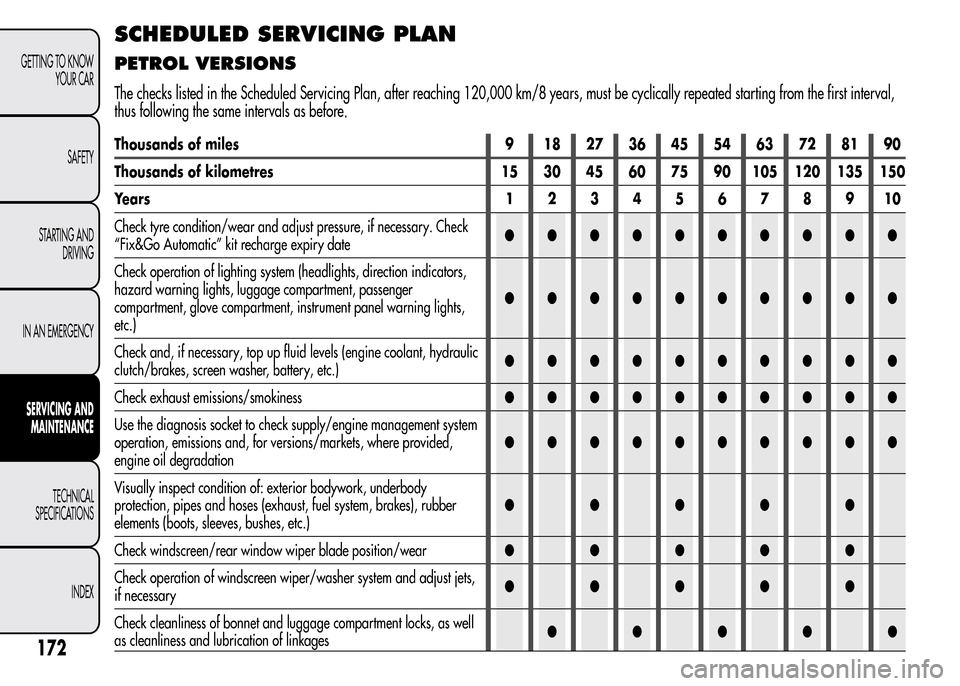
SCHEDULED SERVICING PLAN
PETROL VERSIONS
Thousands of miles 9 18 27 36 45 54 63 72 81 90
Thousands of kilometres 15 30 45 60 75 90 105 120 135 150
Years12345678910
Check tyre condition/wear and adjust pressure, if necessary. Check
“Fix&Go Automatic” kit recharge expiry date●●●●●●●●●●
Check operation of lighting system (headlights, direction indicators,
hazard warning lights, luggage compartment, passenger
compartment, glove compartment, instrument panel warning lights,
etc.)●●●●●●●●●●
Check and, if necessary, top up fluid levels (engine coolant, hydraulic
clutch/brakes, screen washer, battery, etc.)●●●●●●●●●●
Check exhaust emissions/smokiness●●●●●●●●●●
Use the diagnosis socket to check supply/engine management system
operation, emissions and, for versions/markets, where provided,
engine oil degradation●●●●●●●●●●
Visually inspect condition of: exterior bodywork, underbody
protection, pipes and hoses (exhaust, fuel system, brakes), rubber
elements (boots, sleeves, bushes, etc.)●●●●●
Check windscreen/rear window wiper blade position/wear●●●●●
Check operation of windscreen wiper/washer system and adjust jets,
if necessary●●●●●
Check cleanliness of bonnet and luggage compartment locks, as well
as cleanliness and lubrication of linkages●●●●●
172
GETTING TO KNOW
YOUR CAR
SAFETY
STARTING AND
DRIVING
IN AN EMERGENCY
SERVICING AND
MAINTENANCE
TECHNICAL
SPECIFICATIONS
INDEX
The checks listed in the Scheduled Servicing Plan, after reaching 120,000 km/8 years, must be cyclically repeated starting from the first interval,
thus following the same intervals as before.