Wipe Alfa Romeo MiTo 2016 User Guide
[x] Cancel search | Manufacturer: ALFA ROMEO, Model Year: 2016, Model line: MiTo, Model: Alfa Romeo MiTo 2016Pages: 280, PDF Size: 8.52 MB
Page 176 of 280
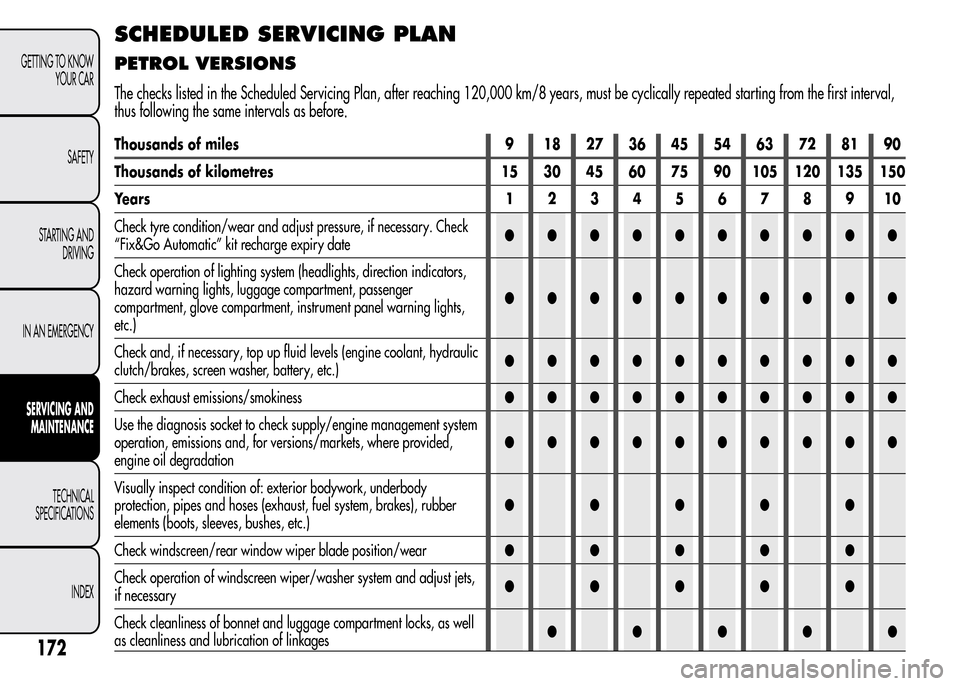
SCHEDULED SERVICING PLAN
PETROL VERSIONS
Thousands of miles 9 18 27 36 45 54 63 72 81 90
Thousands of kilometres 15 30 45 60 75 90 105 120 135 150
Years12345678910
Check tyre condition/wear and adjust pressure, if necessary. Check
“Fix&Go Automatic” kit recharge expiry date●●●●●●●●●●
Check operation of lighting system (headlights, direction indicators,
hazard warning lights, luggage compartment, passenger
compartment, glove compartment, instrument panel warning lights,
etc.)●●●●●●●●●●
Check and, if necessary, top up fluid levels (engine coolant, hydraulic
clutch/brakes, screen washer, battery, etc.)●●●●●●●●●●
Check exhaust emissions/smokiness●●●●●●●●●●
Use the diagnosis socket to check supply/engine management system
operation, emissions and, for versions/markets, where provided,
engine oil degradation●●●●●●●●●●
Visually inspect condition of: exterior bodywork, underbody
protection, pipes and hoses (exhaust, fuel system, brakes), rubber
elements (boots, sleeves, bushes, etc.)●●●●●
Check windscreen/rear window wiper blade position/wear●●●●●
Check operation of windscreen wiper/washer system and adjust jets,
if necessary●●●●●
Check cleanliness of bonnet and luggage compartment locks, as well
as cleanliness and lubrication of linkages●●●●●
172
GETTING TO KNOW
YOUR CAR
SAFETY
STARTING AND
DRIVING
IN AN EMERGENCY
SERVICING AND
MAINTENANCE
TECHNICAL
SPECIFICATIONS
INDEX
The checks listed in the Scheduled Servicing Plan, after reaching 120,000 km/8 years, must be cyclically repeated starting from the first interval,
thus following the same intervals as before.
Page 179 of 280
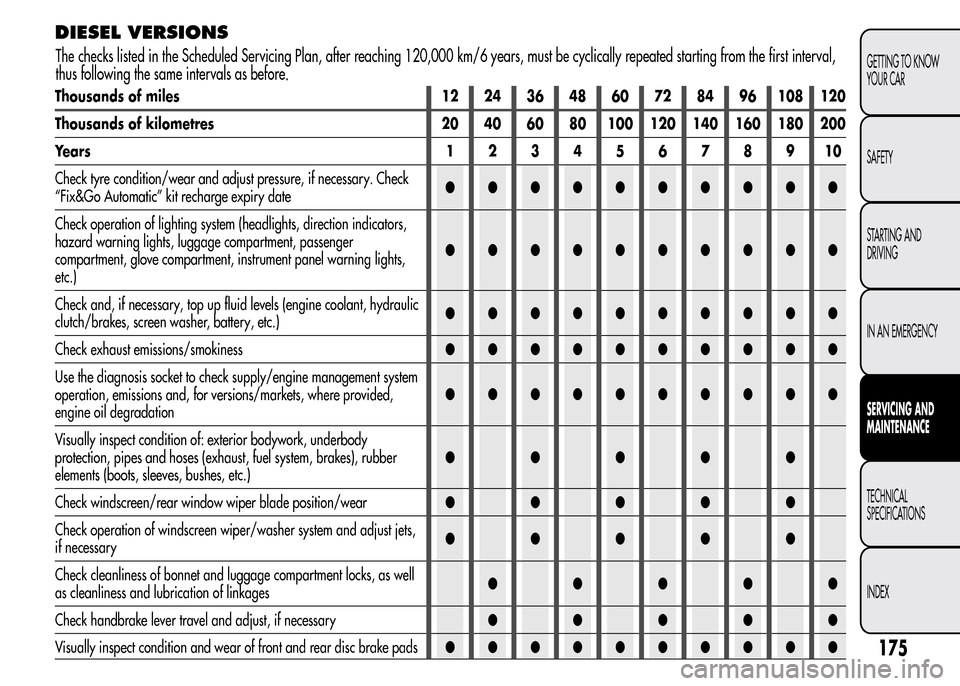
DIESEL VERSIONS
Thousands of miles 12 24 36 48 60 72 84 96 108 120
Thousands of kilometres 20 40 60 80 100 120 140 160 180 200
Years12345678910
Check tyre condition/wear and adjust pressure, if necessary. Check
“Fix&Go Automatic” kit recharge expiry date●●●●●●●●●●
Check operation of lighting system (headlights, direction indicators,
hazard warning lights, luggage compartment, passenger
compartment, glove compartment, instrument panel warning lights,
etc.)●●●●●●●●●●
Check and, if necessary, top up fluid levels (engine coolant, hydraulic
clutch/brakes, screen washer, battery, etc.)●●●●●●●●●●
Check exhaust emissions/smokiness●●●●●●●●●●
Use the diagnosis socket to check supply/engine management system
operation, emissions and, for versions/markets, where provided,
engine oil degradation●●●●●●●●●●
Visually inspect condition of: exterior bodywork, underbody
protection, pipes and hoses (exhaust, fuel system, brakes), rubber
elements (boots, sleeves, bushes, etc.)●●●●●
Check windscreen/rear window wiper blade position/wear●●●●●
Check operation of windscreen wiper/washer system and adjust jets,
if necessary●●●●●
Check cleanliness of bonnet and luggage compartment locks, as well
as cleanliness and lubrication of linkages●●●●●
Check handbrake lever travel and adjust, if necessary●●●●●
Visually inspect condition and wear of front and rear disc brake pads●●●●●●●●●●
175
GETTING TO KNOW
YOUR CAR
SAFETY
STARTING AND
DRIVING
IN AN EMERGENCY
SERVICING AND
MAINTENANCE
TECHNICAL
SPECIFICATIONS
INDEX
The checks listed in the Scheduled Servicing Plan, after reaching 120,000 km/6 years, must be cyclically repeated starting from the first interval,
thus following the same intervals as before.
Page 181 of 280
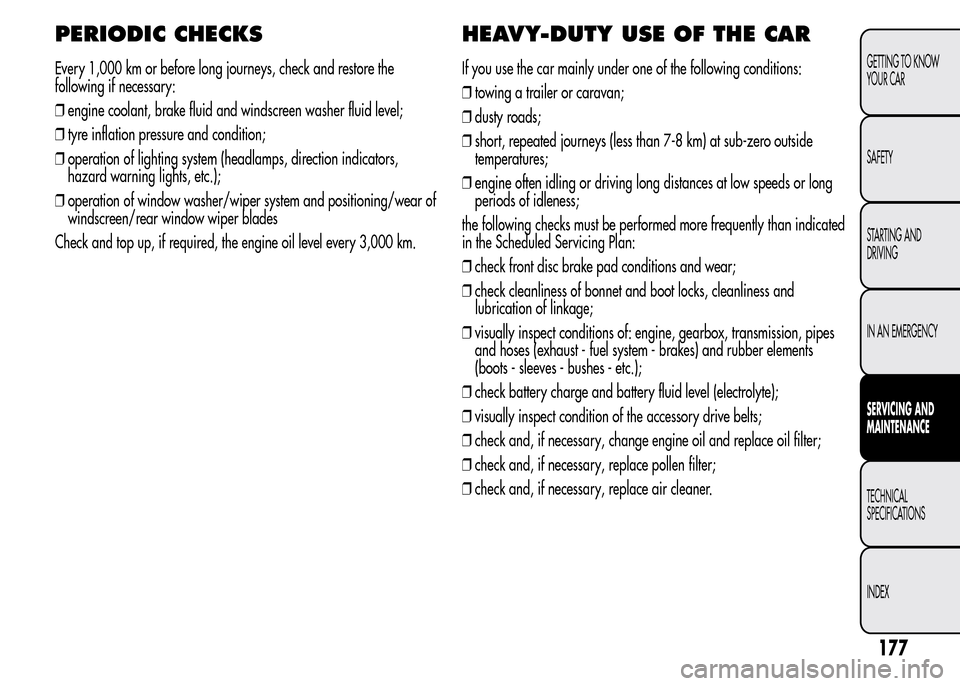
PERIODIC CHECKS
Every 1,000 km or before long journeys, check and restore the
following if necessary:
❒engine coolant, brake fluid and windscreen washer fluid level;
❒tyre inflation pressure and condition;
❒operation of lighting system (headlamps, direction indicators,
hazard warning lights, etc.);
❒operation of window washer/wiper system and positioning/wear of
windscreen/rear window wiper blades
Check and top up, if required, the engine oil level every 3,000 km.
HEAVY-DUTY USE OF THE CAR
If you use the car mainly under one of the following conditions:
❒towing a trailer or caravan;
❒dusty roads;
❒short, repeated journeys (less than 7-8 km) at sub-zero outside
temperatures;
❒engine often idling or driving long distances at low speeds or long
periods of idleness;
the following checks must be performed more frequently than indicated
in the Scheduled Servicing Plan:
❒check front disc brake pad conditions and wear;
❒check cleanliness of bonnet and boot locks, cleanliness and
lubrication of linkage;
❒visually inspect conditions of: engine, gearbox, transmission, pipes
and hoses (exhaust - fuel system - brakes) and rubber elements
(boots - sleeves - bushes - etc.);
❒check battery charge and battery fluid level (electrolyte);
❒visually inspect condition of the accessory drive belts;
❒check and, if necessary, change engine oil and replace oil filter;
❒check and, if necessary, replace pollen filter;
❒check and, if necessary, replace air cleaner.
177
GETTING TO KNOW
YOUR CAR
SAFETY
STARTING AND
DRIVING
IN AN EMERGENCY
SERVICING AND
MAINTENANCE
TECHNICAL
SPECIFICATIONS
INDEX
Page 193 of 280
Remember that the road holding qualities of your car
also depend on the correct inflation pressure of the
tyres.
If the pressure is too low the tyre overheats and can be
seriously damaged.
Do not cross switch the tyres, moving them from the
right of the car to the left and vice versa.
Never submit alloy rims to repainting treatments
requiring the use of temperatures exceeding 150°C.
The mechanical properties of the wheels could be
impaired.
WINDSCREEN/REAR WINDOW
WIPER
BLADES
We recommend replacing the blades once a year.
A few simple precautions can reduce the possibility of damage to the
blades:
❒if the temperature falls below zero, make sure that ice has not frozen
the rubber against the glass. Use a de-icing product to release it if
required;
❒remove any snow from the window;
❒do not operate the windscreen/rear window wipers on dry glass.
Driving with worn windscreen/rear window wiper
blades is a serious hazard, because visibility is reduced
in bad weather.
189
GETTING TO KNOW
YOUR CAR
SAFETY
STARTING AND
DRIVING
IN AN EMERGENCY
SERVICING AND
MAINTENANCE
TECHNICAL
SPECIFICATIONS
INDEX
Page 194 of 280
Replacing the wiper blades
Proceed as follows:
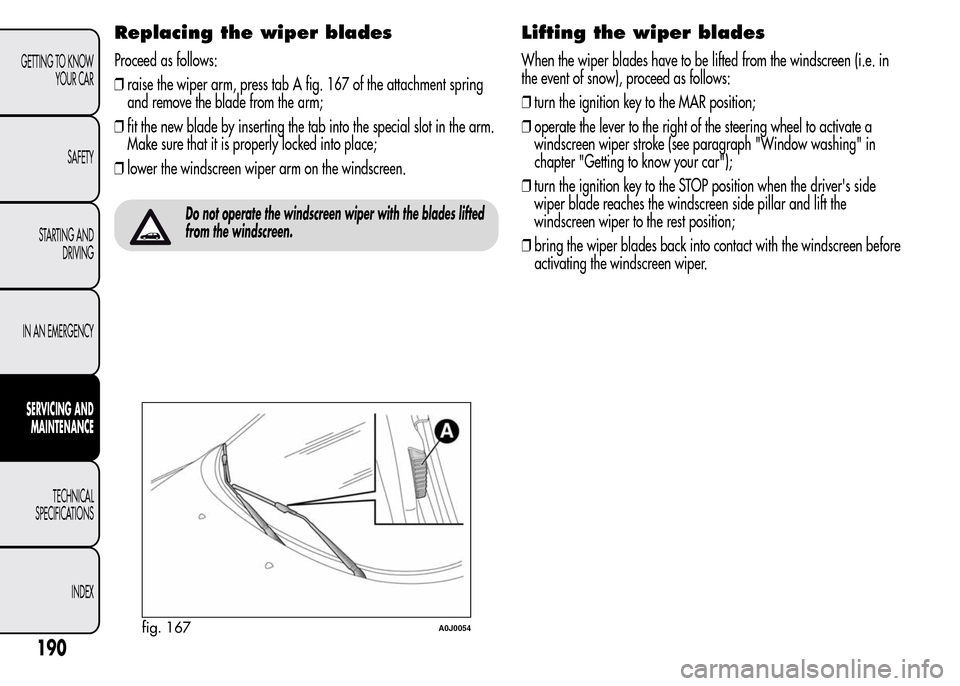
❒raise the wiper arm, press tab A fig. 167 of the attachment spring
and remove the blade from the arm;
❒fit the new blade by inserting the tab into the special slot in the arm.
Make sure that it is properly locked into place;
❒lower the windscreen wiper arm on the windscreen.
Do not operate the windscreen wiper with the blades lifted
from the windscreen.
Lifting the wiper blades
When the wiper blades have to be lifted from the windscreen (i.e. in
the event of snow), proceed as follows:
❒turn the ignition key to the MAR position;
❒operate the lever to the right of the steering wheel to activate a
windscreen wiper stroke (see paragraph "Window washing" in
chapter "Getting to know your car");
❒turn the ignition key to the STOP position when the driver's side
wiper blade reaches the windscreen side pillar and lift the
windscreen wiper to the rest position;
❒bring the wiper blades back into contact with the windscreen before
activating the windscreen wiper.
fig. 167A0J0054
190
GETTING TO KNOW
YOUR CAR
SAFETY
STARTING AND
DRIVING
IN AN EMERGENCY
SERVICING AND
MAINTENANCE
TECHNICAL
SPECIFICATIONS
INDEX
Page 195 of 280
Replacing the rear window wiper
blade
Proceed as follows:
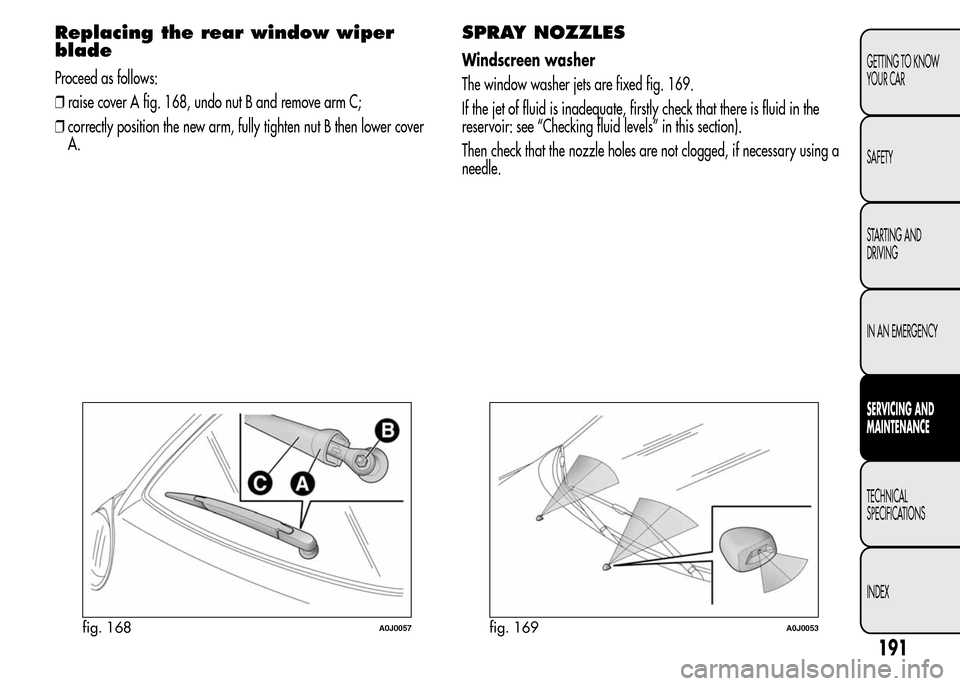
❒raise cover A fig. 168, undo nut B and remove arm C;
❒correctly position the new arm, fully tighten nut B then lower cover
A.
SPRAY NOZZLES
Windscreen washer
The window washer jets are fixed fig. 169.
If the jet of fluid is inadequate, firstly check that there is fluid in the
reservoir: see “Checking fluid levels” in this section).
Then check that the nozzle holes are not clogged, if necessary using a
needle.
fig. 168A0J0057fig. 169A0J0053
191
GETTING TO KNOW
YOUR CAR
SAFETY
STARTING AND
DRIVING
IN AN EMERGENCY
SERVICING AND
MAINTENANCE
TECHNICAL
SPECIFICATIONS
INDEX
Page 197 of 280
BODY AND UNDERBODY WARRANTY
Your car is covered by warranty against perforation due to rust of any
original element of the structure or bodywork. For the general terms
of this warranty, refer to the Warranty Booklet.
PRESERVING THE BODYWORK
Paintwork
Touch up abrasions and scratches immediately to prevent the formation
of rust.
Maintenance of paintwork consists of washing the car: the frequency
depends on the conditions and environment where the car is used. For
example, it is advisable to wash the car more often in areas with
high levels of atmospheric pollution or salted roads.
On some versions the car may be equipped, on request, with an
exclusive opaque paint on the roof which, in order to be maintained
intact, requires special care: see the instructions below.
Avoid washing with rollers and/or brushes in washing
stations. Wash the car only by hand using neutral pH
detergents; dry it with a wet chamois leather. Abrasive
products and/or polishes should not be used for cleaning the car. Bird
droppings must be washed off immediately and thoroughly as the acid
they contain is particularly aggressive. Avoid (if at all possible)
parking the car under trees; remove vegetable resins immediately as,
when dried, it may only be possible to remove them with abrasive
products and/or polishes, which is highly inadvisable as they could
alter the typical opacity of the paint. Do not use pure screen washer
fluid for cleaning the front windscreen and rear window; dilute it min.
50% with water. Only use pure screen washer fluid when strictly
necessary due to outside temperature conditions.
To correctly wash the car, follow these instructions:
❒remove the aerial from the roof when using a carwash;
❒if high pressure jets or cleaners are used to wash the car, keep a
distance of at least 40 cm from the bodywork to avoid damage
or alteration. Bear in mind that a build up of water could cause
damage to the car in the long term;
❒wash the bodywork using a low pressure jet of water;
❒wipe a sponge with a slightly soapy solution over the bodywork,
frequently rinsing the sponge;
❒rinse well with water and dry with a jet of air or a chamois leather.
Dry the less visible parts (e.g. door frames, bonnet, headlight frames,
etc.) with special care, as water may stagnate more easily in these
areas. Do not wash the car after it has been left in the sun or with the
bonnet hot: this may alter the shine of the paintwork.
Exterior plastic parts must be cleaned in the same way as the rest of
the car.
Detergents pollute the environment. Only wash your car in
areas equipped to collect and treat wastewater from this
type of activity.
In order to preserve the aesthetic properties of the
paintwork, abrasive products and/or polishes should not
be used to clean the car.
193
GETTING TO KNOW
YOUR CAR
SAFETY
STARTING AND
DRIVING
IN AN EMERGENCY
SERVICING AND
MAINTENANCE
TECHNICAL
SPECIFICATIONS
INDEX
Page 198 of 280
IMPORTANT
Avoid parking under trees; the resin dropped by trees makes the
paintwork go opaque and increases the possibility of corrosion.
Bird droppings must be washed off immediately and thoroughly as the
acid they contain is particularly aggressive.
Windows
Use specific detergents and clean cloths to prevent scratching or
altering the transparency.
IMPORTANT Wipe the rear window inside gently with a cloth following
the direction of the filaments to avoid damaging the heating device.
Front headlights
Use a soft cloth soaked in water and detergent for washing cars.
IMPORTANT Never use aromatic substances (e.g. petrol) or ketenes
(e.g. acetone) for cleaning the plastic lenses of the front headlights.
IMPORTANT When cleaning with a pressure washer, keep the water jet
at least 20 cm away from the headlights.
Engine compartment
At the end of every winter, wash the engine compartment thoroughly,
taking care not to aim the jet of water directly at the electronic control
units or at the windscreen wiper motors. Have this operation
performed at a specialised workshop.
IMPORTANT The washing should take place with the engine cold and
the ignition key in the STOP position. After the washing operation,
make sure that the various protections (e.g. rubber caps and guards)
have not been removed or damaged.INTERIORS
Periodically check for water puddles under the mats that could cause
the panels to rust.
Never use flammable products, such as petrol ether or
rectified petrol to clean the inside of the car. The
electrostatic charges which are generated by rubbing
during the cleaning operation may cause a fire.
Do not keep aerosol cans in the car: they might
explode. Aerosol cans must not be exposed to a
temperature exceeding 50°C. When the car is exposed
to sunlight, the internal temperature can greatly exceed this
value.
SEATS AND FABRIC PARTS
Remove dust with a soft brush or a vacuum cleaner. It is advisable to
use a moist brush on velvet upholstery. Rub the seats with a sponge
soaked in a solution of neutral detergent and water.
CLEANING ALCANTARA SEATS
Alcantara trim can be treated and cleaned easily in the same way as
the other trims. The same indications given for cleaning fabrics are
also therefore applicable for this trim.
194
GETTING TO KNOW
YOUR CAR
SAFETY
STARTING AND
DRIVING
IN AN EMERGENCY
SERVICING AND
MAINTENANCE
TECHNICAL
SPECIFICATIONS
INDEX
Page 230 of 280
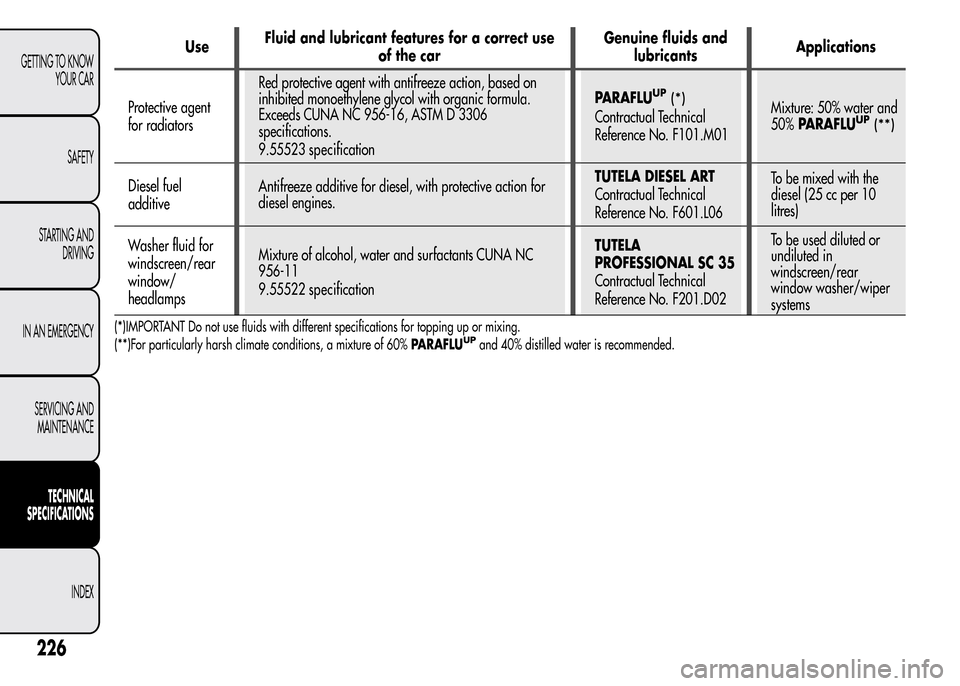
UseFluid and lubricant features for a correct use
of the carGenuine fluids and
lubricantsApplications
Protective agent
for radiatorsRed protective agent with antifreeze action, based on
inhibited monoethylene glycol with organic formula.
Exceeds CUNA NC 956-16, ASTM D 3306
specifications.
9.55523specificationPARAFLU
UP(*)
Contractual Technical
Reference No. F101.M01Mixture: 50% water and
50%PARAFLUUP(**)
Diesel fuel
additiveAntifreeze additive for diesel, with protective action for
diesel engines.TUTELA DIESEL ART
Contractual Technical
Reference No. F601.L06To be mixed with the
diesel (25 cc per 10
litres)
Washer fluid for
windscreen/rear
window/
headlampsMixture of alcohol, water and surfactants CUNA NC
956-11
9.55522specificationTUTELA
PROFESSIONAL SC 35
Contractual Technical
Reference No. F201.D02To be used diluted or
undiluted in
windscreen/rear
window washer/wiper
systems
(*)IMPORTANT Do not use fluids with different specifications for topping up or mixing.
(**)For particularly harsh climate conditions, a mixture of 60%PARAFLUUPand 40% distilled water is recommended.
226
GETTING TO KNOW
YOUR CAR
SAFETY
STARTING AND
DRIVING
IN AN EMERGENCY
SERVICING AND
MAINTENANCE
TECHNICAL
SPECIFICATIONS
INDEX
Page 235 of 280
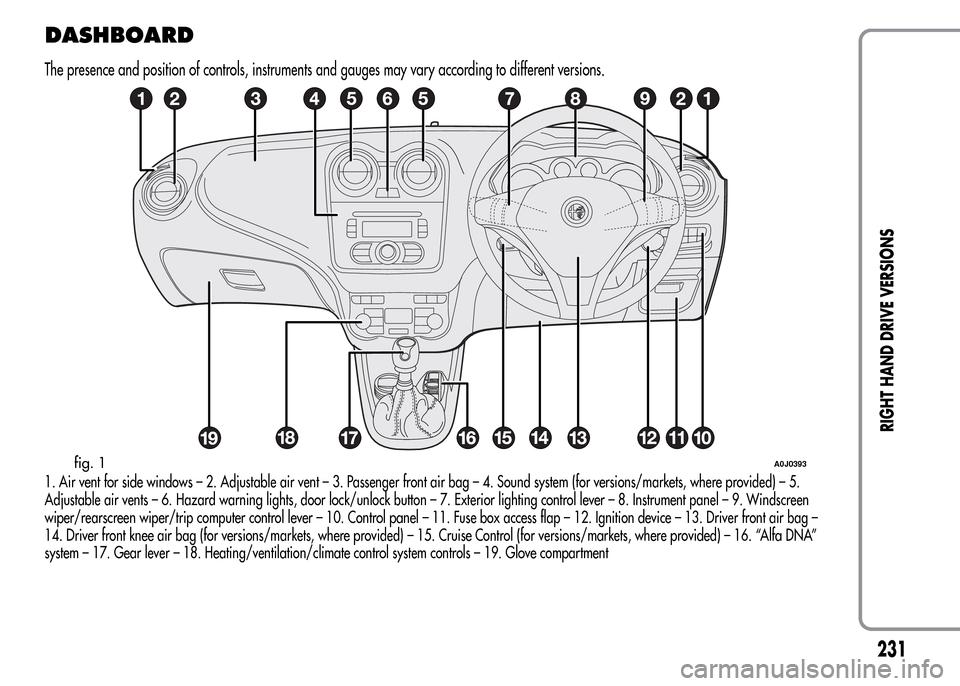
DASHBOARD
The presence and position of controls, instruments and gauges may vary according to different versions.
1. Air vent for side windows – 2. Adjustable air vent – 3. Passenger front air bag – 4. Sound system (for versions/markets, where provided) – 5.
Adjustable air vents – 6. Hazard warning lights, door lock/unlock button – 7. Exterior lighting control lever – 8. Instrument panel – 9. Windscreen
wiper/rearscreen wiper/trip computer control lever – 10. Control panel – 11. Fuse box access flap – 12. Ignition device – 13. Driver front air bag –
14. Driver front knee air bag (for versions/markets, where provided) – 15. Cruise Control (for versions/markets, where provided) – 16. “Alfa DNA”
system – 17. Gear lever – 18. Heating/ventilation/climate control system controls – 19. Glove compartment
fig. 1A0J0393
231
RIGHT HAND DRIVE VERSIONS