Start stop Alfa Romeo MiTo 2016 Workshop Manual
[x] Cancel search | Manufacturer: ALFA ROMEO, Model Year: 2016, Model line: MiTo, Model: Alfa Romeo MiTo 2016Pages: 280, PDF Size: 8.52 MB
Page 153 of 280
❒if after five minutes it is still impossible to reach at least 1.8 bar,
disengage the compressor from the valve and power socket, then
move the car forwards by approx. ten metres in order to distribute
the sealing fluid inside the tyre evenly, then repeat the inflation
operation;
❒if you still cannot obtain a pressure of at least 1.8 bar within 5
minutes from the compressor switching on, do not drive off and
contact Alfa Romeo Authorized Services;
❒after driving for about 10 minutes, stop and check the tyre pressure
again; remember to put the handbrake on;
❒if a pressure value of at least 1.8 bar is detected, restore the correct
pressure (with the engine running and the handbrake engaged),
resume driving and drive with great care to Alfa Romeo Authorized
Services.
Apply the adhesive label where it can be easily seen
by the driver as a reminder that the tyre has been
treated with the quick repair kit. Drive carefully,
particularly on bends. Do not exceed 80 km/h. Do not accelerate
or brake suddenly.
If the pressure has fallen below 1.8 bar, do not drive
any further: the Fix&Go Automatic quick tyre repair kit
cannot guarantee the correct hold because the tyre is
too damaged. Contact Alfa Romeo Authorized Services.
Inform the dealership that the tyre has been repaired
using the quick tyre repair kit. Give the leaflet to the
technicians who will be handling the tyre that was
repaired using the quick repair kit.
149
GETTING TO KNOW
YOUR CAR
SAFETY
STARTING AND
DRIVING
IN AN
EMERGENCY
SERVICING AND
MAINTENANCE
TECHNICAL
SPECIFICATIONS
INDEX
Page 172 of 280
BATTERY RECHARGING
IMPORTANT The battery recharging procedure is given as information
only. Contact Alfa Romeo Authorized Services to carry out this
operation.
IMPORTANT After turning the ignition key to STOP, wait at least 1
minute before disconnecting the battery power supply.
We recommend recharging the battery slowly for approximately 24
hours at low amperage. Charging for a longer time may damage the
battery.
VERSIONS WITHOUT Start&Stop
SYSTEM
(for versions/markets, where provided)
Charge the battery as follows:
❒disconnect the negative battery terminal;
❒connect the charger cables to the battery terminals, observing the
polarity;
❒turn on the battery charger;
❒when it is recharged, turn the charger off before disconnecting it
from the battery;
❒reconnect the negative battery terminal.
VERSIONS WITH Start&Stop SYSTEM
Charge the battery as follows:
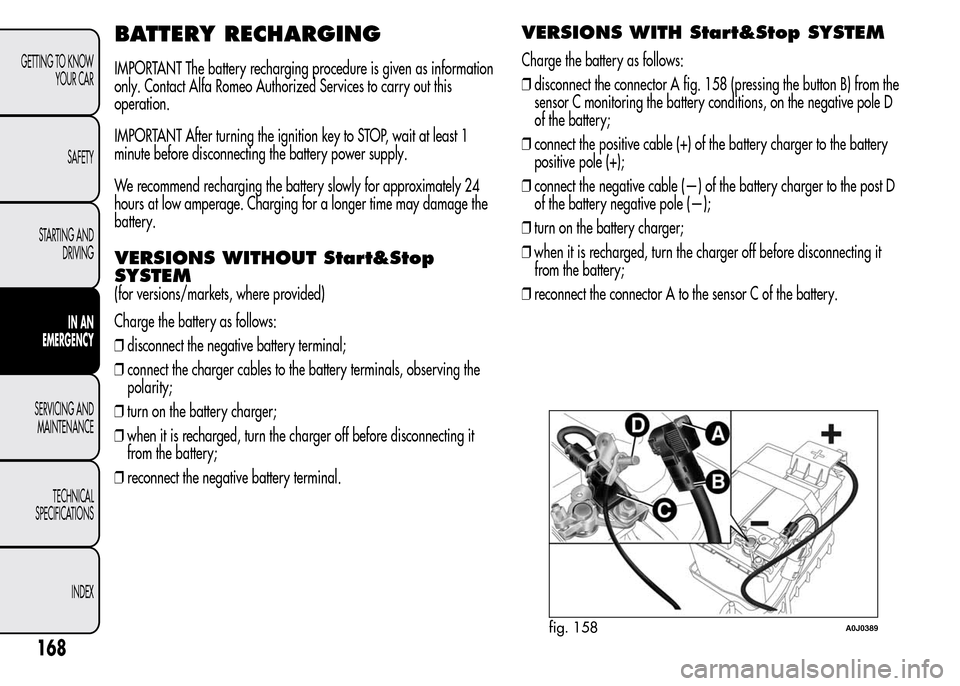
❒disconnect the connector A fig. 158 (pressing the button B) from the
sensor C monitoring the battery conditions, on the negative pole D
of the battery;
❒connect the positive cable (+) of the battery charger to the battery
positive pole (+);
❒connect the negative cable (—) of the battery charger to the post D
of the battery negative pole (—);
❒turn on the battery charger;
❒when it is recharged, turn the charger off before disconnecting it
from the battery;
❒reconnect the connector A to the sensor C of the battery.
fig. 158A0J0389
168
GETTING TO KNOW
YOUR CAR
SAFETY
STARTING AND
DRIVING
IN AN
EMERGENCY
SERVICING AND
MAINTENANCE
TECHNICAL
SPECIFICATIONS
INDEX
Page 174 of 280
Before beginning to tow, turn the ignition key to MAR
and then to STOP, without extracting it The steering
column will automatically lock when the key is
removed and the wheels cannot be steered.
Remember that whilst towing it is necessary to exert a
greater force when steering and braking because the
brake servo and electro-mechanical power steering
will be inoperative. Do not use wires for towing. Do not jerk. Be
careful not to damage parts in contact with the car while towing.
When towing the vehicle, you must comply with all specific traffic
regulations and adopt an appropriate driving behaviour. Do not
start the engine while towing the car. Clean the threaded seat
carefully before fastening the hook. Make sure that the hook is
fully fastened in the housing before towing the car.
The front and rear tow hooks should be used only for
emergencies on the road. You are allowed to tow the
vehicle for short distances using an appropriate device
in accordance with the highway code (a rigid bar), to move the
vehicle on the road in readiness for towing or transport via a
breakdown vehicle. Tow hooks MUST NOT be used to tow
vehicles off the road or where there are obstacles and/or for
towing operations using cables or other non-rigid devices.
Respecting the above conditions, towing must take place with the
two vehicles (one towing, the other towed) aligned as much as
possible along the same centre line.
170
GETTING TO KNOW
YOUR CAR
SAFETY
STARTING AND
DRIVING
IN AN
EMERGENCY
SERVICING AND
MAINTENANCE
TECHNICAL
SPECIFICATIONS
INDEX
Page 192 of 280
WHEELS AND TYRES
Before embarking on a long trip, and every two weeks, check the tyre
inflation pressure and space-saver wheel. Check the tyres when cold.
While driving the car, the pressure increases under standard
conditions: for the correct tyre inflation pressure, see "Wheels"
paragraph in the "Technical specifications" chapter.
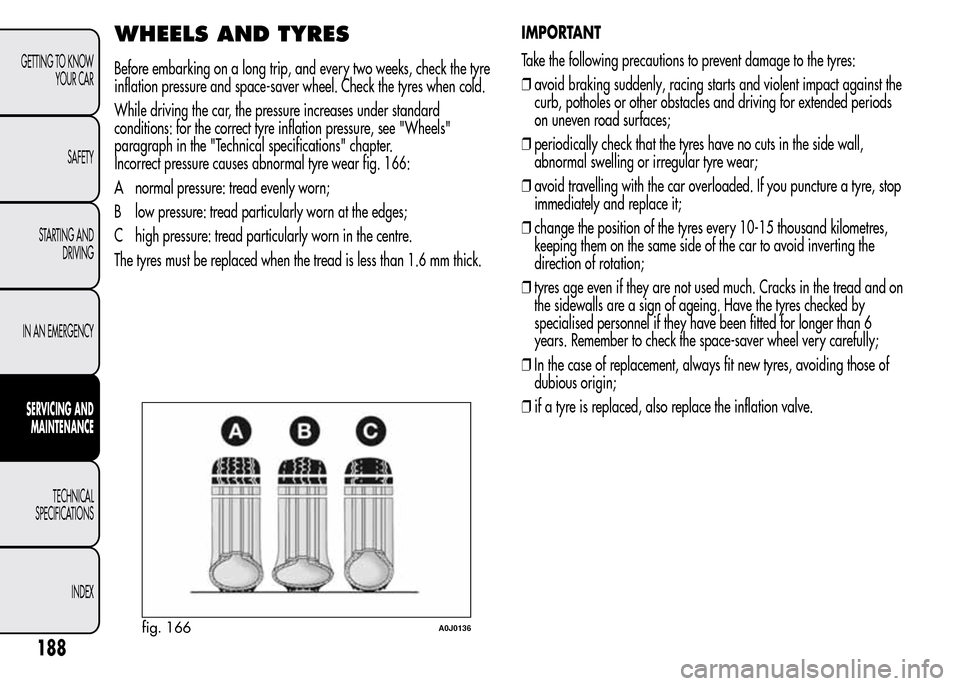
Incorrect pressure causes abnormal tyre wear fig. 166:
A normal pressure: tread evenly worn;
B low pressure: tread particularly worn at the edges;
C high pressure: tread particularly worn in the centre.
The tyres must be replaced when the tread is less than 1.6 mm thick.IMPORTANT
Take the following precautions to prevent damage to the tyres:
❒avoid braking suddenly, racing starts and violent impact against the
curb, potholes or other obstacles and driving for extended periods
on uneven road surfaces;
❒periodically check that the tyres have no cuts in the side wall,
abnormal swelling or irregular tyre wear;
❒avoid travelling with the car overloaded. If you puncture a tyre, stop
immediately and replace it;
❒change the position of the tyres every 10-15 thousand kilometres,
keeping them on the same side of the car to avoid inverting the
direction of rotation;
❒tyres age even if they are not used much. Cracks in the tread and on
the sidewalls are a sign of ageing. Have the tyres checked by
specialised personnel if they have been fitted for longer than 6
years. Remember to check the space-saver wheel very carefully;
❒In the case of replacement, always fit new tyres, avoiding those of
dubious origin;
❒if a tyre is replaced, also replace the inflation valve.
fig. 166A0J0136
188
GETTING TO KNOW
YOUR CAR
SAFETY
STARTING AND
DRIVING
IN AN EMERGENCY
SERVICING AND
MAINTENANCE
TECHNICAL
SPECIFICATIONS
INDEX
Page 194 of 280
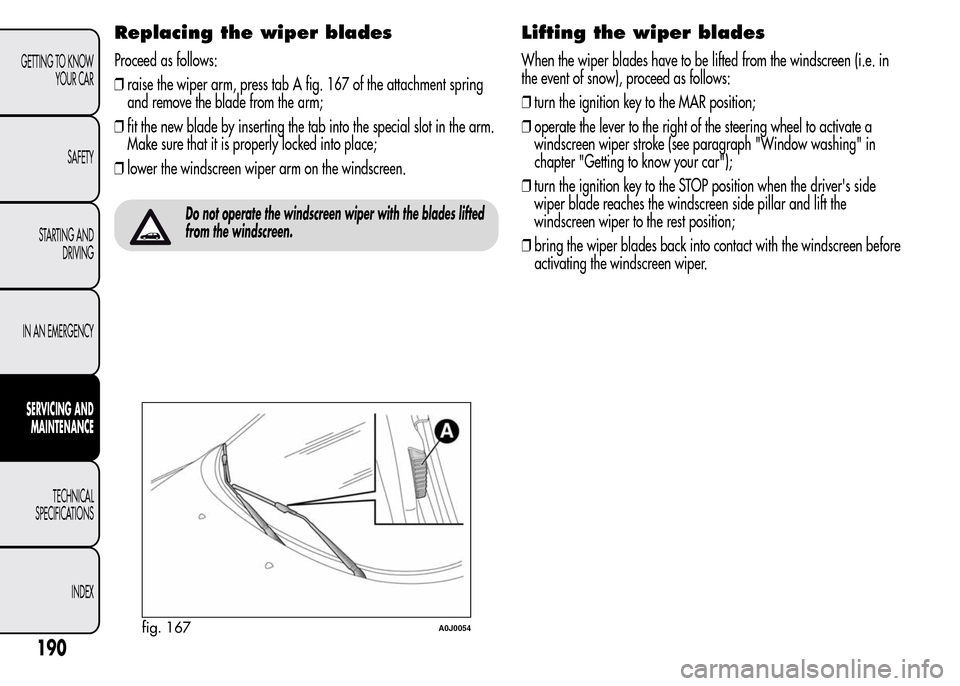
Replacing the wiper blades
Proceed as follows:
❒raise the wiper arm, press tab A fig. 167 of the attachment spring
and remove the blade from the arm;
❒fit the new blade by inserting the tab into the special slot in the arm.
Make sure that it is properly locked into place;
❒lower the windscreen wiper arm on the windscreen.
Do not operate the windscreen wiper with the blades lifted
from the windscreen.
Lifting the wiper blades
When the wiper blades have to be lifted from the windscreen (i.e. in
the event of snow), proceed as follows:
❒turn the ignition key to the MAR position;
❒operate the lever to the right of the steering wheel to activate a
windscreen wiper stroke (see paragraph "Window washing" in
chapter "Getting to know your car");
❒turn the ignition key to the STOP position when the driver's side
wiper blade reaches the windscreen side pillar and lift the
windscreen wiper to the rest position;
❒bring the wiper blades back into contact with the windscreen before
activating the windscreen wiper.
fig. 167A0J0054
190
GETTING TO KNOW
YOUR CAR
SAFETY
STARTING AND
DRIVING
IN AN EMERGENCY
SERVICING AND
MAINTENANCE
TECHNICAL
SPECIFICATIONS
INDEX
Page 198 of 280
IMPORTANT
Avoid parking under trees; the resin dropped by trees makes the
paintwork go opaque and increases the possibility of corrosion.
Bird droppings must be washed off immediately and thoroughly as the
acid they contain is particularly aggressive.
Windows
Use specific detergents and clean cloths to prevent scratching or
altering the transparency.
IMPORTANT Wipe the rear window inside gently with a cloth following
the direction of the filaments to avoid damaging the heating device.
Front headlights
Use a soft cloth soaked in water and detergent for washing cars.
IMPORTANT Never use aromatic substances (e.g. petrol) or ketenes
(e.g. acetone) for cleaning the plastic lenses of the front headlights.
IMPORTANT When cleaning with a pressure washer, keep the water jet
at least 20 cm away from the headlights.
Engine compartment
At the end of every winter, wash the engine compartment thoroughly,
taking care not to aim the jet of water directly at the electronic control
units or at the windscreen wiper motors. Have this operation
performed at a specialised workshop.
IMPORTANT The washing should take place with the engine cold and
the ignition key in the STOP position. After the washing operation,
make sure that the various protections (e.g. rubber caps and guards)
have not been removed or damaged.INTERIORS
Periodically check for water puddles under the mats that could cause
the panels to rust.
Never use flammable products, such as petrol ether or
rectified petrol to clean the inside of the car. The
electrostatic charges which are generated by rubbing
during the cleaning operation may cause a fire.
Do not keep aerosol cans in the car: they might
explode. Aerosol cans must not be exposed to a
temperature exceeding 50°C. When the car is exposed
to sunlight, the internal temperature can greatly exceed this
value.
SEATS AND FABRIC PARTS
Remove dust with a soft brush or a vacuum cleaner. It is advisable to
use a moist brush on velvet upholstery. Rub the seats with a sponge
soaked in a solution of neutral detergent and water.
CLEANING ALCANTARA SEATS
Alcantara trim can be treated and cleaned easily in the same way as
the other trims. The same indications given for cleaning fabrics are
also therefore applicable for this trim.
194
GETTING TO KNOW
YOUR CAR
SAFETY
STARTING AND
DRIVING
IN AN EMERGENCY
SERVICING AND
MAINTENANCE
TECHNICAL
SPECIFICATIONS
INDEX
Page 221 of 280
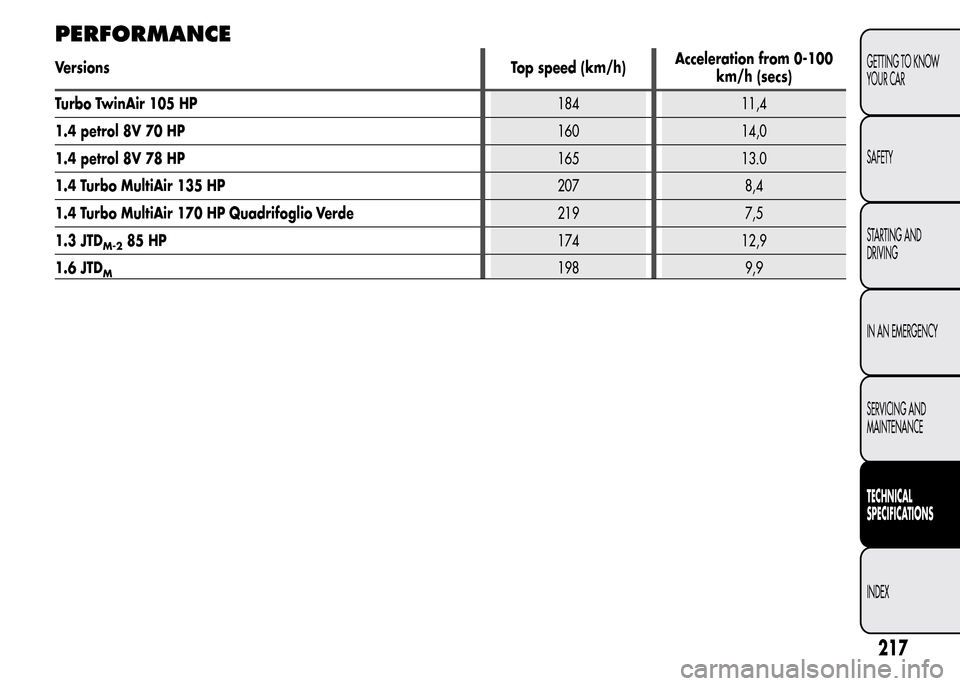
PERFORMANCE
VersionsTop speed (km/h)Acceleration from 0-100
km/h (secs)
Turbo TwinAir 105 HP184 11,4
1.4 petrol 8V 70 HP160 14,0
1.4 petrol 8V 78 HP165 13.0
1.4 Turbo MultiAir 135 HP207 8,4
1.4 Turbo MultiAir 170 HP Quadrifoglio Verde219 7,5
1.3 JTD
M-285 HP174 12,9
1.6 JTD
M198 9,9
217
GETTING TO KNOW
YOUR CAR
SAFETY
STARTING AND
DRIVING
IN AN EMERGENCY
SERVICING AND
MAINTENANCE
TECHNICAL
SPECIFICATIONS
INDEX
Page 232 of 280
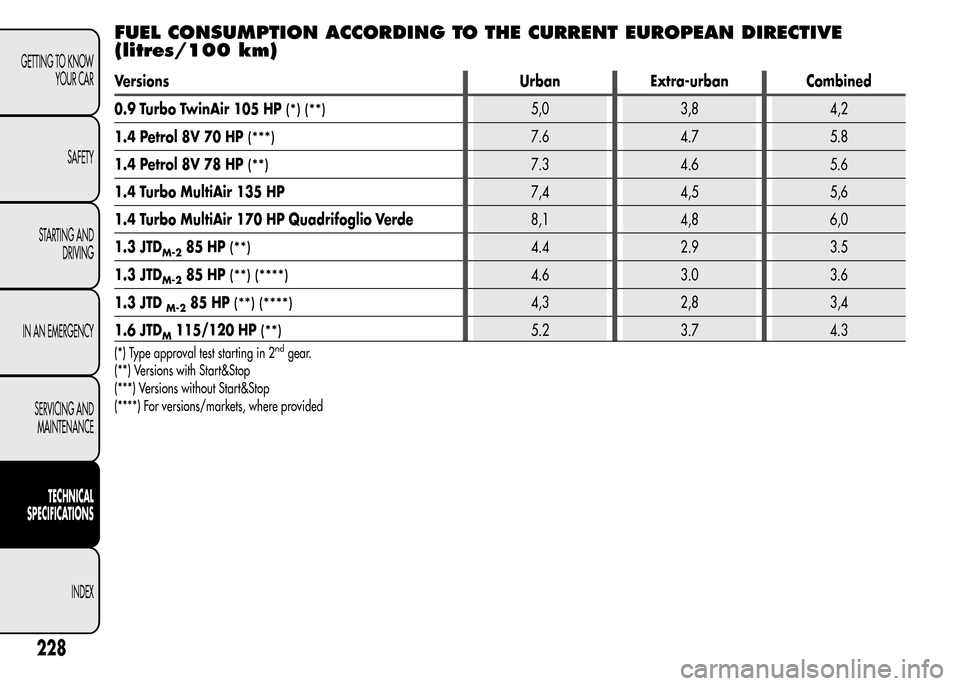
FUEL CONSUMPTION ACCORDING TO THE CURRENT EUROPEAN DIRECTIVE
(litres/100 km)
Versions Urban Extra-urban Combined
0.9 Turbo TwinAir 105 HP
(*) (**)5,0 3,8 4,2
1.4 Petrol 8V 70 HP
(***)7.6 4.7 5.8
1.4 Petrol 8V 78 HP
(**)7.3 4.6 5.6
1.4 Turbo MultiAir 135 HP7,4 4,5 5,6
1.4 Turbo MultiAir 170 HP Quadrifoglio Verde8,1 4,8 6,0
1.3 JTD
M-285 HP(**)4.4 2.9 3.5
1.3 JTD
M-285 HP(**) (****)4.6 3.0 3.6
1.3 JTD
M-285 HP(**) (****)4,3 2,8 3,4
1.6 JTD
M115/120 HP(**)5.2 3.7 4.3
(*) Type approval test starting in 2ndgear.
(**) Versions with Start&Stop
(***) Versions without Start&Stop
(****) For versions/markets, where provided
228
GETTING TO KNOW
YOUR CAR
SAFETY
STARTING AND
DRIVING
IN AN EMERGENCY
SERVICING AND
MAINTENANCE
TECHNICAL
SPECIFICATIONS
INDEX
Page 233 of 280
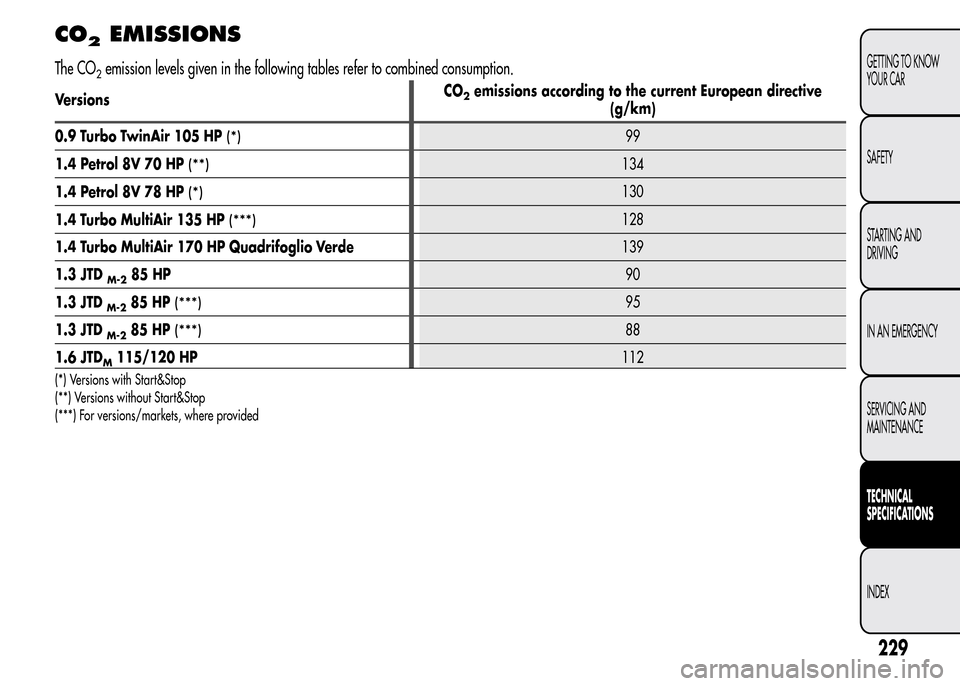
CO2EMISSIONS
The CO2emission levels given in the following tables refer to combined consumption.
VersionsCO2emissions according to the current European directive
(g/km)
0.9 Turbo TwinAir 105 HP
(*)99
1.4 Petrol 8V 70 HP
(**)134
1.4 Petrol 8V 78 HP
(*)130
1.4 Turbo MultiAir 135 HP
(***)128
1.4 Turbo MultiAir 170 HP Quadrifoglio Verde139
1.3 JTD
M-285 HP90
1.3 JTD
M-285 HP(***)95
1.3 JTD
M-285 HP(***)88
1.6 JTD
M115/120 HP112
(*) Versions with Start&Stop
(**) Versions without Start&Stop
(***) For versions/markets, where provided
229
GETTING TO KNOW
YOUR CAR
SAFETY
STARTING AND
DRIVING
IN AN EMERGENCY
SERVICING AND
MAINTENANCE
TECHNICAL
SPECIFICATIONS
INDEX
Page 248 of 280
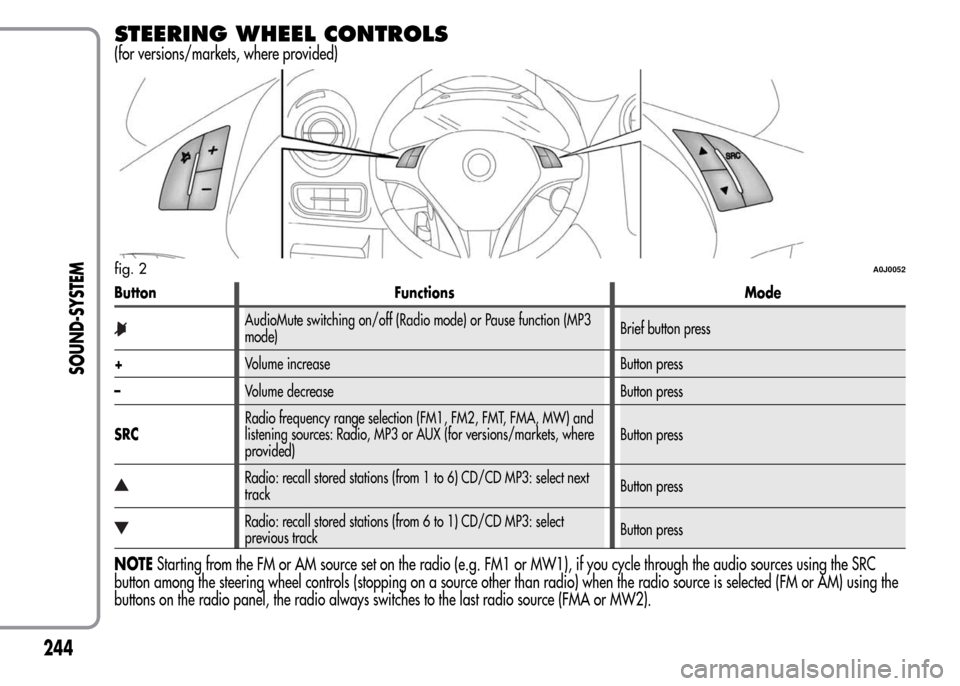
STEERING WHEEL CONTROLS
(for versions/markets, where provided)
Button Functions Mode
AudioMute switching on/off (Radio mode) or Pause function (MP3
mode)Brief button press
+Volume increase Button press
–Volume decrease Button press
SRCRadio frequency range selection (FM1, FM2, FMT, FMA, MW) and
listening sources: Radio, MP3 or AUX (for versions/markets, where
provided)Button press
Radio: recall stored stations (from 1 to 6) CD/CD MP3: select next
trackButton press
Radio: recall stored stations (from 6 to 1) CD/CD MP3: select
previous trackButton press
NOTEStarting from the FM or AM source set on the radio (e.g. FM1 or MW1), if you cycle through the audio sources using the SRC
button among the steering wheel controls (stopping on a source other than radio) when the radio source is selected (FM or AM) using the
buttons on the radio panel, the radio always switches to the last radio source (FMA or MW2).
fig. 2A0J0052
244
SOUND-SYSTEM