door Alfa Romeo MiTo 2017 User Guide
[x] Cancel search | Manufacturer: ALFA ROMEO, Model Year: 2017, Model line: MiTo, Model: Alfa Romeo MiTo 2017Pages: 212, PDF Size: 4.36 MB
Page 31 of 212
ELECTRIC WINDOWS
15)
2)
These operate when the ignition key is
turned to MAR and for about 3 minutes
after turning the key to STOP or
removing it if one of the doors is open.
Anti-crush safety device
An anti-crush device is operated when
the windows are lifted. This safety
system detects the presence of an
obstacle during the window closing travel
and cuts in by stopping and reversing the
window travel, depending on its position.
The anti-crushing feature is active during
window manual and automatic operation.
CONTROLS
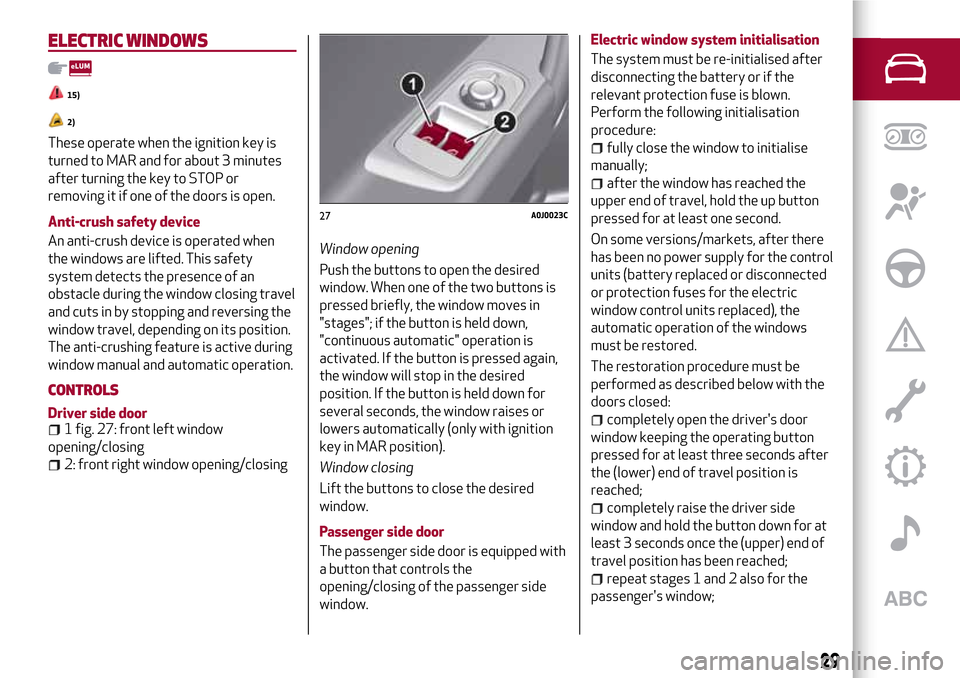
Driver side door1 fig. 27: front left window
opening/closing
2: front right window opening/closingWindow opening
Push the buttons to open the desired
window. When one of the two buttons is
pressed briefly, the window moves in
"stages"; if the button is held down,
"continuous automatic" operation is
activated. If the button is pressed again,
the window will stop in the desired
position. If the button is held down for
several seconds, the window raises or
lowers automatically (only with ignition
key in MAR position).
Window closing
Lift the buttons to close the desired
window.
Passenger side door
The passenger side door is equipped with
a button that controls the
opening/closing of the passenger side
window.Electric window system initialisation
The system must be re-initialised after
disconnecting the battery or if the
relevant protection fuse is blown.
Perform the following initialisation
procedure:
fully close the window to initialise
manually;
after the window has reached the
upper end of travel, hold the up button
pressed for at least one second.
On some versions/markets, after there
has been no power supply for the control
units (battery replaced or disconnected
or protection fuses for the electric
window control units replaced), the
automatic operation of the windows
must be restored.
The restoration procedure must be
performed as described below with the
doors closed:
completely open the driver's door
window keeping the operating button
pressed for at least three seconds after
the (lower) end of travel position is
reached;
completely raise the driver side
window and hold the button down for at
least 3 seconds once the (upper) end of
travel position has been reached;
repeat stages 1 and 2 also for the
passenger's window;
27A0J0023C
29
Page 36 of 212
LUGGAGE COMPARTMENT
INITIALISATION
IMPORTANT If the battery is
disconnected or the protection fuse
blows, the luggage compartment
opening/closing mechanism must be
initialised as follows:
close all the doors and the luggage
compartment;
press the buttonon the key;
press the buttonon the key;
EXTENDING THE LUGGAGE
COMPARTMENT
The luggage compartment can be
partially (1/3 or 2/3) or totally extended
by splitting the rear seat.
See the descriptions in “Rear seats” for
how to expand the luggage compartment.
HEADLIGHTS
LIGHT BEAM DIRECTION
The correct orientation of the headlights
is important for the driver's comfort and
safety as well as for all other road users.
This is also covered by a specific rule of
the highway code.
The headlights must be correctly
directed to ensure the best visibility
conditions for all drivers. Contact a Alfa
Romeo Dealership to have the headlights
checked and adjusted, if necessary.
FOG LIGHTS ALIGNMENT(where provided)
Contact a Alfa Romeo Dealership to have
the headlights checked and adjusted, if
necessary.
ADJUSTING THE HEADLIGHTS ABROAD
The dipped beam headlights are aligned
to comply with the regulations of the
country of purchase. When driving in
countries with a different traffic
direction, to avoid blinding the drivers
travelling in the opposite direction, it is
necessary to cover the areas of the beam
according to the provisions of the
Highway Code of the country you are
driving in.
Alfa DNASYSTEM (Car dynamic
control system)
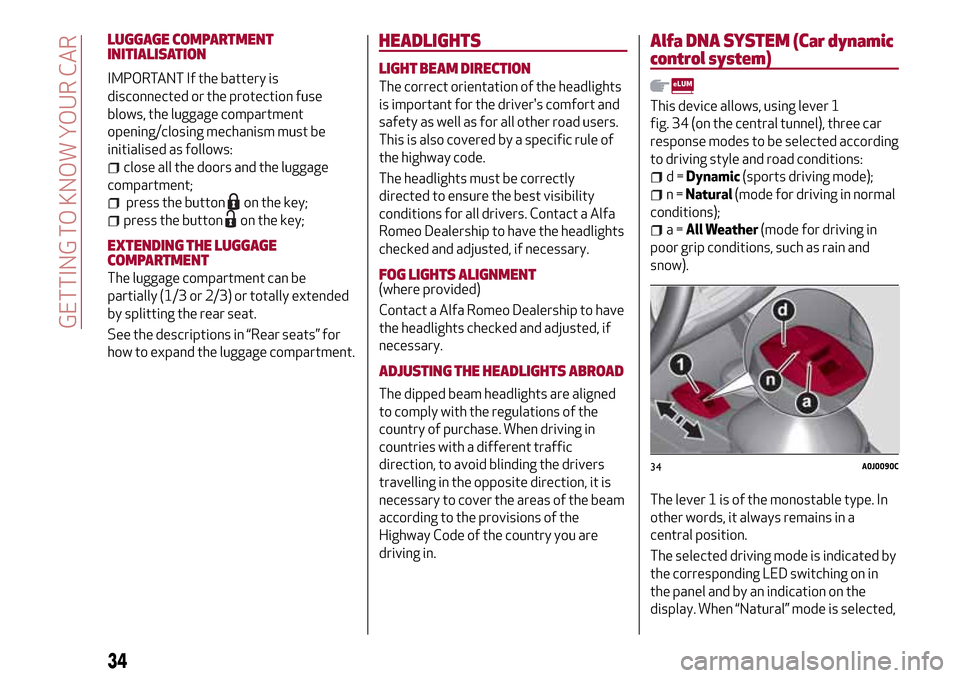
This device allows, using lever 1
fig. 34 (on the central tunnel), three car
response modes to be selected according
to driving style and road conditions:
d=Dynamic(sports driving mode);
n=Natural(mode for driving in normal
conditions);
a=All Weather(mode for driving in
poor grip conditions, such as rain and
snow).
The lever 1 is of the monostable type. In
other words, it always remains in a
central position.
The selected driving mode is indicated by
the corresponding LED switching on in
the panel and by an indication on the
display. When “Natural” mode is selected,
34A0J0090C
34
GETTING TO KNOW YOUR CAR
Page 44 of 212
DISPLAY
The car is equipped with a reconfigurable
multifunction display that, according to
the previously applied settings, will show
useful driving information.
With the ignition key removed, the
display lights up and shows the time and
total odometer reading (in km or miles)
for a few seconds when a door is
opened/closed.
RECONFIGURABLE MULTIFUNCTION
DISPLAY
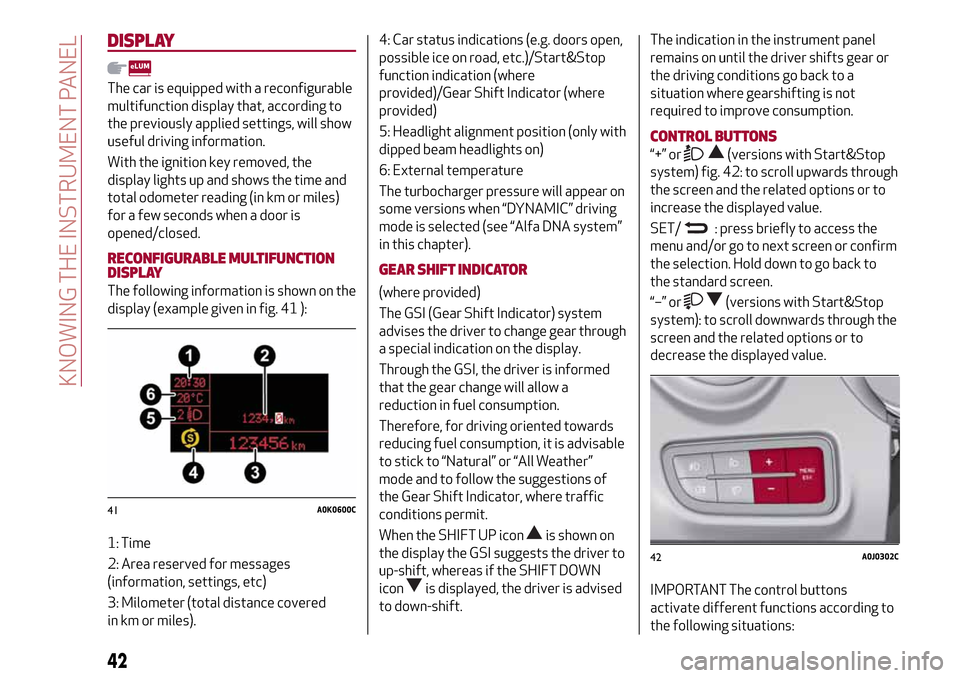
The following information is shown on the
display (example given in fig. 41 ):
1: Time
2: Area reserved for messages
(information, settings, etc)
3: Milometer (total distance covered
in km or miles).4: Car status indications (e.g. doors open,
possible ice on road, etc.)/Start&Stop
function indication (where
provided)/Gear Shift Indicator (where
provided)
5: Headlight alignment position (only with
dipped beam headlights on)
6: External temperature
The turbocharger pressure will appear on
some versions when “DYNAMIC” driving
mode is selected (see “Alfa DNA system”
in this chapter).
GEAR SHIFT INDICATOR
(where provided)
The GSI (Gear Shift Indicator) system
advises the driver to change gear through
a special indication on the display.
Through the GSI, the driver is informed
that the gear change will allow a
reduction in fuel consumption.
Therefore, for driving oriented towards
reducing fuel consumption, it is advisable
to stick to “Natural” or “All Weather”
mode and to follow the suggestions of
the Gear Shift Indicator, where traffic
conditions permit.
When the SHIFT UP icon
is shown on
the display the GSI suggests the driver to
up-shift, whereas if the SHIFT DOWN
icon
is displayed, the driver is advised
to down-shift.
The indication in the instrument panel
remains on until the driver shifts gear or
the driving conditions go back to a
situation where gearshifting is not
required to improve consumption.
CONTROL BUTTONS
“+” or(versions with Start&Stop
system) fig. 42: to scroll upwards through
the screen and the related options or to
increase the displayed value.
SET/
: press briefly to access the
menu and/or go to next screen or confirm
the selection. Hold down to go back to
the standard screen.
“–” or
(versions with Start&Stop
system): to scroll downwards through the
screen and the related options or to
decrease the displayed value.
IMPORTANT The control buttons
activate different functions according to
the following situations:
41A0K0600C
42A0J0302C
42
KNOWING THE INSTRUMENT PANEL
Page 46 of 212
Rain sensor
(where provided)
Adjustment (4 levels) of the sensitivity of
the rain sensor.
TripB activation
Activation (“On”) and deactivation (“Off”)
of Trip B display (partial trip counter). For
more information see the "Trip computer"
section.
Set time
Clock setting through two sub-menus:
“Time” and “Format”.
Set date
Date setting (day - month - year).
First page
(where provided)
Selection of the information you would
like to see on the main screen. You can
view the date or the trip distance.
See radio
On the instrument panel display, the
information onUconnect™system is
shown.
Autoclose
Activation of the automatic locking of the
doors on exceeding the speed of
20 km/h.
Measurement unit
Unit of measurement setting via three
submenus: “Distances”, “Fuelconsumption” and “Temperature”. If the
set distance unit is “km”, the display
allows the fuel consumption unit to be set
as km/l or l/100km. If the set distance
unit is “mi” the fuel consumption unit will
be displayed in “mpg”.
Language
Display language selection.
Warning volume
Adjustment (8 levels) of the volume of
the buzzer which accompanies the
display of failures/warnings.
Seat belt beep
This function can be displayed only after
an Alfa Romeo Dealership has
deactivated the SBR system (see
paragraph “SBR system” in the “Safety”
chapter).
Service
Display of information about km/mileage
intervals or, for versions/markets, where
provided, time intervals for car servicing.
Passenger airbag
Activation/deactivation of front
passenger side airbag and side air bag for
pelvis, chest and shoulder protection -
Side bag
Daytime running lights
Activation/deactivation of Daytime
Running Lights (DRL).Courtesy lights
This function turns on the internal
courtesy lights for approximately
25 seconds when the doors or luggage
compartment are opened using the
remote control. The courtesy lights are
turned off when the doors are closed or
locked using the remote control.
Exit Menu
Return to standard display screen.
44
KNOWING THE INSTRUMENT PANEL
Page 60 of 212

SYMBOLS ON THE DISPLAY
Symbol on the display What it means What to do
ALTERNATOR FAILURE
The symbol appears on the display in case of alternator
failure.If the symbol continues to be displayed, contact an Alfa
Romeo Dealership immediately.
ELECTRIC POWER STEERING FAILURE
(where provided)
The symbol appears on display in case of electric Power
Steering failure. If the symbol is still displayed (together
with a message) you will not benefit from the electric
power steering and the effort needed to turn the wheel
will be significantly increased, although it will still be
possible to steer the car.If the symbol continues to be displayed, contact an Alfa
Romeo Dealership immediately.
DOOR OPEN
(where provided)
The symbol appears on the display when one or more
doors are not completely shut. An acoustic signal is
activated with the doors open and the car moving.Close the door(s) properly.
LUGGAGE COMPARTMENT OPEN
The symbol appears on the display (together with a
message) when the luggage compartment is openClose the boot correctly.
BONNET OPEN
The symbol appears on the display (together with a
message) when the bonnet is openClose the bonnet properly.
SPEED LIMIT EXCEEDED
(where provided)
The symbol appears on the display when the vehicle
speed exceeds 120 km/h. An acoustic signal is also
emitted.Contact an Alfa Romeo Dealership as soon as possible.
58
KNOWING THE INSTRUMENT PANEL
Page 62 of 212
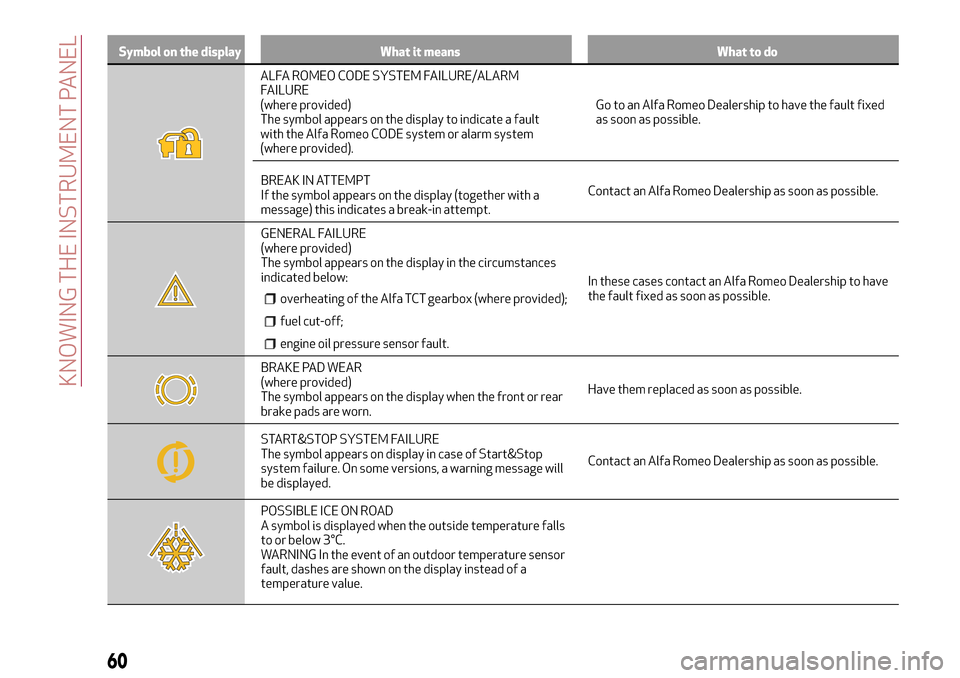
Symbol on the display What it means What to do
ALFA ROMEO CODE SYSTEM FAILURE/ALARM
FAILURE
(where provided)
The symbol appears on the display to indicate a fault
with the Alfa Romeo CODE system or alarm system
(where provided).Go to an Alfa Romeo Dealership to have the fault fixed
as soon as possible.
BREAK IN ATTEMPT
If the symbol appears on the display (together with a
message) this indicates a break-in attempt.Contact an Alfa Romeo Dealership as soon as possible.
GENERAL FAILURE
(where provided)
The symbol appears on the display in the circumstances
indicated below:
overheating of the Alfa TCT gearbox (where provided);
fuel cut-off;
engine oil pressure sensor fault.
In these cases contact an Alfa Romeo Dealership to have
the fault fixed as soon as possible.
BRAKE PAD WEAR
(where provided)
The symbol appears on the display when the front or rear
brake pads are worn.Have them replaced as soon as possible.
START&STOP SYSTEM FAILURE
The symbol appears on display in case of Start&Stop
system failure. On some versions, a warning message will
be displayed.Contact an Alfa Romeo Dealership as soon as possible.
POSSIBLE ICE ON ROAD
A symbol is displayed when the outside temperature falls
to or below 3°C.
WARNING In the event of an outdoor temperature sensor
fault, dashes are shown on the display instead of a
temperature value.
60
KNOWING THE INSTRUMENT PANEL
Page 89 of 212
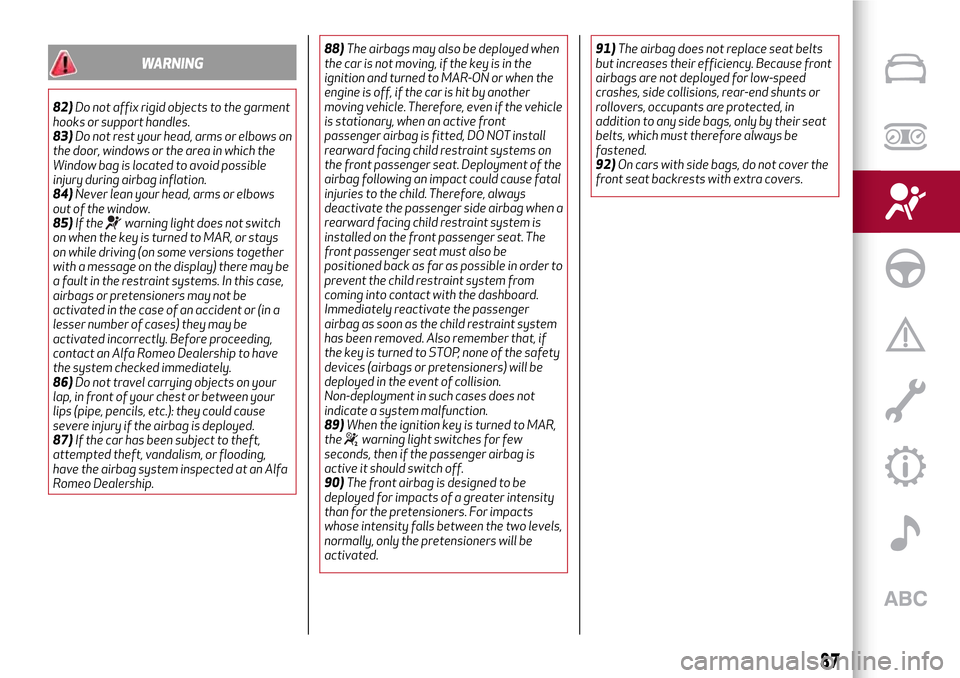
WARNING
82)Do not affix rigid objects to the garment
hooks or support handles.
83)Do not rest your head, arms or elbows on
the door, windows or the area in which the
Window bag is located to avoid possible
injury during airbag inflation.
84)Never lean your head, arms or elbows
out of the window.
85)If the
warning light does not switch
on when the key is turned to MAR, or stays
on while driving (on some versions together
with a message on the display) there may be
a fault in the restraint systems. In this case,
airbags or pretensioners may not be
activated in the case of an accident or (in a
lesser number of cases) they may be
activated incorrectly. Before proceeding,
contact an Alfa Romeo Dealership to have
the system checked immediately.
86)Do not travel carrying objects on your
lap, in front of your chest or between your
lips (pipe, pencils, etc.): they could cause
severe injury if the airbag is deployed.
87)If the car has been subject to theft,
attempted theft, vandalism, or flooding,
have the airbag system inspected at an Alfa
Romeo Dealership.88)The airbags may also be deployed when
the car is not moving, if the key is in the
ignition and turned to MAR-ON or when the
engine is off, if the car is hit by another
moving vehicle. Therefore, even if the vehicle
is stationary, when an active front
passenger airbag is fitted, DO NOT install
rearward facing child restraint systems on
the front passenger seat. Deployment of the
airbag following an impact could cause fatal
injuries to the child. Therefore, always
deactivate the passenger side airbag when a
rearward facing child restraint system is
installed on the front passenger seat. The
front passenger seat must also be
positioned back as far as possible in order to
prevent the child restraint system from
coming into contact with the dashboard.
Immediately reactivate the passenger
airbag as soon as the child restraint system
has been removed. Also remember that, if
the key is turned to STOP, none of the safety
devices (airbags or pretensioners) will be
deployed in the event of collision.
Non-deployment in such cases does not
indicate a system malfunction.
89)When the ignition key is turned to MAR,
the
warning light switches for few
seconds, then if the passenger airbag is
active it should switch off.
90)The front airbag is designed to be
deployed for impacts of a greater intensity
than for the pretensioners. For impacts
whose intensity falls between the two levels,
normally, only the pretensioners will be
activated.91)The airbag does not replace seat belts
but increases their efficiency. Because front
airbags are not deployed for low-speed
crashes, side collisions, rear-end shunts or
rollovers, occupants are protected, in
addition to any side bags, only by their seat
belts, which must therefore always be
fastened.
92)On cars with side bags, do not cover the
front seat backrests with extra covers.
87
Page 92 of 212
STARTING THE ENGINE
93) 94) 95)
17) 18) 19) 20)
Before starting the engine, adjust the
seat, the interior rear view mirrors, the
door mirrors and fasten the seat belt
correctly.
Never press the accelerator pedal for
starting the engine.
If necessary, messages indicating the
starting procedure can be shown on the
display.
PROCEDURE FOR PETROL VERSIONS
Except Turbo TwinAir versions
Proceed as follows:
engage the handbrake and place the
gearbox lever in neutral;
fully depress the clutch pedal, without
touching the accelerator;
turn the ignition key to AVV and
release it as soon as the engine starts.
Turbo TwinAir versions
Proceed as follows:
engage the handbrake and place the
gear lever in neutral or fully press the
clutch pedal if a gear other than neutral is
engaged;
turn the ignition key to AVV and
release it as soon as the engine starts.Versions with LPG system
To properly perform the starting
procedure, refer to as previously
described.
The engine always starts up on petrol
independently of the mode previously
selected. There must therefore always be
some petrol in the tank to protect the
petrol pump and to guarantee temporary
switching from LPG to petrol operation, if
high performance is required.
IMPORTANT NOTES
Except Turbo TwinAir versions:Ifthe
engine does not start at the first attempt,
return the ignition key to STOP before
repeating the procedure.
For Turbo TwinAir versions only:Ifthe
vehicle does not start at the first
attempt, return the ignition key to STOP
and repeat the starting procedure placing
the gear lever in neutral and fully
pressing the clutch pedal.
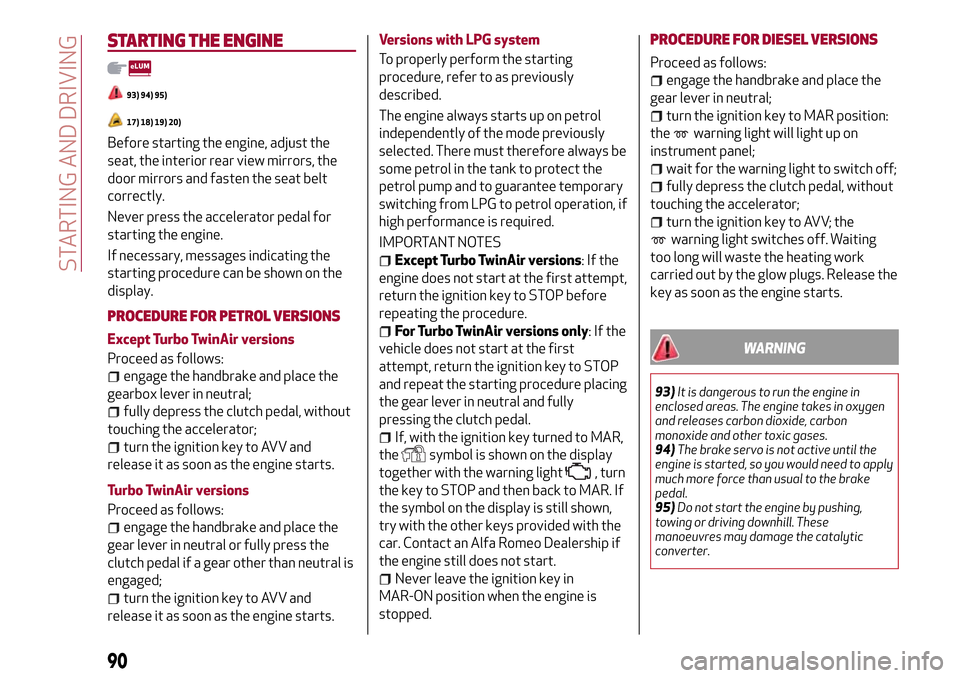
If, with the ignition key turned to MAR,
the
symbol is shown on the display
together with the warning light
, turn
the key to STOP and then back to MAR. If
the symbol on the display is still shown,
try with the other keys provided with the
car. Contact an Alfa Romeo Dealership if
the engine still does not start.
Never leave the ignition key in
MAR-ON position when the engine is
stopped.
PROCEDURE FOR DIESEL VERSIONS
Proceed as follows:
engage the handbrake and place the
gear lever in neutral;
turn the ignition key to MAR position:
the
warning light will light up on
instrument panel;
wait for the warning light to switch off;
fully depress the clutch pedal, without
touching the accelerator;
turn the ignition key to AVV; the
warning light switches off. Waiting
too long will waste the heating work
carried out by the glow plugs. Release the
key as soon as the engine starts.
WARNING
93)It is dangerous to run the engine in
enclosed areas. The engine takes in oxygen
and releases carbon dioxide, carbon
monoxide and other toxic gases.
94)The brake servo is not active until the
engine is started, so you would need to apply
much more force than usual to the brake
pedal.
95)Do not start the engine by pushing,
towing or driving downhill. These
manoeuvres may damage the catalytic
converter.
90
STARTING AND DRIVING
Page 98 of 212
SYSTEM MANUAL ACTIVATION /
DEACTIVATION
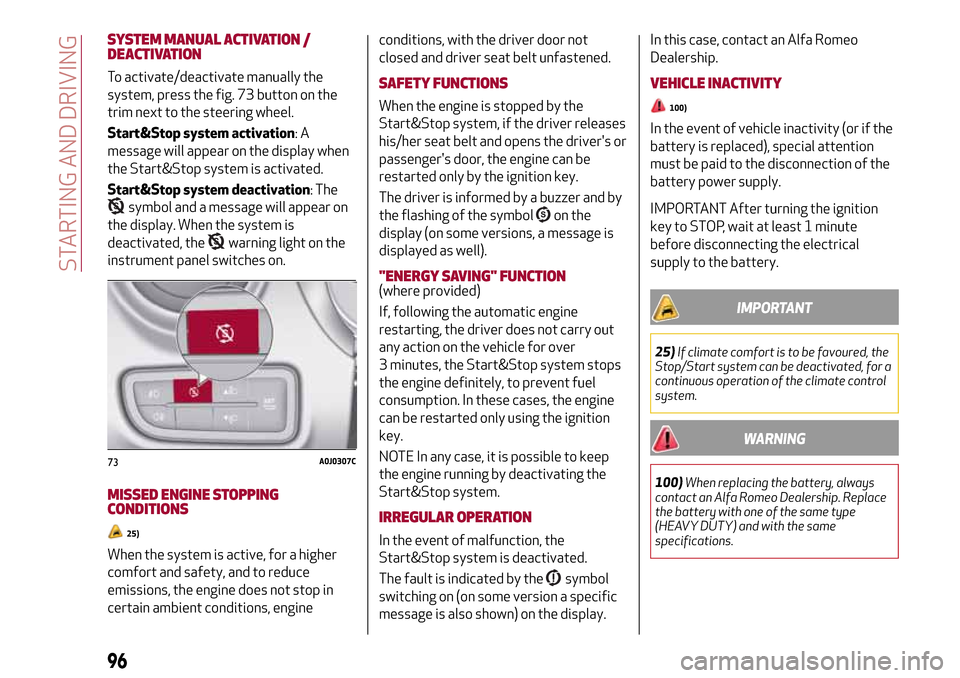
To activate/deactivate manually the
system, press the fig. 73 button on the
trim next to the steering wheel.
Start&Stop system activation:A
message will appear on the display when
the Start&Stop system is activated.
Start&Stop system deactivation: The
symbol and a message will appear on
the display. When the system is
deactivated, the
warning light on the
instrument panel switches on.
MISSED ENGINE STOPPING
CONDITIONS
25)
When the system is active, for a higher
comfort and safety, and to reduce
emissions, the engine does not stop in
certain ambient conditions, engineconditions, with the driver door not
closed and driver seat belt unfastened.
SAFETY FUNCTIONS
When the engine is stopped by the
Start&Stop system, if the driver releases
his/her seat belt and opens the driver's or
passenger's door, the engine can be
restarted only by the ignition key.
The driver is informed by a buzzer and by
the flashing of the symbol
on the
display (on some versions, a message is
displayed as well).
"ENERGY SAVING" FUNCTION(where provided)
If, following the automatic engine
restarting, the driver does not carry out
any action on the vehicle for over
3 minutes, the Start&Stop system stops
the engine definitely, to prevent fuel
consumption. In these cases, the engine
can be restarted only using the ignition
key.
NOTE In any case, it is possible to keep
the engine running by deactivating the
Start&Stop system.
IRREGULAR OPERATION
In the event of malfunction, the
Start&Stop system is deactivated.
The fault is indicated by the
symbol
switching on (on some version a specific
message is also shown) on the display.In this case, contact an Alfa Romeo
Dealership.
VEHICLE INACTIVITY
100)
In the event of vehicle inactivity (or if the
battery is replaced), special attention
must be paid to the disconnection of the
battery power supply.
IMPORTANT After turning the ignition
key to STOP, wait at least 1 minute
before disconnecting the electrical
supply to the battery.
IMPORTANT
25)If climate comfort is to be favoured, the
Stop/Start system can be deactivated, for a
continuous operation of the climate control
system.
WARNING
100)When replacing the battery, always
contact an Alfa Romeo Dealership. Replace
the battery with one of the same type
(HEAVY DUTY) and with the same
specifications.
73A0J0307C
96
STARTING AND DRIVING
Page 101 of 212
The following conditions may influence
the performance of the parking
assistance system:
reduced sensor sensitivity and a
reduction in the parking assistance
system performance could be due to the
presence on the surface of the sensor of:
ice, snow, mud, thick paint
The sensors may detect a
non-existent obstacle (echo interference)
due to mechanical interference, for
example when washing the car, in rain
(strong wind), hail.
The signals sent by the sensors can
also be altered by the presence of
ultrasonic systems (e.g. pneumatic brake
systems or pneumatic drills) near the
vehicle.
sensor performance can also be
influenced by the position of the sensors.
For example by a change in the ride
setting (caused by the wear of the shock
absorbers, suspension), overloading the
car and carrying out specific tuning
operations that require the car to be
lowered;
The detection of obstacles at the top
part of the car may not be guaranteed
because the system detects obstacles
that could cause an impact with the car in
the bottom part.
IMPORTANT
26)The sensor must be free of mud, dirt,
snow or ice in order for the system to work.
Be careful not to scratch or damage the
sensors while cleaning them. Avoid using dry,
rough or hard cloths. The sensors must be
washed using clean water, with the addition
of vehicle shampoo if necessary. When using
special washing equipment such as high
pressure jets or steam cleaning, clean the
sensors very quickly keeping the jet more
than 10 cm away.
WARNING
103)Only have the bumpers repainted or
any retouches to the paintwork in the area of
the sensors carried out by an Alfa Romeo
Dealership. Incorrect paint application could
affect the operation of the parking sensors.
104)Parking and other dangerous
manoeuvres are, however, always the
driver’s responsibility. While carrying out
these manoeuvres, always make sure that
no people (especially children) or animals are
in the area concerned. The parking sensors
are an aid for the driver, but the driver must
never allow their attention to lapse during
potentially dangerous manoeuvres, even
those executed at low speeds.
TOWING TRAILERS
105) 106)
IMPORTANT NOTES
The car must be provided with a
type-approved tow hook and adequate
electric system to tow caravans or
trailers. Installation must be carried out
by a specialist.
Install any specific and/or additional door
mirrors as specified by the Highway
Code.
Remember that when towing a trailer,
steep hills are harder to climb, the
braking spaces increase and overtaking
takes longer depending on the overall
weight.
Engage a low gear when driving downhill,
rather than constantly using the brake.
The weight of the trailer reduces the load
capacity of the car by the same amount.
Consider the weight at full load, including
accessories and luggage, to make sure
you do not exceed the maximum towable
weight (shown in the registration
document).
Do not exceed the speed limits specific
to each country you are driving in, in the
case of vehicles towing trailers. In any
case do not exceed 100 km/h.
99