fuel Alfa Romeo MiTo 2017 Owner's Guide
[x] Cancel search | Manufacturer: ALFA ROMEO, Model Year: 2017, Model line: MiTo, Model: Alfa Romeo MiTo 2017Pages: 212, PDF Size: 4.36 MB
Page 115 of 212
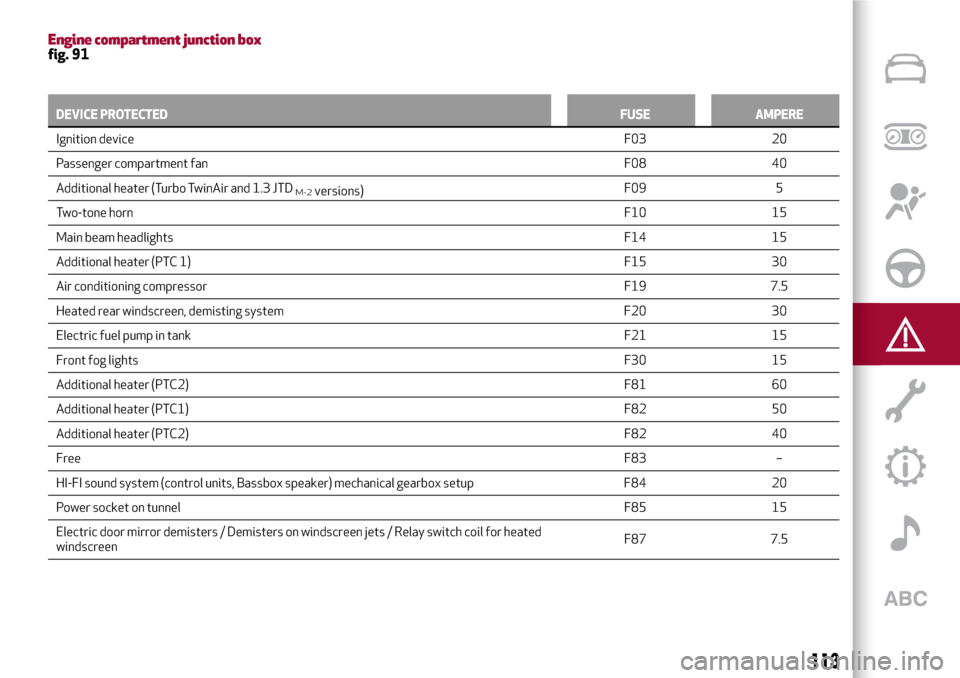
Engine compartment junction boxfig. 91
DEVICE PROTECTEDFUSE AMPERE
Ignition deviceF03 20
Passenger compartment fanF08 40
Additional heater (Turbo TwinAir and 1.3 JTD
M-2versions)F09 5
Two-tone hornF10 15
Main beam headlightsF14 15
Additional heater (PTC 1)F15 30
Air conditioning compressorF19 7.5
Heated rear windscreen, demisting system F20 30
Electric fuel pump in tankF21 15
Front fog lightsF30 15
Additional heater (PTC2)F81 60
Additional heater (PTC1)F82 50
Additional heater (PTC2)F82 40
FreeF83 –
HI-FI sound system (control units, Bassbox speaker) mechanical gearbox setup F84 20
Power socket on tunnelF85 15
Electric door mirror demisters / Demisters on windscreen jets / Relay switch coil for heated
windscreenF87 7.5
113
Page 125 of 212
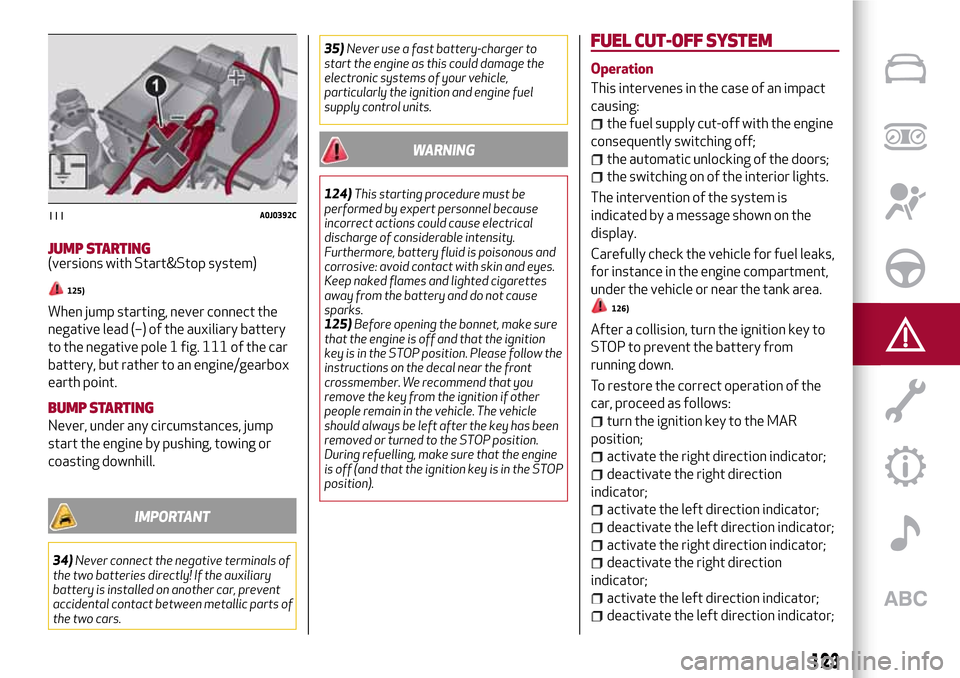
JUMP STARTING(versions with Start&Stop system)
125)
When jump starting, never connect the
negative lead (–) of the auxiliary battery
to the negative pole 1 fig. 111 of the car
battery, but rather to an engine/gearbox
earth point.
BUMP STARTING
Never, under any circumstances, jump
start the engine by pushing, towing or
coasting downhill.
IMPORTANT
34)Never connect the negative terminals of
the two batteries directly! If the auxiliary
battery is installed on another car, prevent
accidental contact between metallic parts of
the two cars.35)Never use a fast battery-charger to
start the engine as this could damage the
electronic systems of your vehicle,
particularly the ignition and engine fuel
supply control units.
WARNING
124)This starting procedure must be
performed by expert personnel because
incorrect actions could cause electrical
discharge of considerable intensity.
Furthermore, battery fluid is poisonous and
corrosive: avoid contact with skin and eyes.
Keep naked flames and lighted cigarettes
away from the battery and do not cause
sparks.
125)Before opening the bonnet, make sure
that the engine is off and that the ignition
key is in the STOP position. Please follow the
instructions on the decal near the front
crossmember. We recommend that you
remove the key from the ignition if other
people remain in the vehicle. The vehicle
should always be left after the key has been
removed or turned to the STOP position.
During refuelling, make sure that the engine
is off (and that the ignition key is in the STOP
position).
FUEL CUT-OFFSYSTEM
Operation
This intervenes in the case of an impact
causing:
the fuel supply cut-off with the engine
consequently switching off;
the automatic unlocking of the doors;
the switching on of the interior lights.
The intervention of the system is
indicated by a message shown on the
display.
Carefully check the vehicle for fuel leaks,
for instance in the engine compartment,
under the vehicle or near the tank area.
126)
After a collision, turn the ignition key to
STOP to prevent the battery from
running down.
To restore the correct operation of the
car, proceed as follows:
turn the ignition key to the MAR
position;
activate the right direction indicator;
deactivate the right direction
indicator;
activate the left direction indicator;
deactivate the left direction indicator;
activate the right direction indicator;
deactivate the right direction
indicator;
activate the left direction indicator;
deactivate the left direction indicator;
111A0J0392C
123
Page 126 of 212
ignition key turned to the OFF
position;
turn the ignition key to the MAR-ON
position.
Versions with LPG system
In case of impact, petrol supply is
immediately cut-off, the LPG safety
valves are closed and the injection is
interrupted, switching off the engine.
WARNING
126)If, after an impact, you smell fuel or
notice leaks from the fuel system, do not
reactivate the system to avoid the risk of
fire.
ALFA TCT TRANSMISSION - KEY
REMOVAL
36)
The ignition key can be removed only if
the gear lever is in position P (Park).
If the battery is flat and the ignition key is
engaged, the latter is locked in position.
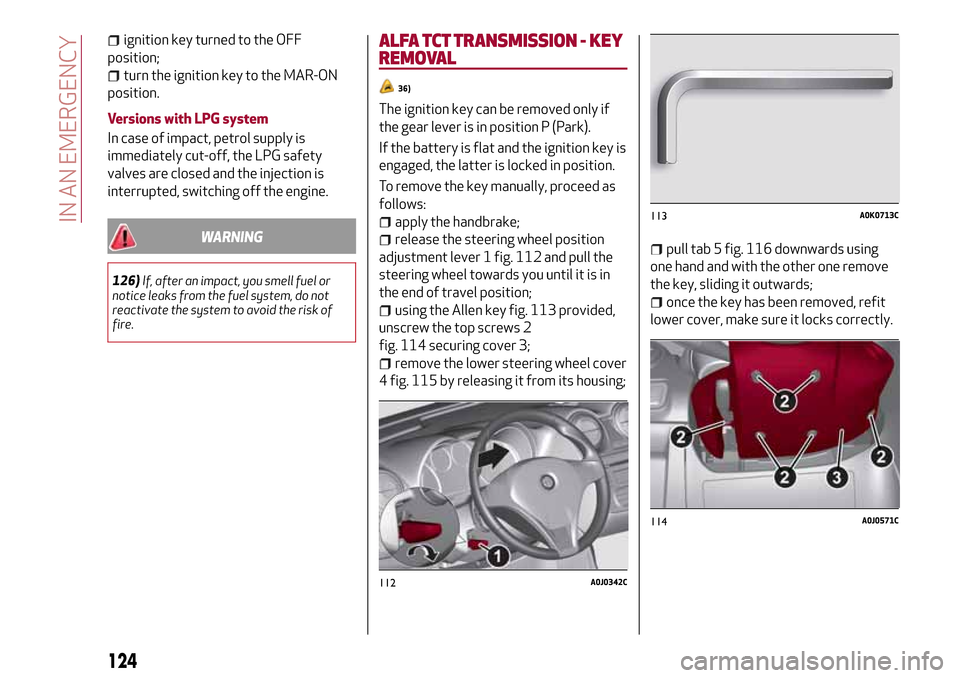
To remove the key manually, proceed as
follows:
apply the handbrake;
release the steering wheel position
adjustment lever 1 fig. 112 and pull the
steering wheel towards you until it is in
the end of travel position;
using the Allen key fig. 113 provided,
unscrew the top screws 2
fig. 114 securing cover 3;
remove the lower steering wheel cover
4 fig. 115 by releasing it from its housing;
pull tab 5 fig. 116 downwards using
one hand and with the other one remove
the key, sliding it outwards;
once the key has been removed, refit
lower cover, make sure it locks correctly.
112A0J0342C
113A0K0713C
114A0J0571C
124
IN AN EMERGENCY
Page 132 of 212
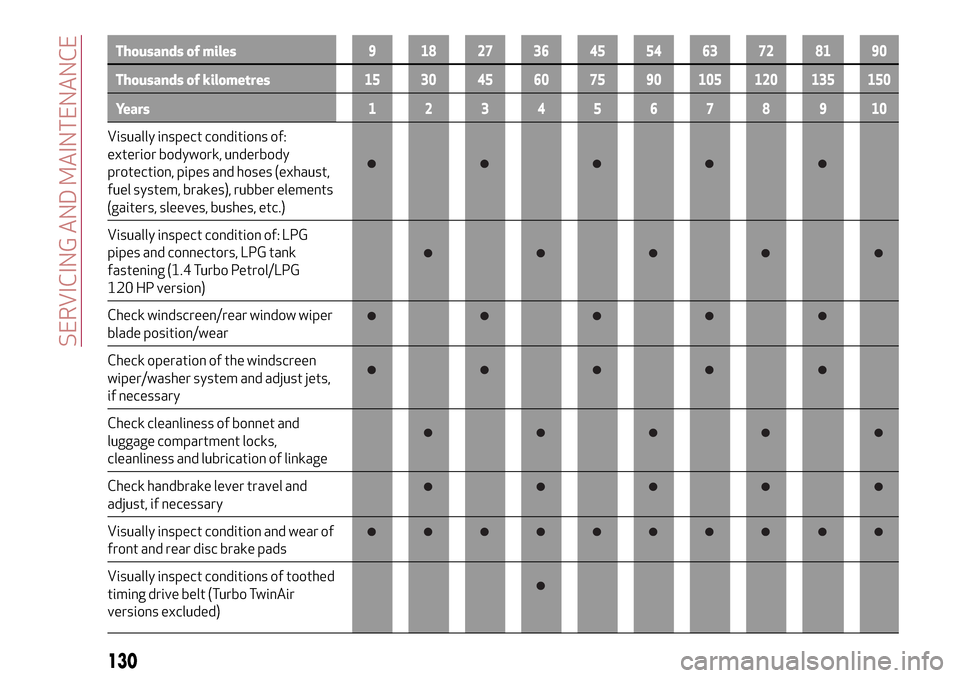
Thousands of miles9 182736455463728190
Thousands of kilometres15 30 45 60 75 90 105 120 135 150
Years12345678910
Visually inspect conditions of:
exterior bodywork, underbody
protection, pipes and hoses (exhaust,
fuel system, brakes), rubber elements
(gaiters, sleeves, bushes, etc.)
Visually inspect condition of: LPG
pipes and connectors, LPG tank
fastening (1.4 Turbo Petrol/LPG
120 HP version)
Check windscreen/rear window wiper
blade position/wear
Check operation of the windscreen
wiper/washer system and adjust jets,
if necessary
Check cleanliness of bonnet and
luggage compartment locks,
cleanliness and lubrication of linkage
Check handbrake lever travel and
adjust, if necessary
Visually inspect condition and wear of
front and rear disc brake pads
Visually inspect conditions of toothed
timing drive belt (Turbo TwinAir
versions excluded)
130
SERVICING AND MAINTENANCE
Page 136 of 212
Thousands of miles12 24 36 48 60 72 84 96 108 120
Thousands of kilometres20 40 60 80 100 120 140 160 180 200
Years12345678910
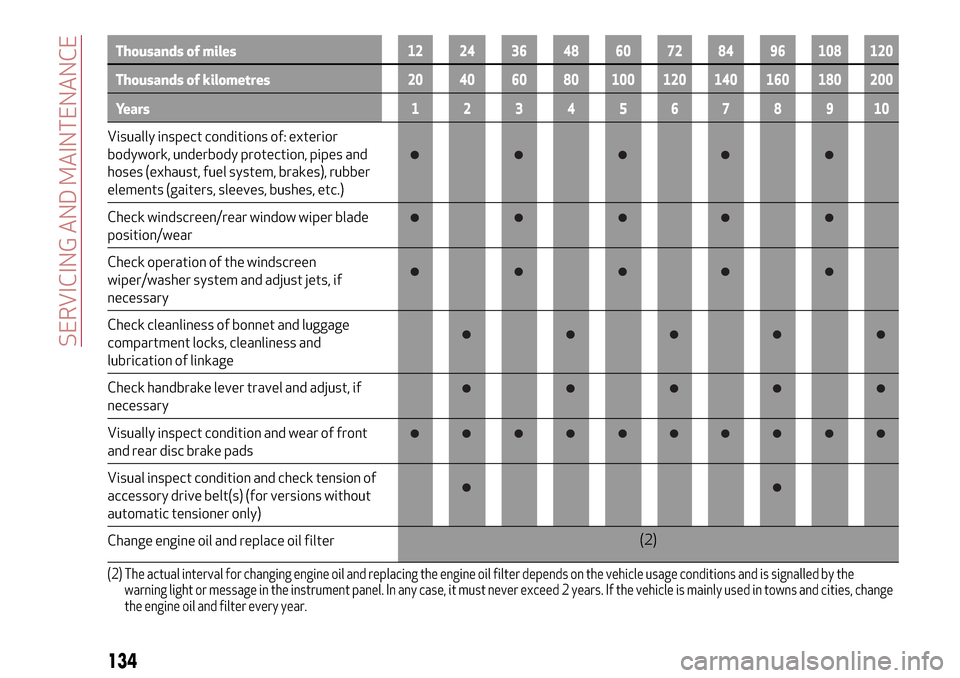
Visually inspect conditions of: exterior
bodywork, underbody protection, pipes and
hoses (exhaust, fuel system, brakes), rubber
elements (gaiters, sleeves, bushes, etc.)
Check windscreen/rear window wiper blade
position/wear
Check operation of the windscreen
wiper/washer system and adjust jets, if
necessary
Check cleanliness of bonnet and luggage
compartment locks, cleanliness and
lubrication of linkage
Check handbrake lever travel and adjust, if
necessary
Visually inspect condition and wear of front
and rear disc brake pads
Visual inspect condition and check tension of
accessory drive belt(s) (for versions without
automatic tensioner only)
Change engine oil and replace oil filter(2)
(2) The actual interval for changing engine oil and replacing the engine oil filter depends on the vehicle usage conditions and is signalled by the
warning light or message in the instrument panel. In any case, it must never exceed 2 years. If the vehicle is mainly used in towns and cities, change
the engine oil and filter every year.
134
SERVICING AND MAINTENANCE
Page 137 of 212
Thousands of miles12 24 36 48 60 72 84 96 108 120
Thousands of kilometres20 40 60 80 100 120 140 160 180 200
Years12345678910
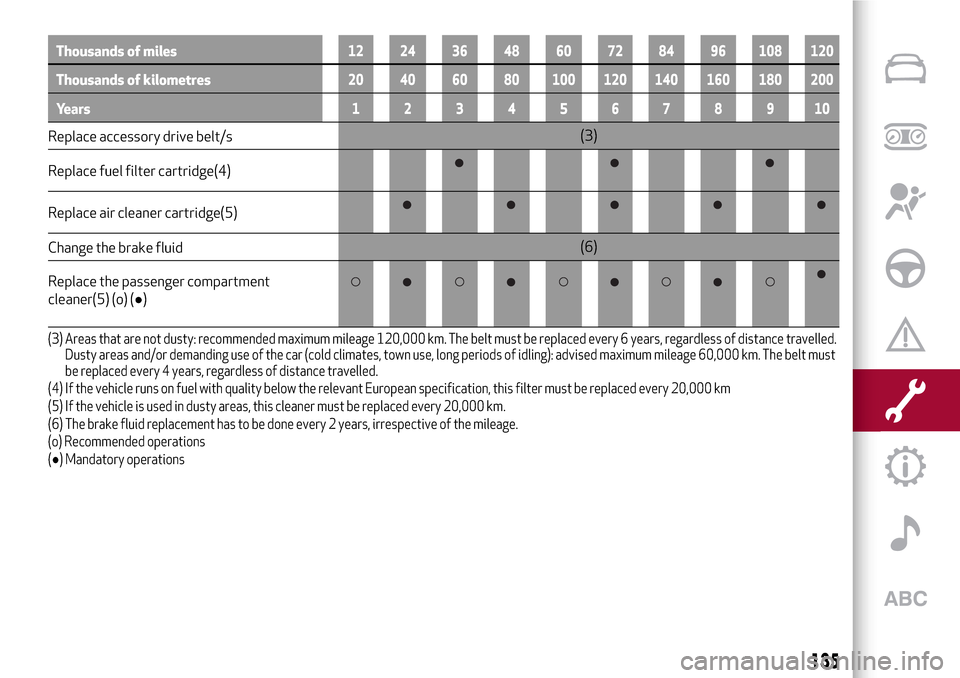
Replace accessory drive belt/s(3)
Replace fuel filter cartridge(4)
Replace air cleaner cartridge(5)
Change the brake fluid(6)
Replace the passenger compartment
cleaner(5) (o) (●)
(3) Areas that are not dusty: recommended maximum mileage 120,000 km. The belt must be replaced every 6 years, regardless of distance travelled.
Dusty areas and/or demanding use of the car (cold climates, town use, long periods of idling): advised maximum mileage 60,000 km. The belt must
be replaced every 4 years, regardless of distance travelled.
(4) If the vehicle runs on fuel with quality below the relevant European specification, this filter must be replaced every 20,000 km
(5) If the vehicle is used in dusty areas, this cleaner must be replaced every 20,000 km.
(6) The brake fluid replacement has to be done every 2 years, irrespective of the mileage.
(o) Recommended operations
(●) Mandatory operations
135
Page 138 of 212
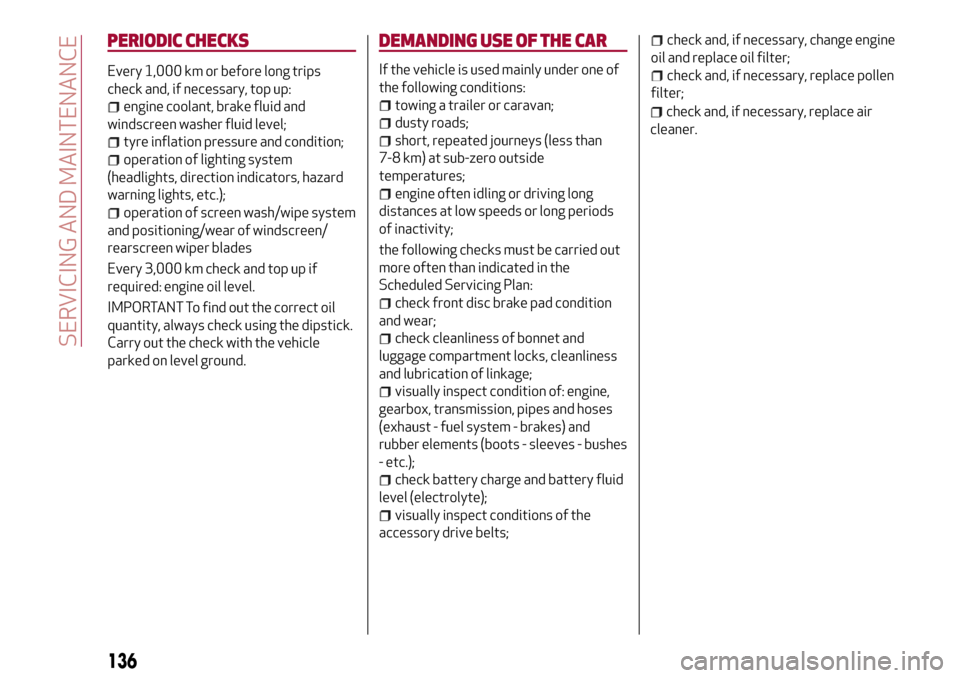
PERIODIC CHECKS
Every 1,000 km or before long trips
check and, if necessary, top up:
engine coolant, brake fluid and
windscreen washer fluid level;
tyre inflation pressure and condition;
operation of lighting system
(headlights, direction indicators, hazard
warning lights, etc.);
operation of screen wash/wipe system
and positioning/wear of windscreen/
rearscreen wiper blades
Every 3,000 km check and top up if
required: engine oil level.
IMPORTANT To find out the correct oil
quantity, always check using the dipstick.
Carry out the check with the vehicle
parked on level ground.
DEMANDING USE OF THE CAR
If the vehicle is used mainly under one of
the following conditions:
towing a trailer or caravan;
dusty roads;
short, repeated journeys (less than
7-8 km) at sub-zero outside
temperatures;
engine often idling or driving long
distances at low speeds or long periods
of inactivity;
the following checks must be carried out
more often than indicated in the
Scheduled Servicing Plan:
check front disc brake pad condition
and wear;
check cleanliness of bonnet and
luggage compartment locks, cleanliness
and lubrication of linkage;
visually inspect condition of: engine,
gearbox, transmission, pipes and hoses
(exhaust - fuel system - brakes) and
rubber elements (boots - sleeves - bushes
- etc.);
check battery charge and battery fluid
level (electrolyte);
visually inspect conditions of the
accessory drive belts;
check and, if necessary, change engine
oil and replace oil filter;
check and, if necessary, replace pollen
filter;
check and, if necessary, replace air
cleaner.
136
SERVICING AND MAINTENANCE
Page 153 of 212
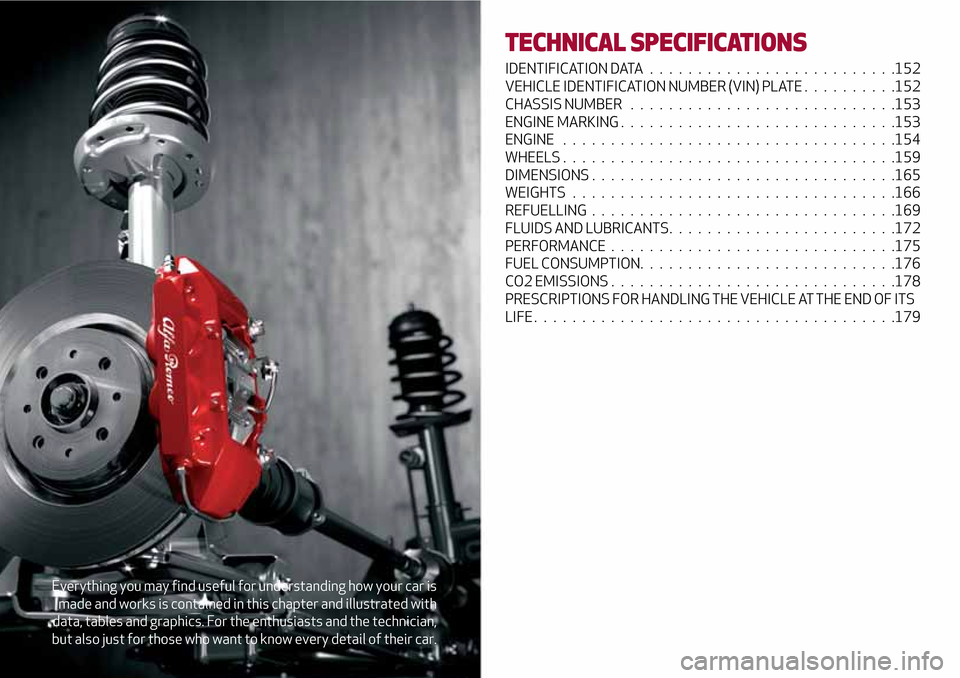
Everything you may find useful for understanding how your car is
made and works is contained in this chapter and illustrated with
data, tables and graphics. For the enthusiasts and the technician,
but also just for those who want to know every detail of their car.
TECHNICAL SPECIFICATIONS
IDENTIFICATION DATA..........................152
VEHICLE IDENTIFICATION NUMBER (VIN) PLATE . . . . ......152
CHASSIS NUMBER . . . . . .......................153
ENGINE MARKING . . . . . ........................153
ENGINE...................................154
WHEELS...................................159
DIMENSIONS . . ..............................165
WEIGHTS..................................166
REFUELLING................................169
FLUIDS AND LUBRICANTS. . . .....................172
PERFORMANCE . . . . . . . . . . . . . .................175
FUEL CONSUMPTION. . . . . ......................176
CO2 EMISSIONS . . . . ..........................178
PRESCRIPTIONS FOR HANDLING THE VEHICLE AT THE END OF ITS
LIFE......................................179
Page 156 of 212
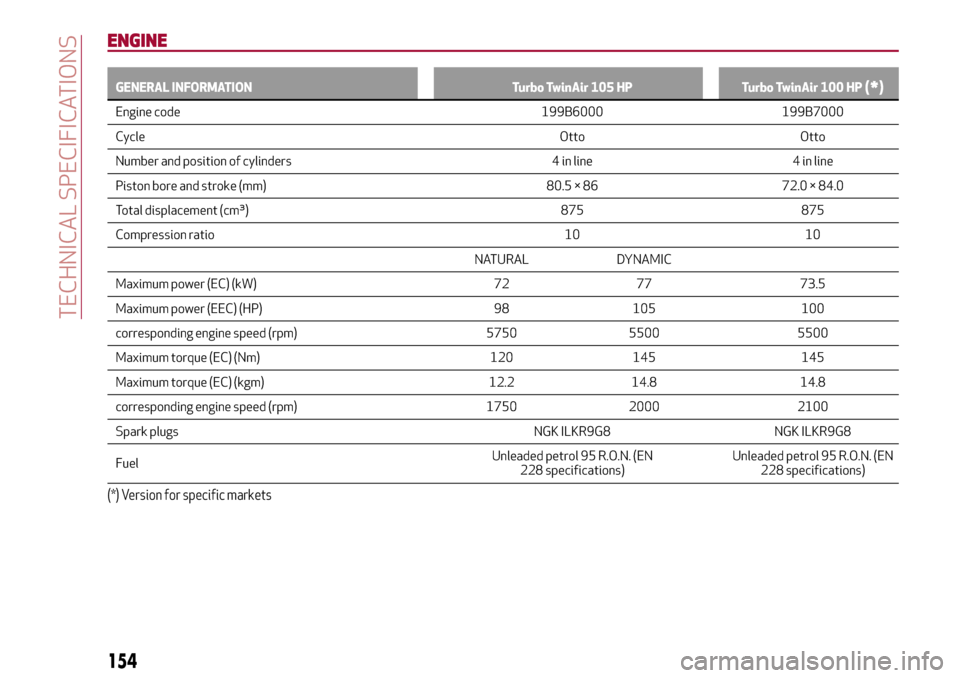
ENGINE
GENERAL INFORMATION Turbo TwinAir 105 HP Turbo TwinAir 100 HP(*)
Engine code 199B6000 199B7000
CycleOtto Otto
Number and position of cylinders 4 in line 4 in line
Piston bore and stroke (mm) 80.5 × 86 72.0 × 84.0
Total displacement (cm³) 875 875
Compression ratio 10 10
NATURAL DYNAMIC
Maximum power (EC) (kW) 72 77 73.5
Maximum power (EEC) (HP) 98 105 100
corresponding engine speed (rpm) 5750 5500 5500
Maximum torque (EC) (Nm) 120 145 145
Maximum torque (EC) (kgm) 12.2 14.8 14.8
corresponding engine speed (rpm) 1750 2000 2100
Spark plugs NGK ILKR9G8 NGK ILKR9G8
FuelUnleaded petrol 95 R.O.N. (EN
228 specifications)Unleaded petrol 95 R.O.N. (EN
228 specifications)
(*) Version for specific markets
154
TECHNICAL SPECIFICATIONS
Page 157 of 212
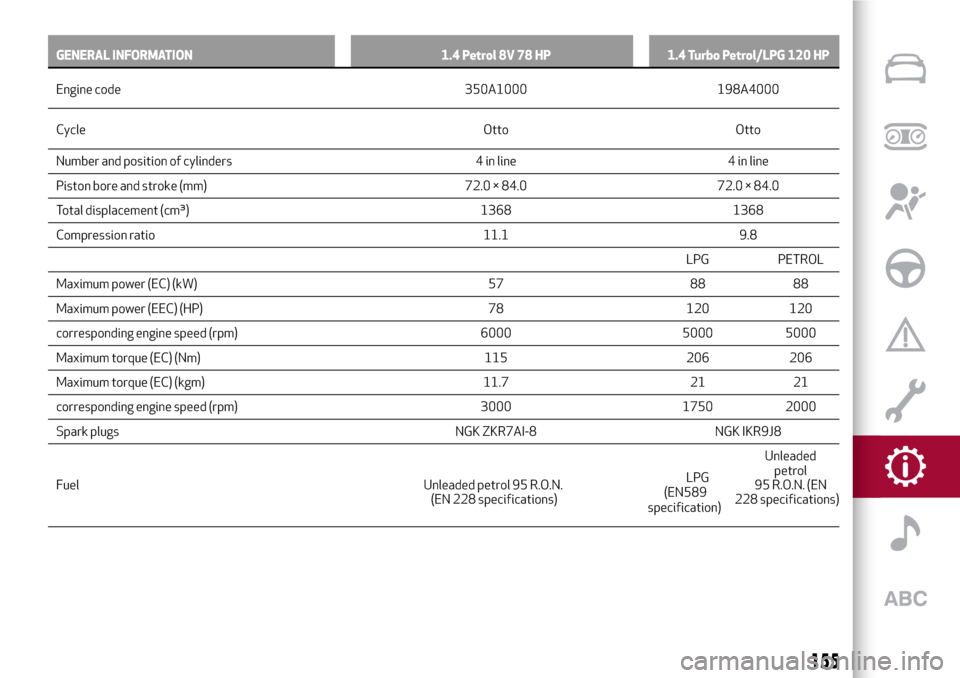
GENERAL INFORMATION 1.4 Petrol 8V 78 HP 1.4 Turbo Petrol/LPG 120 HP
Engine code 350A1000 198A4000
Cycle Otto Otto
Number and position of cylinders 4 in line 4 in line
Piston bore and stroke (mm) 72.0 × 84.0 72.0 × 84.0
Total displacement (cm³) 1368 1368
Compression ratio 11.1 9.8
LPG PETROL
Maximum power (EC) (kW) 57 88 88
Maximum power (EEC) (HP) 78 120 120
corresponding engine speed (rpm) 6000 5000 5000
Maximum torque (EC) (Nm) 115 206 206
Maximum torque (EC) (kgm) 11.7 21 21
corresponding engine speed (rpm) 3000 1750 2000
Spark plugs NGK ZKR7AI-8 NGK IKR9J8
Fuel Unleaded petrol 95 R.O.N.
(EN 228 specifications)LPG
(EN589Unleaded
petrol
95 R.O.N. (EN
228 specifications)
155
specification)