warning lights Alfa Romeo MiTo 2017 Owner's Guide
[x] Cancel search | Manufacturer: ALFA ROMEO, Model Year: 2017, Model line: MiTo, Model: Alfa Romeo MiTo 2017Pages: 212, PDF Size: 4.36 MB
Page 58 of 212
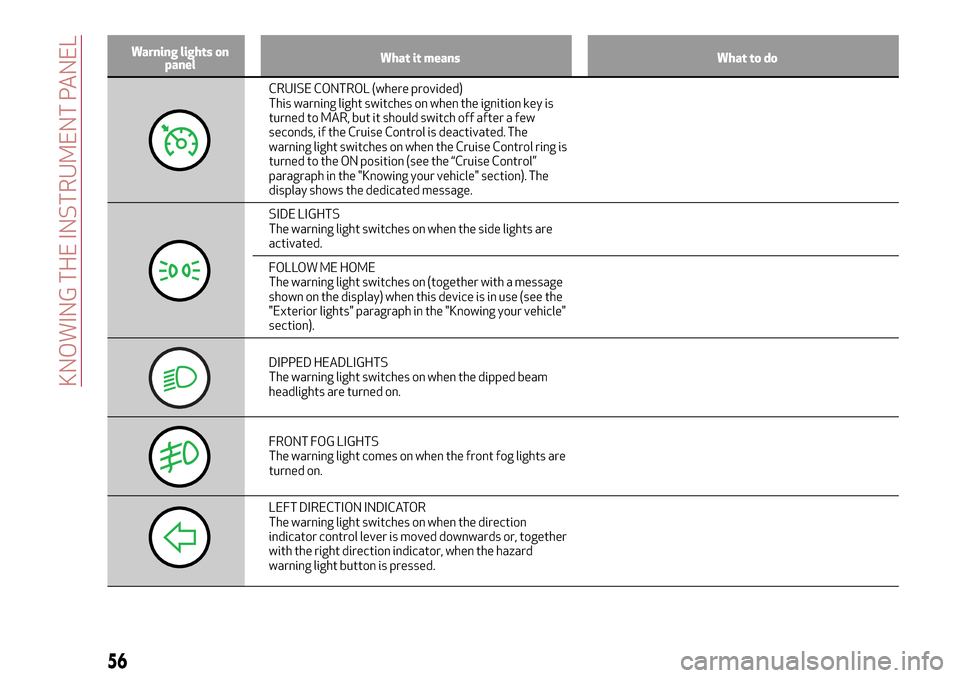
Warning lights on
panelWhat it means What to do
CRUISE CONTROL (where provided)
This warning light switches on when the ignition key is
turned to MAR, but it should switch off after a few
seconds, if the Cruise Control is deactivated. The
warning light switches on when the Cruise Control ring is
turned to the ON position (see the “Cruise Control”
paragraph in the "Knowing your vehicle" section). The
display shows the dedicated message.
SIDE LIGHTS
The warning light switches on when the side lights are
activated.
FOLLOW ME HOME
The warning light switches on (together with a message
shown on the display) when this device is in use (see the
"Exterior lights" paragraph in the "Knowing your vehicle"
section).
DIPPED HEADLIGHTS
The warning light switches on when the dipped beam
headlights are turned on.
FRONT FOG LIGHTS
The warning light comes on when the front fog lights are
turned on.
LEFT DIRECTION INDICATOR
The warning light switches on when the direction
indicator control lever is moved downwards or, together
with the right direction indicator, when the hazard
warning light button is pressed.
56
KNOWING THE INSTRUMENT PANEL
Page 59 of 212
Warning lights on
panelWhat it means What to do
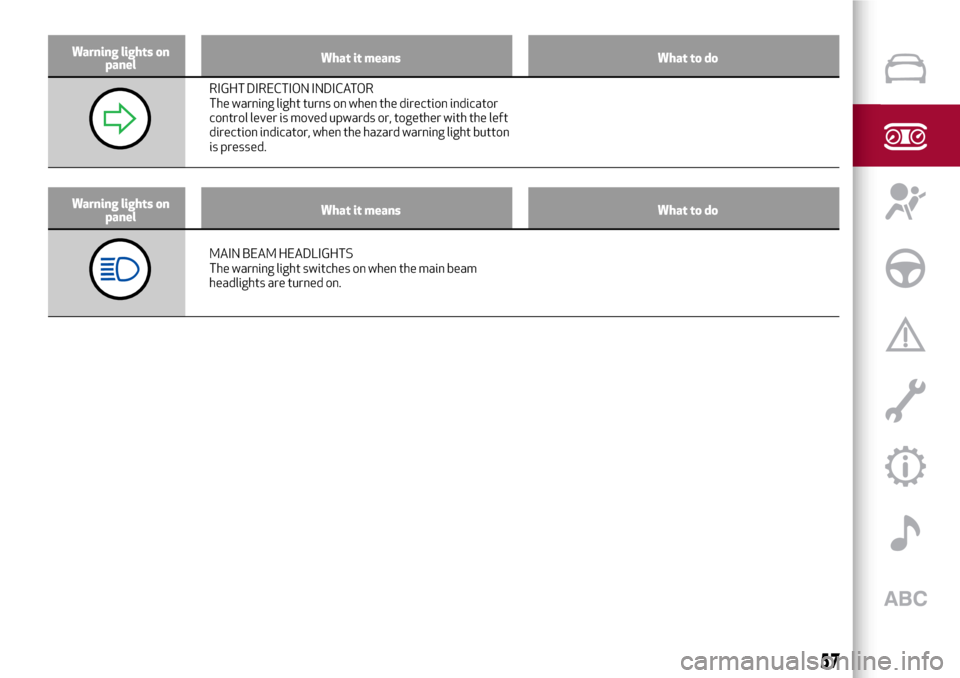
RIGHT DIRECTION INDICATOR
The warning light turns on when the direction indicator
control lever is moved upwards or, together with the left
direction indicator, when the hazard warning light button
is pressed.
Warning lights on
panelWhat it means What to do
MAIN BEAM HEADLIGHTS
The warning light switches on when the main beam
headlights are turned on.
57
Page 66 of 212
EOBDSYSTEM (European On
Board Diagnosis)
(where provided)
Operation
The EOBD system (European On Board
Diagnosis) carries out a continuous
diagnosis of the components of the car
related to emissions.
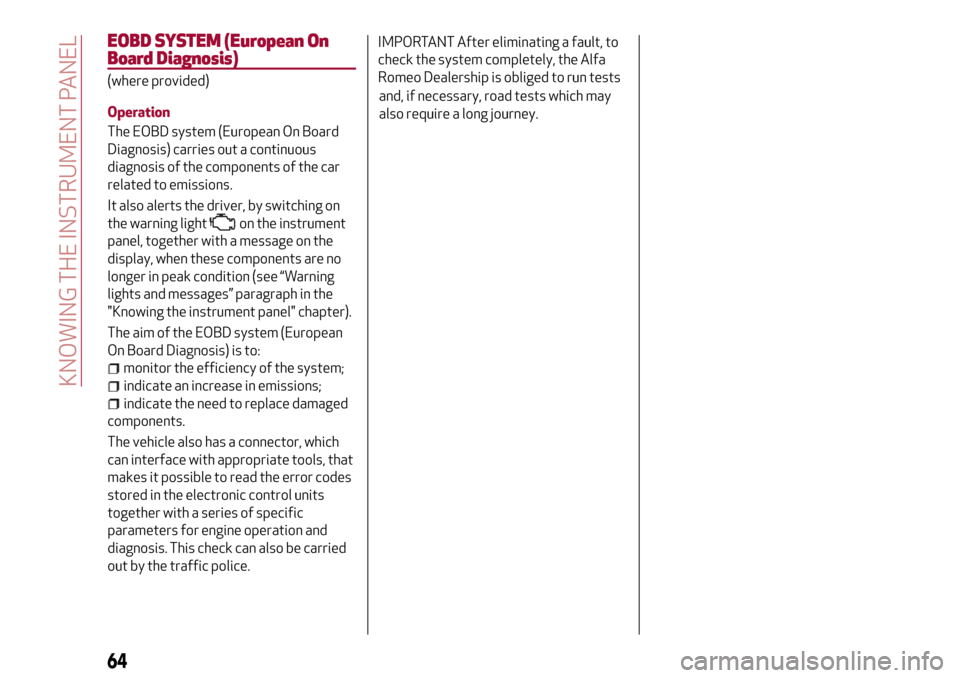
It also alerts the driver, by switching on
the warning light
on the instrument
panel, together with a message on the
display, when these components are no
longer in peak condition (see “Warning
lights and messages” paragraph in the
"Knowing the instrument panel" chapter).
The aim of the EOBD system (European
On Board Diagnosis) is to:
monitor the efficiency of the system;
indicate an increase in emissions;
indicate the need to replace damaged
components.
The vehicle also has a connector, which
can interface with appropriate tools, that
makes it possible to read the error codes
stored in the electronic control units
together with a series of specific
parameters for engine operation and
diagnosis. This check can also be carried
out by the traffic police.
IMPORTANT After eliminating a fault, to
check the system completely, the Alfa
Romeo Dealership is obliged to run tests
and, if necessary, road tests which may
also require a long journey.
64
KNOWING THE INSTRUMENT PANEL
Page 74 of 212
SBR SYSTEM (Seat Belt
Reminder)
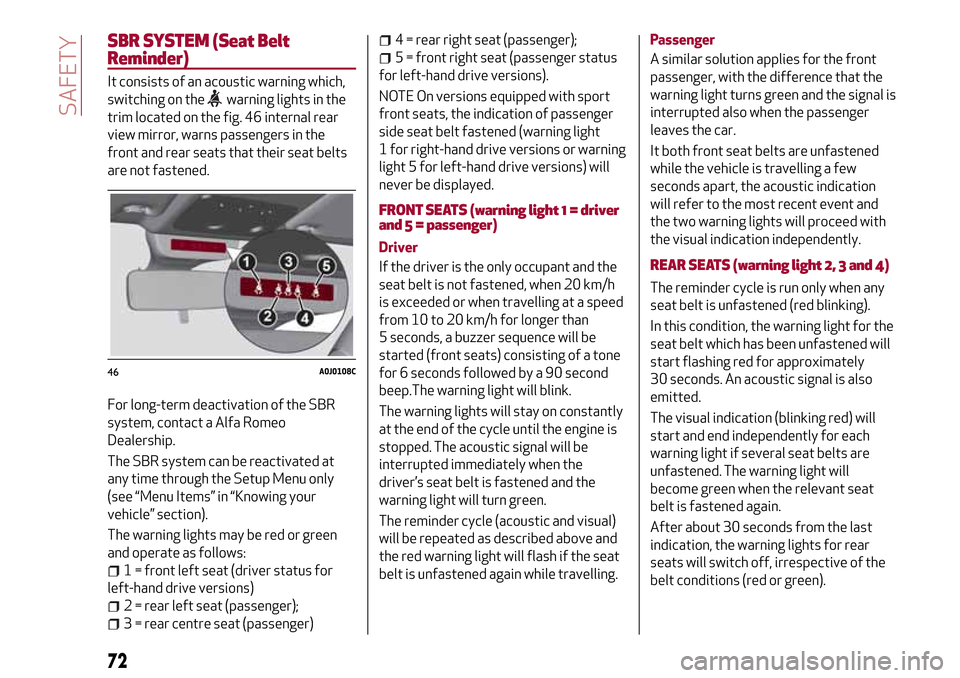
It consists of an acoustic warning which,
switching on the
warning lights in the
trim located on the fig. 46 internal rear
view mirror, warns passengers in the
front and rear seats that their seat belts
are not fastened.
For long-term deactivation of the SBR
system, contact a Alfa Romeo
Dealership.
The SBR system can be reactivated at
any time through the Setup Menu only
(see “Menu Items” in “Knowing your
vehicle” section).
The warning lights may be red or green
and operate as follows:
1 = front left seat (driver status for
left-hand drive versions)
2 = rear left seat (passenger);
3 = rear centre seat (passenger)
4 = rear right seat (passenger);
5 = front right seat (passenger status
for left-hand drive versions).
NOTE On versions equipped with sport
front seats, the indication of passenger
side seat belt fastened (warning light
1 for right-hand drive versions or warning
light 5 for left-hand drive versions) will
never be displayed.
FRONT SEATS (warning light 1 = driver
and 5 = passenger)
Driver
If the driver is the only occupant and the
seat belt is not fastened, when 20 km/h
is exceeded or when travelling at a speed
from 10 to 20 km/h for longer than
5 seconds, a buzzer sequence will be
started (front seats) consisting of a tone
for 6 seconds followed by a 90 second
beep.The warning light will blink.
The warning lights will stay on constantly
at the end of the cycle until the engine is
stopped. The acoustic signal will be
interrupted immediately when the
driver’s seat belt is fastened and the
warning light will turn green.
The reminder cycle (acoustic and visual)
will be repeated as described above and
the red warning light will flash if the seat
belt is unfastened again while travelling.Passenger
A similar solution applies for the front
passenger, with the difference that the
warning light turns green and the signal is
interrupted also when the passenger
leaves the car.
It both front seat belts are unfastened
while the vehicle is travelling a few
seconds apart, the acoustic indication
will refer to the most recent event and
the two warning lights will proceed with
the visual indication independently.
REAR SEATS (warning light 2, 3 and 4)
The reminder cycle is run only when any
seat belt is unfastened (red blinking).
In this condition, the warning light for the
seat belt which has been unfastened will
start flashing red for approximately
30 seconds. An acoustic signal is also
emitted.
The visual indication (blinking red) will
start and end independently for each
warning light if several seat belts are
unfastened. The warning light will
become green when the relevant seat
belt is fastened again.
After about 30 seconds from the last
indication, the warning lights for rear
seats will switch off, irrespective of the
belt conditions (red or green).
46A0J0108C
72
SAFETY
Page 75 of 212
All warning lights will remain off if all
the seat belts (front and rear) are already
fastened when the key it turned to MAR.
All the warning lights will come on
when at least one belt changes from
fastened to unfastened status or vice
versa.
PRE-TENSIONERS
59) 60)
The vehicle is equipped with front seat
belt pretensioners, which draw back the
seat belts by several centimetres in the
event of a strong frontal impact. This
guarantees the perfect adherence of the
seat belts to the occupant's bodies
before the retention action begins.
It is evident that the pretensioners have
operated when the belt withdraws
toward the retractor.
This car is also equipped with a second
pretensioner (fitted in the kick plate
area). Its activation is signalled by the
shortening of the metal cable.
A slight discharge of smoke may be
produced during the activation of the
pretensioner which is not harmful and
does not involve any fire hazard.
IMPORTANT To obtain the highest
degree of protection from the action of
the pretensioner, wear the seat belt tight
to the torso and pelvis.
The pretensioner does not require any
maintenance or lubrication: any changes
to its original conditions will invalidate its
efficiency. If, due to unusual natural
events (floods, sea storms, etc.), the
device has been affected by water and/or
mud, contact an Alfa Romeo Dealership
to have it replaced.
LOAD LIMITERS
To increase passenger safety, the front
seat belt reels contain a load limiter
which allows the force acting on the chest
and shoulders to be modulated during the
belt restraining action in the event of a
frontal impact.
GENERAL INSTRUCTIONS FOR USING
THE SEAT BELTS
61) 62)
Seat belts must also be worn by pregnant
women: the risk of injury in the event of
an accident is reduced for them and the
unborn child if they are wearing a seat
belt.
Pregnant women must position the lower
part of the belt very low down so that it
passes over the pelvis and under the
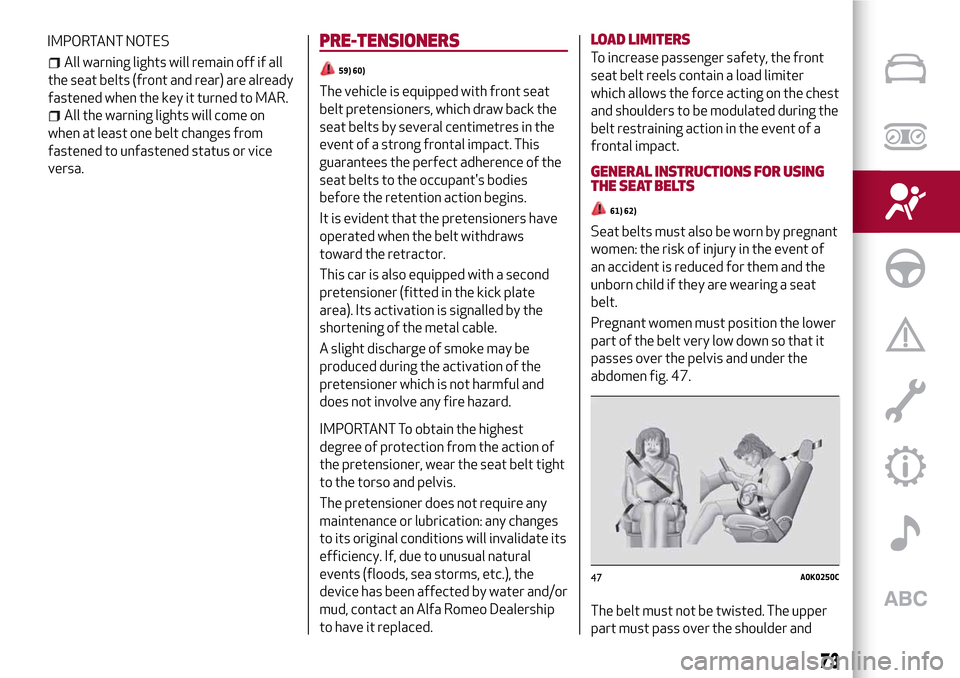
abdomen fig. 47.
The belt must not be twisted. The upper
part must pass over the shoulder and
47A0K0250C
73
IMPORTANT NOTES
Page 84 of 212
jamming of the car underneath other
vehicles or protective barriers (e.g.
underneath a truck or a guard rail) as, in
this case, the bags would offer no
additional protection with respect to the
seat belt and their deployment would be
inappropriate. Failure to activate in the
conditions described above is due to the
fact that they may not provide any
additional protection compared with seat
belts, so their activation would be
inappropriate. In these cases,
non-deployment does not indicate a
system malfunction.
FRONT AIRBAG DRIVER'S SIDE
This consists of an instantly inflating
cushion contained in a special
compartment in the centre of the
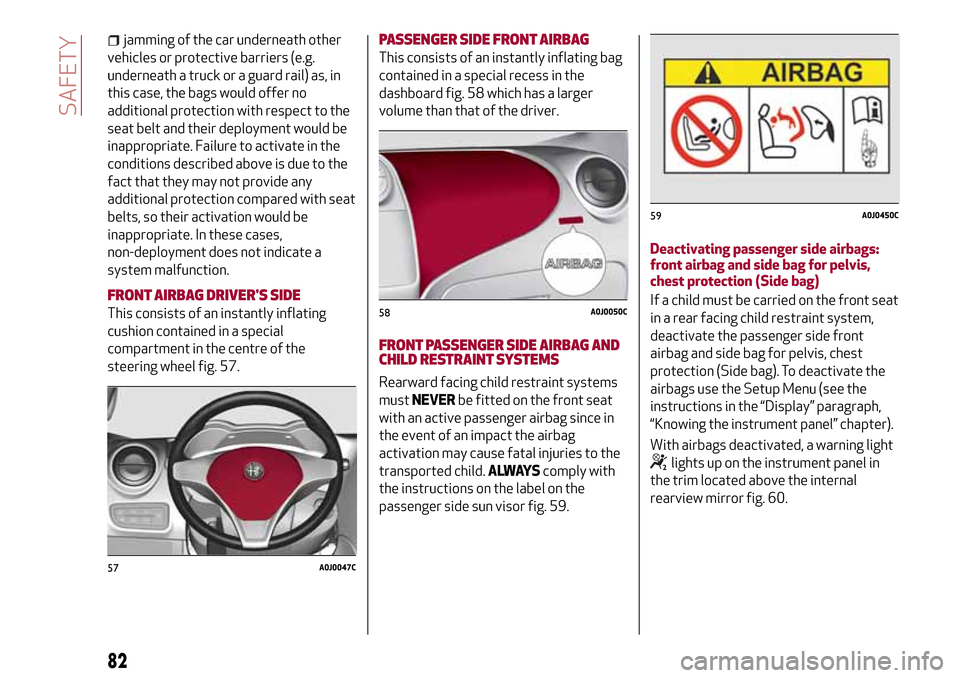
steering wheel fig. 57.
PASSENGER SIDE FRONT AIRBAG
This consists of an instantly inflating bag
contained in a special recess in the
dashboard fig. 58 which has a larger
volume than that of the driver.
FRONT PASSENGER SIDE AIRBAG AND
CHILD RESTRAINTSYSTEMS
Rearward facing child restraint systems
mustNEVERbe fitted on the front seat
with an active passenger airbag since in
the event of an impact the airbag
activation may cause fatal injuries to the
transported child.ALWAYScomply with
the instructions on the label on the
passenger side sun visor fig. 59.Deactivating passenger side airbags:
front airbag and side bag for pelvis,
chest protection (Side bag)
If a child must be carried on the front seat
in a rear facing child restraint system,
deactivate the passenger side front
airbag and side bag for pelvis, chest
protection (Side bag). To deactivate the
airbags use the Setup Menu (see the
instructions in the “Display” paragraph,
“Knowing the instrument panel” chapter).
With airbags deactivated, a warning light
lights up on the instrument panel in
the trim located above the internal
rearview mirror fig. 60.
57A0J0047C
58A0J0050C
59A0J0450C
82
SAFETY
Page 105 of 212
A punctured tyre or a burnt-out bulb?
At times, a problem may interfere with our journey.
The pages on emergencies can help you to deal with critical
situations independently and with calm. In an emergency we
recommend that you call the freephone number found in the
Warranty Booklet. You can also use the universal, national or
international freephone number to find your nearest Authorised
Alfa Romeo Dealership.
IN AN EMERGENCY
HAZARD WARNING LIGHTS . . . . . . .................104
REPLACING A BULB . . . . ........................104
REPLACING AN EXTERIOR BULB....................108
REPLACING FUSES . ...........................110
CHANGING A WHEEL ...........................116
"Fix&Go Automatic" KIT. . . . ......................120
JUMP STARTING . . . . ..........................122
FUEL CUT-OFF SYSTEM . ........................123
ALFA TCT TRANSMISSION - KEY REMOVAL . . . ..........124
TOWING THE VEHICLE ..........................125
Page 106 of 212
HAZARD WARNING LIGHTS
108)
Operation
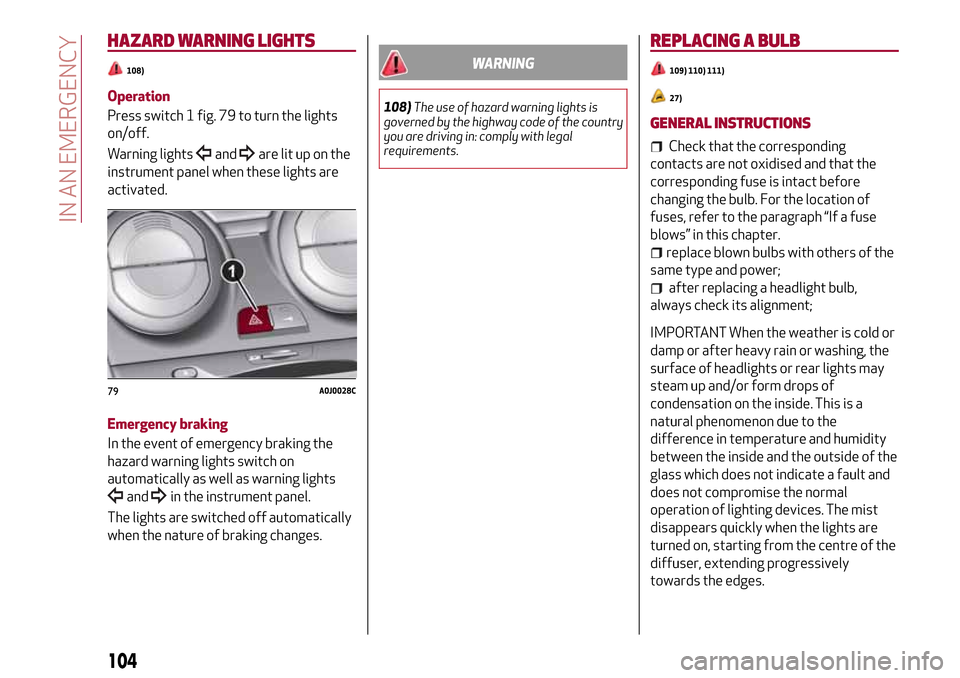
Press switch 1 fig. 79 to turn the lights
on/off.
Warning lights
andare lit up on the
instrument panel when these lights are
activated.
Emergency braking
In the event of emergency braking the
hazard warning lights switch on
automatically as well as warning lights
andin the instrument panel.
The lights are switched off automatically
when the nature of braking changes.
WARNING
108)The use of hazard warning lights is
governed by the highway code of the country
you are driving in: comply with legal
requirements.
REPLACING A BULB
109) 110) 111)
27)
GENERAL INSTRUCTIONS
Check that the corresponding
contacts are not oxidised and that the
corresponding fuse is intact before
changing the bulb. For the location of
fuses, refer to the paragraph “If a fuse
blows” in this chapter.
replace blown bulbs with others of the
same type and power;
after replacing a headlight bulb,
always check its alignment;
IMPORTANT When the weather is cold or
damp or after heavy rain or washing, the
surface of headlights or rear lights may
steam up and/or form drops of
condensation on the inside. This is a
natural phenomenon due to the
difference in temperature and humidity
between the inside and the outside of the
glass which does not indicate a fault and
does not compromise the normal
operation of lighting devices. The mist
disappears quickly when the lights are
turned on, starting from the centre of the
diffuser, extending progressively
towards the edges.
79A0J0028C
104
IN AN EMERGENCY
Page 121 of 212
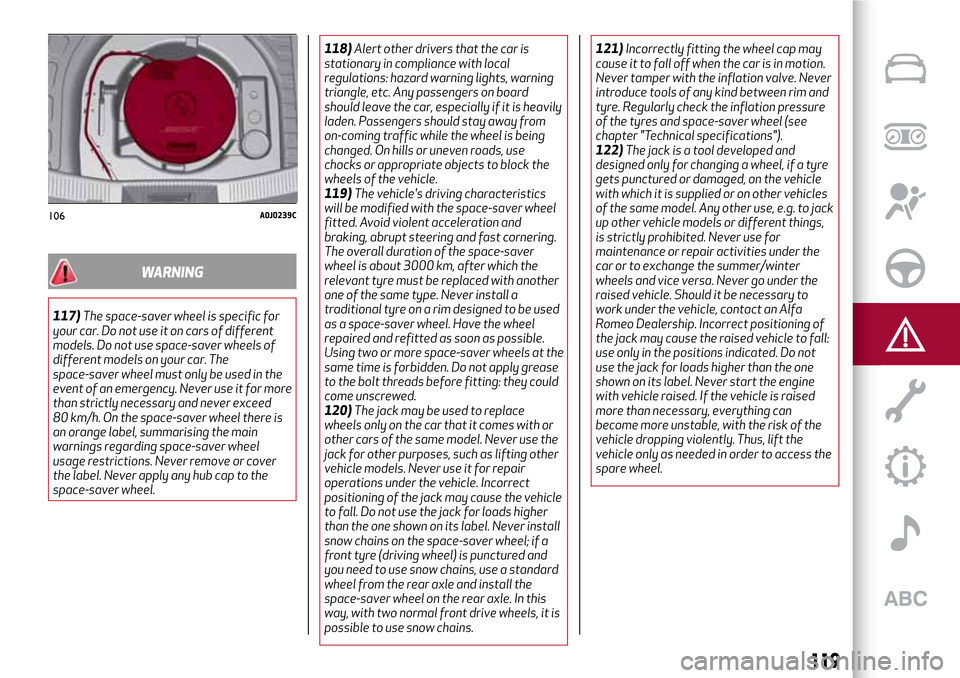
WARNING
117)The space-saver wheel is specific for
your car. Do not use it on cars of different
models. Do not use space-saver wheels of
different models on your car. The
space-saver wheel must only be used in the
event of an emergency. Never use it for more
than strictly necessary and never exceed
80 km/h. On the space-saver wheel there is
an orange label, summarising the main
warnings regarding space-saver wheel
usage restrictions. Never remove or cover
the label. Never apply any hub cap to the
space-saver wheel.118)Alert other drivers that the car is
stationary in compliance with local
regulations: hazard warning lights, warning
triangle, etc. Any passengers on board
should leave the car, especially if it is heavily
laden. Passengers should stay away from
on-coming traffic while the wheel is being
changed. On hills or uneven roads, use
chocks or appropriate objects to block the
wheels of the vehicle.
119)The vehicle's driving characteristics
will be modified with the space-saver wheel
fitted. Avoid violent acceleration and
braking, abrupt steering and fast cornering.
The overall duration of the space-saver
wheel is about 3000 km, after which the
relevant tyre must be replaced with another
one of the same type. Never install a
traditional tyre on a rim designed to be used
as a space-saver wheel. Have the wheel
repaired and refitted as soon as possible.
Using two or more space-saver wheels at the
same time is forbidden. Do not apply grease
to the bolt threads before fitting: they could
come unscrewed.
120)The jack may be used to replace
wheels only on the car that it comes with or
other cars of the same model. Never use the
jack for other purposes, such as lifting other
vehicle models. Never use it for repair
operations under the vehicle. Incorrect
positioning of the jack may cause the vehicle
to fall. Do not use the jack for loads higher
than the one shown on its label. Never install
snow chains on the space-saver wheel; if a
front tyre (driving wheel) is punctured and
you need to use snow chains, use a standard
wheel from the rear axle and install the
space-saver wheel on the rear axle. In this
way, with two normal front drive wheels, it is
possible to use snow chains.121)Incorrectly fitting the wheel cap may
cause it to fall off when the car is in motion.
Never tamper with the inflation valve. Never
introduce tools of any kind between rim and
tyre. Regularly check the inflation pressure
of the tyres and space-saver wheel (see
chapter "Technical specifications").
122)The jack is a tool developed and
designed only for changing a wheel, if a tyre
gets punctured or damaged, on the vehicle
with which it is supplied or on other vehicles
of the same model. Any other use, e.g. to jack
up other vehicle models or different things,
is strictly prohibited. Never use for
maintenance or repair activities under the
car or to exchange the summer/winter
wheels and vice versa. Never go under the
raised vehicle. Should it be necessary to
work under the vehicle, contact an Alfa
Romeo Dealership. Incorrect positioning of
the jack may cause the raised vehicle to fall:
use only in the positions indicated. Do not
use the jack for loads higher than the one
shown on its label. Never start the engine
with vehicle raised. If the vehicle is raised
more than necessary, everything can
become more unstable, with the risk of the
vehicle dropping violently. Thus, lift the
vehicle only as needed in order to access the
spare wheel.
106A0J0239C
119
Page 125 of 212
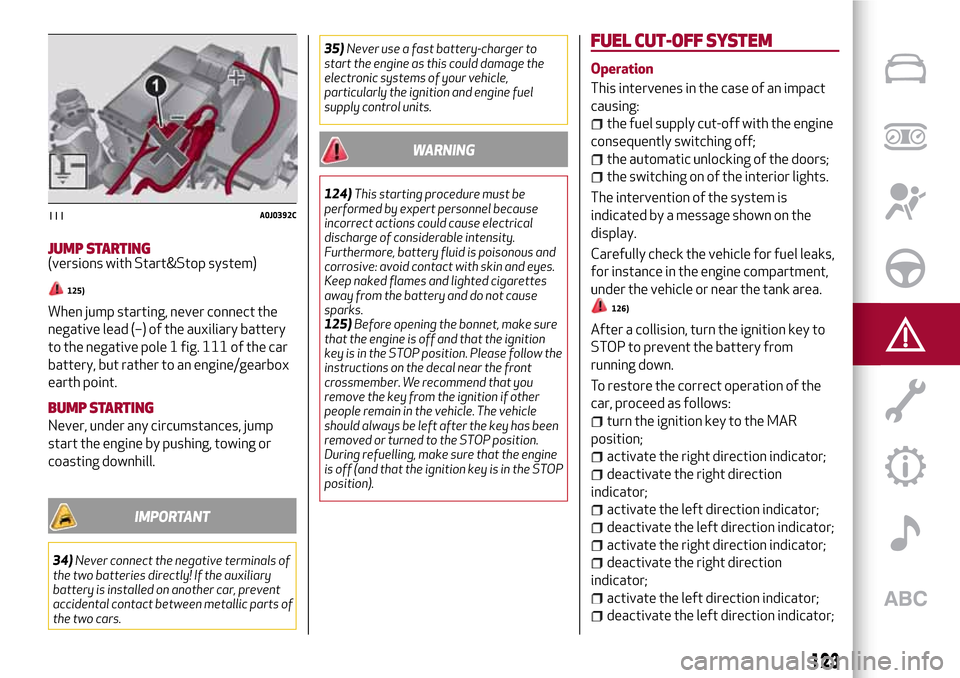
JUMP STARTING(versions with Start&Stop system)
125)
When jump starting, never connect the
negative lead (–) of the auxiliary battery
to the negative pole 1 fig. 111 of the car
battery, but rather to an engine/gearbox
earth point.
BUMP STARTING
Never, under any circumstances, jump
start the engine by pushing, towing or
coasting downhill.
IMPORTANT
34)Never connect the negative terminals of
the two batteries directly! If the auxiliary
battery is installed on another car, prevent
accidental contact between metallic parts of
the two cars.35)Never use a fast battery-charger to
start the engine as this could damage the
electronic systems of your vehicle,
particularly the ignition and engine fuel
supply control units.
WARNING
124)This starting procedure must be
performed by expert personnel because
incorrect actions could cause electrical
discharge of considerable intensity.
Furthermore, battery fluid is poisonous and
corrosive: avoid contact with skin and eyes.
Keep naked flames and lighted cigarettes
away from the battery and do not cause
sparks.
125)Before opening the bonnet, make sure
that the engine is off and that the ignition
key is in the STOP position. Please follow the
instructions on the decal near the front
crossmember. We recommend that you
remove the key from the ignition if other
people remain in the vehicle. The vehicle
should always be left after the key has been
removed or turned to the STOP position.
During refuelling, make sure that the engine
is off (and that the ignition key is in the STOP
position).
FUEL CUT-OFFSYSTEM
Operation
This intervenes in the case of an impact
causing:
the fuel supply cut-off with the engine
consequently switching off;
the automatic unlocking of the doors;
the switching on of the interior lights.
The intervention of the system is
indicated by a message shown on the
display.
Carefully check the vehicle for fuel leaks,
for instance in the engine compartment,
under the vehicle or near the tank area.
126)
After a collision, turn the ignition key to
STOP to prevent the battery from
running down.
To restore the correct operation of the
car, proceed as follows:
turn the ignition key to the MAR
position;
activate the right direction indicator;
deactivate the right direction
indicator;
activate the left direction indicator;
deactivate the left direction indicator;
activate the right direction indicator;
deactivate the right direction
indicator;
activate the left direction indicator;
deactivate the left direction indicator;
111A0J0392C
123